Howard Hugues

  • Melvin and Howard (1980)

    (On TV, January 2022) I didn’t even realize that Melvin and Howard was based on a true story while I was watching it. Yes, I knew who Howard Hugues was—in fact, it was one of the things that drew me into this film. But what I only found out after the end credits was that the film is based on real events. Or rather—real affirmations of what may or may not have happened. To recap: In our timeline, eccentric billionaire Howard Hugues died without having a formally recognized will. That much is true. What is also true is that hundreds of claims to his fortune and fraudulent wills emerged in the years following Hugues’s death, all of them found wanting. One of those claims was “The Mormon Will,” which apparently awarded one sixteenth of Hugues’ fortune to an everyday man named Melvin Dummar, who claimed that he had once given a lift back to Los Angeles to someone claiming to be Hugues, and had the will dropped in his gas station by a mysterious stranger. There are a lot of dubious “claims” in these assertions (which were resoundingly proven false in court), but Melvin and Howard plays it straight—what if Melvin’s side of the story was the truth? (Suddenly, I don’t feel too bad about not immediately knowing that this was a “true” story.)  That hook ends up being a reason for director Jonathan Demme to deliver a compassionate character study of struggling Americans throughout the 1970s. If you, like me, don’t know from the get-go that Melvin and Howard is supposed to be a true story, the resulting film feels oddly mis-structured. After an opening in which Hugues crashes his motorcycle in the desert, Dummar picks him up out of happenstance (and the kindness of his heart) and the two men bond over the following truck ride. Then the film forgets about Hugues for more than an hour as Dummar struggles to keep a job, remarries his ex-wife, moves to another state and generally tries to keep things together through divorce and unemployment. Dummar is near the bottom of the American society, often a single step ahead of repossession and being fired. Paul Le Mat gives a credible and likable portrait of a lower-class working man making poor choices, even if the always-wonderful Mary Steenburgen steals the movie as his long-suffering (then re-divorced) wife. It’s only late in the film, as the opening moments have been nearly forgotten, that a will is mysteriously left on his desk and the film renews with Hugues’ legacy. From that point on, Melvin and Howard is not necessarily to be trusted on factual grounds: the film tells it squarely from Dummar’s perspective, and the trial that convincingly determined that the “Mormon Will” was a hoax is here presented as the persecution of an honest man. It does make for an interesting film, even if not necessarily a cohesive one: A portrait of a working-class schlub bookended by much jazzier fiction about a billionaire’s intrusion on his life. What makes the film special is its affection for its erring protagonist—and the slice-of-life portrayal of a struggling family. While not exactly truthful, Melvin and Howard does poke at universality.
  • His Kind of Woman (1951)

    His Kind of Woman (1951)

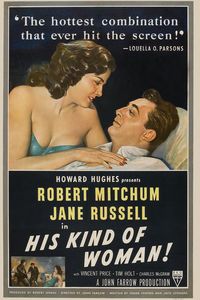
    (On Cable TV, June 2021) I’m not going to say that His Kind of Woman is a good or great movie, but I will say that if you’re looking for something halfway between romantic drama and film noir, this is a very representative example of form as of the early 1950s — and that does double if you start looking at the film’s typical production problems. The story itself sees a tough guy (Robert Mitchum) travelling to a Mexican resort, where he encounters a beautiful singer (Jane Russell) and a movie actor (Vincent Price) with marital problems. After various shenanigans, the film eventually realizes it has to go with dead bodies, gunfights and something more suspenseful. The escalates to a tidy action-driven conclusion with a heavy helping of dumb comedy and that’s that. Even if you don’t know about His Kind of Woman’s rocky production history, you can certainly see the evidence of an abrupt change of direction. In front of the camera, you have a few icons of the time being used as per their specifications. Mitchum is reliably enjoyable, Russell is the bombshell and Price plays to type as an actor prone to hamming it — he was never subtle, but maybe this is the film that validated his approach. The film’s genre-hopping is almost like getting an anthology of many of the era’s most distinctive genres. The last half feels like a desperate afterthought of action and comedy, but the film is strong whenever you have Mitchum and Russell going through their romantic material, or contemplating Hollywood’s backstage through one actor’s behind-the-scenes insecurities. His Kind of Woman’s representativeness grows even stronger one you read about the film’s production and find out that this was another one of RKO’s films that eccentric billionaire-producer Howard Hugues endlessly tinkered with during his tenure as the studio’s owner, much to the detriment and belated release of the film. The result speaks for itself as a bit of a mess, but a very pleasantly circa-1950 kind of mess.

  • The French Line (1953)

    The French Line (1953)

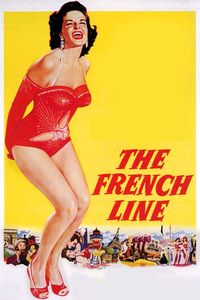
    (On Cable TV, November 2020) There have always been Hollywood star vehicles designed to feature specific actresses’ ample assets, but The French Line’s dedication to showcasing the great Jane Russell is exceptional by any standards. Produced by Howard Hugues, this is a film that explicitly set out to capitalize on Russell’s considerable sex appeal. Not only is it a film that revolves around her character, not only is it a film that shows her off in surprisingly skimpy outfits during dance numbers, this is a movie that was shot in 3D mainly to show off her curves to a thirsty public. (“J.R. in 3D—Need we say more?” bluntly goes the poster.) Legend goes that Hugues had a very personal interest in Russell, and designed many of the film’s outfits. He arguably overstepped—the film was judged so salacious that it was refused a production code seal of approval, earned scathing ratings from the era’s moral guardians, was banned from a few cities/countries and had to have an entire musical number trimmed before being shown in other territories. Today, of course, it’s quite tame—you can see more revealing numbers in PG-13 films. And once absent the titillation element, The French Line becomes another ordinary musical, once whose similarities to the previous year’s Gentlemen Prefer Blondes become a handicap more than a selling point. Oh, it’s watchable enough: Jane Russell became a sex-symbol for good reasons, and they go far beyond skimpy outfits. She gets a few good numbers as a Texan oil magnate looking for love at sea and abroad—While the infamous final number “Looking for Trouble” gets most of the attention, I really enjoyed “Any Gal from Texas.” The tone is amiable, and there’s enough going on around the edges of the supporting characters to be interesting: Mary McCarthy looks good, and Arthur Hunnicutt gets his fair share of smiles thanks to a grander-than-life Texan character. Still, there’s no denying that The French Line is about Jane Russell and little else: it’s her film, curves and all.

  • The Racket (1951)

    The Racket (1951)

    (On Cable TV, November 2020) Probably the best thing about The Racket is seeing bad-boy Robert Mitchum take on the role of a two-fisted police captain hellbent on taking down a major organized crime leader played by Robert Ryan. The film, a remake of one of the first movies ever nominated for the first Oscars, is essentially a grand strategy game between the two, as they vie for the affection of a cabaret singer (Lizbeth Scott), try to manipulate politicians in doing their bidding, and have proxy battles through surrogates. There’s some awareness here of the tricky intersection between justice, politics, the media and the personal emotions of the characters themselves. Mitchum may not be ideally cast as a square-jawed icon of law and order (his celebrated arrest and conviction for drug offences were still fresh in the public’s mind at the time), but I found that his screen persona actually worked in his favour here, as the character didn’t seem above a few horrible actions in order to fight his criminal counterpart. Having seen and rather enjoyed the 1928 original, I wasn’t bowled over by the remake—while Mitchum is remarkable, Scott is good and Ryan isn’t bad (switching roles may have been a better casting decision, but then again no one would have cheered for the police in that case), the rest of the film is merely solid, whereas the original had a few moments of innovative brilliance. (Although the remake keeps the spectacle factor: woo-hoo, a big car crash!) But it may be more fascinating for its behind-the scenes drama, as producer Howard Hugues kept tinkering with the film (as was often his habit) and brought in no less than five directors to complete it. The result can occasionally feel disconnected with too many subplots and plot turns underdeveloped. I still enjoyed The Racket—it’s compelling viewing as a film noir (which the first one wasn’t really, instead heralding the gangster movies of the 1930s) and it clicks in the same ways a competent crime story does.

  • Jet Pilot (1957)

    Jet Pilot (1957)

    (On TV, September 2020) Can a film be fascinating for all of the wrong reasons? Of course. Take Jet Pilot, for instance—starting with being far more interesting for its production than for what appeared on-screen. On its own, it’s a bad movie. The premise blends Cold War thrills with romance in what may be one of the worst ways to go about it—featuring John Wayne as a fighter pilot who is asked to seduce an attractive Russian pilot who has defected to the United States. While the film drapes itself in the nuts-and-bolts realism of circa-1950 American fighter jets in luscious colour cinematography, the spy-caper plot itself doesn’t make a shred of sense. The casting alone is ludicrous: I don’t like John Wayne, and he’s completely wrong here as an ace pilot lusting after twenty-year-his-junior Janet Leigh, who’s also badly miscast at the Russian defector. A badly written script leads to titters of amusement, as, in the words of a better film critic than I, “the planes enjoy a more active sex life than the human beings”. Jet Pilot becomes increasingly more ludicrous as it goes on, and the miscast pair ensures that we’re less charmed than relieved that it’s all over by the end. But things become far more interesting once you hit the film’s Wikipedia page and start reading about the incredible production and post-production odyssey of the film. The legendary Chuck Yeager was a stunt pilot for the film. Josef von Sternberg directed some of the film but not all of it. Producer Howard Hugues, clearly lusting after the success of his earlier aviation films, spent no ness than seven years editing the final film—By the time the film appeared on screens in 1957, some footage was seven years old, and the US Air Force had moved on to another generation of planes. Much of that is irrelevant to twenty-first century audiences, but it explains part of why the film was a commercial and critical dud upon release even with some really interesting colour footage of US fighter planes. I like aviation just a bit too much not to find the entire thing interesting, but I would have liked Jet Pilot a lot more with different actors and a script that actually tried to be halfway plausible.