Ian McShane

  • Case 39 (2009)

    (In French, On Cable TV, January 2022) There’s an interesting misdirection early in Case 39 when all signs point to a child being abused by her parents. But since that plot thread wraps up at the end of the first act, there’s clearly more to the story than adults trying to kill their kid. As the social worker on the case takes an adorable little girl home, the real shape of the story eventually develops—and gives splendid reasons to the adults for trying to stuff their adopted daughter into an oven. At its best, Case 39 is a bit wild, and greatly enhanced by a few good casting choices. For Renée Zellweger, playing the kind-hearted case worker means a relatively rare genre film excursion and she’s not bad at it. Jodelle Ferland gets an early great lead role as the unspeakably evil young girl, Ian McShane brings some gravitas to a stock character, but it’s Bradley Cooper who’s most interesting here: Dating from his pre-stardom days playing doomed boyfriends in horror films (also see 2008’s The Midnight Meat TrainCase 39 was actually completed in 2007), watching him here now has a different connotation than upon the film’s release: We expect him to last much longer than he does. It all adds to a straightforward but well-executed horror film that deals in (eventually) obvious matters but does so with a certain zip. The ending disappoints, though: after setting up its antagonist as someone with near-unlimited powers and bringing her back for a few encores, the climax of the film ends up being somewhat perfunctory after some better-handled moments in the third act. Still, not a bad pick—and at a time when horror films were going for the rough-and-gritty found-footage style, Case 39 marks a welcome return to a more conventional style.
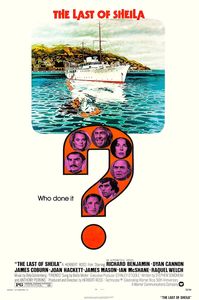
  • The Last of Sheila (1973)

    The Last of Sheila (1973)

    (On Cable TV, January 2021) There’s something primal and timeless about a good murder mystery—the universal stakes of death being on the line, and the playful nature of the convoluted plotting that usually accompanies such films. The Last of Sheila has, to put it bluntly, not necessarily aged well: The muddy cinematography is clearly from the early 1970s, as are the sometimes-hideous fashions and the contemporary details that pepper the film. Here, a Hollywood mogul calls six “friends” for a Mediterranean holiday aboard his yacht. But what they discover early on is that the puzzle-obsessed mogul has fun and games in mind for them: Six days, six stops, six enigmas to resolve. But what they eventually discover is that the mogul has a much darker scheme in mind—a year earlier, his wife was killed in a hit-and-run, and the guilty driver is among them. Then it gets more complicated—all the way to an ending where the survivors all find killers and guilty consciences. The cast is interesting, what with James Coburn having far too much fun as the mogul, and guests played by a motley crew, including an old James Mason, a young Ian McShane, and Raquel Welch in the middle of her peak popularity. The script, from unlikely scribes Anthony Perkins and Stephen Sondheim (who used to host murder mystery parties), is suitably twisty, witty and clever—I’m not too sure that the third act is as spectacular as it should be given its more intimate setting, but it satisfies well enough. Despite being visibly stuck in the early 1970s, The Last of Sheila is highly watchable—even more so for fans of the actors involved, but accessible to all, especially once the fun and games start.

  • Cuban Fury (2014)

    Cuban Fury (2014)

    (On Cable TV, December 2018) Let’s be clear: There’s nothing in Cuban Fury that’s all that original, but it’s still a nicely handled romantic comedy with a substantial dancing component. Nick Frost stars in a role that’ generally less comic and more romantic than many in his filmography, and it generally works. Rashida Jones is fine as the object of his affection (with a deliciously slimy Chris O’Dowd completing the triangle), although Ian McShane and Kayvan Novak are highlights as (respectively) a cranky dance instructor and a flamboyantly gay dancer. The plot is as by-the-number as they come, what with past trauma, romantic interest, training montages and to-thine-self-be-true message complete with a triumphant ending. Still, the protagonist is endearing, the entire film is fun and it fits squarely in the kind of gentle British comedy that we’ve grown accustomed to. Cuban Fury may not be challenging, innovative or meaningful, but it doesn’t have to be.