Jeff Bridges

  • Dumb and Dumber (1994)

    Dumb and Dumber (1994)

    (Second viewing, On Cable TV, May 2016) I didn’t have very good memories of Dumb & Dumber, and a revisit twenty-some years later only highlights why: I don’t react well to deliberately dumb humour, and this film has enough of it to fill a trilogy. I spent the film’s first half-hour in an increasing state of self-loathing, wondering why I was re-watching it and feeling my IQ dropping every minute. Eventually (specifically during the diner scene where a seasoned criminal unsuccessfully try to kill the protagonists), I reached an equilibrium of sorts, and the film finally started feeling funny. Not exceptionally funny, but funny enough to coast until the end. Jim Carrey does deliver a remarkable performance (alongside Ace Ventura and The Mask, it’s part of his astonishing 1994 breakout year), and seeing Jeff Bridges abase himself so low does have an interest of its own. The humour is dumb enough that it’s easy to forget that two skilled comedians (the Farrelly Brothers) wrote this stuff, but some of the film’s more outlandish moments (such as the fantasy sequences, or the living-large segment) do show some invention going beyond the dumb humour. I’m not going to claim that I was seduced by the results, but Dumb & Dumber does become good enough to escape the confines of its chosen dumb-jokes subgenre, and it’s that kind of success that highlights a better-than-average effort. This being said, I’m more than OK with the thought that I may not have to watch this again for another twenty years.
  • Seventh Son (2014)

    Seventh Son (2014)

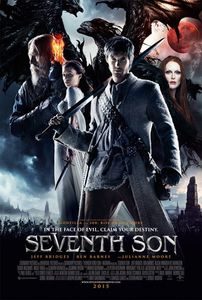
    (On Cable TV, January 2016) As much as I like being surprised by good low-budget films, bad expensive box-office failures have an attraction of their own as well. When it comes to movie-watching, big money is compelling, especially if you can see it on the screen: even when the story is hum-drum and the actors are sleepwalking through the plot, it can be moderately amusing (for schadenfreude-heavy values of “amusing”) to be swept along by what’s made possible by a big-enough budget. So it is that in Seventh Son, we get Jeff Bridges reprising his persona from True Grit and R.I.P.D. (speaking of expensive disappointments…), a curiously alluring Julianne Moore vamping it up as an evil witch, sweeping camera shots, an epic fantasy setting and slick CGI creatures. Unfortunately, we also have to suffer through a dull-as-dirt story, clichés by the barrel, barely repressed misogyny and grotesque secondary characters. Seventh Son is not fun, not thrilling, not even interesting to contemplate on a plot level: it’s far better to watch it for the visuals, the unintended laughter or the way it somehow manages to make its male protagonists exterminate the female antagonists without quite realizing how awfully misogynistic it is. Director Sergei Bodrov does put together a few interesting moments with the means to his disposal—too bad it’s in service of such an easily forgotten result. The decade-long glut of fantasy films lazily adapted from rote source material in an attempt to replicate the success of The Lord of the Rings is not helping the genre gain any ground. In the meantime, we can only watch in amusement and marvel at the colossal waste of money it is.

  • Arlington Road (1999)

    Arlington Road (1999)

    (In French, on Cable TV, November 2015)  Some movies are made before their time, and I really wonder if Arlington Road would have been a more unnerving film had it been released three (or more) years later.  There is, of course, a definite mid-nineties vibe to the proceedings, drawing from the Oklahoma City bombing to Ruby Ridge and Waco in setting up an anti-government domestic terrorism rationale: Three years later, the American national paranoia would be obsessed about foreign-driven terrorism.  Adding foreign involvement to Arlington Road would have muddled an already preposterous plot that draws equally upon unlikely coincidences, comically evil plans, superhuman levels of deception by the antagonist and plans that would have a near-impossible chance to succeed if this wasn’t a movie.  There’s emotional manipulation nearly everywhere, and at times it’s hard to believe that anyone in the cast, even Tim Robbins and Jeff Bridges, can keep a straight face pushing the story forward.  On the other hand, well-executed ludicrousness has a believability of its own, and so Arlington Road has the decency to remain interesting on a pure “OK, what will happen next?” level, egging us on to the next unlikely plot point.  I’m not sure that it helps that the film is so determined to get its downbeat ending: you can forgive a lot more silliness if it’s all neatly wrapped with a happy bow.  It makes for a more-memorable-than-average thriller, but it doesn’t necessarily make for a better one.

  • R.I.P.D. (2013)

    R.I.P.D. (2013)

    (On Cable TV, August 2014) Poor Ryan Reynolds.  He’s a very likable actor with a string of good performances in smaller movies (Waiting, Adventureland, Buried, Safe House) but who seems unable to get a role in a high-budget franchise film good enough to make him a superstar.  Blade 3, Wolverine, Green Lantern and now R.I.P.D.: he just can’t catch a break.  His latest effort is clumsier than most: While R.I.P.D.‘s “undead policemen” premise almost self-consciously attempts to ape high-concept SF comedy such as Men in Black, it never manages to transform a few interesting images into anything close to the potential of its premise.  The first act has some potential and amply demonstrates that it’s a big-budget production.  Afterwards, though, it seems to become steadily less ambitious and increasingly inept at what it does attempt: The hunt-the-deados rationale lacks urgency compared to the entire “undead policemen” premise, while the overarching plot about a magical artifact seems far too rote to be interesting.  It really doesn’t help that the film’s sense of humor is so… odd.  Not bad, just odd in ways that seem more bizarre than amusing.  (Often, you can tell that someone thought a details would be funny, even though it’s not, in itself, funny.)  Many of the script’s conceptual laughs fall flat on-screen –which may simply betray sub-par directing and deficient special effects more than anything else: the idea of “mismatched avatars”, for instance, is cause for more frustration than laughs when it’s used so inconsistently.  But the more questions you ask about this film, the more frustrated you’ll get.  (Never mind the uncomfortable theological questions raised by the premise, then wilfully ignored by the rest of the film.)  The few bright spots include a few early special-effects sequences, Reynold’s aw-sucks performance and a relatively good turn by Jeff Bridges who seems to be reprising his True Grit frontier-lawman persona with panache.  R.I.P.D. remarkably degenerates the longer it goes on, suggesting that it, too, is a dead film that doesn’t quite understand how not-alive it is.  Hopefully Ryan Reynolds will take notice of the parallels with his career before it’s too late.

  • True Grit (2010)

    True Grit (2010)

    (In theaters, December 2010) The Coen Brothers never do anything in a straightforward fashion, and so it is that if their homage to the classic True Grit may be as dirty and unforgiving as we imagine the West to have been, it’s also surprisingly entertaining and even, yes, amusing.  The repartee between rivals Jeff Bridges and Matt Damon is one of the film’s finest points, and the film often acknowledges the absurdity of its own premise.  But for all of its tension-defusing laughs, the film isn’t a comedy: the drama plays without ironic distancing, the characters aren’t completely softened for Hollywood effect, and the finale doesn’t pull any stops in punishing characters for going so deep in the wild.  While Bridges is magnificent as the one-eyed marshal “Rooster” that becomes the film’s true hero, it’s Hailee Steinfeld who makes the strongest impression as the 14-year-old heroine of the film capable of mouthing the Coens’ typically dense dialogue.  This leads us to the film’s main weakness in theaters: The often thick accents duelling on-screen.  Home-video viewers will have the advantage of captions: movie theatre viewers will have to tough it out on their own.  At a time where filmed Westerns are most often anachronistic genre recreations, it’s a bit surprising to find True Grit to be such a true-pedigree Western, spiced but not overwhelmed by comedy.  It’s an old-fashioned film worth watching and savouring.

  • Tron aka Tron: Legacy (2010)

    Tron aka Tron: Legacy (2010)

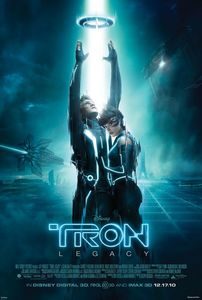
    (In theaters, December 2010) Given the impact of the original Tron over the generation that went on to build the Internet, it’s a wonder that it took so long for a sequel to arrive.  It’s not much of a surprise, however, to find out that the follow-up is best appreciated as a visual-arts piece than a narrative film: special effects have advanced enormously since 1982’s original, and the impact of all-computerized imagery isn’t what it used to be.  On the other hand, Tron: Legacy puts most of its budget on-screen, and it’s the visuals of the action pieces that hold them together more than the narrative tension.  Never mind the tedious many-against-one videogame battles: just enjoy the swooping lines and cubic destruction.  The plot, merely serviceable, is just an excuse to keep together an exercise in nerd nostalgia.  While that occasionally works (there’s something retro-cyberpunkish in contemplating late-1980s technology creating fully-virtual worlds), it’s not quite enough to offset the tedium of the film’s neon-on-black visuals in which the character’s faces literally fade to dark.  Ironically, perhaps Tron: Legacy’s most achieved visual effects is the way Jeff Bridges manages to play two roles, including one with the face he had almost thirty years ago.  Also worth noticing: Daft Punk’s distinctive electro-synth soundtrack.  Otherwise, this sequel suffers from an overstuffed plot (only explained if you get the graphic novel and the video game), hazily-motivated character actions (let’s hope they understand why they’re doing things, because we don’t), dull dialogue and a merely-satisfactory effort in sketching out the virtual world and why we should care about its liberation.  Tron: Legacy certainly adds up to something interesting, but not in the conventional sense: it’s a film to be stared at rather than enjoyed, and while that’s good enough for a casual viewing, it may not be what’s required to ignite nerd audiences as much as the original did.

  • Crazy Heart (2009)

    Crazy Heart (2009)

    (In theatres, February 2010) Yet another entry in the “Film I wouldn’t see if it wasn’t for their Oscar nominations” category.  Would I willingly go see the story of a past-his-prime country music singer who learns to deal with his alcoholism while romancing a single mom half his age?  Gee, Oscar, you really make things difficult for me this year, don’t you?  Cheap shots aside, there’s a little bit to like in Crazy Heart: Jeff Bridges is great in the title role, and the various details about life as an ex country music star are fascinating.  Maggie Gyllenhaal is as cute as she can be (which is a lot) as the single mom, whereas Colin Farrell has a small and perfect supporting role and Robert Duvall is up for another kind bartender role.  This is not a fast film, and it’s definitely aimed at a quiet Midwestern audience.  Bits and pieces of the film are trite and obvious (who couldn’t see the whole “missing child” moment coming?), and the overall arc of the film seems copied from VH1 specials.  Still, for a movie that has practically no guns, explosions, comedy, one-liners, car chases, giant robots or anything designed to get me in the theatre, it’s a bit more bearable that I expected.  But I’m as far from Crazy Heart’s target audience as I could be, so never mind me and go read a review from someone who cares more about the film.

  • King Kong (1976)

    King Kong (1976)

    (In French, On TV, December 2005) Some childhood memories should be left alone, and the seventies remake of King Kong may be one of them. Another look at it, post 2005-King Kong, largely serves to make the Peter Jackson effort look good: The script is even more tedious than the 2005 version and the special effects really haven’t aged well at all. (Here’s a piece of trivia for you: It won the “Special Visual Effects” Oscar in early 1977. The next winner in that category, of course, would be Star Wars.) Fortunately, there are still a few good things about it: Jessica Lange (in her screen debut) still looks great thirty years later, Jeff Bridges is delightful in an early role as a shaggy photographer and the World Trade Center is prominently featured. The opening sequences have a charming feel to them as a petroleum expedition is efficiently dispatched to The Island. Things start to sour soon after, as the film grinds down to a halt to go through all of the expected plot points. King Kong himself is a disappointing man in a suit, even if said man is Special Effects legend Rick Baker. It adds up to a fine piece of seventies blockbuster entertainment: Sometime tedious, sometime earnest, occasionally fun, but certainly not something that escapes its context.

    (Second Viewing, On Cable TV, April 2020) I have changed my mind. Having seen the other versions of King Kong, I go back to the 1976 one feeling as if it’s my favourite. There’s some nostalgia at play here—I recall seeing it on TV as a boy—but it’s also because it’s relatively well made. I like the mid-1970s feel, I like the techno-thrillerish approach, I like the links to the 1933 version (such as having an actress on board the exploration ship) without the endless CGI excesses of the 2005 version. I certainly like that we spend more time on Manhattan than on Skull Island. I like the gradual mystery—even if we know damn well that there’s a giant ape behind the gate. Even forty-some years and one 9/11 later, this is one of the most striking uses of the Twin Towers ever put on-screen. The plot is admittedly a bit dull, but the execution is fine. Some (but not all) of the special effects hold up—and Jessica Lange, in her first film role, is a special effect of her own. This is Kong filtered through the 1970s disaster movie lens (director John Guillermin had previously directed The Towering Inferno) and it has the kind of accidental details that anchor this film into a now-remarkable period feel. The 1976 version of King Kong is not the best, the slickest or the most innovative… but it just may be my personal favourite.