John Sturges

  • Jeopardy (1953)

    (On Cable TV, January 2022) There’s much to say about solid thrillers featuring well-known actors. While they may fade into obscurity, they remain satisfying entertainment pieces, especially if you’re not expecting all that much from the result. All Barbara Stanwyck devotees will eventually make their way to Jeopardy, a genre suspense film that manages to add just enough dramatic complexity to a straightforward race-against-the-clock thriller. It begins innocently enough, as an ordinary American family (mom, dad, son) heads over to Baja California for their holidays. After quite a bit of throat-clearing and scene-setting (probably a by-product of the original story coming from a 22-minute radio play), the thrills begin in earnest once Dad gets his leg stuck underneath an unmovable piece of timber… on a beach… as the tide is rising. It’s up to Mom to get help, except that (in the kinds of contrivances that only make sense in genre thrillers) the only person available to help is an escaped convict who has already demonstrated his ability to kill. Will she convince him to help? Will they make it back to the beach before the tide rises? And what will be the cost? Well-known genre suspense director John Sturges was still in the ascendant phase of his career when he completed Jeopardy, and his work here heralds the long string of successes he would later have. Stanwyck has what looks like an inglorious role as a typical 1950s housewife largely dependent on her husband (that “car driving” scene… eek) but she makes it work, especially as the film suggests increasingly darker trade-offs necessary in getting the help of the escaped killer. That last element adds a nice patina of dramatic weight to the more conventional rescue plot, and it’s what makes Jeopardy more surprising than you’d expect. No, it’s not going to be a film that will often be mentioned in contemporary discussions. But as an example of a rough-and-tumble thriller, it’s surprisingly watchable and just substantial enough to impress.
  • McQ (1974)

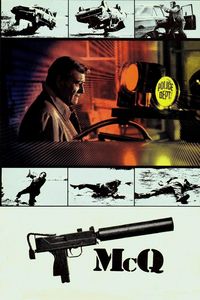
    McQ (1974)

    (On Cable TV, March 2020) John Wayne doing Dirty Harry is pretty much the unholy union of two heave-inducing flavours in one detestable package. The creepy uncle of Classic Hollywood taking on the vigilante fantasies of New Hollywood is far from being the most compelling premise. And Wayne does show up in McQ as an old and bloated cop, shooting corrupt policemen as part of a sombre drug conspiracy. Since the entire film rests on his shoulders, it’s nearly a miracle if it eventually settles for being an average and forgettable affair—a middle-of-the-road neo-noir with local Seattle colour, redolent with 1970s atmosphere but dragged down by a wholly inappropriate lead actor. He’s old, he looks stupid by making dumb cracks about “women’s lib” and is generally treated with undeserved reverence by director John Sturges. But hey—Wayne was a relic of a past era by 1974, and certainly feels like it here too: no fancy car nor big gun can compensate for this 65-year-old having trouble with even the most elementary of action hero business. McQ is certainly distinctive, though—After seeing young upstarts Eastwood and McQueen having their own action movie thunder, old Wayne wanted his, and the result speaks for itself as an indulgence.

  • Marooned (1969)

    Marooned (1969)

    (On Cable TV, March 2019) Considering that I really like the subgenre of space disaster thrillers, I’m more favourably predisposed than most toward Marooned. On the one hand, it’s an early example of the space thriller, and you’d be surprised at the numerous parallels that this 1969 film has with both the 1970 real-life Apollo 13 incident and its 1995 movie depiction. The close cooperation that director John Sturges got from NASA helps the film’s credibility, and in turn helped it age remarkably well—the Cold War period feel is a glimpse into how such premises played out at the end of the 1960s, and give a fascinating patina to the result. The film won an Oscar for best Visual Effects, and much of the miniature work is still quite good—and there’s a lot of it. Acting-wise, the film can depend on the great Gregory Peck, Richard Crenna and a young Gene Hackman. On the other hand, there’s a reason why the film was also featured on Mystery Science Theater 3000—it’s stoic to the point of being bloodless, almost unbearably dull even in the middle of the suspense. The realism is pushed to an extreme that prevents it from being truly involving. Marooned can’t quite figure out the difference between displaying steely-eyed upper-lip stiffness and between allowing its characters to feel endangered. Later movies of the subgenre, from Apollo 13 to Gravity, would fare much better.