Laurence Olivier

  • The Entertainer (1960)

    The Entertainer (1960)

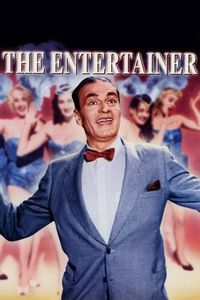
    (On Cable TV, December 2021) For all of the self-serving myth-making that actors sustain about the profession of acting, there’s something more interesting to say about The Entertainer’s merciless look at a failed performer, one steadily heading toward irrelevance as the world moves on. The film takes place on a seaside British town, the kind of summer destination with performing halls fit for tourists. It’s a near-perfect playground for our protagonist (honestly played by Laurence Olivier), even if it’s in his own mind: As he performs to smaller and smaller crowds, his egocentrism prevents him from seeing how his life is falling apart — his repeated affairs harming his second marriage, his brother off to war, his father getting older, the music-hall tradition going away, and his commercial appeal being practically gone. Filmed in stark black-and-white by director Tony Richardson with an equally unsentimental script, The Entertainer is the cautionary tale warning anyone against an acting career. It’s really not a fun time at the movies, but the seedy atmosphere of desperation permeates the character and gives the film a still-unique feeling.

  • The Devil’s Disciple (1959)

    The Devil’s Disciple (1959)

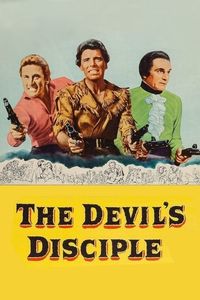
    (On Cable TV, September 2021) I’m going to keep this review short, considering how banal The Devil’s Disciple actually is once you get past its few flourishes. It’s true that I may have gone into the film with too-high expectations:  As a drama featuring no less than Kirk Douglas and Burt Lancaster with a supporting turn for Laurence Olivier, I had some hope that their acting talent could carry the picture through its humdrum revolutionary war setting. This is only partially true: Olivier is fun to watch in a role designed to steal attention from the two leads through acerbic dialogue, but Douglas and Lancaster, as able as they are, can’t quite save the result from growing boredom. The other element of note in the film is the stop-motion opening and interstitial segments — they’re still remarkably fun to see even today in black-and-white, but as soon as the image dissolves to live action, a bit of the film’s interest goes with it. There are much, much better Lancaster/Douglas pairing out there than The Devil’s Disciple even if they have blander titles.

  • The Prince and the Showgirl (1957)

    The Prince and the Showgirl (1957)

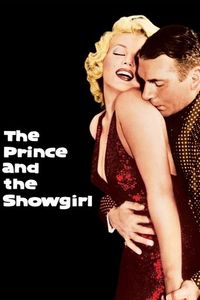
    (On Cable TV, July 2021) In many ways, the trivia about The Prince and the Showgirl (Marilyn Monroe meets Laurence Olivier!) is more captivating than the film itself. There’s even a movie, My Week with Marilyn, that revolves around its production. But The Prince and the Showgirl itself is surprisingly dull, especially if you’re familiar with movies in which commoners hobnob with aristocracy. It doesn’t help that the film has a strong nostalgic attachment to the trappings of classic European aristocracy (the story takes place in 1911), which can be of very limited interest to twenty-first century audiences. In all fairness, the film does hold back on the clichés, especially toward the end, which is more along the lines of “things are looking up” rather than “…and they lived happily ever after.”  Lavishly produced in colour to take advantage of the sets and costumes, it does carry the weight of that overwrought production: the directing can be stultifying at times, moving glacially through moments that should have the fast pacing of a light comedy. Monroe herself is not particularly interesting here — the heaviness of the production holding back her natural comedic skills — while Olivier (who stars and directs) seems most to blame for the ponderousness of the result. Surprisingly underwhelming, The Prince and the Showgirl ends up being more interesting to the meta-narrative of Monroe’s career. Even though she produced it, there’s a sense that she would have been happier without it.

  • A Little Romance (1979)

    A Little Romance (1979)

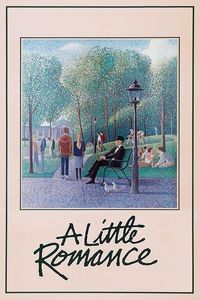
    (On Cable TV, April 2021) There is so much unadulterated syrupy-sweet sentiment in A Little Romance that while watching the film I had the time to develop obesity, cavities and diabetes. Consciously twee, it’s a romance featuring an American 13-year-old (Diane Lane, in her film debut) and a French 13-year-old (Thelonious Bernard), under the watchful eye of an older man (late-career Laurence Olivier). The backdrop is Paris, and then Venice, but if the leads are teenagers, the audience for the film is clearly meant to be adult, as the themes have more to do with the purity of an ideal teenage romance than anything else. Director George Roy Hill keeps things so light and unlikely that the film is best seen as a fantasy of sorts. A Little Romance probably works well with its intended audience in their most receptive mood, but if you happen to fall outside that segment… well, the sugar is overwhelming.

  • That Hamilton Woman (1941)

    That Hamilton Woman (1941)

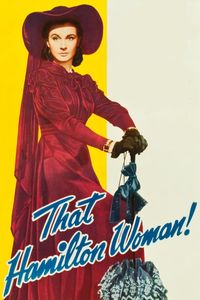
    (On Cable TV, January 2021) By most standards, That Hamilton Woman was 1941’s equivalent to a sure-fire blockbuster. Despite Britain being under siege by the Nazi regime, producer Alexander Korba was betting on a number of strong box-office factors: It’s a film that paired then-wedded superstars Vivien Leigh (still riding high on Gone with the Wind) and Laurence Olivier. It tackled a salacious affair involving revered eighteenth-century national hero Horatio Nelson. Lavishly produced, it features great costumes and impeccable technical credentials for the time. Despite being a historical film, it clearly made clear parallels between fighting the tyranny of Napoleon with the effort of fighting Hitler. In other words, That Hamilton Woman was the perfect thing to whip up popular fervour at a time that needed it. Alas, such virtues don’t always travel well across eighty years, and so to modern audiences it feels like a film constrained. Putting aside how 1940s period dramas haven’t necessarily aged well in terms of narrative pacing, histrionic melodrama or insistent soundtrack, this film feels limited by the censorship of the time, unable to portray the adulterous relationship at the core of its narrative with the honesty that modern audiences would expect. It doesn’t help that Leigh plays an exceptionally annoying character in the first half of the film, setting a bad tone from the get-go. In other words, I had a rough time getting through That Hamilton Woman—the strongest elements remain the propagandist nature of its narrative in whipping up fighting fervour in the Commonwealth. (On the other hand, I was primed for that, having just watched the documentary feature Churchill and the Movie Mogul a few days earlier.)

  • 49th Parallel (1941)

    49th Parallel (1941)

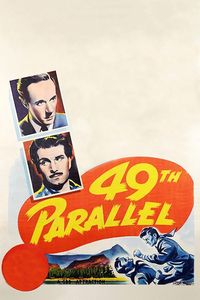
    (Criterion Streaming, January 2021) I usually scrutinize foreign films about Canada with a sharp eye, but 49th Parallel is a very satisfying mixture of semi-clichés, adventure, anti-Nazi propaganda and decent location shooting. Coming from the British film industry in the middle of WW2, it’s obviously conceived by filmmaking duo Powell/Pressburger as a kick in the pants for the then-neutral United States, and the best way to do this is by having Nazi saboteurs land in Canada and try to make their way to the States. As an adventure tale, it does have a nice forward rhythm, going from one episode to another as the Nazi infiltrators make their way across the country in a truly roundabout way and encounter various kinds of Canadians, with their numbers dwindling along the way. It starts off strongly with none other than a young Laurence Olivier playing a French-Canadian trapper (with decently accented French!) telling Nazis to shove off when they try to drive a wedge between French and Anglo-Canadians. Next up is a colony of Hutterite German immigrants, once again telling the Nazis to go away when they start playing on their common ancestry. After a detour through Winnipeg and the Rockies (where a British writer makes a strong stand for “soft” democracies), the action inexplicably gets back to Ontario in time for one last episode, where a less-than-perfect soldier (played by Raymond Massey, brother of future governor general Vincent Massey, who narrates the opening segment!) gets the finishing move near Niagara Falls. 49th Parallel would probably be fifteen minutes shorter without the speeches and propagandist material, but at a time of resurgent neo-Nazism, it’s still satisfying to see a portrayal of Canadians fighting back against the Third Reich. Aside from the ludicrous cross-country-and-back nature of the episodes, there’s plenty to like about the way Canada is showcased here. Some location shooting gorgeously feature its forests, prairies and mountains, while the characters have nicely done speeches making the country sound like amazing antagonists for the Nazis. Even the First Nations have some authentic representation, which is quite a lot more than we can say about many subsequent films. All told, 49th Parallel is quite a lot of fun to watch, and it’s an intriguing glimpse at the way Britain thought of Canada at the time.
  • Pride and Prejudice (1940)

    Pride and Prejudice (1940)

    (On Cable TV, February 2020) One of the appealing characteristics of Jane Austen’s Pride and Prejudice is how it charmed readers and filmmakers throughout generations, meaning that we can compare and contrast adaptions dating back to early Hollywood history. Now, there are Austen devotees that can give you lengthy explanations about the merits and issues of the 1940 version of Pride and Prejudice with far more detail and passion than I can. I’ll do my own best by underlining the cast (the lovely Greer Garson and Laurence Olivier in the lead role, with notables such as Edna May Olvier and Marsha Hunt in supporting roles), the lavish nature of the MGM production and the fact that none other than Brave New World’s Aldous Huxley contributed to the screenplay. It’s not necessarily a problem if the costumes here are all about the 1940s conception of a historical drama than actually being exact to the period—it’s the kind of thing that adds to the charm of a particular take on the material. Most importantly, Austen’s bon mots and comedy of manners have been adapted rather well to the screen, creating not only a hit back then, but also a nice little classic adaptation that still holds its own against more modern takes on the same source material.

  • Sleuth (1972)

    Sleuth (1972)

    (archive.org Streaming, December 2019) I have some admiration for movies that attempt ambitious or over-restrictive premises, and Sleuth certainly qualifies—it’s a bit of a spoiler to say that the film only has two actors (but not really, I mean—you can recognize Michael Caine in any kind of disguise) but that’s part of the film’s interest: An actor’s duel between Caine and Laurence Olivier, as two characters with plenty of secrets spend the entire film engaged in line-by-line combat. There was a chance that a film with such a limited number of actors could run dry, but fortunately there’s enough of a convoluted plot about thievery, lovers, deception and murder to keep things interesting. In the theatrical tradition that inspired it, much of the movie takes place in an elaborate library with plenty of visual interest. It’s quite a lot of fun, and with the calibre of the actors involved (the entire cast was nominated for best acting Oscars, a rare but not unique feat) it’s easy to be swept in the film’s high concept. Directed with a veteran’s ease by Joseph L. Mankiewicz, Sleuth manages to sustain attention with two actors and some great writing.

  • Wuthering Heights (1939)

    Wuthering Heights (1939)

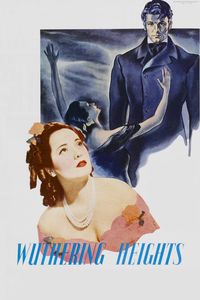
    (On Cable TV, October 2019) 1930s Hollywood adaptation of literary classics are a specific category, but Wuthering Heights is in a category of its own even as a novel. Dismantling the archetype of the vengeful romantic hero, it presents protagonist Heathcliff as an obsessive monster destroying everyone’s lives in order to get what he wants. The glossy Hollywood adaptation, by necessity, does muddle the portrait: it lops off the more disturbing second half of the book, softens a few edges and provides a tragic romantic happy ending of sorts to the lead couple. (This being the second time in a few weeks that a classic Hollywood adaptation of a literary landmark features the heroine dying in the hero’s arms, I’m suddenly curious about the device.)  Being what it is, Wuthering Heights doesn’t completely delve into the most unsavoury aspects of the protagonist’s issues, although even a cursory viewing establishes that neither of the protagonists are particularly admirable in any way. For movie fans, there’s a certain pleasure here in seeing a young and dashing Laurence Olivier playing a cad opposite the beautiful Merle Oberon, or an even younger David Niven in an early role as another suitor. To contemporary viewers, the heightened melodramatic tone of the film can have a certain deliciousness, even if ironic. The film certainly won’t be much of a primer for a novel that keeps going for an entire generation after the events depicted in the film. Still, Wuthering Heights remains a landmark of sorts, and the period atmosphere is worth a brief time-travel trip.

  • The Chronicle History of King Henry the Fifth with His Battell Fought at Agincourt in France aka Henry V (1944)

    The Chronicle History of King Henry the Fifth with His Battell Fought at Agincourt in France aka Henry V (1944)

    (On Cable TV, February 2019) As regular readers of these reviews know, I do poorly with Shakespearian adaptations. I find the language nigh incomprehensible, the premises overly familiar, the staging artificial, etc. It takes a lot to get me to perk up at a Shakespearian adaptation, but Laurence Oliver’s Henry V does have quite a bit to offer only on a visual level, least of it being shot in colour. Perhaps the most distinctive thing about it is how it operates stylistically like an onion. The opening has a very detailed model shot of Shakespearian London, which gives place to an obviously staged theatrical production, then again to a less stylized production, then to surprisingly cinematographic battles, and then back again to the outer layers as the story wraps up. Considering that I usually spend my time watching Shakespearian productions for the visuals rather than the dialogue or story, this scratched just the right spot for me. Still, I can’t guarantee that I remained awake through it all … but while I was aware of Laurence Olivier’s skills as an actor, in Henry V he shows quite a bit of skill as a director as well.

  • Rebecca (1940)

    Rebecca (1940)

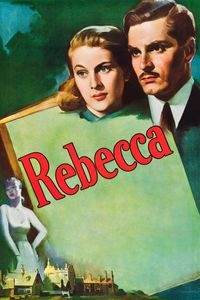
    (On DVD, September 2018) For all of his famed ability at creating and sustaining suspense, Alfred Hitchcock could have a surprisingly romantic streak at times, and few of his movies manage to combine both traits as intriguingly as in Rebecca, perhaps one of the best depiction of the Gothic romance sub-sub-genre ever put on-screen, adapted from Daphne Du Maurier’s still well-known novel. The mystery here is intensely personal, as the new wife of a rich man has trouble measuring up to the example set by her predecessor, the mistress of a vast estate who clearly still has her fans in the household help. Against the lonely and oppressive backdrop of a house far too big for its inhabitants, the heroine starts wondering who’s not out to murder her. It escalates into a fiery climax, but the point of the film, after a sunny romantic first act, is the heroine looking over her shoulder, discovering deeper secrets about her new husband and his house, and sparring with a standoffish housekeeper. Rebecca is noteworthy in Hitchcock’s oeuvre in a few respect: it was his first Hollywood project after emigrating from Great Britain; it was produced/dictated by the legendary producer David O. Selznick and it’s the only Hitchcock film to win the Best Picture Academy Award. Both Joan Fontaine and Laurence Olivier are quite good as the leads, but it’s Judith Anderson who has the best role as the ever-faithful Mrs. Danvers. Otherwise, Rebecca is still good fun to watch, not quite noir but definitely Gothic enough to be visually interesting on top of Hitchcock’s usually skillful direction.

  • Spartacus (1960)

    Spartacus (1960)

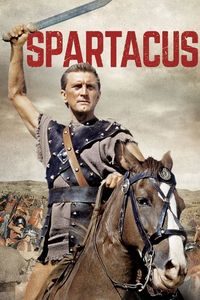
    (On TV, April 2018) The fifties were big on sword-and-sandal epics, and Spartacus is in many ways just another link in the chain that goes from, at least, Quo Vadis (1951) to Cleopatra (1963). That it happens to be a Stanley Kubrick film (directing a script by the equally legendary Dalton Trumbo) is almost immaterial—Kubrick famously disliked the end result, and reacted to his experience making the film by staying as far away from Hollywood as possible for the rest of his career. Still, there’s a lot to like here, starting with Kirk Douglas’s spectacular performance as Spartacus, or Laurence Olivier sparring with him as Crassus, or notables such as Charles Laughton, Peter Ustinov (back in sandals!) Tony Curtis or Jean Simmons in other roles. Trumbo’s script is quite good (the “I’m Spartacus ! ”scene lives on) and the execution does live up to Kubrick’s exacting standards. As historical epics go, Spartacus is one of the better ones, and it warrants watching as more than a historical reference.

  • Hamlet (1948)

    Hamlet (1948)

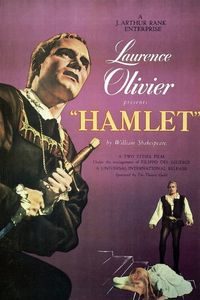
    (On Cable TV, March 2018) Despite my best intentions, I have something of an irrational aversion to Shakespearian dialogue. My first language isn’t English, for one thing—and while I can appreciate modernized versions of Shakespearian works, the source material itself nearly always leaves me cold. You can imagine the problem with Laurence Oliver’s 1948 Hamlet, as strict a representation of Shakespeare as you can imagine (minus some judicious editing to bring the play down to feature-film length). The only thing that kept me going is the strikingly stylized imagery on-screen—as a director, Olivier went for stark, nearly-noir depictions of the story, and it remains interesting to watch even today. Never mind the dialogue and appreciate the images. Still, as far as movies go (and as far as Oscar-winning movies go), this is really dull stuff. It doesn’t help that, for all of the violent twists in the tale, much of Hamlet contains few surprises today in terms of plot given its familiarity to nearly every high-school student in the Anglosphere. It (barely) remains watchable today solely by dint of execution … which, all things considered is about as high praise as you can get from filming the Bard’s work directly for the screen.