Meryl Streep

  • The Deer Hunter (1976)

    The Deer Hunter (1976)

    (Second viewing, On Cable TV, October 2016) I saw The Deer Hunter decades ago, but couldn’t remember much other than the Russian roulette sequences. Watching it again reminded me why. As much as there’s a lot to like in the story of blue-collar workers being irremediably damaged by their Vietnam experience, the film is just too long and meandering to be as effective as it could be. The interminable wedding sequence springs to mind as the worst culprit here (boo, director Michael Cimino, boo) although there’s enough fluff elsewhere in the film to make the running time balloon even higher. At least the film is blessed with a few terrific performance, the best being a very young Robert de Niro as a quiet hunter, an equally young Christopher Walken as the one who goes crazy, and Meryl Streep as the object of their affection. Great sequences also fill the movie, but the connective material between them kills much of the film’s urgency, and takes away from the relatively straightforward plotting. The Deer Hunter’s then-daring portrait of soldiers as real people without glorifying war heroics doesn’t come across as clearly now, given the steps taken to humanize warriors in later movies. A classic for a good reason, The Deer Hunter is not a bad piece of work—although its emotional impact is bound to vary widely.

  • Death Becomes Her (1992)

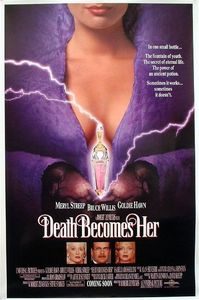
    Death Becomes Her (1992)

    (On Cable TV, June 2016) I remember seeing bits and pieces of Death Becomes Her before (especially the special effects work) but not the entire thing and having watched it, I can only conclude that Hollywood’s become far more risk-averse in the past twenty-five years because … wow, this is a weird film. It blends comedy with a fair bit of understated horror, hops viewpoints between protagonists, plays with supernatural tropes and seems delighted in deglamorizing its stars. Seeing Bruce Willis play a downtrodden surgeon is remarkable not only because he’s relatively animated in the role, but because it’s the kind of self-deprecating role he’d never play any more. Goldie Hawn (occasionally in a fat suit) and Meryl Streep (gamely going to lowbrow physical comedy) also play against persona, carefully directed by Robert Zemeckis with the kind of silliness that seems absent from the last two decades of his work. What’s definitely within his filmography is the film’s use of special effects for storytelling purpose: While dated, the work still carries a certain charge even today, and it’s not a surprise to find out that it won the Special Effects Oscar back in 1993. Beyond effects, Death Becomes Her does have a bit of beauty/age thematic depth to it, although I probably would feel better about a clash between aging actresses had the script been better at portraying the female gaze: At times, the “ha-ha, they’re so vain!” gags can feel mean-spirited and missing the point of the theme. But it’s definitely a weird film, also so much so that it’s to be discovered and savoured. It takes chances, occasionally missteps and often dares to indulge in risk-taking humour. The result may not be entirely successful, but it’s gleefully audacious and remains its own creation, without giving the impression of being photocopied from the Hollywood mainstream. Worth a look, if only as a reminder of the kind of stuff that Hollywood won’t dare touch these days at it chases predictable results.

  • Ricki and the Flash (2015)

    Ricki and the Flash (2015)

    (On Cable TV, April 2016) I only saw Ricki and the Flash because of “Meryl Streep as an aging rocker” and after watching the film, I can confirm that “Meryl Streep as an aging rocker” is pretty much the only reason you need. Here, Streep plays an older woman who has sacrificed everything (including a marriage and three children) to music. Her nights playing at a local bar may still be glamorous, but her days as a cashier aren’t. Things start to change when she finds herself drawn to reconciliation after her daughter goes through a suicidal depression. Much family comedy/drama ensues, with Kevin Kline playing back-up as her ex-husband. While Ricki and the Flash is written by Diablo Cody, there’s little here to wow anyone: Much of the film seems tepid, chugging along to a halfway-celebratory conclusion. There are some pacing issues, most notably in the last half-hour where the film slows rather than pick up to a conclusion. Streep remains the film’s best asset throughout, picking up a guitar and credibly signing in-between an unusually sympathetic of a woman who may or may not have screwed up her life. At least she can still sing and carry a tune, which is what the curiously pat ending stops at. Ricki and the Flash is obviously aimed at a particular public, meaning that anyone who falls out of it is likely to find it a bit lengthy and flat. Streep’s pretty good, though, if that hasn’t been said enough already.

  • It’s Complicated (2009)

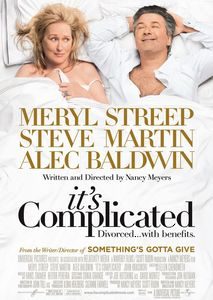
    It’s Complicated (2009)

    (On Cable TV, October 2015)  Doesn’t Alec Baldwin make a splendid shmuck?  That kind of performance seems to be the main justification for It’s Complicated, an otherwise amiable film to the point of not being of much interest.  Director Nancy Meyers once again turns her attention to Rich White People’s problems (as in; hiring an architecture firm to supervise the construction of a kitchen addition) before resigning herself to showing some conflict.  It sort-of-works if that’s the kind of film you’re looking for, or if you simply want to enjoy the film on superficial acting performances, lifestyle aspiration or simply the idea of people having very small problems.  To its credit, It’s Complicated has a bit of sense in its conclusion, and can depend on Meryl Streep to sleep-walk through an unchallenging role, while Steve Martin is blander than expected in a stealth romantic hero role (he does get a split-second “wild and crazy guy” moment, though.) and Alec Baldwin is almost delightfully slimy.  Jon Krasinski also gets one or two good moments, but otherwise It’s Complicated is a film on auto pilot, almost too nice to be interesting.

  • Into the Woods (2014)

    Into the Woods (2014)

    (On Cable TV, August 2015)  I honestly thought I’d enjoy Into the Woods a lot more than I did.  Having a pre-schooler running around the house means watching a lot of Disney films, so the thought of a musical parodying classic fairy-tales has a certain appeal to it if only as a change of pace.  To be fair, Into the Woods does have its good moments.  Princes dueling for attention while signing dramatically; Anna Kendrick with a singing role; Meryl Streep playing a demented witch; clever twists and turns of plot –especially in the first section of the film.  But then comes the second section of the film, which seems determined to frustrate even viewers hungry for parody – the tone turns far darker, the musical number get less interesting, heroes are revealed to be villains and the film sort of degenerates into a mush of unsatisfying endings.  Cue my flagging appreciation.  And that’s not mentioning the various missteps along the way, not the least of them being Johnny Depp showing up as a lecherous big bad wolf.  But much of the so-called flaws of the film are intentional, and so is its intention to frustrate those looking for more conventional fare.  The bigger surprise here is to realize that Into the Woods is a Disney production tweaking the nose of fairy tales closely associate with Disney itself.  I suppose that, given Disney’s recent willingness to remake even its animated classics into live-action films, that an affectionate tweak on those same classics wouldn’t be out of place. 

  • The Giver (2014)

    The Giver (2014)

    (On Cable TV, April 2015)  There’s been a recent glut of Young Adult Science Fiction movies adaptations lately, and while The Giver is of a slightly-older nineties-novel vintage than Divergent, The Hunger Games and its ilk, it has so many points of similarity that it courts generic repetitiveness.  Here again, we have a young person with singular talents discovering The Truth behind their too-perfect post-post-apocalyptic society, then rising up against the established order in order to upset the status quo.  Same story, same basic credibility problems, same obvious attempts to manipulate teenage audiences.  Not gaining points for originality, The Giver at least gets a few in terms of execution: there’s something cheap but interesting in the way the black-and-white of the film’s first few moments gradually lets color in, and director Philip Noyce is enough of a veteran to have a steady hand in presenting the action.  Still, that’s not quite enough to rescue The Giver from occasional ennui.  It’s not meant to be particularly smart.  Given the mediocre nature of its premise, it’s surprising to see an actress like Meryl Streep in a matriarch role, playing alongside Jeff Bridges (and Katie Holmes, and Taylor Swift in an unexpected small role).  Still, The Giver has the somewhat unusual daring to feature a baby in peril for a long while, and that baby upstages Streep every chance it gets –The Giver goes heavy on life-affirming clichés, but The Baby In Peril may raise the stakes a bit too high compared to the rest of the film.  Still, for all of its affirmed averageness, The Giver manages to score one or two good lines, plays with ideas without committing to them, and concludes on the kind of life-affirming notions that can mollify even the most bored reviewer. 

  • Hope Springs (2012)

    Hope Springs (2012)

    (On Cable TV, April 2013) Obvious aimed at older audiences, this gently-paced comedy is about an older couple seeking to re-connect after decades of increasing neglect and disaffection.  Meryl Streep and Tommy Lee Jones (as the estranged couple) alongside Steve Carrell (as their therapist) lend star-power to a premise that could have gone just as naturally in a straight-to-TV film.  As a comedy, it’s low-laughs, high-heart stuff, as the couple repeatedly stumbles while trying to reconnect.  The look at mature relationships is unusual enough to be interesting (consider the film as a companion piece to This is 40) but this is in no way a wacky-hijinks comedy, and in fact it may be funny only because it ends on a happy note –much of the film could go either way.  There are few surprises in the script, which means that much of the film’s appeal rests squarely on Streep and Jones’ shoulders.  Fortunately, they’re veteran actors for a reason, and their sweetly vulnerable portrayal of an old couple is almost worth the time it takes to watch the film if you’re a fan of either actor.  Both end up playing far lesser-powered versions of their usual screen personas, and the result has a hum-drum domesticity that is almost surprising.  Jones’ character is so broadly defined as to court caricature at times, but he still makes it work; meanwhile, Streep conclusively demonstrates the potential sex-appeal of a sixty-something woman.  Many younger viewers won’t have the patience, interest span or life-experiences required to sit comfortably through the film, and that’s fine: Hope Springs may work best as a film targeted to older audiences.  It may not be an overly memorable film, but it’s not bad, and it has a few welcome reminders that romance can be rekindled.

  • Julie & Julia (2009)

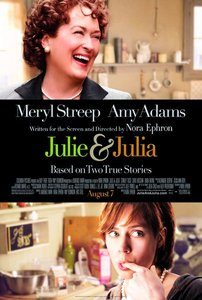
    Julie & Julia (2009)

    (In-flight, November 2009) Nora Ephron’s films are generally amiable and unobjectionable, but after a short absence from the big-screen, it’s good to see her move slightly-away from romantic comedies to tackle a film about cooking, blogging and female empowerment.  The twin true stories of Julia Child (who, in the fifties, popularized French cuisine in America) and Julie Powell (who, nearly fifty years later, took on the project to cook her way through Child’s first book in a year and blog about the experience), Julie & Julia is perhaps most enjoyable as the journey of two foodies.  It’s practically impossible to sit through the film and not be shamed into becoming a better cook.  Food remains the film’s love interest even as various romantic subplots are weaved in the narrative.  The film’s biggest problem is that its two true stories don’t necessarily intersect with grace (although there are a few nice transitions) and that the conclusion feels a bit flat: There are no big dramatic finales built into the true events that inspired Julie & Julia, and some of the most intriguing elements of the story (such as Child’s lack of affection for Julie’s blog) are not necessarily explored.  More happily, it’s striking that the best depiction of a blogger so far in mainstream American cinema (what motivates them, the challenges they face, the thrills of being read) has been in a fluffy food romance.  Who would have thought?  Otherwise, there’s little to dislike in Julie & Julia: maybe a sense of material not being fully exploited, but the funny moments, another great performance by Meryl Streep and food-friendly atmosphere usually compensate for those.

  • Mamma Mia! (2008)

    Mamma Mia! (2008)

    (On DVD, sometime mid-2009) I’m not that familiar with the original stage jukebox musical, but even I know that it’s a frothy romantic comedy built around a number of ABBA songs. As such, the film adaptation Mamma Mia! does service to the concept: It’s lighthearted, romantic, and features a series of numbers based on ABBA songs. As three older men converge on a Greek island where an ex-flame and her daughter live, it’s the film’s smallest mystery to find out who is the girl’s father. Much of the time is spend singing and dancing, helped along by the inescapable (and somewhat delightful) fact that ABBA’s music has inserted itself deeply into modern pop culture. The result may be kitsch, but it’s familiar and comfortable kitsch without a mean bone and with an inordinate desire to please. It is, in other words, almost impossible to dislike. The actors involved aren’t all good singers, but it’s part of the film’s charm to see Pierce Brosnan croon, even hoarsely, to Meryl Streep. Amanda Seyfried is cute as a Muppet as the daughter with a mystery father, and the fantastic Greek scenery adds a lot to the film’s sunny atmosphere. Mamma Mia! isn’t high art, but sometimes campy pop is more than good enough.