Minnie Driver

  • Stage Fright (2014)

    (On Cable TV, April 2022) I’m not sure it’s right to say that there’s a lot of opportunity wasted in Stage Fright – after all, what’s the reasonable ceiling on a camp slasher film adopting musical comedy tropes? Still, there’s a sense that the film achieves only a portion of its potential. As someone who loathes slashers but likes musicals, I probably shouldn’t be surprised at my mixed reaction: the musical aspects buoy my reaction to the slasher elements, and the slasher elements limit my liking of the musical bits. That tension comes into play from even the first sequence, as the joy of seeing Minnie Driver (yay!) as a Broadway star is almost immediately cut short by her being the first victim in a series of gory murders. The story really picks up ten years later, as her children are on the staff of a musical summer camp teetering on the edge of bankruptcy. But financial problems soon become the least of their worries when people start being killed (once again with maximum gore) all over the camp. The rest is rather standard slasher material, with kills every few minutes to keep audiences awake (or unimpressed, if they don’t like the genre) until a conclusion that’s slightly better than average for the genre. In between the kills, we have musical sequences (not an easy structural conceit!) – nothing particularly memorable, but enough to establish the film’s dual allegiances. Allie MacDonald is not bad as the plucky final girl, which Meat Loaf seems to have the most fun in a role that’s not particularly glamorous. There’s clearly a novelty to Stage Fright that will interest fans of genre hybridization, and a few cute quirks here and there that show how clever writer-director Jerome Sable can be. But there’s something missing, or a clear limit to how good this blend of elements can be. Perhaps pulled back by the different directions of its inspirations, Stage Fright may be worth a very marginal curious look, but don’t expect much conventional satisfaction no matter which way you approach it.

  • Spinning Man (2018)

    (In French, On TV, April 2022) It’s perfectly acceptable to watch mediocre films if the cast is interesting, and in Spinning Man’s favour, you do get Guy Pearce and Pierce Brosnan sparring as (respectively) a man suspected of murder and a slightly-too-dogged detective. On the distaff side, you have both an evergreen favourite in Minnie Driver and a rising star in Alexandra Shipp. But casting may be the film’s best and sole asset, because the rest of the story (not very well adapted from a novel) is designed for frustration, but then goes on to compound its foundational issue with even more unforced problems. The situation, as we understand it, is that our protagonist (Pearce) is a philandering husband whose fondness for young women ideally fits his job as a philosophy teacher, with a resumé that consequently includes a suspicious transfer from one school to another. When an ex-student of his goes missing, the detective has plenty of clues to suggest he’s involved. But here’s the thing: Spinning Man isn’t really interested in a conventional murder mystery. It’s one of those films more interested in meditations about memory, guilt, truth and perception. It dumps a load of red herrings on the viewer, pulls the rug of conventional murder mysteries from under them, and makes a little victory dance of having fooled everyone. It’s one of those movies-as-elaborate-game things, which only works if the viewer is interested in playing. I’m sure someone, somewhere, gets where the film was going with its multiple false leads, denial of a crime and imaginary sequences – probably the novelist, maybe the screenwriter, not necessarily the director. By the end of it, Spinning Man is more likely to feel tedious than anything else—OK, so you lay out the groundwork for a murder mystery, but then proudly claim to not care about it? Fine, here’s me claiming that I don’t care about the results either. I’m not completely disappointed in the film – there’s a nice slightly-gloomy small-town college atmosphere, and the four main actors are well worth watching in their own way. But while I see Spinning Man make elaborate pretentious gestures, I’m not really invested enough to make even the slightest effort to go beyond a surface level read of the film, where it intentionally fails at satisfaction.

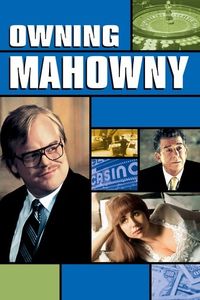
  • Owning Mahowny (2003)

    Owning Mahowny (2003)

    (On TV, July 2021) I’m not always fond of Canadian Content (CanCon) restrictions on Canadian Cable TV channels requiring them to show a certain percentage of Canadian material if they want to keep their broadcast licenses. It certainly makes for a convenient scapegoat whenever a terrible made-in-Canada movie gets in regular rotation for a while. Of course, the pleasant flip-side of this is that CanCon often helps in keeping good but obscure Canadian movies in play long after they would have otherwise been forgotten. Seeing Owning Mahowny pop up regularly on schedules eighteen years after its release, for instance, is one of those cases where CanCon isn’t so bad. Based on a true piece of Canadiana, it’s the story of a bank vice-president who figures out a way to tap into his company’s funds in order to cover his gambling debts, only to see this “temporary” charade deepen, as he’s unable to cover his losses. Along the way, it clearly becomes a case study in a gambling addiction, as the protagonist goes bigger and bigger (becoming a “whale” for competing casinos) without quite getting any satisfaction out of it. Philip Seymour Hoffman is typically excellent in the lead role, consistently underplaying things in a way that becomes a statement by itself. Minnie Driver doesn’t get much to do as “the girlfriend” (aka the voice of reason), although seeing her in dirty-blonde straight hair with bangs is interesting in itself. John Hurt is delightful as a very amused casino manager trying to learn more about the player with deep pockets showing up in his establishment. Still, this is Hoffman’s show, and he shines brighter than the muddy 1980s-style cinematography attempting a period look. Fortunately, the film is progressively compelling: Hoffman’s character is clearly stuck in a spiral of lies and deception and there’s a perverse pleasure in seeing how far he’ll go in trying to cover up his growing debts. Among Owning Mahowny’s most interesting choices is a sequence that, in any other gambling film, would be about the flash and fun of being treated like a high-roller. Here, however, the entire thing feels like a pain for the protagonist, who would rather go on with the business of playing than being lavished with attention. Some decent screenwriting gives weight to even the minor characters and structural scenes — it makes for an absorbing film even when it doesn’t necessarily start out like one. Owning Mahowny is definitely worth a look if you’re even slightly interested by gambling movies, white-collar crime thrillers or character studies. So: score one more for CanCon victories in further exposing a home-made success.

  • Beyond the Lights (2014)

    Beyond the Lights (2014)

    (On TV January 2021) Beyond the Lights isn’t unique in taking us backstage of a music superstar’s public image (heck, it’s not even the only such film I watched today with an unintentional double bill with The High Note), but it can depend on decent execution and a good ensemble cast to distinguish itself. In between Gugu Mbatha-Raw, Minnie Driver, Nate Parker and Danny Glover, there are plenty of interesting actors here. As a romantic comedy, Beyond the Lights starts with unpleasant sequences, as a prologue depicting parental abuse is followed by a suicide attempt by the film’s grown-up protagonist. Fortunately, a handsome policeman (Parker) is there to prevent the superstar signer (Mbatha-Raw) from falling to her death, and what follows is a romance mixed with attempts from the singer to extricate herself from an artificial persona facilitated by her domineering mother (Driver, in a surprisingly unlikable turn). Straightforward direction by Gina Prince-Bythewood doesn’t get in the way of her own script. I have long been interested in Mbatha-Raw, but this early film is a far better showcase for her talents than many of her later performances: the role is complex, spans various emotional states and even if it’s not clear whether she performed her vocals, it takes presence to credibly play a musical superstar. I have a few qualms about the male protagonist’s character, but those things have to be put in perspective considering that it’s female-centric romantic comedy. Still, I had a decent time—despite overused plot devices (is there a single movie singer who doesn’t dream of singing their own heartfelt material?), Beyond the Lights is an entertaining film that, by now, almost qualifies as an overlooked one.

  • Sleepers (1996)

    Sleepers (1996)

    (On Cable TV, October 2017) The mid-nineties were a surprisingly good time for solid thrillers, and Sleepers works not because of its atypical revenge plot or unobtrusive direction but largely because it managed to bring together an impressive group of actors. In-between Kevin Bacon, Jason Patric, Brad Pitt, Robert De Niro, Dustin Hoffman and the always-compelling Minnie Driver, it’s a nice mixture of generations and styles. It helps that the script is built solidly around an unusual conceit, with an ambitious lawyer doing his best to lose a case but make sure it’s widely publicized to take revenge upon childhood enemies. A blend of courtroom thriller and working-class drama, Sleepers may or may not be based on a true story, but it works well as fiction. Despite revolving around difficult subjects such as child abuse, Sleepers manages to be slightly comforting in how it ensures a victory of sorts for its characters, present a solid underdog story in an accessible fashion, and largely depends on familiar actors doing what they do best. Director Barry Levinson mostly stays out of the way of his actors, and the result is curiously easy to watch despite harsh sequences.

  • Conviction (2010)

    Conviction (2010)

    (On DVD, June 2011) There’s something almost earnestly old-fashioned about Conviction, a film that has few scruples about belonging to the “inspiring story based on true events” category.  Here, a woman puts herself through law school for the express purpose of freeing her wrongfully accused brother.  It ends pretty much like you’d think.  Still, Conviction is more polished than you’d expect: the setup is handled efficiently, and the early structure of the film seamlessly meshes two levels of flashbacks to explain how the characters got where they are.  This is the kind of film that showcases actors, and Hilary Swank is very good in the lead role, with a strikingly transformed Sam Rockwell as her wrongfully accused brother.  I almost always, for some reason, enjoy seeing Minnie Driver on-screen, and she gets a lot of screen time as a sidekick to the protagonist’s legal investigation.  For a film of its genre, it’s curiously restrained until the very end, and clever about how it takes us from one detail of the case to the next.  It doesn’t necessarily spring Conviction up and away from typical TV-movie-of-the-week fare (it will live best on DVD than it did in theaters), but it does pretend to be a dramatic awards contender, and it’s not misplaced in those ambitions.  It all piles up to amount to a satisfying film, but not an overly memorable one.

  • Barney’s Version (2010)

    Barney’s Version (2010)

    (In theatres, January 2011) As much as I like supporting Canadian Content (and there’s nothing more CanCon than an adaptation of Mordecai Richler’s last novel, filmed and set in Montréal), there’s something just subtly off about Barney’s Version.  It’s an accumulation of small annoyances that damage the film, from a scatter-shot episodic narrative to flat performances to overly sentimental moments.  I’ll be the first to note that presenting forty years of a man’s life on-screen isn’t the simplest screenwriting challenge: As an adaptation of a dense and thick novel, you can perceptibly feel the loose threads running over everywhere and be frustrated at the amount of extra detail missing from the screen.  That’ll explain the way the film doesn’t quite seem to hang together.  While Barney’s Version revolves around Paul Giamatti’s exceptional lead performance and Dustin Hoffman’s unrecognizable turn as his father, actors surrounding them are far less credible.  Most of the female characters seem played either without subtlety (I once thought I could watch Minnie Driver all day, but her one-note shrill performance tested that assumption) or without affect (Rosamund Pike, sedated throughout): even assuming that the film is from Barney’s subjective perspective isn’t enough to excuse it.  Humorous in the details and tragic in the whole, Barney’s Version runs off in all kinds of directions, and it’s not in its nature to finish neatly with a big finale.  It’s best, then, to appreciate its small quirky moments, its Montréal atmosphere and the occasional Denys Arcand cameo.  It is, as is the case with so many middle-of-the-road Canadian dramas, amiable but unremarkable.  Barney’s Version is good enough to make Canadian audiences feel better about seeing it, but it’s not worth much commentary otherwise.