Patrick Swayze

  • To Wong Foo Thanks for Everything, Julie Newmar (1995)

    To Wong Foo Thanks for Everything, Julie Newmar (1995)

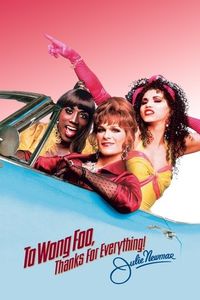
    (On Cable TV, October 2021) There’s a perfectly fair argument to be made that To Wong Foo Thanks for Everything, Julie Newmar is too conventional a film—fluffy, predictable, shallow and willfully unwilling to confront deeper issues about its characters. On the other hand—this was a major Hollywood studio production about drag queens from the middle of the somewhat less accepting 1990s: How could it not be such a film? A safe way to talk about outsiders is to make them irresistibly likable, and that’s the bet successfully waged here. Patrick Swayze, Wesley Snipes and John Leguizamo star as three drag queens whose cross-country road trip lands them in a small Midwestern town, where they’ll confront local bigots, crooked police and various semi-romantic entanglements. It goes without saying that our three protagonists are without personal flaws, and are free to use both masculine and feminine virtues to overcome their obstacles. It all works really well, at least on a somewhat fairy-tale level. But notice how To Wong Foo quickly skims over the question of the protagonists’ sexuality (and when it does, makes such broad sassy considerations with such outdated terminology that they immediately become suspect) and takes the very convenient route of avoiding the transformation process—save from a scene at the very beginning of the film, our leads remain in drag all the time, night and day. There’s a sanitization process that helps with the film’s fantasy of easy acceptance, but we’re nowhere near realism. Reading about the film from the perspective of queer cinema commentators is highly enlightening. But on the surface level that it seeks out, To Wong Foo is more successful than not—let’s not underestimate the performances of Swayze and Leguizamo (for whom this is still one of his best movies)—plus a still-remarkable performance by black masculinity icon Wesley Snipes. Non-queen actors are also not too bad, with Blythe Danner and Stockard Channing getting some attention in largely functional roles. It all looks clean and stereotypically mid-American, with director Beeban Kidron keeping things moving at the intended level. No, To Wong Foo is not a heart-wrenching drama nor cutting social commentary—but it is likable and fun to watch and, in normalizing the outsiders, makes them less of outsiders. Not a bad result then or now.
  • I Am Patrick Swayze (2019)

    I Am Patrick Swayze (2019)

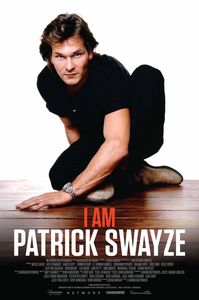
    (On Cable TV, April 2021) It’s interesting to see how Patrick Swayze has maintained his good reputation despite his death in 2009. His peak movies between 1987’s Dirty Dancing and 1991s Point Break are a legendary streak (yes, especially Road House) and cynics will say that it helped him to peak well before his death — by the time he passed away, he had managed to escape Hollywood and see his legacy solidify. Still, he did die before his time at 54, and in keeping with Network Entertainment’s “I Am” series of documentary biographies, the film is a paean to him by friends and family. Plenty of family footage appears over interviews about him, archival footage and excerpts from his films. The portrait we get is one of a supremely gifted dancer who turned his attention to Hollywood and got what he wanted out of his superstar years — namely, the opportunity to buy a ranch and have a life away from the spotlight. It would have been interesting to delve a bit deeper into why he has such a spotty filmography after becoming a box-office superstar — even in the 1990s, there could be years between his roles and I’m not sure the film clearly explains why. Still, the result is emotional enough: Swayze, as portrayed here, is the epitome of a good soul: kind, humble, and graceful, with a variety of interests and skills. Jennifer Gray’s description of what it was to work with such a generous actor is moving, and so is the work ethic that led him to work on his last TV series through chemotherapy. Perhaps a bit more sentimental than other films in the “I Am” series, I Am Patrick Swayze reflects its subject by taking a more emotional and gentle approach. It’s a really good reminder of why Swayze became so famous despite a relatively small number of career-defining features — you could see the man shine through the roles, and that was more than good enough to charm everyone.

  • Next of Kin (1989)

    Next of Kin (1989)

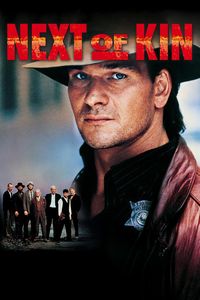
    (In French, On TV, September 2019) The interesting thing about going back in movie history and checking the lesser-known movies is that, from time to time, you get to discover something. Next of Kin isn’t that well known today, but have a look at this cast: Patrick Swayze, Liam Neeson, Adam Baldwin, Helen Hunt, Bill Paxton and Ben Stiller in one of his earliest roles. The premise also has some potential, what with Kentucky folks seeking revenge against Chicago mobsters who killed one of their own. Alas, the film itself doesn’t quite manage to justice either to its premise or its cast—although we do get to see Neeson, decades before Taken and the Liamsploitation craze, use his physical bulk to seek revenge for a fallen family member. Next of Kin comes closest to achieving is semi-comic potential in a climactic sequence set in a cemetery, with machine-gun-armed mobsters being outwitted by rural opponents using bows, bear traps and a bus full of snakes. But that’s a very short section in what feels like a much longer film that tries far too hard to play things seriously and ends up simply being bland. Swayze isn’t bad (especially playing off Hunt’s minor role or Neeson as his brother) but the script simply doesn’t fully seize upon what it had at its disposal. The cinematography is largely undistinguishable from countless other urban crime thrillers, and the direction isn’t much either: For all of the semi-fizz of a sequence set atop Chicago transit trains, the script itself just goes through the expected motions most of the time. Too bad for Next of Kin … but have you seen that cast?

  • Youngblood (1986)

    Youngblood (1986)

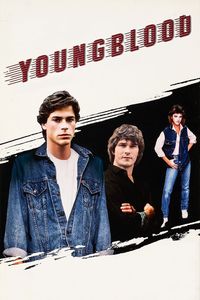
    (On TV, July 2019) For most of Youngblood’s duration, I was firmly onboard the movie. I happen to think that there aren’t enough hockey movies as it is, and this one happens to portray junior hockey in generally believable detail. Rob Lowe stars (with some assistance from Patrick Swayze—although not as much as you’d think—and a tiny part for Keanu Reeves as a goalie) as a young man escaping the farm to try to make it in the minor leagues. Much of the movie is about his attempts to fit in, as an American crossing the border to play with a Canadian team. There aren’t that many unusual or intriguing things about Youngblood (although the boarding house madam who collects players may qualify), but for most of its duration it’s a straightforward hockey movie. But then, just as I forgot that I had recorded the film off The Fight Channel (temporarily descrambled, I swear), there came the last minutes where, not content with winning a climactic game, the film feels forced to throw in a gratuitous fight. Nooo, that’s not the essence of hockey. And with that went my amicable recommendation for the film, its small-city atmosphere, its forced romance or its gentler take on Slap Shot material. Hockey is a noble sport—it doesn’t need fights and it’s not about fights.

  • Road House (1989)

    Road House (1989)

    (On TV, November 2018) Peak Patrick Swayze cannot be explained—it has to be seen to be understood. And while Dirty Dancing usually imposes itself as the obligatory film in considering his Swayzeeness, I’d argue that Road House is a better place to start, or maybe to end. Swayze here plays a bar bouncer with a particular genius in making sure the place is well organized—keeping the riff-raff away, ensuring that employees are honest and taking care of any customers making trouble. As the story begins, he’s somehow convinced to leave a prestige assignment in New York City to help turn around a bar set deep in rural Missouri. As he rolls into the small community, we’re left to grin at this elaborate set-up for a classic “stranger comes into town” plot: The question isn’t whether he’s going to attract the attention of the corrupt local authorities and clean up the place, but in what style he’s going to do so. As such, it’s a near-perfect Swayze vehicle, allowing the actor to flex his skills as a credible action hero. Only a fairly lacklustre romance prevents Road House from truly making him shine. The rest of the film is familiar business, with the local mafia intimidating the honest men out there, and the protagonist going on an over-the-top rampage of violence to right the wrongs of the place. It gets surprisingly violent at times. Road House is not what we’d call a good movie: it’s clearly aimed both at female Swayze fans and at their boyfriends looking for a few action thrills. But its unsubtle, almost-earnest approach to a classical story means that it can be appreciated either straight or ironically, depending on your chosen viewing level. Many movies of the time have aged far less gracefully.

  • Dirty Dancing (1987)

    Dirty Dancing (1987)

    (On TV, May 2017) Surprisingly enough for a forty-something man, I ended up liking Dirty Dancing quite a bit better than I expected … but I don’t expect my idiosyncratic reaction to be widely shared, or even comprehensible. The roots of my appreciation, paradoxically enough, go back to the history of American stand-up comedy: Ever since learning that generations of American comedians developed their craft in the so-called “Borsch Belt” of Jewish-dominated resorts nestled in the Catskill mountains, I’ve been fascinated by that kind of vacationing. Leaving New York, driving upstate to spend a week or two in a big isolated resort? Intriguing. So imagine my astonished reaction when I sat down to watch Dirty Dancing and realized that it was a trip back in time to this kind of vacationing. Never mind that I went thirty years without realizing that Dirty Dancing wasn’t an eighties movie set during the eighties—here, we’re back to summer 1963, with a rich Jewish family going to a Catskill resort for summer holidays. Never mind the romance between our innocent protagonist as the dancer played by Patrick Swayze—I’m here for the depicting of Borsch Belt resorts, fun at the lake, hiking in the mountain and Wayne Knight delivering a bad joke as the movie portrayal of stand-up comedians hitting the Catskill resorts at the beginning of their careers. Of course, there’s a whole other movie going on about a girl losing her innocence (and wow does this film get dark on the margins of its main plot) and Patrick Swayze being offended when someone puts Baby in the corner. My interest in that aspect of the movie was never better than lukewarm, but that’s the idiosyncratic part of my reaction to the film. Jennifer Gray is instantly sympathetic as the heroine, at least, and Swayze does manage to keep his character likable even considering their mismatched levels of maturity. As I’ve said—I don’t expect anyone else in the world to like Dirty Dancing for the same reasons I did, but that’s not the point … unless you want it to be that different people can like the same thing for wildly different reasons.

  • Ghost (1990)

    Ghost (1990)

    (On Cable TV, June 2016) There’s no denying that Ghost has ascended to the film pantheon as a romantic fantasy film (cue the pottery sequence!) but a fresh viewing shows that the film is a bit more than that: Beyond the romance, it’s got strong comic moments, a decent amount of imaginative flair and quite a few thrills. Anchored by Patrick Swayze’s fair performance and bolstered by a surprisingly funny and good-looking Whoopi Goldberg, Ghost is more interesting when it deals with the mechanics and complications of a ghost trying to make contact with the living. Suspense elements are woven (not always seamlessly) with comic sequences, giving the film a multifaceted appeal that doesn’t quite degenerate into abrupt tonal shifts. Demi Moore is a bit generic and baby-faced Tony Goldwyn is more fascinating than anything else considering how well he has aged in Scandal. Still, the film holds up relatively well beyond the pottery sequence, hitting marks on a wide spectrum of targets. It’s enough to make anyone wonder if today’s blockbusters have grown a bit too selective in their intentions for fear of tonal incongruity. Ghost, at least, deftly goes from romance to comedy to horror to thrills, and the result still speaks for itself.

  • Point Break (1991)

    Point Break (1991)

    (Second viewing, On TV, May 2016) I must have first watched Point Break on TV sometime during the mid-nineties, but revisiting the film twenty-five years later reveals a stripped-down thriller that has aged into something of an enjoyable period piece. It helps that Kathryn Bigelow’s direction is almost timeless, using both snappy editing and long shots (such as the FBI office scene) to effectively make the most of its moments. The great action sequences complement a serviceable plot template that has been copied a few times—I’m looking at you, The Fast and the Furious. Keanu Reeves is practically iconic as the standoffish Johnny Utah, while Patrick Swayze remains effortlessly cool as the antagonist. There is, as pop culture has noted in the past twenty-five years (hello, Hot Fuzz), a considerable amount of overdone melodrama in the result—but that quality, paradoxically, has helped Point Break remain distinctive even today. The early-nineties details are now charming, while the core of the film’s execution remains just as sharp today as it was then. There’s now a “remake”, but it’s not really essential viewing.