Paul Newman

  • Exodus (1960)

    (On Cable TV, September 2021) There’s no denying that Exodus has a place in cinema history — it was a rare recent-history epic film in the 1950s tradition, it featured Paul Newman in an early role, and most importantly it marked the end of the Hollywood blacklist when director Otto Preminger, ever the iconoclast, publicly announced that the script was from the now-legendary Dalton Trumbo, who until then had been forced to work under pseudonyms. It also, perhaps more troublingly, heralded America’s one-sided support for Israel, blurring even then-recent history in order to play nice with everyone and eschewing the explosive complexities of Israel’s foundation. But historical importance doesn’t necessarily translate into enduring watchability, so let’s just say it: Exodus has aged poorly. Perhaps it was ill-conceived in the first place, trying to cram a thick historical novel into even an expansive 208-minute film complete with an intermission. One of the biggest problems is that it qualifies as an epic film through length rather than scope: As our protagonists romance themselves against the backdrop of Israel’s foundation, the result seems curiously lacking in thrills or even in ambition. It feels small but, fatally, empty — there’s no reason for the film to last this long and deliver such a trite message. The immersion in Israel’s founding years is not as captivating as I would have liked, and the ultimate message feels trite. Newman is still compelling no matter the circumstances (and it’s a harsher role for him than usual), but everything else feels dated and not in a good way: too-static camera angles, underwhelming special effects, stiff staging and the sense that Exodus is cutting away a lot of the novel’s depth without managing to condense what’s left into a cinematic work, which is rather vexing when it goes with an “epic” film.
  • The Verdict (1982)

    The Verdict (1982)

    (Disney Streaming, August 2021) The unsung hero of The Verdict is whoever who took the decision to cast Paul Newman in the lead role — what best way to portray a lawyer past his prime than to cast an aging movie idol? Newman still looks fantastic, of course (compare and contrast with how he looks in the roughly contemporary Absence of Malice), but the deliberate grey hairs, added fat and slower demeanour tell us everything we need to know, even before his character gets thrown out of a funeral in the opening scene. What follows, in keeping with the tone set early on, is an examination of justice with a jaundiced but not entirely cynical eye — as our burnt-out protagonist is handed an easy settlement but decides to push matters to a civil trial, and quickly gets enmeshed in dirty tactics and counter-tactics. If The Verdict remains compelling viewing today, it’s how it skirts the edges of an uplifting film with a gritty look at the less admirable aspects of civil law. Our protagonist isn’t above stealing mail; his opponent will spy on him; and in the film’s defining sequence, a slam-dunk testimony and piece of evidence that would, in another film, be the final blow are here (with some heavy dramatic license) judged inadmissible and struck from the record. But to get back to a crowd-friendly idealistic finale, it turns out that even inadmissible evidence can’t just be erased from memory. While the pacing of the film is a bit slow, especially at first, veteran director Sidney Lumet does keep good control over his material, gradually unfolding the layers of complexity in David Mamet’s narrative. (Unusually for Mamet, this first screenplay is adapted from existing material, and so his distinctive dialogue is not really present.)  Good supporting turns from Charlotte Rampling and the irreplaceable James Mason help round out the acting talent involved. The Verdict, then a box-office success and Oscar favourite from cerebral material and a strong narrative, is almost unusual today — but fret not, it’s still very enjoyable and the circa-1980 period has aged rather well… like its star.

  • Somebody Up There Likes Me (1956)

    Somebody Up There Likes Me (1956)

    (On Cable TV, April 2021) I don’t generally like boxing movies, but there are plenty of exceptions, and Somebody Up There Likes Me is one of them. Based on the life of middleweight legend Rocky Graziano, it’s a film that greatly benefits from early Paul Newman’s streak for rebellious yet somehow likable characters. It’s also a film that, while clearly boxing-centric, has most of its dramatic action take place outside the ring, offering a well-rounded portrait of the lead character. Newman plays Graziano (in a star-making turn) with uneducated roughness but a great deal of charm even if his early life is one of teenage delinquency, troubles within the army and defiant attitude. Things start turning around for him when he discovers an aptitude for boxing and meets his future wife (a good turn from Pier Angeli). Newman is surprisingly good at the physical part of the role — he convincingly plays the boxer and channels the rebelliousness into physical aggression. But more than that is the film’s balancing of personal life and professional life (that is, boxing), all the way to a surprisingly dramatic third act that doesn’t solely depend on the outcome of a big match. In other words, there’s more than boxing in Somebody Up There Likes Me to keep even non-boxing fans happy.

  • The Long, Hot Summer (1958)

    The Long, Hot Summer (1958)

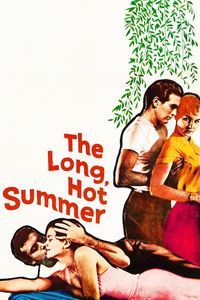
    (On Cable TV, April 2021) Long before becoming a respected Hollywood icon and salad dressing tycoon, Paul Newman was the designated bad boy of the late-1950s-early-1960s and The Long, Hot Summer clearly takes advantage of that persona. A rural melodrama featuring a drifter (Newman), a rural patriarch (Orson Welles!) and his daughter (Joanne Woodward, soon-to-be Newman’s wife), it breaks no new grounds in narrative matters. We can guess how these things go, but the film’s biggest asset is its sense of rural atmosphere, and actors such as Welles and Newman playing off each other. There are links here with Tennessee Williams plays (especially if you follow Newman’s filmography at the time), with later films such as Hud and with a certain kind of rural southern-USA drama that would periodically pop up in Hollywood history later on. For twenty-first century viewers, Welles is a bit in a weird transitional persona here — overweight and no longer young but not yet bearded nor all that old. The melding of three Faulkner stories into one film actually works well into getting to a coherent whole with plenty of interesting side-details. While The Long, Hot Summer does not amount to an essential film (well, except for those Newman and Welles fans), you can see the way it worked back then, and an archetypical kind of southern rural drama.

  • Sweet Bird of Youth (1962)

    Sweet Bird of Youth (1962)

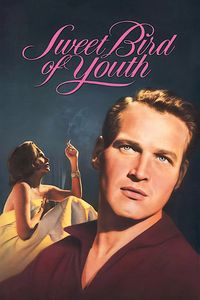
    (On Cable TV, January 2021) I really expected a film about a young man coming back to his small-town with a fading Hollywood star in tow to be more interesting than Sweet Bird of Youth. Despite the mixture of Hollywood bitterness and small-town politics, the film is a bit of a damp muddle. Paul Newman plays the kind of overly hard-headed semi-hoodlum that he did so well at the time, but somehow seems miscast. Geraldine Page does better as the drug-addled Hollywood star on the decline (although she still looks too young for the part), and so does Ed Begley as the powerful politician with mob boss habits. The theatrical origins of the film can be seen in the small scales and restrained locations—and knowing that the film was adapted from a Tennessee Williams play automatically leads one to look for the way in which it was softened from the original. (And this one is a doozy.)  Still, even with the happier ending, Sweet Bird of Youth isn’t much of a sit: it drags, it meanders, it gives us the yearning to escape back to Hollywood by the nearest available bus out of town. Newman fans may want to have a look, but even they may overdose on the obnoxious persona that he had at the time.

  • Torn Curtain (1966)

    Torn Curtain (1966)

    (On Cable TV, November 2020) With Torn Curtain, I have reached the end of Alfred Hitchcock’s second tier of films—I think that the only remaining movies I haven’t watched by him are the practically obscure The Paradine Case, Under Capricorn, and after that we get into 1930s British movies and 1920s silent films. Working from a popularity-based list, I am clearly going backward through quality as well: Made between Marnie and Topaz, Torn Curtain is clearly not among Hitchcock’s best, although it does have a few highlights. The best one of those is something I either somehow didn’t know or had forgotten: Paul Newman in a Hitchcock film?! He’s clearly not the best choice for the kind of cool thriller that Hitchcock did best (and it’s easy to confuse the opening minutes of Torn Curtain with that of The Prize), but much of his innate charm still makes quite an impression. On the other hand, Newman being Newman means that we’re not fooled when the film tries to make him a traitor defecting to the east. Fortunately, that’s not meant to be a twist—and that’s part of the film’s problem, as it keeps going on long after a blackboard combat that should have been the climax of the film. There are sequences that fare better, but even in those moments, the specifics don’t quite match the desired impression—I get that the kitchen sequence is meant to drive the point home that it’s hard to kill someone, but there are about six different better weapons on the set to finish off the guy than sticking his head in an oven. Julie Andrews is there but fails to make much of an impression as the woman who follows her fiancé deep behind the Iron Curtain and back. It’s no secret that Hitchcock did better on more personal movies than when he tried to go geopolitical (Topaz would confirm that a few years later) and so Torn Curtain seems a bit scattered compared to his better movies—it’s still watchable, but not always compelling.

  • The Prize (1963)

    The Prize (1963)

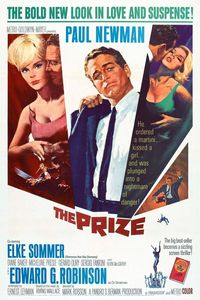
    (On Cable TV, September 2020) Nothing, exactly nothing about The Prize makes any sense—least of all the plot, which is rather embarrassing for a narrative-driven thriller. The beginning sees an alcoholic, womanizing American author somehow winning the Nobel Prize for Literature (based on, what, a corpus of one novel?) The action begins after he flies into Stockholm to receive the prize, and meets the other winners. A lovely young Scandinavian (Elke Sommer, in an early role) is assigned to him as hostess, and his meetings with the other winners show an eclectic group of intellectuals. But as various strange events occur, we stumble onto a premise that only made sense at the height of the Cold War: a dastardly plan by the Soviets to replace the Nobel Prize winners with lookalikes so that the lookalikes can denounce the western world in their acceptance speeches and then “defect” to The Soviet Union. Trying to even pretend that this premise makes sense is tiresome, so let’s skip to the overall impression left by the film: it’s about as scattershot as its premise in blending comedy, young-punk protagonist, some danger from the spying team at work in Stockholm, Paul Newman in the lead role, Edward G. Robinson in one of his late-career performances, a scene set at a nudist convention, and many more idiosyncrasies than you’ll know what to make of. The film was a success upon release, but newer viewers are more likely to be perplexed by the ungainly blend of ill-fitting elements. At least Newman is quite likable, despite a character not necessarily written to be so. He’s almost enough to make us forget a plot that wouldn’t make sense even at the protagonist’s most drunken state.

  • Hud (1963)

    Hud (1963)

    (On Cable TV, March 2020) The mark of a great actor can be to make you cheer, even reluctantly, for a terrible character. This, thanks to Paul Newman, is the key to Hud: He plays a strikingly unpleasant person, but somehow transforms it into a compelling performance through sheer charisma. Perhaps aware that such a character is best watched from afar, the film doesn’t give Hud the viewpoint character—that goes to a younger man who’s initially smitten with Hud’s personality, but grows progressively disillusioned as the film goes by and nearly everyone walks away from Hud after seeing who he truly is. While comfortably set in 1960s rural western America, Hud is not a traditional western: in various ways, it undermines and destroys the myth of the morally superior self-reliant rancher. By the end of the film, Hud finds himself alone, on a farm with nearly nothing left of his father’s efforts. Some moments are hard to watch, either because of basic empathy (the cattle slaughter) or because of psychological devastation (as Hud becomes isolated). This makes Newman’s anchor performance even more important in drawing viewers even as everything goes wrong. A great supporting cast wraps it up. I would suggest a double-bill with the somewhat similar The Last Picture Show (they both share roots in a Larry McMurty novel), but only if you can stand nearly four hours of unalloyed rural Texas misery.

  • Absence of Malice (1981)

    Absence of Malice (1981)

    (On Cable TV, July 2019) We seldom get feature-length classes in journalism ethics, so Absence of Malice is a welcome entry in the genre. Featuring no less than Sally Field as a journalist with a dodgy sense of propriety, Paul Newman as an aggravated suspect singled out by the media, and Bob Balaban as a slimy underhanded District Attorney, this is a film that shows a complex dance between police, media, and private interests. It’s seldom glorious, but it does portray a nicely cynical view of the city newspaper desks of the early 1980s, with the “public interest” running afoul of private interests when unscrupulous individuals get involved. It’s a crime thriller, a newspaper drama, a doomed romance all at once. Wilford Brimley gets a short but spectacular role late in the film as the troubleshooter sent from Washington to untangle the mess and assign punishment—his folksy demeanour hides an iron mind and a determined fist. Meanwhile, Balaban plays a far less admirable version of his usual characters, while Newman and Field are up to their usual standards at the time. The atmosphere of Miami is well presented, and the period details are striking—I mean, the film begins with a montage showing us the minutia of publishing a daily metro newspaper, instantly endearing me. The rest of the film does toy with mounting curiosity as how it’s all going to play out—the script cleverly features first-act secrets, mid-movie coyness and final revelations hopping over each other, a sure-fire way to keep the audience interested. Absence of Malice amounts to a decent film—perhaps not a classic, but one worth revisiting even in these accursed times when the daily metro newspaper is regrettably becoming a relic of the past.

  • Nobody’s Fool (1994)

    Nobody’s Fool (1994)

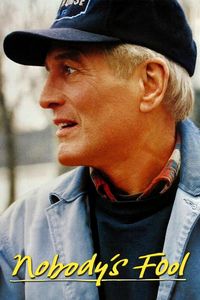
    (On Cable TV, June 2019) For an actor that was once so vital to American cinema, it’s surprising to realize after the fact that Paul Newman essentially retired in the nineties, with a total of five films during that decade: At the exception of Road to Perdition, his twenty-first century career was low-key—voice acting, TV movies, smaller roles, this kind of thing. So, it’s a bit of a surprise to discover Nobody’s Fool as one of his parting lead roles, a small-town character-driven drama focused entirely on his character. Newman’s filmography is not the only one being enhanced by Nobody’s Fool—he plays opposite a cross-generational ensemble cast that includes a prime-era Bruce Willis, one of Jessica Tandy’s last roles, as well as turns for Melanie Griffith (who hilariously flashes her breasts to Newman’s character) and Philip Seymour Hoffman (as a policeman, no less). Willis, in particular, is almost a revelation for those who have grown used to his increasingly detached screen persona—here he is playing a now-unfamiliar character—loose, funny and engaged. Still, the show belongs to Newman: In a revealing contrast to his earlier, sullen roles, the bad boy of Hud and The Prize and Cool Hand Luke has mellowed into an elderly actor playing an elderly man who has found contentment in a simple life. It does complement the small-town charm of the film, albeit one tempered by a depressing snowy atmosphere and the very down-to-earth portrait of flawed characters. There’s more nudity than you’d think from a “small-town intimate drama.”  Still, Nobody’s Fool remains a bit more interesting than expected—and not just as a lesser-known title on multiple filmographies.

  • The Color of Money (1986)

    The Color of Money (1986)

    (In French, On Cable TV, May 2019) I’m one of those weirdos that doesn’t particularly care for the original The Hustler (1961), so I was coming to The Color of Money with low expectations. Which may have worked to the later film’s advantage, as I found it more interesting than its predecessor. It helps that this follow-up does what sequels often loath to do—use the previous film as back-story while telling a new story in which returning characters are developed in interesting ways. Much of the credit for this creative intention goes directly to the authors of the novel from which The Color of Money is adapted, who conceived it as a sequel to the novel that spawned The Hustler. Paul Newman is back as a former professional pool player, now more interested in staking bets for younger players. Playing against him is Tom Cruise as a younger, more impulsive player, and the great-looking Mary Elizabeth Mastrantonio as the third party in their merry crew. (Plus, John Turturro as an evil hustler.)  The relationship between the three characters is what sustains The Color of Money on its way to the final tournament in Atlantic City, with everyone changing and allying themselves differently every few scenes. The middle of the film even sees a significant plot rearrangement, as the mentor/mentee relationship gives way to the mentor getting himself back into the game. While not quite as dramatic as its twenty-five-year distant prequel, The Color of Money nonetheless makes for fascinating viewing. Director Martin Scorsese being Scorsese, there are a few technically impressive shots here, as well as new ways of showing familiar things—most notable being the pool-as-tennis sequence, and some shorts from the perspective of the ball. The ending isn’t particularly cheery, but it does work to cap off the film in a satisfying way. It’s not quite as ambitious or universal as The Hustler, but The Color of Money does feel more enjoyable.

  • Rachel, Rachel (1968)

    Rachel, Rachel (1968)

    (On Cable TV, March 2019) Oof: It’s not because films are nominated for an Academy Award that they’re worth a look. Case in point: The grating, annoying, irritating Rachel, Rachel—a story of a small-town mid-1930s spinster rediscovering herself that ends up being more boring than anything else. Sadly directed by Paul Newman, with his wife Joanne Woodward in the lead role and their daughter playing the heroine at a younger age. I’m not necessarily claiming nepotism here—Woodward was hailed for tackling a difficult role, won a Golden Globe and was nominated for an Academy Award. But keep in mind that Rachel, Rachel is a product of the late 1960s, a time more concerned with gleefully pushing the limits left unguarded by the end of the Production Code and audiences thirsting for neorealism. While it worked at the time, it hasn’t necessarily aged well. It’s not a bad film, but it feels slow, long and dull. The herky-jerky flashbacks anticipate more modern non-chronological technique and grammar, but feel like unpleasant experiments to twenty-first century audiences—the added padding on a small story feels more grating than enlightening, with an inexplicable slowness to everything. But Rachel, Rachel remains in the pantheon of Academy Award-nominated movies, so there’s that.

  • Fort Apache the Bronx (1981)

    Fort Apache the Bronx (1981)

    (In French, On Cable TV, March 2019) In a fit of perverse humour, I decided to watch Fort Apache the Bronx right after the original Fort Apache it references. The comparisons are not kind to the 1981 film in more ways than one. Obviously, it’s not as much of a classic as the original—the titular reference is an ironic nod at the state of New York City’s Bronx by the late 1970s—with entire city blocks destroyed as urban blight, and a police force under siege by so-called barbarian forces. But the episodic police drama does miss one of the earlier film’s most interesting point—that “the other side” opposing the policemen actually had valid grievances for going to war and was portrayed in something of a sympathetic fashion. There’s not much of that here—Paul Newman plays a young cop assigned to the worst precinct in the city, and coming to grip (or not) with its casual lawlessness, drug use, unpunished crimes and code of silence regarding abuses by police officers. Fort Apache the Bronx is a grim movie, and it exemplifies the prevailing attitude that “drop dead” NYC was then considered unsalvageable. The rubble-strewn post-apocalyptic atmosphere is worth a watch by itself but remains hard to shake, and it’s good to have such anchor points as Newman, Rachel Ticotin as a likable nurse, Danny Aiello or Pam Grier as no less than a cop-killing prostitute. The unusual plotting, mean to unsettle viewers used to tidy endings, feels very New Hollywood with its unabashed grittiness and refusal to comfort audiences. Still, it’s not that dour of a film despite the setting: the burnt-out cynicism of the police characters, used to “holding the fort” against the criminal hordes, manifests itself through biting black humour. In keeping with the nihilistic 1970s (and in opposition to the reactionary 1980s), Fort Apache the Bronx is at ease with the idea that peace in a neighbourhood can depend on police leniency—things start turning truly sour when a new inflexible police chief comes in and demands stricter crackdowns. The slice-of-life plotting doesn’t have much of a main plot and features a number of clichés along the way, but forty years later it feels like an anthropological expedition in an alien land. I ended up liking quite a bit better than I thought at first.

  • Slap Shot (1977)

    Slap Shot (1977)

    (On TV, February 2019) In hockey-mad French Canada, Slap Shot has become a bit of an unintentional classic for reasons unforeseen to the original producers. As legend has it, the dub for the Quebec release was handed over to someone who unusually decided to translate it into French-Canadian street joual—as far away from proper grammatical French as it can be. This was a rarity back in 1977, and an entire generation grew up on the vulgar patois proudly heard in the dub. While the cultural omnipresence of the film has waned somewhat in recent years, it’s easy to see why Slap Shot would prove to be a smash hit in Quebec. For one thing, it makes no pretence as to the nobility of hockey: Taking place in the rough-and-tumble minor leagues, this is a sports comedy in which skating is accessory to fist-fighting, taking a very populist stance toward the sport. Then there’s the French-Canadian factor: Taking place in the world of northeastern hockey, it’s natural that some of the characters end up being French-Canadian (featuring snippets of French here and there even in the original English dub), and that some known French-Canadian actors would be featured in the film—such as Yvan Ponton, who would find later celebrity headlining the hockey-focused TV series Lance et Compte and playing in Les Boys series. It does help that the script (written by Montréaler Nancy Dowd) effectively creates striking characters. Paul Newman pleasantly looks out of his element here, his good-natured personality clashing with the gritty and vulgar late-1970s blue-collar environment. While billed as a comedy, the ending is more bittersweet than anything else, although there are a few funny moments along the way. Looking at the film’s release date, it does occur to me that you can draw a straight line from Slap Shot to the underdog comedies (sports or otherwise) of the 1980s, making this film feel even more than a precursor to a much larger movement. The consequence, of course, is that Slap Shot certainly doesn’t feel as fresh or shocking as it must have back then—but that’s the price of success.

  • The Sting (1973)

    The Sting (1973)

    (On Cable TV, June 2018) If The Sting doesn’t play quite as well today as it did back in 1973, it’s largely its own fault—it was so influential that, having birthed an entire sub-genre of con movies, it finds itself imitated to the point of irrelevancy. This is not to say that the film isn’t worth a look—in between Paul Newman and Robert Redford in the main roles (Redford being a touch too old, but who cares), some playful directing by George Roy Hill, and a rather charming recreation of mid-thirties Chicago, The Sting was and remains a top-notch crowd-pleaser. Where it fails is in keeping a sense of surprise. Even without having seen the film before, the ending is utterly predictable … not because it’s badly written (in fact, it was quite surprising to audiences at the time), but because the basic tenets of the entire ending have been endlessly duplicated by other lesser conman movies since then. Of course, the conman is in perfect control of the plot. Of course, the con is so big as to envelop even the structures in which the con operates. Of course, you have to confuse and whisk away the victim without them even suspecting the truth. Of course, even the authorities aren’t. Surprise: zero. But… Pleasure: quite high. Mixing memorable ragtime music, fancy scene transitions and even fancier title cards, The Sting is made for fun. It’s early enough in the post-Hays code to be cheerfully amoral, but not quite dedicated to the darkness that engulfed Hollywood cinema in the early seventies.