Stewart Granger

  • The Wild North (1952)

    (On Cable TV, February 2022) As I make my way through the second and third tiers of Cyd Charisse movie, it’s easy to notice a trend that’s simply as obvious from her best-known movies: Given her dark hair and middle-European facial features (she was of German/Austrian ethnicity), she could reasonably pass as someone of non-Caucasian ethnicity and Hollywood certainly noticed: She was cast as a Mexican in at least two films, while in The Wild North she gets to play Native-American. Or rather First Nation, as the film takes place in the Canadian North. Now, it doesn’t hurt to say that Charisse looks really cute in stereotypical tresses… but in-between her casting and Stewart Granger’s oversized French-Canadian accent, it’s difficult to take the film seriously. Which may not be as scathing a criticism as you can imagine, considering that the film is made in the overblown tradition of the MGM technicolour spectacles, in a reality somewhere adjacent to ours. Even the plot goes back to basics with a French-Canadian trapper accused of murder, a steadfast Mountie tasked with bringing him in, and the First Nation girl showing up at infrequent intervals to make things more interesting. There are some good things about the result if you’re willing to be indulgent: most notably some good action scenes set in the wilderness, thankfully shot in colour rather than black-and-white. The dialogue-heavy portions of the film, on the other hand, veer closer to comedy than thriller. As a French-Canadian, I’m not entirely unhappy with Granger’s broad accent—he behaves in such an over-the-top way that it’s more charming than insulting. Still, this all makes The Wild North a bit of a draw: uneven, often disappointing, sometimes interesting. I may need a second viewing to make up my mind.
  • Scaramouche (1952)

    Scaramouche (1952)

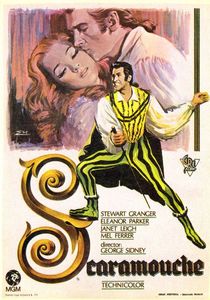
    (On Cable TV, August 2020) Hey, let’s head back to royal France for some good old-fashioned land-bound swashbuckling! Scaramouche is the kind of expansive epic film that Hollywood was able to execute so well in the early 1950s. Filmed in bright colours, it adapts classic literature into an adventure meant for the big screen. Our hero is a young man ably played by the square-jawed Stewart Granger, who finds himself tempted by two women (the gorgeous red-headed Eleanor Parker, and the no less good-looking Janet Leigh) as he makes an enemy of an aristocratic master swordsman (deliciously played by Mel Ferrer). Realizing that he doesn’t stand a chance in combat, he goes hiding in a theatre troupe, hoping to sharpen his sword-fighting skills until he can confront his nemesis. The emphasis on the theatrical performance of comedia del arte allows Scaramouche to have some intentionally comic interludes in-between the bouts of action and swordplay, but don’t worry: it ends with a magnificent eight-minute sword-fight that goes all around and behind a theatre, blending all of the clichés of Hollywood fencing in a rather delightful package. It’s all quite charming, and an almost pitch-perfect of the kind of Hollywood was churning out on an assembly line at some point. It’s far less leadened than many other historical movies, and Parker is a sight to see while waiting for the climactic sword-fight. The far-fetched plot elements are insane, but completely in keeping with Scaramouche’s slightly feverish pace and attitude.

  • The Prisoner of Zenda (1952)

    The Prisoner of Zenda (1952)

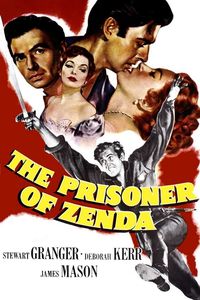
    (On Cable TV, May 2020) Modern critics of Hollywood’s fondness for near-identical remakes should find perverse satisfaction in being reminded that this is not a recent development. In fact, many periods in Hollywood’s history had blatant remakes as the order of the day—the 1930s for sound remakes of silent hits; the 1950s wave of colour remake of past black-and-white crowd-pleasers. Few, however, have been as blatant in remaking the same material as the 1952 version of The Prisoner of Zenda, which took nearly the exact same script (aside from a few minor modifications) as the 1937 version. Except in colour, and with the added technical innovations of 15 years of filmmaking. The premise is a trope classic: the visitor in a foreign country who looks exactly like the king, and thus becomes involved in palace intrigue. It’s generally watchable for a wide variety of audiences, considering that it hits upon matters of adventure, romance, action and political conflict. While lead actor Stewart Granger is a second-tier classic Hollywood reference at best, the film has another lead role for Deborah Kerr, and a deliciously scene-chewing performance from James Mason as a villain. As a modern (ish) European fairytale, The Prisoner of Zenda ends with a spectacular sword fight and plenty of swashbuckling victories for its hero. It’s not bad by itself, and even more interesting as a remake… but the baseline is that it works no matter how you see it.

  • King Solomon’s Mines (1950)

    King Solomon’s Mines (1950)

    (On Cable TV, November 2019) Anyone watching a 1950s MGM Technicolor adventure film and expecting a sensitive, respectful take on its African setting is not going to have a good time—much like its 1937 film forebearer and 1885 original H Rider Haggard novel, this is a straight-up adventure in the time of colonialism, with buried treasure and hostile natives. (Although this, like the previous film, does add a female character—and an excuse to see Deborah Kerr in the jungle.)  Largely shot on location and meant as a big MGM spectacle, this version of King Solomon’s Mines generally delivers on its premise, even if this premise can be repugnant to modern audiences (I really could have done without the elephant shooting, for one thing). There’s some spark to the relationship between the two lead characters, with Kerr playing opposite Stewart Granger as Allan Quatermain. The nature landscape photography alone can be spectacular. You’ll have to ignore some heavy-duty colonialism along the way, though, especially considering how this version minimizes some of the more heroic African characters. While this King Solomon’s Mines is, as a whole, slightly better than the earlier film version, it’s still not quite satisfying—with the underwhelming ending not helping with the dissatisfaction.