Terence Stamp

  • Histoires extraordinaires [Spirits of the Dead] (1968)

    (In French, on Cable TV, March 2022) There was a small anthology movie craze in the 1960s, and it’s a surprise to take a look at the credits for Histoires extraordinaires and realize that no less than Roger Vadim, Louis Malle and Federico Fellini (!!!) got together to deliver the film’s segments, all loosely based on Edgar Allen Poe short stories. The result, unfortunately, is not quite up to expectations: Vadim goes for medieval fantasy, Malle for a sombre crime story and Fellini digs into the inner life of an actor. I’m not going to pretend that it’s all dull. There’s quite a bit of fun seeing how Vadim directs then-wife Jane Fonda play an evil countess opposite Peter Fonda. Malle has a bit of fun re-creating an atmosphere of crime, religion and dissection with Brigitte Bardot and Alan Delon along the way. Still, neither of those two segments quite get up to where they should be. I’ll be kinder to Fellini’s concluding segment, as his exuberant approach to the material (Terence Stamp playing an alcoholic actor losing his grip on reality while attending an awards ceremony) feels far more exciting—in itself and in having Fellini do what he did best—than the rest. I’m disappointed by aspects of that third segment, most notably the drawn-out ending that takes far too long to deliver a foregone conclusion, but it’s easily the best of all three. In the end, though, Histoires extraordinares can’t quite transform a terrific cast and intriguing premise into better-than-average piece of entertainment. And that certainly explains why anthology films have remained such marginal propositions for the past few decades: it’s really, really difficult to get an even level of quality and enjoyment out of them.
  • Far from the Madding Crowd (1967)

    Far from the Madding Crowd (1967)

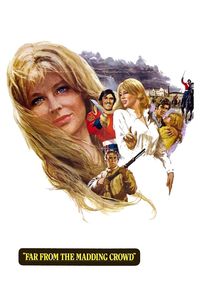
    (On Cable TV, April 2021) I am of two complementary minds about the 1967 version of Far from the Madding Crowd. The first, having already been exposed and (mildly) bored by the 2015 version, is a lack of enthusiasm at the freshness of the story. I really didn’t care enough about the twenty-first century version to be able to dig deeply into the differences between the two — it was enough knowing that this is not a kind of story I respond too deeply to (although I note that a similar story in French-Canadian setting, Maria Chapdelaine, has become a bit of a classic) and letting a 1960s-style take on the story take its turn in 169 languid minutes. The other part of me is tempted to point at both versions of Far from the Madding Crowd, adapting an 1874 novel, and say, “See, this is how you learn about how different eras of filmmaking adapt similar non-contemporary material!”  There’s no big reinterpretation à la action-movie rethinking of Les Trois Mousquetaires — while both versions of Far from the Madding Crowd place different emphases on elements of the whole, they’re still very much the same recognizable story set in very much the same kind of setting. While the 1960s version it noteworthy for cast and crew having become famous later on—Julie Christie in the lead role, Terence Stamp as a suitor and Nicholas Roeg as cinematographer—it’s also notable for bucolic rendition of the 19th century English countryside as interpreted by the sensibilities of the time, and that’s not insignificant. This being said, Far from the Madding Crowd is best suited to those willing to sit slightly less than three hours to hear all about romance in rural Victorian England.

  • Yes Man (2008)

    Yes Man (2008)

    (On TV, January 2015)  I’m not sure when the Jim Carrey golden era ended.  We all know it started in 1994, but the classic rubber-faced speed-talking Carrey sort of petered out during the mid-2000s, and Yes Man, with its similarities with archetypical Carrey vehicle Liar, Liar, feels like the end of an era not even eight years later.  Suffice to say that a simple premise (a man convinced he must say Yes! To all questions asked of him) leads to ample opportunities for broad comedy in the typical Carrey mold, stripping away a clean-cut exterior to reveal madness within.  Carrey is pretty good as his usual shtick, even though the mechanics of the say-yes plot are moronic at best.  This being said, the film doesn’t quite work as a romantic comedy, partially because Carrey is eighteen years older than co-star Zooey Deschanel (and looks like it; the role plays better as a young-man one) and partially because the film has such a high concept that it sucks all the oxygen required for a romantic subplot to truly breathe – it simply falls back on broad strokes in which the audience supplies their own emotional connection based on generic subplot knowledge.  Still, Yes Man isn’t hard to watch – it’s good-natured, dumb and goofy enough to be pleasant even when it doesn’t do much that the expected.  Terence Stamp has a fun turn as a cranky motivational speaker and, of course, Carrey is likable no matter the circumstances.  While the results may not be spectacular, they do extend what we could think of as the classic-Carrey filmography and that’s already nothing to dismiss.

  • The Art of the Steal (2013)

    The Art of the Steal (2013)

    (On Cable TV, August 2014) I’m a sucker for fast-moving crime comedies, and so it is that Canadian low-budget The Art of the Steal manages to hit all of the right buttons.  From the get-go, it presents itself with narration-heavy stylish grace, zipping along its plot points while keeping a pleasantly cynical tone throughout.  Kurt Russell stars as the protagonist/narrator, a master thief who’s been burnt once by an accomplice (Matt Dillon, as slickly slimy as he can be).  When both of them are reunited for One Last Caper, you can guess where the story goes.  Jay Baruchel becomes another good neurotic oddball (alongside veteran Terence Stamp for an added touch of class), but it’s writer/director Jonathan Sobol who delivers the most stylish performance.  While The Art of the Steal liberally borrows from other similar films down to the expected twist ending, the result is pleasant enough to excuse any familiarity: sometimes, comfort is what we’re after, and fans of caper films should be more than happy with the result.  Best of all; this is a cheerfully Canadian film both in origins and in setting: For something shown partially to fulfill CanCon requirements for home-grown cable channels, it’s surprisingly entertaining and slickly made as a bonus. 

  • The Adventures of Priscilla, Queen of the Desert (1994)

    The Adventures of Priscilla, Queen of the Desert (1994)

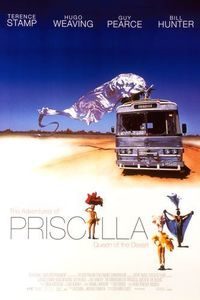
    (On DVD, August 2010) I realize that I’m fifteen years behind the rest of the world in (finally) seeing this charming Australian comedy, but then again you would be horrified at some of the other curious omissions in my personal film-viewing record.  Suffice to say that hindsight has advantages of its own: It’s hard to see The Adventures of Priscilla, Queen of the Desert now without spotting Hugo Weaving, Guy Pearce and Terence Stamp in fearless performances that are remarkably different from the kind of roles for which they have become best known.  (Go ahead; make a joke about Agent Smith in drag: “Mis-ter An-der-son, you look… fabulous”.)  The film itself has aged remarkably well: While social attitudes toward queer issues represented in this film have hopefully evolved, the exuberant quality of the characters does a lot to bring audiences into their colourful reality.  By the end, the film reaches a quasi-idyllic acceptance that acts as inspiration.  But social issues aren’t the reason why the film has become such a self-confident camp classic: You just have to look at the astonishing visuals of a scene in which a bus drives across the desert featuring a rooftop performance by a drag queen draped in long billowing silver drapes to realize how awe-inspiring this film can be.  The Australian outback makes for a spectacular background, and the script deftly moves between emotional tones without losing track of its goals.  It’s all very impressive, and you don’t have to be interested in LGBT issues to appreciate the cinematography, the script or the fun of the bus ride.