Wes Craven

  • Invitation to Hell (1984)

    (In French, On Cable TV, October 2021) I gave a shot to Invitation to Hell because it’s a Wes Craven film. There’s an important caveat, though: this is a mid-1980s TV movie directed by Craven, not a theatrical release, and that can be seen in the lousy budget, familiar plotting strands and slap-dash conclusion. Still, the film hasn’t aged all that badly, especially when measured against most horror films of the period. Still, the story is odd: it’s about an engineer moving to a new area in order to join a high-tech firm, and becoming concerned that he’s being pressured to join a mysterious country club run by a disquieting woman. (Since she magically kills a man in the first scene, we’re concerned as well.)  Things kick up in high gear once his wife and kids join the club without him, and he’s attacked by them. Relying on the super-technology at his disposal at work, he suits up in a super-space outfit and uses his lasers to break into the club, get into its inner sanctum and discover that (wait for it) it’s a portal TO HELL, where his real family and kids are detained. But that’s all right—he’ll bust them out with THE POWER OF LOVE. So, yeah: TV movie. As a Poltergeist-ish (or rather: Stepford-Wives-ish) suburban horror film, Invitation to Hell is actually not too bad despite the heavy suspension of disbelief that it requires. Despite the limitations of the TV movie format, Craven does manage to give life to the result, and the production values (illustrating a familiar kind of Southern California 1980s suburbia) are good enough to carry us to the third act. The film becomes more laughable once the HELL AND LOVE things come up and the special effects technology can’t meet the requirements of the script, but that’s a familiar part of 1980s films. This is clearly not in the same league as, say, Craven’s Nightmare on Elm Street (also released in theatres that year) but it’s slightly better than I expected and not completely awful to watch. Expectations matter!
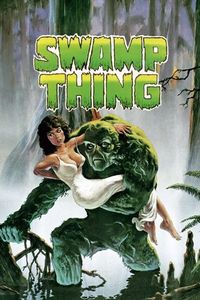
  • Swamp Thing (1982)

    Swamp Thing (1982)

    (Second Viewing, In French, On Cable TV, September 2021) I dimly recall seeing Swamp Thing on French-Canadian TV as a kid, but revisiting the film decades later is a very different experience. It’s nowhere near as scary as it felt, for instance, and Adrienne Barbeau is far more interesting than she was then. On a larger level, the film is now noteworthy for adapting a comic book superhero after Superman but before the twenty-first century boom of the genre. It remains a Wes Craven film even if not being much in terms of horror—except perhaps in its nods toward The Creature from the Black Lagoon. Much of the story is going to be very familiar — scientists studying an unusual creature, industrialists trying to weaponize their findings, the protagonists falling in love, action and adventure as the beast helps the beauty, etc. — and you can draw a few parallels with the (much later) Oscar-winning The Shape of Water. The atmosphere of Southern-USA swamps is very nicely portrayed, and the somewhat campy tone of the film is often more interesting than an overly serious take on the story could have been. Still, Swamp Thing feels like a more ordinary film than I remembered: whether that’s due to me being far less impressionable in middle age or the film remaining of the 1980s, I can’t say.

  • Deadly Blessing (1981)

    Deadly Blessing (1981)

    (In French, On Cable TV, February 2020) Writer-Director Wes Craven has had a very strange career. His filmography includes everything between horror-defining classics and some of the ordinary derivative filmmaking imaginable. Deadly Blessing is closer to the bottom of the barrel, although not quite the worst. The story is pure farmhouse horror, as a widow and two visiting friends have to fend off the aggressive behaviour of a local sect of totally-not-Amish farmers. It’s all quite unusual in terms of what passed for slasher horror back in the early 1980s (the rural setting is distinctive enough) and while Craven’s execution still had some young-filmmaker energy, the sum of it all doesn’t quite make up something worth remembering. Weird ending, too; when is a slasher not a slasher, it perhaps should foreshadow that it’s not a slasher. Amusingly, Sharon Stone stars (not very well) in a very early role, while Ernest Borgnine doesn’t cover himself with honours with a histrionic performance as a sect elder. Some individual moments are interesting (the bathtub-snake sequence strongly suggests another bathtub scene in Craven’s later Nightmare on Elm Street) but Deadly Blessing as a whole is more dud than success—although, as any Craven fan knows, there are far worse movies in his filmography.

  • The People Under the Stairs (1991)

    The People Under the Stairs (1991)

    (On TV, October 2019) I have a feeling that I should be liking The People Under the Stairs a lot more than I do. After all, it does feature non-traditional protagonists, social issues such as accessible housing, and more unhinged antagonists than usual. The structure of the film is also a bit unusual, with the protagonists escaping the Bad Place on the third-act turn, only to return later. Seasoned writer-director Wes Craven blends the appearance of weird creatures with more prosaic concerns, such as a family in danger of being evicted, in order to skirt the edges of the horror genre. That’s all well and good, except that, well, I didn’t care much for it. The creatures feel needlessly grotesque, the protagonist a bit too young, the social commentary muted, the humour out-of-place. The Gulf War footage does bring some intriguing period atmosphere to the proceedings, but not enough to take the film out of the confines of its own set. In other words, I don’t quite get The People Under the Stairs and there are worthier movies to puzzle over.

  • The Serpent and the Rainbow (1988)

    The Serpent and the Rainbow (1988)

    (In French, On Cable TV, June 2019) Knowing that The Serpent and the Rainbow is a horror movie taking place in midt-1980s Haiti, I was expecting the worst—and for the most part I got what I was expecting: the portrayal of a nation torn between petty dictatorship (The Duvalier regime fled the country midway through the shoot, prompting a move to nearly Dominican Republic) and old-school pre-Romero voodoo zombies. In the middle of it comes a white scientist (Bill Pullman, mildly likable) investigating the voodoo drug that turns people into zombies—for pharmaceutical science! What he encounters in Haiti is a nightmare gallery of characters either in service of a terror-based regime complete with genital torture, or all-knowing in the ways of voodoo. What may have been plausibly deniable as drug-fuelled realism turns ambiguously supernatural in time for the ending, with a villain defeated by lost souls freed from their restraints and a hero whose mind can now do telekinesis. No, The Serpent and the Rainbow (very loosely adapted from a true story) does not deal in subtleties. That’s too bad—As a French-Canadian, I have a real affection for Haiti, and I wish the country was portrayed in a somewhat more credible fashion once in a while. On the other hand, and I’m not that happy about it: now that the film is thirty years old, there is some value in it having captured the terror of the Tontons Macoutes and the Duvalier family of despots. The Serpent and the Rainbow is on somewhat firmer ground when dealing straight-up scares: Director Wes Craven knows what he’s doing, and while the hallucination shtick gets obvious early on, he still gets to build a few intriguing images and suspense sequences along the way. The film does also benefit from solid work from Zakes Mokae as a villain, Brent Jennings as a morally chaotic contact, and the very cute Cathy Tyson in the thankless role of the doctor/damsel-in-distress. As distasteful as the stereotypical portrait of Haiti can be, it does add quite a bit of atmosphere to The Serpent and the Rainbow and helps it stand out from blander horror movies of the time.

  • The Hills Have Eyes (1977)

    The Hills Have Eyes (1977)

    (In French, On TV, March 2019) The 1970s were a turning point for low-budget gritty horror grindhouse movies, and it’s hard to get trashier than The Hills Have Eyes, which often feels shot by high school students on a summer break. As with other landmark horror movies of the era (I’m thinking Texas Chainsaw Massacre, but especially Last House on the Left, which was The Hills Have Eyes’s director Wes Craven’s first feature film), there’s no gloss, no spectacle, just matter-of-fact horror in the middle of nowhere featuring desert hellbillies. The topic matter is just as dead simple, with a suburban family being targeted by cannibal mutant psychos. It’s really not a likable film, but it’s somewhat effective … if you like that stuff. Unsurprisingly far less slick than its 2010 remake (although not quite as humourless), but somewhat dull once you get past the rawness of the production. Of course, films like The Hills Have Eyes are made for a specific kind of viewer—those who shy away from grotesque and decadent horror may choose not to apply.

  • The Last House on the Left (1972)

    The Last House on the Left (1972)

    (In French, On Cable TV, February 2019) There are two things that are guaranteed to drive me up the wall in terms of movies, and Wes Craven’s The Last House on the Left manages to hit both of them at once: Amateurish filmmaking and nihilistic horror. To be fair, this was an incredibly innovative film at the time of its release: by the early-1970s, horror films hadn’t yet gone to the extremes that we’ve somehow grown accustomed to, and there was an undeniable New Hollywood quality to the intention of turning out an exploitative gory cinema-vérité horror film in which a heroine is raped and killed, only for the parents to take merciless revenge. Public reaction at the time was aghast, and even today it’s easy to see why: the film is an extremely unpleasant combination of naturalistic filmmaking and merciless gore. Craven’s first film did not have the budget to be slick, and even the film’s biggest opponents (that would be me) will recognize that the overbearing musical cues, hair stuck in the film, muddy picture quality, choppy editing, neighbourhood sets and static cameras do create an eerie realism that would have been destroyed by higher production values. Even today, the very early-1970s fashion and music fix the film to a very specific time. Still, there’s no denying that the movie is excruciating to watch, especially when the filmmakers refuse any easy escape. The rape sequence drags on and on, and the film doesn’t spare anyone even when the parents of the murdered girl take their revenge. At some point, even jaded reviewer such as myself have to recognize that this is a specific kind of movie and that it appeals to a specific kind of audience. But certainly not everyone.

  • A Nightmare on Elm Street (1984)

    A Nightmare on Elm Street (1984)

    (On DVD, August 2016) I was about to watch the 2010 remake of Nightmare on Elm Street without paying homage to the 1984 original … but then common sense came back to me and I had to take a look at it. Despite the film’s flaws, I’m glad I did, because this original Nightmare has a few things that weren’t captured by the remake. Probably the most significant of them is the eerie horror of the film’s dreamlike logic: Freddy’s first confrontation alone has more disturbing imagery than the entire remake, and the roughness of the film’s execution often highlights the disarming surrealism of writer/director Wes Craven’s vision. It’s this nervous energy that runs through Nightmare on Elm Street and makes it far more memorable than many slasher horror movies of the time. In other aspects, the film doesn’t fare as well: The acting isn’t particularly good (Heather Langenkamp is disappointing as the lead, and Johnny Depp does not impress in his big-screen debut), the pacing stops and goes, the cinematography is recognizably low-budget. And that’s without mentioning the somewhat unsatisfying ending, which just throws reality and nightmares in the same dumpster, then sets fire to everything and runs around laughing. Meh. It’s worth noting, from a perspective thirty years later, that Freddy’s character in this inaugural film, even played by Robert Englund, isn’t the wisecracking chatterbox of latter films: he largely remains this implacable threat and that further distinguishes this film from latter sequels and remakes. While this original Nightmare on Elm Street isn’t, strictly speaking, an exceptional movie or even a particularly good horror movie, it does have, even today, something more than other horror movies of the time. No wonder it still endures.