William Powell

  • The Key (1934)

    The Key (1934)

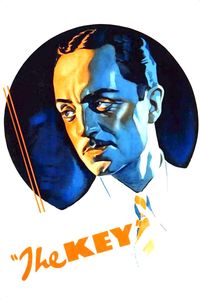
    (On Cable TV, March 2021) Not every film featuring a favourite actor is a success, and while I have a problem being overly critical of The Key given that it stars William Powell, the result is just a bit too ordinary to be worth much more than a few scattered notes. Here, Powell sheds a bit of his screen persona in service of a more serious melodrama, as he plays a British officer sent to Dublin in the 1920s. Never mind the action potential in this situation, because The Key is more interested in raising the stakes by putting the protagonist in contact with an old flame, now married to another British officer. As the complications pile up, they force the protagonist to confront his old lover and (predictably) fall on his sword for her happiness. Powell is not bad as a stiff upper-lipped Brit (surely I wasn’t the only one who laboured under the misapprehension that he was originally from the United Kingdom?) but The Key is not a film that takes advantage of his talent for comedy or dry wit — it feels like the kind of role many other actors would have played, and in the middle of an unremarkable film that would be forgotten today if it wasn’t for Powell in the lead role.

  • Evelyn Prentice (1934)

    Evelyn Prentice (1934)

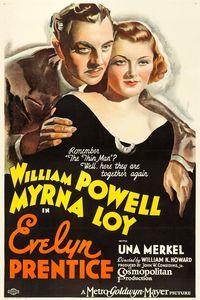
    (On Cable TV, March 2021) The pairing of William Powell and Myrna Loy would be glorious in The Thin Man, but you get another glimpse at their chemistry in Evelyn Prentice, a substantially darker melodrama dealing with contemplated affairs, attempted blackmail and definite murder. Powell is impeccable as a high-powered lawyer who neglects his wife by working too much. Loy’s character, exasperated by loneliness and motivated by an overly affectionate client of her husband, starts looking around for company and ends up manipulated by a seductive poet. When he is found murdered shortly after visiting him for a final time, it’s her husband who ends up involved in a middle act filled with dramatic ironies. By the time he realizes that she may be involved, the film ends on high-powered courtroom drama as he manages to forgive his wife, find the truth and resolve the situation to everyone’s benefit. Evelyn Prentice is short and punchy, not quite going for comedy but not without its share of amusingly ironic moments. Powell and Loy are great even at lower intensity, and the film has the well-polished rhythm of mid-1930s studio pictures, with scarcely an element out of place. Modern audiences will notice that there’s definitely a double standard at play in how adultery affects wife and husband differently, but that’s almost a given for movies of that time. Still, it doesn’t affect the film’s impact as much as you’d think: Powell and Loy are good enough as to make even humdrum material feel much better, and indeed the film is seldom any more enjoyable than when Powell goes on a legalistic rampage, or when Loy wrestles with conflicting emotions. Evelyn Prentice isn’t a great film and it definitely pales in comparison to the duo’s work in the contemporary Thin Man series, but it’s an entertaining time nonetheless.

  • One Way Passage (1932)

    One Way Passage (1932)

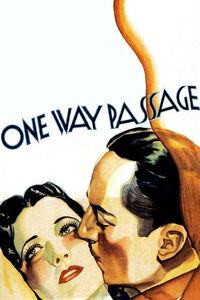
    (On Cable TV, March 2021) I’m a twenty-first century modernist, so it’s strange to realize that in watching older movies, I sometimes feel a nostalgic pang for things that don’t really exist any more: twice-daily newspapers, overnight train travel, automats, Hollywood studios or cruise liners. It’s aboard such a transpacific cruise that most of Pre-Code romantic tragedy One Way Passage takes place, as a criminal on the run and a terminally ill woman meet, seduce each other but never ride off into the sunset as a couple. Deepest the “comedy” moniker and comic incidents throughout, it’s glum, wistful and somewhat grown-up compared to other Hollywood films made during the later Code period. It’s a good showcase for a young and more dramatic William Powell, as well as his frequent screen partner Kay Francis — this was their sixth and final pairing in three years! The subplots and episodic incidents don’t hold a candle to the doomed love story at the heart of the film, nor to the usual charm of Powell and Francis. This is certainly not the funniest Powell film ever made—him as a murderer on the run is not exactly what his persona became—but then again, if comedy is what draws people into One Way Passage, tragedy is what people remember about it.

  • Fashions of 1934 (1934)

    Fashions of 1934 (1934)

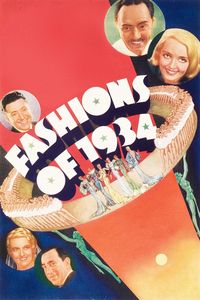
    (On Cable TV, November 2020) This may sound a bit sad to those who don’t like movies (although what’s the point in caring what these people say?) but one of the greatest things about having an encyclopedic knowledge of film and favourite actors is that you can sit down to watch a film without any idea of who’s in it, and be pleasantly surprised at who appears on screen, almost as if they were friends or something. (Look up Dunbar’s number and wonder at how many of those 150 spots are taken up by actors’ personas.) So it is that I sat down to watch Fashions of 1934 without any expectations other than this was going to be one of those solid 1930s musicals. But then William Powell and Bette Davis both walk on-screen, and you know you’re going to have a better time than expected. Now, let’s not go overboard: Fashions of 1934 is, at best, a representative film of its genre and era. It’s decently funny at times, does showcase contemporary fashions, moves briskly at 78 minutes and throws in a few kaleidoscopic dance numbers from Busby Berkeley. The musical numbers are spectacular (with a special mention to the bit in which dancers with feather fans transform themselves into a gigantic flower and then seamlessly changing into a maiden emerging from a foamy sea), the dialogue can be quite amusing and Powell is up to his usual standards. The Pre-Code nature of the film is best seen in the saucy jokes and the scantily clad dancers (oh, and mention of pornographic pictures for sale on the streets of Paris)—those would disappear months later with the imposition of the Hays Code. When you throw in all of those elements, the one thing that strikes out is Davis herself—Fashions of 1934 was so early in her career that it features a misguided attempt to make her a blonde-haired sexpot: her vivaciousness shines through what little dialogue she has, but even the film seems to forget about her for minutes at a time. The script is a bit scattershot, and it’s clear that it’s far too focused on its musical numbers—especially in its last third—to allow Powell or Davis to develop their screen persona. Still, it’s an enjoyable watch: not an essential example of its era, but a look at what Warnes Studios could do in the musical genre as a matter of everyday business. Powell and Davis are just icing on the cake even if they’re not used to their fullest extent.

  • High Pressure (1932)

    High Pressure (1932)

    (On Cable TV, August 2020) It’s amusing that the two kinds of roles in which William Powell did best were either amateur sleuths or fast-talking hucksters. High Pressure is one of the best of the second type: Powell plays a loquacious promoter who has specialized in giving legitimacy to high-risk investment schemes, not quite resorting to fraud but not quite doing things the most orthodox way. (Or what we’d call today a serial start-up entrepreneur.) The latest venture is about synthetic rubber and it seems to work well until the protagonist meets the “inventor” of the product and concludes that he’s made a terrible mistake in trusting a crackpot. But plotting his overseas exit isn’t so simple when romance with his long-suffering girlfriend is involved. High Pressure isn’t that good, but it does sport rather wonderful art deco sets, a very charismatic Powell spitting one convincing pitch after another, and moves forward rather amusingly thanks to director Mervyn LeRoy. The satirical look at the exaggerations required for success in business remains evergreen. (Why bother having a hiring process for a president when you can just hire someone who looks the part?) Since the same theatrical play was adapted four years later as Hot Money, it’s easy to see both films and appreciate just how much Powell brings to the result. Powell fans will love High Pressure, and those who don’t know Powell just may become fans.

    (Second viewing, On Cable TV, February 2022)  William Powell is usually a delight to watch, but his early-1930s films have him going back and forth between the kind of villains he played in the 1920s, and the suave urban charmer he would go on to play for the rest of his career.  In High Pressure, we get him as a borderline cad – a fast-talking hype man for speculative business ventures, this close to a huckster without quite losing our sympathy along the way.  Much of the story has him trying to drum up interest for a synthetic rubber business venture, while navigating the rocky straits of his romantic relationship and learning more about the genius inventor who came up with the product he’s trying to sell.  The business satire is obviously coming from the depths of The Great Depression, but could play just as well with twenty-first century crypto-nonsense.  There’s at least one big laugh in the last third as our protagonist can prove beyond any doubt the false credentials of the inventor.  Otherwise, this is a rather amiable and typically zippy (72 minutes!) early-1930s film – already self-assured in its use of fast-paced dialogue and generous in allowing Powell to take centre-stage.  There’s much better out there, but any Powell fan should have a look at High Pressure.

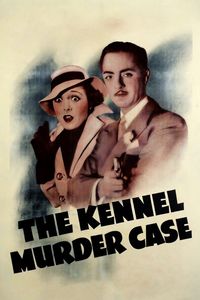
  • The Kennel Murder Case (1933)

    The Kennel Murder Case (1933)

    (On Cable TV, August 2020) Come for William Powell as a sleuth; stay for a locked-room mystery so convoluted that it becomes a performance piece in The Kennel Murder Case. This was the fourth time Powell played then-popular literary detective Philo Vance (in the fifth film adaptation of the character). The actor, of course, was suited to portraying an upper-class gentleman investigator, but Vance isn’t quite the same as his later Nick Charles interpretation: Vance is single, serious and not quite as much of an alcoholic. Still, Powell’s charm and unflappability serve him well even when the script can’t quite serve up the quips. It helps that then-journeyman director Michael Curtiz does well in giving energy to the talky thriller through stylish decisions. The 1930s were a strong decade for murder mysteries, and The Kennel Murder Case does rather well in its elevated company: it’s intricate, presented smoothly (especially for a film of the early sound era) and engrossing – and doesn’t last more than 73 minutes! Narratively, it’s not quite perfect: Powell without a sparring partner feels like a missed opportunity, and the very last bit of the ending is slightly disappointing after the high-flying summation of all evidence. But generations of moviegoers have demonstrated an unquenchable thirst for good murder mysteries, and The Kennel Murder Case will satisfy even today.

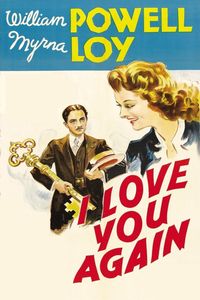
  • I Love You Again (1940)

    I Love You Again (1940)

    (On Cable TV, August 2020) You can’t really go wrong with the William Powell / Myrna Loy duo in romantic comedies, and their ninth outing I Love You Again is a good example of that: the premise is ridiculous but the zest with which both Powell and Loy dive into the material is what elevates it to another level. Taking the good old amnesia trope out for a spin, the film begins when a straight-laced model citizen (Powell) suffers a head blow and discovers that he has reverted to a state prior to another blow to the head, ten years earlier when he was a conman. Finding himself in a position to use his good community standing, he launches a few schemes… but also discovers that his fuddy-duddy personality was so dull that his wife (Loy) is planning to divorce him. Deftly navigating between romance, scheming, comedy, preposterous bits of plotting and quite a bit of crackling dialogue, I Love You Again first works as a script, and then becomes even better in the hands of Powell and Loy, both of whom are able to get back into Thin Man-esque repartee without the accumulated weight of the series’ later instalments. While Powell gets the biggest roles in terms of comic shenanigans, Loy’s dialogue is funnier and better delivered. On the other hand, Powell in a boy-scout monitor’s uniform is one for the clip book. Funny, witty and rather cute too, I Love You Again is a demonstration of pure star power: director W.S. Van Dyke lets Powell and Loy do what they’re best at, and doesn’t interrupt of call attention to himself.

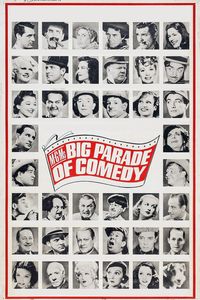
  • The Big Parade of Comedy (1964)

    The Big Parade of Comedy (1964)

    (On Cable TV, August 2020) Anticipating That’s Entertainment! by a decade, The Big Parade of Comedy is director-anthologist Robert Youngson’s idea of a comedy clip show, digging in MGM’s archives to present a few choice bits. The clips limit themselves to the 1920s-40s and take a star-centric structure to present its material. Youngson favours lengthier excerpts rather than montages, which makes sense whenever the clips have gags that build upon the previous ones. Les Tremayne narrates the film in the characteristic fashion of the times. I was surprised to see no less than three fairly long excerpts from the somewhat lesser-known Hollywood Party, one of them (with Abott and Costello, as well as Lupe Velez), I actually appreciated more upon a second viewing due to the nodding between Abbott and Costello. Obviously, your taste for comedy will dictate what segments are funniest – I can watch the Marx Brothers and William Powell as Nick Charles all day long, but the Three Stooges and Laurel & Hardy are a harder sell. Still, comedy is comedy, and watching The Big Parade of Comedy is almost more fun as a reminder of great comedies I’ve seen lately, whether it’s Two-Faced Woman, The Cameraman or The Philadelphia Story. It won’t replace the original films, but it’s decently entertaining.

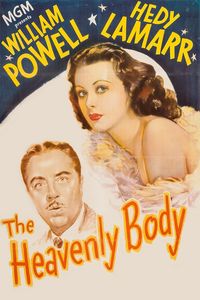
  • The Heavenly Body (1944)

    The Heavenly Body (1944)

    (On Cable TV, August 2020) Star vehicles have been a feature of Hollywood forever, and for all of the flak they can get, they’re often a direct delivery vehicle to see likable actors doing what they do best. Taking this into account, there are two reasons to watch The Heavenly Body, and they’re Hedy Lamarr and William Powell. They play a disaffected couple – he, an astronomer, spends far too much time at the observatory, making her feel neglected. When an astrologer portends that she will find happiness with someone else, she loudly declares her intention to leave the marriage, leaving him frantic to resolve matters. Things are complicated by the arrival of a handsome air-raid warden, hastening his efforts just as the culmination of his professional career is coming fast. Powell is in a class of his own as the protagonist, his obvious gift for sophisticated comedy outstripping the somewhat loose script. There’s some fun in exploring astronomy as a plot driver — there’s even a nice special effect shot featuring a comet crashing into the moon. The rest of The Heavenly Body is a bit of a paint-by-number production, although it does harken to the late-1930s comedies of remarriage in pulling apart a couple only to have them reunite at the end. Not a great movie by any means, but a good show for Powell and Lamarr fans.

  • Life with Father (1947)

    Life with Father (1947)

    (On Cable TV, July 2020) When the point of an old film’s popularity is that it’s old-fashioned, I suppose it’s natural to react with very mixed feelings to the result. Life with Father is a film of the past in many ways—a 1947 adaptation of a long-running 1939 Broadway play looking nostalgically upon life in 1880s Manhattan, it’s triple-piled-up nostalgia even before we begin digging into it. As the patriarchal title suggests, it’s an examination of a family with a strong-willed father at the helm, a role that would have been unbearable without the considerable charm of William Powell, completely in his element here. He’s hard-headed, unwilling to listen and impervious to the damage he causes, but the saving grace of the film is how it shows the rest of the family subtly manipulating him into serving their own objectives, taking advantage of his own bluster in order to get what they want. Still, much of Life with Father is subservient to the 1880s and 1940s, all the way to a baptism subplot that seems inconsequential today, but somewhat harms the free-thinking nature of the protagonist. (Significantly enough, film historians tell us that the film’s final line, “I’m going to get baptized,” is a bowdlerization of the Broadway play’s punchline, “I’m going to get baptized, damn it.”) If you’re willing to let slide those things slide, the film does have its charms. In addition to Powell’s performance, we have smaller roles for silent film veteran ZaSu Pitts, a charming turn by a very young Elizabeth Taylor, great matrimonial dialogue between Powell and Irene Dunne, and a few comic set-pieces that still work well. There are times where a film’s appreciation hinges on how much you can surrender to an earlier era’s idea of feel-good movies, and Life with Father is definitely one of those.

  • Double Harness (1933)

    Double Harness (1933)

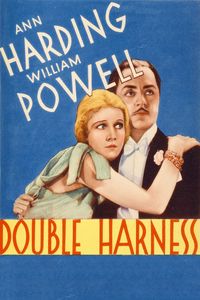
    (On Cable TV, April 2020) Wait, wait, wait—you’re telling me that a Pre-Code William Powell film was considered lost for decades until it was brought back from obscurity by TCM? Strange but true—Loaned to RKO by Warners, Powell played in Double Harness and that film (along with five others) ended up excluded from RKO’s film library when its rights were sold back to the producer in 1946, who then did nothing with them. TCM managed to get those films back in circulation in 2007 and the result is yet another treat for Powell fans. The actor doesn’t step away from his persona too much in Double Harness—he plays a playboy manipulated into marriage, and then courted-for-real by his own wife. It’s a sophisticated romance well in-line with other Powell films, and having Ann Harding as his romantic sparring partner is a welcome change of pace. At 69 minutes, Double Harness is short but steadily amusing, and clearly Pre-Code in its faux-cynical consideration of the relationship between love and marriage. It would have been cruel to deprive the world of this Powell film—admittedly minor, but still a Powell film.

  • Libeled Lady (1936)

    Libeled Lady (1936)

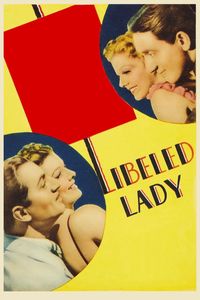
    (On Cable TV, January 2020) If someone tells you that Libeled Lady is one of the top comedies of the 1930s, believe them—there aren’t many better ones. Firmly ensconced in the screwball subgenre, this is a film that plays into the whole weddings-don’t-mean-much (but they do!), harebrained-schemes-are-better-than-honesty, let’s-see-who’s-the-craziest ethos of those kinds of films. The cast alone is a solid treat, what with the legendary William Powell/Myrna Loy screen duo, bonified with Jean Harlow (who was romantically involved with Powell at the time, adding another layer of interest) and a dark-haired Spencer Tracy to round off the main cast. Everything takes place in a gloriously escapist Manhattan upper-class society setting (with a bit of newspaper journalism thrown in) where people have no better things to do than to pursue demented schemes, maintain misunderstandings and riff off quips at each other. It’s a hugely enjoyable film [April 2024: And one that appreciates upon subsequent viewings] because director Jack Conway’s execution is so smooth, not to mention the acting—Powell being Powell, his line delivery is perfect, but every main player has three other gifted comedians to play with, and the result is a small triumph. Even the outdated period detail becomes charming or at least easy to forgive. (There’s a bit of casual racism at the very beginning of the film, but it’s early, quick and more annoying than insulting.) The cavalcade of last-minute twists that serve as resolution is part of the joke: having no reasonable way to untangle the plot, the writers added more things and called it quits while daring anyone to say anything about it. Libeled Lady was, upon release, a box-office hit and an Academy Awards Best Picture nominee. It’s still a marvel even today—easily worth a watch.

  • The Thin Man (1934)

    The Thin Man (1934)

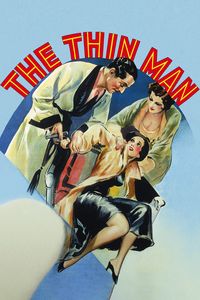
    (On DVD, September 2019) I’d heard very nice things about The Thin Man, but it took a long while before I was able to see it. For reasons I still haven’t figured out, it looks as if the Canadian distribution rights of the film are snarled in something—whenever it’s scheduled to play on Turner Classic Movies, the Canadian simulcast substitutes something else; the latest DVD is unavailable through official Canadian channels; and it never plays anywhere else on TV (trust me, I’ve been checking for the past three years). Ultimately, I gifted myself with a pricey gray-market import from amazon.com, and it was worth it: The Thin Man is indeed a charming mixture of complex whodunit, strong characters, married-couple romance and 1930s period feel. It features Nick and Norah Charles, a witty leisure-class married couple with a strong interest in alcohol, parties and recreational murder investigations. The plot is complex enough to be interesting, but the heart of the film is in the repartee between the leads, the unflappable Charles, the unusually strong Norah and the sophisticated comedy that comes from seeing such characters conduct their own investigations. It all naturally culminates around a dinner table when villains are unmasked and police rushes in to arrest the killer. Despite pushing eighty-five-years old, The Thin Man doesn’t feel old: While the script has its structural issues (serving far too long an introduction, only fully exploiting its own possibilities in its later half), much of the (barely) pre-code script adapted from a Dashiell Hammett novel contains great snippets of dialogue, delivered with debonair aplomb by William Powell and Myra Loy, with some assistance from Skippy the dog. Director W. S. Van Dyke takes a while to get things moving, but once he does it’s all straightforward to the end. The Thin Man may take a bit of work to see up here in the North, but it’s worth the trouble.

  • Ziegfeld Follies (1945)

    Ziegfeld Follies (1945)

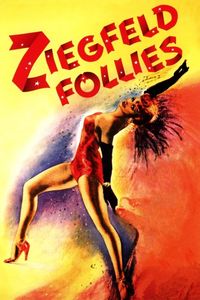
    (On Cable TV, August 2019) For fans of golden-age Hollywood musicals, it’s easy to get excited about Ziegfeld Follies from the get-go, as the names pile up the opening credits: Fred Astaire, Gene Kelly, Judy Garland, Cyd Charisse, Lena Horne, Lucille Ball in the same movie? Well, yes, but don’t expect a full narrative: As the opening number makes clear (featuring William Powell reprising his titular role in the Oscar-winning The Great Ziegfeld, looking down from paradise and wishing he could assemble another revue), this is a series of unconnected musical numbers and comic sketches featuring some of the era’s biggest stars. First number “Here’s to the Girls/Bring on the Wonderful Men” gets going with a bang, with Fred Astaire introducing Cyd Charisse leading to Lucille Ball in full grandiose Ziegfeld choreography, with a cute and very funny spoof from the deadpan Virginia O’Brien to wrap it up. The comedy numbers that follow have nearly all aged poorly—the comic style is broad, repetitive and laid on far too thick. The exception is the half-comedy, half-musical number “The Great Lady Has an Interview” in which a great-looking Judy Garland sings and charms her way through a satire of interviews—the number concludes with an extended comedy/dance/song tour de force from Garland. Still, there’s a lot more: Astaire features in three other numbers in the film, all of them quite different. “This Heart of Mine” starts on a conventional note with Astaire as a gentleman thief sneaking his way in a jewelry-heavy ball, where he dances with Lucille Bremer—but then the floor under them becomes a pair of treadmills and then a giant turntable and we see Astaire’s gift for innovative dance choreography take flight, leading to a cute conclusion. “Limehouse Blues” is something different, billed as a “dramatic pantomime” with a tragic storyline that takes Astaire (in yellowface, alas) through a vividly imagined Asian-inspired dance. But the kicker is “The Babbitt and The Bromide,” the sole golden-era joint performance by Astaire and Gene Kelly: the number plays up both the sincere admiration and the playful audience-imposed rivalry between the two screen legends. It’s everything such a joint performance between the two should be. For fans of more classical dancing/singing numbers, Esther Williams, Lena Horne and Kathryn Grayson all get standard numbers showing both their beauty and talent. A few other numbers and sketches round the film, perhaps the only other highlight being a half-funny comic sketch featuring Fanny Brice (one of Ziegfeld’s original 1910s girls) with Hume Cronyn (an actor still remembered in the 2010s for roles in 1980s films)—an astonishing duo. Disconnected, uneven but very impressive at times, Ziegfeld Follies is a real treat for golden Hollywood musical fans.

  • Mister Roberts (1955)

    Mister Roberts (1955)

    (On Cable TV, July 2019) There’s a very odd quality to Mister Roberts that makes itself known early on, as this “war movie” remains behind the front lines, spending its time with the crew of a supply ship that never gets close to the front. The forced comedy of the first few scenes feels amazingly close to the anarchic spirit of 1970’s MASH at times, with sailor goofing off in between their war effort, characters intentionally shirking their duties (most notably Jack Lemmon) and the title character (Henry Fonda) trying to shield his crew from an irascible captain (James Cagney). The main cast is intriguing, but the rhythm of the film feels forced, making jokes that remain unfunny and multiplying the episodes that don’t amount to much. The material is there for an examination of men at-war-but-not-at-war, but Mister Roberts, perhaps shackled by source material (it was first a novel and then a Broadway play), seems split between rambling dialogues, incongruous voiceovers and mildly annoying characters. It does feel like a film out of time, more at ease in the anti-war movies of the 1970s than the still-triumphant mood of 1950s WW2 films. (I’m actually amazed that the film got the full cooperation of the US Navy for location shooting.)  Mister Roberts’ plot does get better as the film advances, but it leads to a tragic conclusion that feels at odds with the rest of the film.

    (Second Viewing, On Cable TV, April 2021) Revisiting Mister Roberts two years later but with better knowledge of the main actors involved does give a different perspective on the entire film. Jack Lemmon in an early role, going up against a mid-career Henry Fonda, a late-career turn from James Cagney and William Powell’s last screen role. It’s the kind of cast that makes the film worth viewing no matter what. Mister Roberts does play with tone at times, delving into absurdity and then coming back to some kind of funny realism only to plunge into wistful drama a few seconds before the end. I kept thinking about MASH in seeing the way the film takes an almost-affectionate look at men coping with war (or their decidedly unheroic role in it) by cracking jokes until they sound insane. (Interestingly enough, the last moments of the film sound like a paean for those smart enough not to be a hero, which is a kind of attitude we wouldn’t often see in Hollywood movies until the 1970s.)  In some ways, this kind of tonal yo-yo makes the second viewing a more interesting experience – we know what to expect and when to expect it, and to take in the sketches that make up much of the film’s running time. Still, there’s no denying that the draw here is the cast . Lemmon is already comfortable in his semi-manic persona, while Powell couldn’t be more at ease, dignified and funny as the ship’s doctor. Meanwhile, Fonda and Robinson are up to themselves here – matching established personas to strong roles. Some movies don’t pack as big of a punch the second time around, but Mister Roberts feels like a better film the second time around.