Month: September 2010

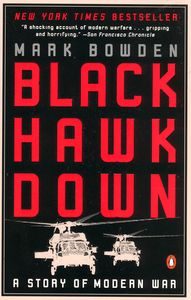
  • Black Hawk Down, Mark Bowden

    Black Hawk Down, Mark Bowden

    Penguin, 2000 revision of 1999 original, 392 pages, ISBN 0-14-028850-3

    Even casual collectors know that the first edition of a book is almost always worth more than any subsequent printing, even more so when the book has enjoyed some success.  The first edition presents the book as it first arrived in the world, without too many expectations or any idea of its true impact.  A nice signed first edition copy of Chuck Palahniuk’s Fight Club or Barack Obama’s Dreams of my Father (to pick two high-profile examples) could have, at their author’s peak popularity, netted you a few thousand dollars.

    But for readers, sometimes it’s better to get a latter, updated edition –especially with nonfiction books: They can include updated information and conclude the narrative arc a bit more firmly.  So it is that a fine first edition of Mark Bowden’s Black Hawk Down will cost you a few dozen dollars, but a far cheaper paperback edition will get you an updated afterword that explains how the book became not only a commercial success, but a classic of military writing and an enduring epitaph of its subjects along the way.  After all, many readers of this review will have heard about Ridley Scott’s 2001 movie adaptation, and associate the city of Mogadishu with what the back cover of the book describes as “the longest sustain firefight involving American troops since the Vietnam War”.

    Which isn’t all that bad considering that when Bowden set out to write the book, the events were on their way to collective oblivion: Americans don’t like to think about their military defeats, and their intervention in Somalia practically qualified as such. As one of the more acute manifestations of the US’s self-image as the world’s policeman following the end of the Cold War, Somalia interrupted the triumphalism of the Gulf War and pushed Americans toward a more cautious foreign policy… at least until 2001.  The turning point of that Somalian adventure was the battle that Bowden describes in Black Hawk Down: a routine capture mission that turned spectacularly wrong when two helicopters were downed and American forces had to fight their way into the city to rescue their own.  The engagement lasted for hours and by the end of it, Americans had suffered nearly a hundred casualties –and left ten times as many Somali dead or wounded.

    Black Hawk Down tells the story of that engagement as a narrative: Based on personal recollections, recordings of the events, contemporary documentation and other sources familiar to investigative journalists, Bowden meticulously reconstructs the battle from as many perspectives as he can, then attempts to present the events as a story with recognizable characters.  The result isn’t just an exceptional piece of reporting: it’s a suspenseful, compulsively readable account of what it feels like to be under fire.  Bowden is able to get in the soldiers’ heads and portray the strange mixture of excitement and terror that comes from mortal danger.  Such credible portrayals are rare, and it’s no wonder if Black Hawk Down became mandatory reading for a generation of American military officers.  The decade since its publication may have been tumultuous in terms of geopolitics, but its impact remains: The images that we get from reading the book aren’t that different from the ones broadcast during the American invasion of Iraq.

    When Bowden started working on Black Hawk Down in the mid-nineties, he wasn’t the most likely writer to attempt such a project: An investigative reporter for the Philadelphia Inquirer, he had none of the military knowledge or unofficial connections one would presume from the final result.  But as he explains in the revised edition’s afterword, he attacked the subject like the reporter he was, and it may be this outsiders’ perspective that makes the book so accessible to various kinds of audiences.

    What’s more, Black Hawk Down has found another niche as an enduring remembrance of everyone who was involved in the events.  For a military engagement that seemed destined to be forgotten, the “Battle of the Black Sea” has, thanks to Bowden and the film adaptation of his work, now been given it due.  And the book remains as an acknowledgement of what soldiers go through in modern military engagement, portraying them at their best when confronted by the worst.  More directly, though, Black Hawk Down is a perfectly-mastered book that will continue to astonish readers for a long time, no matter which edition they can get.
  • Tomorrow, When the War Began (2010)

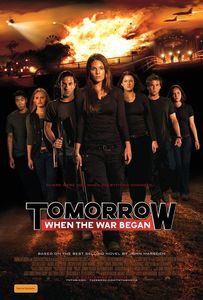
    Tomorrow, When the War Began (2010)

    (In theaters, September 2010) Chances are good that you will never see Tomorrow, When the War Began in North-American theaters: Despite its generous production values and good action sequences, this is an Australian production based on a series of young-adult books largely published for Australian audiences.  (I was lucky enough to be in Australia when it was released, with a strong marketing push that included public transit buses plastered with the film’s promotional art.)  A quick summary of the film would probably be something like “Red Dawn for Australian teenagers”, as a group of plucky teen protagonists comes back from a quick bush holiday to discover that their country has been taken over by a foreign invader.  Stuck behind, they strike back… with the expected action sequences and fast-paced growing-up that active resistance involves.  As such, it’s really not bad: Some of the writing feels forced and everyone keeps making stupid decisions to advance the plot, but the entire film is entertaining, and many sequences pack some punch.  The characters are sympathetic, and the development of the links between the six protagonists is fascinating to watch.  A few details feel different from the Hollywood standard: The emerging leader of the group is female, she gets involved in a romance with a male of Asian origins, and the ending isn’t a triumph as much as it’s a victory with potentially dramatic consequences.  As a piece of slick blockbuster entertainment, Tomorrow, When the War Began is ripe for worldwide success… pending distribution deal and favourable word-of-mouth.  As for the rest of the series, there are five more books in James Marsden’s “Tomorrow” cycle and three more in the “Ellie Chronicles”: even if the rest of the series isn’t adapted, the story as written will always be there.  Will the film ever make it to North America, even as a straight-to-DVD film?  I’d bet on it.  There’s certainly many worse home-grown movies out there.

  • The Tipping Point, Malcolm Gladwell

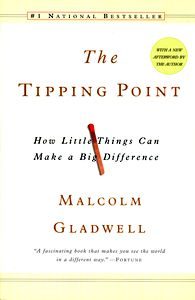
    The Tipping Point, Malcolm Gladwell

    Back Bay, 2002 revision of 2000 original, 301 pages, C$21.95 pb, ISBN 0-316-34662-4

    Ten years after publication, I come to Malcolm Gladwell’s The Tipping Point like a teenager trying to get to a wild party the morning after: The event is over, everyone has gone home, every scrap of nourishment or entertainment has been picked clean and even those who were arrested for disorderly conduct are now home after making bail.

    OK, that metaphor overextended itself, but my point is that there’s really nothing new to say about Gladwell’s book debut that hasn’t already been said by other smarter reviewers.

    By now, for instance, Gladwell’s modus operandi is well-known: He will consider an off-beat idea, bolster it with anecdotes, refer to some real academic work on the subject, link it thematically to other known examples and wrap up everything in accessible, even compelling prose.  Gladwell wasn’t the first socioeconomic vulgarizer, but it’s worth wondering if his popularity hasn’t been largely responsible for Freakonomics and its endless cohorts.  You do feel smarter after reading Gladwell and his colleagues, but it’s never too clear if it’s just an impression.

    Most of those overall qualities are obvious from his book-length debut The Tipping Point, a book that studies how an accumulation of small changes can abruptly produce a dramatic effect.  Despite Gladwell’s assertions that this is a counterintuitive idea, it really isn’t new –having been enshrined in popular culture through expressions as common as “the straw that broke the camel’s back” and, indeed, the “tipping point” of the title.  It’s a bit of an achievement that Gladwell never once mentions catastrophe theory (“sudden shifts in behavior arising from small changes in circumstances”), despite decades of mathematical research in such matters.  But that’s OK: Gladwell is in the business of selling books (many of them to so-called serious decision-makers), so it’s in his interest to pretend that this is all new stuff.

    On his way to a demonstration of his topic, Gladwell takes many roads, many of them eloquent in the narrative power of anecdotes rather than convincing research supporting his assertions.  Some scepticism, obviously, is warranted… especially in soft-science fields in which conclusive proof is so difficult to obtain.  For Gladwell, data seems to be the plural of anecdotes, and the stories he chooses to illustrate his sub-theories are often so much fun to read that readers can be expected to overlook that they are merely a few successful instances of his book’s thesis.  Tales in The Tipping Point include a look at the success of the novel Divine Secrets of the Ya-Ya Sisterhood, the resurgence in Hush Puppies, the Sesame Street / Blue’s Clues model of television shows and Airwalk’s destructive flirtation with mainstream success.  It’s wrapped up in enough psycho-babble to convince anyone that these are examples to emulate.  You can almost picture businessmen studying the book, stroking their chins and thinking Yes, this book will lead to increased sales!

    But this cynical take on Gladwell’s narrative strategies minimizes the reading pleasure of his prose.  His writing skills, honed after years in the newsroom, are able to grab readers’ attention quickly and guide them through a series of complex arguments.  Among other successes, The Tipping Point features a crystal-clear explanation of the Broken Windows theory of social decay, and the wide variety of sub-themes is enough to make intellectually-curious readers race through the book in search of the next big memetic discovery.

    I’m certainly not immune to the springboards that Gladwell builds in his book.  A brief explanation of how ethics are often largely circumstantial had me thinking out loud about making a moral argument for proper planning and preparation: Someone in a hurry or without alternatives is often forced to make choices that run counter to ethics, thrift or good social graces.  In this context, being prepared is one way to ensure virtuousness.  (But I say this as a former Boy Scout…)  Anyone reading The Tipping Point next to friends and loved one should be aware that they’re liable to keep up a stream of quotes, paraphrased ideas and grunted hunhs fit to annoy anyone within earshot.

    Fortunately, it’s this quality that makes The Tipping Point such an essential read even after ten years of being picked apart by various people.  It’s a fascinating launching pad for ideas of your own, it connects together different fields in fascinating ways and it remains a highly readable work of pop sociology.  It’s also a great introduction to the rest of Gladwell’s work: given his pre-eminence as a public intellectual, you might as well start somewhere in reading everything he’s done, right?