Year: 2010

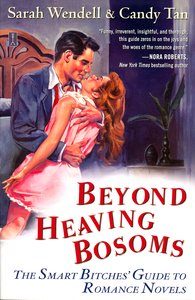
  • Beyond Heaving Bosom: The Smart Bitches’ Guide to Romance Novels, Sarah Wendell and Candy Tan

    Beyond Heaving Bosom: The Smart Bitches’ Guide to Romance Novels, Sarah Wendell and Candy Tan

    Fireside, 2009, 291 pages, C$19.99 pb, ISBN 978-1-4165-7122-3

    I don’t read a lot of romance fiction, but I don’t look at the genre unsympathetically: What little I have read in the genre was entertaining, and given my affection for a number of other literary genres from science-fiction to thrillers, I tend to see dedicated romance readers as kindred spirits: they read what they like, I read what I like, and the combined sales figures of popular fiction genres are good enough to puncture the pretentions of those who think that fiction ends at the literary aisle.  So you could say that I was receptive to the idea of an irreverent guide to romance novels, and I couldn’t have dared hope for a better one than Sarah Wendell and Candy Tan’s Beyond Heaving Bosom: The Smart Bitches’ Guide to Romance Novels.

    Wendell and Tan are minor internet celebrities for writing the Smart Bitches, Trashy Books blog, which covers romantic fiction in a way that makes some cheer and others blush.  Their hip, intelligent and foul-mouthed commentary on romance fiction is one of the many reasons why the web is fostering one of the golden eras of reviewing: This is contemporary commentary on fiction being written now, and it’s as entertaining as it is brutally honest.

    With Beyond Heaving Bosoms, they get to go beyond quick blog posts and make a sweeping judgement about the entire field.  Part introduction to the field, part affectionate satire, part advocacy in favour of the genre, this guide packs the romance genre between two covers and tells you why you should pay attention.  I read it as a complete outsider and got in three hundred pages the accumulated wisdom of years of genre reading.  New-skool/old-skool divide; typical characteristics of the protagonists; cover illustration analysis; familiar plot devices; bad sex clichés: Wendell and Tan have it all figured out, so pay attention.

    Not that you’ll have any trouble staying interested: Fighting for eyeballs in an oversaturated web of review blogs, our authors have staked themselves a place as the genre’s irreverent hipsters.  Their foul-mouthed style is as frank as it’s hilarious, and it definitely makes romance look far more contemporary than its sometimes-stodgy reputation would suggest.  It helps that the authors are passionate about their subject: they love romance while recognizing its faults, and their passion for the material shines though.  So much so, in fact, that the chapter dedicated to explaining why smart people would love romance ends up feeling oddly defensive when the rest of the book is such an eloquent illustration of why the genre is worth so much to its readers.

    The best part of Beyond Heaving Bosoms is how quickly its blend of insights and snark leads to a compulsively readable experience.  In attempting to explain the core of romance, the authors provide a helpful flowchart to help readers decide whether they’re reading old or new-skool romance (“Does the hero ever rape the heroine?” [P.14]), a list of thirteen ways for a heroine to be virginal before meeting the hero, a “Big Misunderstanding” board game, a revealing interview with a real male cover model (along with a prototypical “Ultimate Cover”) and a pick-your-own-romance adventure that keeps its funniest payoff for its last entry.

    Smart and funny, Beyond Heaving Bosoms has something to offer to fans, foes and bystanders of romance.  It’s a successful and entertaining overview of a genre that doesn’t get nearly enough respect, and it does a fine job at discussing romance’s clichés without losing touch with what makes it so compelling… and does so in a way that should convince even newcomers.  I’d like to see a similar approach to other genres.  How about a Smart Bastards’ Guide to Thriller Novels?  Can I interest any publisher in the Smart Nerd’s Guide to Science-Fiction Novels?

  • Fast Food Nation, Eric Schlosser

    Fast Food Nation, Eric Schlosser

    Harper Perennial, 2002 updated re-edition of a 2001 original, 383 pages, C$22.95 tp, ISBN 0-06-093845-5

    Almost ten years after its publication, it’s not a stretch to call Eric Schlosser’s non-fiction exposé Fast Food Nation a budding classic.  It’s been influential enough to spawn one direct film adaptation (as an ensemble drama, no less) and inspire a documentary picture (Food, Inc), while becoming a primary inspiration for a basket of food-related non-fiction such as Morgan Spurlock’s Super-Size Me and Michael Pollan’s The Omnivore’s Dilemma.  The 1,462 reviews on Amazon.com so far hint at the influence it had on readers during its decade-long history.  Best of all; it’s still a terrific read in 2010.

    It’s not as if his basic thesis is controversial: Fast-food (ie; food you order at a counter and get almost immediately) is a uniquely American creation, and its continued existence hints at a number of profound second-order effects.  Born in the socio-economic context of 1950s Southern California, its growth as an industry has changed the way America feeds itself.  That much is unarguable, but as Schlosser set out to examine American through the prism of fast-food, the less savoury aspects of the fast food industry quickly emerge.

    It starts with the food, obviously: Chemically manipulated to a point where basic taste and smell can be manipulated at will, fast food is laden with salt, sugar and fat designed to fill you up and make you ask for more.  The resemblance with traditional food is more a matter of habit than substance.  Thankfully, Schlosser doesn’t spend a lot of time dealing with the health impact of the industry: the point having been made elsewhere, he feels free to talk about the second-order effects of the rapid-restaurant agri-cultural complex: The regression of the meat-packing industry to appalling standards that would make even Upton Sinclair blanch; the transformation of agriculture into a corporate cartel (a subject that has since been explored in greater detail by a variety of sources), the transformation of food in neatly marketable categories… if you thought fast food was bad for your health, just wait until you realize the impact of the industries that had to be built in order to make that cheap burger possible.

    Once we’re sliding down the greased rabbit hole of the fast food underbelly, through, it’s hard to stop.  What about the voluntary servitude asked of the largely teenage employees employed at fast food restaurants?  What about the far less optional servitude of illegal immigrants employed in the meat-packing factories?  What about the lower food safety standards that result from a system concerned with profits and speed?  Fast food is not just a way for people to buy food, it’s a system that, domino-like, affects everything it touches.  The idea that one can explore a culture through what it eats has seldom been as troubling.

    In delivering this work of investigative journalism, Schlosser depends on a wide variety of historical sources, personal interviews, documented statistics and verifiable press clippings.  One of the book’s smartest decisions is to ground its subject in Cheyenne Mountain, Colorado, and examine the facets of the fast food community through a community small enough to be understood.  This microcosm becomes a way to grasp an issue that would otherwise be too overwhelming to contemplate.

    Circa 2010, Fast Food Nation continues to show the way.  There is now a lot more material available to those who would like to learn more about the modern food industry, and others have picked up the threads identified by Schlosser.  There’s a reason why it’s still selling briskly: But even today, the book is still a fun, engaging, noxiously informative read… even as most of its points are now common sense.

    [March 2010: As an experiment in investigative criticism, I actually went out of my way to go get lunch at McDonald’s shortly after finishing the book.  I was reminded within moments of stepping into the lunchtime rush of the restaurant why it had been years since my last Big Mac.  I’d like to say that the food was horrible, but it was… fine.  I did have some trouble at the office due to the smell of the meal, however: plans to stealthily eat at my workstation as usual were foiled by the unmistakable aroma of the combo I had ordered, and I had to retreat to the lunch room where I got a few surprised comments about what I was eating.  All in all, not an experience I’m bound to repeat soon.]

  • The Strain, Guillermo del Toro & Chuck Hogan

    The Strain, Guillermo del Toro & Chuck Hogan

    Morrow, 2009, 401 pages, C$34.99 hc, ISBN 978-0-06-155823-8

    Any review of Guillermo del Toro and Chuck Hogan’s The Strain can start from an embarrassing number of attention-grabbing hooks: The celebrity stunt-writing aspect; the resurgence of the evil-vampire breed; the post-9/11 New York setting; the first-book-in-a-trilogy angle.  They all compete for attention, obscuring the fact that the book reads like an average middle-of-the-road horror novel with techno-thriller overtones.

    It would be easy to focus exclusively on Guillermo del Toro, who’s one of the finest genre horror director currently working.  Few others combine his rich affection for the fantastic, his storytelling skills and his strong visual imagination.  But his obvious influence on The Strain seems limited to two things.  First: how the vampires have a striking similarity to the ones in del Toro’s own Blade 2.  Second, how his name alone seems to have added 5$ to the book’s cover price for a shoddily-made hardcover.  Otherwise, one would assume that the book has been written in more or less the same way as other celebrity collaborations: Ideas and concepts from the celebrity, actual writing from the below-the-line writer. In this case Chuck Hogan, taking a detour in horror after his rather good crime novels Prince of Thieves and others.

    The resurgence of the evil vampire as an antagonist is only noteworthy thanks to a blip in popular culture that, from Lestat de Lioncourt to Edward Cullen while passing through a good chunk of the paranormal romance genre, had momentarily de-fanged the vampire in quasi-genre literature.  One notes, however, that most of this vampiric denaturation has occurred at the borders of the genre, and not too often within horror itself: The “return of the evil vampire” was never needed for core horror fans.  Still, del Toro and Hogan make no secret of what they’re trying to do in this novel: As vampires land in Manhattan, it’s time for a zombie epidemic scenario featuring blood-suckers.

    The post-9/11 setting offers a few more interesting opportunities for critical commentary, especially considered within the book’s techno-thriller affections.  From the Dracula-inspired opening sequence in which a Boeing 777 lies immobile on the JFK tarmac with only four survivors left inside, The Strain co-opts some of the techno-thriller tricks to heighten its depiction of an initial vampire outbreak.  We get short chapters alternating between many narrative viewpoints.  We get tons of historical and technical details weaved into the fabric of the story.  We even get historical flashbacks explaining back-story, familiar characters, one-off vignettes in which the viewpoint character ends up dying horribly and use of landmark locations in action set-pieces.  (Or, as it happens, the use of former landmark locations in action set-pieces.)

    It may be familiar, but it works well: The opening sequence is creepy in part because it explains so patiently how official authorities would react to a supernatural mystery.  The picture that del Toro and Hogan end up creating of modern New York feels convincing, and does much to distinguish this novel from others in the same pack.  The use of thriller plot mechanics also allows the story to tackle a bigger canvas than other horror novels, which is practically a necessity in this avowed first volume of a trilogy that seems headed for global apocalypse.

    This potential for scope and breath, however, remains the most distinctive element of a novel that remains overly familiar in its other aspects.  If the vampire/zombie hybrids feel as if they stepped out of Blade 2, the human characters also seem to come out of Central Casting: Give me an overworked divorced scientist, a wizened holocaust survivor and a level-headed blue-collar worker! The entire narrative thrust of the novel is just as ordinary, down to the convenient “kill the head of the vampires and the rest will die” plot device.  The satisfaction-denied ending is also predictable from the moment we understand that this is the first volume of a trilogy.

    The good news are that this first volume does set up a promising follow-up, and that it’s solid enough to please horror fans looking for an uncompromisingly gory take on the vampire genre.  The Strain is forthright enough to announce that the two other volumes in the trilogy, The Fall and The Night Eternal, will be forthcoming in June 2010 and 2011.  Hopes are that they will take the story in more original territory.

    [October 2010: The Fall is a decent follow-up in that it continues the story is pretty much the same way, using pretty much the same characters and monsters.  While the apocalyptic atmosphere is stronger, the techno-thriller detailing isn’t as strong.  Traditional narrativus interruptus is typical for a second-volume-in-a-trilogy.  Recommended for fans of the first book, although it won’t make new converts to the series.]

    [January 2024: Oof — it took nearly fourteen years, but I finally made my way to The Night Eternal, third and concluding volume of The Strain trilogy. Never mind why, or how there was time in-between my buying the book and reading it for packing/unpacking my personal library three times and for a complete four-season TV show adaptation (which I haven’t seen) to be announced, produced, released and forgotten. This third volume is actually quite a bit more interesting than I expected — to the point that I seriously thought about reviewing it at length rather than hide it as an appendix to the review of the first volume.  But here goes, summarized: The post-apocalyptic setting of this third volume is unbelievable and overdone, but it does take the series to a logical and intriguing conclusion: “What if the vampires got everything they wanted?” It’s a third book that absolutely nails the tone of what a concluding installment should deliver: big payoffs, high drama and a nearly operatic conclusion.  Less happily, it transitions from a techno-thriller rationalist perspective to one in which biblical mumbo-jumbo ends up “explaining” everything.  At least the book does, once again, make good use of its New York City locations.  Amazingly enough, the third act leaves Manhattan and makes its way north, north, north… until it lands in the Thousand Islands of the St. Lawrence River — less than two hundred kilometers from where I live. The story itself may be interesting in many ways, but I’m not sure I’d classify it as completely successful:  There’s a romantic triangle to resolve, a family unit to disintegrate, old rivalries still burning bright after a two-year time-skip after the end of western civilization, and more contrivances than I care to highlight.  The nominal protagonist of the series has become a laughingstock of a junkie in order to set up his redemption arc, while his son is being turned into a vampire in many different ways.  As a reviewer getting back into the book-criticism game, I found it all interesting, but I could see how it would divide other readers — especially those who don’t pass by the Thousand Islands one a year.  Still, I’d rather have a flawed wild ride than the too-safe approach taken by the first volume.  In many ways, I wonder if a fourteen-year break between the second and third book may have worked to the third’s advantage: my expectations were nil except to get the book out of my to-read pile.  Now let’s have a look at that TV show…]

    [February 2024: Ooh, how interesting. I just watched (sometimes casually) The Strain TV show, and it’s a fascinating case study in adaptation.  Adapting a trilogy in a four-season show is not the same process as making a film out of a novel: While the latter means abridgement and concision, del Toro and Hogan had to go the other way in transforming their work into thirty-plus hours of running time: New characters are introduced, subplots expanded, second thoughts executed and entire dramatic arcs changed.  Sure, it starts with that immobile 777 on the JFK tarmac — but as the series develops, the differences get wilder and wilder.  The overall story scope is often smaller (the infection remains limited to New York City; the climax never leaves the island), there’s a lot of flashback-filler, some plot threads take forever to develop, and the series can never decide whether it’s committing to the vampire-plague apocalypse or not.  More significantly, the fates and arcs of some characters are significantly altered in the adaptation.  I ended up liking Fet a lot more due to actor Kevin Durand; I ended up liking Eph somewhat less even if he was played by the normally reliable Cliff Stoll. The increasing differences in plot as the series progressed actually kept my interest up — the moment some characters died early on, I couldn’t necessarily predict the specifics of the episode-to-episode plotting.  Past the end of the first season, The Strain TV Show is absolutely not a faithful adaptation of the trilogy — which may be for the best… and illustrate just how off-base the third volume is compared to the two first ones.]

  • Cemetary Dance, Douglas Preston & Lincoln Child

    Cemetary Dance, Douglas Preston & Lincoln Child

    Grand Central, 2009, 435 pages, C$29.99 hc, ISBN 978-0-446-58029-8

    It’s books like this one that make me fear that one day, “they” will take away my critical license and forbid me from ever posting reviews on the web again.  When I will ask why, they will point to this review and stay silent, because it will stand on its own as the ravings of a terminally jaded reviewer.

    So here it is: Cemetary Dance is a dull disappointment that is barely worth the Preston/Child name.  It’s not particularly distinctive, recycles some of Preston/Child’s worst narrative tics and squanders one of its series’ recurring characters.  Once the last page is turned, we’re left without lasting memories, except for the impression of having wasted our time.

    It begins, like so many of Preston/Child’s previous collaborations do, with a gruesome murder.  This time, though, the victim is someone near and dear to readers of the series: Journalist Bill Smithback, who has been part of the Preston/Child universe since The Relic, is killed in his own apartment.  (This isn’t a spoiler, as it happens in chapter two and is an integral part of the cover blurb.)  Investigating the case, NYPD detective Vincent D’Agosta and FBI super-agent Aloysius Pendergast are troubled to find out that the murderer was conclusively identified as dead two weeks before.  Their investigation soon reveals mysterious connections with a cult hidden in an estate north of Manhattan.  Zombiis are inevitably involved.

    You would think that sacrificing a sympathetic recurring character would serve a greater purpose, but Smithback’s death has narrative meaning only in that the novel raises the possibility of reanimated zombie killers.  In this context, propping up the corpse of a dear old character is more effective than in grabbing a random stranger.  But in terms of narrative payoff, Smithback’s exit isn’t particularly worthwhile: the villains in this book aren’t noteworthy opponents, and when one thinks that Smithback made it through the Diogenes trilogy more or less intact, it seems like a waste of a good opportunity.  At the very least, Preston/Child are good enough to give us two dramatic farewell scenes from Smithback’s friends.

    But enough about Smithback, especially when there are bigger issues with the novel.  The most obvious one is the constant suggestion of supernatural mysteries, something that has always been part of the fabric of the Preston/Child universe ever since The Relic, but seldom more so than in the post-Brimstone sequence.  Again, though, the supernatural is unmasked to reveal a particularly tortured set of thriller conventions: By now, we’re so used to that Scooby-doo tricks that it’s hard to be worked up about it: Readers making it through Cemetary Dance will be more exasperated than thrilled in waiting for the inevitable rational explanation.  Those are getting increasingly implausible as novels go by, risking suspension of disbelief at every turn.  There comes a point in convoluted thrillers where supernatural explanations are simpler and more believable than the ludicrous chain of events that Preston/Child now favour.

    It also dovetails into a feeling that rather than trying to be original (say, by breaking out something as different as The Ice Limit), Preston/Child are seeking refuge in the familiar playground of New York settings and hackneyed thriller tricks.  By now, Pendergast and friends have been used in so many successive books and plunged in a succession of so many outlandish adventures that we know better than to take the adventures at their initial word: There is always another trick, another hidden Kevlar vest, purloined gun or fake death to rescue the characters.  (Well, except for Smithback who, until further notice, is stone-cold-dead.)  The titles of the latest Preston/Child novels have been largely interchangeable (something-death-something, from The Book of the Dead to The Wheel of Death to Dance of Death), but that only reflects something about their books

    All of this to say that it may be time for Preston/Child to either leave Pendergast behind or come up with a major novel in the sequence.  Cemetary Dance is, except for one major death, a minor work in their bibliography, forgettable to an extent that even Constance Green (who ought to be a mom by this time in the sequence) isn’t even to be found in the novel.  It’s a waste of money in hardcover, and barely worth a beach read in paperback.  Preston/Child have and will do better… but just not this time.

    Unless I’m so spectacularly jaded that I can’t even appreciate a run-of-the-mill thriller anymore.

  • Percy Jackson & The Olympians: The Lightning Thief (2010)

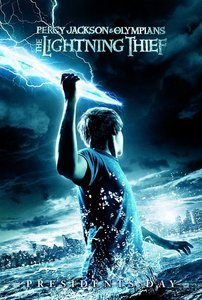
    Percy Jackson & The Olympians: The Lightning Thief (2010)

    (In theatres, February 2010) The trailer for this film was unremarkable, so it’s a small surprise that the film itself proves just fine.  No in terms of plotting, which blends “kid with a fantastic origin” with “quest!” and explicitly takes on the good old plot-coupon approach to second-act plotting.  Not in terms of verisimilitude, when some of the dumbest material actually makes it on-screen in what looks like a summer camp that no one would enjoy.  No, the chief saving grace of this adaptation of the first Percy Jackson & The Olympians book is in the way it adapts Greek mythology to a modern-day context.  Part of this package are seeing a bunch of known actors in small roles: While Pierce Brosnan is OK as centaur Chiron and Sean Bean is credible as Zeus, it’s Uma Thurman as a leathery Medusa and Rosario Dawson as luscious Persephone that get all the attention.  They are barely enough to make us ignore more fundamental details about the film’s world-building, and how it doesn’t exactly hang together gracefully.  It’s a good thing that it’s Chris Columbus who directs the film, because it makes the clunky first-act plot similarities with Harry Potter easier to dismiss.  But then again, the fun of the film is in the details, not the overall plot.  A few good action sequences, complete with top-of-the-line special effects, finish off a package that is, all things considered, a bit better and more fun than anyone would have thought.

  • The Baroque Cycle, Neal Stephenson

    The Baroque Cycle, Neal Stephenson

    Amalgamated from:
    Quicksilver, 2003, Morrow, 927 pages, C$39.95 hc, ISBN 0-380-97742-7
    The Confusion, 2004, Morrow, 815 pages, C$39.95 hc, ISBN 0-06-052386-7
    The System of the World, 2004, 892 pages, C$39.95 hc, ISBN 0-06-052387-5

    For years, Neal Stephenson’s Baroque Cycle stared at me from my “to read” shelves, daring me to take the time necessary to get through its dense 2,600 pages without losing track of the plot, losing patience or losing myself in endless Wikipedia lookups.  As a Stephenson fan dating back to Snow Crash, I had purchased the entire C$120 behemoth upon publication and then lost courage every time I even thought about starting the adventure.  The first crack in my resistance came in early 2009 when I read Stephenson’s subsequent Anathem during a particularly dull long weekend in an even duller city.  The second happened in summer 2009 when I managed to finish David Foster Wallace’s interminable Infinite Jest.  The last occurred in late 2009, when I finished my year-long Hunter S. Thompson reading project and started looking for another challenge.  To celebrate the beginning of 2010, I vowed to clear that Baroque Cycle off my shelves.

    Cut to: Eight weeks later.

    It’s a good thing I read about two or three books in parallel, depending on location.  Even at a pace of about fifty pages per day, The Baroque Cycle is a hefty undertaking.  The hardcover books are too cumbersome to carry on public transportation; even casual home use wears them down over weeks.  These are not books that can be read in bed without special accommodations for weight and heft.  But then again, it’s tough to explain the origins of the modern world in only three books.

    Because what Stephenson attempts here is nothing less than an exploration of the roots of contemporary society.  Taking place roughly between 1660 and 1720, The Baroque Cycle covers a period in which many of the foundations of our world are laid down.  Things as simple as science, mathematics and currency weren’t obvious at first: they had to be developed, harmonized and often bitterly argued over before being accepted.  What Stephenson tries to do here is to take us through a period rich in intrigue, discoveries and innovation.  To complain that The Baroque Cycle is filled with anachronisms, that it’s a historical novel that keeps making reference to modern ideas is to miss the point that the book wouldn’t exist without its unstated future: It’s all about finding out where the system of our world comes from.

    It’s no accident if The Baroque Cycle also connects on a fundamental level to Stephenson’s previous Cryptonomicon.  Not only do we get early passing references to a then-new book of the same name, but many of the main characters of the trilogy are meant to be distant ancestors of their WW2/modern counterparts in Stephenson’s earlier novel.  There’s nerd Daniel Waterhouse, action hero Jack Shaftoe, and, surprise-surprise, possibly-immortal (and constant plot device) Enoch Root.  The events of the third volume lead to those of Cryptonomicon, with several plot devices set up in a way that make Stephenson’s 1999 book look even more profound.  As with Cryptonomicon, the Baroque Cycle is keenly interested in economics, technology and cryptography.  As with half of Cryptonomicon, it’s basically a historical novel for nerds… and I say that in the fondest sense, because its focus (and attitude) is so refreshingly about topics seldom discussed in mainstream historical fiction.

    Reading The Baroque Cycle, we get a sense of the heady cognitive rush as new natural principles are discovered and codified.  We get an idea of the war of ideas as new infrastructures are put in place and looked at doubtfully by sceptics.  We appreciate the risks that threatened early adopters, except that they were trying currency and political systems rather than technological gizmos.  We get to see the familiar structures of our world slowly taking over the medieval chaos of What Came Before.  As Stephenson’s trio of characters each see their own part of the world (and for a story that would be complex enough just in Europe, The Baroque Cycle does eventually circle the entire globe), we piece together a dense tapestry of interactions between a bundle of new ideas.  They meet many historical figures, and in turn act upon events as they occur.  They witness fires, revolutions and discoveries.  They’re stuck in palace intrigue, busy with far-away travels, stuck in wars and swashbuckling their lives away.  Considering the unfathomable genealogy of Europe’s ruling class at the time, using words like “epic” to describe The Baroque Cycle is, for once, being a bit modest.  Even the characters are bigger-than-nature: Not only do significant historical figures get speaking parts (from Newton to Leibniz to Louis XIV to Samuel Pepys to many others), but our fictional protagonists themselves are extraordinary figures.

    And yet –for it is time to stop speaking in superlatives-, there’s no denying that 2,600 pages is a lengthy slog.  It’s an open question as to whether it’s best to already have a seventeenth-and-eighteenth-century history degree in order to fully appreciate The Baroque Cycle, or if it’s better to be awed by events as they come along.  But for readers with a preference for casual reading, making it to the end of the trilogy means being pummelled by pages and pages of historical minutia, certainly entertaining to a particular audience but a bit of a drag for others.  Yet, at other times (usually when Jack Shaftoe is stuck in another impossible situation), the book becomes almost hypnotically readable, with narrative payoffs big enough to make anyone wave their fists in the air in pure glee.  The language isn’t nearly as difficult as you may expect from a trilogy set in the Baroque era: the writing, despite a slightly-different vocabulary, feels very contemporary, with a number of linguistic anachronisms (one of them played for laughs as “sounding better in Armenian”) and ironic commentary slipped in-between declarative sentences.  Most of the novel is told in the usual focused-third-person POV, but there are occasional digressions in epistolary passages, or theatre-style script-writing.  It does nothing to accelerate the pacing of the book, but it does make it easier to follow.

    If the trilogy is too long, I suspect that no one will agree as to what deserved to be cut, and if the resulting cuts wouldn’t fatally damage the result.  It’s best to read it like a butterfly, spending more time over the interesting sequences while flitting over that seems less interesting.  Sure; a lot of fascinating details will disappear that way, but at least you will be able to read the series in less time than it takes to get an undergraduate degree in history.

    For genre readers used to the intricacies of science-fiction, the cycle is a unique case study.  There’s no denying that it comes from a mindset heavily influenced by science-fiction, and that it is aimed at readers of the same persuasion.  Aside from a few overt SF/alternate-history elements that get heavier play in the third volume (unusual gold; long-lived Enoch Root; a few fictional countries; at least one unexplainably science-fictional resurrection), it’s delightfully nerdy in how it stops to explain facets of its universe (sometimes dryly, sometimes not; a sequence in the second volume uses a dinner party entertainment to vulgarize new ideas regarding trade and currency) and unapologetic in its focus on science and economics.  It’s, perhaps too bluntly, a historical novel for those who were too busy playing with computers to pay attention in history class –and that’s assuming your history classes even mentioned the Baroque era.  It even pushes readers into thinking about the future and consider: Will future historians look at today’s era and see such fundamental changes?  What’s almost certain is that there are enough maddening loose ends (most of them related to Enoch Root) to justify a follow-up that will take the events of The Baroque Cycle and Cryptonomicon a bit farther, probably exploring the future of currency.

    And while you may blame a certain amount of modified Stockholm reader’s syndrome for my odd affection for the series (if it’s going to hold me hostage for eight weeks, it may start sounding far more reasonable than the rest of the world), it’s probably more exact to give credit to the nerd attitude.  While I frequently wished for scissors and a more aggressive editor throughout my entire time with The Baroque Cycle, I emerge from it triumphant, grateful, slightly more educated and quite a bit awed by the entire thing.  No one can get through Anathem without understanding on a deep cellular level that Stephenson is a genius; but I could have had that realization a few years earlier had I been more prompt in reading The Baroque Cycle.

  • Les 7 Jours du Talion [Seven Days] (2010)

    Les 7 Jours du Talion [Seven Days] (2010)

    (In theatres, March 2010) Given my friendship with Patrick Senécal, who adapted his own novel to the big screen in this minimalist anti-revenge thriller, don’t expect a completely unbiased review.  (Hey, I’m even friends with the doctor who suggested to Senécal some of the story’s most gruesome moments.)  If nothing else, I’ve had conversations with Senécal about his intent to question the vengeful nature of contemporary movies, and so I tend to judge the film version in terms of how well it manages to avoid turning into the kind of films it’s meant to criticize.  It’s a delicate balance: When the doctor-protagonist’s daughter is kidnapped, raped and killed, he chooses to take justice in his own hands, renounce his Hippocratic Oath and subject the accused to seven days of meticulously planned torture.  But what could have been a run-of-the-mill thriller turns into something far more disturbing chiefly because of what it doesn’t do.  The absence of background music, at first off-putting, eventually becomes disturbing in how it supports the film’s stark cinematography and allows no emotional distance from the events on-screen.  The camera seldom seems to move or give viewers the benefit of cinema-like movement: Everything is meant to be as real, unpolished and brutal as could be in real-life.  Other absences are subtler yet harsher: Torturer and child molester never exchange even a single line of dialogue, and a last whispered “No” abruptly makes the film avoid the cheap moralism it could have embraced easily.  It goes without saying that this refusal to glamorize violence does exactly what it’s supposed to do: While the film’s gore isn’t particularly bloody by horror-movie standards, its contextualization makes it seem almost unbearable.  Many, many viewers simply won’t make it to the end of the film, and those who do may find that the ending isn’t the satisfying revenge fantasy that everyone would be expecting.  As such, the film accomplishes its basic goals, even if that doesn’t satisfy all audiences.  There are, as you would expect, a few flaws: Some of the book’s shakier third-act flourishes feel far less tolerable on the big screen and dilute the intensity of the film.  In more nit-picky matters, the newscasts feel forced.  But Senécal’s third adaptation of his own work is, in some ways, the most successful so far: After Sur le Seuil and 5150 Rue des Ormes, Les Sept Jours du Talion continue to show Senécal moving away from solid but conventional horror into more complex moral dilemmas… something that has become even more obvious in his latest novels.  So when are they going to be brought to the big screen as well?

  • Shutter Island (2010)

    Shutter Island (2010)

    (In theaters, February 2010) First five minutes: Promising direction by Scorcese.  Last fifteen minutes: Pretty much the same as in Dennis Lehane’s mind-bending thriller.  In-between: Your reviewer slept through a terrible headache.  Consider this a placeholder for a real review coming shortly.

    (In theatres, March 2010) As suspected, staying awake during the film does improve the experience quite a bit.  While I can’t see the film anew without any idea of what’s coming (first having read Lehane’s novel, then having caught the big end revelations during my first sleepy viewing), it’s not such a bad way to evaluate the film.  Even knowing the ludicrousness of the underlying premise, the film is still satisfying: it’s a brilliant illustration of what a skilled director like Scorsese can do with pulp-thriller plotting.  There are, as it turns out, plenty of subtle and unsubtle clues about the real nature of the film even from the get-go, and the filmmaking itself is compelling: The cinematography is clean, the scenes move well, the actors are interesting and the stormy atmosphere, so important in thriller, is all-powerful.  At times, it feels like a realistically-presented waking nightmare, and that’s already quite a bit better than the average cookie-cutter thriller.  The premise is still as aggressively nonsensical as it has even been, but that doesn’t matter as much: Shutter Island is an engaging thriller built upon a flimsy foundation, and it works a lot better than a flimsy thriller built upon an engaging foundation.  Even those who feel “spoiled” by knowing the film’s twist may end up liking it better than those who come at it perfectly cold.

  • Cube 2: Hypercube (2002)

    Cube 2: Hypercube (2002)

    (On DVD, February 2010) For years, I avoided this sequel to the imaginative low-budget Canadian SF film Cube on suspicions that it would be more of the same.  I was half-right: While Cube 2: Hypercube manages to be, substantially, the same film as its predecessor (a group of people are trapped in a repeating cubic structure they come to deduce is a prison; some gruesome deaths; one of them flips out and starts killing other members of the group), it doesn’t look the same, has a few new tricks up its sleeve, and is even a bit more dramatically satisfying than the first film.  Some of the first film’s best quirks have been kept: the nightmarish nature of the endlessly repeating environment is there, as is the high concept of making a film that feels much bigger than its eight actors and single set.  White has replaced black as the cube’s base color and as the subtitle of the film suggests, the structure is quite a bit more complex.  It’s also far heavier on purely science-fictional concepts, from variable time and gravity to dimensional extrusion to parallel reality collapse.  Alas, those tricks are used more as arbitrary stingers than elements of a carefully put-together environment or plotline: A gifted SF prose writer could have built an intricate puzzle-box with those elements, but in Cube 2 they seem subservient to the whims of the plot.  It gives an unfocused, unsatisfying aftertaste to the entire film, even as the film seems far more generous than its predecessors in providing a satisfying semi-closure.  Still, it’s more intriguing than many other low-budget SF sequels, and it’s relatively successful in reaching its own objectives.  The DVD contains an instructive audio commentary track, as well as a lengthy making-of documentary that focuses almost exclusively on the special effects –which may tell you something about the nature of the film.  There’s a profound irony in that the film’s CGI is used for both unconvincing traps and flawless set extension (some shots of the cube are virtual, and indistinguishable from the physical set).  But all in all, Cube 2: Hypercube is an unassuming and surprisingly decent film that I should have seen much earlier.

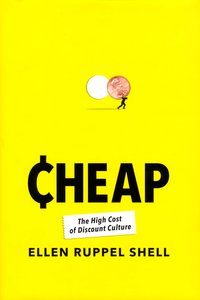
  • Cheap, Ellen Ruppel Shell

    Cheap, Ellen Ruppel Shell

    Penguin, 2009, 296 pages, $32.50 hc, ISBN 978-1-59-420-215-5

    Everything has its fair price, but whereas customers think of themselves as experts at spotting when something is too expensive, fewer are as skilled in detecting when something is priced too low.  In Cheap, Ellen Ruppel Shell takes us on a tour of, as the book subtitle promises, “the high cost of discount culture”.

    But “Someone always pay” could also have been the book’s subtitle as Shell traces the impact of a retail environment in which almost everything is said to be a bargain.  This isn’t a simple issue, as discussions of Wal-Mart and other big-box stores quickly take us on a tour of economics, social policy, urban planning, human psychology and the nature of quality.  With an unpleasant dilemma hovering in the background: While consumers are, on average, paying less for food and clothes and electronics now than they did a generation ago, is it fair to ask whether things are now too cheap?

    It’s a fair question: Always Low Prices are often a race to the bottom for an entire distribution chain.  By pushing suppliers to ever-lower profit margins, are today’s monolithic retailers eroding the various social institutions that have led to their creation?  Has the great flight of manufacturing jobs outside America been a consequence of such relentless bargain shopping?  Fifty years ago, well-paid employees were able to educate themselves and their children, live on a single salary and depend on good pensions to give back to the rest of society.  But the aftermath of the latest frenzy towards price-cutting at all costs has taken away benefits that can only be found in healthy profit margins.  The race to the bottom is global, now, as Shell travels to the countries that manufacture most of what’s sold in America, and finds out that the price to be paid for cheap good is often the exploitation of a population that is powerless to react.

    Shell’s simple premise ends up leading us to one subject area after another and making troubling revelations along the way.  The chapter on cheap food will find echo with Michael Pollan’s food policy journalism –Shell even manages to answer a question I’ve always been afraid to ask about the availability of cheap shrimp and as expected, the answer is likely to make you think twice about your next cheap seafood plate.  A chapter on durability takes a number of well-deserved pot-shots at IKEA, whose mystique far outweighs its place as a devourer of possibly illegally harvested wood.  Another chapter on retail outlets ends up being a primer on the ways manufacturer dilute their own hard-won brand in an effort to scoop up just another retail market, and how “cheap” outlet shopping isn’t so.

    To total up her exploration of price, Shell depends on a mixture of historical research on the evolution of retailing in North America, original reporting both of the trivial (let’s go shopping!) and the globe-trotting variety, statistics, market analysis, expert interview and newspaper clipping.  As a look at her chosen subject, it’s all-encompassing, careful, convincing and quite a bit upsetting.  Confirming what socially-conscious readers already suspect, Cheap shows that there is no such thing as a bargain.  Someone always pays, and the true price of cheap goods is in external costs: The idea that the customer who is purchasing the item at retail is not only paying just a fraction of the item’s true cost to the world, but encouraging endless levels of suppliers to do the same.  The impact is always felt somewhere, most often in decaying social infrastructure and environmental damage.

    It’s no surprise if this conclusion is entirely consistent with a bunch of activist literature from Naomi Klein to Eric Schlosser.  We are, as globalized customers, embedded in this system.  There are no easy answers no matter where we look: the current logic of economic systems makes breaking out of this spiral to the bottom seems impossibly daunting.  Tellingly, Cheap, has little to offer in terms of solutions: It seems content to describe the problems in excruciating detail and leave the policy-making to others.

    Which is not a bad decision: Cheap works best as a dispassionate and generally non-partisan exploration of an issue: The solutions are likely to be far more contentious, touching upon market regulation, fiscal policy, social programs and customer awareness.  Then again, the ultimate solution to wage imbalances between first and third world is a drastic equalization: Better wages for third-world countries, and a dramatic involuntary lowering of our living standards.  It’s not that there are no solutions to the high price of discount culture; it’s just that you may not like them when they solve the problems.  Those who “shop till they die” won’t care about discount sales in the grave.

  • The Princess and the Frog (2009)

    The Princess and the Frog (2009)

    (In theatres, February 2010) It’s difficult to see The Princess and the Frog, Disney’s first animated featuring starring an African-American lead character, without thinking about Disney’s troubled relationship with race, from the eternal embarrassment of Songs of the South to its tradition of whiter-than-white lead characters.  But this is a new decade, and it seems that Disney has caught up with the times and if the result is recognizably another Disney princess fantasy, it’s also a film that has a lot more to offer.  By taking place in 1920s New Orleans, the film is able to draw upon rich sources of inspiration for visuals and music: At its best, The Princess and the Frog is quite unlike anything else seen from Disney, with art-deco segments, and jazz, soul, blues and gospel music.  That’s when the film reaches its top velocity, and act as an old-fashioned crowd-charmer.  Unfortunately, the entire film’s not like that: More conventional segments are, well, more conventional, and while they tie the film together, they don’t do much more than connect the narrative dots in a plotting fashion.  Still, through it all, it’s almost too easy to forget that this is Disney’s first 2D feature after the resurrection of their hand-drawn studio.  The Princess and the Frog is a creditable success for the 2D division, and a proud successor in a long line of Disney features.  One that, indeed, will make believers out of even the most hardened Disney-basher.

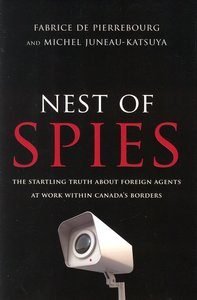
  • Nest of Spies, Fabrice de Pierrebourg & Michel Juneau-Katsuya

    Nest of Spies, Fabrice de Pierrebourg & Michel Juneau-Katsuya

    Harper Collins, 2009, 372 pages, C32.99 hc, ISBN 978-1-55468-449-6
    (Read in the original French as Ces Espions venus d’ailleurs, Stanké, 2009, 358 pages, C$29.95 tp, ISBN 978-2-7604-1049-6)

    One doesn’t think of Canada as a hotbed of espionage, but covert information-gathering is omnipresent, and it’s not because Canada isn’t a world stage player that it’s magically immune to spying drama.  Obviously, we’re close to the USA in more than the obvious ways.  But Canada’s companies are also at the forefront of technological innovation and, as such, are vulnerable to corporate espionage, whether my other companies or foreign governments.  In the twenty years since the fall of the USSR, the spy business has grown even more complicated, and showing the current state of the art is part of what Fabrice de Pierrebourg (journalist) and Michel Juneau-Katsuya (ex-CSIS operative, now private security consultant) are trying to do with Nest of Spies.

    Originally written and published in French as Ces Espions venus d’ailleurs, but now widely available in English as Nest of Spies, the book begins at the end of the Cold War, partly to show Canada’s past success stories (including a spectacular coup following a fire at the USSR’s Montréal consulate), partly to compare then and now.  Whereas Cold-War-era RCMP merely had to deal with one big opponent, today’s CSIS has to track down not only terrorists, but spies from a lengthy list of “friendly” nations and foreign companies.  Foreign operatives on Canadian soil not only snoop around, some of them also seek to intimidate and marginalize members of Canada’s ethnic groups.  And that’s not even discussing the new electronic espionage threats, the tensions between the Canadian security apparatus and its political masters, or the way very limited resources have to be allocated against a variety of threats.

    It’s a big, big subject, and the authors can be forgiven if the book is more scattered than ideal.  The table of content jumps from one theme to another, sometimes dwelling at length on a single topic (such as Chapter 002, which is all about the mysterious Paul William Hampel), while others whizz by a variety of topics.  The scatter-shot nature of the book is also obvious from the way the book seems to switch audiences.  Sometimes seemingly targeted at covert operation buffs, sometimes at executives wishing to beef up corporate security, Nest of Spies runs with its “spying in Canada” theme without taking much time to organize and structure.

    As with most books dealing with intelligence-gathering, its revelations come from a mixture of open source information and confidential interviews.  Although the authors assure us that they’ve made sure that the content of the book is entirely truthful, it’s often hard to separate fact from rumour or well-informed speculation.  This becomes crucial when the book often shifts gears from reporting to advocacy.  The evidence in the book suggests that Canada’s secret services have been historically underfunded, badly managed and treated casually by the country’s political masters.  While the recommendations of the authors for a better-funded, better-managed, more respected CSIS make sense, they do so based on an accumulation of statements that can’t be validated easily.  (To estimate the impact of economic espionage, the authors have to resort to a 15-year-old study, and match it with other estimates in comparable countries.)

    But for the vast majority of readers that are completely powerless in setting priorities for the Canadian security establishment, Nest of Spies remains a fascinating update on the current state of intelligence activities in Canada.  While economic spying is old news, the look at Chinese intelligence operations is revealing, and the long list of incidents in which foreign operatives are said to harass their own (ex-)citizen on Canadian soil is troubling.  The authors’ sources have been generous in providing them with great stories of covert operations –including a spectacularly inept attempt to recruit a high-ranking Soviet diplomat.  In providing an overview of what’s happening now in Canada in terms of foreign intelligence operations, Nest of Spies is as good as unclassified sources ever get.

    (Those with access to both the English and French version of the book will note that the English version is better-designed and has a slightly more serious prose style.  On the other hand, the French version has a sarcastic tone that isn’t always translated faithfully in the English version, and it inserts its photographic documents in the main body of the text rather than sandwiched in glossy plates in the middle of the English book.  The translation to English is competent, so much so that many bilingual readers fluent in the English intelligence lingo will find the translation easier to read.)

  • A Single Man (2009)

    A Single Man (2009)

    (In theatres, February 2010) I can see how this film would pack an emotional wallop for people in particular circumstances.  The story of a widower in terminal stage of grief, A Single Man moves with great deliberation as it follows one man’s last day.  As he closes off parts of his life, we see him slowly complete his isolation.  Tremendously affecting stuff, except for the part where I don’t really understand the character’s plight or care for the way it’s portrayed.  Even featuring more slow-motion shots than any John Woo movie, A Single Man has trouble making it the 100-minutes mark and it feels about twice as long despite a surprising amount of wit and sly humour.  A study in controlled cinematography, fifties set design, closeted passion (including a color saturation motif that gets stale more quickly than it is used) and deliberate direction, it’s not as if A Single Man isn’t successful in what it achieves: it’s just that its objectives are very different from what many moviegoers will be looking for.  Colin Firth, at least, is magnificent as the haunted lead character: I saw the film because of his Oscar nomination, and the least I can say is that it’s deserved.  As for the rest, well, I’ll let other people judge of its effectiveness.

  • Crazy Heart (2009)

    Crazy Heart (2009)

    (In theatres, February 2010) Yet another entry in the “Film I wouldn’t see if it wasn’t for their Oscar nominations” category.  Would I willingly go see the story of a past-his-prime country music singer who learns to deal with his alcoholism while romancing a single mom half his age?  Gee, Oscar, you really make things difficult for me this year, don’t you?  Cheap shots aside, there’s a little bit to like in Crazy Heart: Jeff Bridges is great in the title role, and the various details about life as an ex country music star are fascinating.  Maggie Gyllenhaal is as cute as she can be (which is a lot) as the single mom, whereas Colin Farrell has a small and perfect supporting role and Robert Duvall is up for another kind bartender role.  This is not a fast film, and it’s definitely aimed at a quiet Midwestern audience.  Bits and pieces of the film are trite and obvious (who couldn’t see the whole “missing child” moment coming?), and the overall arc of the film seems copied from VH1 specials.  Still, for a movie that has practically no guns, explosions, comedy, one-liners, car chases, giant robots or anything designed to get me in the theatre, it’s a bit more bearable that I expected.  But I’m as far from Crazy Heart’s target audience as I could be, so never mind me and go read a review from someone who cares more about the film.

  • The Unincorporated Man, Dani Kollin & Eytan Kollin

    The Unincorporated Man, Dani Kollin & Eytan Kollin

    Tor, 2009, 479 pages, C$28.95 hc, ISBN 978-0-7653-1899-2

    If you look on the cover of Robert J. Sawyer’s early novels, you can read the following quote by Spider Robinson: “If Robert J. Sawyer were a corporation, I would buy stock in him.”.  As a cover blurb, it’s memorable.  As a social principle, though, it’s something else.

    Something that Dani & Eytan Kollin are willing to explore in their debut novel The Unincorporated Man: As a cryogenically preserved businessman wakes up hundreds of years from now, he discovers that everyone is incorporated: To raise money for education, housing and other personal needs, people sell shares of themselves.  Parents get 20% of their newborn’s shares from birth and government gets 5%, but the rest is up to the incorporated person.  The catch is that investors do have a say in what their investments do, and someone who doesn’t own a majority of their own shares may not be free to do as they please.  Naturally, share prices go up and down, which creates both social classes (“pennies” whose shares trade for mere cents) and mobility.  Weddings take the form of mutual stock exchanges; the implications go on.

    It’s an intriguing idea to explore, but you wouldn’t necessarily want to stay there.  Alas, our time-travelling hero doesn’t have much choice.  Fortunately, he quickly gathers up a solid group of friends that teach him everything he needs to know about his new universe.  Flying cars, nanotechnology, near-immortality and what seems to be world-wide peace and happiness: It’s not a bad future, even for those without a majority of shares in themselves.  But the notion of personal incorporation proves to be intolerable for our protagonist, who fights off all attempts to regularize his unincorporated status.  It escalates, especially when a powerful corporation takes an early interest in him.

    I picked up the book mostly for its premise.  Personal incorporation seems like an idea borne out of free-market capitalism run wild (the book begins by a quote from Milton Friedman prefiguring the concept) and not something I’d be keen to see in practice, but I always enjoy that kind of social thought experiment.

    What I had missed on the cover blurb was that The Unincorporated Man interrogates the premise of personal incorporation from a libertarian perspective.  Oh yes; if ever there was a sure-fire nominee for the Prometheus Award, The Unincorporated Man would be it.  Regular readers of these reviews already know that I consider libertarianism a philosophy for and by aliens; in fact, it a kind of thinking that looks silly as soon as you step outside a very narrow American perspective.  But I see no point in belabouring the point further, except to flag that my ideological biases are orthogonal to the authors’ –and so the rest of this review should be read accordingly.

    This being said, I do believe that it’s possible to write a libertarian novel that would appeal without reservations to foreign left-leaning pinko socialists like myself.  Unfortunately, that would require a bit more subtlety than what we get in The Unincorporated Man, which lumps the ACLU with pedophiles, has a pathological aversion to taxes and can’t help but take snide pot-shots at the New York Times like the worst right-wing bloggers of today.  No one will be surprised to find out that our protagonist’s distinguishing quality is that he is very, very rich.  The novel may interrogate personal incorporation from a libertarian perspective, it doesn’t change that there isn’t all that much philosophical ground between libertarian utopia and the one portrayed in the book.  Whatever objections are voiced against personal incorporation tend to take the form of “Raaaah, freedom!” rather than the more reasonable “it doesn’t work!” because, in the universe of the novel, everything is rigged for it to work.

    This left-bashing is not a good idea in that it only makes me more critical of the way the novel argues with the reader.  And this is where it’s obvious that The Unincorporated Man is a first novel.  Let’s start with the title, which presupposes that in the entire whole wide world, there is only one person (our protagonist) who is left unincorporated.  Although the novel spends very little time outside the US, or even considering non-American perspectives, we are led to believe that everyone on planet Earth, no matter which race, nationality or religion, has adopted the unfamiliar social contract of personal incorporation.  Notwithstanding an unconvincing “virtual reality apocalypse” that, in the back-story of the novel, has dramatically reduced the population of the Earth, how did that work?  How did you convince various constituencies such Muslims, Hindus, orthodox Jews, dirt-poor peasants and political activists of all sorts to buy into such a scheme?  How do you convince them to stay with it?  The Unincorporated Man quickly takes on the feeling, so familiar to libertarian fiction, of a pocket toy universe –not a serious work of extrapolation.  This lack of complexity, subtlety and sense that this is a real world is actually a blessing in disguise, because it allows the book’s problems to be dismissed as being nothing that libertarian self-posturing.

    It’s a good thing that the book is so concerned about its central idea, because it’s not going to convince readers based on the strength of its prose.  A throwback to old-fashioned SF writing, The Unincorporated Man is written bluntly, with little to offer in terms of finer literary qualities.  Readers asking for polished writing may wince at the unapologetic usage of old-fashioned plot devices, or the way our hero so quickly assembles the group of friends that will see him to the end of the novel.  The structure of the novel doesn’t do much better, audibly shifting gears from a first-half description of the world to a second-half that is increasingly concerned with fighting the system.  The book ends, but not the story: we’re told to expect a trilogy in much the same vein.

    But as I page through the book, I am reminded of editor David G. Hartwell’s quote (relayed by Michael Swanwick) that “I have infinite patience for hearing why somebody’s work is good and none whatsoever for why it isn’t.”  So it is in that spirit that while I found much to dismiss or dislike in The Unincorporated Man, it’s has engaged me at a level I wasn’t expecting.  Even as I kept arguing against its simplifications, I found within its page a good chunk of the fun that I expect from a Science Fiction novel: new ideas, straightforward writing and characters who are, basically, winners.  It has a ludicrous premise, unconvincing world-building and ham-fisted writing, but I couldn’t stop thinking about it for days (usually leading to a description of the novel to friends and acquaintances) and that seldom happens with better and more respectable SF novels.

    What irony: that a limited novel with which I may profoundly disagree would end up capturing a larger part of my imagination than other more respectable works.  If I take a look at the short-list of last year’s SF novels that have grabbed my attention, The Unincorporated Man remains in good company.  Granted, 2009 hasn’t been such a good year for SF novels: Highly-anticipated books by authors like Sterling and Doctorow were lifeless on arrival.  But at some point, novels are as much what you make of them than what they contain, and in this light, I have no trouble suggesting a look at the Kollin’s first novel… as long as you know what to expect.

    [August 2010: I should be careful about what I wish for, because follow-up The Unincorporated War is a lot less focused on libertarian ideas and considerably duller as a result.  The action largely moves off-Earth as the unincorporation forces wage war against the old system.  Anyone wishing for Solar System-based space combat will be happy with the results, even though the novel is far less intellectually provocative than its predecessor.  The writing isn’t necessarily better, and neither are the characters: the end result unfortunately feels restrained to the point of being boring.  It ends on a false cliffhanger just in time for the third volume in the trilogy.]