Year: 2010

  • Precious (2009)

    Precious (2009)

    (In theatres, February 2010) There are movies that I see coming with weary resignation.  As a confirmed Oscar junkie, I make an effort to see at least the triple-nominees and up, even though I may have no interest whatsoever in the film itself.  So it is that heart-warming tales about grossly overweight uneducated Harlem single mom really aren’t the kind of film I would willingly see for myself.  But from time to time, I get surprised, as so it is that Precious is a bit better than I expected it to be.  The lead character’s rich inner life, competently portrayed by director Lee Daniels, makes this film a bit more spectacular than the usual terrible-life-of-the-week that one could expect.  (There’s one “learning” scene, in particular, that features a generous amount of special effects)  The film’s main claim to fame, though, is the decidedly unglamorous way it treats its actors, nearly all of whom can be praised for emotionally raw performances.  Gabourey Sidibe is a revelation in the lead role, but Mo’Nique and Mariah Carey also earn attention for roles that are as far away from their usual screen personae as could be.  (Lenny Kravitz also has a glorified cameo.)  We come to expect so little from the circumstances of the film that we’re pleasantly surprised when it ends on the smallest of victories.  In some ways, Precious deals with its subject with the knowledge that we have seen (or felt) this story many, many times before, and it’s what it does to distinguish itself from this familiarity (by flights of fancy, by unflinching acknowledgement of reality) that make it worthwhile.  It’s still not my kind of film, but it’s about as good as that kind ever gets.

  • Shades of Grey, Jasper Fforde

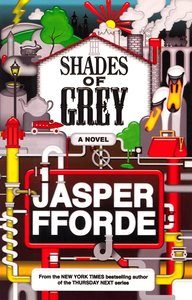
    Shades of Grey, Jasper Fforde

    Viking, 2009, 390 pages, C$32.50 hc, ISBN 978-0-670-01963-2

    It took a year of silence for Jasper Fforde fans to realize how privileged they had been.  From his spectacular debut The Eyre Affair in 2001 to First among Sequels in 2007, Fforde was able to deliver one highly imaginative novel per year, every year for most of a decade.  But after setting up a heck of a cliff-hanger in his seventh novel First among Sequels, Fforde’s schedule slipped in 2008 and more than a year went by without a new book from him.

    The reason for the delay became more obvious when Shades of Grey was finally published in late 2009.  A novel set in an entirely different universe than the ones that hosted his Thursday Next and Nursery Crime series, Shades of Grey is an ambitious debut for another trilogy… one that sends Fforde in pure Science Fiction territory.

    At first glance, it looks like a typically British, somewhat comfortable universe.  Our protagonist, young Eddie Russett, is traveling with his father to their new temporary home: a small village in which nothing is supposed to happen.  It initially looks like a cozy British countryside novel, with trains and post delivery and tea spoons and village elders and teenage romance and nothing out of the ordinary.

    But look closer, because this is a very different world.  For one thing, people are distinguished and segregated by their ability to see color.  Red; Greens; Blues; Yellows; Greys and so on: Apparently, everyone in this world is partially color-blind, and what you see (including how well you see it) definitely determines your rank in society.  Our boy hero Eddie is about to be formally tested for his color perception in a late-teen rite of passage, but there’s a lot to do in-between.  After all, his father is replacing an essential Chromaticologist who died in mysterious circumstances, and their new rural town reveals itself to be rotten to the core.

    Shades of Gray is both a departure and showcase for Fforde’s core strengths.  Fans will be immediately familiar with the way Fforde introduces all sorts of satirical details to set up his world, with the clarity of his prose, or the delights of his imagination.  After a few swim-or-sink pages in which this new world is carefully constructed, readers are once again reminded why Fforde is such a dependable author: it’s a fantastic experience, and pretty soon everyone plays along with the color-blind premise.

    And that’s when more interesting Ffordian tics appear.  The “Shades of Gray” of the title serves double ironic meaning is describing a world that has more black-and-white rules than could be considered possible.  This distantly post-apocalyptic society has been engineered for stability at all costs, and periodic technological regressions ensure that everyone remains free from choice.  Our narrator Eddie is not entirely conscious of his own indoctrination, and one of the particular pleasures of the novel is to see him race to a cognitive breakthrough of the kind so beloved by SF readers.  Not that the readers know terribly more than him; we do realize from various clues that Eddie and his fellow citizen aren’t human in the sense we are today, but many of the mysteries of this world have been left to solve in the other two novels of the trilogy launched by Shades of Gray.

    Where it is a departure from the usual Fforde novel is that it is quite a bit slower and grimmer than its predecessors.  The pacing is quite a bit more restrained than previous novels, reducing the number of subplots and allowing his characters to breathe a bit more easily.  Elsewhere, the nature of the world in which Eddie lives is totalitarian in ways that jokes about Goliath Corporation and the Toast Marketing Board in the Thursday Next series only scratched.  The ending, surprisingly bittersweet, sets up latter instalments by denying complete victory to our protagonists.  While Shades of Gray is just as strange, funny, thrilling and fresh as Fforde’s previous novels, its intent is considerably more serious.

    We can only guess at what this means for the next instalment in the series.  The small surprise of Shades of Gray, however, is that I am now looking forward to its sequel with as much anticipation, if not more, than resolving the cliff-hanger at the end of the latest Thursday Next novel.  Now that’s a successful first volume!

  • From Paris With Love (2010)

    From Paris With Love (2010)

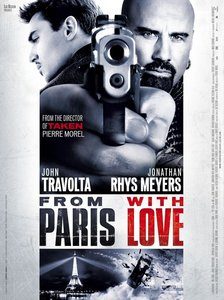
    (In theatres, February 2010) Action comedies are tough to screw up, but leave it to Luc Besson to do his best.  Besson’s not know for his subtlety, after all, and whenever he starts writing scripts, one can expect the worst.  At first glance, From Paris With Love seems idiot-proof: Match a young bookish secret agent (Jonathan Rhys-Meyer) with a older, wilder operative (John Travolta), add a little bit of terrorism, shoot up everything in Paris and voilà.  For a while, it even works: it doesn’t matter if the plot makes no sense from the start: This is an action comedy, and it’s not supposed to.  As Travolta grins shoots his way through restaurants without a single care for consequences, it’s almost fun.  The occasional meaningless drug interlude aside, From Paris With Love starts as a competent B-grade action buddy comedy.  Director Pierre Morel does fine with the action sequences.  The film is nothing spectacular, nothing particularly achieved, but well enough to pass the time.  But then, and it’s hard to be specific without spoilers, the film truly sours once the third act gets underway: Suddenly, a big pile of drama lands into the film, and no one seems to know what to do with it: it breaks the flow, and sends the plot in another direction.  That direction ends up more problematic than anyone could expect, as it lays bare the film’s overall misogyny and makes a repulsive mess out of the conclusion.  By the time our two protagonists are back on the airport tarmac laughing and comparing the size of their guns (this isn’t a metaphor, but it could be), it’s hard to avoid thinking that something has gone horribly wrong in the writing stages.  From Paris With Love wishes it could get away with just being a forgettable entry in the action/comedy sub-genre.  Instead, it’s saddled with elements that go out of its core mission, and a remarkably obnoxious attitude towards women.  Can someone stop Besson from writing without adult supervision ever again?

  • The Caryatids, Bruce Sterling

    The Caryatids, Bruce Sterling

    Del Rey, 2009, 295 pages, C$28.00 hc, ISBN 978-0-345-46062-2

    My latest yearly reading statistics confirmed suspicions left by a look at my 2009 reviews: During the past year, I have read less Science Fiction than usual, and practically ignored the latest SF published in 2009 to the profit of current non-fiction.  I do not disown SF, but today’s real world seems so much more interesting than even richly imagined futures.

    So if anyone could bring me back to SF in a big way, it’s Chairman Bruce: Sterling has, over the past two decades, successfully built his reputation as a global-head, an elder statesman of the genre with his finger on the pulse of what happening now.  His annual WELL “State of the World” addresses are condensed wisdom, and few other writers can switch as effortlessly from fiction to futurism and back.

    Why is The Caryatids such a boring mess, then?

    I may have been expecting too much.  Indeed, looking at Sterling’s past decade, it’s easy to start thinking that his novel-length work has been a case of hype over substance.  Distraction (1998) was the last unarguably enjoyable Sterling novel.  Present-day techno-fantasy Zeitgeist (2000) was weird for its own sake: not a bad reading experience, but not exactly a fully satisfying SF novel either.  The Zenith Angle (2004) mused about techno-thrillers and post-9/11 American paranoia in amusing ways, but was also perceived as a contemporary sideshow more than a real meaty Sterling novel.  Now, with The Caryatids (his third novel in ten years, if anyone’s counting), Sterling returns to real-future speculation.

    Alas, it’s speculation of the catastrophic degree.  The seas have risen, political power blocks have shifted in entertaining fashions and it’s up to a group of cloned sisters to cope with the aftermath of even worse things.  The Caryatids is more hopeful than most in that even the novel’s future has a future, but readers who, like me, are getting fed up with catastrophic thinking may not find the book entirely to their liking.

    It really doesn’t help that the book is both a schematic mess.  Three of the cloned sisters are operating in the three super-power blocks left on Earth, and much of the novel is about one man meeting all three of them in turn.  There are worse ways to set up a travelogue to show us the future, but I’m not sure that there are duller ways.  Because the book is rife in self-conscious dialogue, jumping from one idea to another without much of a care for the ideal “entertainment experience” that readers should expect.  There are plenty of good concepts throughout The Caryatids, but the attitude in which they’re delivered seems to exasperate more than illuminate.  The most interesting parts of the book, which is to say the dialogues, are also its most ridiculous moments: They seem cut-and-pasted from smart-ass web forums in which every interlocutor is sure that they hold the key to how the world works.  Do these self-satisfied snippets of future dialogue support a plot?  Isn’t it enough of a burn to ask the question?

    That The Caryatids would be so dull and forgettable is a surprise.  I normally live for this kind of mid-future social extrapolation, and have no basic objections to cleverer-than-thou characters.  But this novel simply doesn’t work no matter how generous I try to be.  While I could be wrong, cranky, over-sugared or simply out to lunch on this novel, a quick look at The Caryatid’s online reviews reassures me with social proof that I’m hardly the only one to be disappointed: the Amazon reviews of The Caryatids alone are about as bad as I’ve seen them on a top-tier SF novel.  In novel-length fiction, Sterling has spent the last decade becoming an acquired taste, and it may be that he has overreached himself here.  I don’t have any good explanations: I’m just staring at the novel with dashed expectations, scratching it off my list of potential Hugo nominees.  Now let me go read another non-fiction book and see if it’s any better.

  • Nine (2009)

    Nine (2009)

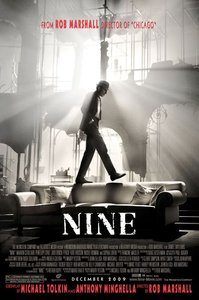
    (In theatres, February 2010) I’m favourably disposed towards musicals, but my indulgence felt its limits with Nine, a somewhat limp take on Fellini and his approach to cinema.  Some things work really well: the atmosphere of bygone Italy, the portrait of the director as a hedonistic monomaniac, the flashy cinematography, the eye-popping line-up of female stars… it adds up to a project with potential.  Seeing Fergie deliver the film’s best musical number won’t leave anyone indifferent, but it’s more fun to see Kate Hudson pop her way through “Cinema Italiano”, the film’s bounciest number, and Penelope Cruz vamp it up in fancy lingerie.  Lucky Daniel Day-Lewis, playing a director stuck in the middle of so much female attention.  But in most of its musical numbers, the film has trouble distinguishing itself through a series of mopey ballads.  The plot troubles multiply, but they all lead to a narrative crash from which the film never recovers: there’s only an epilogue to suggest that our protagonist is on his way back.  There is, in other words, little pay-off for all that came before, and a surprising amount of boredom on the way there.  Nine is not a film that involves; it prefers to be looked at and occasionally admired for its art direction.  Which is really too bad, since its first half promises a lot more than it delivers in the second.

  • Up in the Air, Walter Kirn

    Up in the Air, Walter Kirn

    Anchor, 2009 movie tie-in reprint of 2001 original, 362 pages, C$10.99 mmpb, ISBN 978-0-307-47629-6

    How unfair it is to base a book review on comparisons between the novel and its movie adaptation.

    But since I do it all the time, I might as well defend the practice.  Once the movie exists, it’s almost a sure bet that more people will see the film during its theatrical run alone than the book has had readers.* So it’s likely that anyone reading the review of the book will be reasonably familiar with the film.  But numbers aside, comparisons between original and adaption is usually a good way to get to the essence of a book: By looking at what was kept and what was left off, we can slice thinner in terms of what was at the essence of the story.

    At least that what I keep telling myself when furious authors do drive-by bookings of my house.

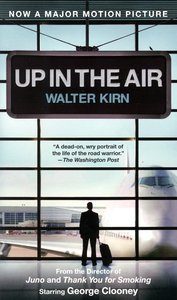
    In the case of Walter Kirn’s Up in the Air, the 2009 movie adaptation amounted to nothing short of a resurrection.  First published in 2001 to fair reviews and reportedly low sales, Up in the Air had long faded away by the time Jason Reitman adapted and directed the Oscar-nominated big-screen adaptation.  Now available in two varieties of paperbacks as well as audio and electronic versions, Up in the Air is back to be appreciated by a brand-new public.  Kirn may have had a bit of trouble getting tickets to the Oscars, but let’s hope his agent was able to negotiate some nice royalties for the movie tie-in re-editions.

    The bare bones of the book’s premise remain more or less intact in the movie: Ryan Bingham is an executive with a lifestyle optimized for constant air travel.  Taking planes more often than other people take the bus, Bingham is collecting air-miles and shunning meaningful human contact.  While the movie insists on making Bingham an active professional downsizer, that’s only one of the many jobs the book’s Bingham has accumulated in his nebulous career as an all-purpose business executive.  But what the book has that the film doesn’t is a mysterious employer who may or may not be trying to recruit Bingham, threatening packages that may or may not be from Bingham’s enemies, strange transactions that may or may not mean ongoing identity theft, and a heavier emphasis on the fact that Bingham is stone-cold crazy.

    This last aspect is particularly fascinating, because while from the outside Bingham is a successful man (even describing his high-flying always-on-the-go jet-setter lifestyle sounds synonymous with success), his narration reveals that he is addicted to all sorts of cheap business therapy gimmicks.  He increases his vocabulary artificially; he wants to market the advice of a guru with cheap promotional products; he has high hopes for the business inspiration book he’s writing, but even that may not be wholly sane.  Underneath the suit, Kirn’s Bingham is a massive void of insecurity.  (The film’s Bingham, played by George Clooney, has massive issues of his own, but he owns up to his faults and can only be criticized for following his obsessions too single-mindedly.)  Plane novels inevitably end up featuring a crash, but the one that awaits the reader at the very end of Up in the Air does not involve machinery.

    Spending a few hundred pages in a universe narrated and explained by such a mind is an experience that’s worth a read by itself.  Seeing everything in terms of efficiency, air miles, commuter routes and a mild loathing for his fellow human beings, Bingham tells the story in a way that will please fans of Chuck Palahniuk and other hip big-boy writers.  Clipped present-tense narration: Go up in Tulsa; land in Denver.  Negotiate a car rental deal thanks to a privileged customer account.  Find a chain restaurant that serves the same meal across America.  Do the job.  Move on.

    What’s less enjoyable is that Kirn would rather leave things unresolved than hand a victory of sorts to his narrator.  Up in the Air is an exercise in deliberate futility as the leads pursued by Bingham nearly all dissolve in smoke.  The accumulation of shaggy-dog endings at the end, coupled with one last revelation about Bingham that leaves readers, well, up in the air, doesn’t do much to close the deal set up by the book’s first two-third.

    But as a take on modern life as seen by a businessman, Up in the Air has a number of strong moments.  It’s a different, far less sentimental work than the movie.  As a ten-year-old novel then set at the cutting edge of modernity, it hasn’t aged all that much, even though one suspects that 2010’s Bingham would make a bit more use of portable electronic devices.  And while not entirely successful thanks to its last-minute lack of narrative closure, it nonetheless offers a memorable portrait of a unique character.  It’s probably best not to read Up in the Air for its plot, but for the voice of its narration, and the plethora of small details and quips that Bingham is so generous in sharing.  For viewers of the film, it will be as good an experience; they will be amazed at how lines in one context of the film will appear in an entirely different context in the book.  But what’s more, they will be reminded that all novels are their own creation.

    *: Let’s crunch a few numbers to bolster that common assertion: Movie studios always report box-office results in dollars, never in tickets sold.  Nonetheless, we know that the average movie ticket price in 2009 was $7.50.  We also know that the hundredth top-grossing film of 2009 (which I’m using as median for “people only hear about 200 movies per year, or four new films per week”) made $25,450,527: This translates into roughly 3.4 million viewers, and that’s only for the theatrical run, without including DVD rentals and various TV viewings that accumulate over the life of the film –and in today’s audiovisual universe, DVD sales are big money!  (The 150th movie on the list of 2009 theatrical top-grossers, The Road, made $8,104,518 or a “mere” 1.1 million entries.  At the upper end of the scale, #2 film Transformers 2 made 400 million dollars and sold 53 million tickets, or roughly one ticket for every six humans in North America.)  Book data is a lot harder to obtain, but news reports told us that Dan Brown’s The Lost Symbol had shattered all sales records for adult fiction by selling a whopping two million copies in two weeks, with a total first printing of five million copies.  That too doesn’t include backlist, library and second-hand sales for the duration of the book’s life.  Nonetheless… the math clearly shows that when it comes to books versus movies, most people familiar with the story have seen the movie rather than read the book.  Now you know why authors will grab the film option money and hope for the best.)

  • Edge of Darkness (2010)

    Edge of Darkness (2010)

    (In theatres, January 2010) It’s been a long time since Mel Gibson has simply acted in a film, and his choice of vehicle for his come-back really isn’t a stretch: As a Boston cop who seeks to avenge his murdered daughter, Gibson relies on tics developed for Payback and the Lethal Weapon series, although in a far darker context.  What seems like a botched criminal revenge killing eventually develops into a conspiracy involving politicians, state secrets, eco-terrorists and professional assassins.  It doesn’t end well for anyone.  While all of the above sounds pleasantly crunchy, the result feels curiously uninvolving.  The story (adapted, updated and condensed from a mid-eighties BBC series) advances in jolts, with the political angle feeling particularly disconnected and superfluous.  Gibson himself does better as the vengeful father, his grim (and increasingly creased) face lending a bit of gravitas to the shootouts that pepper the film.  Director Martin Campbell brings a few good shocks and suspense sequences to compensate for mawkish flashbacks to the daughter-as-a-girl and an over-the-top final sequence that marks the fourth big movie in three weeks to make heavy use of pseudo-Christian mythology.  Edge of Darkness doesn’t embarrass itself, but neither does it achieve narrative velocity.  It’s a thriller for post-teenage moviegoers, but even with its grim atmosphere, it’s not even up to the equally-adapted-from-the-BBC State of Play in terms of effectiveness.

  • Game Change, John Heilemann & Mark Halperin

    Game Change, John Heilemann & Mark Halperin

    Harper, 2010, 448 pages, C$32.99 hc, ISBN 978-0-06-173363-5

    If politics is showbiz for ugly people, then Game Change is its quadrennial gossip rag, dishing saucy un-sourced dirt on the celebs of the field.  Nominally a behind-the-scenes exposé of the events leading up to the 2008 US presidential elections, Game Change thus follows in the footsteps of an entire political non-fiction sub-genre, the “Making of a President” campaign memoir based on candid anonymous interviews (in this case: 300 of them, the authors claim) and released well after the events.  By purporting to offer a look behind the political high point of 2008, it’s definitely a book aimed at political junkies who can recall just about every mini-scandal of the campaign.  But it also offers a portrait of the candidates that’s often quite different from their stage-managed podium personas, or the superficial media coverage that passes for political news in the US.

    After a dramatic prologue set the night of the Iowa caucuses, Game Change really begins four years earlier, with the fallout of the Bush/Kerry contest and the election of a young senator named Barack Obama.  Running for president isn’t something done on a whim, and the book documents how Obama and Hilary Clinton each come to the conclusion that they would be running for president in 2008.  This sets up more than half of the book: as observers of the 2008 campaign remarked, some of the most interesting moments of the year happened during the Democratic party nomination process as the old-guard faithful to Clinton slowly came to realize the potential of Obama, and how Obama’s strategy gradually chipped away at the perceived inevitability of Clinton’s nomination.  This rivalry, often far more intense than the one opposing Obama to Republican candidate John McCain, ends up being part of the book’s conclusion –which closes on Clinton’s decision to accept the post of Secretary of State after almost rejecting it.

    In-between, well, we get it all: John Edward’s abrupt fall from grace following an infidelity scandal, Sarah Palin’s embarrassing rise to national prominence, McCain’s impulsive decision-making, Joe Biden’s gaffes, views from the campaign staffers (many of whom hate each other), private doubts and poignant vignettes.  Heilemann and Halperin reconstruct pivotal moments, give internal monologue to their characters and try to contextualize events in the vast flow of information that every campaign generates.  Some stuff falls by the wayside (“Joe the Plumber” is never mentioned, for instance), but much of the book is an instant-replay of 2007-2008 American politics, with added revelations of what the people involved were thinking at the time.

    Naturally, everyone gets dirtied along the way.  Hilary Clinton’s bad management skills account for part of her campaign’s failure, including her husband Bill’s unhelpful contributions.  Sarah Palin’s awful reputation is bolstered by even-stranger episodes of her practically turning catatonic on the campaign trail (“They began discussing a new and threatening possibility: that Palin was mentally unstable” [P.401]).  Surprisingly, though, it’s not Palin who suffers the most from Game Change’s revelation as much as John Edwards and his wife: While he’s portrayed as a candidate whose self-entitled narcissism ends up with self-immolation (after ignoring repeated interventions by his staff), Elizabeth Edwards is revealed not as the quasi-sainted figure of cancer survivor legend, but as “an abusive, intrusive, paranoid, condescending crazywoman” [P.127]  To think that Edwards was once a viable candidate is to fully appreciate the bullet dodged by American voters.

    In the same vein, it’s probably not an accident if the only ones who emerge from Game Change with their reputation intact are Barack and Michelle Obama.  Sure, there’s a sense that history is written by the winners; but there is also sufficient evidence that Obama’s already-legendary calm behaviour made converts out of many sceptics, including the Clintons.  In discussing the impact of the September 2008 financial crisis on the campaign, the authors conclude that “The crisis atmosphere created a setting in which [Obama’s] intellect, self-possession, and unflappability were seen as leaderly qualities.” [P.393].  Sure, the new President is quoted (even on the book’s flap-jacket!) as being quite a bit more profane than we would expect –but that’s the kind of thing that only erupts in a scandal if there’s a microphone present.

    Some scepticism is in order, obviously: un-sourced interviews are all about axe-grinding and selective memories.  But much of what is in Game Change is just elaboration on known themes.  Those who read the November 2008 Newsweek special edition on the campaign already knew quite a bit about the dynamics confirmed here.  It also turns out that bloggers at the time had a pretty good handle on the Obama strategy.  Much of what Game Change does is to confirm rumours that few people were willing to acknowledge at the time.  Significantly, as the book is being read and picked apart by highly knowledgeable participants in the events described, there doesn’t seem to have been any detailed challenges to the factual accuracy of the book: In fact, a mini-scandal about Harry Reid’s off-the-cuff remarks reported in the book occurred because the quote was true.

    But what we get in exchange for this murky lack of sourcing is a picture of the politicians as human beings: It’s fascinating to peek at the personalities involved, the rivalries and friendships between political figures that would never even hint at their true feelings while there’s still a chance that they may run for office again.  The extraordinary nature of Obama’s win is never more obvious when considering the way that he was casually dismissed as an unworthy opponent early on by the Clinton and their allies.  (It’s no exaggeration to say that Clinton and McCain got along better together than either of them did with Obama.)  Meanwhile, we also get an idea of the considerable toll that presidential campaigns can take on candidates, who have to rush from one event to another for months before even getting the nomination of their party.  Though it amounts to cliché, families are never too far away from their minds.

    Game Change also offers a credible answer to the increasingly pertinent question of whether books are still needed at a time of always-on cable shows, blog commentary and Twitter feeds.  The authors manage to squeeze out and contextualize quite a bit of material that would be impossible to grasp from short and frequent updates: They can look at the big picture, and form a narrative about the events.  I wouldn’t be surprised to see a made-for-TV movie adaptation at some time or another.

    It helps a lot that Game Change is an absolute joy to read.  Readers without the political junkie gene may beg to differ, but I read every page with rapt attention, slowing down my usual reading speed to be sure to catch every line.  The authors know how to structure their narrative in dramatic ways, and their smooth prose style makes it easy to flash back to the news of the time.  Of course it’s a book that rewards political trivia knowledge.  Yet it’s also one that offers a lot more than discussions of policy and polls.  It may be a package of gossipy hearsay, but gossip has the advantage of dealing with human beings.  If nothing else, it’s a useful reminder that as the TV news show us nothing more than crafted sound-bites without the benefit of context, the people saying those lines have lives of their own.  We’ll never know the true story as it occurs, but Game Change does manage to explain a lot about the crazy, cool, unprecedented and unique 2008 US presidential campaign.

  • The Lovely Bones (2009)

    The Lovely Bones (2009)

    (In theatres, January 2010) For viewers unfamiliar with Alice Sebold’s novel, Peter Jackson’s take on Alice Sebold’s The Lovely Bones has two major problems: First; its determination to beef up an elegiac tone about the aftermath of a brutal murder with suspense sequences that aren’t just jarring, but drawn-out to an extent that they become more ridiculous than gripping.  Second; its utter refusal to provide conventional closure on both the thriller as the dramatic elements of the picture.  There are several small flaws (such as Mark Wahlberg’s unremarkable “say hi to your mother” performance, the difficulty of literalizing heavenly metaphors, or Stanley Tucci’s over-the-top performance as a character who screams serial-killer), but those two stick out badly.  The second is actually a feature, especially for those who have read the book: The point of The Lovely Bones is not vengeance from beyond the grave (even though the narrator is the murder victim speaking from heaven) nor police procedural success despite the fixation on tracking down the serial killer.  It’s reaching that final Kubler-Rossian step of acceptance, letting go of horrible things and accepting with serenity the idea that some things are never avenged, explained or satisfied.  Still, this leaves us with the troubling tonal problems in transforming a dramatic novel that uses genre elements into a genre picture that seems stuck in inconclusive drama.  The differences between book and movie are both profound and trivial: the chronology is compressed, one dramatic climax is toned down to a simple kiss, various lines of the novel are rearranged wildly.  Some of this is due to the demands of presenting material on-screen, while others are simple prudishness.  Still, Jackson does make a few sequences last twice, maybe three times as long as they needed to be, and that simply reinforces the sense that his approach to the material is fundamentally flawed.  The best thing about the film, in fact, may be that those who go read the book afterwards will enjoy hearing Saoirse Ronan’s voice as the narrator.

  • The Lovely Bones, Alice Sebold

    The Lovely Bones, Alice Sebold

    Back Bay Books, 2004 reprint of 2002 original, 328 pages, C$19.95 pb, ISBN 0-316-16881-5

    I’m really not the right person to comment on this book.  This won’t be news to anyone who’s read more than a few of my reviews, but even after years of solid counter-examples, I’m still faintly dubious about mainstream fiction books that take up some aspects of genre fiction.  The reading protocols are often too different to mesh together, and the plot density is generally too sparse to keep me interested.  I am not, after all, a reader interested in prose for prose’s sake.

    But The Lovely Bones received its share of acclaim, was once featured on CBC’s long-lamented Open Book TV book club, and can now be purchased second-hand for next to nothing.  When Peter Jackson announced he was shooting the movie adaptation, the book went on my embargoed-until-I-see-the-movie waiting list.  Such an embargo usually proves beneficial in that the book is (almost) always better than the movie, and given the disappointment that was Jackson’s adaptation, there was a lot to enjoy about the carefully-controlled original work.

    But we’ll talk about the book/movie comparison in a moment.  What you need to know about The Lovely Bones is simple: It’s narrated from the hereafter by the victim of a brutal crime.  Suzie Salmon is, in most respects, your happy mid-seventies teenage girl: stable family, fine neighbourhood, doing OK in school, on the verge of experiencing her first romantic relationship.  Then she is murdered.

    It’s what happens next that makes The Lovely Bones so special: Suzie tells us about what happens to her family, her friends and her community as the echoes of her murder continue to reverberate.  There is a police investigation, but it is not a mystery.  There are details about the afterlife and some proof of interaction between the living and the dead, but this is not a fantasy story.  Sebold is really using genre devices to explore a mainstream drama of grief and acceptance.  In the wake of Suzie’s disappearance, people cope in various ways with the wrongness of her death.  The murderer escapes detection for a while; her family is driven apart; her friends commemorate her and then eventually forget.  Even Suzie herself has a few unresolved issues, and the novel doesn’t end until she can let go of her own existence.

    Now that the book has been brought to the big screen, a new group of readers will come to the book having seen the film, and pleasantly discover how much better the written version is.  This is interesting to discuss in the ways it shows how finely Sebold controls her material compared to Jackson’s ham-fisted heightening of every conceivable melodramatic hook.  In the book, Suzie’s death is minimally described; after all, we don’t need the details to fill in for ourselves that it’s a terrible thing: the rest of the book does that.  In the movie, though, Jackson milks the tension leading to her death to a degree where it becomes overdone and ridiculous.  Sebold seldom insists and her book is both subtler and stronger for it.  Meanwhile, Jackson rearranges events to milk a suspense that will never be satisfied, heightens the sentimental meaning of a few details (such as the pictures that Suzie takes, never a strong plot point in the book) and doesn’t seem to realize the importance of tonal unity.  As a result, the movie version of The Lovely Bones is at times sad, horrific, comic, suspenseful, wondrous and dramatic, with little thematic unity between its emotional moods.  But the worst thing about the movie, which is directly relevant to the book, is how it tries to create a genre picture out of a mainstream novel that is not really interested in being a genre novel.  The police investigation is heightened to a point where viewers feel cheated when it doesn’t conventionally pan out; whereas Sebold doesn’t really dangles this possibility in front of her readers in the first place.  The same thing goes for the ghost-story elements: While the film plays with the idea that Suzie can have some influence in leading her family to her murderer, this isn’t as much of a concern in the book.

    Amusingly, while the movie fails by being more extreme than the book, the book actually contains at least two strong scenes that were deemed unsuitable for the film: Without spoiling anything outright, let’s just say that the police investigator serves another purpose than not catching the killer, and that Suzie’s final reunion with her boyfriend doesn’t stop where it does in the film.  It’s easy to see the screenwriters looking at those scenes and deciding that there was no way they could work on-screen.  They were probably right, but it’s a shame that didn’t realize that the same was true for a number of other things.

    But talks of “ruining” the book are only valid if, somehow, you don’t recognize that the book is still there, waiting for readers just as it did before the film was released.  In fact, reading the novel made me understand better why the film wasn’t working, and who to blame.  (As a bonus, you will “hear” the novel’s narration in Saoirse Ronan’s voice, probably the best thing about seeing the movie in the first place.)  Sebold intentionally withholds the kind of closure that you would see in genre stories.  Suzie’s ghost doesn’t tritely lead police investigators to the killer, for instance.  The closure in The Lovely Bones is of a different sort, not the heightened artificial closure that screenwriters are told to put at the end of their third act, but the Kübler-Rossian fifth stage of acceptance and letting go.  And it works in ways that genre novels usually don’t, thanks to clean prose and mature storytelling.

    So it is that I’m still struck by the quiet dramatic power of the novel, even a novel for which I was thoroughly spoiled and more interested in taking apart narratively.  The Lovely Bones, so twee and overdone on the big screen, is better seen as a novel that leaps across natural readership boundaries, making use of genre conventions to its own purposes and, along the way, delivering a reading experience quite unlike anything else.  This coming from someone who’s so far away from the intended audience of the book, imagine how it may work on you.

  • Legion (2010)

    Legion (2010)

    (In theatres, January 2010) The second religious-themed action/fantasy thriller in as many weeks in North American theatres, Legion has the elementary decency not to be terribly serious about its usage of Christian mythology.  God has decided to wipe out mankind, angels are out to zombify humanity and only one renegade can save the world by protecting the mother of an unborn child.  No, it doesn’t make any sense: Legion’s screenwriters would rather spend five interminable minutes setting up character relationships between cannon fodder than actually making sense.  But some of the character time is worthwhile: For a cheap B-grade horror film that blends zombies with angels and demons, it’s unusually generous with the patter, and that almost makes it better than average.  It’s a good thing that all of God’s forces are well-mannered enough to line up zombie-style for maximum usage of conventional firepower by our small band of survivors, and that we’re never asked to think too much.  Which is sad, really, because in-between the tattered script and the conventional execution, there are glimmers of a terrific concept, character set-pieces and several cool scenes.  (Paul Bettany is better than expected as a renegade angel, while Dennis Quaid provides a dependably gruff presence as the owner of the small lonely diner where everything happens.)  But the banal dialogue, indifferent scenes and dumb mistakes keep ruining the fun: For such a self-aware, borderline-camp film, Legion never fully realizes its potential.  What remains isn’t much more than the type of genre picture that sinks to the bottom of the remaindered bin, and becomes an unfair trivia question within years of its release.

  • The Book of Eli (2010)

    The Book of Eli (2010)

    (In theatres, January 2010) Genre-hopping movies are fun if the genres mesh together, which is why no one will bat an eye when The Book of Eli crosses back and forth between action and post-apocalyptic science-fiction, reminding viewers of Mad Max and The Road along the way.  But (spoilers!) when the movie takes a sharp turn toward evangelical apologia in its third act, it’s as if the rules of the picture change abruptly: the invincible hero has divine protection, the lousy world-building becomes an intentional sop to a certain audience and you can hear an audible crack as individual suspensions of disbelief break down.  It’s not helped by a sepia-tinged self-important tone (complete with persecution complex) that makes it impossible to claim special camp-craziness dispensation.  Aw well; it’s not as if The Book of Eli is a complete loss: As crazy as the last act turns out to be, much of the film has a few qualities worth noticing, from capable direction by the Hugues brothers to a handful of well-presented action sequences, to a capable performance by Denzel Washington.  It’s a shame, then, that Denzel (who also co-produced the film) should use The Book of Eli to reveal his evangelical complex to the world at large.  It could have been a far better film without the last-minute slide in fantasy.

  • Cooking Dirty, Jason Sheehan

    Cooking Dirty, Jason Sheehan

    FSG, 2009, 355 pages, C$32.50 hc, ISBN 978-0-374-28921-8

    Anyone looking for another hit of that crazy professional kitchen attitude can stop re-reading their Anthony Bourdain: Jason Sheehan is here to tell his story as a cook in America’s kitchens, and he has both the life experience and the writing skills to produce a memorable book.  Unlike Bourdain, who graduated from the Culinary Institute of America and eventually demonstrated enough supervisory skills to assume leadership positions in his kitchens, Sheehan’s biography remains that of a professional kitchen cook, occasionally climbing up then sliding down as Sheehan goes through the rough life of an American line cook.

    Because working in a kitchen is similar no matter where you go: It’s about working in an environment that tolerates no weaknesses, about beating the dinnertime rush, about lasting as long as you can and then stepping away.  It’s a tough life, and Sheehan’s description of his years in the kitchen is unflinching.  The book’s subtitle is “A story of life, sex, love and death in the kitchen” and only the death part is over-promising.  (On the other hand, we get plenty of gruesome injuries, including what happens to hands when they reach into a vat of boiling oil.  Nightmares guaranteed.)  Sheehan is a spokesperson for an entire class of working cooks who find the rhythm of professional kitchen to be compatible with their scattered lives.  They may live paycheck-to-paycheck on a string of cheap drugs, easy partners and low-rent apartments, but their cooking skills are good enough to carry them no matter where they go.  Over and over again (until Cooking Dirty’s last third), Sheehan is able to walk out of kitchens when thing aren’t working out, set out for another restaurant or even another state, and pick up working when he wants.  This is expected: No matter where he is, the kitchen atmosphere remains the same, with colleagues that largely share his own ambitions.  And that may be the crucial difference between Shehan’s book and Bourdain: When Bourdain talks about his kitchen crew, it’s with the knowledge of someone who fit there for a while, but had the potential to grow into increasingly senior positions.  Sheehan’s identification to the lifestyle is much stronger: if it wasn’t for an accident of relationships, economic recession and luck with an editor looking for another Bourdain, Sheehan may very well still be in the kitchen.

    He is also just as good as anyone in describing the hectic rush of dinnertime in a crowded restaurant.  His description of a kitchen battered to the breaking point is unforgettable: the craziest passage (in chapter “Will Work Nights”) involves a new guy, sabotaged frozen fish on a busy Friday night, and a natural gas build-up that results in an explosion in the kitchen.  They kept cooking; the new guy never came back.

    All the while, we get another reminder about the nature, temperament and personalities of people working in kitchen to serve food to, well, you.  There is little new in learning this (as readers of other restaurant memoirs will find out) but the difference is the vividness with which Sheehan can tell his story.  His career as a cook is peppered with odd and amazing stories, from being the bartender at a swingers’ night to working in an industrial kitchen, to serving catered food in a convention hotel.  Incidentally, Science Fiction and Fantasy fans will even recognize in Sheehan one of their own, as he peppers his narrative with geek-chic references –and even gets beaten up for reading Michael Moorcock.

    When Sheenan’s self-destructive streak finally catches up with him in late 2001 in Albuquerque and he finds out that he can’t get a job in the kitchen, there’s only one escape: writing.  One stroke of luck follows another, and so Sheehan finds himself in Denver reviewing restaurants and winning the James Beard Award for food journalism.  And that’s how, improbably, a food mercenary ends up telling his story: not just as a Bourdain clone, but as a writer with an authentic voice and a terrific sense of narration.  While Bourdain’s Kitchen Confidential remains the top example of the form, Cooking Dirty is a look in the trenches that some cooks never escape, partly by lack of opportunity, drive or talent, but also sometimes by choice, however misguided they may sound to others.  As a look in kitchen culture, it completes Bourdain’s book and makes for a heck of a read.  The Amazon recommendation engine has seldom served me better than when it coughed up that title.

  • Shopportunity!, Kate Newlin

    Shopportunity!, Kate Newlin

    Collins, 2006, 240 pages, C$31.00 hc, ISBN 978-0-06-088840-4

    There are many ways in which a given book can fail to achieve its potential, but Kate Newlin’s Shopportunity! is one of the rarest blend of misguided intentions, flagrant elitism and inane chatter.  It’s easy to read, written by a smart person, filled with interesting factoids and yet fails to cohere in a fascinating fashion.  It frustrated me in ways that simply-bad or dull books simply can’t even dream of.

    Its biggest problem is that it simply doesn’t know what it’s about.  From the cover blurbage, we get the impression that this will be, in the footsteps of Paco Underhill’s Why We Buy and Call of the Mall, an exposé of the contemporary American shopping experience and how it fools the average shopper into making suboptimal choices.  But then again, it may be an instruction manual for shop owners: Newlin, after all, works for a consulting firm that specializes in retail business advice.  A quick look at the first paragraph tells us that the contemporary shopping experience has become soulless and mechanized: Is Shopportunity! an ironic title meant to propel an acid critique of today’s big box stores and their devastating impact on the nature of consumer choice?

    This confused, perhaps even schizophrenic impression grows stronger as the book advances.  Because it’s possible to find all three messages in Shopportunity!, along with brain-damaged passages in which Newlin summarizes her main arguments in bullet-points meant to enhance our shopping experience.  (“Rule #17: Break Out of the Big Box” [P.165])  As if what we really needed was a retail consultant telling us how to become a better, more satisfied shopper…

    Oh yes; in between the looks at the psychology of the modern shopper, savage anti-Wal-Mart diatribes, explanations on how bad stores drive away customers and a lament on the terrible cost of “cheap”, Newlin actually aims part of her book to people who love shopping and want to make it even more fun.

    It’s not necessarily a contradiction in term, although my own prejudices are having trouble coping with that concept.  I’m not, after all, a happy shopper.  Like many men, I see retail stores as places for hunting, not gathering: I know my prey, I’m a busy guy, and my ideal store minimizes the nonsense between me and what I want.  So when Newlin flies in a rage against Costo/Price Club, I take it personally: I love Costo in ways that airy discussions about the chain’s efficiency, logistics and force concentration can’t fully convey.  (But I don’t always shop there.)

    On the other hand, I do boycott Wal-Mart and love my upscale(ish) neighbourhood grocery store.  Yet when Newlin blasts a suburban (read; poor and lower-class) IGA while praising Whole Food, I can’t help but twitch an eyebrow.  That reflex is confirmed pages later when Newlin talks about a simply wonderful, dahrling shopping afternoon in trendy upscale Manhattan boutiques.  It then becomes reasonable to suppose that Newlin has lived the Manhattanite life for too long to be able to relate to most of her shopping readership: much of the (short) book isn’t about shopping as it seems to be about pure class exhibitionism, and the demonstration that Newlin’s tastes are unarguably better than those poor schlubs trucking it to their local IGA.  There’s a difference between having the means to consume better products and rubbing one’s self-designated superiority in everyone else’s faces, and Shopportunity! comes revoltingly close to the second.  As a result, I found myself disliking the book long after Newlin moved on to other topics.  In fact, I found myself disliking the author (who, I’m sure, is a perfectly nice person when she’s not writing books), and there’s little coming back from that point.  I hope it burns her to learn that I got the book at a remainders table.

    But even ignoring the class issues, Shopportunity! is just a mess, destined at about four different and incompatible audiences.  Those looking at business advice will resent being treated to incoherent “Shopping Tips” like brain-damaged Valley Girls (“Rule #3: Let Brands Transform You” [P.40]), while socially-conscious shoppers will be put off by Newlin’s effortless arrogance.  While there is substantial insight buried in-between the dumbed-downed bullet points and the shoppier-than-thou arrogance, Shopportunity! never gels, and comes across as an unsatisfactory mixture of material found elsewhere in purer, more coherent fashion.  There are so many fundamental social problems in the way retail outlets are set up nowadays that building about around how it’s “not fun to shop anymore” is the dumbest possible way to approach the issue.  Shopping technicians are better off reading Paco Underhill’s books; shopping activists are better off with Naomi Klein or Ellen Ruppel Shell’s Cheap and shopping fans are better off at the mall.

  • The Futurist: The Life and Films of James Cameron, Rebecca Keegan

    The Futurist: The Life and Films of James Cameron, Rebecca Keegan

    Crown, 2009, 273 pages, C$29.95 hc, ISBN 978-0-307-46031-8

    Admitting that James Cameron is one of my favourite directors is endangering my movie-reviewing license and exposing myself to endless mocking.  Somehow, the more successful his films become, the most acceptable it is to dismiss his achievements.  But as someone whose mind was blown away by Aliens and Terminator 2, someone who still likes Titanic and Avatar despite the faux-chic scorn they attracted, it was hard to pass up Cameron’s latest biography, one that picks up twelve years after Christopher Heard’s poorly-sourced Dreaming Aloud.

    Rebecca Keegan has one big advantage over Heard, and it’s that she wasn’t limited to newspaper clippings and a few meagre interviews: she reportedly had full access to Cameron, his family and his long list of friends and acquaintances in Hollywood.  As a result, The Futurist is a rich and well-researched book, one that remains interesting throughout and not just when its subject hits the big time.

    Of course, the notion of “big time” for Cameron starts early, as he’s been helming his own celluloid visions since 1984’s The Terminator.  Every subsequent Cameron film after that is a study in increasingly complex endeavours, with making-of stories that rival the film itself.  “Just another day on a Cameron set” may include everything from hanging off a plane suspended by a crane over the Miami skyline, nearly drowning in an abandoned nuclear reactor cooling tower, building a near-full-scale model of the Titanic with period detail, or inventing new technology to get unprecedented visuals.  From its very title, The Futurist aims to show how much of a visionary Cameron truly is; how he has the mind of an engineer, the hands of an artist and the eye of a filmmaker.  Tales after tale show Cameron doing things no one else has ever done before, winning large bets against those who said it just couldn’t be done.

    The flip-side of this incredible forward drive is Cameron’s abrasive personality, one that has annoyed a number of award-watchers, left film crews rebellious and broken four of his own marriages.  Cameron delivers fantastic movies, but he’s a demanding master in making them.  But then again, he has paid his dues: One of the best-known stories about him involve feverish sickness in Rome while fruitlessly re-editing his first film (an episode that would lead, as fans know, to the genesis of the Terminator films), but Keegan also reports on a lesser-known story about his first shoot that involved Cameron literally mopping up blood on the set and trying to keep the rest of the lunching crew from finding out what happens when you shoot in a real morgue.  Keegan doesn’t shy away from describing Cameron at his worst or identifying who has said they would never want to work with him again, but she does her best to show how the same facets of his personality can lead to good and bad.

    The rest of the book is just as skilful.  With deft and clear narration, Keegan moves from project to project, weaving industry facts with recollections from Cameron acquaintances.  For moviegoers, The Futurist is a lot of fun to read.  I don’t follow gossip much, and so there were a number of new anecdotes to me here and there, including one in which Cameron helped arrange for the safe release of Guillermo del Toro’s father after a kidnapping.  Perhaps the most revelatory section of the book follows Cameron in the twelve years between the release of Titanic and Avatar.  Flush with cash and acclaim, Cameron chose to step away from Hollywood and spend a decade indulging in his passions, from deep-sea diving to space exploration and setting up the new technology that we would need to deliver Avatar.

    Given all of this, the flaws of The Futurist are slight, obvious and inevitable.  Released to coincide with Avatar’s release, it hopes for another Cameron success but really has no idea how big the movie would become, and how warmly it would be greeted by audiences.  Then again, updated material is what paperback editions are meant to feature.  (One wishes, though, that some of Keegan’s most ridiculous claims about Cameron’s predictive powers would be toned down: Using Arab terrorists in 1995’s True Lies doesn’t make him anticipate Al Quaida any more than did contemporary thrillers such as Executive Decision and Air Force One.)

    It’s not quite the ultimate Cameron biography (one hope that he still has a few great movies in him), but it’s a very good one.  It’s certainly the best and most complete book about Cameron’s life so far (even though Paula Parisi’s Titanic and the Making of James Cameron remains a resource for Titanic minutiae) and a pretty good compendium of arguments for those willing to argue that Cameron is among the most important directors of the past quarter-century.