Month: December 2011

  • Dance Flick (2009)

    Dance Flick (2009)

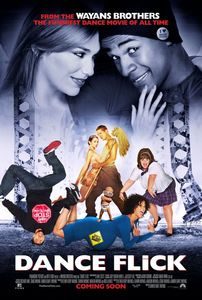
    (On DVD, December 2011) If Wayan Brothers parody films seemingly write themselves without too much thought, reviewing them can be done just as automatically.  There’s little here that will be surprising to anyone who’s seen any of the sub-standard parody films of the 2000s: Dance Flick seems happy to take up a subgenre (here: teenager dance movies), extract its basic plotline, and re-create striking moments with more cartoon violence and gratuitous profanity.  It’s not great art, and it struggles to become even adequate entertainment.  Often more groan-inducing than funny, Dance Flick has a few moments… but most of them are buried under tedious recreations of better movies that don’t even bother adding any comic intent.  It’s a bit worse than being useless, though: despite black writers, directors and producers, Dance Flick seems almost determined to reinforce most movie stereotypes of the American black community.  You almost have to feel sorry for Shoshana Bush, who turns in a game performance as the heroine of the film.  While Dance Flick is a cut above some of the worst examples of the parody genre, that’s not much of a recommendation.  (At least it avoids the meanness and gross-outs of the worst of its brethren.)  Perhaps it’s best to say that the film will appeal most to teenagers that have seen most of the referenced dance movies and not much more.  The initial-release DVD has no supplemental material, but that’s OK: we didn’t necessarily want to see more.

  • American Steel, Richard Preston

    American Steel, Richard Preston

    Avon, 1992 reprint of 1991 original, 278 pages, C$12.00 pb, ISBN 0-380-71822-7

    Even two decades later, journalist Richard Preston is still best-known for The Hot Zone, a mesmerizing account of deadly viruses run amok.  A few follow-ups, including The Demon in the Freezer and the novel The Cobra Event followed; his collection of non-fiction pieces was even titled Panic in Level 4 as a nod to his best-selling work.  But Preston’s bibliography is more diverse than just deadly viruses, and 1987’s American Steel is a good demonstration of his versatility in telling us about the renewal of the US Steel industry as exemplified by the construction of a Nucor facility in Crawfordsville, Indiana.

    Preston was allowed access to the site as it was being built and tested; no insignificant achievement as the “Crawfordsville Project” tried to build a new kind of facility at a time where few were willing to even bet on the company’s chances of success.  The history of US steel-making, explains Preston, is one where gigantic steelwork operations were gradually replaced by nimbler, smaller competitors.  The “mini-mills” led by technological innovation, a willingness to deal in smaller profit margins and a belief that they could do better jobs if they specialized in specific market niches.  The Crawfordsville project was one of those status-upsetting move; an American company using German technology to develop a machine that could transform rusting carcasses into shining new metal.

    One of the most surprising facts from American Steel, especially to 2011 readers, is the blanket statement that over half the steel used in the US in the mid-eighties was recycled.  (This figure has since gone up significantly.)  Newer steelworks don’t refine iron ore extracted from the ground as much as they recast existing iron in newer forms; the Crawfordsville location was selected in part because it was geographically located close enough to the ruins of the “rust belt” and amply served by train lines carrying recyclable metal.

    But machinery is far from American Steel’s only concerns, especially not when steelworkers prove to be such memorable characters.  It takes a special kind of man to work in a steel foundry, explains Preston; trying to manipulate hot steel with cold steel is a bit like building a water machine with ice, except that renegade hot steel tends to explode, melt human bodies and destroy buildings.  Working in such facilities means always being ready to run outside at a moment’s notice, breaking bones after jumping down platforms if the alternative is being burnt alive.  Those steelworkers are the focus of the book, and hanging with them as they work hard and party even harder becomes one of the Preston’s ways to involve the reader with his subject matter.

    You would think that presenting a corporate history of parent corporation Nucor would be relatively dull in comparison, but that’s not considering the tortuous road taken by automobile manufacturer REO (as in “REO Speedwagon”, the O of REO also standing for “Olds” as in Oldsmobile –it’s a complicated story) as it transformed itself in a Nuclear-focused company (hence “NUclear CORporation”), then as a holding company for various ventures before realizing that the best profits were to be made in the steel industry.  Nucor eventually became one of the most aggressive of the US steelmakers that renewed US steel production.  What contemporary readers know is that the electric arc furnace-driven mini-mills as exemplified by Nucor did manage to remake the US steel industry to their image: Once-mighty corporate behemoths such as blast furnace-powered Bethlehem and U.S. Steel have closed down, bought by mini-mills or been restructured in smaller entities.  There’s a darker side to Nucor’s success in its opposition to labour unions, but Preston also portrays a corporation with few management perks, a strong emphasis on humane working conditions and no layoffs to date.  The safety of Nucor’s plants is disputed throughout the book; a spectacular blow-out with fatal consequences at the Crawfordsville plant is discussed in one of the last chapters.

    While the book isn’t perfect (some of the dialogues are so steeped in steel-making jargon that they give a flavour of the workers but no real understanding) and could now use at least one updated afterword to bring us up to speed with the latest developments regarding the industry, American Steel is a fine and gripping non-fiction account of a fascinating and dangerous industry.  Considering our reliance on steel produced in facilities just like the Crawfordsville plant, it’s not a bad idea to pay attention to those kinds of things.

  • Sherlock Holmes: A Game of Shadows (2011)

    Sherlock Holmes: A Game of Shadows (2011)

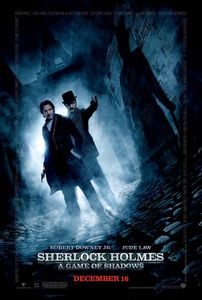
    (In theaters, December 2011) It goes without saying that sequels often aim to replicate the elements that made the success of their predecessor, and add something more.  In this light, this follow-up to 2009’s Sherlock Holmes is an unqualified success, and maybe even a more enjoyable film than its predecessor.  Front and center, of course, is Robert Downey Jr.’s fast-witted take on the title character, complete with instant-strategy monologues and slashy repartee with Jude Law’s dependable Watson.  More importantly, though, Game of Shadows ups the ante by providing an antagonist that is strong enough to present a challenge to Holmes: Jared Harris’ Moriarty lives up to its literary namesake, and makes for a formidable opponent.  It all leads to a climactic chess game that plays off a few of the series’ signature motifs.  (Literary fans will see Reichenbach Falls appear and nod at where the film is going.)  Casting Stephen Fry as Mycroft is a bit of a coup, while it’s nice to see Noomi Rapace’s high cheekbones get a bit of Hollywood gloss after her role as “The Girl” of the Millennium trilogy.  Director Guy Richie once again provides an action-adventure take on the basic premise, along with light steampunk esthetics and slow-motion action sequences.  (A blue-tinted run through a forest provides a quasi-impressionistic sequence of almost-still images.)  While the end result doesn’t transcend the Hollywood holiday blockbuster genre, it’s a well-executed example of the form, keenly aware of its audience’s demands and almost eager to satisfy them.

  • Death Race 2 (2010)

    Death Race 2 (2010)

    (On DVD, December 2011) I won’t try to hide my disdain for the 2008 film that led to this follow-up, especially given how it establishes my low standards for approaching this film.  Can you expect anything good from a Direct-to-Video prequel to a wholly useless remake/prequel?  No way.  And yet, especially by the rising standards of Direct-to-Video action movie, Death Race 2 actually isn’t too bad.  Director Roel Reiné knows how to work with a small $7-million budget, and the film feels just as big as the big-budget 2008 film.  Luke Goss makes for a fine stand-in to Jason Statham as an action hero, Lauren Cohan seems to be auditioning for a chunk of Milla Jovovich’s career (similitudes may not be accidental given Paul W.S. Anderson’s presence as a writer/producer), and there are surprisingly big and enjoyable roles for both Danny Trejo and Ving Rhames.  The concept of the film has been stolen from the 2008 Death Race, but the dialogue has occasional moments, the story leads straight into the 2008 film, and the direction is quite a bit better than what we could expect with moving cameras, ambitious pyrotechnic stunts and audacious shots –some of them in super-slow-motion.  The car chase following the bank robbery looks as if its cost quite a bit, and the film seems to have been able to re-use a bunch of material from the 2008 film.  It’s certainly more colourful than its predecessor, taking away one of the main criticism I had of the earlier film.  No, there certainly isn’t any more social consciousness here compared to the 1975 film.  But it is exactly what it claims to be: a competently-made action film released straight to video.  I even enjoyed chunks of it.  The DVD extras are far more successful in focusing on the making of the film than trying to glorify it as an entry in an ongoing “franchise”; director Reiné is more interesting in discussing aspects of his approach in low-budget film-making.

  • The Rise and Fall of the Great Powers, Paul Kennedy

    The Rise and Fall of the Great Powers, Paul Kennedy

    Fontana Press, 1989 reprint of 1988 original, 898 pages, C$14.95 tp, ISBN 0-00-686052-4

    Continuing self-education for its own sake is seldom acknowledged in contemporary North-American culture.  There is a strong bias in favour of adult education if it has clear monetary advantages (ie; adult students getting degrees required for better employment) but there seems to be little to no discussion of knowledge for knowledge’s sake, simply to learn more about the world.  We’re expected to perfect our knowledge of matters such as world history in High School, and never think about it again unless it’s somehow part of our jobs.

    Nice theory, but if you’re a product of the modern education system, chances are that world history wasn’t your most compelling subject.  You probably learned about history as it led to the state of your country, with next to no overview about what else happened in the world at the time.  That’s… not ideal, but neither is it one of the big scandals of our society.  History, it can be argued, can’t be fully appreciated by individuals who scarcely have any sense of antecedents.  High School students barely have a past of their own –how can they be expected to think of civilizations are entities lasting hundreds of years?

    This ties into Paul Kennedy’s The Rise and Fall of the Great Powers insofar as it remains, even nearly twenty-five years later, one of the best and most readable overviews of world history between 1500 and 1988.  (The book’s subtitle promises “Economic change and Military Conflict from 1500 to 2000” and that’s a fair assessment, but then there’s the important “1989 – Fall of the Soviet Empire” asterisk to consider.)  This is the remedial class-in-a-book that adult readers may have been asking for, looking at world history from a very broad perspective in an attempt to contextualize the rest.

    It begins by describing the world circa-1500, noting as part of its first sentence that nothing at the time would have suggested Europe’s dominant role in world affairs during the next 500 years: Barely out of the dark ages, severely backwards compared to the Ming, Mogul, Persian or Ottoman Empires, Europe wasn’t seen as a particularly interesting player.  But Europe had the advantage of many smaller opposing kingdoms, all of them jockeying for dominance and nearly all of them ready for radical experiments with technology, economics and political systems.  Over the next half-millennium, the intense wars played over a small territory would lead Europe to dominance over their complacent neighbors.

    Of course “intense wars played over a small territory” is all of European History until 1945 and “Western Europe” is really a basket full of various empires fighting it out viciously.  (For a French-Canadian, reading about European history is an exercise in cheering for either England or France as they take on the rest of the world.)  The Rise and Fall of the Great Powers does an exemplary job at explaining the changing fortunes of each empire as it rises or declines, based on technological advances, enlightened policy decisions or the availability (or lack) of resources.  Names from the past emerge and disappear; why is it that I was never taught about the Habsburg Empire?  Who forgot to tell me about Amsterdam’s pivotal role in world affairs?  Ah, and this is what happened to the Austrian Empire…  and here’s why France squandered its advantages despite all the pro-French propaganda I was taught in High School.

    As much as any other book I’ve read this year, The Rise and Fall of the Great Powers was a learning experience.  Kennedy writes about world-spanning subjects, but does so with a witty prose style, clear explanations, solid documentation and well-developed theses.  It took me much longer than usual to page through the book, but I don’t regret a moment of it.

    The weaker portion of the narrative follows World War 2, as Kennedy studies Cold War history and engages in nearly a hundred pages’ worth of predictions regarding the world’s circa-1988 power blocks.  It’s duller because it’s more familiar, but I should note that much of his predictions seem spot-on nearly a quarter of a decade later.  Kennedy isn’t particularly optimistic about Japan’s chances (something that economic crises and demographic implosion have since confirmed), is bullish about China (confirmed), thinks well of Europe’s chances as a unified power block (damaged by 2011’s Euro crisis, but still very much the case), is pessimistic about the Soviet Union (confirmed in spade by is implosion two years later) and is cautiously bullish about the United States.

    That last statement unpacks a bit with nearly 25 years’ worth of hindsight.  After considering half a millennium’s worth of history, readers may look at the invasion of Iraq and the United States’ current fiscal problems as a chilling demonstration of the kind of imperial overreach that have doomed empires before.  You can make a case that resource acquisition, at least in 2003, was behind the US actions in the Middle-East; you can also now make a case that like many empires before (or, ahem, during the Vietnam war), the US severely over-extended itself in a doomed attempt to secure its vital resources.  Kennedy, by 1987, was already predicting the end of the bipolar world in favour of geopolitics with several competing power blocks and it’s hard not to use the hindsight offered by his book as further evidence that this is happening.  It’s even possible that, having weakening itself through an entirely optional military adventure, the US has hastened its ongoing decline vis-à-vis other power blocks.

    So it is that by the time I re-emerged from The Rise and Fall of the Great Powers, eyes blinking in the sunlight, I felt as if I had crammed a semester’s worth of world history and written a paper on the topic.  The kind of heady sensation isn’t the only reason to keep on learning new things, but it’s near the top of the list.
  • A Very Harold & Kumar 3D Christmas (2011)

    A Very Harold & Kumar 3D Christmas (2011)

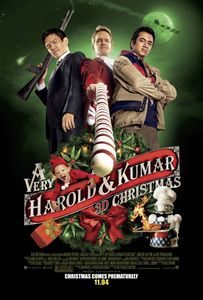
    (In theaters, December 2011) I’m not sure there’s a more conceptually offensive film out there in theaters at this end of 2011: Whether you’re talking about characters who enjoy the stoner lifestyle, a toddler doing cocaine, graphically-portrayed phalluses, Santa Claus getting shot in the face, nude nuns, angels performing sexual favours on a cracked version of Neil Patrick Harris or a murderous waffle-making robot, a straight-up description of the film’s content reads like a decadent horror show at the end of civilization.  And yet, the series’ considerable irreverent charm is intact, and a solid core of moral value underlies the entire film: the story daringly picks up six years later with a grown-up Harold and a arrested-development Kumar, then throws them together in order to come up with a relatively mainstream-friendly conclusion.  In-between, though, there’s plenty of refreshing hijinks, quasi-experimental segments (just wait for the Claymation stuff, or the 3D-tableau “plan”) and meta-fictional laughs about the actor’s other careers/roles, 3D gags (I almost regret not seeing this one in 3D) and more irreverence than you’d think possible.  It’s still a silly comedy for people who like silly comedies, but it’s hilarious, fast-paced, sweet without being cloying and a perfectly self-aware third installment in a series –for one thing, it doesn’t seem as if it’s simply coasting on recycling its previous gags.  Both Kal Penn and John Cho are great in the title role, with Neil Patrick Harris once again stealing the show and Danny Trejo joining the cast as a pitch-perfect father-in-law.  If you’re a fan of the series, don’t miss it.

  • Margin Call (2011)

    Margin Call (2011)

    (In theaters, December 2011) Obviously inspired by the financial crisis of September 2008, Margin Call is a rare thriller in which conversations, analysis and boardroom meetings take the lead over car chases, explosions and gunfights.  It starts with a mass layoff at an unnamed Wall Street trading firm and a dire warning from one fired analyst to his still-employed protégé: “Be careful.”  Before long, our intrepid boy wonder has discovered that the firm is about to go bankrupt, and the news spread upward in a series of meeting with ever-more-important people.  Strategies are discussed, blame is tentatively assigned, speeches are made, decisions are taken and, eventually, a terrible no-return strategy is adopted.  The film isn’t as good as it could be: Margin Call’s low-budget and first-time director shows in the static cinematography, tepid pacing, overlong shots and lack of a fully satisfying conclusion.  But the achievement here is considerable, starting from the terrific cast assembled here: Kevin Spacey gives a far more humane take on his usual screen personae; Paul Bettany is terrific as a high-flying trader who realizes the danger of his current situation; Jeremy Irons makes an impression as a point-one-percenter with gravitas; Stanley Tucci is wonderful as usual as an engineer turned financial analyst; and so is Zachary Quinto (looking a lot like a prettier Ewan McGregor in Rogue Trader) as the pivotal character who flags the crisis.  The dialogue is sharp, the dramatic dilemmas are unusual, the characters are well-developed and the themes are current at a time where an increasing number of Americans are openly questioning the social usefulness of the business described here.  While the dialogue-heavy piece won’t appeal to everyone, Margin Call  is a clever and efficient film that fully exploits the limits of its budget to deliver a striking result.