Month: December 2014

  • The Hunger Games: Catching Fire (2013)

    The Hunger Games: Catching Fire (2013)

    (On Cable TV, December 2014) There are few surprises in The Hunger Games: Catching Fire.  If you’ve read the Suzanne Collins book, it’s a pretty faithful adaptation.  If you haven’t, then it’s a straight continuation of the previous film, with somewhat better direction by Francis Lawrence and a structure that consciously echoes the first film… before breaking out of it.  Jennifer Lawrence continues to be the anchor of the series, while Josh Huchinson does his best to stay out of the way.  The background details of that imagined future still don’t make sense, and the story gradually picks up steam until it sparks into the long-awaited insurrection.  Otherwise, though, it’s serviceable without being particularly memorable.  It sets down the necessary element required for the sequel.  If that’s less than enthusiastic as a reaction, it’s largely because there’s a glut of such young-adult films all crowding the marketplace and their cynical intentions are only too apparent.  It is what it is, though, and as far as execution is concerned, this second volume is competent enough, with just a bit more spark to it than the first film.  Bring on the third and fourth movies… it’ll have to end at some point.

  • Bruce Almighty (2003)

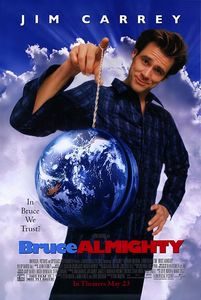
    Bruce Almighty (2003)

    (On TV, December 2014)  A good chunk of Jim Carrey’s early filmography from Ace Ventura to Liar, Liar (both also directed by Bruce Almighty’s Tom Shadyac) is made of high-concept comedies built around Carrey’s mannerisms,: Past 2003, Carrey would attempt more and more dramatic roles, and his return to comedy would either feel dated or aimed in a different direction.  In this light, Bruce Almighty certainly feels like the last in a good Shadyac / Carrey line-up, offering Carrey the chance to play both mild-mannered everyday-man and unhinged rubber-faced maniac.  The premise couldn’t be simpler: Following a terrible day, an ordinary man curses God and is given his powers and responsibilities to see if he would do better.  As an excuse for Carrey to play with divine powers, it couldn’t be better: water parts, girlfriends get curvier and various religion-based puns rain down on the audience.  It’s not hilarious, but it’s relatively amusing, almost entirely unthreatening despite the religious subject matter and Carrey gets one good reason to play the kind of comedy that made him famous.  Morgan Freeman is perfect as God, while Steve Carell has an early supporting role as a foil and Jennifer Aniston is cute but unremarkable as the perfunctory girlfriend.  For all of the chuckles, though, there are few outright laughs, and the film’s insistence to remain respectfully grounded (all the way to third-act sermons) stops its absurdity from being more gripping.  The results, in other words, don’t quite live up to the premise and the result settles for a middling average.

  • The Forever War, Joe Haldeman

    St. Martin, 1975 (2009 reprint), 288 pages, ISBN 978-0312536633

    I have spent a good chunk of my reading time this year rereading a few Science-Fiction classics (Card, Heinlein, etc.), usually to disappointing results: Finding out that old favourites haven’t aged well since one’s teenage years is common enough that SF fans often use the expression “visited by the suck fairy” to describe how books seem to curdle on their own once reread with a contemporary (and often, more personally mature) perspective.

    So it is that I’m overjoyed to report that Joe Haldeman’s The Forever War has not been perceptively visited by the suck fairy. It remains just as interesting now as when it was published forty years ago, and it has lost little of its qualities since then. (This being said, keep in mind that I was reading the 1997 “definitive” edition, notable chiefly for including a middle section that wasn’t in the version I read twenty years ago, along with a number of small fixes here and there.)

    The story is familiar enough: An unwilling man is drafted in the war effort against an alien race, and (thanks to the wonders of time dilatation) ends up living through the ensuing multi-millennium war. Through his relatively contemporary perspective, readers find themselves pushed farther and farther in an equally alien future. There’s military action, romance, savvy SF devices deployed well and hard-hitting enough narration to make the novel instantly gripping, even from its classic first line (“Tonight we’re going to show you eight silent ways to kill a man.”) It’s not an accident if it’s from a Vietnam veteran who was wounded in combat.

    The lineage that The Forever War owes to an entire tradition of military Science Fiction (most notably Heinlein’s Starship Troopers) is obvious, as are its intentions to subvert some of the inherent heroism in the genre. It’s notable, for instance, that the protagonist of the book isn’t a particularly good warrior, and that his only notable feat of military prowess comes very late in the novel—until then, he accidentally survives through luck and caution.

    Interestingly enough, it’s that grounded view of military service that has allowed The Forever War to survive through the decades. War, Haldeman seems to be saying, is not noble or glorious when you’re the grunt on the frontlines: it’s a scramble for survival, it’s something that separates you from your loved ones, it’s in service of other people who may not care all that much about you. The profound sense of alienation that carries through the novel was partially meant to reflect the aftermath of Vietnam for its veterans, but it still carries a potent charge today when measured against other more triumphant military-SF novels. In many ways, The Forever War is both a veteran’s novel, but one that can be readily understood, and championed, by readers without a minute of military service.

  • 300: Rise of an Empire (2014)

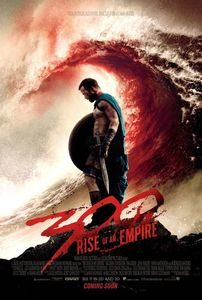
    300: Rise of an Empire (2014)

    (On Cable TV, December 2014)  My strongest reaction to the first 300 back in 2004, once past the first few garish beheadings, was the realization that I had suddenly been kicked out of the “young males, 18 to 34” demographic category: I found the film excessive, manufactured, far too violent and aimed at younger viewers.  So, in saying that the sequel isn’t too bad, I’m just coming to terms with the idea that I’m even older than I was back then.  Striking a balance between more of the same and a little bit of new, 300: Rise of an Empire wraps itself around the original film by explaining the origins of its antagonist, taking place alongside the first movie’s timeline and concluding a little bit later.  Director Noam Murro renews with the heavy (and bloody) post-processing aesthetics of the Zack Snider original, but benefits from a script that takes place largely in a naval environment, allowing for a bit of extra variety to the visuals.  Sullivan Stapleton is no Gerald Butler as the lead, but Eva Green makes a strong impression as the quasi-demented antagonist and almost single-handedly makes the film watching for something other than visual style.  Otherwise, it’s a slick historical action war movie, which is to say that it’ll please a certain viewership and doesn’t cater to others.  Worth a look, but maybe not a thought.  

  • The Zero Theorem (2013)

    The Zero Theorem (2013)

    (On Cable TV, December 2014) I actually had big hopes for this film.  Director Terry Gilliam is a true iconoclast, and his filmography contains a number of classics.  But then again, his filmography is also filled with less-successful material and lengthy pauses between projects.  Alas, The Zero Theorem doesn’t qualify as a success: While thematically ambitious and as visually intriguing as most of his other projects, this science-fiction film unfolds without rigor, letting its excesses run wild while not ensuring that the basic demands of the plot are met.  There are moment of wit (including a gigantic sign telling park visitors what not to do in great detail) and intriguing characters: Christoph Waltz is good in a nearly-unrecognizable role, whereas Mélanie Thierry makes for an unconventional romantic interest; Matt Damon and Tilda Swinton are unexpectedly fun in small roles.  Still, The Zero Theorem’s existentialist musings quickly devolve into pure incomprehensible yadda-yadda, choosing pretention over substance.  The story has tone issues that the film’s manic design only makes worse, while the conclusion doesn’t do much to bring all of the separate plot threads into a satisfying conclusion.  It’s a film best appreciated (and then again, not that much) by cinephiles and Gilliam completists rather than general audiences who will watch it and shrug: The Zero Theorem ends by disproving itself.

  • About Time (2013)

    About Time (2013)

    (On Cable TV, December 2014) On one hand, this is a terrible science-fiction film.  On the other hand, this is an excellent science-fiction film.  Those aren’t necessarily contradictions, if you accept that SF is at its best when it aims to illuminate facets of humanity and if you accept that genre SF has evolved to be as self-consistent as possible.  Written and directed by Richard Curtis, a talented artist with no background in genre SF, About Time firmly belongs to the naïve school of SF that believes that the worst logical flaws are irrelevant as long as viewers are moved by the emotional consequences of the science-fictional device.  And on that point, About Time is quite successful: While its time-traveling device isn’t much more that fuzzy wish-fulfilment (go in a closet, close your fists and wish really hard) with no consistent set of rules save for those that can be ignored by dramatic impact, the film does manage to poke at some of life’s biggest emotional dilemmas in a way that feels relatively fresh.  It helps, of course, that it’s part of the gentle British rom-com tradition: Domhnall Gleeson makes for an affable romantic hero, whereas Bill Nighy steals every scene as an amiable man who has figured out much of his life.  The film is a bit of a slow burn, starting in firmly comic territory before going into heavier themes.  Sure, it’s frustrating that the rules of the premise don’t seem to hold together, or that lies seem built-in most of the protagonist’s relationships.  But the film itself is pure charm, and such likability goes a long way in leaving viewers with a big smile and a bit of a heartache.

  • The Perks of Being a Wallflower (2012)

    The Perks of Being a Wallflower (2012)

    (On Cable TV, December 2014) I don’t usually go for teenage coming-of-age dramas –seeing The Perks of Being a Wallflower was a bit of self-imposed viewing to complete a checklist.  But there’s quite a bit to like in this tale of early-nineties growing up in Pittsburgh: a textured look at damaged teenagers (ie; all of us) and the way they can help each other cope.  Alternately hilarious, heartbreaking, tragic and uplifting, The Perks of Being a Wallflower goes everywhere but in a carefully deliberate fashion: there’s little that’s accidental in this story (written and directed by Stephen Chbosky, adapting his own novel) about how a high school freshman comes to find a support group among eccentric seniors and break out of his shell.  Logan Lerman is likably bland as the protagonist, while Emma Watson proves herself to be an interesting actress in this first post-Potter role and Ezra Miller steals every scene with his outspoken character.  The last twenty minutes are a roller-coaster of emotions as secrets are revealed, friendships are tested and tragedies unfold.  This is a movie with heart, complexity and a decent amount of subtlety as well: It reminded me of my own early-nineties high-school years despite having almost none of the specific experience of the characters.  The Perks of Being a Wallflower is not a spectacular film, but it lingers in mind far longer than most Hollywood spectacles.

  • Big Ass Spider! (2013)

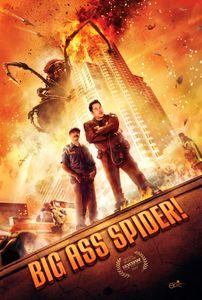
    Big Ass Spider! (2013)

    (On Cable TV, December 2014) It’s no use trying to pretend otherwise: Big Ass Spider! is nothing but another of those cheap monster-movie-of-the-week that you see so often on SyFy and other cable channels desperate for content.  Here, a mutant spider gets bigger and eventually terrorizes Los Angeles, while a local exterminator teams up with the Army to remove the threat.  It’s far more comic than horrific, tries to present a monster invasion of a threadbare budget and never aims much higher than blue-collar amusement. (From the title onward, what else were you expecting?) There is, as they say, a market for that, even when it’s a one-note cliché blown over 90 minutes.  To its credit, though, Big Ass Spider! is a bit better than most similar films.  It has a sense of humor about itself, recognizes some of its limitations, does manage a few effective shots (the lesson, as usual, is to spend more on the important sequences) and even features a Lloyd Kaufmann cameo.  Greg Gunberg makes for an effective everyman-hero, but it’s Lombardo Boyar who turns in the most likable performance as his wisecracking sidekick.  The script may be a touch too heavy on stereotypical humor, but other lines work well: I was particularly amused at the leading pair’s reactions during an exposition-heavy scene.  Big Ass Spider! is not really a good movie, but you can be assured that there is much, much worse out there.

  • The Lego Movie (2014)

    The Lego Movie (2014)

    (On Cable TV, December 2014) There are so many ways this movie should have been awful.  Toy tie-ins usually don’t do very well.  The temptation to just turn out just a quick kid-level adventure must have been tremendous.  The third act jumps the fourth wall with gleeful abandon.  The very idea of a movie based on Lego is rife with pitfalls.  That only serves to make The Lego Movie feel all the more amazing: Not only does it deliver a hugely enjoyable action/comedy/fable, it does so while understanding, on a deep level, both the frantic sugar-rush of creation (for those who play with Lego) and the nostalgic appeal of those very same bricks (for those who played a lot with them and for some reason have stopped.)  The intricately clever script somehow manages to serve a straight-up adventure with cynical snark and heartfelt sentiment.  It’s quite an accomplishment, and it happens at approximately one joke every three seconds.  The third-act conceptual breakthrough (brick-through?) is insanely risky but pays off in spades, heightening the stakes raised thus far and transforming The Lego Movie into something far grander than the sum of its pieces.  The visual density of the film (computer-animated to mimic stop-motion) is terrifying, at times even overwhelming: this is a film that will warrant a second viewing, preferably in high definition.  After Cloudy With a Chance of Meatballs and 21 Jump Street, this is the third time that writer/directors Phil Lord and Christopher Miller have managed to create something exceptional out of unpromising elements, and I’m hearing great things about 22 Jump Street as well: time to put those two on a must-watch list.  As for The Lego Movie, it builds a sense of giddy enjoyment rarely found at the movies –a sure sign that it’s aimed straight at my year’s-best list.

    (Second Viewing, in 3D, On Blu-Ray, January 2017) My list of movies to see for the first time is so long that I rarely re-watch anything these days, but I was willing to make an exception for The Lego Movie due to a number of reasons: I thought it was an instant classic upon first viewing; I ended my Lego “Dark ages” over the past year and am now reacquainted with the tactile experience of the bricks; and I managed to get my hands on a 3D blu-ray version of the movie. Seeing it again two years later, I’m still amazed at the results. The film can be re-watched with as much fun and sentiment — the density of visual details and the clean narrative act work in the film’s favour, and knowing a lot more about Lego had me appreciating details that I had missed before (such as the inclusion of Technic elements and much of the build techniques). The father/child dynamic also struck me more deeply, echoing various philosophies of Lego in my household. The Lego Movie is also remarkable in that watching it in 3D actually makes a positive difference: Despite my overall dislike of 3D as a gimmick, there is something very tactile about watching Lego bricks moving around in three dimension that brings the experience closer to the experience of playing with bricks. Even the small imperfections of the digital Lego pieces seem heightened by the 3D, and it goes without saying that the film becomes awe-inspiring when it moves through its gigantic virtual sets in three dimensions. (Unless I’m mistaken, the 3D Blu-Ray plays at 60fps on my 3D television, which also added to the quasi-tactile experience.) I can’t imagine re-watching most of the movies I see a second time, but I can see myself carving out a third viewing of The Lego Movie before long.

    (Third viewing, On 3D Blu-ray, April 2018) I don’t voluntarily see movies three times in four years, but The Lego Movie is an exception in many ways: Obviously enough it’s a kid’s film at a time when I’ve got a kid nearby; but it’s also a great movie with high rewatchability value: the joke density is insanely high, its visual density means that there’s always something to see on-screen, and it is structured in such a way that it unlocks more jokes and more thematic material the more you know about Lego.  I’ve gone from Dark-Ages lapsed Lego fan to full-fledged AFOL in the past three years, and this third viewing of the movie works even better considering that I get more of the jokes, that I know more about Lego techniques and history, and that the film’s central conflict reflects this household’s ongoing debate about Lego: instructions or creation; display or play; reality or fantasy?  Watching it in 3D isn’t just a useless gimmick here: The film is dynamic enough to justify the added 3D effect, and it makes for a great family experience to go “wow!” at once at some three-dimensional special effect.  We may even make watching this film a yearly event.

  • The Book Thief (2013)

    The Book Thief (2013)

    (On Cable TV, December 2014) At its most basic level, The Book Thief is about a girl living in a small German town during the Nazi regime: you can predict how well that’s going to go.  But beyond that, it seems as if most of the neat things about the film don’t add much to its foundation.  It’s fascinating, for instance, to discover that the story is narrated by Death itself… except that for all of the added depth that the narration brings (especially during the tacked-on epilogue), it doesn’t have much of an influence over the story itself.  I will gleefully defend any story that takes up reading as its cause… except that it, again, doesn’t seems to do much when set against a backdrop of World-War 2 Nazi Germany.  And yes, it’s great to see WW2 movies… except when it seems to be used to make point made quite eloquently elsewhere already. (Surely I can’t be the only one to have thought about The Reader.) The movie has its strong points: Sophie Nélisse is captivating as the titular heroine, (though there isn’t much book-stealing going on) Geoffrey Rush is warm and likable as the father-figure, while even Emily Watson gets a better role as the film develops her character.  Director Brian Percival ends up packaging a convincing portrait of life under the Nazis.  It’s skilfully made, touches upon many of my own personal leitmotivs… but it seems as if the ending comes too soon, prematurely cutting short a bunch of subplots, making them feel perfunctory or ordinary.  It ends without taking full advantage of its own strengths.  How strange. 

  • Butter (2011)

    Butter (2011)

    (On Cable TV, December 2014) I like discovering small-scale movies lurking in the late-night schedules of specialized cable channels.  You can often end up with competent fare such as Butter, a cynical comedy about Midwestern alienation, resentment and butter carving.  It’s not exactly a hidden gem featuring unknown actors: Jennifer Garner stars as a driven housewife, while Olivia Wilde plays a vengeful stripper and Hugh Jackman shows up for a small but entirely ridiculous role.  The story revolves around a woman taking up butter carving at a very competitive level after her husband’s retirement, only to be challenged by a young black girl with unusual natural talent for the craft.  Butter comes up decently when it’s most focused on the silliness of its characters given the low stakes surrounding them.  (Wilde’s character is preposterous, but despite her dodgy motivations the film simply feels funnier when she’s on-screen.)  There’s a bit of heart alongside the cynicism (most notably when Rob Corddry opens up with his foster daughter), but enough gags here and there to justify the time.  Butter does miss a number of its targets: There are obvious parallels here with the 2008 Democratic presidential nomination process, but they end up being more distracting than amusing.  The film does take place in a slightly-altered comic reality when characters often behave in ways more outrageous than realistic, and it may have been interesting to see the script commit even more broadly to this kind of absurdity.  Still, it’s tough to begrudge such a modest comedy, especially given the various pointed barbs it’s willing to feature.