Month: August 2015

  • Atlantis: The Lost Empire (2001)

    Atlantis: The Lost Empire (2001)

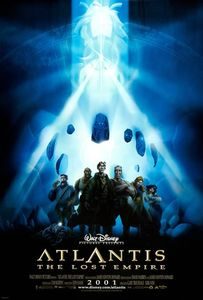
    (In French, on Blu-Ray, August 2015) Disney’s Atlantis never measured up against the heavyweight animated features for which the studio is best known, but even today there’s a lot to like in this proto-steampunk (or rather; “Jules Verne-inspired”) adventure looking for a lost continent.  Protagonist Milo is a likable nerdy hero, and there’s quite a bit of plotting going on as he discovers the true nature of those who are helping him.  The visuals are impressive (partly thanks to Mike Mignola’s design), and the integration between traditional cell-based animation and the computer-assisted animation used to bring the machinery to live has seldom been better-executed.  The film has a few laughs, a few serious moments, a generally controlled tone (which wasn’t a given for Disney animated features at the time) It aims a bit older (and a bit more male) than usual for Disney, with no musical numbers and some striking images along the waythe .  (I’m still pleasantly surprised at the surprisingly noirish way that Helga Katrina Sinclair character is introduced)  Some of the plotting is awfully convenient, something that limits its appeal to adult audiences.  Still, the adventure is briskly-paced, and rather interesting –especially as a change of pace from other Disney features.

  • 54 (1998)

    54 (1998)

    (In French, On TV, August 2015)  What is it about the Disco era that makes every single historical film about it feel so… dour?  Was it the way it imploded upon itself in a few months?  Was it that it gave way to the AIDS era?  I’m not sure, but there are a lot of disco-themed films, from Funkytown to Party Monster and Discopath, that ultimately show Disco as a false front for existential emptiness.  All of this throat-clearing is meant to say that 54 still stands strong as pretty much the same fall-from-grace narrative, wistfully recalling an era of excess before taking it all away from the lead character.  It feels very, extremely, completely familiar as a nominal protagonist played by Ryan Phillippe discovers Disco at the famed Studio 54, befriends plenty of interesting people, and then becomes completely disillusioned about it all.  Two or three things still save the film from terminal mediocrity: First is obviously the period recreation, especially early on when we discover the excesses of Studio 54 at the same time as our protagonist does.  Then there are a few performances worth talking about.  Neve Campbell was on the cusp of superstardom in 1998, and her role here plays off of that then-popularity.  Salma Hayek has an early-stardom role as a signer that makes an impression.  This being said, the film’s best and most affecting performance is Mike Myers’ decidedly dramatic turn as Studio 54’s owner, a sad role with a terrific scene set on a money-covered bed.  Myers has never done anything half as dramatically powerful since then, and it’s with the same kind of sadness that we can look at 54 more than fifteen years later, measuring it against the end of the Disco Era’s promises of non-stop fun.  The film itself may struggle to distinguish itself, but it doesn’t mean that it doesn’t have one or two redeeming qualities.

  • Seal Team Eight: Behind Enemy Lines (2014)

    Seal Team Eight: Behind Enemy Lines (2014)

    (On Cable TV, August 2015)  I normally wouldn’t stop to watch a straight-to-video third sequel in a series where most people don’t even know about the second and third film, but it turns out that this fourth film in the not-really-connected Behind Enemy Lines series is directed by Roel Reiné, a surprisingly effective low-budget director who, somehow, always manage to get a few impressive action sequences in otherwise unremarkable films.  So it is that I got my interest’s worth in Seal Team Eight: Behind Enemy Lines, which heads to Africa for a rather predictable story about a SEAL team investigating the acquisition of nuclear material by a local warlord.  The story is a big ball of nonsense (with an mysterious antagonist whose identity can be deducted from the very first briefing scene), and the actors aren’t particularly skilled, but the action sequences and the atmosphere of the film aren’t bad at all – some of the stunts look genuinely dangerous, Reiné gets the most out of his location shooting and he has a knack for capturing striking images. (Alas, one of those is of a human being blown into paste.)  The subpar screenplay hurts the film most toward the end, with a fairly mean-spirited turn into misogyny near its unsurprising conclusion.  Still, as long as you know what you’re looking for (action sequences looking great despite a small budget, that is), then Seal Team Eight: Behind Enemy Lines has something for you.

  • Blades of Glory (2007)

    Blades of Glory (2007)

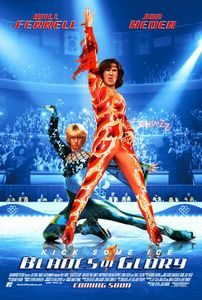
    (On TV, August 2015) I have a soft spot for comedies that take on a relatively specialized subject and then try to milk as many laughs out of it.  Blades of Glory is recognizably “a Will Ferrell film”, which is to say a broad mainstream comedy that relies on Ferrell’s particular brand of humor.  And yet, it executes the usual formula competently, can depend on a couple of good performances and even features Montréal as Montréal. Ferrell is less annoying than usual in a role that benefits from machismo arrogance rather than simply his usual man-child persona.  (The film itself also gets a lot of comic mileage in confronting bad-boy macho aesthetics with those of figure ice-skating, and not all of it is mean-spirited.)  Fortunately, the jokes work, while Will Arnett and Amy Poehler make for a good pair of antagonists.  The ice-skate chase through Montréal is funnier if you have an idea of the city’s geography (unsurprising hint: it’s all over the place).  The cast includes a number of famous and infamous figure skaters, and the work required to transform Ferrel and Jon Heder in world-class skaters seems curiously effective.  While Blades of Glory isn’t much more than an assembly-line mainstream Hollywood comedy, it’s well-tuned for its purpose and works reliably well as getting its smiles.  (Useless personal trivia: When I travelled to Los Angeles in 2006, my only encounter with Hollywood filmmaking in the wild came at the Los Angeles Stadium, when I saw a few trailers tagged as being from “Blades of Glory”.  I find it a bit ironic that it would be for a film that features Montréal so prominently… which is where I boarded the plane for Los Angeles. )

  • I Now Pronounce You Chuck & Larry (2007)

    I Now Pronounce You Chuck & Larry (2007)

    (On TV, August 2015)  Social progress can be measured in laws and statistics, but it’s also a matter of unsaid stereotypes and evolving culture.  Watching I Now Pronounce You Chuck & Larry eight years after its initial release, I’m stuck most strongly about the film’s uneasy relationship with gay stereotypes, as it presents two heterosexual men marrying for obscure (and frankly nonsensical) administrative benefits.  On one hand, the film is good-natured enough to (eventually) argue firmly in favour of progressive values, show homophobia in a bad light and affirm that sexual orientation isn’t something that should be discriminated against.  Coming from the mid-naughties, after Canada had legalized same-sex unions but before most of the US followed suit, that wasn’t too bad.  But then again I Now Pronounce You Chuck &  Larry crassly makes a lot out of stereotypes, characters spouting regrettable epithets and a barely-repressed attitude that “isn’t it hilarious to pretend to be gay???!?” as a freak-show.  I certainly hope that the very same plot wouldn’t be developed in the same way today.  It’s best to consider I Now Pronounce You Chuck & Larry as a relic of its time, at a moment when same-sex marriages were past reprobation, but well before they were normalized.  More shocking is the realization that this review spent nearly two hundred words discussing social progress before mentioning that this is an Adam Sandler film, and that he is more or less up to his usual crude shtick here. He is, of course, portrayed as a strongly heterosexual man (and the film stops just as a same-sex kiss with Kevin James was coming up.)  Don’t think that the film is all harmless: As disturbing than the gay stereotypes is seeing Rob Schneider in yellow-face, with a broad and unfunny imitation of an Asian character.  Otherwise, the dumb comedy of I Now Pronounce You Chuck & Larry pales in comparison to its socially-risky premise: it’s all dumb gags, obvious developments, flat direction and an expected conclusion.  There may be something interesting to say about slipping a dose of progressive values to Sandler fans under the deceptive guise of a dumb comedy, but I’ll let others tackle that train of thought –I’ve blathered long enough about the film already.

  • Grudge Match (2013)

    Grudge Match (2013)

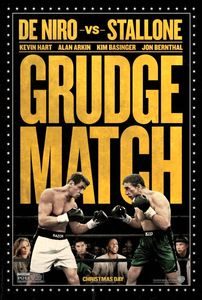
    (On Cable TV, August 2015) Grudge Match isn’t an unofficial remake of Rocky Balboa, but is sure does feel like it at times, as a retired boxer played by Sylvester Stallone takes up the gloves once again to face an old rival.  But while Rocky 6 tried hard to keep up the serious underdog tone of its series, Grudge Match thankfully seems willing to let the natural comedy in its premise run free.  Or so it seems for a while, it bits and pieces –because far too often, Grudge Match lets go of its comic premise and muddles down in emotional sequences that take away from its strengths.  It doesn’t help that the film is deeply conventional – it’s not so bad when the characters are exchanging barbs or indulging in easy physical comedy, but when Grudge Match gets serious, it also gets dull.  Still, there is considerable entertainment in seeing Robert de Niro take up old glories (although this does nothing to calm critics claiming that his twenty-first century output so far has been almost entirely riffing on his previous career), and Stallone arguably plays a better take on his Rocky Balboa character.  Alan Arkin once again plays crusty-old-guy better than anyone else, much as Kevin Hart can somehow remain a non-obnoxious motor-mouth.  It’s also good to see Kim Basinger again in a substantial role.  The laughs rescue the film from rote emotional familiarity –there is, in particular, a single-shot silent gag involving a bridge, jogger, a scooter and careful composition.  Still, Grudge Match is pretty good entertainment, especially for anyone in the mood for a solid way to pass the evening.

  • Boyhood (2014)

    Boyhood (2014)

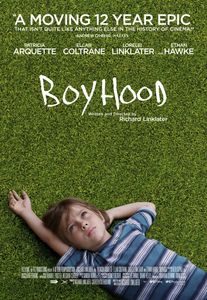
    (On Cable TV, August 2015) It would be tempting to criticize Boyhood’s endless digressions, hefty running time and scattershot plotting, but that would be missing the point of the film.  Famously filmed over twelve years, Boyhood is about the little moments of early life – the dumb conversations with friends, the visits to church, the breakups and the trips and the fights and the dress-downs and the ways lives changes.  Even as Boyhood grinds to a halt for family parties, philosophical digressions and daily minutia, there is a poignant resonance here with everyone’s universal experiences.  Despite my uneventful early years as far away from Texas as possible, I could certainly find flashes of similarities between my boyhood and moments of the film.  Boyhood lives in the interstices of other flashier stories, and there’s something almost profound in the way it combines the very intimate with the epic sweep of a twelve-year story in which the protagonist visibly matures before our eyes.  The cultural references are amusing (albeit liable to make older audiences reflect on the passage of time as in “was that twelve/ten/eight years ago already?”)  Acting-wise, Ethan Hawke and Patricia Arquette provide welcome anchors of continuity, which somehow becomes more and more important as Ellar Coltrane and Lorelei Linklater do a great job aging twelve years in nearly three hours.  It doesn’t take much to zone out during Boyhood (perhaps evoking the first image of the film, reflected on the poster) as the film effortlessly puts us in a reflective mood, thinking about our lives and how they go on, one small moment after another.  Unique in scope, Boyhood is another small triumph for iconoclast director Richard Linklater, once again doing fascinating things with cinema.

  • We Steal Secrets: The Story of Wikileaks (2013)

    We Steal Secrets: The Story of Wikileaks (2013)

    (On Cable TV, August 2015) You could ask why anyone should watch a documentary about a story that’s both not that old (The Wikileaks saga peaked in 2009-2011), and so well-covered just about everywhere (starting with Wikipedia’s interminable articles on Wikileaks, Julian Assange and Chelsea Manning) that another take on the same events would be redundant.  But Alex Gibney is a top-level documentarian, and he understands that the art of the doc is largely based on selection of material and emotional impact.  So it is that We Steal Secrets structures its material in a way that makes a complex issue relatively clear, and does amazing things in presenting Instant Messenger chats: The use of pauses, selective highlight of text and isolated sentence fragments in exceptionally powerful.  Roughly 30 minutes of the 2-hour film is made of computer-animated segments, providing a visual unity to the film that could have been diffused had it been a straight-up succession of talking heads.  While Assange himself is typically missing from the film’s roster (he’s not really the type to contribute to fair-minded depictions of him or his activities, as proven by his over-the-top reaction to The Fifth Estate and other examinations) and while Manning is obviously absent by dint of being detained, We Leak Secrets thrives on a series of good interview subjects.  While some of the remote psychoanalysis of Assange and Manning is a bit exasperating, most of the talking heads say interesting things –perhaps the most interesting of them being ex-CIA head Michael Hayden, who says things you may not expect from a man of his experience. (The title of the film is his.) Otherwise, We Steal Secrets is generally even-handed, giving voice to dissenting, even fringe opinions, while trying to be as clear as possible about its topic.  Heartbreak is inevitable, especially as the film delves into Manning’s crushing isolation, the actions of Adrian Lamo and, later on, a testimony by one of the woman who accused Assange of sexual impropriety.  I’ve been casually following the Wikileaks story for a while, and couldn’t find inaccuracies in the finished product.  (Wikileaks posted a detailed rebuttal, but Assange’s thin skin is legendary and he’ll be forever unsatisfied by anything short of hagiography.)  I have seldom been disappointed by a Gibney documentary yet, and if We Steal Secrets seems to be his most obvious topic yet, it’s as slick and fascinating as any of his other films.  As a first-pass attempt at history-making, it seems fairer than most… although I believe that the final word on Wikileaks, Assange and Manning is yet to come.  

  • Funny People (2009)

    Funny People (2009)

    (On Cable TV, August 2015)  There is a good reason why Funny People often comes up in any discussion of Adam Sandler’s career: While Sandler has done dramatic roles elsewhere (Punch-Drunk Love, Reign over Me), his turn in Funny People as a terminally-ill famous comedian trying to grapples with his impending mortality builds upon his performances in other, far sillier movies.  It’s a masterful use of an existing actor persona by writer/director Judd Apatow, and Sandler actually gets some dramatic mileage out of his role.  A good chunk of the film isn’t bad either: the dramatization of the stand-up comedian’s life in Los Angeles is fascinating, and the film features a bunch of good performances by other actors, from an unusually serious turn for Seth Rogen (with similarities to material later explored in 50/50), to fine performances by Leslie Mann, Eric Bana, Jason Schwartzman, Jonas Hill, Aubrey Plaza and a ton of comedy cameos.  (The Hill/Rogen interactions are fascinating, especially given the trajectories that both of their careers took afterward).  Some of the meta-commentary about Sandler films, usually seen through glimpses of the terrible movies featuring the protagonist, are a treat for any followers of American comedy films.  Happily, there is some thematic and emotional heft to it all, striking a good balance between comedy and drama.  But it could have been better.  The first half of Funny People is conventionally satisfying… then comes The Twist, and the second half of the movie seems at odds with the first, the pacing slowing down to a crawl, the setting, characters and tone changing significantly.  Apatow, of course, does what he pleases –and his films have never been accused of being too short.  But at two-and-a-half hour, Funny People seems to lose its way at some point, and tightening up the result could have worked wonders.  Still, Sandler’s striking performance remains, and the result is an impressive collaboration between a gallery of notable circa-2009 comedians.