Month: August 2015

  • American Heist (2014)

    American Heist (2014)

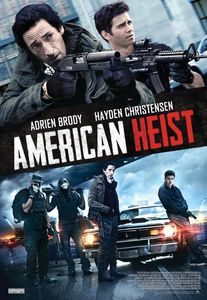
    (Video on Demand, August 2015) I actually wanted to like this movie, and I wanted to like it the way it was meant to be: a straight-up B-grade crime thriller, the kind of thing that follows likable anti-heroes as they rob a bank and try to salvage their audience sympathy along the way.  Unfortunately, American Heist is about as generic as its title suggests, with little to make the film in any way compelling.  There’s a bit of interest or two to see Adrian Brody show up, ripped, to play a tattooed career criminal.  It’s also interesting to see formerly-big actors such as Hayden Christensen and Jordanna Brewster pop up in relatively important roles.  Alas, that’ it as far as distinctions are concerned: the rest of American Heist plays like Generic Heist Film with few deviations from the template.  Worse yet: the film can’t pull off any kind of moment-to-moment interest beyond advancing the story further.  The dialogues, characters and events are all instantly forgettable and the picture soon blurs into forgettable mediocrity the moment the end credits roll.  There’s little to recommend it –especially since the heist sub-genre has produced some stellar examples of the form lately.  The Town this isn’t –and there must be another half-dozen heist films that are more instantly memorable than this one.

  • Mirrors (2008)

    Mirrors (2008)

    (On TV, August 2015)  A common failing for horror movies is to fail to match the surface shocks with a coherent background acting as explanation.  Some filmmakers aren’t even interested in doing so, and their films feel like a series of shocks untroubled with justifications.  But I trust that viewers like a bit of substance to go with the scares.  Mirrors, to its credit, almost gets it right: its surface shocks have to do with reflective surfaces and what can reach characters from behind the mirror.  The gather good atmosphere supports an effective sense of dread (especially during its very end), and the film’s various gags get to have a bit of fun with the concept of “mirrors”.  As Mirrors develops its mythology further, though, we’re asked to believe in increasingly arbitrary details, inconsistent powers and a rather dull origin story.  Keifer Sutherland does what he can to keep things interesting, and Paula Patton does her darnedest in an underwritten role, but there really isn’t much more here than a few showpieces for director Alexandre Aja.  Mirrors is far more interesting in small disconnected moments than as a coherent whole, and even a few effective shots don’t make more of a lasting impact if they’re impossible to place in an effective story.  

  • The Break-Up (2006)

    The Break-Up (2006)

    (On TV, August 2015)  I have now seen too many so-called comedies about breakups and they all share one common characteristics: They are depressing, unfunny, unpleasant and almost a chore to go through.  The Break Up may be directed by Peyton Reed –who, in between Bring it On and Down With Love, once seemed such a promising director), it’s not particularly funny, compelling nor all that insightful regarding human relationships.  The basic premise has something to do with a couple breaking up but being forced to live together for some reason, but the basic dramatic arc here is one of likable people being quite unlikable with each other, and I suppose that I’m really not a good audience for that kind of stuff.  It doesn’t help that the lead couple is played by Vince Vaughn and Jennifer Aniston: I’m not a big fan of Vaughn even in the best of circumstances, and I find Aniston to be a dull actress, usually playing parts that could have been far better handled by many other actresses.  Such comedies often live on the strength of secondary characters and comic set-pieces, but there is almost nothing of interest to find here –The Break-Up is just a sad film, and the longer it goes on, the more unpleasant it gets.

  • Into the Woods (2014)

    Into the Woods (2014)

    (On Cable TV, August 2015)  I honestly thought I’d enjoy Into the Woods a lot more than I did.  Having a pre-schooler running around the house means watching a lot of Disney films, so the thought of a musical parodying classic fairy-tales has a certain appeal to it if only as a change of pace.  To be fair, Into the Woods does have its good moments.  Princes dueling for attention while signing dramatically; Anna Kendrick with a singing role; Meryl Streep playing a demented witch; clever twists and turns of plot –especially in the first section of the film.  But then comes the second section of the film, which seems determined to frustrate even viewers hungry for parody – the tone turns far darker, the musical number get less interesting, heroes are revealed to be villains and the film sort of degenerates into a mush of unsatisfying endings.  Cue my flagging appreciation.  And that’s not mentioning the various missteps along the way, not the least of them being Johnny Depp showing up as a lecherous big bad wolf.  But much of the so-called flaws of the film are intentional, and so is its intention to frustrate those looking for more conventional fare.  The bigger surprise here is to realize that Into the Woods is a Disney production tweaking the nose of fairy tales closely associate with Disney itself.  I suppose that, given Disney’s recent willingness to remake even its animated classics into live-action films, that an affectionate tweak on those same classics wouldn’t be out of place. 

  • Just Married (2003)

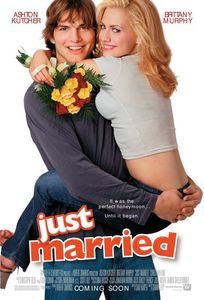
    Just Married (2003)

    (On TV, August 2015) Mix the mismatched-couple trope with the ugly-American tourist clichés and suddenly you’ve got Just Married, a rather dispiriting “comedy” in which a likable newly-wed couple sees their relationship disintegrate into loathing during their European honeymoon.  Starring Ashton Kutcher and Brittany Murphy, it’s not much than an average broad comedy film with plot points so unlikely as to court disbelief.  It’s all about laughing at European countries, misunderstandings and humiliation… the kind of thing that plays better to a younger or less demanding crowd.  For everyone else, the film does work in isolated moments, either as chaos engulfs the couple or they confront unexpected developments.  Still, it’s a good thing that we’re virtually assured of a happy ending, because otherwise the film would be quite a bit harder to watch through the progressive fighting.  Insubstantial by design, purposefully unsophisticated, Just Married is just good enough to entertain, but nothing more.

  • The Fault in Our Stars (2014)

    The Fault in Our Stars (2014)

    (On Cable TV, August 2015)  I really wasn’t expecting to like this film as much as I did.  Or even, having recently seen a friend die of cancer, to like it at all.  But The Fault in Our Stars prides itself on being quite unlike any of the other cancer movies out there in telling us about two teenagers meeting at a cancer support group.  The sarcastic dialogue and caustic gallows humor that follows is almost immediately charming in its own way, with both Shailene Woodley and Ansel Elgort being likable teenagers stuck in terrible situations.  Heartwarming without being cloying, merciless without being hopeless, The Fault in Our Stars makes much out of depressing material – it’s an enjoyable and funny film about something terrible and sad.  The stars motif is interesting, the comic set-pieces are memorable, and Willem Dafoe brings an element of mystery, then frustration in the mix.  The script is on-point and if the film does feel a touch too long during its Amsterdam segment, it’s ruthlessly curt coming back from it as it destroys expectations.  Telling you more about the film would be a disservice; take a look and enjoy it for yourself.

  • Authors Anonymous (2014)

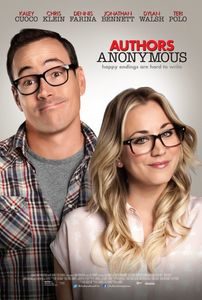
    Authors Anonymous (2014)

    (On Cable TV, August 2015) I am, as noted elsewhere, an almost-helpless sucker for movies about writers.  Notwithstanding my own delusions of authorhood, my decades-long involvement in science-fiction fandom in two separate languages means that I’ve met and befriended a lot of writers, giving me a bit of insight into the profession.  As such, it’s hard to watch Author Anonymous without noticing the very broad stereotypes used in the film, the dumb jokes, the rather unidimensional ways the writing characters are presented, and the somewhat acid conclusion.  The premise has something to do with a documentary about a Los-Angeles-based writer’s group, but there are serious issues with the useless mockumentary conceit – the film isn’t all that interested in keeping that illusion going, and the interview-with-the-writers material could have been presented more elegantly.  Still, Authors Anonymous does have plenty of small chuckles to offer, mostly playing off the delusions of the characters: The military guy (Denis Farina, in fine form) idolizing Tom Clancy and resorting to self-publishing; the brooding young man emulating Bukowski without ever writing more than a page; the bored housewife seeing writing as an affectation; her enabling husband (Dylan Walsh, effortlessly charming) confusing ideas with actual writing; and a bubblehead (Kaley Cuoco, playing her own sitcom role) who manages to put a book together without having read one before.  There is a protagonist of sort played by Chris Klein as an honest author afflicted with writer’s block and being jealous of an unlikely success, but the film doesn’t really care all that much about him.  As you may imagine, this is the kind of weakness that can limit a film’s success, and Authors Anonymous is perhaps more tolerable as a string of cheap jokes and stereotypes about writers.  Never mind the conclusion or some of the ways it gets there.  Non-writers may or may not appreciate the film as much as writers will or won’t.

  • The Dukes of Hazzard (2005)

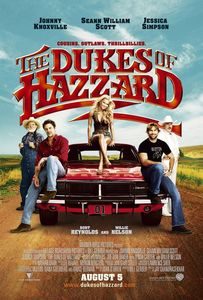
    The Dukes of Hazzard (2005)

    (On TV, August 2015) My memories of the original Dukes of Hazard TV show are dim enough that there was no chance that a remake would offend me.  Early on, The Dukes of Hazard does get to (re)establish its premise: Redneck humor, Southern-US rural charm, that iconic Dodge Charger, those voiceovers still frames… it doesn’t take much for the film to fall into kind of dumb charm, something helped along quickly by Seann William Scott’s sweetly likable performance as a soft-witted young mechanic well on his way to becoming a good-ole-boy.  (Meanwhile, Johnny Knoxville is unremarkable in the other lead role.)  The Dukes of Hazzard, big-screen version, does get a lot of mileage out of its own charm, but the effect gets a bit dulled as it becomes clear that the film won’t have as many car stunts as the premise would imply, and once the dumb corn-fed humor of the film becomes less surprising.  The conclusion feels underwhelming, although it consciously tries to feed the comic assumptions of the viewers.  So is it as good as it could have been?  Certainly not.  Is it watchable?  I’d say so.  Whether one outweighs the other is something that viewers will have to decide by themselves.

  • The Invention of Lying (2009)

    The Invention of Lying (2009)

    (On TV, August 2015) It’s clear, almost from the very beginning, why The Invention of Lying will never completely work.  As the voice-over laboriously explains its alternate-universe in which humanity never managed to evolve the concept of lying, the film just as quickly shreds its premise’s credibility.  Telling the truth and oversharing aren’t the same thing, and while the second makes for bigger laughs (the things Jennifer Garner says early on…), we know five minutes into the film that this is not going to make a single bit of sense.  So The Invention of Lying takes place in absurdity early on, which would have been fine if the film hadn’t tried to develop a romantic plot or an abrasive take on religion.  Writer/producer/director/star Ricky Gervais is a notorious atheist, and while there is some interest in seeing him work out some justification for religion (as comfort to the masses given the empty void of existence), much of the film’s second half, in which religion is invented, seems filled with easy pot-shots, not-particularly-funny moments and laboriously drawn-out dramatic potholes.  A bunch of comedians in quasi-cameos makes the film more interesting that it otherwise could be (Tina Fay gets a small but striking moment as an honestly resentful administrative assistant.)  You can see flashes of interest here and there in the film’s extrapolation of its ground rules (the inner workings of a film studio when fiction doesn’t exist are amusing), but just as often, The Invention of Lying showcases what happens when a smart person becomes convinced of the hilarity of an idea impossible to sustain over 90 minutes.  (For instance, there’s a running gag about hereditary concerns being at the base of any relationship that’s almost clever but handled too bluntly.)  It doesn’t help that the film is directed and assembled flatly, without much in terms of color or filmmaking prowess –it makes everything feel even blander.  There’s a lot of wasted potential here, but there’s no use denying that the film simply fails to meet its own expectations.  (This being said –and can I be completely truthful here?–, I’m aware that if I ever ended up making a movie, it would probably feel a lot like The Invention of Lying –a bunch of amusing imaginative concepts bogged down by poor execution, ultimately failing to reach anyone else but me.)

  • What a Girl Wants (2003)

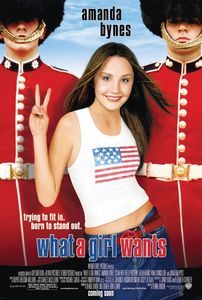
    What a Girl Wants (2003)

    (On TV, August 2015) Amanda Bynes may now be best-known as a cautionary tale about the hazards of undiagnosed mental health issues, but she had a few good years as a gifted comedy actress, and What a Girl Wants is a good showcase for what she was capable of doing.  The preposterous premise has Bynes as the daughter of an earthy American mother and a respectable member of the British establishment.  When she, as a young cool American girl, tries to reconnect with her estranged father in the middle of his political ascension, various wacky hijinks ensue.  What a Girl Wants is, obviously, aimed at the tweenager set: most of the comic set-pieces involve British aristocrats gawking speechless at the antics of our unrefined protagonist.  As I grow older, I find that I have less and less tolerance for the unexamined assumption that high-class refinement is inherently stultifying, that it always needs shaking up by younger-cooler-brasher protagonists: manners exist for a reason, and wouldn’t it be fun to see a film argue in favor of that at some point… (Oh, hey, Kingsmen.)  But that’s not What a Girl Wants is built to do, so it may be more helpful to focus on the success of Bynes’ antics, the fact that Colin First couldn’t possibly be any Colin-Firthier than he is here as an idealized father figure, and enjoy the various comic set-pieces in the spirit in which they were executed.  Predictable but executed competently, What a Girl Wants delivers what it was aiming for, and should please most of its intended audience… delivering what they want. 

  • Wild Horses (2015)

    Wild Horses (2015)

    (Video on Demand, August 2015)  Let’s be frank: It’s rare to see a film start as unpromisingly as Wild Horses does, with a few scenes acted in such an amateurish fashion as to make us wonder if the actors truly are professionals, or just regular people asked to read lines before a camera.  (It doesn’t help, confidence-wise, to find out that one of the two troublesome actors is writer/director Robert Duvall’s wife, although it makes more sense when you find out that English isn’t her first language.)  Wild Horses never completely recovers from those initial missteps, although it does get more self-assured as it goes on.  The increasing presence of such actors as Robert Duvall, James Franco and Josh Hartnett certainly helps, as does the gradually developed mystery at the heart of the tale.  For Duvall, this may or may not have been a vanity project, but it may remain a misguided one: Wild Horses, at times, feels like another version of the very similar The Judge (also starring Duvall), except with less charm and missing pieces in its narrative tissue.  Some set-pieces are good – I’m thinking about the meeting at a lawyer’s office and the conclusion, both effectively handled.  The rural atmosphere is also comfortable in its own way.  But the rest of the film is hit and miss, with even the good actors not quite managing to lift the film above its pedestrian script.  It’s too bad –for all the respect we can give to a seasoned veteran such as Robert Duvall, his film is too flawed to do him justice.

  • Sharknado 3: Oh Hell No! (2015)

    Sharknado 3: Oh Hell No! (2015)

    (On TV, August 2015) The problem with self-aware trash cinema is that it’s frankly still trash cinema.  Third in a series meant to be mocked, Sharknado 3 knows the routine by now, and keeps escalating the craziness into orbit.  (This is not a figure of speech.)  Things start with such a full-tilt roar even before the opening credits, as sharks rain down on Washington and a crazy White House sequence ensue, that it’s hard to figure out how the film will top its own opening.  But after a slower first hour or so, things get crazy once again toward the end, delivering a big bang of a conclusion.  I’m not sure how they’ll top that in the already-announced Sharknado 4, but that’s part of the fun.  In the meantime, there are plenty of celebrity cameos, over the-top set-pieces, CGI sharks eating bystanders in equally-CGI bursts of blood.  Tara Reid and Ian Ziering know the routine as well, and work through their lines without breaking up.  (This being said, Cassie Scerbo steals most of her scenes.)  If nothing else, Sharknado 3 delivers on the promises made by its previous instalments, and little more should be said.  Still, it’s still trash cinema, and I can’t help but wonder if my time wouldn’t have been best spent watching something else.  But who am I kidding –I’m already planning forward to the sequel.  

  • Brother Bear (2003)

    Brother Bear (2003)

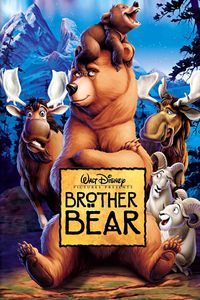
    (In French, On Blu-Ray, August 2015)  One thing about watching Disney films as an adult is noticing how many of them have crippling tonal issues.  Brother Bear, for instance, is explicitly based on presenting different visions of the same world – at one point, our protagonist undergoes a transformation that expands his mind, something that is shown with a looser art style, more colors and a shift to wide-screen ratio.  That’s not a bad thing.  But what can be worse are the film’s jarring shifts from respectful drama dealing with death, family and responsibility, to a comedy with silly animal sidekicks hamming it up.  The comedy undermines the other more serious material and makes the film feel far more lightweight than it should.  But, of course, none of this matters to the very young target public of the film, who just experience Brother Bear (with its cute talking animals!) as if everything of-course happened that way.  The animation feels a bit lacking compared to other contemporary Disney releases, but is still pretty good in absolute terms.  The story doesn’t necessarily goes where one expects it to, although some of the plot points along the way are fairly predictable.  It amounts to a Disney feature slightly less impressive than other ones, but still relatively good family entertainment.

  • Premonition (2007)

    Premonition (2007)

    (In French, On TV, August 2015)  There may have been something interesting at the core of Premonition’s premise; a woman experiencing flashes of her life a week later, after a number of mishaps and a fatal accident involving her husband.  But as she tries to understand what’s going on without driving herself crazy, the film somehow manages to squander a lot of that potential.  There’s a bit of mystery, sure, but the process of discovering what’s happening takes too long and frustrates more than it fascinates.  Sandra Bullock isn’t too bad in the lead role –unfortunately, there’s not much to the film for her to do.  Alas, the film occasionally dips into so-terrible-it’s-funny territory, first with a macabre decapitated-head sequence (tastefully shot, but there’s no mistaking what’s happening) and then with an ending that seems so ill-conceived that it strains credulity. (Nice job fixing it, hero!) That terrible ending is pretty much the final nail in Premonition’s coffin –it’s one thing to be dull (no one will remember the film, but that may be OK considering the alternative) but ending on that kind of overblown dramatic note is the kind of thing fit to any anyone remember Premonition as a bad one.  (Great poster, though!)

  • Anastasia (1997)

    Anastasia (1997)

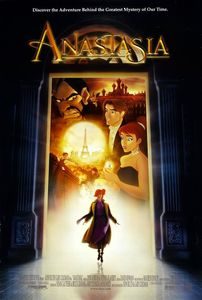
    (Netflix Streaming, August 2015) I’ve been seeing so many Disney animated movies lately that I’d forgotten what sub-par Disney imitators could feel like, and here’s Fox Animation’s Anastasia to remind me of what I hadn’t missed.  There’s an amazingly ill-conceived blend of elements at the basis of Anastasia’s premise: Taking the rather tragic real world story of Anastasia, a Russian princess killed at a young age by revolutionaries, as a springboard on which to build an animated musical action/comedy film with the reanimated corpse of Rasputin as antagonist, musical numbers and funny animal sidekicks.  What the heck?  At times, it’s not clear whether we should be toe-tapping or howl in historical outrage.  All of this being said, though, the film is often quite better than its nearly-insane premise:  The visual details are fascinating, Anastasia herself is drawn attractively, some of the action sequences are exciting, the musical numbers are catchy and by the time the film comes to an end, the insane premise has been beaten down to quasi-normalcy.  The similarities with the classic Disney animated playbook are obvious and generally work.  (The one exception is the rather uneasy blend of CGI and classic animation, although to Fox Animation’s credit, no one was getting it right in 1997 –it would take until Disney’s 1999 Tarzan until that breakthrough). So it is that Anastasia still ends up a moderate success, although there’s a substantial hump to pass in the first few minutes in order to settle down with the rest.