Month: January 2019

  • Elvis Gratton: Le king des kings (1985)

    Elvis Gratton: Le king des kings (1985)

    (In French, On TV, January 2019) I remember seeing at least a part of Elvis Gratton: Le king des kings as a younger teenager—it was, after all, a shared cultural reference in French-Canada, with a few catchphrases going around middle school. No kid back then cared about the political references that writer/director Pierre Falardeau gracelessly slipped in, making sure to associate its boorish idiotic character with federalism: Everyone remembered Gratton acting like a moron and the slapstick gags and the slangy catchphrases. Watching the film now is a bit different—the political text is intrusive and self-contradictory, while the slapstick is cheap and about as stupid as the character himself. It doesn’t help that the film is a fix-up of three smaller films: the first introducing the character in his full reprehensible sexism, racism, small-minded bigotry; the second one exporting Gratton’s humour to a tropical vacation, while he completely misses the point of a dictatorial regime; and the third one bringing together various gags about winter and Christmas. It ends with Gratton’s death and resurrection, explicitly like Jesus. The episodic nature of the three smaller films is made even worse by the disconnected string of slapstick gags. To be fair, lead actor/writer Julien Poulin created a heck of a character with Elvis Gratton, even though the satirical point of the character was often missed by everyone … as is often the case with outrageous satire. The film does have a few laughs, but I can’t honestly say which ones are nostalgic middle school flashbacks and which ones are genuine—the film does have its share of exasperating moments as well, so any assessment of the film has to be properly mixed.
  • It’s a Mad Mad Mad Mad World (1963)

    It’s a Mad Mad Mad Mad World (1963)

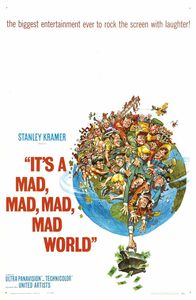
    (In French, On TV, January 2019) The 1960s were a strange time for movies, with studios chasing epic films in a decades-long fight to convince TV viewers to make the trip to theatres. It’s a Mad Mad Mad Mad World is special in that it (along with The Great Race) was a rare attempt to make an epic comedy rather than rely on oh-so-very-serious biblical or historical source material. The result is, indeed a spectacle: As a few strangers hear a dying thief give them the location of a hidden treasure, the rest of the film is a madcap, multi-character chase through the southwestern United States in an attempt to get to the treasure before everyone else. The ensemble cast is a collection of early 1960s comedy stars, even though most of them are now unfamiliar to contemporary audiences. Still, what has not gone out of style is the succession of action set-pieces, impressive stunt work, breakneck editing and far-fetched comic situations in which the characters find themselves. Where else can you witness a plane flying (for real!) through a billboard; a man destroying a service station; or characters stuck on an out-of-control fireman ladder? It’s a Mad Mad Mad Mad World is admittedly very long—at nearly three hours (with half an hour cut from the first showings!), it would be a test of anyone’s patience, except that the laughs and the fast pacing do keep things hopping quickly: director Stanley Kramer may not have the deftest touch with comedy and specifically verbal comedy, but the result speaks for itself. While the film is easy to like, there are a few things that hold it back from unconditional love—namely, that the point of the film is a greedy chase, and so nearly every character (even the one played by the normally likable Spencer Tracy) eventually succumbs to pure old-fashioned backstabbing greed. The ending does the most of what it can with the cards it’s given, but there’s still an absence of a pure happy ending for anyone that stings a bit. Still, It’s a Mad Mad Mad Mad World is a classic for a reason, and its sheer lengths and density of comic set-pieces make it a decent prospect for a rewatch.