Month: June 2021

  • Marilyn Hotchkiss’ Ballroom Dancing & Charm School (2005)

    Marilyn Hotchkiss’ Ballroom Dancing & Charm School (2005)

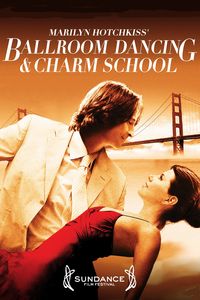
    (On Cable TV, June 2021) I’ve been paying close attention to movies for a quarter-century by now, and yet I still get surprised at some of the films I’ve missed along the way. A look at the cast of Marilyn Hotchkiss’ Ballroom Dancing & Charm School will have anyone wondering why it wasn’t a bigger film. Featuring not only Robert Carlyle close to his career peak, but actors such as John Goodman, Sean Astin, Mary Steenburgen and Marisa Tomei (plus a few other surprises in smaller roles), it’s a bit of a time capsule of interesting mid-2000s actors. I have a specific fondness for Steenburgen and Tomei, so my surprise at the film is even less explicable. On the other hand, it just takes a viewing of the film to understand why it didn’t catch fire at the box office nor stayed in mind as a success. A mash-up of three timelines, it’s a film about 1) a man finding love on the dance floor as he tries to execute the dying wish of 2) a man dying of a car crash, who tells us about 3) his experiences as a young boy learning to dance. Unexplainably filmed in dreary almost-monochrome black-and-blue, it’s an amazingly ugly film to watch for no reason at all — and that, more than the age of the actors, may date the result as being from the overprocessed mid-2000s. While the film is meant to be a meditation on life and death, the result is often far too ridiculously overdone to be effective. It also calls to mind the more successful Strictly Ballroom, which is to no one’s advantage. When Hotchkiss works, it does so in bits and pieces: The montage in which our protagonist learns dance is a lot of fun, but it’s hard to mess up something to the tune of Cherry Poppin’ Daddies’ “Dr. Bones.”  Steenburgen and Tomei are as lovely as ever, but the heavy hand of the writer-director Randall Miller barely lets the characters breathe as one ludicrous coincidence after another is trotted out until the protagonist can achieve his quest. If I correctly understand the film’s production, part of the dislocation between the film’s three narrative strands can be explained by how the historical segments are from an earlier 1990 short film and were not shot specifically for the feature film. (That theory does not, however, explain the overprocessed look of the rest of the film, or the drawn-out nature of the middle segment that could have been handled in five minutes.)  In the end, Marilyn Hotchkiss’ Ballroom Dancing & Charm School leaves us with an ambitious but half-successful result — certainly likable, but constantly pulling audiences back through some weird narrative choices and disconcerting stylistic features. See it for the dancing or for your favourite actors, but keep your expectations in check.
  • Revenge of the Ninja (1983)

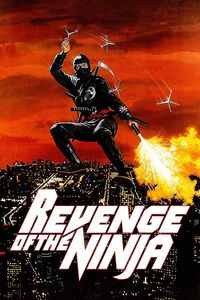
    Revenge of the Ninja (1983)

    (On Cable TV, June 2021) Words fail me in describing the odd abomination that is Revenge of the Ninja. Second in Cannon Films’ “Ninja trilogy” that familiarized western audiences with the idea of a ninja, it’s both a decent action film and a completely ludicrous, almost parodic take on ninja movies. Coming from Canon Film, purveyors of not-so-fine action spectacles, it’s expected that the film will be nothing subtle, and it is not. As slapped together by director Sam Firstenberg, the action is gleefully over-the-top, cheaply produced and not bound to any amount of credibility. By today’s standards, it’s incredibly racist as well, with clichés being thrown about as frequently as blows to the face. The film is not interested in acting or plotting — as long as it gets to stage fights and breathlessly worships a highly unlikely vision of “ninjas,” it’s satisfied going from one ludicrous set-piece to another. Revenge of the Ninja is terrible and yet, at the same time, compelling if only to see what else the filmmakers will try to pass off as worth showing.

  • Cloak and Dagger (1946)

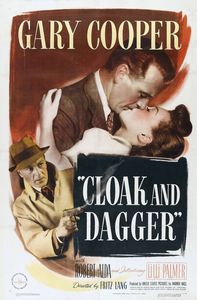
    Cloak and Dagger (1946)

    (On TV, June 2021) In sitting down to watch Cloak and Dagger, I thought I was going to see the 1984 spy thriller (or so the DVR listing reassured me), but I ended up with the 1946 WW2 spy thriller. I’m not complaining — while I do want to see the 1980s film someday, I was only too happy to see Gary Cooper taking on the Nazis and seducing a European resistance member. Based on OSS activities during the war, Cloak and Dagger also touches on the Manhattan Project, perhaps one of the first narrative films to do so. Along the way, it almost invents the James Bond formula, what with its suave agent, world-trotting settings, serial seductions and world-threatening plot in the balance. (If parts of the film feel familiar, it’s because the ending sequence has been parodied in Top Secret!)  Directed by Fritz Lang, you can see how the film is digesting noir cinematography (with many, many sequences set at night) and bridging WW2 propaganda films with later spy thrillers (which, come to think of it, would be a fascinating link to explore). It’s not all that far away from The Third Man or the Greenfield/Lorre geopolitical thrillers of the late 1940s. While I’m not Gary Cooper’s biggest fan, he’s well suited to the role here, gradually evolving from a meek atomic scientist to a dangerous spy (one brutal death along the way) with his usual stoic demeanour. For a film I wasn’t expecting, I found quite a bit to like in Cloak and Dagger, perhaps the most intriguing being the similarities with the Bond formula.

  • Sing and Like It (1934)

    Sing and Like It (1934)

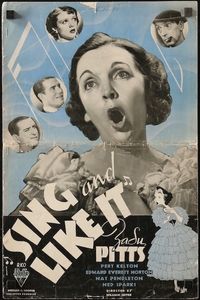
    (On Cable TV, June 2021) As a mildly amusing showbiz comedy from the Pre-Code era, Sing and Like It doesn’t have much of a premise in mind — almost all of it revolves around its protagonist (played by the distinctive Zasu Pitts) and her inability to sing, even as events conspire to make her the star of a Broadway show. Organized crime plays an important part in the plotting, but all she really wants to do, in the end, is to go back to her farmer husband. Most of the jokes have the characters riffing on her awfulness, and yet despite everything her sole number “Dear Mother” becomes a bit of an earworm by the end of the film. Amiable throughout, Sing and Like It does get funnier as it goes on, all the way to a theatrical climax and a happy ending. The interplay between criminal thugs trying to make their way in Broadway society is amusing, and the Pre-Code nature means that a few subtle jokes with violent subtext are more audacious than what you’d see in movies for the next thirty years. As an unlikely Pitts fan, I was thoroughly satisfied here — it’s one of her biggest and best roles as a comedienne, and it’s firmly set within a film that has zingers going all around. Sing and Like It isn’t a particularly well-known film, but looking around for reviews, I see that nearly everyone who saw it liked it.

  • Le Redoutable [Godard Mon Amour] (2017)

    Le Redoutable [Godard Mon Amour] (2017)

    (On TV, June 2021) The French student protests of May 1968 in Paris still echo in the Francosphere’s cultural heritage, and there have been no dearth of movies portraying it, helped along by the considerable participation and sympathy of the filmmakers of La Nouvelle Vague to the cause. One of the newest entries in the subgenre is Le redoutable, a Jean-Luc Godard biopic that covers a few years in the filmmaker’s life, through his wedding and breakup with Anne Wiazemsky (who wrote the autobiography from which the film is adapted). As a portrait of Godard, writer-director Michel Hazanavicius (continuing his meta-cinematic obsession that led to the Oscar-winning The Artist) offers a portrait that’s both detailed and uncompromising: intellectually self-obsessed, lisping, not particularly communicative nor warm with his girlfriend and devastated by the events of May 68 that leave him politically unmoored, Godard is not a hero here. Louis Garrel takes on a titan of cinema as Godard, and the result is a treat for anyone, fan or foe, who knows about the Nouvelle Vague and wants another look at the events of May 68. While I’m not overly amazed by Le redoutable, I’m happy to have seen it and even happier that it exists at all — as a contribution to the corpus of cinema about cinema, it’s not a bad entry at all, and it resists the temptation to paint its subject as saint or villain. (I still like Truffaut a lot more.)

  • Cockneys vs. Zombies (2012)

    Cockneys vs. Zombies (2012)

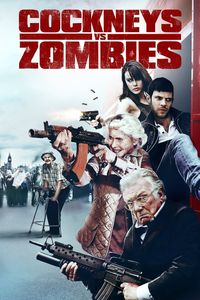
    (In French, On Cable TV, June 2021) Now here’s a pleasant little surprise: just as I was overdosing on zombie films thanks to a weekend-long movie marathon, here is Cockneys vs. Zombies to shake things up. I won’t try to pretend that it’s a particularly fine film or one that has something all that new to offer. But after a stream of dreary nihilistic undistinguishable zombie films, its proudly East-Londonian comic approach has something refreshing about it. The title says it all: Set in a working neighbourhood of East London, a group of petty thieves working to pay for their grandfather’s retirement home suddenly has to confront a zombie uprising. The accents are definitely lost in the French dub (which may make the entire thing more understandable), but one character played by Alan Ford is particularly good, and probably couldn’t have been improved if he had been played by Michael Caine himself. Not taking itself overly seriously, Cockneys vs. Zombies does have most characters survive to the end (something that should be more frequent in zombie movies) and keeps a tone that makes the gore and zombie killings more tolerable. I’m probably overrating this film on purely circumstantial grounds, having seen it right after an overdose overly grim zombie films. Still, it has its strengths even if seen solely as a zombie film: its sense of place is strong, and it doesn’t engage in sub-genre clichés as readily as most of its contemporaries. The brash soundtrack has some insanely catchy songs—with a specific mention of “Head to Head (With the Undead)”—and is just as fun as the film itself. Cockneys vs. Zombies’ sub-90 minutes running time means that there isn’t a lot of fat once past the setup, and the distinctive characters, with their preoccupations, are above the norm for the subgenre. I may have a look later, preferably in a zombie-movie drought, to see if it really holds up. [July 2021: A second viewing definitely holds up.]

  • The Werewolf (1956)

    The Werewolf (1956)

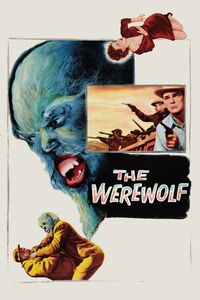
    (On Cable TV, June 2021) On the one hand, there have been countless werewolf movies over the decades since cinema’s invention, and The Werewolf is another one of them. On the other hand, it’s a familiar take executed according to mid-1950s conventions, meaning a bit of noir style, a story taking place in small-town America, and obsessions about “irradiated wolf serum” allowing subjects to survive the inevitable nuclear apocalypse. In other words, it has the advantage of its dated nature, and no film since then would be able to re-create what it manages to put on-screen. It does help that, in the hands of director Fred F. Sears, the film is a snappy watch at 80 minutes, and that the story generally holds up despite the nature of werewolves not being much of a mystery to us viewers. Then again, 1950s audiences weren’t complete innocents either — werewolves and wolfmen having been part of the cinematic vernacular for more than a decade at that point. What’s more important is that The Werewolf works relatively well by itself and even better as a period piece — I don’t mind the time-capsule effect of comparing werewolf films across the decades.

  • Playback (2012)

    Playback (2012)

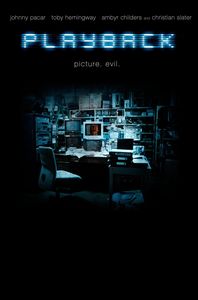
    (In French, On Cable TV, June 2021) As far as low-budget horror films go, there’s something mildly intriguing about Playback and its thematic mixture of circa-2010 DIY filmmaking opposed to early-cinema history. The plot has to do with a family murder in a small American town, leading the characters (fifteen years later) to investigate the matter and discover eerie parallels with the work of a mad pioneer of early cinema who came up with the means to possess people though filming. It’s not much, but you can see how the same elements could be remixed into a far more interesting story—as I await a good film adaptation of Theodore Roszak’s Flicker. Clearly issued from a low-budget production, Playback’s only marquee name is Christian Slater in a supporting role, the rest of the cast being composed of young actors playing teenagers in an inexpensive small town. Wikipedia tells us that the film’s sole claim to fame is having been the lowest-grossing film of 2012, with a total of 33 tickets sold. Ouch — but to be honest, it’s not as if those who skipped on the film missed much. While the result is not terrible when compared to other horror films, there are enough missed opportunities here to make anyone annoyed.

  • Necronomicon (1993)

    Necronomicon (1993)

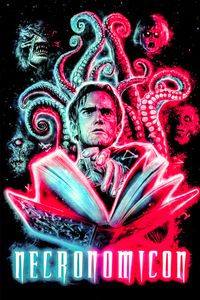
    (In French, On Cable TV, June 2021) Horror anthology films are a roll of the dice every time — not only are the films themselves a gamble, but so are their individual segments as well. Necronomicon has the distinction of focusing on adaptations of Lovecraft’s short stories, but that’s about all that the segments have in common. The framing device has Jeffrey Combs playing Lovecraft as he reads the Book of the Dead in an evil library — not a bad concept, but clearly not the meat of the film either. The rest is uneven. The first segment, “The Drowned,” has some marine chills and an authentic Lovecraftian monster as an antagonist. Follow-up “The Cold” is a more domestic piece that gets away from classic Lovecraftian mythos to deliver an ill-fated romance between a male prey and a female monster (although it does feature David Warner). Final segment “Whispers” is thankfully crazier, going back and forth between reality and fantasy and climaxing with an insane kind of revelation that’s both fun and makes the segment rather pointless. Behind the scenes, there are some impressive names in the crew, from Brian Yuzna to Tom Savini to Christophe Gans. But the result doesn’t quite match the intent — Necronomicon is watchable without being memorable, and there’s a feeling that the tight budget may have limited some ambitions. It’s likely that a modern attempt at the same would be closer to its intentions due to digital special effects technology. More substantially, there’s something regrettable in seeing that the “Lovecraftian” horrors conjured here are about the flash of gooey creatures more than the headier cosmic horror often found in the author’s work. But that’s evaluating Necronomicon based on later, loftier standards — it does remain a decent piece of 1990s horror, and one thankfully focused on supernatural creatures rather than psycho slashers.

  • Heavenly Bodies (1984)

    Heavenly Bodies (1984)

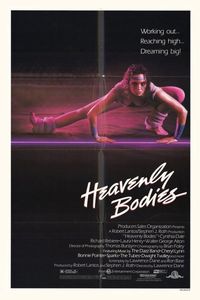
    (On Cable TV, June 2021) While I was alive for the early-1980s aerobics craze, I was (as a prepubescent boy) part of neither the primary nor the secondary audience for it. But thanks to the power of movies and profit-seeking film producers, the craze has been immortalized and we can all rejoice in the results. Piece of evidence: Heavenly Bodies, a made-in-Canada aerobixploitation film with a threadbare plot and many, many shots of women exercising. Featuring plucky entrepreneurs creating their dance studio to escape the drudgery of 9-to-5 work, the film gets most of its dramatic “structure” from a rivalry with another, less nice dance studio owner who has vowed to destroy them. It ends, as it should, with a big dance competition. But no one has ever watched Heavenly Bodies for the plot in its thirtysomething-year history. Most 1980s viewers watched it for the aerobics factor, there was probably a twenty-year lull starting in 1990 and twenty-first century viewers probably watching simply to gawk at what was considered cool at the time. Notice that I haven’t included voyeurs in the list—Despite more neon leotards than you’d ever seen at once, Heavenly Bodies isn’t particularly sexy nor revealing—you’d see more flesh in most non-aerobics horror films of the time. It also counts that the film is more interested in delivering dance session after dance session — there are overt references to Flashdance here in between the aerobics showcases. Cynthia Dale is not bad and rather cute as the plucky heroine, but she’s only a component of a film interested in showing as much aerobics as it can, plot justifications pending. It’s not particularly good, but it’s memorable and rather charming in its aerobics-obsessed mindset.

  • One Week (2008)

    One Week (2008)

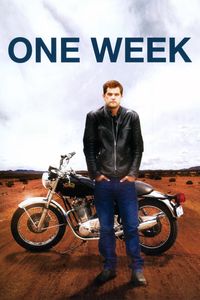
    (On Cable TV, June 2021) Dear Canada: I’m sorry I have failed you by not seeing One Week in the thirteen years since it was released. It’s not only a good movie, it’s a great Canadian movie and I really should have made an effort to see it earlier. But seriously: There are simply too many movies to see all of them promptly, and a few usually escape while we’re too busy watching other things. One Week is one of those, and its non-Hollywood nature isn’t an excuse when the film is a CanCon favourite that is broadcast multiple times a year on Canadian Cable TV channels. The story, in a few words, has a young man (Josuah Jackson, quite good) making a road trip from Toronto to the Pacific Ocean upon learning that he has terminal cancer. His fiancée and family can’t understand, but we can: it’s his last chance for an adventure before chemotherapy kicks in, especially given his rambling conviction that he hasn’t lived much of a life until then. This sets up a terrific road trip film, as he encounters various people along the way and lets them change him even as he has an impact on their lives. The story literally moves all the way west, taking in the landscapes of Canada west-of-Toronto as he rides his motorcycle across half the country in a credible approximation of the Great Canadian Journey. Writer/Director Michael McGowan is clearly aiming high here, featuring cameos by Canadian musicians (including a gobsmacking one by The Tragically Hip’s Gordon Downie as a cancer survivor, given that Downie famously died of cancer in 2017), and touches of magical realism that could only exist in Canada. No, the film is not overtly supernatural, but getting guidance from a Tim Horton Roll-up-the-Rim and stumbling into a small-town arena featuring the Stanley Cup is about as close as it gets. (Alas, the Bakenaked Ladies’ titular song doesn’t make an appearance, probably because its upbeat chords don’t fit the film.)  The addition of an all-knowing narrator adding context and narrative tangent does add a lot to the gravitas and the humour of the film, although this narration leads straight to my biggest problem with the film: A last-scene revelation that the narration is from the protagonist’s book, which sabotages its omniscience and creates vexing questions about what the narrator did not know. Still, I liked One Week quite a bit: It’s not perfect in its details and runs a bit roughshod over a few supporting characters, but it has some real heft and a great sense of Canadiana. I’ve been mulling about an Ottawa-to-Victoria road trip for a while, and One Week confirmed that I shouldn’t wait too long.