Author: Christian Sauvé

  • Dream House (2011)

    Dream House (2011)

    (On Cable TV, February 2013) How can a film with a big twist be so predictable?  Dream House first appears to be a formula-heavy haunted-house thriller with a family in peril and dark secrets underneath the floorboards.  Then it turns into something much stranger, as the supernatural takes a back seat to the delusional and we’re left with a far less interesting murder mystery from a cracked perspective.  The biggest problem with such plot twists is that if they don’t work, if they leave the viewers saying “Really?”, then the whole film has imploded on itself, with little left to say.  Dream House compounds that issue by making all sorts of little mistakes: While it doesn’t try to end on its end-of-second-act twist, the film is left spinning its wheels for a long time after confessing, making a mockery of the film’s now-barely-comprehensible first half.  Also disappointing is the way Dream House dangles a supernatural horror story in front of our noses only to yank it back to “just a crazy person!” and a dull movie-psycho ending.  It’s surprising to see actors such as Daniel Craig (as effective as ever), Rachel Weisz and Naomi Watts (both wasted in dull roles) in fare best suited for direct-to-video mediocrity.  The film does look good, and a few moments could have been more interesting had they been in the service of a better film.  It’s said that director Jim Sheridan made a mess out of a substantially different script, but the result is unarguable: As is stands, Dream House is a big wasted opportunity, a series of potentially promising tangents that, eventually, go nowhere. 

  • Flight (2012)

    Flight (2012)

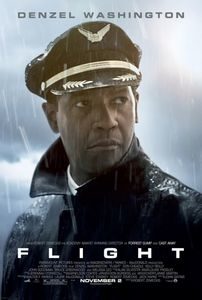
    (Video on Demand, February 2013)  Flight is the kind of film, once popular, that is now rarely seen as a Hollywood wide-release: A character study of a flawed anti-hero, along with a decidedly un-heroic look at an ethical conundrum.  Denzel Washington truly stars as a constantly-intoxicated pilot who manages to save a flight from certain doom after a freak accident: he exploits his screen personae to the fullest in delivering as unpleasant a character as he has managed since Training Day.  Much of the film rests on his shoulders as the post-accident investigation process circles around his own failings as a cause of the crash.  There are some harrowing thrills as Flight graphically portrays a terrible airplane ride (director Robert Zemekis is nothing if not a technically competent director), but most of the film is just solid drama, all leading up to a climactic scene in which the story can go either way.  The result is surprisingly satisfying; the kind of solid film-making that survives on a good old-fashioned script and strong performances.  It’s certainly worth a look, especially for Washington’s performance.

  • What to Expect When You’re Expecting (2012)

    What to Expect When You’re Expecting (2012)

    (On Cable TV, February 2013) When I say that What to Expect When You’re Expecting (the book) was one of my constant references in late 2011, I’m not just recommending the book, but also announcing that as a new parent I’m far more sympathetic to the film than other reviewers (or myself at an earlier age) could be.  Ensemble comedies with multiple plot-lines are a tricky bet: not all plotlines are equally interesting, not all characters get enough screen time to be fully defined, and not all subplots intersect in meaningful ways.  What to Expect does a heroic job at fashioning a comic narrative out of a reference work, and generally manages to avoid the pitfalls of ensemble comedies: All five pregnancy subplots are developed with sufficient detail, the characters are endearing in their own ways, and the interplay between them is often amusing.  It’s not all meaningless fluff throughout: the subplot involving Anna Kendrick remains a bit of a downer for much of the film, whereas the film’s biggest emotional punch unexpectedly comes from an adoption sequence (perhaps because, unlike the delivery scenes, it doesn’t cover very familiar ground) featuring a Jennifer Lopez fresh off the similarly-themed The Backup Plan. Otherwise, there’s plenty of good character work here, from Elizabeth Banks’ frustration-filled (yet most realistic) journey to Dennis Quaid’s happiest role to date.  But the standout performance title goes to Chris Rock, who elevates the film every time the hilarious “Dude’s Group” is featured onscreen.  Is What to Expect a formula-scripted film?  Of course.  Are the comic beats broad and obvious?  Most of the time.  Could it have been better?  Probably.  But will it appeal to anyone in its target demographic?  Well, that’s the whole point of the film.

  • Hysteria (2011)

    Hysteria (2011)

    (On Cable TV, February 2013)  The British film industry has, by now, perfected the science of transforming transgressive subjects into nice little harmless comedies.  From male stripping to The Fully Monty, from naked geriatric photography to Calendar Girls, from cross-dressing to Kinky Boots… Well, why not?  After those precedents, seeing Hysteria make a gentle period comedy out of the invention of the first vibrator is almost expected.  Hugh Dancy stars as a young doctor whose hand-cramps lead to the creation of an assistive mechanical device, but the real subject of the film is a discussion of the ways women were treated in Victorian England, with medical jargon being used to paper over a real disparity in status.  Hysteria isn’t very subtle about this thematic focus (it’s definitely a modern film congratulating itself for not being Victorian England), but the overall light tone keeps things from getting too ponderous.  The film can depend on the innate charm of Dancy and Maggie Gyllenhaal (in a provocative companion piece to Secretary), with occasional assistance by Rupert Everett in a handful of flashy scenes.  Enjoy the lighthearted atmosphere, but don’t try to fact-check the film against the real history of the electrical vibrator.

  • End of Watch (2012)

    End of Watch (2012)

    (Video on Demand, February 2013) Writer/director David Ayer has basically worked his entire career so far in the “LAPD thriller” genre, but the surprise with End of Watch is how the film seems determined to re-invent the police drama, in presentation if not necessarily in content.  Seen from the street-level perspective of two LAPD officers, End of Watch deliberately creates its cinema-vérité atmosphere through the use of enough handheld camera footage as so not to distract when the entire film turns out shot more conventionally.  This appeal to realism is reinforced by actions that go against the grain of how movie policemen usually behave, along with dialogue that sounds improvised and a lack of detail regarding the big picture of the film’s plot.  The episodic plotting gets ludicrously flashy at times (our heroes get involved with enough drug stashes, imperilled kids, human trafficking rings, car chases and shootouts to qualify for the evening news several times over) but the direction of the film keeps everything grounded.  It helps that in-between the action sequences, End of Watch spends time a lot of time with its characters and so ends up focusing on their day-to-day reality.  Jake Gyllenhaal isn’t initially convincing as a tough police officer, but he gets more credible as the film advances.  Still, it’s Micahel Peña who steals the show in a typically compelling performance.  By End of Watch’s conclusion, it becomes clear that this is (unlike much of Ayer’s work-to-date) a film that celebrates the work of ordinary policemen: there are no corrupt cops here, no half-gangbangers, no superheroes: just two guys with badges, trying to do their jobs and make the world safer for their kids.

  • John Carter (2012)

    John Carter (2012)

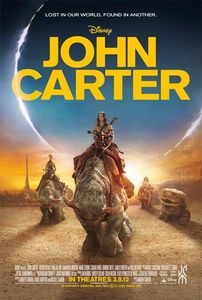
    (On Cable TV, February 2013) Maligned upon release as one of the biggest flops in recent memory, John Carter may not be a great film, but it’s nowhere near as bad as its initial reputation may suggest.  This big-budget adaptation of Edgar Rice Burroughs’s A Princess of Mars may have made heroic efforts to pump some dramatic interest in its now-familiar source material, but it remains a product of another era in many ways: John Carter isn’t naive science-fiction as much as it’s studied science-fantasy, operating with the handicap of adapting a work that helped codify the Science Fiction subgenre.  If John Carter feels intensely familiar or even nostalgic it’s not entirely because the filmmakers have chosen to stay true to familiar genre formula: it’s because the material itself shaped the genre.  Still, a lot of money (250$M) has been spent by director Andrew Stanton in a quest to put Burroughs’ hero on-screen and much of it is visible to the naked eye: The film is crammed with special effects, fully-animated characters and lavish set-pieces.  It’s a spectacle of the highest order, and that aspect alone may justify a viewing even through the other aspects of the film may be lacking.  The film has been in development for a very long time, so seeing it on-screen is a bit of a marvel.  There’s a sense of missed opportunities, though: for all of the impressive work done in order to transform Burroughs’s rough adventure novel into a coherent three-act script, there’s a sense that the film is indulging into nostalgia rather than trying to deliver something new.  It’s old-school SF, so old-school that it may not have deserved the revival.  Taylor Kitsch is bland in the title role, but at least Lynn Collins seems to step out of the covers of pulp SF magazines as Martian princess Dejah Thoris.  The special effects are plentiful for those who like that sort of things, and the wide-screen visuals often mask dull moments in the plotting.  Direction-wise, Stanton has an odd sense of rhythm and editing that work against the picture: Carter’s exaggerated feats look silly no matter how carefully explained.  The script does have a few good moments (surprisingly enough, even the framing device works well) but it’s cookie-cutter stuff, made even worse by the deliberate naiveté of the Science Fiction being practiced here.  So: See it for the visuals.  Don’t expect much from the rest.

  • Taken 2 (2012)

    Taken 2 (2012)

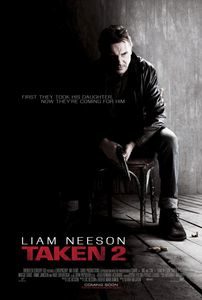
    (Video on Demand, February 2013) Part of the appeal of the original Taken was seeing a rather serious dramatic actor like Liam Neeson take on an action-hero role, within an exploitation film that was competently scripted and directed.  Taken 2 has no such element of surprise, and little to offer in terms of execution.  Frankly, its premise half-reads as a parody: Members of his family get kidnapped… again!  Of course, there’s a little more than that to it: the revenge-driven premise cleverly springs from the consequences of the first film, and you can point at this sequel to show how the expectations set by the first instalment are cleverly tweaked (ie; the adults get kidnapped but the daughter doesn’t, and the protagonist has to work with his daughter to get the means to escape) alongside the way Istanbul is used as a setting in order to show how Taken 2 is reasonably good at what it set out to do.  Unfortunately, there isn’t much extra substance or interest to the film.  Luc Besson’s “Digital Factory” is not known for consistent products, and Taken 2 falls in the middle of their offerings.  Director Olivier Megaton isn’t as meanly efficient as Taken’s Pierre Morel (his action sequences don’t flow quite as well), and the script seems noticeably lighter: Mute off the gunfights and chase sequences, and not much remains in this fairly linear plot.  Liam Neeson, of course, isn’t the same actor as he used to be: Although equally effective at inhabiting his character, he is now (after Taken, The A-Team, Unknown and The Grey) almost his own Liamsploitation action category.  Taken 2 isn’t much of a surprise, nor does it work as hard as the original at pleasing audiences… considering that the effectiveness of original was almost an accident, trying to replicate it doesn’t really work.  It’s a film that works best as filler for people who want a quasi-copy of the original.  Everyone else may want to look at something else.

  • Terrorvision (1986)

    Terrorvision (1986)

    (On Cable TV, January 2013) I must be losing whatever little horror-camp sense of humor I might have had, because my reaction to this horror/comedy hybrid is closer to faint disgust than knowledgeable amusement.  Terrorvision (watched because of three silly reasons: I’d never heard of it, it shares a title with a British pop band I like and it could be recorded on the PVR without too much trouble) mixes lame comedy with gooey horror in showing an extraterrestrial monster invading a family home.  But it’s all in the execution, and clearly the filmmakers had no intention of delivering a conventional film.  Here, the family home is decorated like a brothel, the adults are swingers, the grandpa is a survivalist, the teenage daughter incarnates 80s-pop-chic and all are meant to become monster fodder.  Terrorvision is directed with a sense of overacting, plastic sets, straightforward cinematography and a garish design sense that make lower-rung sitcoms look subtle.  The initial impression is off-putting (especially for those without affinity with trash camp cinema), but what keeps the first half-hour interesting is a growing dismay at how bad the movie can become, mixed with an unhealthy fascination at seeing so many 80s clichés piling up on-screen.  (Also: getting a glimpse at the naughty art on the wall of the house)  Once half the family has been killed shortly after the hour-long mark, however, much of the interest evaporates, leaving a slight sense of grossness at the results.  Grotesque and iconoclastic, Terrovision does have a few things going for it: its willingness to subvert expectations, however, would have been more acceptable had it been tempered with better laughs, fewer gross-out moments, a bit more wit and/or some nudity (curiously enough for a non-mainstream horror/comedy hybrid, Terrorvision mercilessly teases but never delivers.)  I ended up fast-forwarding through much of the last half-hour, and watching the last few minutes in real-time did not make me regret that decision despite the narrative subversion that gets wilder and wilder as the film advances.  In fact, I felt slightly dirty after watching the film, as if it hadn’t managed to earn its transgressions with basic filmmaking competence.  But then again, maybe I’m losing my sense of humor.

  • Starship Troopers: Invasion (2012)

    Starship Troopers: Invasion (2012)

    (On Cable TV, January 2013)  It’s almost reasonable that this fourth film in the Verhoeven-influenced series would make the jump to full CGI animation: after all, most of the film takes place in entirely-synthetic environments, with aliens battling human soldiers in oversized power-suits.  Never mind if the human CGI characters haven’t improved much since 2001’s Final Fantasy: The Spirit Within: they’re now much cheaper to produce (Final Fantasy was a prestige $137M production released in thousands of movie theaters; Invasion is a direct-to-video release) and actors don’t have to negotiate harder if they’re asked to perform nude scenes.  (In the spirit of the franchise, Invasion has one naked locker-room scene.  In CGI, it’s about as appealing as you’d think –which is to say, not very much.)  At least the format enables the screenwriters to indulge into complicated action sequences that could never be executed otherwise: Invasion spends much of its time in space, battling evil bugs aboard space stations and starships.  The goal here is to deliver on a lot of military Science Fiction action against evil bugs, and the film more or less manages to deliver –albeit with some rough pacing issues in the first act, as undistinguishable characters are set up with the goal of killing off most of them before the end of the film.  Invasion plays roughshod with physics (an action beat early in the film makes no sense considering that there’s no gravity in space, but the entire film assumes that there is) and Parisian geography, but there are a few neat ideas here and there (being able to use the powered armor adds a bit of action), a good sense of mounting tension and at least a nod at the series’ continuity –although I’m told that the story makes more sense if you’ve seen the Roughneck animated series.  While the result may be a bit formulaic, the screenwriting possibilities offered by CGI make it better than either the second or third film in the series… and that’s significant: Invasion may be most interesting considered, alongside Sony stable-mate Resident Evil: Degeneration, as an early example of how animation can be used to extend the life of SF franchises (perhaps soon allowing characters to remain forever young despite their connection to an actor).  As it is, the film isn’t a complete waste of time, although you may have to like military SF in order to make the best of it.

  • The Words (2012)

    The Words (2012)

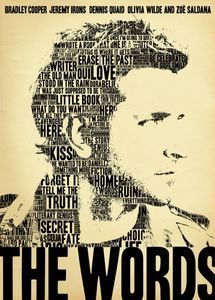
    (Video on Demand, January 2013) I’m favourably pre-disposed toward films about writing and writers, but even with this added sympathy, there are many ways in which The Words doesn’t quite work as well as it could.  The interweaving of stories in which a successful author tells us about a young writer hearing about another young author’s life is intriguing, but the conclusion seems to spring forward at about thirty second’s notice, with a scarcity of details at the upper level.  The sudden appearance of the end “directed by” card is a disappointment, as so much of the story seems unfinished.  More holes emerge the longer one thinks about the film.  I also had a few problems with the putative protagonist of the film, ably played by Bradley Cooper: What kind of idiot calling himself a writer works exclusively for years on a single literary manuscript in New York City?  Who is incurious enough not to investigate a literate manuscript from post-War France when so many great writers lived there at the time?  Why even call yourself a “writer” when there’s so little hesitation in plagiarizing so thoroughly?  Even allowing The Words those premises as given (and adding the improbability of a manuscript remaining undiscovered for decades) and appreciating the careful way in which the film is constructed doesn’t necessarily make the film a success considering its cast.  Dennis Quaid and Olivia Wilde’s characters remain half-developed mysteries, unbalancing the film’s core of interest to its first fictional level.  Despite the deliberate ambiguity at the very end of the film, The Words seems half-finished, a decent film petering out in a wet whisper of a conclusion.  Despite wanting to like the film and everyone involved in it, it ends up being a bit of a dud.  A well-made, respectable, often-likable dud, but a dud nonetheless.

  • Cooking for Geeks, Jeff Potter

    Cooking for Geeks, Jeff Potter

    O’Reilly Media, 2010, 432 pages, C$43.99 tp, ISBN 978-0-596-80588-3

    To repeat the obvious: Books aren’t just about their subject matter than they are about their relationship with their intended audience.  You can turn an ordinary book into a remarkable oddity simply by shifting the audience, and that’s where the genius of Jeff Potter’s Cooking for Geeks comes in.

    Yes, there have been a lot of cookbooks over the past few years.  Cooking has become something cool, and cookbooks are reliably the top-selling genre of non-fiction books.  Everyone needs to eat, so the theoretical audience for cookbooks is everyone.  Who isn’t hungry for a few more delicious recipes? So when publishing house O’Reilly, specialized in technical manuals for computer experts, decides to publish something called Cooking for Geeks, you can expect some serious cooking advice for equally-serious nerds. 

    One of the best things about the book is that it makes no assumptions of competence.  Geeks can learn anything, and much of the book is dedicated to re-explaining cooking from a technical perspective.  If ever you’re in the market for an explanation of food that somehow involves references to UNIX, solid engineering principles and geek-culture icons such as Mythbusters and XKCD, then, well, Cooking for Geeks is exactly what its title promises.

    As may be expected from a geek-book explaining the world, Cooking for Geeks is both playful and endlessly curious.  One of the earliest exercise in the book, demonstrating how recipes aren’t sacred tests, consists in data-mining the internet for pancake recipes, and then averaging out the results into a peer-reviewed meta-recipe of sorts.  Cooking isn’t like programming in that precise syntax isn’t required (loose typing is fine), but cooking is like coding in that there are often many, many ways to get to the same results.  (It’s no accident if Cooking for Geeks contains both “don’t deviate from the recipe” and “deviate from the recipe” as fundamental advice.)  If everything else fails, you can either recompile (alter the ingredients) or go COTS (order pizza).

    Potter’s assured main text is enlivened by numerous pull-outs and interviews with geek and cooking notables.  The interviews bring different voices into the narrative, explore tangential subjects or simply show how cooking is unusually well-suited to personal explorations.  All interviewees are enthusiastic about their topics, and this attitude carries over into the book’s cheerful boosterism for cooking.  Nearly every page of Cooking for Geeks brims with the typical geek attitude of endless curiosity about the world.  Compared to other introductions to cooking, Potter’s technical tangents are what makes the book worth reading.

    From relatively basic beginnings, Cooking for Geeks gets quite a bit more complicated as it goes on, eventually touching upon deeply geeky cooking innovations such as molecular cuisine, sous-vide and “power-tool” cooking in which warranties get voided.  Throw in an exemplary chapter on food safety and the result is a well-rounded introduction to the culinary arts for an audience that wouldn’t necessary know where to begin in the vast, vast ocean of cooking-related information.  Potter has done the research, cleared away the confusion and presented an invaluable distillation

    Will it transform anyone into a decent cook?  It depends on readers’ follow-up, of course: The danger with cookbooks, no matter the audience, is that they are read enthusiastically and then gradually forgotten without having made an impact, falling victim to the chronic lack of time that everyone (not just geeks) is belabouring under.  The same amount of time required to become a proficient coder is the same as one required to become a decent cook, and no amount of cheerleading can go against the pressures of life.  But that’s outside the book, and in the meantime Cooking for Geeks is almost exactly the best cookbook that could have worn this title.

  • Final Destination 5 (2011)

    Final Destination 5 (2011)

    (On Cable TV, January 2013) I’m of two minds about the Final Destination horror film series: While the first one created a nice sense of dread that carried through after the credits rolled, much of the subsequent series has been pure carnography, with ingenious Rube-Goldbergian death sequences leading to excessive gore.  Final Destination 5 is neither better nor worse than the series has been on average: The opening disaster sequence is impressively staged, with Vancouver’s Lions Gate Bridge earning a starring role in the process.  When it comes to the usual death sequences, they blend amusing fake-outs with preposterous assumptions about the fragility of a human body: In this film, the slightest blunt trauma apparently causes bodies to explode and rain internal organs.  It’s this cheap Grand-Guignol approach to its deaths scenes that drag down the series’ more interesting themes.  At least Final Destination 5 is slightly better than its immediate predecessors in expanding the mythology: it suggest another way out of the death cycle but, true to the series’ increasingly tedious nihilism, immediately snatches it away in a muddle of dark irony and plot holes.  The finale brings back the film to the first installment but the stunt feels more perfunctory than interesting –it would have worked best as a trilogy-finale, but it’s not as if there won’t be another Final Destination 6 in a few years, after all.  As for the film itself, there’s some crisp and efficient work here by director Steven Quale (shot in 3D, the film still works just fine in 2D TV-land), and some of the actors are charismatic enough to make us sympathise with them a little bit. (“Aw, c’mon, couldn’t we wait a bit before killing Olivia?”)  While still a notch better than usual horror film (and quite a bit better than the usual fifth installment of ongoing horror franchises), this Final Destination 5 is also sadly notable for the opportunities it doesn’t take.  It’s good at what it tries to do, but for once I’d like a less gory and more thoughtful take on the same material.

  • Wrath of the Titans (2012)

    Wrath of the Titans (2012)

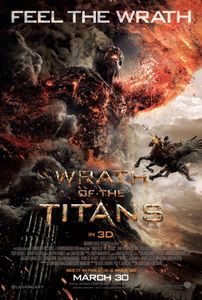
    (On Cable TV, January 2013) The sad news is that Wrath of the Titans doesn’t have the arch melodramatic tone that made its predecessor so much fun to watch: “Release the Kraken!”, anyone?  The good news is that this sequel to Clash of the Titans remains a relatively entertaining action/fantasy film: the bare-bones plot serves handily as an excuse for well-choreographed action sequences involving grander-than-life fantastical creatures.  Director Jonathan Liebesman shows a good eye for flowing action sequences, and the film has a few gorgeous continuous shots in which the action plays out beautifully.  Tons of fiery special effects add more interest, especially when dealing with the skyscraper-sized end boss.  Sam Worthington holds the film together as no-nonsense reluctant hero Perseus, but Bill Nighy has a bit of fun as a half-mad god while Liam Neeson also makes an impression as a bound Zeus.  Thematically, there’s a flicker of interest when we realize that the story is taking place at the twilight of the gods’ influence over human affairs: there’s a last-hurrah atmosphere to the plot that interesting in its own right.  Still, let’s not kid ourselves: this is pure spectacle, the fantasy elements being excuses for bigger action set-pieces.  Wrath of the Titans works well in this context, and delivers the high-gloss entertainment factor that viewers of the first film expected.  That first entry wasn’t all that good, but this follow-up best succeeds at what it tries to do, and that’s already quite a bit better than many recent action/fantasy hybrids.

  • Looper (2012)

    Looper (2012)

    (Video on Demand, January 2013) There are quite a few things that annoy me about Looper: The inanity of its time-traveling premise, the slap-dash way its future is assembled, the way the two main stories of the film don’t seem to mesh seamlessly, the lengthy time-out in the third quarter of the film… all elements that could and should have been fixed.  But these doubts having been expressed, let us not be distracted from the fact that Looper remains one of the strongest SF films of 2012 in a relatively crowded field: It’s a solid movie, a confident effort that doesn’t spoon-feed its audience and engages with provocative questions about our relationship with ourselves (in the first plot-line) and our duty to the future (in the second).  Joseph Gordon-Levitt stars as the younger version of a character also played by Bruce Willis, but it’s writer/director Rian Johnson who emerges as the big winner of the film: not only does he turn in an accomplished piece of cinema, he also plays with SF archetypes in a refreshing matter-of-fact fashion that allows him to use those elements to get to the core of the drama he wants to set up.  Looper goes effortlessly from the streets to the cornfields, striking a Midwest SF atmosphere that feels refreshingly different from many of the other recent SF blockbusters.  While the script has weaker points, it manages to present a few complex ideas cleanly, and its second half’s sense of moral uncertainty is uncanny in the best sense.  For SF fans who are tired of the same old visually-spectacular-but-dramatically-hollow products, Looper is a small triumph and another entry in the mini-boom of good original cinematic SF since District 9.

  • The Girl (2012)

    The Girl (2012)

    (On Cable TV, January 2013)  The example set by Alfred Hitchcock still looms large over the entire suspense genre, but as the years go by the filmmaker seems to be remembered more as a cultural icon than a man.  That makes him ripe for a re-interpretation:  The Girl uses the director’s troubled relationship with actress Tippi Hedren as a way to explore his weaknesses and the result is damning.  Here, Hitchcock is portrayed as an unapologetic harasser, blending unwelcome advances into the power dynamic between director and actress, abusing Hedren under the guise of filmmaking as a way to take revenge against her unwillingness to play along.  The Girl is obviously told from Hedren’s point of view –Sienna Miller spent some time with Hedren in preparation for her role, and Toby Jones seems fully committed to presenting an increasingly unlikable portrayal of the director.  For a TV (BBC/HBO) film, the film has acceptable production values and decent direction.  Both Miller and Jones turn in good performances, and film enthusiasts will appreciate both the recreation of The Birds’ shooting process alongside an unusual look at the dynamic between actor and director.  While Hitchcock’s portrayal here is one-sided (numerous other associates of the director have spoken against the film; the competing Hitchcock biopic is said to be more sympathetic), it’s certainly not uninteresting.  As such, the film warrants a look even as a dramatized exaggeration of real-life events: we may not know the true story, but the way it’s presented here is enough to make anyone wonder about what went on in 1960s Hollywood.