Author: Christian Sauvé

  • Flammen & Citronen [Flame & Citron] (2008)

    Flammen & Citronen [Flame & Citron] (2008)

    (On DVD, September 2011) It would have been so easy to take the basic premise of this film and make a big schlocky over-the-top action movie out of it: After all, what better than two distinctive assassins working together to kill Nazis during occupied WW2 Denmark to inspire gunfights, car chases and explosions?  In fact, for short moments, it’s possible to mistake Flammen & Citronen for such an action movie.  There’s gunplay, car chases and maybe an explosion or two.  But make no mistake: As it advances, the film gets grimmer and grimmer, as it becomes obvious that the resistance is being exploited, that the Nazis may not all be worth a bullet in the head, and as the two lead characters fall in increasingly desperate circumstances.  Sooner or later, their actions doom them to an inglorious end.  Still, Flammen & Citronen does deliver in terms of entertainment, and the downbeat ending fits with the ambiguous thematic aspirations of the script.  (It’s also faithful to the true story that inspired the film.)  As a look at World War 2 from a different perspective than the Anglo-Saxon (or French) one, Flammen & Citronen is an entry on par to the Dutch Zwartboek / Black Book.  (Even though Verhoeven’s film feels more polished, the pair makes for a splendid double feature.)  The production values of the film as impressive, and the recreation of the era is believable.  Thure Lindhardt and Mads Mikkelsen are fine in the title roles, but WW2 cinephiles will have more fun spotting Christian Berkel in yet another Nazi role.  Flammen & Citronen got practically no play in North America, but it’s a world-class piece of cinema; anyone who thinks that there’s nothing more to say about World War 2 may want to have a look at this one.

  • The Ultimate Game Guide to Your Life, Christopher Monks

    The Ultimate Game Guide to Your Life, Christopher Monks

    Tow Books, 2008, 238 pages, C$14.95 pb, ISBN 978-1-58297-534-4

    I’m not quite sure what I was expecting from Christopher Monks’ The Ultimate Game Guide to Your Life, except that it was sitting cheap on the remainder cart, was billed as humor and anything with a subtitle like “The Video Game as Existential Metaphor” interests me.  Flipping through the book showed a few cute illustrations; what else could I hope for?  Life’s hard enough –don’t we all need a comforting walkthrough?

    For a while, though, it looked as if I may have made an error in picking up the book.  The first few pages are a tough slog, as the game/life metaphor initially fails to gel, and the putative protagonist of the walkthrough hasn’t yet been developed enough to sustain the comic narrative that later emerges.  There are a few good lines about you, the baby, not yet being too sure about “mom’s friend”, and how the game’s control at this early stage aren’t just unlabeled but don’t do the same thing.  Still, the first chapter seems like a fairly conventional way to talk about infants and toddlers.  Where’s the substance?

    Things show some clear improvement in Level II (“Your Childhood”) as the rules and complex meta-fictional devices of the narrative start settling down.  Suddenly, the life being described becomes a story of sorts, with recurring characters emerging through the successive narratives (that darn Dennis!).  By Challenge Eight (“Losing your sister at the Huddy Sizzlebolt Happy! Fun! Learn! Show!”), the book loosens up and finally benefits from a protagonist old enough to have adventures and feature more darkly absurd material.  By this time, we’re also becoming more familiar with the conventions of the book, as The Ultimate Game Guide to Your Life isn’t just a gaming walk-through, but an unauthorized one that sometimes second-guesses what the designers were thinking.

    Like life itself, the book reaches a certain narrative velocity as it hits the protagonist’s teenage years.  Making it through high school is amusing, and the fun doesn’t stop by the time the character reaches college and then takes a job at the donut store.  Hilarious bits include high school cliques, a memorable reunion with a high-school crush that somehow involves freeing minks, and using hostage crises at the donut shop as an advancement mechanism.  There are also a few throwaway gags about an optional robot war.  The first chunk of the early adulthood stage ends with the hero becoming a father…

    …and without getting too personal, this is where the book sucker-punched me.  You’d have to be at my place in life and read pages 169-172 to understand why.  Maybe I suspected something in picking up the book.

    Much of the rest of The Ultimate Game Guide to Your Life seems to be downhill from that moment, as (and this is where the book’s existentialism becomes obvious) much of life also seems to be.  Kicking back from the content of book for a moment to indulge in a bit of idle thoughts about video-gaming and life, there’s some wisdom in realizing that most people never get a satisfying dramatic arc; that lives go on after their main stories end, and that preparing another generation to play is the closest we’ll ever get to “winning the game”.  No wonder new parents give up gaming… at least as they focus on something else.

    Back to The Ultimate Game Guide to Your Life, it’s not much of a surprise if the last third of the book seems to turn grimmer as the end approaches.  Despite the jocular consistency of the game’s challenge, it doesn’t take much of a subtext to cringe during the last challenge set in an Assisted Living Facility.  As the line goes, “Old age isn’t for Sissies.”  Appropriately enough (this isn’t a spoiler), the book ends at the end of the protagonist’s life… that is, Your Life.

    One thing is for sure: I wasn’t expecting such a kick in the pants from a humour book making parallels between gaming and an ordinary life.  It’s enough to make you sit quietly in a chair and ponder the meaning of it all.  We all, I suppose, create our own mythological frameworks for what happens to us, and the future we can reasonably expect to have.  At the moment, it’s a surprisingly effective tactic to draw upon the modern mythology of the age, video games, to tackle the question.  Uneven but amazingly effective when it works, The Ultimate Game Guide to Your Life is a memetic wolf in sheep’s trade binding.  Open it carefully if you’re going through one of life’s big transitions.

  • Zwartboek [Black Book] (2006)

    Zwartboek [Black Book] (2006)

    (On DVD, August 2011) For a director who helped re-shape American popular cinema with four solid hits and one legendary failure in-between 1987’s Robocop and 1997’s Starship Troopers, Paul Verhoeven has been really quiet since the artistic failure of Hollow Man in 2000.  To see his only film since then, you’d have to find  Zwartboek, a World War 2 thriller in which a beautiful young Netherlander woman is stuck between the occupying Nazi forces and the local resistance movement during the last few days of the war.  While, at first, Zwartboek seems to be just another resistance film, the increasingly messy tangle of allegiances makes for a far more interesting narrative, and a striking statement on what happens after victory is obtained: Accounts are settled, resentment surfaces as aggression and accusations are more effective than doubt.  Produced with what feels like a decent budget by Netherlander standards, Zwartboek convincingly re-creates the period, and features more than decent production values.  There are even a few chases and explosions to reassure us that, yes, it’s that Paul Verhoeven.  But much of the film belongs to the actors, starting with Carice van Houten playing a merciless role as the heroine.  (WW2 cinephiles will also recognize Christian Berkel from other similar movies as Valkyrie, Downfall and Inglourious Basterds, among many others.)  Amusingly for a film featuring an unusual non-Anglo-Saxon viewpoint on WW2, Canadians get a fairly good portrait as the liberators toward the end of the story.  Weaker points include a framing device that robs the film of a bit of suspense, and a clunky first act that seems to run around in coincidental circles, meeting everyone twice in the small universe of The Hague.  Still, while the film’s solid European origins clearly show in the amount of casual nudity and the last act’s lack of moral certitudes, the overall result is an entertaining film that more than holds up to anything else in the world.

  • Best Worst Movie (2009)

    Best Worst Movie (2009)

    (On cable TV, August 2011) A documentary about the revival of Troll 2 as a cult movie favourite by its grown-up child actor Michael Stephenson, Best Worst Movie is most interesting when it touches upon the lives of actors twenty years later.  It wisely focuses on George Hardy, who shelved his acting ambitions to become a dentist and discovers to his surprise that the film has grown in popularity since its financially disastrous release.  Going from his quiet Midwestern life to the film festival circuit, Hardy acts as the audience’s stand-in as he discovers the peculiar nature of cult movie aficionados.  Best Worst Movie eventually ends up speaking to nearly every major contributor to Troll 2, showing us a bittersweet diversity of fates: From a New York Times bestselling author to a self-admitted failure, a reformed mental patient, a bitter delusional director and an actress whose hard life has left her unhinged from reality, the aftermath of a low-budget film proves fascinating to explore.  At a time where film geeks can learn nearly everything about a film after its release on DVD, Best Worst Movie takes the long view and asks where minor actors can be found twenty years after a disreputable low-budget effort.  (Some of them, still working in the industry, conveniently leave Troll 2 out of their resume.)  There’s a dramatic arc of sorts to the film as Hardy briefly flirts with the idea of a revived acting career, then hits a wall at two major conventions and realizes how little he has to regret as a successful member of his community.  A cult movie success doesn’t necessarily translate into broader horizons, and few seem to miss that point as completely as Troll 2 director Claudio Fragasso, who mistakes the trash-movie following for his earlier film as a repudiation of the critics’ savaging. (Admittedly, he may be self-consciously playing an Italian-director archetype here.)  Best Worst Movie is an entertaining, not-always-funny trip through the underworld of cinema; the so-bad-it’s-good upside-down universe of horror cult films, the not-so-triumphant aftermath of lives after “being in a movie” and the unsettling realization that most bad movies never get even an affectionate cult revival, but slink away from mind without a single trace in popular culture.  Despite the occasional laughs in Best Worst Movie, there’s enough in here to inspire sober reflection.  I suppose that a more dispassionate filmmaker may have been able to dig a bit deeper in the issues raised by Troll 2’s cult revival; on the other hand, Michael Stephenson got access to nearly everyone of consequence, and the resulting film is far more affectionate about its subject than you may expect.

  • Ice Quake (2010)

    Ice Quake (2010)

    (On cable TV, August 2011) There isn’t much to be said about Ice Quake besides “made-for-TV science-fiction disaster movie”.  From that curt description, everyone should understand that the film’s low-budget doesn’t allow it to match its own ambition.  A small number of cookie-cutter characters, truncated action sequences, slap-dash special effects, stupid science, straightforward plotting and surprise-less drama quickly follow.  Still, compared to the standards set by previous “Syfy Channel Specials”, Ice Quake is a bit better than most.  The quality of the images is fairly nice: some Alaskan stock footage helps, but there are a few BC location sequences that are pretty in their own right.  Thanks to the actors (including Brendan Fehr), the characters are somewhat sympathetic despite the ham-fisted screenwriting.  More significantly, the film dares to attempt things like snow-bound location shooting, snowmobile stunts, CGI helicopter sequences and a kind of disaster (methane build-up, released in super-frozen geysers) that hasn’t yet been overused on film.  It doesn’t really achieve complete success, but the attempt is ambitious and the level of quality could have been far worse.  For hard-SF fans, the plot to the film is in the comforting template of scientists seeing a problem, understanding a problem and resolving the problem (also see: the joined-at-the-hip Movie Network/Super Écran made-for-TV disaster film Metal Tornado).  The Christmas theme should play big around the holidays.  Don’t expect much, and you just may be not entirely disappointed.

  • Barrayar, Lois McMaster Bujold

    Barrayar, Lois McMaster Bujold

    As second half of Cordelia’s Honor, Baen, 1996, 596 pages, C10.99, ISBN 0-671-57828-6

    I first read Lois McMaster Bujold’s Barrayar more than a decade and a half ago, as I was making my way through the long list of Hugo award-winning novels.  At the time, the only copy I could find was a French translation, and I didn’t have a lot of knowledge about the Vorkosigan universe in which Barrayar is such a keystone.

    Recently, though, I happened to pick up a copy of Cordelia’s Honor, an omnibus containing both Barrayar and its prequel Shards of Honor.  Filling the blanks in my Vorkosigan series, I read Shards of Honor and then, while I was at it, started on Barrayar to see if there was anything I’d forgotten in the meantime.

    It turns out that I had forgotten quite a bit, and didn’t know about many other things.

    The first thing that struck me going from Shards of Honor to Barrayar is how seamlessly the story flows from one book to the other.  Barrayar picks up pretty much where Shards of Honor leaves off: Cordelia’s Honor makes for a far more justifiable omnibus than the other collections of Vorkosigan material that Baen has been throwing together for a while.  There’s a five-year difference of writing experience in-between both books, and it shows: While I had some trouble staying interested throughout Shards of Honor, such unevenness isn’t as apparent in Barrayar as the novel starts out strong and stays that way: Bujold’s prose flows more easily, and her gift for portraying characters get better and better.

    The second thing I noticed is that even if Barrayar is chronologically one of the first volumes in the Vorkosigan saga, it’s quite a bit more enjoyable for veteran readers of the series.  Dramatic irony abounds for those who know where the universe is going and what the fates of the characters introduced here will be.  It’s amusing to see familiar characters during their younger years and heartbreaking to see doomed characters get their moments of glory.  It’s also hard to overstate how crucial the events of this novel are to the rest of the series: Globally, Barrayar describes how Aral Vorkosigan is designated as regent and takes over the reins of power during a difficult civil war.  More personally for the characters of the series, this is where a pregnant Cordelia Naismith suffers from a neurotoxin attack, something that will forever shape her unborn son (and series protagonist) Miles.  Less seriously, it’s intriguing to see here the first seeds (Ivan’s birth; the Kou/Drou romance) of plotlines that will keep going through much of the series so far.  I don’t, as a rule, tend to like long-running series, but Bujold does it better than anyone else, and setting a novel a generation before the main body of the series allows her to bring the most out of her overarching plotlines.  It’s one thing to read through the Vorkosigan series and hear about the history of the characters; it’s another to directly experience it here.

    We can also see in this novel the beginning of Bujold’s middle-period Vorkosigan era: From 1991’s Barrayar to 1999’s A Civil Campaign represents, to date, the peak of this series, past the initial throat-clearing and before the relatively minor exercises of Diplomatic Immunity and Cryoburn.  It’s during that time that she’s at her best blending SF plot devices, strong character development, pitch-perfect transparent prose and ingenious plotting with whatever tone any particular novel mar require.  Few other SF writers have ever reached the kind of sustained excellence of that series, and Barrayar is without a doubt one of the major novels in that cycle.  Never mind the Science-Fictional trappings and the accumulated knowledge of the series you need to have in your head in order for the book to work best: This is one great novel, beautifully conceived and skilfully written.  It’s worth a read if you’re not familiar with the Vorkosigan saga, and well-worth a re-read if you are.

    [August 2011: Let me hide in a footnote another difference in reading the novel that should have headlined the review if I wasn’t so reluctant to discuss my private life on-line: Reading Barrayar, with its embryonic neurotoxin subplot, as an older teenager is one thing.  Reading it while my wife and I are experiencing the first trimester of our first pregnancy is positively terrifying.]

  • 30 Minutes or Less (2011)

    30 Minutes or Less (2011)

    (In theaters, August 2011) As a criminal comedy, there are a lot of similarities between this and Pineapple Express.  Not only does Danny McBride has a prominent role in the two movies, but both are criminal comedies starring underperforming slackers in the lead roles.  Here, a pizza delivery guy in his twenties is kidnapped by two other slackers, put in an explosive vest and told he’s got no other choice by go rob a bank.  What follows is a quick 80-minutes tale of criminal stupidity and plucky heroes.  Forget about social commentary, wholesome family entertainment or mind-expanding revelations: It’s pure comic character work set within a thriller template.  Despite the film’s similarities to the Brian Douglas Wells criminal case, 30 Minutes or Less doesn’t claim to be based on a true story, and fortunately doesn’t try to remind aware audiences of the real-life drama.  Jesse Eisenberg is a bit more tolerable than you’d expect as the lead, but it’s really Aziz Ansari and Michael Peña who steal the show in enjoyable supporting performance.  The script is peppered by high-energy moments –including a car chase that plays with the conventions of the genre and a quick ending that’s over almost before we know it.  The humour to too crude to be fully enjoyable, the violence is too gory to be forgettable and the rhythm is inconsistent, but 30 Minutes or Less still manages to score a few hits, and the tone is just controlled enough to avoid the exasperating immaturity of, say, Pineapple Express.  While it’s a step down for Zombieland director Ruben Fleischer, it’s nonetheless an acceptable summertime crime comedy.

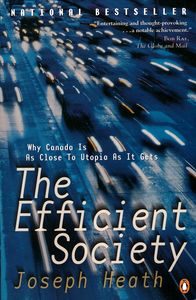
  • The Efficient Society, Joseph Heath

    The Efficient Society, Joseph Heath

    Penguin Canada, 2002 reprint of 2001 original, 339 pages, C$22.00, ISBN 0-14-029248-0

    From time to time, I find myself wishing that I’d read some books earlier.  Part of it is a reflection on my stack of things to read: Even if I completely stopped buying books right now, I would still have about two years’ worth of stuff to read.  Part of it is the vertiginous realisation that the universe of good books is vast, and there are still thousands of them to read.  The Efficient Society is one of those; a book that, in 2001, first brought philosophy professor Joseph Heath to national attention.  Heath would go on to write The Rebel Sell with Andrew Potter, which is the book that made me realize that I should be reading more of Heath/Potter’s work.  Going back in time to The Efficient Society, I end up cursing myself for not reading it ten years ago.

    The basic thesis (“Why Canada is as close to Utopia as it gets”) is that our country is one of the best in the world largely because of its pragmatic efficiency.  This may be surprizing, even worrying to some: after all, most people frown at least a little when “efficiency” is praised.  Trained by decades of cost-cutting exercises presented as the epitome of efficiency, all-too-aware that “efficient” usually means cutting away the extras, fat, lubrication and slack time that make life worthwhile, readers may be forgiven for not being entirely well-disposed toward the notion of “an efficient society”.  But Heath isn’t using the word in that sense.  In his mind, efficiency means finding the best way of co-existing, the best way to deliver services, the best way to live.  It means not caring about the proclivities of other people (because being nosy is inefficient), finding a balance between private and public service delivery (because ideological approaches are usually wasteful) and understanding how social forces compel us toward common lifestyle decisions (because society works like that, and understanding why is the first step toward changing it).

    As a philosophy professor, Heath is well-equipped to vulgarized grand ideas.  For instance, in the section of the book which concerns itself with moral efficiency, he proposes that old-fashioned morality is based on an ideal of human perfection.  Living up to these expectation is practically impossible; hence, the more efficient idea of tolerance; as long as others aren’t actively interfering in our lives, as long as everyone’s actions aren’t harming others, what’s the point of measuring others against an ideal that is impossible to reach?

    The book is on even firmer ground in discussing economics and efficiency.  Canada, argues Heath, has found an ideal balance between European pro-state and American pro-business ideologies.  The United States, after all, seems perfectly happy wasting a few percentage points of GDP to health care billing services that a single-payer model doesn’t even need.  Europe, on the other thand, wastes GDP points by over-nationalizing businesses that should be handled by the private sector.  This efficient Canadian equilibrium between the state and private enterprise is to everyone’s benefit.  Many other examples abound, exploring the delicate interaction of the market in its modern, efficient form.  Eventually, the narrative becomes an argument for improving the status quo rather than burning everything down –a theme that Heath carries through to The Rebel Sell.

    From this promising start, The Efficient Society wanders a bit during a last third notionally dedicated to social efficiency: While there are a few striking passages –the deconstruction of typical gender roles in couples raising young children seems particularly implacable- the book seems to become an anthology of Health’s ideas without much of a guiding theme to carry it along.  It’s also in this segment that The Efficient Society most clearly shows its age.  The technological references are obviously a decade old, and developments since then (particularly in democratization of web publishing, and the increasing universality of web access devices.) would be interesting to study through the efficiency prism.

    Still, The Efficient Society easily contains more thought-provoking material than most other non-fiction books of its length.  Heath interrogates economics from a philosophical viewpoint (a left-wing one, albeit a more sophisticated left-wing perspective than the activist fringe) and the rest of his investigation can be just as revealing as any of the Freakonomics-style books that have been published since then.  I wish I’d read this book upon publication; maybe the world would have made a bit more sense.

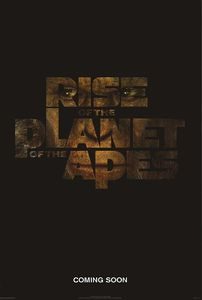
  • Rise of the Planet of the Apes (2011)

    Rise of the Planet of the Apes (2011)

    (In theaters, August 2011) Frankly, I wasn’t expecting much from Rise of the Planet of the Apes: I have no particular affinity for apes, would have left the Planet of the Apes series left for dead, and wasn’t overly impressed by the film’s trailer.  But there’s no substitute for watching the movie, and the story’s slow, emotional build is ill-suited to be presented in a two-minute trailer.  The best way to appreciate Rise of the Planet of the Apes is to ignore that it’s meant to be part of a larger story –not only will you avoid knowing the end of the story in advance, but you will also appreciate the somewhat more dramatically ambitious aims of this new film.  There’s an easy answer to anyone wondering why the film needed to exist: the advances in computer graphics have enabled some amazing acting to be captured digitally and re-rendered as completely convincing simian creatures.  No more men-in-suits: The newly-intelligent apes of this film are not only undistinguishable from the real thing, but have impeccably-controlled dramatic performances.  Andy Serkis, in the lead performance as “Caesar”, steals the show from a sympathetic James Franco.  Quite a number of sequences are not only wordless, but take place entirely between computer-generated creatures.  The fact that most people won’t notice either particularity is testament to Rise of the Planet of the Apes’ success.  Also worth mentioning is the good use of the San Francisco location, and the way the progressive dramatic build-up engrosses the audience.  It’s hardly a perfect film (the end climax on the Golden Gate bridge seems almost too implausibly contrived to be credible, the theme is a bit too obviously “humans are scum” and the SF elements are conventional enough to appear as quasi-mainstream now) but it’s a great deal better than anyone would have expected ten years after the underwhelming Tim Burton remake.  It’s been a while since special effects alone dictated a should-see movie, but Rise of the Planet of the Apes earns that accolade by using the technology to do something emotionally gripping.

  • Funkytown (2011)

    Funkytown (2011)

    (On DVD, July 2011) I should begin by saying that I’m less impartial toward this film than most, having put together a web site for director Daniel Roby’s first feature film a few years ago.  But even then, it’s hard not to be impressed by the scope of Funkytown, which looks at the late-seventies disco scene in Montréal through a large ensemble cast.  The first few minutes are electrifying, as the characters are introduced within a fluid sequence.  Patrick Huard headlines the film as an influential media personality whose decline forms the backbone of the film’s dramatic arc.  Period music is used effectively, and the period is rendered in its glorious brown-and-gold glory.  Not stopping at disco, Funkytown also dares to tackle the socio-political turmoil of the era (which would see the center of Canadian power shift from Montréal to Toronto as separatism led to an exodus of well-off decision-makers from one city to the other) and the rise of AIDS within the gay community.  Loosely inspired by real events (look up the story of Alain Montpetit and Douglas Leopold for reference), Funkytown has enough plot to stuff an entire TV show season as seven or eight main characters jostle for attention.  Screenwriter Steve Galluccio is able to keep everything intelligible, but the story cries out for a novel or a longer-form format, especially toward the end as subplots seem to be cut short.  There’s still a decent amount of subtlety and depth to the end result, and the film’s soundtrack alone is worth a look.  (Never mind the slight anachronisms, though.)  The way both English and French dialogues are used, often in the same conversation, feels authentically Montréal-style.  As one of the bigger-budgeted films in Quebec history, Funkytown has a decent dramatic heft and feels like a reasonably faithful look at the era.  It’s a joy to watch even despite its downbeat dramatic trajectory, and will probably rank as a definitive piece for the era.

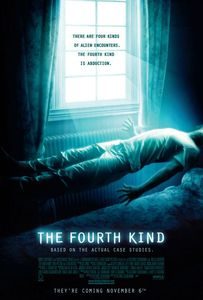
  • The Fourth Kind (2009)

    The Fourth Kind (2009)

    (On cable TV, July 2011) As someone who sees far too many movies in the first place (and once vowed to write something up for every single one of them), I’m probably friendlier toward straight-up experimentation than most.  So never mind when writer/director Olatunde Osunsanmi claims that The Fourth Kind is all based on real events or when the film’s marketing takes pleasure in polluting the information space: I’m more interested in the way the film skips and hops in-between levels of fiction, splitting its screen four-way and trying everything it can think of to appeal to documentary viewing protocols.  The fun begins in the very first moment of the film, as Milla Jovovich gamely tells us she’s a movie star playing someone else.  From that moment on, we cut between putative archival material (featuring director Osunsanmi interviewing “the real Abigail Tyler”, who’s really Charlotte Milchard in an uncredited role) and a more conventional dramatic rendition of events with a very small cast led by Jovovich, Will Patton and Elias Koteas.  The Fourth Kind has a wobbly fourth wall, directly asking its audience to believe.  As interesting as it can be to see two levels of fiction playing off each other (sometimes in similar camera angles shown side-to-side), it’s an experiment that shoots itself in the foot in constantly reminding us about the level of fakery of the more conventionally-shot segments, and then shoots itself again in the other foot when we remind ourselves that even the pseudo-documentary footage is just as fake.  Oh, it’s entertaining itself to see a film self-destruct in this fashion and then hobble around screaming (and oh boy, is there a lot of screaming in The Fourth Kind) as it falls apart.  (There’s so much hand-held wobble that even the split-screen itself moves around, earning a snicker as if the film itself couldn’t decide which footage to show.)  But the film’s interest has little to do with its effectiveness as a horror film, because we’re left with a muddle of UFOs, Summerian myth, distorted voices and unexplained events.  In its lack of ultimate release, The Fourth Kind is once again trading satisfaction for interest: while it’s unusual to see a horror film hold on so steadfastly to audience satisfaction denial, it doesn’t make it any better from a narrative viewpoint, and it sure looks as if the film doesn’t deliver a conclusion by lack of imagination or guts rather than purposeful enigma.  It amounts to a film that jaded horror fans may appreciate for what it attempts to do rather than what it achieves.

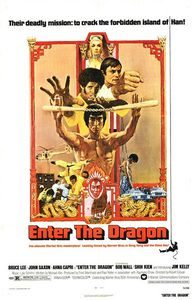
  • Enter the Dragon (1973)

    Enter the Dragon (1973)

    (On cable TV, July 2011) Given Enter the Dragon’s importance within the martial arts film genre, it’s a bit surprising that I hadn’t seen the film until now.  Well, that’s now done, and checking this film off my to-watch-some-day list wasn’t much of a chore.  Bruce Lee’s performance is compelling, but the film has, in aging, become a brief period look at early-seventies Hong Kong, followed by a deliciously unconscious take on the James-Bondian “Megalomaniac Island” plot device.  (Better yet is the period-inspired Black-Power character played by Jim Kelly, who definitely doesn’t get enough screen time.)  Even though scripting isn’t high on the priorities of martial arts films, Enter the Dragon has a few interesting refinements: The introduction of the main character is handled through flashbacks, the final fight has thematic visual ambitions, and there are a few well-done moments in-between.  It’s surprisingly coherent, but best of all it leads to a few well-shot fighting sequences that don’t chop the action in excessive cutting.  It’s pleasant to watch, and doesn’t necessarily ask viewers to forgive its flaws.  Lee is fantastic, both charismatic as an actor, and intense as a martial artist (there’s a sequence with nunchucks that will leave most viewers going “wow!”); too bad this ended up being his last film.  This is still well-worth a look; keep your eyes open for a few surprises.  If you think you spot a young Jackie Chan somewhere in the movie, well… you just may be right.

  • Cowboys & Aliens (2011)

    Cowboys & Aliens (2011)

    (In theaters, July 2011) There’s no real reason to dislike the western/Science Fiction hybrid Cowboys & Aliens, but no real reason to love it either.  It plays surprisingly straight, what with Daniel Craig and Harrison out-gruffing each other on the way to rid the Earth of an alien menace.  The SF elements are weak (Mining gold?  Really?  Did they miss all the asteroids on their way here?), the action sequence lack a certain oomph and the film seems happy just delivering the goods in more or less the same way the audience expects.  Given that even competence is sometimes missing from Hollywood blockbuster, the acknowledgement that Cowboys & Aliens does deliver on its promises should be seen as a compliment.  (If nothing else, you do get both Cowboys and Aliens.  Happy?)  The problem is that there’s little more to director Jon Favreau’s film.  After a thorny first act, everything reverts to unthreatening adventure with a perfunctory finale and the self-simplification of the script is particularly harmful to its SF elements: There’s little rhyme or reason to the aliens’ capabilities except for dramatic effect, and at the point it becomes harder for the viewer to actually form expectations or build any kind of suspense if narrative rabbits are going to be taken out of various orifices.  Interestingly enough, some of the better works comes from supporting actors: Sam Rockwell is once again unrecognizable in an atypical role far from his better-known characters; Adam Beach is earnest and sympathetic; whereas Olivia Wilde manages to carry an element of ethereal difference to her character beyond simply looking pretty.  Oh, Cowboys & Aliens plays well and satisfies base expectations.  There’s just a nagging feeling that the film could have been just a little bit more…

  • Captain America: The First Avenger (2011)

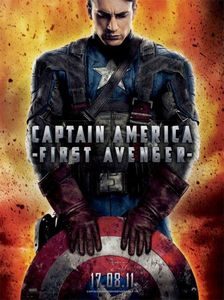
    Captain America: The First Avenger (2011)

    (In theaters, July 2011) The inherent nationalism of the Captain America character makes it a tricky sell outside the United States.  How best to translate a superhero originally developed to tap into pro-American anti-Nazi fever to an international audience that, to put it politely, may not believe as much in American exceptionalism?  Nazis, unsurprisingly, are part of the answer: This Captain America not only takes places during World War 2 (albeit a dieselpunk-verging-on-atompunk fantasy version of WW2) and squares off against a supernatural Nazi opponent, but director Joe Johnston also adopts an un-ironic filming style reminiscent of classic adventure films.  Fortunately, it all fits together, with a little surprise at the end: Trying something a bit different from other films superhero films proves to be a good idea, and Captain America turns into a refreshingly old-fashioned entertainment.  A good chunk of the fun belongs to Chris Evans, who takes on the square-jawed heroics with unselfconscious honesty; good supporting roles also go to Hugo Weaving as the villainous Red Skull, Stanley Tucci as an eccentric mentor and Tommy Lee Jones, chewing on the kind of gruff military man role he’s so naturally suited for.  The story plays itself out over a few years, with a few unexpected hooks and references to the real-world history of Captain America: keep your eyes out for a reproduction of the real Captain America #1 cover during the film’s amusing showbiz digression.  Fans of the Marvelverse put on film will love the references to Thor and the Iron Man hooks with the importance given to Tony Stark’s father.  Add to that a few good supporting characters, a decent romance with chronological room to grow, a nifty coda and some fascinating special effects and Captain America isn’t just good enough to become a high point of Summer 2011 in Hollywood, but a superb lead-in to 2012’s The Avengers.

  • Metal Tornado (2011)

    Metal Tornado (2011)

    (On cable TV, July 2011) There’s no way around the fact that this made-for-TV-movie struggles in presenting a wide-scale unnatural disaster on a shoestring budget.  It’s in the nature of the thing, and it’s a small wonder to see how many low-budget SF movies actually try to deliver on catastrophe.  Naturally, some indulgence is helpful in watching this kind of movie: It’s better to squint a little and focus on what the filmmakers were attempting to do rather than focus on the unconvincing special effects and flat cinematography that follows low-budget filmmaking.  In a generous mood, it’s tempting to suggest that Metal Tornado’s premise is more original than most and just convincing enough to suspend disbelief: As satellite power generation becomes possible, a flawed experiment creates the titular metal tornado that runs along underground iron ore and sucks up anything metallic in its path.  The techno-babble isn’t completely dumb, Lou Diamond Phillips makes for a likable hero, there’s some cleverness in the usual plot template and the quantity of special effects almost make up for their quality.  It builds, it plays, it ends –basically, it does what it was designed for.  This being said, Metal Tornado doesn’t rise much above the usual made-for-TV-Sci-Fi-movie level: as one would expect from budgetary limitations, the dialogue is dull, the plot points are expected, the camerawork is plodding, and the re-use of actors/characters gets increasingly ridiculous rather than powerful.  Mistakes abound, including non-magnetic metals being sucked into the tornado, but they’re not nearly as hilarious as the last act, which wipes out Paris but manages to triumphantly save… Pittsburgh.  As an added treat, Canadians may have fun spotting the small tell-tale details that betray the film’s shooting location.  I spotted the Canada Post mailboxes, but I was a bit surprised to find out, reading the credits, that the film was shot locally, in/near Ottawa.  (“metal tornado Ottawa” is just a search away to tell you that it was shot in summer 2010, featuring local talent and in exotic locations such as Wakefield.)  The local connection alone makes it a must-see in my case… but I can’t vouch for you the farther away you feel from Ottawa.