Author: Christian Sauvé

  • The Goonies (1985)

    The Goonies (1985)

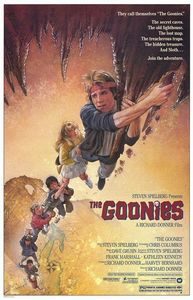
    (On DVD, June 2011) Never having seen The Goonies (I know, I know…), I can’t say for sure if the film holds up for those with fond memories of the original.  But seen fresh, the film still has a lot of fun and narrative energy.  Sure, the kid actors often overact: Corey Feldman, in particular, seems to be mugging for the camera over and above what a motor-mouth should.  The acting is broad and unsubtle: there’s little naturalism in how the characters are portrayed.  But up to a certain point, that’s part of the charm: The Goonies is recognizably an early-teen fantasy of adventure and action: in-between wacky inventions, ingenious traps, first kisses, sibling tension, silly criminals and treasure maps, the film aims square at boys and girls and succeeds in portraying the kind of adventure many wished for in late grade school.  As a collaboration between producer Steven Spielberg, writer Chris Columbus and director Richard Donner, The Goonies is also a powerhouse of talents who were at their mid-eighties peak: all would go on to make other things, but their reputation would hinge heavily on this film.  Even from the first snappy minutes, it’s easy to see how everything clicks in this film.  Not every sequence and plot elements works as well (I’m not so fond of Sloth, nor the various plot tricks), but even a quarter of a century later, the pacing is fairly good, the atmosphere between the kids is credible and the spirit of adventure rarely flags.  There’s an added bonus in seeing familiar actors in younger roles, from Sean Astin to Josh Brolin to Joe Pantoliano.  The DVD does justice to the film, with great picture quality and extensive supplements ranging from a superlative audio/video commentary to a few featurettes about the making of The Goonies.  I’m probably one of the last kids of the eighties to see this film, but the wait has been worth it.

  • Bridesmaids (2011)

    Bridesmaids (2011)

    (In theaters, June 2011) There’s definitely something refreshing in seeing a women-centric film trying to one-up the boys in the R-rated comedy department: Bad language, worse behaviour and gross-out gags aren’t the sole province of frat-boys, and seeing Bridesmaids trying to be outrageous carries its own doubtful freshness.  I just wish the result would have been consistent, because the entire movie veers between downbeat humiliation and all-out outrageousness.  The pacing of the film, particularly in its first half, seems slack to the point of obnoxiousness: mini-sketches go on for far longer than the joke is worth (ex; one-upping memories of the bride-to-be at the engagement party) while the story advances with little wit in its editing.  (Things change, a bit, with the trip to Vegas and the “trying to get a cop’s attention” sequence.)  It really doesn’t help that the script seems convinced of its ability to combine the cringe-worthy story of a woman hitting bottom while still flying off in far less subtle bursts of crass comedy. Character-driven comedy doesn’t always mesh well with pratfalls and crude silliness, and Bridesmaids shows why: By the time the heroine trashes a sumptuous bridal shower, we’re cringing rather than enjoying the self-destructive nature of the act.  (It’s also annoying that at times, the film seems to ape Saturday Night Live, not only in dragging scenes longer than they should be, but building the film as a series of sketches.)  Dramatically, the self-destructive lead character is too annoying to be fully sympathetic and the film seems so intent on chronicling her downward spiral that it doesn’t provide much in terms of payoffs.  Still, even with mixed feelings about the film in general, I still laughed a bit too much to be entirely dismissive: While Kristen Wiig is better when she’s acting seriously than when she’s trying to mug for the camera, Melissa McCarthy steals practically nearly every scene she has, Wendi McLendon-Covey and Ellie Kemper are both under-used and I’m already on record since Idiocracy as being happy to watch Maya Rudolph in just about anything.  There are a few funny lines, successful sketches (the airplane sequence, overlong but ending on a high note), silly sight-gags and absurd non-sequiturs to qualify Bridesmaids as a comedy when it’s at its best –the problem is the time in-between, stuck watching the protagonist as she digs herself deeper in trouble.  Those don’t belong in the same movie.  Where’s a competent script editor when you need one?

  • Inside the White House, Ronald Kessler

    Inside the White House, Ronald Kessler

    Pocket, 1995, 302 pages, C$31.00 hc, ISBN 0-671-87920-0

    Sometimes, a book reviewer’s first priority is a warning: That book you’re picking up is not the book you think you’re going to get.  While I don’t think that warning people about a non-fiction book sixteen years and three presidents later counts as a valuable customer service, it’s a bit of a red flag regarding the author… which may be useful given that he’s still out there writing similar things.

    A quick glance at Ronald Kessler’s Inside the White House promises a look at “the hidden lives of the modern presidents and the secrets of the world’s most powerful institutions”.  This may lead you to expect a flint-eyed examination of how the White House operates, perhaps a journalistic description of day-to-day operations within the building, maybe even a few anecdotes regarding the past few presidents.  So be prepared for a highly partisan collage of presidential gossip, complaints about the White House’s budget and a cursory look at the isolation of presidents from everyday life.

    Don’t worry if Kessler uses the term “White House” very loosely: As it quickly becomes clear, Kessler’s really writing a high-end gossip rag about presidents from Johnson to Clinton.  The reported rumours start early and low on the first page, the second sentence including the words “…having sex on a sofa in the Oval Office, with one of the handful of gorgeous young secretaries…”  Things don’t necessarily get more graceful after that, with Kennedy’s extramarital affairs trotted out once more alongside Johnson’s similar exploits.  From affairs to blatant exploitation of the public purse and presidential misconduct including gratuitous abuse of staff, Kessler trots out decade-old gossip in lieu of reporting.

    It certainly doesn’t stop there: If you believe everything included here, every president since then has been an awful human being, their personal weaknesses magnified by absolute power.  Interviewing (on record!) staff members from previous White Houses and more vaguely sourced current ones, Kessler cherry-picks decades of history for purely titillating anecdotes about runaway presidential children, ungrateful spouses, thefts, paranoia and worse (or better: If ever you’ve been looking for reference material regarding presidential flatulence, then your quest ends here).  Much of it sounded familiar until I realized that Kessler re-used much of the same material in writing the similar 2009 book In the President’s Secret Service.

    It’s all entertaining, and if you want to be particularly nice to the end result, all of it ends up reinforcing Kessler’s overall theme of a White House disconnected from the rest of the nation.  The Presidency has become a quasi-imperial position because the American public demands it (would the nation tolerate presidents having to take time away from running the nation to wash dishes or make grocery runs?), but the price to pay is that the occupant of the White House always loses touch with life as lived by most Americans.  The vast excesses available to presidents end up letting their worst instincts run wild.

    There’s more substantial material in Inside the White House about the carefully-obfuscated costs of running the White House.  Thanks to decades of presidential manoeuvres, the true operating costs of the White House are dispersed in-between dozen organizations, never acknowledged in full lest their magnitude become apparent to the taxpayers.  As a result, financial accountability is low; mini-empires grow unchecked; everyone tries to get assigned a prestigious “White House job” and few people ever fully understand how it all works.

    But that’s pretty much all there is to say about the substantial content in Inside the White House.  The gossip takes up much of the rest, and through accumulation it’s hard not to notice that Kessler is a lot kinder to Republicans than Democrats.  Republicans Ford, Reagan and Bush (the first) practically come across as saints compared to their Democratic counterparts, but the hilarious part of the book begins once Clinton takes power: Suddenly, Kessler doesn’t hide behind quotes from interview subjects to attack the president: Words like “childish” and “rudely” and “indolence” suddenly find their way in the main body of the text and Kessler, afflicted by a bad case of Clinton Derangement Syndrome, whips himself up in a fury describing incidents that seem well in-line with what other presidents have done.  No surprise if a quick look at Kessler’s Wikipedia page shows a writer now associated with right-wing sites, and known for erroneous reports about Barack Obama.  (With a special bonus as Kessler attempted to remove mentions of the controversy from his Wikipedia page)  Partisan writer writes partisan account of presidents?  What a surprise!

    The result, alas, isn’t a serious piece of journalism as much as it’s an opinion piece wrapped in anecdotes with dubious credibility.  While I’m impressed that some of the more outrageous statements in the book are directly sourced to interviewees, I’m not exactly convinced that they amount to a significant indictment of those who stayed at the White House over the past fifty years.  Once Kessler’s partisan nature becomes obvious, his indignation becomes less convincing, and readers may start thirsting for a better spokesperson in matters of presidential accountability.  There’s an interesting thesis in Inside the White House that few people will dismiss: too bad that its execution undermines it.

    On the other hand, if what you want is a National Enquirer book-length special about American presidents…
  • Resurrection, Steve Alten

    Resurrection, Steve Alten

    Forge, 2006 reprint of 2004 original, 523 pages, C$10.99 mmpb, ISBN 0-812-57957-7

    There are authors out there who are reliable, stable and predictable.  Not in the bad sense of the word, mind you: Their name is a badge of quality and consistency, a virtual guarantee that what you’re going to get is exactly what you expect.  Michael Connelly, Lee Child and Carl Hiaasen all come to mind as such models of reliability.

    Then there’s Steve Alten, who has become increasingly unpredictable since his impressive debut with Meg, back in 1997.  His subsequent biography has been… eclectic.  Sequels to Meg (five of them by 2011) drove the exact same premise into the ground and kept stomping.  Other standalone novels ranged from a vigorous (but slightly crazy) military techno-thriller with Goliath, to conspiracy-drenched agitprop in The Shell Game.  More rarely, there’s just dullness, such as the Loch Ness monster-themed The Loch.

    And then there’s his Domain trilogy.  I wasn’t aware that Resurrection was the second volume of that series when I picked it up: I thought it was another standalone novel.  Imagine my growing surprise when I realized the amount of backstory required to end up where Resurrection starts: After averting a worldwide nuclear war in 2012, our heroine gives birth to twin boys, fulfilling a copious heaping of Mayan mythology.  This being said, backstory is the least of Resurrection’s insane charm as the novel fast-forwards through the next twenty years of its deliriously imagined future: In-between an abused girl growing up to become the Antichrist (or a reasonable facsimile thereof), famous people who are somehow able to become equally famous under different identities, Alten’s shameless grab for all the mythologies and pseudoscience he can find, ridiculous future world-building, wild presidential assassination attempts, and hiccupping plotting spread over decades, Resurrection stays away from basic credibility, which is probably wise when you have a sequel to a near-catastrophe of global proportion.

    The accumulation of quirks and the progressive transition of the novel from fanciful techno-thriller to full-on science-fiction is interesting, mind you… but not in a conventional or even respectable sense.  As the incongruities, half-baked ideas and caricatures accumulated (the sultry villainess alone seems taken straight out of the Big Book of Evil), I found myself firmly hooked, but only to find out what else Alten was going to introduce to much fanfare.  It finally dawned on me that Resurrection is unintentional crackfic, the term most enlightened readers will use in describing something so obviously outlandish that it flips into meta-fictional comedy.  In this light, Resurrection isn’t borderline incompetent fiction as much as it’s an experience that must be read to be believed.

    It would work better, admittedly, if Alten showed the slightest bit of self-awareness as to the ludicrousness of his premise.  But as the novel sinks deeper into disparate mythologies, pop mysticism and magical combats featuring resurrected protagonists in alternate realities (or is it far-flung time travel?  Oh, who cares…), the signs also accumulate that Alten’s being undisciplined.  Not being a genre SF writer, he has no natural instinct nor any coherent framework for his extrapolated future: Scene after scene enthusiastically dumps exposition because he thinks it’s cool, not because it’s in any way needed.  There are digressions about entirely-fictional sport team leagues, and more curiously an entire narrative recap of the American space program up to now… even as the novel is set a few decades in the future.  This is just sloppy stuff no matter how you look at it; fortunately, it’s in the middle of a madcap attempt at writing a large-scale thriller with no sense of focus.  It’s not even done particularly well –unlike Dan Brown’s novels, which have an undeniable forward sense of narration, Resurrection sorts of sprints, sputters and retreats at random intervals.

    Resurrection works in ways that are orthogonal to the typical rewards of well-written fiction.  The best way to make sense of it is to abandon reason entirely.  That is, its appeal is bound to be largely idiosyncratic, reaching self-satisfied hipster readers with qualities that the author, I suspect, never intended.  It’s probably the craziest novel I’ve read from Alten; given the unevenness of his bibliography so far, I’m impressed but I can’t say I’m surprised.

  • Real Genius (1985)

    Real Genius (1985)

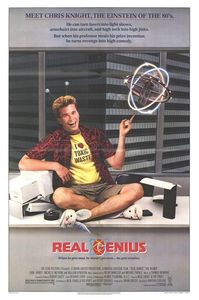
    (Second Viewing, on DVD, June 2011) The danger is revisiting an old favourite whose memories have faded is discovering the dull bits in-between the remembered highlights.  While Real Genius is still an amusing-enough film with a strong whiff of mid-eighties Cold War atmosphere that now adds to the comedy, it’s far more leisurely paced than I remembered, and the standout lines (“A girl’s got to have standards.”) feel more like abnormalities in the middle of a far less funny film.  The surprisingly heavy military satire takes a lot more time than I remembered, and the script doesn’t have the zing than its more inspired moments lead to remember.  Still, judged by the standards of films now twenty-five years in the past, Real Genius has survived pretty well: Its portrait of gifted students is sympathetic, and never more so when the brash and self-confident character played by Val Kilmer (looking impossibly young) reveals that he’s behaving this way to avoid burnout.  Compared to Kilmer, film anchor Gabriel Jarret is practically a non-entity –overshadowed by a flashier supporting character, and not given anything interesting to do by the script.  The ending at least has the decency to wrap everything on a high notes, with the memorable popcorn explosion and an oh-so-typically-eighties musical moment with Tears for Fear’s “Everybody wants to Rule the World”.  In-between the comic set-pieces, Kilmer snark and odd moments of antiestablishment politics, Real Genius is just fine –not a classic, clearly, but a fond memory.  The DVD, unfortunately, has no extra features.

  • Siren (2010)

    Siren (2010)

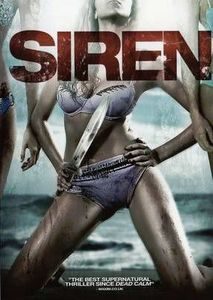
    (On DVD, June 2011) While the box cover art promises a schlocky sex-and-supernatural-horror film, Siren is really a classy sex-and-supernatural-horror film.  The difference lies mostly in the absence of nudity and the presence of some good cinematography.  The story is dirt-simple; as three young people (a randy couple, plus their friend) end up on a deserted island where various foreboding omens don’t stop them from spending time with a beautiful woman who clearly knows more than she’s willing to say.  It doesn’t get any better for any of the characters after that.  But in horror films, it’s all in the delivery, and the small cast gets to play against some beautiful Mediterranean scenery, well-framed within widescreen cinematography.  The pacing of the film is leisurely, the characters are mildly unpleasant, the coda barely makes sense and the lack of nudity feels more frustrating given the naughty nature of the film (which even throws in a bit of girl-on-girl kissing as further titillation), but there’s still a lot to admire in the way this low-budget film plays with the elements it has on-hand.  The blood and violence is restrained, effectively showing up only during the last act.  (A pretty good bliss/death sequence certainly shakes things up.)  The actors struggle a bit with their English, but they’re appealing in their own way despite the indifferent script. (Headliner Anna Skellern is particularly good as the protagonist.)  Siren’s rhythm, as slow as it is, certainly gives an extra gloss of respectability to what is, after all, a fairly lightweight B-movie.  The script could have used a lot of tightening-up (or even a few extra characters/subplots), but DVD extra features show how much worse the film’s original vision could have been, with the Siren character suddenly talking the ears off the other characters in a few judiciously deleted scenes.  While I’m not exactly a fan of the film and resent the marketing bait-and-switch, Siren is far more respectable than many other straight-to-DVD horror films, and it may be worth a look by horror fans looking for a change of pace.

  • Green Lantern (2011)

    Green Lantern (2011)

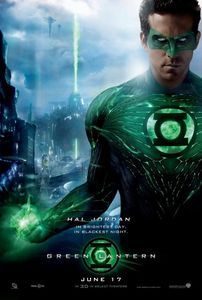
    (In theaters, June 2011) Every so often, a film reminds me that I’m fast aging out of the coveted male-geek’s demographic segment… and makes me grateful for that.  So it is that I come out of Green Lantern wondering why that movie even exists.  My tolerance for comic-book mythologies has never been particularly high, and seeing the Green Lantern universe on-screen only highlights how profoundly silly it is, even by comic-book standards.  Here, the accumulated weight of decades of backstory abruptly presented on-screen never goes beyond the simply ridiculous.  (Was it really important to learn that practically all characters in the film were grade-school buddies?)  By the time we’re flying across the galaxies, discussing the yellow power of fear and fighting threats that unfortunately take the form of a skull over liquid-brown tentacles, the whole Green Lantern shtick is so far removed from human concerns that the film practically degenerates in nonsense.  Few of the many people writing the script apparently stopped to ask why audiences should care.  Little of the blame over the film’s lack of success should go to Ryan Reynolds, whose cocky charm prevents the film from sinking further into irrelevancy.  (It’s also awesome to see Angela Bassett on the big screen again, even in such a small role.)  On the other hand, Reynolds’ screen persona is so self-assured that the film is never believable when it questions the character’s lack of courage: Green Lantern’s annoyingly familiar coward-to-hero dramatic arc never gets going, let alone concludes satisfactorily.  The dull script occasionally gives birth to a few well-handled scenes (mostly thanks to director Martin Campbell’s touch when it comes to action sequences), but the overall impact is muted.  There’s also something slightly off with the special effects, although this ties into the whole “let’s go cosmic without making you care for it” problem.  Clearly, I’m not as good an audience for comic book movies as I used to be when I can’t be bothered to say nice things about average efforts like Green Lantern.  Ultimately, it may have more to do with the film’s point: Is it using comic-book mythology to talk about something else, or is it simply content to regurgitate the mythology on-screen, without caring if it has any real-world relevance?

  • Impact, Douglas Preston

    Impact, Douglas Preston

    Forge, 2009, 364 pages, C$31.00 hc, ISBN 978-0-7653-1768-1

    Now that the Preston/Child writing duo has had time to work on their own novels in addition to their collaborations, we’re getting an opportunity to see what are the strengths and weaknesses of either writer.  Lincoln Child, judging from his solo novels from Utopia to Terminal Freeze, is supremely gifted at making up interesting premises.  Unfortunately, his novels have a tendency to turn into far more pedestrian genre exercises by their middle third, and end on intensely familiar notes to either techno-thriller (“The AI did it!”) or Science Fiction (“Aliens!”) fans.  Meanwhile, Douglas Preston seems a bit more versatile, and in-between The Codex to Blasphemy seems interested in a broader range of narrative structures.  Adventure ranks high in his plotting techniques, and if his premises are a bit less clear-cut than his colleague’s own novels, he seems a bit better at sustaining narrative tension throughout.

    Impact is clearly another novel from the Child/Preston stable: It’s easily readable, generously paced with action sequences, mysterious from the get-go and seasoned with a blend of technical details.  It’s also structurally flawed, can’t let go of recurring characters and badly inserts SF ideas within a traditional thriller template.

    It starts with the titular impact: In costal Maine, a brilliant young woman wasting her potential as a waitress uses elementary astrophysics and her knowledge of the area to deduce that the rock landed on a nearby isolated island, and that there’s money to be made in bringing back a meteorite.  She sets off with a friend and her father’s boat, but not before annoying a young man persuaded that she’s his girlfriend.  In a completely unrelated development, a scientist working in California gets wind of a surprising scientific discovery involving Mars and people who are willing to kill in order to keep it a secret.  Finally, in yet a third completely unrelated subplot, Preston series regular (and all-rounded special operative) Wyman Ford is asked to go investigate a source of mysterious gems in Cambodia.

    Those three threads eventually converge, but not as cleanly as you may expect from a top-notch thriller novelist.  It’s one of Impact’s many flaws that the novel is inelegantly split in two parts spaced by weeks, upsetting the kind of tight dramatic unity that we’d expect from a thriller.  Furthermore, it doesn’t help that one of the three initial subplots is quickly cut short, or that there is not real reason to bring back Wyman Ford after the world-changing events of Blasphemy when just about any competent protagonist could have done the job.

    (It’s a pet peeve of mine that the thriller genre is rarely suited to series: to be meaningful, thrillers developments should have consequences.  You can’t threaten the world with nuclear war every novel of the series, for instance, and the high-impact shenanigans at the end of high-stakes thrillers should leave a mark on the characters, and often the world at large.  What bad thriller continuity series does is press the reset button, not even acknowledging that what was important in the previous book is still important now.  Wynan Ford’s previous adventure Blasphemy ended with a global revelation that isn’t even mentioned here.  There’s an even bigger global revelation in Impact, and I’m practically certain that one of Preston’s next novel will once again feature Ford, and once again ignore Impact’s impact.)

    While Impact does introduce a sympathetic heroine with Abbey and has the good idea of pairing her up with Ford, the novel seems too loose to be fully satisfying.  The subplots go here and there (Ford’s trip to Cambodia start out promisingly, then peters off in traditional heroics), the book can’t make up its mind whether it’s best suited to the rocky grit of New England or techno-scientific brinksmanship in Washington DC.  The last quarter of the novel features world-changing SF concepts, but Preston shies away from exploring their consequences in favour of well-worn thriller tricks.

    It results in a disappointing novel, full of promise but let down by a loose, almost chaotic execution.  Impact has lengthy periods of boredom in-between the interesting ideas, and it always feels as if there’s something not quite right in the way those ideas and concepts are developed.  Science Fiction fans may have a worst time with the books than those who aren’t as used to SF conventions: Like many authors working outside the SF genre, Preston doesn’t quite understand how to develop premises with world-changing potential, and maddeningly focuses on the wrong end of the story in an effort to hold the hands of his general readership.  Even Preston’s usual audience may not feel that this is his best work.

  • Mogworld, Yahtzee Croshaw

    Mogworld, Yahtzee Croshaw

    Dark Horse, 2010, 413 pages, $7.99 mmpb, ISBN 978-1-59582-529-2

    Our latest instalment in the “books I’m reviewing because they give me an excuse to talk about online stuff that I like” is Yahtzee Croshaw’s Mogworld, a humorous fantasy novel written by the creator of the Zero Punctuation weekly videogame reviews series.  Executed as five-minute video-clips, Zero Punctuation distinguishes itself through an uncompromising sense of humour, a blistering pace, a cynical outlook on the nature of contemporary game development and an iconic visual style.  While Mogworld can’t match the yellow visuals and punctuation-less vocal throughput of the videos, it does combine humour and a solid understanding of modern gaming narrative conventions to deliver a satisfying fantasy comedy.

    The fact that the narrator (Jim, he of limited wizardry capabilities) dies at the end of the first chapter isn’t much of an impediment to adventure –especially when he’s resurrected at the beginning of Chapter Two.  And again a few more times in the next few pages.  Curiously enough, he seems to be resurrected every time he should stay dead, along with everyone else in that world.  From that point on, Jim’s main goal in life is to die as permanently as possible.  In his quest, he’ll end up making unlikely friends, traveling widely and discovering the true nature of his world.

    While Mogworld  waits a bit more than a hundred and fifty pages to reveal a connection between Jim’s problem and the issues faced by programmers working on a massively multiplayer online role-playing game (MMORPG), the back cover readily reveals it, so I’m not about to consider it a spoiler.  In fact, Mogworld may work better if the reader understands from the get-go that Jim is a sentient character in a MMORPG: Part of the books’s charm is the way it plays the narrative conventions of a novel against those of a role-playing game: There is a lot of dramatic irony between what the character finds out and what we, as denizen of the twenty-first century, already know.  In-passing, Croshaw gets to comment on the inherent power fantasies of MMORPGs and the storytelling compromises in trying to provide satisfying narratives to multiple players.

    Does that mean that you already have to be a level-60+ World of Warcraft addict to enjoy Mogworld?  Absolutely not: Heck, I have never played an MMPORG.  In writing his debut novel, Croshaw shows a deft touch in balancing fantasy elements with humour so that fantasy genre readers can get to enjoy the story.  The obvious touchstone of comic fantasy is Terry Pratchett, and so it’s almost obligatory to say that Mogworld does remind me of middle-period Pratchett novels in sending up fantasy conventions through judicious use of very dry British humour.

    What’s more interesting from my reviewer’s point of view, however, is the kind of conceptual generational shift that fantasy novels such as Mogworld represent.  It’s no secret that fantasy videogames trace their origins in fantasy role-playing games like Dungeons and Dragons, themselves heavily influenced by fantasy literature.  Now here’s fantasy fiction influenced from fantasy videogames, which either completes the self-referential circle if you’re the fatalistic kind of pundit, or contributes to a renewal of fantasy tropes and archetype if you’re somewhat more hopeful about genre fiction.  It will make optimists happy to note that Mogworld is the first prose novel published by comic-book publisher Dark Horse Books and, as such, represents a modest expansion of the market.  I suspect that Mogworld will be read by a lot more gamers than traditional fantasy readers, which is another interesting development by itself.

    Fortunately, the result itself is worth a read: Jim’s adventures are entertaining, and while the novel is meant to be funny, it’s not entirely too silly to lose its dramatic potential.  There are a few good scenes, ideas and trope inversion in the book (it’s no accident if there’s a TV-Tropes page dedicated to Mogworld; warning, spoilers!) and the reading experience is pleasant.  There’s even a little bit of real-world relevance in looking at how MMORPGs are created.  Now, what about a second novel?

  • The Marine 2 (2009)

    The Marine 2 (2009)

    (On DVD, June 2011) The original The Marine wasn’t much more than a forgettable action B movie, and that may explain why this sequel feels pretty good, even though it went Direct to Video.  Taking the basic plot of the first film (Marine rescues girlfriend from clutches of bad guys, gun-fights, explosions, etc.) but with new characters, structure and setting, The Marine 2 daringly moves the action to a resort in Thailand.  After the protagonist’s wife is taken hostage, our protagonist spends the rest of the picture killing bad guys; it pretty much ends like you’d expect.  There normally wouldn’t be much more to say about a low-budget action film, but this one actually seems to have good production values and an imaginative director who knows what he’s doing: The first few minutes in Thailand offer some really spectacular scenery, while the action sequences are better-directed than most action films there says.  Director Roel Reiné is fond of using lengthy shots, and as a result one hand-to-hand fight is far more interesting to watch than you’d expect.  Most of his action sequences show a good sense of geography, and it looks as if he was able to push the limits of his budget.  This doesn’t make The Marine 2 a good film: the dialogue is average, all-American-boy-hero-killer Ted DiBiase Jr. is bland as the lead, and there’s a mid-movie lull in which the hero spends 40 minutes going back to the resort to kill more terrorists without much by way of plot progression.  Still, it does make of The Marine 2 one of the increasingly common DTV semi-sequels that have at least some entertainment value, even in isolated bits and pieces.  At a time where theaters and movie-rental chains are getting marginalized as movie distribution channels, non-awful DTV films are a significant development.

  • Super 8 (2011)

    Super 8 (2011)

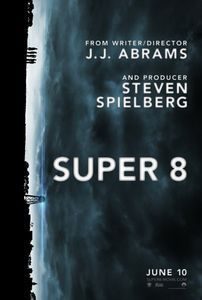
    (In theaters, June 2011) The best homages aren’t as much about faithful imitation as much as they’re about the understanding of what made the original click and working from the same assumptions and methods.  So it is that Super 8 is a gleefully good throwback to some of the great summer blockbusters of the eighties, from E.T. to The Goonies to Gremlins and more.  Set in 1979 and featuring half a dozen kids stumbling upon a big mystery while shooting their own amateur film, JJ Abrams’ authorized Spielberg pastiche is a solid filmmaking accomplishment: It balances mystery, action, terror, laughs, spectacle and sentiment in a deft fashion, constantly evoking pure joy at every moment.  It’s a highly satisfying film, in part due to how Abrams focuses on the basics even with the latest digital tools at his disposal.  (This being said, Abrams should really give up his addiction to lens flares –they were bad enough in Star Trek, but they’re getting ridiculously intrusive here).  The SF elements are restrained but effectively used, and the nostalgic glance at 1979 is sincere and fascinating without being overpowering or condescending.  Worth noting is the absence of any name actors (the best-known being Noah Emmerich), allowing the picture to take place without the distraction of any familiar faces.  The kid actors are very convincing, and Abrams never forgets to spend time with his characters –even though some emotional moments are carried just a bit too far, especially toward the end.  Individual set-pieces include a terrifying attack on a bus where a few characters are imprisoned, a spectacular train derailment and the amazing sight of a small Midwestern town taken over by a befuddled military attack.  It all amounts to a comfortably enjoyable summer film –easily the kind of film that a whole family could go enjoy in theaters.

  • Sanctum (2011)

    Sanctum (2011)

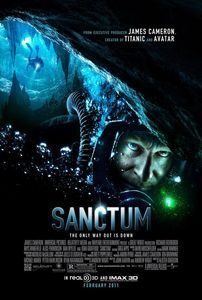
    (On DVD, June 2011) The spirit of adventure is something that Sanctum gets right, at least in its first half: The idea of going deep underground, in underwater body-tight passageways is both terrifying and exhilarating, and there’s some joy in seeing characters looking at new things just because no one else has seen them before.  Then the film turns into not just a survival adventure story, but one that is structured around a horror-movie structure –with characters dropping left and right until the story is over.  While some of the footage, special effects and establishing shots are interesting, the same can’t be said about the characters or the dialogue.  Even some of the special effects work looks a bit shoddy at times.  Released in 3D in theaters, the flattened film that can be seen at home has little left to impress.  Of the actors, Richard Roxburgh is most remarkable as a hard-boiled adventurer who will let nothing stand in-between him as his survival.  While the sense of claustrophobia is effectively used and some of the footage evokes a sense of natural awe, most of the action sequences quickly become boring, allowing viewers to tune out until the identity of the latest victim is revealed.  Even at less than two hours, Sanctum feels long, with a third act that could have ended a few minutes early.  While the film is just a bit too beautiful to be called a complete waste of time, it’s nowhere near as gripping as an adventure of that scope should be.

  • The Hangover Part II (2011)

    The Hangover Part II (2011)

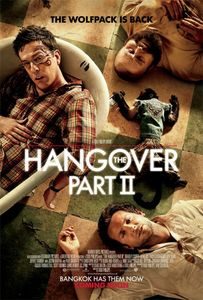
    (In theaters, June 2011) The platonic ideal of a sequel is to recreate the experience of the first film while bringing something new to it.  So it’s not much of a surprise to find out that the screenwriters at work on The Hangover II felt completely justified in stealing the original’s structure almost plot beat per plot beat.  It’s certainly familiar, and that may not be ideal: Part of The Hangover’s appeal was the delirious way in which it went left and right, bowing to traditional narrative expectations only late in the third act.  Here, the element of surprise is gone, and viewers can feel themselves anticipating what should have been twists.  It also lends an unfortunate feeling of laziness to a film that nonetheless went around the world in big-budget style.  It could have been worse, mind you: The characters are recognizable without feeling reduced to catch-phrases (although Zach Galifianakis’s always-irritating “Alan” went from slightly-retarded to too-stupid-to-live in-between the two films), the Bangkok location provides plenty of good color, the rhythm of the film is fine, Bradley Cooper makes for a capable anchor, Ken Jeong is just as refreshing in his brief scenes (even though his presence is absurdly contrived) and up to a certain point, setting the film far away makes it feel a little bit less reprehensible that the quasi-local hijinks of frat-boys gone wild in Vegas.  Still, the film as a whole doesn’t feel quite as joyful as the first one: the laughs seem to suffer in the face of increased danger and raunchiness.  But it’s the feeling of familiarity that brings The Hangover II down, a sense that it’s quite literally going through the same motions as its predecessor.

  • Faster, James Gleick

    Faster, James Gleick

    Vintage, 2000 reprint of 1999 original, 330 pages, C$21.00 pb, ISBN 0-679-77548-X

    I am one of the people James Gleick complains about in Faster.  I am the guy who walks past other people on the sidewalk.  I am the guy who fumes whenever cars drive just under the speed limit.  I am the guy who gets annoyed whenever other people don’t pay attention, dawdle, can’t decide or otherwise start messing with my own hyper-efficient schedule.  I am, in other words, part of the problem that Gleick describes when he talks about “the acceleration of just about everything”.

    Now, keep in mind Faster‘s copyright date of 1999, right at the peak of the dot-com boom; a short era during which “dot-com time” came to shake what was people’s sense of time.  Suddenly, the online world changed every six months; companies doubled in 60 days, crashed and burned in 18 months.  And things kept accelerating, at least until the dot-bomb recession of 2000-2001.  Faster is very much a book of its era, a horrified contemplation of how fast things can possibly go, alongside doubt that anyone but a few inhuman freaks will be able to hold on to the monster we have collectively created.

    As such, most of Faster feels very familiar.  Gleick, the author of such seminal science vulgarization books as Genius and Chaos here turns his attention to a mixture of historical explanation, technical vulgarization and cultural criticism.  In a nutshell: Here’s why/how things went from slow to fast; here’s how fast they really are at the moment; here’s why this is a problem.  Fast food!  Workaholics!  Over-optimized airline schedules!  24-hour news cycle!  Multitasking! Quick-cutting!  MTV!  After a while, it becomes easier to portray Gleick as the stereotypical old man shouting at the kids, not just because they’re on his lawn, but because they can get off of it faster than he can shake his cane at them.  (Also; grandpa, there are better examples of action moviemaking than Sphere.)

    The irony here is that Gleick is not wrong, nor has his kvetching been disproven by the past twelve years.  The world has indeed become much faster, and on a very personal level: You just have to contemplate Twitter or the Facebook news feed to find out that near-real-time publishing to the masses has become ubiquitous: It just takes a moderately-good smartphone with an average data plan to consume and broadcast the most trivial details of our lives.  Meanwhile, the big boys of corporate media have grown even savvier in getting their product to the consumer even faster: As of 2011, DVDs are available not much more than three months after theatrical release; eBooks are launched simultaneously with their paper equivalents (otherwise customers complain loudly on Amazon); most music is sold instantly through digital channels (goodbye music stores); news stories are filed and dissected in minutes… and wristwatches (a subject of one of Faster’s early chapters) are now fashion accessories, because there are now built-in clocks in just about any electronic device that surrounds us.  Our culture digests ideas, fads and memes in weeks (Rebecca Black’s “Friday” was released when I read Faster, almost still hip when I wrote this review a month later, but passé to the point of nostalgia by the time I edited it three further months later) and visibly shows signs of impatience whenever it has to wait.  We have become Faster’s worst nightmare.

    And yet we still deal with it.  One thing that Faster doesn’t do very well is in pointing out that it’s still relatively easy to punch out of the schedule whenever convenient.  Journalists and politicians may be stuck feeding the news channels, but the rest of us can lay low for a few days and stop paying attention to what’s not part of our lives.  Facebook’s reported recent loss in popularity hints at a truth that Social Media apologists and James Gleick alike aren’t happy to acknowledge: That once past the newness effect, everyone self-selects their pace of life.  After a few days/weeks/months/years, many people move on from their blog postings, twittering or facebook updates: What remains at the slower core is the kernel of what we are.

    But as much fun as it is to critique the social critique, there is plenty to like about Faster: The early part of the book has some fascinating material regarding how the notion of globalized time came to be (every American town had its own clock before railways required some standardization), and a chapter on airline scheduling makes the good point that the more efficient a system is, the more it is vulnerable to even small problems –they cascade into big problem due to the lack of slack built in the system.  There are good digressions here and there, such as the sequence in which Gleick pushes the clichéd “Americans spend X minutes every day doing…” statistics into an absurdist dead-end, and a demonstration of “The Strong Law of Small numbers” (ie; there aren’t enough small numbers to be useful.)

    I does help that even if Gleick may be a curmudgeon in training, he’s a dependably readable writer.  Faster is entertaining even when its relationship with reality turns a bit suspect; its thesis may be equal part dubious and paranoid, it’s still largely correct.  I do miss the more scientifically-minded topics of Chaos and Genius compared to this more free-flowing cultural/technical critique, but if Faster is a bit of a disappointment, it still has enough good material for compelling cocktail party chatter.

  • S.W.A.T.: Firefight (2011)

    S.W.A.T.: Firefight (2011)

    (On DVD, June 2011) At a time where the video rental business is crumbling, the Direct-to-Video market is undergoing a curious rehabilitation, even when it comes to cheap action movies.  Helped along with polyvalent digital cameras and cheaper post-production processes, DTV films now look better than ever, and manage to sport scripts, actors and direction that are well above the mediocrity we’ve gotten used to in movies that never played in theaters.  S.W.A.T.: Firefight looks like a perfect example of the form: Sequel-in-name-only to a better-known theatrical action film solely for marketing purposes (there’s practically no story link to the original), it’s a reasonably entertaining way to spend an hour and a half.  Part of the appeal is due to square-jawed Gabriel Macht in the lead role, as a Los Angeles SWAT leader sent to Detroit in order to train the local team.  Refreshingly, the first half of the film adopts a convincingly realistic attitude in portraying a competent SWAT team with minimal dysfunction: S.W.A.T.: Firefight is never as interesting as when it’s showing off the team training, bonding and working together in showcase sequences.  The choice to set the film in the ruins of Detroit is intriguing.  Shannon Kane makes a good impression as a tough new recruit.  Unfortunately, the second half of the film gets farther away from the SWAT rationale the longer it focuses on another improbably all-powerful antagonist who takes a personal dislike to the hero.  It’s not as it Robert Patrick isn’t good, but that the film becomes a lot more predictable once the plot is sketched, and far less interesting as a result.  (It also ends a bit too quickly.)  At least the film moves with energy; director Benny Boom uses his limited budget effectively, even though touches like a gun fastened to a camera give an unpleasant video-game jolt out of the film’s experience.  While the picture quality can’t escape a certain video softness, S.W.A.T.: Firefight looks good, goes by pleasantly, scores a few good scenes and exceeds the low expectation associated with a DTV film.