Author: Christian Sauvé

  • Bright Star, Robert Louis Stevenson III

    Berkley, 1998, 287 pages, C$9.99 mmpb, ISBN 0-425-17301-1

    Before proceeding any further, let’s clear something up right away: Yes, this Robert Louis Stevenson is a descendant of Treasure Island‘s Robert Louis Stevenson. Reading Bright Star, it’s hard to avoid thinking that if Stevenson I was alive today, he’d write techno-thrillers. But then again, maybe Herman Melville would be writing military fiction set on an aircraft carrier, so who knows?

    Bright Star is an unabashed sea adventure, mixing high-tech gadgets, military operations, political intrigue and a dash of romance. It’s not really successful, but at least it’s short and to the point, which is somewhat of a rarity in today’s bloated thriller market.

    It starts promisingly enough, as a revolutionary high-energy orbital weapon system is demonstrated to the American military. They want it in orbit as soon as possible, but they better be patient, given that the shuttle transporting the satellite is quickly hijacked and sent to the bottom of the ocean. A rescue mission is unsuccessful in retrieving the weapon, so soon enough the hunt is on to retrieve the missing weapon.

    Technically sophisticated readers may arch their eyebrows at the above plot summary, with good reason: landing a shuttle in the ocean, from orbit, would seem to be an entirely inefficient strategy if the goal is to retrieve even parts of the shuttle intact. (There’s a reason why landing gear exist, and another that passenger aircrafts pretty much never survive an attempted sea landing; at even waterskiing speeds, water becomes roughly equivalent to a brick wall!) Furthermore, the hijacking of a sophisticated weapon is useless unless the weapon is backed by a sufficient architecture, which either implies terrorists (ridiculous) or a foreign power, which logically leads to a de facto declaration of war.

    The least we can say is that Bright Star isn’t really big on plausibility. It gets worse and worse throughout the novel, as our deep-diving protagonist is thrown from one contrived situation to another in which he’ll have to use his best diving skills to save the fate of the world! Bright Star is a lot like those cheap TV series where the protagonists are in a position to use their special capabilities over and over again (to quote the Simpsons, “We now return to Nightboat: the Crime-Solving Boat. Every week there’s a canal. Or an inlet. Or a fjord.” [“Maggie Makes Three”]) Here, everything eventually revolves around diving. When all you’ve got is a hammer, everything looks like a nail…

    I can normally forgive a lot of implausibility if I can believe in the rest of the novel, but that’s not the case here: The protagonists are macho, unbelievable, needlessly tortured and constantly horny. I’m not sure which worldview Stevenson is espousing, but the attitude of his male characters towards women was more creepy than endearing. The rest of their psychology doesn’t fare much better. Many of them die with scarcely a twinge of sympathy from us.

    Overall, that’s pretty much how I also feel about the whole novel. While there are intriguing elements here and there, the one-solution-fits-all plotting, the sinister characters and the indifferent prose all combine to produce a curiously flat techno-thriller. Bright Star isn’t particularly well-written; there are several interesting scenes that fail to take fire even as they should, because everything is described without panache or precision.

    Too bad, really.

    (I should probably note that Bright Star is a sequel of sort to Stevenson’s previous Torchlight, which I haven’t read. The wealth of back-story referred to in this second volume is voluminous enough to suggest that Bright Star might be improved by reading the first tome.)

  • Star Wars: Episode II – Attack of the Clones (2002)

    Star Wars: Episode II – Attack of the Clones (2002)

    (Downloaded, May 2002) Take five die-hard Star Wars geeks, give them a big-screen TV, sugared drinks and a VCD copy of Episode II downloaded a full week before it hits theaters, and you have an instant nerd-MST3K party! Then watch with amazement as said five geeks start shouting back at the screen with reckless abandon, jeering Jar-Jar, cheering Samuel L. Jackson, pointing out the parade of stupid logical holes and screaming like little girls at the Yoda light-saber duel! Awful sound and even lousier picture quality ensures at least one subsequent trip to the theater, but the ghastly dialogue, appalling romance subplot and lackluster pacing can’t be corrected by a big screen and big sound. But oh, the laughs they had…

    (Second viewing, In theaters, May 2002) Big Screen! Big Sound! Even after seeing Episode II on VCD-rip, a trip to the theater screen is mandatory to extract all the audiovisual goodness from this ILM demo reel. Story, you say? Blah; Lucas can’t be bothered to write a good script from even the most exciting elements, as he amply shows here. There’s a romance. A godawful romance. A romance starring aliens, because no humans act like that. A romance by George Lucas. Be afraid. Or close your eyes and hum loudly until the last forty minutes, which are impressive from an action standpoint. The visual polish of the film is astonishing, and it better be, because most of the actors don’t seem to know what they’re doing. The lead couple is especially bad, which is a surprise given that both Hayden Christianssen and Natalie Portman have proven to be good thespians elsewhere. Oh no; is that more proof that George Lucas can’t direct actors? Well, he can’t think logically either, because the film is filled with logical stupidities that even the dullest viewer can spot. That it, if they’re not wowed by the Yoda-Dooku fight (Yay!) and the spectacular combat scenes… am I starting to repeat myself? Hm. Think so, I do.

    (Third viewing, In theaters, May 2002) I’m not a card-carrying Star Wars geek, but that’s going to be hard to prove after seeing the film for a third time the month of its initial release. Hey, I plead the usual extenuating circumstances (workplace outing, pretty girl at my side, etc.) but it still doesn’t change the fact that I’m seeing the damn film for a third time in as many weeks. The bad points still stick out; the atrocious romance subplot, weak dialogues, simplistic politics and bad plotting are worse than ever. On the other hand, the really good sequences of the film still hold up; the asteroid battle is a joy, as is the final land war, the Yoda fight sequences and the arena Jedi/droid battle. There is enough eye-candy to maintain interest, which is something of an achievement for such a poorly-written film. I think I now have my fill of the film, at least until the DVD hits the bargain bins.

    (Fourth viewing, On DVD, February 2003) Some movies just aren’t meant to be seen four times in a single year. While the action sequences of this “Episode II” still hold up under scrutiny, the rest of the movie simply grates. At least the DVD contains an informative commentary track, though it predictably focuses more on the technical aspect of the film than the story. In fact, any attempts by Lucas and al to give some legitimacy to the plot are a bit amusing. (Though, to George’s credit, at least he’s aware of Kevin Smith’s work.) The rest of this double-DVD edition is packed with extras, so at least the fans of the film can it knowing that it’ll do until the super-duper-mega enhanced one Lucasfilm is liable to release in a few years. Not that I’ll need to see the film again until then.

  • Spider-Man (2002)

    Spider-Man (2002)

    (In theaters, May 2002) So everyone’s favorite web-slinging superhero swings in theaters, and even if I bemoan the quasi-absence of the classic TV show’s theme, I’m rather impressed with the rest of the film. Focusing as much on character than on action scenes, this is very nearly the ultimate comic-book film insofar as the “secret identity” passages aren’t deathly dull. Tobey Maguire transforms a potentially miscasting in one of the film’s greatest assets; Peter Parker, the geek-turned-superhero! Willem Dafoe is also excellent as the antagonist. (oh, that mirror scene… genius!) Kirsten Dunst, on the other hand, is blander than beige, giving us no reason why we should fall for her like our hero does. The few action scenes in the film really rock, thanks to the dynamite direction of Sam Raimi, who seemingly helms the film he’s been born to. Spider-Man appeals on several levels; if ever you’re bored, you can always watch for how it’s a curiously Catholic superhero film, as Spider-man is defined by guilt, celibacy and self-sacrifice. Good summer entertainment; I would have liked a few more action scenes, but now that the background’s been taken care of, maybe the inevitable sequel will be even faster-paced?

    (Second viewing, On DVD, January 2003) This is pretty much the definition of a superhero movie for general audiences. Some adventure, some romance, some character development, some soap opera plotting, some special effects and some flashy colors. Sure, it made millions, but is it a film one can absolutely love? Eh. Shrug. The DVD is the incarnation of this eagerness to please everyone; two making-of are strictly pre-release promotional material (which isn’t appropriate material for the DVD, since we already paid for the damn thing; we don’t need to know how wonderful everyone was!) and the technical material is reduced to a strict minimum, safely tucked away in a “special feature” where only the die-hard geeks will look for it. The commentary track is okay, and so are the repetitive pop-ups. (Alas, the infamous first “World Trade Center trailer” is missing) Slick entertainment for the whole family, but a second look reveals the mechanical underpinnings of this lucrative enterprise.

  • Showtime (2002)

    Showtime (2002)

    (In theaters, May 2002) I have a soft spot for sunny Californian cop comedies, but Showtime really messes it up by trying to pass off as something it clearly can’t be. The story sets up Robert de Niro as a crusty pro cop forced to team up with a younger showboat (Eddie Murphy, getting old for these roles) in order to become the reluctant star of a reality-TV show. Interesting potential for a humorous take-off on buddies cop comedies, reality shows and the differences between TV cops and real cops. There even a particularly amusing sequence in which William Shatner, as himself, teaches the protagonist how to act like cops à la T.J. Hooker! But Showtime really messes up by, on one hand, decrying all the clichés and on another, ending with a half-hour in which all of the clichés are used. Combined to the weak script, the grating antics of Murphy and the tired nature of some gags, the film proves to be lacking substance and ends up being a waste of talent and opportunity. Too bad!

  • The Rock (1996)

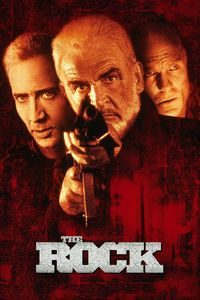
    The Rock (1996)

    (Second viewing, On DVD, May 2002) There is something awe-inspiring in the grandiose panache with which this movie flaunts itself. Continuity mistakes, logical flaws and nonsensical developments are swatted aside like irrelevant trivialities, allowing director Michael Bay full power to show incredible images on-screen. The camera moves, sweeps, pans, captures perfect moments and doesn’t give a damn about the words or the continuity. The Rock is as close as anyone has ever come to the ultimate action movie. I still find parts of it silly beyond words—but soon after I’m silenced by the boffo action sequences and the slick polish of the whole production. I love the characters (Nicolas Cage, Sean Connery and Ed Harris are perfect), I love the direction, I love most of the one-liners and I love the explosions. Why should I complain about the rest? To see if you’re a real action-movie junkie, try watching only five minutes of the film. The first-generation DVD includes the film, and nothing else. But the movie is so good…

  • Panic (2000)

    Panic (2000)

    (On VHS, May 2002) Lukewarm straight-to-video drama about a hit man and his domineering father. What could have been a fun Simpsons episode is transformed in a full-blown bore-fest. Hey, at least it’s good to see Neve Campbell get work again, but that’s a small comfort. William H. Macy is fine as the tortured protagonist and Donald Sutherland is suitably conniving as the father, but unless you’ve got a fetish for hit men family dramas, I wouldn’t bother. Life’s too short. What if a hit man is gunning for you right now? Would you want to waste your last remaining hours watching featureless movies like this one?

  • Manifold: Origin, Stephen Baxter

    Del Rey, 2002, 441 pages, C$40.00 hc, ISBN 0-345-43079-4

    As an avid reader with a limited book-buying budget, I have come to hate inconsistent authors. Greg Bear, for instance; capable of turning out fantastic novels (Moving Mars) and then waste our time with boring crap (Dinosaur Summer). Up until now, Stephen Baxter had proven to be a dependable author, writing book after book of solid hard-SF, often with deficient characters but never without a good lot of interesting ideas.

    What makes Manifold: Origin so frustrating isn’t so much the conviction that Baxter is now an unreliable author as how it’s such a let-down from the first two volumes of the Manifold trilogy. Even as “thematic trilogies” go, this third volume is a bust.

    A quick reminder: With his Manifold trilogy, Baxter set out to examine the question of sentience in the universe, re-using a cast of similar characters in alternate universes. The first volume, Manifold: Time, posited that humans were alone and showed how they set out to solve the problem. In Manifold: Space, the universe was filled with intelligent life and most of it was hostile to each other. In Manifold Origin, the scope is limited to humans. All kinds of humans.

    As the novel begins, our common protagonist Reid Malenfant and his long-suffering wife Emma are flying over Africa. Stuff happens, a mysterious red moon appears, they eject from their plane and a giant vacuum cleaner scoops up Emma as Reid parachutes back to Earth. As with the previous Manifold novels, this is the beginning of Malenfant’s quest to set up an impossible space mission, in this case send a rescue shuttle to the red moon in order to rescue his wife.

    At least a hundred pages of filler pass until Malenfant manages to lift off. Once the rescue shuttle lands (with predictably catastrophic consequences), both Malenfants are stuck on the red moon, where they’ll discover that it’s a device traveling in between universes to cross-pollinate the various branches of humanity. It’s an interesting concept. Unfortunately, you have no idea how dull and unpleasant is the execution.

    The surface of the Red Moon isn’t a fun or peaceful place: Various sub-species of humanity cohabit there, most of them barely above pre-historical social levels. There is a considerable amount of cannibalism, inter-species warfare, senseless deaths and unpleasant mating rituals. Oh, and slavery too. I have accused Baxter of being grim before, but I really had no real grasp of how depressing he really could be. It gets worse, naturally. The end of the novel is as pointless as British SF authors can make’em, which is to say very.

    My main objection to Manifold: Origin is that it’s nowhere near as densely imagined as Baxter’s previous books. Good ideas are far and few in-between, and the whole novel constantly feels padded. Most of the non-homo-sapiens viewpoints can safely be skipped without any loss of comprehension. The whole mission-preparation segment is overindulgent, stopping the action just as we needed to speed up the plot. Even worse, the ending kills off most of the cast, doesn’t solve any problem, barely presents a lame explanation and leaves whatever remaining characters in an unbearable hell.

    The only good news are that given the loose relationship between the three volumes of the Manifold trilogy, you can read the first two and skip out entirely on the third without any harm. At the very least, don’t rush off and buy the hardcover like I did; you’ll be sorry.

    As far as I’m concerned, though, Baxter gets taken off not only my hardcover list, but off my buy list altogether. I’m sure he’ll get over it some day.

  • A Knight’s Tale (2001)

    A Knight’s Tale (2001)

    (On DVD, May 2002) Sometimes, good old-fashioned entertainment is all you need. There isn’t anything particularly new or innovative in this medieval jousting sports drama/romance, but it does what it has to do quite well. Heath Ledger aptly carries the whole film on his shoulders, but he’s helped considerably by the presence of capable character actors, most notably Paul Bettany as “the” Geoffrey Chaucer and Shannyn Sossamon in her debut role. (Her resemblance to Angelina Jolie is astonishing, but she doesn’t get the chance to show much range in this typical romantic role.) The script is adequately written, with moments that actually improve on subsequent viewings. The jousting scenes are deservedly spectacular, giving us an idea of what it must have looked like to medieval audiences. Much has been said about the anachronistic use of pop music in the film’s soundtrack, but when all is sung, it seems almost a shame that more such fun touches haven’t been used. Then again, A Knight’s Tale successfully walks a fine line between unabashed contemporary entertainment and reasonably convincing historical re-creation. In any case, few will be left disappointed by this joyfully entertaining film. The DVD offers everything you could be looking for; information on the stunts, some historical background, a few worthwhile deleted scenes and a hilarious self-depreciating commentary by director/writer Brian Helgeland and co-star Bettany.

  • Kissing Jessica Stein (2001)

    Kissing Jessica Stein (2001)

    (In theaters, May 2002) A plot summary of this film reads like a full bingo-card of things I generally don’t really care to see: It’s an independent romantic comedy in which a Jewish New-Yorker career woman -tired of meaningless dating- falls in love with another girl, an artist who will make our heroine realize who she truly is. Awww. What I didn’t expect is how adorable Jessica Stein would be (she’s played by co-writer Jennifer Westfeldt, and you’d better remember that name!), how witty the script is and how I got so genuinely interested in the overall story. There isn’t too much in terms of sexual politics here, and people on both sides are likely to find fault with the film if they really want to. (In many ways, it’s a coming-of-age story more than a romantic comedy about Jews, lesbians or whatevers) New York really shines here; there aren’t any landmarks shots, but the street-level cinematography gives a better feel for the real city than any of the other blockbuster New-York films I recall seeing recently. (Well, okay, maybe at the exception of Keeping The Faith). The wonderful script is literate and unusually adept at defining its characters. Finding Kissing Jessica Stein might be a challenge at your local video store, but it’s well worth the effort. Even if you don’t think you’ll enjoy it, hey, you just might.

  • Insomnia (2002)

    Insomnia (2002)

    (In theaters, May 2002) A Southern-California detective (Al Pacino) is sent to Alaska to investigate the murder of a young girl. Stuff happens, someone dies, some blackmail takes place and suddenly our protagonist is caught up in complex moral dilemmas, which aren’t helped by his progressive debilitation from lack of sleep. There isn’t much to say about Insomnia besides that it’s a good thriller, with enough grimness and storytelling savvy to keep everyone interested until the end. The Alaskan cinematography is spectacular, and so are most of the actors involved. Director Christopher Nolan’s follow-up to the boffo Memento isn’t nearly as brilliant nor as convoluted, but he proves adept to the task of telling a more classical story. Now let’s wait for his next feature…

  • Il Mostro [The Monster] (1994)

    Il Mostro [The Monster] (1994)

    (On VHS, May 2002) Make no mistake; you have to be in a very specific mood in order to like Roberto Begnini. This being said, it’s always a lot of fun to see him at work if you like his specific shtick. Il Mostro is a touch overlong and a little too repetitive, but when it works, it sort of works well. I wasn’t overly pleased, though, by the introduction of a serial murderer in what is otherwise a rather innocuous comedy; maybe it’s an Italian thing.

  • Storming Heaven, Kyle Mills

    Harper, 1998, 499 pages, C$9.99 mmpb, ISBN 0-06-101251-3

    Looking at genres, from time to time, I despair: Is it possible to do something new or innovative any more? A standard thriller features a lone protagonist who loses everything by fighting a vast conspiracy. Betrayals, unlikely allies and multiple murders usually complete the picture. In this familiar context, is it possible to create something interesting?

    Well, yes. Any sufficiently-capable author can still work wonders with even the most overused plot. It all depends on good characters, interesting twists and good writing. Kyle Mills’ Storming Heaven doesn’t deviate a lot from the usual thriller plot, but the execution of the premise makes it all seem fresh, somehow.

    It starts with a murder, obviously. This time, a suburban millionaire couple is found dead in their home. Their teenage daughter is missing. FBI agent Mark Beamon (suitably renegade enough to serve as our protagonist) suspects something is up. His investigation eventually uncovers disturbing links between the young girl and a vast new religion with links to a telecommunication empire and a few paramilitary operatives.

    Scientology, anyone? Not quite. Clearly, some parallels exist: The Kneissians do pillory their opponent through lawsuits, have an ongoing feud with the German government and operate according to a series of “levels” similar to the real-world sect, but Mills take the concept much farther. The Church of Kneiss is actually closer to Scientology++, if you want: Mills imagines a new religion that consciously uses the latest techniques in marketing and social manipulation to set up a brand-new system of belief. Without the “limiting factor” [P.236] of outdated dogma that holds back established religions.

    Every jaded reader should be paying attention at this moment; while real-world governments are too ponderous to engage in conspiracies and businesses are too subject to market fluctuation to be menacing, religion is something else. When its influence comes crashing down on our protagonist, there isn’t much he can do to stop them. It’s a formidable opponent, and our hero has to use his wits to extricate himself from an impossible situation.

    Fortunately, this is yet another area where Kyle Mills distinguishes himself. We’ve seen countless smart renegade cops before, but few of them are as believable as Mark Beamon. He repeatedly demonstrates his intelligence without inexplicable leaps of logic or hand-waving. Storming Heaven‘s good characterization doesn’t stop there; the novel is filled with memorable supporting characters that resonate even weeks after finishing the novel. The young heroine herself is one of the most sympathetic kid-in-distress in recent memory, as she even gets a chance to shine her wits later in the novel.

    Somehow, everything else seems sweeter when good characters are at the core. Even though the plot mechanics may seem familiar, they work much better when we care about the humans they affect. Beamon’s descent in obscurity is stronger, and so is his inevitable triumph.

    A strong, unconventional, too neat conclusion ties everything together with an effective resolution that doesn’t dredge up the mano-a-mano cliché, and takes the time to deliver a few scenes of pure payback pleasure.

    Well-written and well-executed, Storming Heaven is a shining thriller that can restore your faith in the tired old conspiracy genre. Strong characters remain at the core of the narrative, making this novel more than your run-of-the-mill escapist entertainment. The religious sub-themes are deftly handled and may make you think hard for a moment or two. Mills vaults in the ranks of promising thriller writers. More, please!

  • Friday The 13th (1980)

    Friday The 13th (1980)

    (On VHS, May 2002) Dull, repetitive piece of trash. Hard to see why this has spawned nine sequels (and counting) except for the low production values and the simplistic storyline that can be understood even by gibbering morons. Simple stuff: Teenager separates itself from the group, gets killed. Repeat until only one’s left. I wish I could say that the handheld shots and the amateurishness of the script are a refreshing change after the slick twenty years of insipid rip-offs, but I’d be lying, really. The insipid drawn-out finale is just annoying. It can be watched while reading a book. Heck, there isn’t even much nudity. Blah.

  • Friday the 13th Part III (1982)

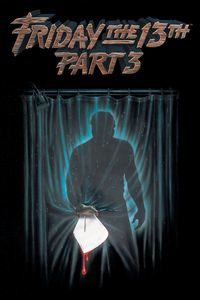
    Friday the 13th Part III (1982)

    (On VHS, May 2002) The shocking -shocking!- thing about this series is not how every damn film in the series is a carbon-copy of itself as much as how it wouldn’t take all that much wit or talent to make something special or interesting out of it. (Hey, that explains Kevin Williamson’s Scream after all…) How many time do we have to suffer through the same stupid screaming, running, tripping? Gaak. Not much new to report in installment #3: The composition of some shots is peculiar… until you realize that the film was meant to be shown in 3-D. The disco-biker gang is rather amusing, perhaps signaling the series’ descent in auto-derision. (The hockey mask also makes its first appearance) The frickin’ three-hour-long climax is once again ridiculously drawn-out. Does this series ever improve? It’s not looking like it.

  • Friday The 13th Part 2 (1981)

    Friday The 13th Part 2 (1981)

    (On VHS, May 2002) Don’t worry if you haven’t seen the first film; it’s recapped (at length) in the first few minutes. To be entirely truthful, this is a better film than the original, if only for the enhanced production values and the better-looking girls. (Still not much nudity, alas) Nevertheless, there isn’t much there in term of cinematic enjoyment. The directing is flat, the actors rather less than convincing and the repetitive structure of the plot starts to grate early on. Naturally, I could also argue that the perfect F13 film would be all porn and no violence. But then again I’m just bored watching that stuff, so what do I know?