Book Review

  • Who Got Einstein’s Office?, Ed Regis

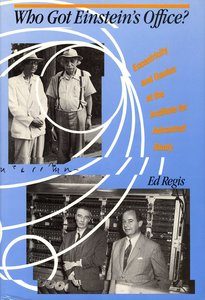
    Who Got Einstein’s Office?, Ed Regis

    Addison Wesley, 1987, 316 pages, $17.95 hc, ISBN 0-201-12065-8 nov28

    I’m never too fond of reading older, unrevised pop-science books.  Science evolves, revises its own theories and even a decade can mark significant shifts in thinking.  Reading older science books can actually be harmful: readers can end up putting the wrong information in their head from well-meaning but outdated work.

    Ed Regis’ Who Got Einstein’s Office? may be pushing almost a quarter of a century by now, but it’s unusually free of obsolescence issues.  A work of science history rather than science fact, it tackles the legacy of Princeton’s Institute for Advanced Study, a think-tank set up to provide a place of study for theoretical scientists.  The first decades of the Institute’s history read like a who’s who of American science superstars: Einstein spent his last two decade there, where he rubbed shoulders with people such as Kurt Gödel.  Over the years, names such as Freeman Dyson, J. Robert Oppenheimer, John von Neumann and Stephen Wolfram all come to spend time at the Institute.  Who Got Einstein’s Office? is not just the story of the institution, but a look at the personalities that it attracted, the research it fostered and the place of such institutes in science.

    The best reason to read the book, even today, remains the portrait of the scientists who worked there.  The book’s title question ends up being a pretext to spend an early chapter looking at Einstein’s history with the institute, and peek a bit beyond the stereotypical image of the one who remains the most famous scientist of all time.  Subsequent chapters study the eccentricities of people such as Kurt Gödel (who ended up starving himself to death out of sheer paranoia), the flamboyance of John von Neumann (“Good Time Johnny”) and the declining years of a politically-persecuted Oppenheimer.

    In-between, we get a great portrait of pure scientists at work and play.  The institute being set up to cater to elderly scientists so that they can spend their time thinking without worrying about research money or even getting lunch, it offers an environment where science dominates over more mundane concerns.  Esoteric practical jokes aren’t rare, and eccentricity abounds as Regis offers a look at the various habits of the Institute’s members circa 1986.  It’s a fascinating book, especially when it focuses more on the way science is conducted than the actual content of the science.  I picked up the book in good part because of Regis’ latter work, and wasn’t disappointed to find out that his gift for clear accessible writing is obvious even in his early work.

    Needless to say, some aspects of Who Got Einstein’s Office? haven’t aged well.  The illustration in the book are recognizably Macintosh-generated low-resolution graphics, while the lengthy passages on chaos theory, fractal graphics, cellular automata, Conway’s Game of Life and then-current computer technology instantly date the book.  Stephen Wolfram has moved from the Institute to quite a number of astonishing things, which leads one to wonder what has happened to the Institute since then.  After all, one of Regis’ conclusions is that the Institute not only had a harder time attracting big names, it didn’t seem to produce as much good science as it should: it worked better as a decent pre-retirement home for elderly scientists than a boiling think-tank for cutting-edge science.

    But none of this reflects badly on the book itself, which is filled with anecdotes, quotes, science and surprises.  Science Fiction fans (once they get over the profiles of Dyson and von Neumann) may be thrilled to see a quick quote from a mathematician named “Rudolf Rucker” [P.47] –the same Rudy Rucker known for his outlandish SF.  Other good stories involve Einstein distracting Gödel long enough for him to pass his American citizenship exam, the grander-than life personality of von Neumann and the various Faculty munities during the Institute’s history.

    It all combines in a book that could use a minor revision for details, but can still be read with pleasure and interest today.  Students of twentieth-century science will find a lot to like here, and even those who can’t remember any scientist’s name except for Einstein will learn a lot about some of the finest minds of the twentieth century.

  • Julie & Julia, Julie Powell

    Julie & Julia, Julie Powell

    Back Bay Books, 2009 movie tie-in reedition of 2005 original, 307 pages, C$16.99 tp, ISBN 978-0-316-04427-1

    Movies based on a single book are common, but the 2009 food comedy Julie & Julia is actually based on two books: Julia Child’s autobiographical My Life in France, and Julie Powell’s own Julie & Julia.  If you have both books available, tackle Child’s book first: It’s a warm narrative of Child’s experience learning to cook properly in Paris, then taking years to transform that skill into a now-classic cookbook.  It’s charming, faithful to Child’s voice and a terrific incentive to learn more about cooking.  My Life in France also provides the foundation upon which Julie & Julia is built: When Julie Powell decides to cook all the recipes in Child’s cookbook in a single year, she’s drawing inspiration from the events that Child describes.

    But this isn’t a review of My Life in France.  For various reasons, it’s more interesting to tackle Powell’s book.  Whereas Child sound happy, confident and masterful, Powell depicts herself as a neurotic, confused and cranky administrative assistant, adrift in life until she sees the chance to do something epic.  It doesn’t make her as admirable a figure as Child, but it sure makes her more interesting.

    So it is that Julie & Julia describes how Powell literally picks herself up from the floor and launches herself in a project that most of us would rightfully consider to be a bit mad: 524 recipes in a year, chronicled as a blog.  The book is not the collected blog; it’s rather a book-length essay, written after the fact but generally espousing the chronology of the events in that “year of cooking dangerously”.

    Much of the book is devoted to cooking by someone whose skills in that matter were good but not impossibly so: Julie occasionally sees recipes fail spectacularly, can’t find ingredients even in New York, makes mistakes and sees her personal life altered by her experiences.  This is all good fodder for comedy, of course: Cooking lobsters doesn’t sound like a big deal until you’re bringing them back home on the subway, and then killing them in various ways.  (The movie makes a big deal of the lobsters, but the book does a lot more mileage out of other traumatic experiences, including cleaving marrow out of bones.)

    But Powell’s year of cooking Childishly isn’t all about laughs and madcap adventures: Child’s low-level work at a Manhattan federal organization dealing directly with the aftermath of 9/11 is fraught with heartbreak and frustration, not to mention workers who aren’t entirely sympathetic to her growing fame as a food blogger.  (She does tend to lump an awful lot of them in a group called “Republicans”, which sounds impolite even to my Canadian ears.)  At home, tensions arise between herself and her husband over the course of the experience: theirs is a mature marriage, and the crises that arise between them are typical of people who have been together a long time.

    But in the end, it’s not the food (although Julie & Julia will shame you in becoming a better one), nor the tale but the words that hold up the story together.  Powell writes well, writes hilariously and writes with a good attention to detail.  The stories fit together, the episodes rise to a narrative climax and there aren’t many dull moments.  We get a glimpse at the mindset of a cook’s developing expertise, as well as a pretty good depiction of what it means to be a blogger who suddenly gets a lot of attention.

    While Julie Powell may not be a super-heroine, she has achieved something extraordinary twice: First in cooking her way out of the book in a single year (something that still leaves me agog; how do you even manage to eat the leftovers during that time?), but also by writing a compelling memoir of the experience, a perfect treat for foodies and readers alike.  See the film (which isn’t all that faithful nor as funny as the book), read the book and cook for yourself.

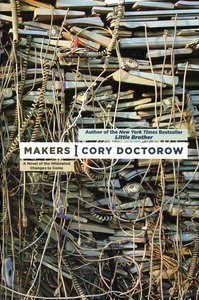
  • Makers, Cory Doctorow

    Makers, Cory Doctorow

    Tor, 2009, 416 pages, C$31.99 hc, ISBN 978-0-7653-1279-2

    I wish I could praise Cory Doctorow’s latest novel Makers without reservations.  I’ve been a Doctorow fan since Down and Out in the Magic Kingdom, read Boingboing for just as long, met him a few times and have reviewed all of his books with varying degrees of enthusiasm.  Makers is his most ambitious work for adults yet; a big book tackling an upcoming technological revolution and its aftermath.  It weighs in at a page count that alludes to Toronto’s phone area code and also marks Doctorow’s first full-sized hardcover.  The cover tagline is nothing less than “A Novel of the Whirlwind Changes to Come.” Published months after his Hugo nomination for Little Brother, there’s little doubt that Makers is a big novel and a significant publication of the year in Science Fiction and techno-nerd circles.

    For a while, the book seems to deliver on its promises.  Taking place in a future not too far away, it begins by telling us about a radical shift in American Business.  “New Work” is about repurposing existing technologies, assembling it in ways unexpected by its original makers and creating something new out of available pieces.  It’s also a way of working that upsets the corporate hierarchies, seeks modest profits from continuous innovations and has little use for the traditional ways of business.  The chronicler of this era is one Suzanne Church, tech-journalist turned blogger as her print publisher downsizes.  Fortunately, she knows just the right people: Perry and Lester, two garage engineers who love to make new stuff and so become the poster-boys of “New Work”.  Various hacks and tech demos later, they look poised to make the world go kablooie with exciting new technologies.  It doesn’t last.  By the time the first third of the novel passes by, the “New Work” boom has turned to bomb, and when the second section picks up years later, all that’s left is a wikified theme park.

    In some ways, this first section sets expectations that the rest of the book can’t match.  The first section had ideas bubbling in my mind; about techno-fascism and what happens to those who like stability, about worker’s rights in “New Work”, about the way Doctorow was recapitulating lessons from the dot-com years and applying them to a more physical sphere of innovation.  But as Makers advances, it becomes weirder, more specific, more personal and also less interesting.  The point of the novel, we eventually realize, is what happens when everyone has given up; it’s about how real innovators establish movements whatever the circumstances.  It’s not about the inevitable singularity, but about the cultural give-and-take of innovation.

    At times, Makers feels like a mashup of popular Boingboing tags:  Here’s a little bit of Disney, here’s a big of copyfighting; here’s a bit of civil right anger; here’s a lot of Maker magazine (obviously a major influence on the novel) and so on.  The problems start occurring when Doctorow’s pet obsessions quietly run away from readers’ own preoccupations.  A good chunk of the book’s second half, for instance, depends directly on the idea of massively popular theme parks recapturing the instant-nostalgia of “New Work”.  I have no perceptible interest or affection for theme parks, and couldn’t actually be bothered to figure out why these theme parks would be popular, or actually mattered.  At the same time, my interest for the characters evaporated, to a point where I didn’t care all that much about how, where and why they were arguing, sleeping together or fighting the forces of Disney.  That’s pretty much the textbook definition of a novel that “doesn’t work for me”, and so you can understand why I’m left unable to muster more than a tepid opinion about the book.

    Which is really too bad, because Makers is more current than much of what I’ve read this year, and I suspect that the novel’s failure to take off in my mind is more due to personal idiosyncrasies than major problems with the book itself.  There’s an essay to be written about the ways Makers is an antonym to Users and how that ties into both Doctorow’s tapestry of work (including the abandoned /usr/bin/god) and current notions of civic involvement, but I really can’t be bothered right now.  Disappointed, I would rather wait for Doctorow’s next novel and hope for the best again.

  • Kingdom of Fear, Hunter S. Thompson

    Kingdom of Fear, Hunter S. Thompson

    Simon & Schuster, 2003, 354 pages, C$24.00 tp, ISBN 0-684-87324-9

    Given the apocalyptic streak running through Hunter S. Thompson’s life-long work (after all, even Fear and Loathing in Las Vegas is a foreboding meditation on the gone-away sixties), it makes perfect sense that he would have been reinvigorated by the cataclysmic tone of the post-2001 era.  So it is that Kingdom of Fear shows him fully settled in his cranky-sage-from-the-Colorado-mountains role, hurtling invectives at everyone and muttering darkly about the future of the republic.  It doesn’t necessarily make the book any more vital than any of his post-1980 work, but it certainly makes him a bit more interesting to read.

    Not that this is always the case.  True to his tendency to repeat his self-aggrandizing mythology, Hunter spends an awful lot of time repeating known stories.  Kingdom of Fear is a collage of previously-published pieces, reprinted material about Thompson and a fair chunk of original material.  But even the original material tends to run in circles: We get to hear, again, about his experiences running for Sheriff, or his 1990 arrest.  He goes over his own biography at length, sometime illuminating periods of relative silence, but just as often rehashing stories read elsewhere.  His writing tics also take on, more than ever, the appearance of self-indulgence in-between gratuitous substitution of ampersands in place of the common “and”.  Also typical of Thompson’s overall oeuvre is the incoherence of the book, which flits from theme to theme without much use for signposts.

    At other times, disappointments are rife.  Kingdom of Fear is the only book, to my knowledge, in which Thompson writes more than briefly about his experience in San Francisco at the end of the eighties (working as a figurehead “night manager” at a strip club) or his travels to Cuba and Grenada.  But even then, we don’t get much more than a few pages: The Caribbean trips are heavily fictionalized, while most of the San Francisco material seems to have been kept in the still-unpublished, perhaps never-written The Night Manager/Polo is my Life.

    Other bits fare better.  Thompson saw early on the consequences of the national panic that gripped his country in the wake of 9/11, and his savage denunciations of the Bush administration ended up being more accurate than anyone was willing to admit in 2003.  For him, the whole War on Terror era feels familiar; a return to the worst days of the sixties, perhaps even to 1964 Chicago where he, as a reporter, was beaten by police.  Nixon being dead, Thompson found no problems in saying that Bush was worse than Nixon.  As usual, Thompson’s style may be repetitive, but it still carries a certain power at shorter lengths.

    But there are also a few gems here and there, finally reprinted in book form.  The best is almost certainly a 1992 short story called “Fear and Loathing in Elko”, a dark piece mixing violent prose with caricatures of popular figures (including a “Judge” with an uncanny resemblance to Clarence Thomas) to produce a terrific short story.  (So terrific, unfortunately, that a good chunk of its middle third was published as “Death of a Poet” in the tiny Screwjack anthology.)  To give you an idea, it starts with a narrator running over a herd of sheep in the middle of a highway and then goes on to more stomach-churning material.  Late in the book, “Fear and Loathing at the Taco Stand” fictionalizes his Hollywood experience and the way he met his second wife.

    Having struggled against a fat and happy country in the eighties and nineties, Thompson seems to regain some of his relevance in times of crisis.  Kingdom of Fear won’t do much to quieten critics who maintain that Thompson’s golden age was a bubble around 1972: For every good page, there seems to be ten filled with redundant filler or empty outrage.  But this volume, published two years before Thompson’s suicide, also shows that he took to bad times as it was his natural environment: it comes as a validation of his predictions and his belief that most Americans were part of “the new dumb”.  For someone who kept writing “When the Going Gets Weird, the Weird Turn Pro”, the post-9/11 era was practically a homecoming.  It’s not hard to see how he would consider those years to be the final proof of his “death of the American dream” thesis.  Sadly, this would prove to be nearly the end of the road for him: His next book, Hey Rube, would prove to be his last, and consist of collected columns about sports and politics.

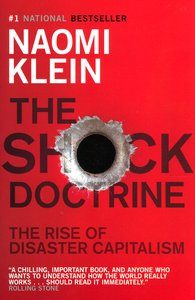
  • The Shock Doctrine, Naomi Klein

    The Shock Doctrine, Naomi Klein

    Vintage, 2008 reprint of 2007 original, 662 pages, C$22.00 tp, ISBN 978-0-676-97801-8

    Some books want to make you laugh, and others want to make you think.  But Naomi Klein’s The Shock Doctrine really wants to outrage you.  It is, after all, about how some very clever people have figured out how to take advantage of human suffering for profit.  It’s about how a class of entrepreneurs is deliberately taking advantage of crises to further their own agenda at the expense of the common good.  It about geopolitical crises can come to be used like forms of torture.  It’s about a more complete history of the past 35 years of geopolitical changes, one that adds an economic dimension to the various revolutions and catastrophes.  It makes Klein’s previous No Logo (which I finally read in a hurry after finishing this book) look like a checklist of benign corporate shenanigans.

    The irony is that I left The Shock Doctrine alongside No Logo for years on my shelves, confident that I knew what it was about.  Disaster capitalism?  How businesses move in devastated zones to make money?  Tell me something new, Klein.  But it turns out that I didn’t fully understand the thesis of the book, because what Klein is after is really a history of the past 35 years in global politics, as influenced by graduates of the University of Chicago School of Economics.

    If you don’t know about Chicago School Economics and their high guru Milton Friedman, you have a lot of catching up to do on free-market theory concepts.  But what Klein does is connect the dots until we’re looking at 35 years of intervention by Friedman-inspired “Chicago Boys” whenever there’s a traumatic political upheaval in the world.  The list of “shock doctrine” sites is long and terrible, going from Chile to Iraq but hitting destinations such as Bolivia, South Africa and Russia along the way.  Klein’s main thesis is that since voting populations does not like, want or accept right-wing economic policies, it’s best to put them in place during times of crises or panic when everyone is too terrified to protest.  If it sounds familiar, well, it should: As Klein suggests, the reforms implemented in New Orleans in the wake of Katrina were simply the homecoming party of techniques successfully field-tested elsewhere in the world.

    The worst thing is that it doesn’t take a conspiracy theory to support her claims: simply a list of people who think along the same lines, and who feel that it’s a good thing to send public dollars into private pockets.  Greed is a powerful thing, and it makes for excellent friends if ever some of the greedy get in positions of influence.  It all makes up for infuriating reading: by the time Klein ran down the list of links between the Bush administration and the oil industry, I was openly wondering how much more of this I could take before I had to stop reading the book and take a breath.

    For intellectual honesty’s sake, I should probably note that there are a few annoying things about The Shock Doctrine.  The first is a feature of every left-leaning attempt to present another version of history (I’m looking at you, Howard Zinn): They tend to presume that you already know the conventional version of history.  If not, quite a few important details are left off, and trying to fit them in the narrative can take some research.  Second; Klein’s comparisons between economic shock therapy and psychiatric electroshocks is provocative and memorable, but it does sensationalize the issue and leaves it open to criticism of irrelevance.  Finally; it’s a big, big subject and the book does take a number of shortcuts.  This being said, I’m not going to insist on any of those issues as problems: Frankly, I had far too much fun reading a selection of one-star reviews of the book on Amazon (many of them personally offended than anyone would say something against Friedman; others simply reading off the same right-wing talking points) to give any comfort to those who are predisposed to hate the book.

    Naaah; I’m going to assume my own biases and tell you that The Shock Doctrine is an important work.  It suggests a context for many seemingly disparate yet oddly congruent policies.  It shows how deeply anti-popular policies are now rooted in the US and, by influence, global policies.  It doesn’t offer a lot of hope, although the best it can do (“shock wears off”) is still inspiring.  But it also blows in the wind of the past decade, one that has seen obvious displays of policies that, until now, had been kept far away or couched in reassuring rhetoric.  The Shock Doctrine strips bare those excuses and, in doing so, give a bit of its own shock therapy to readers.  Read the book, blow a fuse, have all the outrage you want, then come back and do something about it.

  • Kitchen Confidential, Anthony Bourdain

    Kitchen Confidential, Anthony Bourdain

    Harper Perennial, updated 2007 edition of 2000 original, 334 pages, $15.95 tp, ISBN 978-0-06-089922-6

    In some ways, a great book is like great food: You can try to break it down to its individual components, but the final result will always be measured by how you sit back and say “Wow, that was good.”

    But in most other ways, great food really isn’t like a great book at all, and that’s where Anthony Bourdain’s Kitchen Confidential comes in.  Riding high on America’s renewed passion for all things foodish, chef Bourdain’s memoir was published in 2000 to instant acclaim, in part because it offers a refreshingly frank look at what happens in the kitchen of average restaurants.  While Bourdain can (and does, early on) romanticizes the power of great food, much of Kitchen Confidential concerns his own rocky path through the New York restaurant scene, and the hot, frantic, unglamorous reality of a restaurant kitchen when dinnertime starts, patrons rush in and the pressure builds.

    Unlike other celebrity chefs, Bourdain was never renowned as a flashy or particularly meritorious cook: The chronicles of his earliest days includes one particular achievement (graduating from CIA, which should be understood not as the spy agency, but as the “Culinary Institute of America”, a New York school for chefs) and several less-admirable traits: Heavy drug use, fast-burn living, and a generally aimless career path.  His description of what happens in failing restaurants is informed by several personal experiences.  But his flaws are not exceptional in an environment where this type of behaviour is considered normal: It takes a special kind of personality to work in a professional kitchen, and Bourdain’s description of what happens there is one of the book’s most vivid qualities.

    One of the book’s standout chapters, “A day in the life”, chronicles a typical workday for Bourdain, who was then kitchen manager at a middle-class New York restaurant.  It’s a chaotically choreographed ballet of ordering, inventory management, stocking, staffing challenges and, obviously, quite a bit of cooking.  One of Kitchen Confidential’s particular themes is to highlight the distinction between chef and cook: Once the chef (sometimes famous) has determined what the restaurant offers, it’s up to the line cooks to deliver the food to the customers, and that doesn’t take creativity and bonhomie as much as it asks for reliability, consistency and the ability to perform the job in a distraction-rich environment while resisting the pressures to deliver substandard results in the name of efficiency, time, cost or convenience.  Bourdain takes a particular pride in his regular crew of immigrant workers, lauding their work ethics in comparison to born-and-raised-Americans.

    Another of Kitchen Confidential’s big success is in the candid depiction of the atmosphere of a professional kitchen: a multicultural group united by a powerful under-the-fire camaraderie, characterized by vicious put-downs meant to test a comrade’s grace under pressure more than to actually insult the recipient.  Bourdain’s depiction of kitchen language is never less than R-rated, which is part of its authenticity.  But it’s Bourdain’s various portraits of the people he has worked with that round out the look at the very different sub-culture in which he belongs.  Bourdain’s fiction credentials (he had two novels published before Kitchen Confidential) serve him well in characterizing the essential details that spice up his narrative.

    The result is not just a great book, but the kind of gripping narrative that makes one sorry for short commutes and early sleep times.  It’s a tough book to abandon in mid-read, and even non-foodies won’t necessarily be put off by the wealth of culinary knowledge assumed by Bourdain.  At a time where there is a lot of material on the shelves about every single conceivable aspect of food, Kitchen Confidential still holds up a decade later.  This being said, do try to get your hands on the updated edition, which describes some of what happened to Bourdain and his acquaintances since then (he’s become a world-trotting celebrity food commentator with his own TV show) and reports on aspects of the industry since Kitchen Confidential’s original publication.  Fortunately, write Bourdain, things have generally improved: standards are higher, food is more respected, and chefs earn more respect.  Of course, this doesn’t change why you should avoid buffets, fish on Monday or well-done steak… although, as Bourdain suggests, you only live once.  Try a bit of everything.

    [February 2010: Bourdain’s follow-up, A Cook’s Tour, is a different book, although it is clearly prefigured by the closing Japan-based chapters of Kitchen Confidential: As a follow-up, Bourdain decides to live a life of adventure and go eat strange meals in even-stranger places. Alcohol, drugs, adventure and exotic food follow. The book led to a TV series, but it also acts as a commentary to the TV series. It’s all good fun in the tradition of hard-partying travelogues, although people looking for more kitchen-based material won’t find it here.]

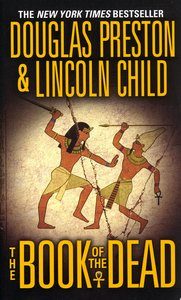
  • The Book of the Dead, Douglas Preston & Lincoln Child

    The Book of the Dead, Douglas Preston & Lincoln Child

    Vision, 2007 mass-market reprint of 2006 original, 619 pages, C$9.50 mmpb, ISBN 978-0-446-61850-2

    After matching wits with his evil-mastermind brother in Brimstone and Dance of Death, Aloysius Pendergast once again has to rise to the occasion in The Book of the Dead, final tome in the so-called “Diogenes” trilogy.  Circumstances looks promisingly hopeless at the start of the book: Pendergast is locked up in a maximum-security prison for murders his brother has meticulously blamed on him, while Diogenes is running free, planning his next horrific crime, interfering with activities of a non-profit institution and seducing Pendergast’s ward.  (He’s probably drinking from the milk carton as well, but Preston & Child have bigger crimes to describe.)

    Fans of Preston & Child’s work will be unsurprised and amused to find out that as The Book of the Dead begins, the much-abused New York Natural History Museum is once again trying to restore its tattered reputation by… staging the exhibition of a cursed Egyptian tomb deep in its basement.  That a mysterious benefactor seems eager to finance this exhibit and only this exhibit alone doesn’t seem to trouble them.  After all, it’s a foolproof plan: What has ever gone wrong with this museum’s special exhibits so far?

    The stage being set for a massive bloodbath, Preston & Child now return to Pendergast and his friends as they try to conceive of a plan good enough to rescue the FBI agent out of a high-security prison, even despite the constant interference of another FBI agent with a huge grudge against the series’ protagonist.  Elli Gunn’s EES is involved, as is a temporarily-suspended Vincent D’Agosta.  The rest of the series’ extended cast of characters pretty much all make an appearance at one point or another, making this volume seems even more familiar.

    And, like clockwork, the expected happens: Pendergast escapes, Diogenes’ plan is revealed, there’s big trouble at the Museum, and the Diogenes issue is settled.  Seen from a high altitude, The Book of the Dead is a bit dull and empty, especially compared to its immediate predecessor.  The museum-exposition crutch seems overly familiar, and the plot seems to unfold in a linear fashion.  It’s far too long at 619 pages: While the pleasure of reading the book remains constant, there are times where it doesn’t advance quickly enough, especially during the extended conclusion that drags out over 75 pages and at least one continent too far. (A change of scenery that seems increasingly forced given Preston & Child’s Italian obsession throughout the entire Diogenes trilogy.  Look, we know you vacation there often, okay?)

    The Book of the Dead (as generic a title as Preston & Child’s last few novels) also fails to impress as the third volume of a trilogy.  While Brimstone promised an apocalyptic fate for New York (if not the whole world), this seems to have been forgotten along the way.  The three books all lead from one to the other, but they fail to cohere in a satisfying whole.  Diogenes may or may not be gone (despite evidence to the contrary, never say never until the corpse has been double-tapped, beheaded, vaporized and even then watch out for the ghost) and it’s about time for Pendergast to go against someone else, but this concluding volume of the trilogy has an air of underachievement about it.

    But where Preston & Child continue to excel is in the construction of small thrilling sequences.  Even if The Book of the Dead is a lesser novel than Dance of Death, it’s got about as many good sequences and set-pieces: The revelation of what Diogenes did with the diamonds he stole in the previous book is inspired, as are the scenes following how Pendergast adapts to prison life.  The Book of the Dead, especially during its latter half, often indulges in pure melodramatic cheese when it goes deep into the Pendergast family secrets: The conclusion is partly driven by the old “scorned woman” plot device, and the final line goes back to over-the-top gothic twists.  Consider the next book nicely set up.

    It goes without saying that The Book of the Dead isn’t particularly accessible to newcomers (too many recurring characters acting out too many ongoing plot threads) but won’t lose any existing Preston & Child fans on their way to the next book.  Despite a few problems stemming primarily from the expectations left by Dance of Death, it’s still an A-list contemporary thriller showing why Preston & Child are the acknowledged master of that market segment.  On to Wheel of Death!

  • Succession, Scott Westerfeld

    Succession, Scott Westerfeld

    (Also known as The Risen Empire and The Killing of Worlds)
    SFBC, 2003, 530 pages, ??.?? hc, ISBN 0-7394-3801-8

    By now, Scott Westerfeld is best known as a massively successful author of Young Adult science-fiction.  His “Peeps” trilogy has earned him a large teen following, and most of his books since then have been aimed (by choice, with compelling arguments) to the younger set.  Given this, it’s easy to forget some of Westerfeld’s earlier works, especially those that were aimed at the adult market.  The last of those was the space-opera diptych The Risen Empire and The Killing of Worlds, known together as Succession.

    Part of why Succession continues to escape notice can be traced back to the Westerfeld’s publisher.  When Succession was first published, Tor felt market pressures to split the complete story into two volumes, severely harming the novel’s shot at awards and even readers’ attention.  It’s no secret that a split novel costs more to buy, but it’s also true that a split novel creates frustration: Here, The Risen Empire ends on a cliffhanger, while The Killing of Worlds makes little sense if you haven’t read the first volume.  (Amazingly, I see that Tor doesn’t seem to consider this a problem, since it’s currently re-publishing Succession in separate volumes.)  This makes the hard-to-find SFBC unified version the only good way to read the story –albeit not the perfect way, as their edition is marred by a sans-serif font choice and the SFBC’s usually unreliable binding.

    Kvetching about the publishing industry aside, the novel itself is worth some attention.  Fully embracing space-opera, Succession delivers a vacillating empire, courageous characters, strong battle sequences (including a bravura space battle that takes place over a quarter of the story), fully developed science-fiction aesthetics and personal stories with galactic implications.  Much of the setting doesn’t make sense except in the rigidly constrained frame of space-operas, but never mind the plausibility aspect: this is a novel that plays around with SF tropes to deliver a reading experience that readers versed in SF protocols will enjoy to the fullest.

    Much of the novel rests on two characters: Opposition politician Nara Oxham and military hero Laurent Zai.  Ironically enough, neither of them actually meet during the story aside from a few flashbacks: Zai is the point man of the Empire’s forces on a small backwater planet during an enemy attack, while Oxham has a privileged outlook on the political fallout of that attack.  Several characters surround them and tell their part of the story, from various men and women under Zai’s command to an enemy agent dropped behind the Empire’s lines.

    It’s a measure of Westerfeld’s contemporary genre-awareness that Empire and its Rix opponents are evenly matched in our affections:  While the ultra-optimized Rix is portrayed as being contrary to everything our protagonists’ Empire stands for, the Empire itself doesn’t seem particularly appealing from the get-go.  This ends up placing our affections with the characters rather than their social structure, a distinction that a number of space-opera writers can’t be bothered to study.  It’s also a good choice given how much emphasis is placed on the characters themselves.  The last line of the story makes it clear that this is, aside its military SF language, a romance.

    But Succession does stand on its own as a hard-tech Science Fiction story:  Westerfeld’s use of contemporary infotech jargon can be as good as his contemporary Charles Stross (high praise indeed) and the showpiece of the story ends up being a meticulously conceived, impeccably presented space battle between two ships that owes practically nothing to naval battles of the past.  It doesn’t make complete sense (there’s a “run silent” scene that evokes bad memories of “stealth in space”), but it’s a lot of fun to read, and the detail in which blows are described will warm the heart of the techno-geeks readers.

    For everyone else (and overlapping sets of readers), Succession is a good story presented in the overblown style of grandiose space-opera.  Numerous gadgets, clean prose (albeit with a sense of humor) and a conclusion that doesn’t quite wrap up all the threads end up making a clear case for Westerfeld’s return to this universe.  If you’ve missed Succession so far, it’s worth a look: It holds up admirably well half a decade later, and it may even drive you to read some of Westerfeld’s novels for the younger generation.

  • Bag of Bones, Stephen King

    Bag of Bones, Stephen King

    Pocket, 1999 mass-market reprint of 1998 original, 732 pages, C$10.99 mmpb, ISBN 978-0-671-02423-9

    Halfway through Bag of Bones, I realized that I had come to take Stephen King for granted.  It’s easy to do so: With a decades-long body of work that makes even so-called prolific authors look like slackers, King has been a fixture of the American publishing scene for decades, and while he’s had both high and low points, his work delivers a dependable reading experience.  Studying my reading history, I see that I tend to read King in big batches every five years or so, running up his back-catalogue until I’m (relatively) caught up once again.

    Now it’s time for another batch, because clearly I had forgotten how much fun a King novel could be.

    Not that Bag of Bones is fun in itself: After all, it begins with the death of our narrator’s wife.  Things don’t necessarily get any better after that: For four years, our scribbling protagonist is physically unable to write even one line of fiction.  It’s only when he returns to their summer home and finds out that she may have been up to a secret project that something changes in him.  This being a King story, our grieving narrator soon finds himself stuck between vengeful ghosts, benevolent spirits, an obsessed billionaire and a cute single mother.

    As a reflection of King’s pet themes, Bag of Bones starts out respectably: Our narrator’s status as a well-selling writer of romantic thrillers allows him to talk about the publishing industry with insider’s knowledge, and King manages to make something as esoteric as writer’s block seems accessible to everyone.  Later on, a few twists end up being referred to as plot devices by an all-too-aware narrator.  What’s less familiar is the theme not just of matrimony, but of domestic intimacy that emerges from Bag of Bones’ description of a widower being reminded of what he shared with his deceased wife.  For some reason, that’s an aspect of life that few writers attempt, let alone pull off convincingly.

    But Bag of Bones was, for me, another opportunity to be immersed all over again in King’s prose style.  He doesn’t have much of a reputation as a stylist because his writing seems so clear, but the way he manages the technical aspects of his prose are still nothing short of amazing: Inner monologue, action, explanations and flashbacks proceed seamlessly, and the voice of the narrator holds it all together.  The only passages that seem atypical are a pair of lengthy dream sequences that eventually prove far more important to the plot than they seem at first.  Still, King’s prose has rarely been as pitch-perfect as it is here, and he is able to highlight various emotional tones from joy to dread to despair.

    Structure-wise, there are a number of sharp turns in the story, some of whom feel gratuitous at first, but all eventually coalesce by the end of the book.  While Bag of Bones is a ghost story, it multiplies the parties involved (both real and occult) to an extent where the usual plot templates don’t readily apply.  The portrayal of small Maine communities has always been one of King’s strengths, and he once again excels at that here.  Add to that the more literary ambitions of a story in which half the battle is a widower getting over his grief and there’s a good chance that non-genre readers pulled away from King’s more bloodthirsty reputation will find much to like in this more nuanced story.  (It’s no accident if the title alone has literal, metaphorical and thematic interpretations.)

    Bag of Bones may not have the conceptual punch of some of King’s other novels, but it all adds up to a big book that’s worth the time to read.  It’s well-crafted, strongly characterized, entirely within King’s pet themes and yet a step beyond into powerful reality-based fiction.  It’s a deft blend of genre horror and character-driven fiction.  It’s also a reminder, even ten years after publication, that I happily still have a lot of King left to read: I ended up drawing a list of his titles that I haven’t read yet, and ended up with enough material for the next two years.  By then, he will have probably published three or four new books.  But that’s OK: The only danger in that much of a good thing is that we come to expect it without a proper amount of gratitude.

  • Superfreakonomics, Steven D. Levitt & Stephen J. Dubner

    Superfreakonomics, Steven D. Levitt & Stephen J. Dubner

    Harper Collins, 2009, 270 pages, C$36.99 hc, ISBN 978-1-55468-608-7

    Picture this: You go to a party, where your colossal intelligence immediately sets you apart from the crowd. You then meet another guy who seems just as eager to make fun of everyone else who’s there. Both of you are unstoppable put-down machines. In conversations, he’s the kind of wit that enjoys telling people when they’re wrong, and what they don’t know. At the end of the party, you go “I like feeling superior to other people, you like feeling superior to other people, we should totally hang out.”

    You friends keep telling you that he’s not quite as wonderful as you think he is, but you brush it off. In fact, you find that his type of patter is great fun to other parties when you’re making conversation. Then, a while later, you meet the guy again. The magic happens again, except that at the end of the night, he starts going on an incoherent rant about how global warming is all a sham, and he can solve it using twenty dollars worth of duct tape and plastic bags. As you slowly step away from your once-best-friend-forever, you start thinking: what happened?

    What happened, indeed, is the main question after reading Superfreakonomics, the follow up to Levitt & Dubner’s massively successful 2005 pop-economics book. Their conceptual overreach, contrarian shtick and intellectual contradictions all reach an apex during a fifth chapter tackling Global Warming, and they only serve to highlight the problems with the authors’ two books so far.

    After all, most of Freakonomics was based on telling people that what they knew about the world was incomplete, wrong and that even their axioms did not reflect reality as it happened. Posing themselves as cold-eyed intellectual tough-guys led by the dispassionate forces of rationality and economics, Levitt & Dubner deal in trivia, reinforced by a little bit of cynical shock value. Telling people, in the first book, that crime had seldom been so low appealed to hard numbers; telling them that the decline may have been caused by abortion (in reducing the number of disadvantaged children turning to crime) is the classic example of shock-pandering: Pro-life people simply dislike the assertion, while pro-choice activists find something here to reinforce their biases.

    As the prototypical guy who loves to know more than anyone else, I fell for Freakonomics from beginning to end, spouting trivia (“Pools are more dangerous than guns!”) at the slightest opportunity. I even gave a copy as a gift before the mounting amount of scepticism made me calm down. What’s not so great about being a contrarian is that is often leads one to take opposite viewpoints “just because”, and that can become a dogma in itself. Superfreakonomics and its prequel don’t just cater to those people; it flatters them for their bad habits.

    So it is that scepticism is the word of the day in reading Superfreakonomics. The good news, I suppose, is that most of the book is on the level of Freakonomics: Engaging writing, memorable examples, careful use of anecdote to illustrate larger microeconomic points, interesting research and an overarching tendency to link specific examples to a larger theory. We learn about drunk-walking, prostitution economics (using words such as “pimpact”), terrorist profiling, unintended consequences, and monkey prostitutes. (There’s a joke to make here about two pop-economic vulgarizers’ obsession with prostitution that I’ll leave to snarkier commentators.) Along the way, Levitt & Dubner take a crowbar to a number of cherished beliefs, including altruism, substandard doctors, the Kitty Genovese murder, the effectiveness of child seats and, oh yes, global warming. References at the back of the book chew up 36 pages (50 with the index), or about 13% of the book (18.5% with the index), which tells you something both about the reference trail and the ridiculous size of this overpriced $37 book.

    The first four chapters try to establish a framework that tells us two things at once: First, that the world is complicated and that there are unintended consequences to everything we do. But at the same time, Levitt & Dubner also try to sell us the idea that some solutions are simple: Even as they show how difficult it is to get doctors to wash their hands (even today), they also tell us that hand-washing is a simple solution to fatal problems.

    These two ideas are not mutually incompatible, but they don’t go well together (one could say that it’s a simple idea with complex consequences) and this tension is nowhere more obvious than in the much-criticized fifth chapter, which tackles global warming with an “aw, shucks, it’s not as bad as you think and it can be fixed easily anyway.” Surefire way to earn controversy and sales, this viewpoint nonetheless exposes the book to substantial criticism. I’m certainly not qualified to take on issues of large-scale climatology, but the contrarian in me can’t help but notice that most of Chapter 5 is based on a single biased source: a visit to Nathan Myhrvold’s Intellectual Ventures, a business that specializes in making money from ideas. Ideas about global warming, for instance. Ideas that the problem isn’t that bad (shock!) and can be solved with simple fixes (relief! –followed by check-writing). Superfreakonomics’ usually fast and far-reaching tone changes completely during this section, turning into a fawning profile of Intellectual Ventures that even had me wondering if they’d consider my résumé. I agree that Nathan Myhrvold is one of the coolest, smartest human beings on planet Earth… but I can’t help but flash back to the rest of the book and its insistence that altruism doesn’t exist, that well-meaning policies have unfortunate impacts and that the real world is, well, really complicated. When Superfreakonomics becomes similar to the kind of article that local papers write about con artists peddling their perpetual-motion machines, it’s time to put on the extra-sceptical goggles.

    Too bad, really, because it’s a classic case of “you should have stopped talking earlier”: Levitt & Dubdner correctly identified global warming (or rather, Global Warming) as the sacrosanct issue of the time, the closest analogue to religious belief that their pool of potential readers may have. The impulse to apply their usual everything-you-know-is-wrong shtick must have been irresistible. Alas, it also carries consequences –such as turning readers against them. What’s the cost/benefit analysis of that scenario? Who wants to reward trolls?

    On the other hand, overreach is a good antidote against uncritical belief about the rest of the book, which isn’t such a bad thing after all. Chapter 5 put aside, Superfreakonomics manages to recreate the electric huh-a-page reading experience of the original, which already isn’t too shabby. Readers may want, however, to wait a while until a “revised and expanded edition” comes out: not only will it fix errors in the main text (much as the original Freakonomics was corrected a year after release) and allow pundits to publish their debunking essays, but chances are that the paperback edition will be a better value for money than this unjustifiably overpriced hardcover. Savvy readers and freakonomists can probably agree on one thing: paying nearly $40 for an airy 220-pages main text makes no economic sense at all.

  • Emergency, Neil Strauss

    Emergency, Neil Strauss

    Harper, 2009, 418 pages, C$21.99 tp, ISBN 978-0-06-089877-9

    I don’t laugh at survivalists.

    While their threat-assessment algorithms may be out of whack, their basic message of self-reliance isn’t something I’m willing to dismiss easily: Our civilization is far more interdependent that even a generation ago, and I don’t have half the survival skills that my father (skilled wood-worker, outdoorsman, scout leader) or my grandfather (farmer: owned a horse, could slaughter and eat backyard animals) had. Survivalism, correctly applied, is about being prepared and having useful skills. I’m still dead meat on the scale of “who’s most likely to survive the apocalypse”, but I didn’t suffer through the North American ice storm of 1998 and the Northeast Blackout of 2003 without making at least a few contingency plans.

    It helps, I suppose, that I’m a Canadian and that our social security net has historically proven pretty effective in case of disaster. Neil Strauss, sadly, doesn’t have that luxury, and as he details during the first third of Emergency, he has spent most of this century’s first decade convincing himself that the end was nigh. What follows is a decade-long personal immersion in the survivalist subculture, where he comes to learn essential survival skills, reassess his life and eventually develop a surprising philosophy of how to best be prepared to survive emergencies.

    This isn’t the first of Strauss’ personal journalism efforts. His best-known book so far, The Game, detailed his “penetration” of a not-so-secret subculture of pickup artists. A former music critic and ghost-writer to the stars (Emergency is filled with mentions and cameos of people such as Britney Spears, Tom Cruise and Leonard Cohen), Strauss may have emerged from The Game with a less-than-honourable reputation, but he knows how to write engagingly, and his descent in the survivalist mindset is hilarious to read about: Emergency, despite a somewhat depressing subject and a fairly lengthy narrative, is never less than a joy to read, especially when it charts Strauss’ evolution from a somewhat self-centred writer to a full-fledged member of his community… all thanks to his evolving conception of what it takes to survive the unthinkable.

    Emergency may be billed as a book that “will save your life”, but it’s not a how-to manual as much as it’s a reasoned description of the survivalism mindset. It does have a few tips and tricks (many of them entertainingly presented as short comic-book pages illustrated by Bernard Chang, who previously collaborated with Strauss on The Game and the disappointing How to Make Money Like a Porn Star.) It’s a gateway of sorts for those looking into how to tackle survivalism: As Strauss investigates a second citizenship, money transfers outside the US, cache-making, goat-slaughtering and weapons training, it’s enough to make any sane reader consider whether they really have to fortitude to commit to such a lifestyle.

    Because, no mistake about it, Strauss describes a life-altering experience. Without giving anything away about the book’s conclusion, Strauss hints that it’s impossible to be a serious survivalist without making permanent and irrevocable changes to the way one lives. This, I suspect (and testify), is likely to be the biggest stumbling block to most people’s quest for self-sufficiency: few of us have the resources, drive, time or interest (not to mention support from loved ones) to seriously pursue self-reliance. I may admire Strauss a lot for what he did in-between the beginning and the end of his Emergency voyage of discovery, but there’s no way I can do the same. Although… you never know: I ended up deliberately locking myself in the trunk of my car to experience a small chunk of what Strauss describes –can weapon training be far behind?

    In the meantime, Emergency is a pretty solid read: After a shaky, whiny, self-pitying start, the book becomes stronger and stronger to end on a note of sheer admiration for Strauss’ odyssey. Beautifully designed (it even includes a treasure hunt through hidden clues), it’s a fun book to read, and that fun doesn’t preclude a number of gripping observations on the way we respond to unforeseen circumstances. I may be far more optimistic about human nature and the likelihood of widespread social breakdown than Strauss can be, but Emergency earns its right to make a vigorous case otherwise. After all, he suggest, the worst thing than a good survivalism outlook can do is make us a better, more capable human being.

  • Quantico, Greg Bear

    Quantico, Greg Bear

    Vanguard Press, 2008 revised edition of 2005 original, 478 pages, C$8.99 mmpb, ISBN 978-1-59315-473-8

    For readers, every new Greg Bear novel is an exercise in gambling. His career spans the best like the worst, although recent work have been on a downward trend. His forays in thriller fiction (Vitals) haven’t always been successful, and Quantico’s troubled path to publication (Vanguard Press isn’t a top-tier publisher for genre fiction, much less one of Greg Bear’s usual publishers) was not a promising sign.

    Happily, it turns out that Quantico is merely average, and not a disaster of Vitals proportions. It’s a too-earnest techno-thriller convinced of its own self-importance and it’s generally duller than any genre reader has any right to expect, but it has a few ideas in its mind, and offers a number of interesting moments.

    It takes place about a decade in the future, at a time where the United States are still deeply obsessed about the War on Terror. 9/11 has been followed by something called 10/4 (details unspecified), and the gloom of the Bush years still seems to be prevalent throughout the novel. The biggest difference is that home-grown terrorists seem to have become as dangerous as foreign ones: As the novel opens, FBI agents are on the verge of capturing an important cult leader. What they find in the wreckage of the operation, though, goes well beyond anything anyone had imagined: At a time where bio-terrorism is cheap, there’s a lot more to fear from viruses than explosives.

    Perhaps the best thing about Quantico is its portrait of a future FBI where law-enforcement technology has kept up with threats. Bear has done his research, and the tools he gives to his heroes do much to ground his novel in foreseeable reality. The three young FBI agents who become the protagonist of the story are exemplary recruits, and through them he’s able to perpetuate the mystique of the Bureau. Quantico is also bolstered with what sounds like authentic police lore and lingo, making feel like an unusually well-detailed thriller at a time where spectacle seems de rigueur.

    The plot itself isn’t quite so successful: it depends on an implausible yet tired antagonist (ah, the good old idiot-savant bio-terrorist…), meanders quite a bit on its way to a conclusion and generally feels like something we’ve seen far too often before. Part of the issue is that Bear may not know how to write thrillers on a sentence-per-sentence level. His flat narration makes little distinction between exposition and action scenes, with the result that even the book’s most suspenseful moments come across as flatter than they deserve.

    All of that is damning enough, but then I realized midway through the novel that I wasn’t enjoying any of it. To put it simply, Quantico isn’t particularly good beach reading and it took me until the end of the novel to figure out why. As I waded in the supplementary material added to the mass-market paperback edition, my unease grew clearer: After a deleted scene, an afterword, a Q&A (badly edited to repeat almost verbatim passages from the afterword a few pages before) and a lengthy annotated bibliography, it struck me that Quantico wasn’t just begging to be taken seriously: It was demanding, with great force, to be accepted as a serious and important statement on the future of terrorism in the United States. Every appeal to authority, research and verisimilitude only underscored the misguided aims of the novel.

    Basically, Quantico gave up on entertaining the reader before it even began. Self-obsessed with Making a Statement, it ends up being an annoyingly shrill retread of catastrophic thinking. It reads, even less than a year in the Obama administration, like an escaped convict from the Bush Terror Years, paranoid at even the slightest provocation, and retreating in its own safe place with somber declarations than only clear-eyed patriots can think about the unthinkable.

    Somber predictions of doom and gloom with little escape aren’t exactly what I need from my entertainment reading. Genre reading protocols are amenable to pessimistic takes on reality (after all, it seems as if most thriller and military fiction writers are obsessed with ever-more-exotic threats to the fabric of the nation), but a good chunk of my favourite thrillers actually dare to envision the possibility of a better future… once threats are disposed of. Quantico is too dour, too obsessed with never-ending danger to be any fun. There’s a public for that, I suppose.

    As I write this review and check my sources, I see that Quantico will soon be followed by Mariposa, a follow-up featuring most of the characters. This does not bode well: thrillers are rarely suited to recurring series… especially in dealing with consequences of previous volumes. Most writers avoid the problem by pretending that previous volumes don’t exist (something that still drives me slightly nuts about Lee Child’s “Reacher” series), but that supposes that previous volumes are worth reading at all. Given how Quantico struggles to even maintain a base level of interest , I’m not going to be among those special-ordering Mariposa upon publication. Especially if it still swears up and down to be taken seriously.

  • Better than Sex, Hunter S. Thompson

    Better than Sex, Hunter S. Thompson

    Ballantine Books, 1995 re-edition of 1994 original, 245 pages, C$20.00 tp, ISBN 978-0-345-39635-8

    Every critical assessment of Hunter S. Thompson’s work is clear on at least one thing: His latter-career work isn’t nearly as interesting as his early-seventies days of glory. Better than Sex certainly bolsters that theory, its focus on the 1992 Presidential race being so closely comparable to Thompson’s own classic Fear and Loathing on the Campaign Trail ’72.

    Twenty years later, though, Thompson isn’t flying around the country to cover the presidential campaign: He’s sitting at home, often drunk, and watching the whole thing via satellite TV. The bile, the verve, the insults are still there, but the insights… not so much. Oh, it’s not a strictly couch-bound book: Thompson did play a gonzo role of sorts in meeting then-candidate Bill Clinton with other Rolling Stones writers early in the 1992 campaign, but most of the book is spent commenting events as they happen on TV, along with long digressions on the Reagan/Bush years and memories of Thompson’s own political experiences.

    Design-wise, the book reflects the scattered nature of its writings: A sometimes-collage of various disparate elements (including pictures, memos, faxes, buttons, newspaper excerpt and a time-line running throughout the book), Better Than Sex can often be more confusing than enlightening in addressing its reader: Some pieces start out as being on a letterhead, then flow into the book’s typical typeface without transition. While the effect highlights Thompson’s favourite device of blending reality with fiction, it also reminds us of the sham nature of many of Thompson’s so-called letters to other recipients.

    A further problem in reading about the 1992 election a bit more than 15 years after the fact is that it’s an inglorious period to recall right now. It’s not recent enough to be interesting for our own purposes (in American political terms, 1992 is at least three generations ago), while not being distant enough to take on a patina of historical respectability. Then there’s our unfair knowledge that the true course of the Clinton administration would be far weirder than even Thompson could imagine.

    This being said, it’s no accident if the better parts of Better Than Sex are the more outrageously fictional sections. Thompson being told about Clinton’s childhood bully is one of the book’s highlights, for instance, and so is his fanciful account of running amok in Little Rock, Arkansas on the night of the 1992 presidential election. (The latter even features Thompson being cheated out of his money by James Carville, with a cameo appearance by Mary Matalin.) Perhaps the third high point of the book is the Rolling Stones meeting with Clinton, although it’s completely coloured by Thompson’s negative impression of Clinton and his early answer to drug-enforcement questions. (In the Gonzo oral biography, readers will find a more balanced assessment of how the meeting truly went and how Thompson didn’t contribute much to the discussion beyond a few early grumpy remarks.) Honourable mentions would have to go to Thompson’s Nixon obituary, which closes the book and is enjoyable not just for its unrelenting vitriol, but also as an epitaph of sorts for the politics with which Thompson was most comfortable.

    Otherwise, Better Than Sex generally reads like a desk-bound attempt to recreate the magic of what Thompson was able to capture in his 1972 memoir. From a transfer of his relationship from Frank Mankiewicz to James Carville and his ineffective attempts to contribute to the Clinton Campaign just like he hobnobbed with the McGovern staffers, Thompson comes across as a writer long past his prime, trying to ingratiate himself with a crowd that doesn’t have much use for him or his era. It inevitably leads to a screed against the “healthy and clean and cautious” Clintonistas, but the contrast couldn’t be clearer. (It’s probably mean to mention that Clinton actually won, unlike McGovern or Thompson himself.)

    As a chunk of Thompson’s bibliography, Better Than Sex shows nothing more exciting than self-repetitive nature of Thompson’s latter work. It milks some expressions for all their worth (in addition to the usual Thompson gonzo standbys, the worst offender here is “Politics is the art of controlling one’s environment”; a good sentiment, but repeated so often that it loses much of its freshness), relies on gold old-fashioned invective as a rhetorical crutch and repeats elements of the Thompson biography that really have nothing new to teach us. It’s still entertaining (which is more than one can say about most political memoirs from 1994) but it also calls to mind better and bolder Thompson books.

  • Here Comes Everybody, Clay Shirky

    Here Comes Everybody, Clay Shirky

    Penguin, 2009 updated re-edition of 2008 original, 344 pages, C$17.50 tp, ISBN 978-0-14-311494-9

    Hang around Web 2.0 circles long enough and you will meet them. The social media gurus who gravely intone that Here Comes Everybody was “deeply influential” to their thinking. (Then they make a pause, steeple their fingers and gravely repeat for emphasis: “Deeply influential”.) Never mind that the book is not much more than a year old: Web 2.0 moves so fast (“That tweet is, like, a week old, man!”) that actual books published in 2008 might as well carry the historical gravitas of stone tablets and brass statues of the founding fathers.

    Books about “Web 2.0” social media naturally lend themselves to a number of pre-emptive criticisms: What makes them worth their weight in paper? What can they tell us that a trawl through boingboing’s archives won’t grep? Who is Shirky, where’s his RSS feed and how can he expect his book to remain interesting as it visibly curdles on the way from the printing plant to the bookstore shelves?

    Fortunately, Shirky’s book lives up to most of the hype. What it brings to the discussion that a swarm of blog posts can’t deliver is perspective. What, Shirky asks, is fundamentally different about the web’ s social innovations? Is sending email such a basic change in the way our species communicates?

    As it happens: yes, it is. The fundamental change is not that we can send email. The change is that the costs of communicating between ourselves are being lowered to, essentially, nothing. Never mind the technology: Once people understand that they can exchange with anyone around the planet with very little costs, quantity becomes a quality of its own. Shirky goes back to the invention of the printing press to bolster his argument that what’s happening nowadays is, in fact, new. That it presents mode of interaction and organization that have no clear analogues in history. That we are currently making up the rules (social as well as legislative) that will govern all of us and our descendants for the rest of history. Whew! Who knew Twitter could actually mean something?

    Like most skilled pop-culture writers, Shirky knows how to go from the specific to the generic: in presenting examples of specific incidents and movements, he’s able to make his way to more sweeping conclusions that can be applied to other groups. Here Comes Everybody is particularly good at providing principles and hypotheses that can be applied to existing social groups. I was amused, for instance, to find out that Shirky’s theories dovetailed into my own observations about the changing nature of SF fandom over the past decade.

    (OK, here’s an applied instance of Shirky’s theory in one short paragraph: The internet has driven down the price of interaction about Science-Fiction and Fantasy to practically nothing. In doing so, it has pretty much killed what was known as the “general local SF convention” which did nothing more than bring together “people who read the same kind of stuff”: SF fans can now visit countless blogs and forums to meet other people with the same interests, regardless of where they live. But at the same time, we’ve seen a bewildering splintering of interests, to the point where some Harry Potter fans can spend all of their time in Potter fandom. Ironically, this has led to the strengthening of the specialized-convention model in which people travel from all over the world to specialized events that cater to very specific, but very intense interests. These highly targeted conventions couldn’t be possible without the “humming background noise” of shallow interests provided by the Internet, creating the pool in which the really hard-core fans can be drawn with little effort. Aren’t new models of social interaction wonderful?)

    Shirky has quite a bit more historical and organizational background than the average blogger, and so his book represents a solid bridge between social, historical and organizational theories as they can be applied to the web. Here Comes Everybody has depth, and it’s one of those books that can be re-read for refreshed insights every so often. It’s a pleasure to read (no dry theory here), it manages to unearth sub-pockets of the Internet that had escaped most people’s attention, and proves to be deeply inspirational in the way it suggests that the future is happening now.

    If that sounds like Shirky’s book was deeply influential, just wait a while: the value of those books is always more obvious a while later, after we get to see what sticks in mind and what disappears. Time will tell whether it’s right. Somehow, though, Here Comes Everybody at least satisfies the initial test: It’s worth reading at least once, right now. At the end of it, you‘ll know at least as much as your local social media guru. Regardless of whether he’s been deeply influenced.

  • Logicomix, Apostolos Doxiadis & Christos H. Papadimitriou

    Logicomix, Apostolos Doxiadis & Christos H. Papadimitriou

    Bloomsbury, 2009, 347 pages, C$28.50 tp, ISBN 978-1-59691-452-0

    What a delightfully odd and wonderful book.

    There’s nothing stating that Logicomix shouldn’t exist, and yet… the thought of a comic book explaining the foundations of mathematically-driven logic via the life of Bertrand Russell certainly ranks high on the list of “book one wouldn’t expect”. The event bigger surprise is that Logicomix is such an absorbing and successful work.

    Scott McCloud would be proud, I suppose, given how clearly Logicomix espouses the principles he sets out in his trilogy of works about comic books. It takes an intellectually challenging subject, gives it life through dramatic events and meta-fiction interludes, hooks readers with beautiful and evocative art and delivers a reading experience unlike anything a prose writer would have been able to achieve. It’s a minor achievement –and not merely as a comic book.

    The easiest dramatic arc to follow in Logicomix is the early life of British intellectual Bertrand Russell, as he grows up to become a logician and blossom alongside the birth of Logic as an academic discipline. Russell sought to explain logic not just as a subset of philosophy, but as being proven by mathematical theorems. (Hence his Principia Mathematica, 379 pages leading up to “From this proposition it will follow, when arithmetical addition has been defined, that 1+1=2.”) Russell may have indulged in intellectual sphere unattainable by ordinary humans, but his life was as dramatic as they came: He came from a well-bred but highly dysfunctional family, married often, rubbed shoulders with some of the greatest names in European intelligentsia (which included mentoring Wittgenstein)… and that’s just the first half of the book. (Such is the richness of Russell’ s life that among other things that Logicomix doesn’t have time to address in depth is the controversy about his pacifism leading to his academic dismissal, much more of his eventful domestic life and his survival of a plane crash that killed nearly half the other passengers.) Through Logicomix, Russell emerges as a sympathetic figure, maybe even a hero of sorts.

    But the real protagonist of Logicomix is human thought itself, the way in which it stems from life and the way it builds upon itself. Logicomix becomes a spellbinding portrait of how great thinkers collaborate, argue, set their theories on paper and often see them superseded by better ideas inspired by their own work. The collaboration between Russell and Alfred North Whitehead is portrayed vividly, as are his (sometimes-fictionalized) contacts with other philosophers and logicians across the Continent. Best of all, Logicomix actually manages to teach a few interesting things to readers, including Russell’s own paradox of set containers. Wittgenstein’s path through life (easily as fascinating as Russell’s) is also sketched with good explanations of his early and latter schools of thought. Those whose education may not include solid primers in logic have nothing to fear and everything to gain from Logicomix’s vulgarization.

    Another layer helps all elements of the book together and make it relevant to today’s audiences: an ongoing meta-fictional conversation between the book’s co-authors and the artists responsible for illustrating Logicomix: We’re meant to follow their progress as they argue about the book’s theses, the metaphors used to present its concepts and what needs to be left on the wayside. It eventually leads to an allegory-rich theatre show and a few highly promising concept for a sequel on computer science, the natural offspring of the concepts discussed throughout the book.

    There’s no need to state how quickly I would buy such a sequel, or any follow-up comparable to Logicomix. For a chance discovery in the “Graphic Novel” section of the bookstore, I’m stunned at how successful Logicomix is at its stated goals. I’m not even bothered by the esoteric nature of the final pages given how I expect to re-read the book eventually and find new things in it. Scott McCloud preached in the wilderness for years about the particular strengths of the graphic novel as a form of expression, and now we have as clear an example of what he was espousing. The result is as accessible as it’s stunning: a primer about logic in graphic novel form. Never mind how some people are going to be blown away by this book: it’s due for a long life as a college textbook, an example of how mature graphic novels can be, and a good old read for anyone who wants a little substance in their entertainment reading.

    Logicomix may be odd and wonderful, but the time is ripe for it to become a bit less sui generis.