Book Review

  • Shopportunity!, Kate Newlin

    Shopportunity!, Kate Newlin

    Collins, 2006, 240 pages, C$31.00 hc, ISBN 978-0-06-088840-4

    There are many ways in which a given book can fail to achieve its potential, but Kate Newlin’s Shopportunity! is one of the rarest blend of misguided intentions, flagrant elitism and inane chatter.  It’s easy to read, written by a smart person, filled with interesting factoids and yet fails to cohere in a fascinating fashion.  It frustrated me in ways that simply-bad or dull books simply can’t even dream of.

    Its biggest problem is that it simply doesn’t know what it’s about.  From the cover blurbage, we get the impression that this will be, in the footsteps of Paco Underhill’s Why We Buy and Call of the Mall, an exposé of the contemporary American shopping experience and how it fools the average shopper into making suboptimal choices.  But then again, it may be an instruction manual for shop owners: Newlin, after all, works for a consulting firm that specializes in retail business advice.  A quick look at the first paragraph tells us that the contemporary shopping experience has become soulless and mechanized: Is Shopportunity! an ironic title meant to propel an acid critique of today’s big box stores and their devastating impact on the nature of consumer choice?

    This confused, perhaps even schizophrenic impression grows stronger as the book advances.  Because it’s possible to find all three messages in Shopportunity!, along with brain-damaged passages in which Newlin summarizes her main arguments in bullet-points meant to enhance our shopping experience.  (“Rule #17: Break Out of the Big Box” [P.165])  As if what we really needed was a retail consultant telling us how to become a better, more satisfied shopper…

    Oh yes; in between the looks at the psychology of the modern shopper, savage anti-Wal-Mart diatribes, explanations on how bad stores drive away customers and a lament on the terrible cost of “cheap”, Newlin actually aims part of her book to people who love shopping and want to make it even more fun.

    It’s not necessarily a contradiction in term, although my own prejudices are having trouble coping with that concept.  I’m not, after all, a happy shopper.  Like many men, I see retail stores as places for hunting, not gathering: I know my prey, I’m a busy guy, and my ideal store minimizes the nonsense between me and what I want.  So when Newlin flies in a rage against Costo/Price Club, I take it personally: I love Costo in ways that airy discussions about the chain’s efficiency, logistics and force concentration can’t fully convey.  (But I don’t always shop there.)

    On the other hand, I do boycott Wal-Mart and love my upscale(ish) neighbourhood grocery store.  Yet when Newlin blasts a suburban (read; poor and lower-class) IGA while praising Whole Food, I can’t help but twitch an eyebrow.  That reflex is confirmed pages later when Newlin talks about a simply wonderful, dahrling shopping afternoon in trendy upscale Manhattan boutiques.  It then becomes reasonable to suppose that Newlin has lived the Manhattanite life for too long to be able to relate to most of her shopping readership: much of the (short) book isn’t about shopping as it seems to be about pure class exhibitionism, and the demonstration that Newlin’s tastes are unarguably better than those poor schlubs trucking it to their local IGA.  There’s a difference between having the means to consume better products and rubbing one’s self-designated superiority in everyone else’s faces, and Shopportunity! comes revoltingly close to the second.  As a result, I found myself disliking the book long after Newlin moved on to other topics.  In fact, I found myself disliking the author (who, I’m sure, is a perfectly nice person when she’s not writing books), and there’s little coming back from that point.  I hope it burns her to learn that I got the book at a remainders table.

    But even ignoring the class issues, Shopportunity! is just a mess, destined at about four different and incompatible audiences.  Those looking at business advice will resent being treated to incoherent “Shopping Tips” like brain-damaged Valley Girls (“Rule #3: Let Brands Transform You” [P.40]), while socially-conscious shoppers will be put off by Newlin’s effortless arrogance.  While there is substantial insight buried in-between the dumbed-downed bullet points and the shoppier-than-thou arrogance, Shopportunity! never gels, and comes across as an unsatisfactory mixture of material found elsewhere in purer, more coherent fashion.  There are so many fundamental social problems in the way retail outlets are set up nowadays that building about around how it’s “not fun to shop anymore” is the dumbest possible way to approach the issue.  Shopping technicians are better off reading Paco Underhill’s books; shopping activists are better off with Naomi Klein or Ellen Ruppel Shell’s Cheap and shopping fans are better off at the mall.

  • The Futurist: The Life and Films of James Cameron, Rebecca Keegan

    The Futurist: The Life and Films of James Cameron, Rebecca Keegan

    Crown, 2009, 273 pages, C$29.95 hc, ISBN 978-0-307-46031-8

    Admitting that James Cameron is one of my favourite directors is endangering my movie-reviewing license and exposing myself to endless mocking.  Somehow, the more successful his films become, the most acceptable it is to dismiss his achievements.  But as someone whose mind was blown away by Aliens and Terminator 2, someone who still likes Titanic and Avatar despite the faux-chic scorn they attracted, it was hard to pass up Cameron’s latest biography, one that picks up twelve years after Christopher Heard’s poorly-sourced Dreaming Aloud.

    Rebecca Keegan has one big advantage over Heard, and it’s that she wasn’t limited to newspaper clippings and a few meagre interviews: she reportedly had full access to Cameron, his family and his long list of friends and acquaintances in Hollywood.  As a result, The Futurist is a rich and well-researched book, one that remains interesting throughout and not just when its subject hits the big time.

    Of course, the notion of “big time” for Cameron starts early, as he’s been helming his own celluloid visions since 1984’s The Terminator.  Every subsequent Cameron film after that is a study in increasingly complex endeavours, with making-of stories that rival the film itself.  “Just another day on a Cameron set” may include everything from hanging off a plane suspended by a crane over the Miami skyline, nearly drowning in an abandoned nuclear reactor cooling tower, building a near-full-scale model of the Titanic with period detail, or inventing new technology to get unprecedented visuals.  From its very title, The Futurist aims to show how much of a visionary Cameron truly is; how he has the mind of an engineer, the hands of an artist and the eye of a filmmaker.  Tales after tale show Cameron doing things no one else has ever done before, winning large bets against those who said it just couldn’t be done.

    The flip-side of this incredible forward drive is Cameron’s abrasive personality, one that has annoyed a number of award-watchers, left film crews rebellious and broken four of his own marriages.  Cameron delivers fantastic movies, but he’s a demanding master in making them.  But then again, he has paid his dues: One of the best-known stories about him involve feverish sickness in Rome while fruitlessly re-editing his first film (an episode that would lead, as fans know, to the genesis of the Terminator films), but Keegan also reports on a lesser-known story about his first shoot that involved Cameron literally mopping up blood on the set and trying to keep the rest of the lunching crew from finding out what happens when you shoot in a real morgue.  Keegan doesn’t shy away from describing Cameron at his worst or identifying who has said they would never want to work with him again, but she does her best to show how the same facets of his personality can lead to good and bad.

    The rest of the book is just as skilful.  With deft and clear narration, Keegan moves from project to project, weaving industry facts with recollections from Cameron acquaintances.  For moviegoers, The Futurist is a lot of fun to read.  I don’t follow gossip much, and so there were a number of new anecdotes to me here and there, including one in which Cameron helped arrange for the safe release of Guillermo del Toro’s father after a kidnapping.  Perhaps the most revelatory section of the book follows Cameron in the twelve years between the release of Titanic and Avatar.  Flush with cash and acclaim, Cameron chose to step away from Hollywood and spend a decade indulging in his passions, from deep-sea diving to space exploration and setting up the new technology that we would need to deliver Avatar.

    Given all of this, the flaws of The Futurist are slight, obvious and inevitable.  Released to coincide with Avatar’s release, it hopes for another Cameron success but really has no idea how big the movie would become, and how warmly it would be greeted by audiences.  Then again, updated material is what paperback editions are meant to feature.  (One wishes, though, that some of Keegan’s most ridiculous claims about Cameron’s predictive powers would be toned down: Using Arab terrorists in 1995’s True Lies doesn’t make him anticipate Al Quaida any more than did contemporary thrillers such as Executive Decision and Air Force One.)

    It’s not quite the ultimate Cameron biography (one hope that he still has a few great movies in him), but it’s a very good one.  It’s certainly the best and most complete book about Cameron’s life so far (even though Paula Parisi’s Titanic and the Making of James Cameron remains a resource for Titanic minutiae) and a pretty good compendium of arguments for those willing to argue that Cameron is among the most important directors of the past quarter-century.

  • The Rebel Sell, Joseph Heath & Andrew Potter

    The Rebel Sell, Joseph Heath & Andrew Potter

    Harper Perennial, 2005 updated edition of 2004 original, 374 pages, C$19.95 tp, ISBN 978-0-00-639491-4

    Shortly after reading Naomi Klein’s virulent No Logo, I ended up buying myself a copy of Adbusters magazine despite Klein’s own misgivings about the publication. It was the first time I purchased the magazine since high school: I wanted to see what I had been missing in the years since then, and gauge the current state of the anti-consumerism movement.  I wasn’t impressed: In-between spastic graphic design, incoherent articles and a message that didn’t seem to have evolved since the early nineties (and which may, in fact, have regressed into further insularity), Adbusters seems more self-satisfied than relevant, a charge that also broadly applies to a number of activists on the left end of the political spectrum.

    So imagine my pleasure in finding kindred spirits in Joseph Heath and Andrew Potter’s The Rebel Sell. –also known as Nation of Rebels in the US market.  The book’s subtitle promise to tell us “why the culture can’t be jammed” and the demonstration is more than a discussion of co-optation.  Indeed, the authors demonstrate, there was never a need to co-opt, since counter-culture does nothing better than reinforce culture itself.  Their argument is complex and I’m not up to the task of summarizing their dense tapestry of ideas, but it generally breaks down in the realization that the mainstream doesn’t really exist.  Mass culture is made of many sub-cultures, including the counter-culture.  Nothing really stops anyone from adopting counter-cultural ideas as part of their individual identity, and there is a lot of money to be made selling ideas of rebellion.

    So far so good; but what really sold me on the book were Heath and Potter’s demonstration that the current (Canadian) system, albeit imperfect in countless ways, actually works better than anything else tried so far.  Whereas the far left thinks it will settle for nothing less than revolution, the author point out that small incremental changes have, historically, been the surest way to chip away at social inequity… not to mention the losing gamble that is the complete replacement of an established system.  It seems like a common-sense point, and yet one that’s not often taken seriously.  Of course, small incremental changes are boring.  They require work, tenacity and, at the very least, some involvement in the messy real-world conflict of interest that is organised politics.  The Rebel Sell may be a triumph of conventional thinking, but it’s also far more reasonable than anything it criticizes.

    Not always reasonable, though: The Rebel Sell is, in many ways, a sneering dismissal of left-wing power fantasies and at times it can’t avoid the trap of acting like the smartest kid in the class.  While most of the book is solid, it sometimes becomes wobbly in specific criticism.  They authors point and laugh at Naomi Klein’s musings about the gentrification of her neighbourhood in a way that almost makes me suspect that they must have had an argument with her at a Toronto social event or something.  (Not to mention their dislike of Alanis Morrissette!)  They also, regrettably, sketch a bit hastily over the point that not all No Logo-inspired left-wing activism is posturing: criticizing third-world sweat shops is about improving lives, not simply selling counter-culture merchandise.  (Maybe that point seemed obvious to the authors who, despite their targets, actually hail firmly from the left side of the political spectrum.)

    But none of this changes the fresh thinking in this book.  It’s articulate, a bit smart-alecky, almost daring in its embrace of middle-of-the-road progressivism.  It’s very Canadian in how it speaks from the middle against forms of excess, and uses the ideals of the left to police its own worst excesses.  (In a formula I’m adopting from now on, they point out that the left has trouble differentiating dissent from deviance.)  This review barely scratches at the fizzy intellectual fireworks of the book, but it’s a joy to read and great way to complete the picture painted by Klein and company.  It’s perhaps most useful as an antidote and vaccine against some of the most inflamed rhetoric that starts to sound so good after eight years of the Bush administration.  Most people are, after all, reasonable people.  They don’t all subscribe to Adbusters magazine and would rather live well than climb to the barricades.

    (Bonus Trivia: You can scour early-nineties Adbusters magazine and spot my name once in their letter columns.  If my memory of what I wrote there is correct, you will find out that I haven’t changed much since then.)

  • Oryx and Crake, Margaret Atwood

    Oryx and Crake, Margaret Atwood

    McClelland & Stewart, 2003, 378 pages, C$37.99 hc, ISBN 0-7710-0868-6

    When a talented mainstream author tackles a science-fiction novel, quite a few interesting things start to happen.  The novel is read by two largely distinct audiences (the author’s audience, and the genre SF audience as well), leading to what can be hilariously divergent takes on the result.  Historically, mainstream authors writing SF did so without the bag of tricks drilled into the heads of budding genre writers (consistent world-building, incluing, social complexity, etc.) and without any lifelong affection for the genre either.  The result tends to read like well-written, but substandard science-fiction: The background doesn’t hold together, the extrapolation is superficial and there’s a suspicion that everything is supposed to be a metaphor standing for something else.

    But Margaret Atwood is not just a “talented mainstream author”: In fact, despite her occasional protestations, she’s perilously close to qualifying as a true science-fiction writer.  She has written at least three SF novels so far, and one of them, The Handmaid’s Tale, remains a minor landmark of the genre.  Mainstream fiction novel The Blind Assassin even included a subplot about a hack SF writer in mid-twentieth century New York.  Atwood has apparently read a lot of SF in her formative years (which may explain her familiarity with an often-outdated notion of the genre) and clearly understands how it can be used to do things that mainstream fiction can’t explore.

    So it is that Oryx and Crake is a return to Science Fiction for her: While the framing device is about a man, a quest and a post-apocalyptic world, the meat of the story is the imagined biography of three people growing up in an increasingly unpleasant future.  Jimmy (later Snowman) is the main viewpoint character, and his experiences growing up with his friend Crake, and then meeting Oryx, form most of the bulk of the novel.  It’s not a pleasant future, what with deadly violence figuring prominently in popular entertainment, and genetic manipulations resulting in ever-stranger life forms.  When humanity is wiped out in the last third of Jimmy’s narrative, just in time to make place for the post-apocalyptic landscape Snowman has been inhabiting in-between telling the story of his life, we feel as if it’s a deserved end.  After all, it has already engineered its better descendant to inherit the Earth once they’re gone.

    Genre readers poking at Atwood’s imagined future won’t be impressed by the originality or depth of the SF elements.  Much of it appears recycled wholesale from other post-apocalyptic genetically-engineered nightmares.  Atwood loves portmanteau words and can’t resist the impulse to label everything in cute fake trademarks, surrounding her characters with a blizzard of consumerist tags.  Her future society, pre-catastrophe, seems to be one in which everyone is gleefully complicit with competing corporations, unchallenged pornographic entertainment and rotten “human” behaviour.  It’s not a nice novel, and even pointing out that it’s supposed to be dystopian satire doesn’t do much to quieten thoughts that we’ve seen all of this before, in more fully imagined settings.  This being said, Atwood does not embarrass herself with paper-thin future elements like so many of her mainstream colleagues: There may not be a lot of SF here, and it may not go far, but it’s good enough to suspend the disbelief of the average SF genre reader.

    But reading Oryx and Crake for the SF elements is like using a Ferrari to commute to the nearest bus stop: It’s a bit of a waste, and it denies the book’s greatest assets.  An Atwood novel is meant to be read for the writing, the sly humour, the deadpan take on human weaknesses.  Never mind the obviously converging plotting; it’s a book meant to be appreciated line-by-line.  Reading it is, if you want to go back to clumsy car analogies, like experiencing a performance engine put in an otherwise unassuming beater: The writing is polished to a level that would cause lesser writers to weep openly.  It doesn’t amount to much in the end, but it’s a ride to get there.

    Oryx and Crake even fans the deep and undying crush that mainstream-friendly SF genre readers may have on Atwood, who will always remain Canada’s hottest writer no matter how much we can take her for granted.

  • From a Buick 8, Stephen King

    From a Buick 8, Stephen King

    Pocket, 2003 reprint of 2002 original, 487 pages, C$11.99 mmpb, ISBN 0-7434-1768-2

    At this stage of his career, Stephen King can take risks that a younger writer wouldn’t dare.  Risks like a novel that consciously withholds complete satisfaction from the reader, wrapping everything in a preachy blanket of “there are strange things we’re not meant to understand”.  No, I’m not talking about The Colorado Kid, but From a Buick 8, an uncanny novel that does things in ways few genre readers would expect.

    Which is just as well, because a very superficial look at the novel immediately summons memories of another King novel: his Christine is the first example that comes to mind whenever talking about “evil car horror novels” for instance.  But the similarities end there: In From a Buick 8, things are far more complicated than just a car haunted by evil spirits.

    After all, it’s not even a car.  When Pennsylvania State Troopers are called to a gas station to pick up an abandoned vehicle, they quickly find out that the object that looks like a Buick Roadmaster really isn’t: Not only do the details don’t match (extra decoration elements, oversized wheel, etc.) but the car won’t even move by itself.  Never mind how it got there, or where its driver has gone: Soon enough, the Troopers discover that the materials used to build the car are quite unlike anything they know, and that the car self-repairs when damaged.

    But wait: it gets worse.  Periodically, the car starts bending reality.  Temperatures next to it drop by several degrees and the inside of the car lights up with eerie electrical light.  Soon after those events, things either disappear or appear next to the car.  One trooper goes missing.  Repulsive plants and animals pop up next to the car.  Faced with such phenomenon, the troopers safely shutter the car in a shed.  Years pass.

    Don’t expect a tidy chronological third-person telling of the tale.  From a Buick 8, also much like The Colorado Kid, is a novel in which a younger protagonist is told things by older, wiser people who have seen it all happen.  In this case, a young teenager, whose recently-killed father knew the secrets of the Buick, prods and asks his father’s colleagues about the car he discovers hanging around the barracks.  Their tale goes from 1979 to the early years of the new century, in bits and pieces given how they don’t want to acknowledge all at once the piece of pure strangeness in the back shed.  The narration is one filled with regional expressions, jaded details, blue-collar vocabulary and homespun turns of phrase.  The teenager wants to know everything as soon as possible, and have it make sense, whereas the older folks know that it’s impossible: The car has been in their lives for decades, and it’s unexplainable as far as they know.

    In many ways, it’s a novel about storytelling and how it’s neater than messy reality.  The Buick becomes an irrational part of the characters’ lives, to be locked somewhere in a shed and occasionally confronted as it takes out another piece away from their orderly reality, or spits out something that has no right to exist.  It’s not a scary novel as much as it’s a quietly terrifying one as the characters come to terms with something that will never be explained.  In that regard as well, it’s a precursor to the dirty trick that King would spring on readers with The Colorado Kid, presenting them with a tantalizing mystery that the author refuses to solve.

    Yet From a Buick 8 is somewhat friendlier to genre readers than The Colorado Kid in that it does feature a decent amount of chills and thrills even before the conclusion, and that it does offer enough of an explanation and a conclusion to mollify most readers.  The central mystery itself remains, but most of the smaller details are tied together in a final vision, and the epilogue offers a surprisingly reassuring way out of the strangeness.

    It amounts to a strange and uncanny novel that works in ways that horror novels usually don’t.  It’s a pleasure to read thanks to the narration and the accumulation of details about the life of state troopers, but it does eventually leads somewhere with its steady freak show of small-scale terror.  The framing device works in large part because the conclusion jumps out of the frame and starts messing with the people telling the story.  Writers will recognize the risks taken by King here, but readers should feel blessed to be in the hands of such a good storyteller.  From a Buick 8 is not your average horror novel, and it’s all the better for it.

  • The Brethern, John Grisham

    The Brethern, John Grisham

    Dell, 2002, 368 pages, C$45.00 hc, ISBN 0-385-49746-6

    Since I’m already on record as being a big fan of Grisham’s post-Runaway Jury career largely because of Grisham’s experimentation with new ways of telling the same stories, I might as well take apart The Brethren and explain why it doesn’t work as well as it should even if it does playfully experiment.

    Like many Grisham novels, it largely takes place in the south-eastern United States.  This time, we’re off to Florida, to a minimal-security federal prison in which three incarcerated judges (the titular brethren) have decided to be proactive in their forced retirement.  We first meet them as they dispense courtyard justice to their fellow convicts, but it doesn’t take a long time until we’re shown their real game: an extortion scam in which they entrap rich men through personal ads placed in newspapers of interest to the gay community, then threaten them with exposure once the pen-pal relationship deepens.

    So far so good, but there’s another more surprising side to the novel as well: While the judges are conducting business from prison, a young federal congressmen is tapped by the CIA to become a presidential candidate on the single issue of national security.  They provide him with funding, and the assurance that national security will be a hot topic in the coming months.  The candidate simply has to go through the motions, and pretty soon he’s seen as the favourite come election time.

    There’s a snag, though: As you may expect, the judges have snagged the congressman in their scheme, and the attempts of the CIA to protect their handpicked candidate ironically make matters even worse.  Pretty soon, the CIA is trying to exert leverage on the incarcerated judges, but it’s not clear who’s got the advantage…

    As the above plot summary may suggest, the book’s biggest problem is that there are no obvious characters to cheer for.  Sure, the congressman is being exploited for minor personal foibles; but he’s solidly at the mercy of his CIA puppet-masters.  The CIA characters are far too powerful to be interesting, while the Brethren are just con artists with fancy résumés and their pet lawyer is too corrupt to be pitied even when bad things happen to him.  This accumulation of unlikable characters doesn’t make the novel uninteresting, but it certainly lessens the readers’ involvement in taking sides and hoping that it wins at the end.  Which such unpleasant forces at play, it feels like a demonstration of clever plotting more than an actually story to enjoy.

    So it’s relatively good news to find out that, despite an uninvolving plot, The Brethren remains as readable as anything else Grisham has done.  There are some amusing plot turns as the CIA’s own incompetence (and acts-of-God such as a plane nearly crash-landing) ends up making a fairly simple situation even worse.  It’s not as much of a page-turner, but it sustains a definite narrative momentum, and readers won’t have any trouble following the twisted conclusion as unlikely characters are rewarded for their brinkmanship.  Ironically, this may be one of Grisham’s happiest ending yet… at least for the characters in the story.

    For those following the evolution of Grisham’s career, there are a few points of interest in The Brethren.  For the first time, Grisham tackles political process issues: much of the novel is dedicated to a demonstration of how massive campaign contributions can alter the course of a presidential candidacy, how the CIA deals with the political apparatus (or rather how it would like to deal with it) and how a political campaign goes.  This novel spends a lot of time in Washington, and that in turn sets the stage for later more overtly thriller-oriented novels like The Broker.  Meanwhile, the emphasis on money once again reflects one of Grisham’s perennial themes.

    For those who criticize Grisham for “the same old plot” over and over again, The Brethern seems custom-designed to earn the author a bit of leeway, prefiguring the even more dramatic departures from formula that would follow this novel.  It may not rank as one of his finest efforts, but it manages to be interesting, which is already not so bad.

  • The Game, Neil Strauss

    The Game, Neil Strauss

    Harper, 2005, 452 pages, $C46.50 tp, ISBN 978-0-06-055473-6

    I seldom think twice about buying books I want to read, but even after loving Neil Strauss’ Emergency, I admit that I hesitated a bit before getting his best-known work The Game.

    Sure, it’s an expensive book.  But the way it looks did more to drive me away than its cover price.  Dressed in imitation leather, clad in gilded rounded edges, sporting a red cloth bookmark and cover silhouettes of exotic dancers, The Game affirms its personality before you even crack open its golden-edged pages.  If it was a person, The Game would be your mysterious and seldom acknowledged uncle from San Francisco who picks you up on your 18th birthday, slaps you heartily on the shoulder, stuffs a lit cigar in your mouth and says “Let’s go to the strip club, son.  Tonight, I’m gonna teach you how to be a man.”

    This, as it turns out, is pretty much what The Game wants to teach you anyway.  Billed as an exploration of a secret society of pick-up artists, it’s an autobiographical memoir of Neil Strauss’ years in the seduction underground.  Learning from the masters, Strauss sheds his geeky writer’s persona to become Style and eventually becomes a master of seduction.  It’s a lively story filled with hilarious anecdotes, a compelling narrative, sharp characters, celebrity cameos and growing doubts about the power of picking up women at will.  He even cracks the threesome code.

    Let’s not try to pretend otherwise: The sole reason why The Game is so expensive and as over-packaged as a peacock is that it’s being sold as a summary of the rules of seduction.  Pick it up, promises everything in the book’s physical appearance, and you too will learn everything you need to know about seducing women.  It’s all about confidence and interesting patter, but members of the pickup-artist community tend to be from geeky backgrounds and so many of the hints become about routines and scripted encounters –as if you could hack the human interaction algorithm.

    Amusingly enough, it seems to be working: As Strauss details techniques and openers and steps to follow, it’s easy to deride those who attempt to boil down seduction to a flowchart… but no one will deny that the traits meant to be bolstered by the routines are those that do make you a more interesting person: A bit of fearlessness, a few useful talents, some verbal wit and a lot of self-confidence.  The Game is geared toward singles bar pick-ups and I’m definitely not a player, but I can recognize that when I’m at my most charming (whether it’s one-on-one or giving speeches to an entire room), I end up independently running through many of the techniques that Strauss outlines.

    But I’ll let other AFCs (Average Frustrated Chumps, in The Game’s highly specialized jargon) take advantage of the book’s didactical aims, because the real reason to read the book isn’t the bag of tricks as much as Strauss’ storytelling and the unbelievable adventures in which he finds himself.  His path from geek-writer to a model for an entire community is richly told, compulsively readable and frequently hilarious.  The community attracts its share of characters and since much of the action takes place in Los Angeles, celebrities sometimes pop up in the narrative: Tom Cruise ends up teaching Strauss a few lessons in natural pick-up ability, while Courtney Love has an extended role as a mad dervish.  Meanwhile, Strauss finds out that his seduction techniques serves him well when comes the time to interview Britney Spears, while one of the book’s secondary characters successfully picks up Paris Hilton using Style’s scripted routines.

    Better yet, though, are Strauss’ clear-eyed epiphanies about the monster he has helped create.  After everyone comes to adopt his techniques, after anti-seduction mechanisms start being used against him, he comes to the most basic realization of all: Learning how to pick up women is supposed to be a mean to an end, and no rote repetition of bar encounters will help him in building a stable relationship.  The Game may end on a strikingly traditional note, but it does manage to sweeten what could have been an unbearably misogynistic book.  (Not that Strauss has given up on the game: A look at his web site shows that he’s still involved in teaching other how to improve their pickup skills.)

    There’s no use pointing out that The Game is very much a young man’s book or that it outlines ways of handling interpersonal relationships that may curdle into dishonesty and exploitation.  It is borderline reprehensible (especially if you stop reading before the end) and can empower twisted minds.  Which is why my recommendation for the book comes with a kilogram of salt: Try to think of it as a book of good stories, not a way of life.

  • Nine Dragons, Michael Connelly

    Nine Dragons, Michael Connelly

    Little, Brown, 2009, 377 pages, C$34.99 hc, ISBN 978-0-316-16631-7

    Michael Connelly likes to do something a bit different with every novel, but in Nine Dragons, the master of police procedural takes on a well-worn thriller plot and gives it a whirl.  Not simply content to give recurring protagonist Harry Bosch a murder investigation in an Asian-dominated area of Los Angeles, he eventually sends him around the world to track down his kidnapped daughter.

    It’s a busy novel, and it starts efficiently.  Ten years after the climactic riots of Angels Flight, Bosch is back in the ghetto to investigate a liquor store murder.  It looks like a robbery gone wrong, but Harry is trained to look beyond the obvious: Soon, elements of the murder don’t add up, and a few crucial clues lead Harry to think that the murder may be gang-related.  Working through the cultural barriers of a murder set in L.A.’s Chinese community, Bosch eventually comes to arrest a suspect.  That’s when his real problems begin: by phone, he gets threats to back off and a video clip suggesting that his daughter (now living in Hong Kong with her mother, recurring character Eleanor Wish) has been kidnapped.

    Through the wonders of modern air travel, Bosch takes a very long day off work to investigate in Hong Kong.  That’s when Nine Dragons surprisingly turns into a thriller, as Bosch teams up with his ex-wife and a local operative to track down his daughter.  Harry is out of his element, and Hong Kong is far less friendly to a Los Angeles policeman than Harry is used to.  It’s no big spoilers to reveal that things don’t go well for anyone.  They even get worse when Bosch gets back home.

    One of the dangers in writing serial fiction is that novels may come to blend together.  There’s little risk of that happening for Nine Dragon, which will probably be remembered as “the one where Harry goes vigilante in Hong Kong”.  The whole kidnapped-daughter plot device has become a bit of a cliché, even when it’s handled in a somewhat muscular fashion (such as the recent film Taken) and so one hopes that Connelly has used his once-in-a-decade opportunity to try that particular story.  On the other hand, it is handled relatively well.  Throwing Bosch in an alien environment where his badge isn’t worth anything is something different, and the pacing of the novel does seem more urgent in this middle section, not-so-subtly named “The 39-Hour Day”.  The back cover photo shows Connelly standing in front of the Hong Kong skyline, and his field research definitely lends some flavour to the result.  Even before getting to Hong Kong, Nine Dragon already has a lot to show about conducting criminal investigations in the insular Chinese LA community.

    On the other hand, one can’t forgive every single annoyance of the novel.  Aside from the somewhat arbitrary nature of the premise (Bosch is supposed to investigate special homicides, but it’s a quirk of fill-in scheduling that gets him to the same liquor store that protected him at the end of Angels Flight), Connelly makes a few choices that are bound to annoy readers.  Two recurring characters don’t make it out of the novel alive, and the second death is handled in a detached flashback that describes a bad character making a mistake and paying for it.  More troubling is one of the novel’s closing ironies, which does goes against the grain of standard thriller plotting, but end up cheapening many of the story’s consequences, and giving Bosch an extra load of guilt.  All of these quirks are intentional, but they don’t necessarily make the novel more pleasant to read of satisfying to think about.

    This being said, Nine Dragons does offer much to the faithful Connelly readers.  When Bosch requires some legal help late in the book, he turns to his half-brother Mikey “Lincoln Lawyer” Haller.  Journalist Jake McEvoy is briefly mentioned, and the consequences of Bosch’s troubled relationship with his newest partner continue to play out.  One thing that gets almost no mention, though, is that Bosch is getting old: Perhaps Connelly didn’t think it useful to mention this again in a story where Bosch gets to play a thriller action hero, but it marks a bit of a discontinuity with previous instalments that acknowledged that fact.

    As a first full Bosch novel since 2007’s The Overlook, it’s a solid comeback for one of the best-known characters in contemporary crime fiction.  The idea to switch genre gears for the novel’s middle third will not please all readers, as is the decision to rely on the old kidnapped-daughter plot driver, but both of those choices give a bit of energy to the instalment at a time where the series’ biggest potential issue is stale repetition.  Given how Connelly manages to keep things interesting and not affect his usually readable style, the net result can’t be dismissed.

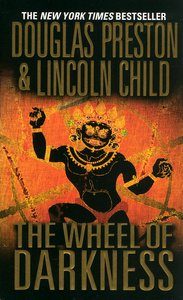
  • The Wheel of Darkness, Douglas Preston and Lincoln Child

    The Wheel of Darkness, Douglas Preston and Lincoln Child

    Vision, 2008 reprint of 2007 original, 495 pages, C$9.50 mmpb, ISBN 978-0-446-61868-7

    Another day means another thrilling adventure for FBI special agent Aloysius Pendergast!  After the triple-punch of the Diogenes trilogy, both Pendergast and his protégée Constance Greene take a break of sorts in a lightweight seafaring adventure.  The result may be a minor Preston/Child novel, but it’s not without a few stronger moments, and it definitely won’t hurt the writing duo’s reputation.

    A plot summary almost reads like a parody: “After the events of the previous books, Pendergast and Constance go for a cruise.”  Of course, you then have to add that they board an ocean liner on its maiden voyage so that they can catch a murderous thief that has stolen a dangerous artifact, but where’s the fun in that?  After a hundred pages, though, the cruise beings and Pendergast’s shipboard activities grows to include things like defeating blackjack cheaters in the ship’s casinos, tracking down a serial killer, helping the crew take down an insane mutineer and losing his mind so that he can enjoy some deep-seated misanthropy.

    Wait, wait, what’s that about turning crazy?  I’m revealing one of the novel’s better moments here, but don’t worry: By this time in the Pendergast series, seeing him act out of character is a treat in itself.  Crazy Pendergast, affected by said dangerous artefact, rivals his brother for contempt of humanity, and that’s when Constance -who gets a fairly generous role throughout the novel- gets to play foil to the even-more outlandish Pendergast.  His state of mind is restored in a way that will strike some as profound and others as amusing, but definitely show how far Preston/Child are willing to go in hocus-pocus mysticism while still claiming to write realistic novels.  Still; one of the better reasons for reading The Wheel of Darkness is for the portrait of Pendergast turning insaaane.

    That’s partly because the rest of the story is mundane stuff.  Sure, Pendergast gets to play James Bond in out-cheating a band of professional blackjack card-counters (their techniques are straight out of Ben Mezrich’s Bringing Down the House).  Of course, we get a look at the way an ocean liner works when it has to cater to a few thousand passengers.  Fine, we have a crazed serial killer eviscerating victims.  But in the context of Preston/Child’s high-adrenaline series, it all becomes routine.

    By the time we’re being told that this is the best, biggest, most massive ocean liner in the history of the world, that this is its maiden voyage, that the company will tolerate no delays and that, well, there’s a tiny storm along the way, readers may start laughing to themselves in anticipation.  There are, fortunately, no icebergs.  But everyone can still guess that this is one maiden cruise that will end badly for many passengers.

    But that’s the way it goes, one supposes, for the type of formula thrillers that Preston/Child have been writing together for more than a decade.  As a conceit, the “ocean liner” one isn’t bad, and most readers are bound to like it.  It’s just that after the triple-punch of the Diogenes Trilogy, this one feels like a far more sedate novel, one that doesn’t change much in the course of the series.  Even Constance’s big final-chapter revelation just confirms the last line of the previous book (as if there was any doubt of where that was going); readers in a hurry are not going to miss much by skipping over this volume in the series.

    But not every volume can be a game-changer, and so The Wheel of Darkness (what’s with Preston/Child’s generic titles, lately?) does manage to fulfill expectations for Preston/Child readers.  The writing is limpid, the three-ring circus of events is efficiently managed, the details of shipboard operations are absorbing and the resolution does take place during a big storm.  What else could we possibly want?  Until the next novel, this one will do.

  • The Audacity of Hope, Barack Obama

    The Audacity of Hope, Barack Obama

    Three Rivers Press, 2006, 375 pages, C$19.95 tp, ISBN 978-0-307-23770-5

    Well before he was nationally known as a rising star in US national politics, Barack Obama impressed a number of readers with Dreams From My Father (1994), a memoir dealing with race, a complex multi-cultural upbringing and a son’s quest to learn more an absent father.  Well-written and having little to do with politics, Obama’s first book was rediscovered a decade later as Obama became an increasingly familiar face on the evening news.  It was followed in 2006 by The Audacity of Hope, a frankly more political book written in-between Obama’s accession to the US Senate and his successful presidential campaign.

    While Dreams From my Father was generally apolitical (although not entirely so, given how Obama was already eyeing a career in politics in 1994), The Audacity of Hope is a different beast.  It’s more easily classified as “pre-electoral”, those books by politicians that pop up whenever they’re thinking about running for high office.  Those books are usually a mixture of political autobiography and vague political program, carefully designed to be read by a literate electorate hungry to learn more about their chosen one.  You can run down the list of nearly every presidential candidate in recent memory to find one of those, usually with subtitles such as “A plan for a new America”.

    This doesn’t necessarily make The Audacity of Hope a bad or calculating piece of work.  It does however place it under very different standards than his first book.  It makes it easier to read as a clue to understand what’s going on in the head of now-president Obama.  It also makes chunks of his books practically irrelevant to non-US audiences.

    Let’s tackle the dullest part of the book first: the vague political program.  In pre-electoral books, those are the parts where the candidate demonstrates his keen understanding of America’s problems and then proposes a number of solutions, designed for wide popular appeal, in order to resolve said problems.  Expect paragraphs of statistics mixed with campaign trail anecdotes illustrating key concepts.  Expect a lot of expensive platitudes such as “more/better defence”, “more/better education” and “lower/better taxes”.  Expect an appeal to new ways of doing politics, away from the current partisan divide.  The Audacity of Hope certainly meets those expectations, as we get a glimpse of Obama’s early platform, untainted by brutal contact with political and fiscal realities.  For non-US audiences, those aren’t the most gripping segments of the book: issues such as racism, for instance, as so specific to the US that strategies to deal with them are alien even in countries as close to the US as Canada.

    Fortunately, there’s more than simply a policy program in The Audacity of Hope.  The most compelling sections of the book are those in which Obama-the-man reflects on his life, his political experience and his early days in federal politics.  Those are the sections in which we learn about his life, his family, what he has learned as a politician so far and what he fears as he sees the rest of his political career in front of him.  Here is where we get to read about his fears about becoming less of a member of the population he’s meant to serve, and more of a professional politician embedded in the traditions of his office.  In-between a too-short account of his romance with Michelle and the affection he has for his daughters, Obama projects the image of a very intelligent man who understands the trade-offs that will be required of him as a politician.

    It also confirms what many people have been suspecting about him despite the “Change” rhetoric: Obama may run on the image of a populist, but he’s a far more intelligent, nuanced and careful politician.  Everything we’ve seen in the 11 months since his inauguration fits his book more than his campaign promises: Obama has an uncanny ability to acknowledge problematic issues in ways to make fans claim “Wow, he gets it”, but his willingness to take action will be calculated to the most minute political consequence.  It actually makes him a far better politician than the alternative (despite partisan cries, politics is really a game of incremental inches: Obama will accomplish a lot more as a careful tactician than a firebrand populist) and reading the book’s passages on the tradeoffs required of professional politicians is a reminder that it’s a deliberate choice.

    So, no, The Audacity of Hope isn’t quite the soaring, lyrical work that Dreams From my Father was.  Nor is it entirely interesting and compelling.  But once you dispose of the pre-electoral fluff and focus on the rest, it’s actually a pretty handy book to understand Obama-the-President.  Which isn’t too bad, as pre-electoral books go.

  • Hey Rube, Hunter S. Thompson

    Hey Rube, Hunter S. Thompson

    Simon & Schuster, 2005 reprint of 2004 original, 246 pages, C$17.95 tp, ISBN 978-0-684-87320-6

    So this is it.  Hey Rube marks the end of my 2009 Hunter S. Thompson Reading Project: All of Thompson’s work read in a year, marking twenty books, thousands of pages and fifty years of American history along the way.

    A collection of sports columns written for ESPN’s web site between 2000 and 2004, Hey Rube marks a trip back to Thompson’s first job as a journalist, covering sports for a military newspaper.  It’s also a wrap-up of sorts, as it brings together many of the elements that defined his career: Digressing often in politics, his life in Woody Creek, excesses and celebrity friendship, the columns take on a more vital quality in the wake of 9/11, as Thompson was one of the first to see clearly beyond the fear and loathing that took over his country at the time.  When the going gets weird, the weird turns pro, and so in times of apocalypse, you could depend on Thompson to be the most reliable commentator.

    For Thompson readers, this collection is 246 pages of indulgence.  Thompson’s writing tics have never been so obvious, what with the Capitalized Words, recurring exclamations (“Selah!”) & ampersands.  Only someone with his reputation and few editing restraints could get away with such quirks. As for themes, his columns often (and by often, I mean “nearly always”) turn to gambling, fictionalized stories of his life on the mountain, vicious rants against the Bush administration and a satisfied tone of “this world is going to hell, and I’ve told you so.”  Some of the material endures, although the sports references are instantly dated and the political references will soon follow as we shake memories of that bad decade.  It’s a book for Thompson fans, and it’s short enough to be considered a nice concluding volume.

    Not that it’s likely to be the final word from Thompson: a third volume of his letters have been announced (and delayed many times, from a 2008 release to February 2011 as of this writing), while reading between the lines of his biographers it’s obvious that there’s enough material left in the Thompson archives to fill at least another collection of material.  Rumours abound about finished but unpublished manuscripts, from The Gun Lobby to The Night Manager to Polo is my Life to early novel Prince Jellyfish… and others.  Whether those are publishable is an entirely different matter, but like many cult writers, Thompson seems poised to be a more reliable author in death than in life.

    Still, “Hunter S. Thompson’s last book” offers an opportunity to summarize what I’ve learned from my reading project.

    The first is a cautious agreement with fans and biographers who say that Thompson’s golden age was a brief period between 1970 and 1974, sometimes between “The Kentucky Derby Is Decadent and Depraved” and “The Great Shark Hunt”.  Sure, you would have to add Hell’s Angels (1966) and quite a few short pieces between 1975-2005, but much of the essential Thompson fits between four covers: Fear and Loathing in Las Vegas, The Great Shark Hunt, Hell’s Angels, and Fear and Loathing: On the Campaing Trail ’72.  After 1975, he became stuck in his own celebrity, content to turn the same tricks –or not write at all.  Drugs gave a lot to Thompson… but they may have taken much as well.

    My second conclusion is that while Hunter S. Thompson is one of the great personalities of twentieth-century America, it’s clear that I really couldn’t have tolerated him in real life.  His profiles all describe someone unable to function in society, an aggressor who didn’t really care about other people.  How much of this was a legend designed to get other people to leave him alone was debatable.  Still, if you’re not convinced, you have your pick of essays.  Wenner and Seymour’s oral biography Gonzo is crammed with fantastic stories about him, while William McKeen’s Outlaw Journalist offers the best and more nuanced biography of him and Simon Cowan’s Hunter S. Thompson is a revealing look as seen by a close friend.  Read those and you too will be able to say whether you would have liked to meet the man.

    My third Grand Statement about my year spent in Gonzoland is that through Thompson, I got to learn a lot more about America from the sixties to 9/11: Between 1965 and 1975, Thompson found himself at the epicentre of radical social changes and, though his coverage, was able to write down what it felt to be there at the time.  Fear and Loathing in Las Vegas endures even today as a great book because of this sense, and the portrait we get of America from Thompson’s fanciful gonzo journalism is perhaps more truthful than most objective accounts of the time.  If you start tracing connections from Thompson to other works and writers, you can get an unconventional crash-course in modern history.

    There will never be another Hunter S. Thompson.  That, as much, is obvious.

  • Orphanage, Robert Buettner

    Orphanage, Robert Buettner

    Orbit, 2008 reprint of 2004 original, 302 pages, C8.50 mmpb, ISBN 978-0-316-01912-5

    I read a lot of science-fiction, but the field is so large that a lot of worthwhile stuff still passes by unnoticed.  For some reason, I completely missed Robert Buettner’s Orphanage and its first sequel when they were first published by Warner Aspect in 2004 and 2005.  It took then-Warner-now-Orbit’s re-edition for the series (now up to five volumes) to register, and I do regret having missed it when it was first published.  It’s more of a familiar comfort SF read than a top-notch example of the form, but it’s not as if we can get too many of those, right?

    Orphanage is familiar from its premise on.  “Aliens attack!  Young troubled man enlists and grows up in a hurry.” has been a staple of military Science Fiction for decades, and every example of the form gets compared to Starship Troopers first, and The Forever War second.  The parallels get even harder to ignore as Buettner uses a chatty first-person narration and follows the usual structural arc from boot camp to first engagement with the enemy.  It’s not a case of imitation as much as it’s one of archetypical storytelling –there are only so many ways one can tell that story, after all, and it’s not as if we’re reading to see if the humans manage to win.  We already know how it ends; now we just want to see how it happens.

    Since the details usually make or break this kind of story, it’s fortunate that Buettner knows what he’s doing.  Our narrator/protagonist Jason Wander is not the most admirable young man as the book begins, but those flaws only gives him opportunities to get better.  Perhaps the best thing about Orphanage is that it proves how the good-old-grunt story can still be adapted to a contemporary setting without turning too ridiculous: Wander is a modern teenager, and the world around him is recognizably ours a few years in the future.  While Buettner isn’t particularly adventurous in his future technology (hand-waving it not-so-convincingly with “the army is always a step backward, you nerds.”), this does add to the conventional, familiar charm of the novel where nearly every plot incident finds a resonance or two in earlier military SF books.

    I suspect that this familiarity will work in one of two ways, depending on the reader: Those with vivid memories of Starship Troopers and The Forever War won’t find anything but an update here, while those who have yet to discover Heinlein and Haldeman will just enjoy the story.  Additionally, I suspect that the novel will find a loyal audience among men that are or have been involved in the military: Buettner’s direct prose and knowledgeable description of military life seems custom-made to reach infrequent readers who aren’t as susceptible to comment about originality or lack thereof.  The flip-side of this argument is that jaded readers who think they can’t enjoy military SF should be warned that there isn’t much more than a prototypical example of the form here.

    There have been far more interesting updates of Starship Troopers since the fifties.  In the early eighties, Card’s Ender’s Game played manipulative ethical games with this premise.  More recently, Scalzi’s Old Man’s War twisted at least part of the formula and did well in presenting a going-of-age war novel written from a non-insider’s perspective.  Orphanage is far too conventional to take any such storytelling risks, but what it does have over Starship Troopers are sequels: four of them, taking Wander through an entire multi-decade career.  SF learns and adapts to its operating conditions, and if Haldeman was able to fit an entire interstellar war in a single thin novel in the seventies, current market conditions suggest otherwise.

    I’m likely to give a chance to at least the first two sequels of the series in part because I’m hoping that the overwhelming familiarity of this first volume will go away (Wander can only attend boot camp once, one hopes) and be replaced by more original material.  That’s where the pacing and prose of Orphanage proves more promising than its plot or world-building: The plot can evolve, the imagined future can become more challenging, but the writing style and rhythm are tougher to upgrade.  Fortunately, if Buettner’s Orphanage may not be all that original, it does announce an engaging writer able to work with well-worn stories.  Now let’s see the ones he gets to invent by himself.

    [January 2010: As expected, sequel Orphan’s Destiny is a great deal less derivative than its prequel: In fact, most of the novel takes place in peacetime, while our narrator returns to Earth and gets to see the world react to its skirmish with alien attackers. But then they come back, and there is desperate damn-the-system combat. It’s both more original and yet not as interesting. Go figure.]

    [May 2010: My interest in the series has flatlined with Orphan’s Journey, a third volume that takes the action outside the Solar System. Alas, I can’t be bothered to care, and chances are that I won’t seek out the rest of the series.]

  • Heat, Bill Buford

    Heat, Bill Buford

    Doubleday Canada, 2006, 318 pages, C$32.95 hc, ISBN 0-385-66256-4

    Given the way food expertise is being adopted as a hobby by an increasing number of people, Bill Buford’s odyssey in Heat doesn’t seem even remotely strange: Is it possible for enthusiastic home cook in his mid-forties to make the leap into the fast-paced world of professional cooking?  Can an amateur learn the ropes and end up preparing food at a world-class three-star restaurant?

    Of course, Buford has advantages that most enthusiastic mid-career home cooks can’t hope for: a home base in New York, a friendship with celebrity chef Mario Batali and enough money saved away to afford apprenticing at Batali’s Babbo restaurant.  But even considering those advantages, his odyssey in going to the other side of the food world remains remarkable: What began as a profile of Batali for the New Yorker ended up a two-year odyssey in the world of cooking, pasta and butchery as Buford went from line cook to apprentice pasta-maker and butcher in Italy

    So, how do you go from writing about a chef to butchering animals in Italy?  It’s a gradual process.  Buford starts out as an enthusiastic civilian chef –one prone to giving invitation to dinner parties, then keeping guests waiting as he races to get everything done.  At some point, outsized personality chef Mario Batali ends up as a guest and Buford eventually musters up the courage to ask for a spot in Babbo’s kitchen, as an apprentice.  Just to see if he could.

    Cooking is a tough young man’s game, and for forty-something Buford, his apprenticeship is brutal.  Not that he picked an easy assignment: Like most New York restaurants, Babbo is small, overheated and boiling from the pressure of the place’s reputation.  Buford ends up working with a colourful cast of sharp-tongued tough kitchen professionals, and they don’t take it kindly to see an intruder in their domain.  Buford starts at the lowest of the low, and though hard work eventually manages to get what he wants: some experience as a cook in a demanding professional environment –and some real scars to show the experience.) Heat never works better than during this first third, as we get to discover the inner working of a restaurant from the perspective of a well-informed civilian.  Buford never becomes a distinguished member of the crew, but he runs with them long enough to make it a memorable narrative.

    But the ever-curious Buford soon becomes obsessed with other culinary goals.  To really learn about pasta, he decides to go get another apprenticeship, this time in Italy.  Later, he gets fascinated with meat and gets another Italian apprenticeship, this time as a butcher’s assistant.  (One of the book’s highlight described how Buford, trying to show what he has learned, drags an entire dead pig in his New York brownstone for butchering and cooking.)  By the closing pages of the volume, he muses about French food and possibly sets up a sequel.

    This European journey is where Heat cools off a bit: While it’s wonderfully picturesque and rustic, it also appeals to different impulses than the description of working in a high-pressure professional environment: It’s about food history, European traditions and a return to basics –not exactly what the first section of the book delivers.   It’s still a pretty good read, mind you: Buford’s style is fun and accessible, while his discoveries pile up.  But it feels like a let-down after the exceptional New York-based section.

    Still, there’s a lot to like in the book even with a lacklustre second half.  The portraits of celebrity chefs Mario Batali and Marco Pierre White are striking, the depiction of being “hammered” while working in a kitchen are vivid, there’s a hilarious passage about catering to chefs’ whims and there’s enough culinary tidbits (about short ribs, about tortellini, about polenta) to make the entire thing worthwhile for food-trivia hounds.  The quasi-instinctive knowledge of food (say, when meat is done) that Buford eventually gets is the kind of practical expertise that can’t be faked.

    As a food book, it may not have the insider’s authenticity of, say, Bourdain’s Kitchen Confidential.  But in some ways, it’s likely to be closer to the reader’s experiences and idle musings, especially when they seriously get home cooking and start wondering if they, too, could turn it into something better.  Marry that impulse to find out with a near-infinite appetite for knowledge, and you end up with Buford’s self-developing narrative.  By the time Heat ends, Buford knows enough about food to stump experts; and readers know enough to be grateful for the journey.

  • No Logo, Naomi Klein

    No Logo, Naomi Klein

    Vintage, 2009 reedition of 2000 original, 490 pages, C$24.95 tp, ISBN 978-0-307-39909-0

    This is No Logo’s tenth anniversary, and I’m about ten years too late in reading it.  Not that it has missed me; Since 2000, Klein’s first book has become a reference in leftish literature.  It’s a coherent map to issues that came to the forefront during the nineties: The selling of public space (“no space”), the consolidation of corporate power (“no choice”), the drive to ever-cheaper overseas operations (“no jobs”) and the interactions between them.  For the turn-of-the-century activist generation, No Logo clearly states the issues and testifies on their behalf.

    I took my time getting to this book even though a copy of the first edition has been sitting on my shelves for years in part because I thought I knew what it was about.  Feh: I was reading Adbusters in high school and spent a lot of time worrying about those same issues, especially when applied to digital media.  But it took a read of Klein’s follow-up book The Shock Doctrine to make me realize that I had to read No Logo, and that I still had quite a bit to learn from it.

    Klein herself is, like most western-world activists, a curious mixture of willing outrage and involuntary complicity.  Most chapters in No Logo begin with memories of her years as a teenage mall rat, segueing into what she now knows about those issues.  It is a place-setting device, a way to remind her readers that she’s not holier than everyone else, and a way to quickly go from common personal experiences to the abstraction of her topics.  Criticizing consumerism is almost always like expressing doubts about the dangers of oxygen and water: although you can raise fair points about their dangers and how they can be limited (Fire brigades! Flotation devices!) the sad reality is that they’re not going away.

    Nonetheless, there’s still a difference between having to live and having one’s mind conquered by orchestrated campaigns.  No Logo gives a few hints on how to move from the later to the former.  By showing how and why mega-corporations encroach on public property, Klein also teaches how to recognize emerging threats, and why they’re so problematic.  The tour of the sweatshop havens (oops, “export processing zones”) in which a good chunk of products are manufactured in miserable conditions may not be new… but it does detail how, exactly, the products we choose to buy are manufactured, and why things have ended this way.

    Knowing anecdotes and disconnected facts is one thing (congratulations if you realize you’re literally surrounded, probably even clad, in products manufactured under conditions you would consider evil) but it’s another to be able to connect them in a semi-coherent fashion.  No Logo ties the anecdotes together and suggests a framework in which to see the issues.  It suggests ways to recognize our complicity with the brands, an essential step if we are to disengage with their more abhorrent practices.  In short, it lives up to its billing as “a bible of the anti-corporate movement.”

    But ten years after publication, it’s worth pondering whether things are better or worse.  Branding certainly hasn’t fallen by the wayside.  It’s even more devious than ever, what with anti-brands and stealth branding vying for the activist dollar (a process better studied in The Rebel Sell, which I’ll be commenting shortly).  Sweatshops are still around, and they’re making beloved iPods.  Corporate power still runs rampant in a media narrative consumed with anti-terror rhetoric tuned to turn us into frightened automatons assuaging our paranoia by soothing shopping sprees.  Even Klein notes in a new foreword that Barack Obama has been the best-branded presidential candidate ever, and that many of his voters were seduced by the branding more than the substance. (Which isn’t knocking down Obama, because even the best candidate deserves the best branding he can get, but may explain why so many people are disappointed that a moderate running on a populist platform ended up behaving, once elected, as… a moderate)  At best, one can say that the citizen-versus-corporation battle outlined in No Logo remains ongoing: the memetic arms’ race between informed citizen and profit-hungry organization has grown more sophisticated but neither side is ceding ground.  Much.

    I won’t claim that No Logo turned me in a better activist overnight: Despite silly personal boycotts and a strong personal aversion to marketing, I’m too far embedded in consumer culture to see a way out.  Still, reading No Logo is a useful reminder.  It was an experience to walk in Toronto’s ad-plastered Union Station halfway through the book.  And it brought me some comfort when I ended up paying an eye-watering amount of money for a winter coat designed and manufactured in Montréal rather than in some exploitative third-world sweatshop.  Neither of those realizations amount to much, but in questioning consumerism, success can only be measured in small victories.

  • Mammoth, John Varley

    Mammoth, John Varley

    Ace, 2005, 364 pages, C$35.00 hc, ISBN 0-441-01281-7

    It’s no exaggeration to say that Mammoth is John Varley’s least remarkable book yet.  It’s not part of a series, has made few waves upon release, seems partly destined to kids and features little science-fictional content.  In tone, it’s a lark that eventually takes itself seriously.  In theme, it pushes no envelopes and even treads upon Varley’s previous work.  In short, it’s forgettable and optional: the very definition of a minor work.

    But that’s not a catastrophic assessment when dealing with a writer like Varley.  Mammoth does have a few qualities of its own.  Anyone looking to compare Varley at his least impressive to any other writer could learn much by studying Mammoth: Even in minor works, Varley manages to out-write a number of his contemporaries, feature one big spectacular sequence, throw in a few neat ideas and find a haunting finale.  The pieces don’t necessarily all fit together in a satisfying fashion, but that’s a comment on a different level: Line per line, Varley remains one of Science Fiction’s most preposterously readable author.

    The best demonstration of that talent is to see how difficult it is to stop reading the novel even when it’s either following obvious paths, refusing to give satisfaction, headed in the wrong direction or tackling soppy sentiments. Varley’s narration somehow makes it all look promising, even when we’re sure of the contrary.  There’s always a neat little hook of storytelling to keep up going forward, a slight twist of perspective or a mini-mystery to keep readers going forward.

    So it is that Mammoth begins as a straight-ahead time-travel story.  Somewhere in the Great Canadian North, a really-rich businessman’s archaeological team has discovered not only a superbly preserved mammoth, but also the remnants of what looks like a piece of advanced technology in the hands of a human wearing a wristwatch.  Looking for answers, the really-rich businessman hires a really-smart scientist to figure out that is probably, after all, a time machine coming from a lost time-traveler.  We get, in-between chapters, snippets of a kiddy documentary about mammoths.

    There are complications.  The time machine looks like a bunch of marbles in a suitcase and no one can understand how (or if) it works.  Animal activists mount an attack against the really-rich guy’s compound and disrupt the marbles.  The really-smart guy figures out the way to travel back in time when the author nudges him so.  The really-smart guy’s return to contemporary Los Angeles, after a few days in the prehistoric wilderness, comes with a bonus mammoth herd.  A spectacular mammoth rampage ensues, followed by extreme police brutality, mammoth mop-up, and a plot that goes increasingly off the rails when it resumes years later.  By the time our protagonists are kidnapping a showbiz-star mammoth and running away to Canada, well, Mammoth fully earns that “least remarkable Varley book” title.

    The time-travel plot ends up in a loop, the strange time machine becomes a formless plot device that Varley isn’t interested in explaining, the super-rich guy becomes a villain (then a more tragic figure) and Canada becomes a haven for mammoth-rights activists.  For those who are tired of conveniently rich characters in science-fiction, deliberately unsatisfying plot devices or dumb animal activism may not find the book entirely to their liking.  (There’s a particularly vexing suspension-of-disbelief problem when we’re asked to believe that mammoth would become the next big thing in showbiz.)  The writing is good, but it all amounts to a plot that alternates between weak and silly.  There are several fine moments in the novel (the return of the mammoth herd in downtown Los Angeles is a spectacular sequence, and it’s announced by a cute re-arrangement of chapter numbers), but they add up to a disappointing shaggy-mammoth story, with a sad extended epilogue that seems curiously out-of-place in the middle of an otherwise light-hearted (even ridiculous) story.  To see a fine premise scatter off in all directions like this is a disappointment, especially considering that it’s coming from a writer who has done far better in the past.

    But even Varley fans have accepted that he can have off decades, and that the fizzy wonderful Varley of the seventies (or, to a lesser extent, the nineties) is not the one writing nowadays.  Mammoth is fine in the ways Varley can be fine even when he’s writing trifles, but it’s also maddening in reminding us that he can do far, far better.  Call it, as I first said, a minor addition to his bibliography: worth tracking down only once you’ve exhausted his top-line work.