Book Review

  • Faster, James Gleick

    Faster, James Gleick

    Vintage, 2000 reprint of 1999 original, 330 pages, C$21.00 pb, ISBN 0-679-77548-X

    I am one of the people James Gleick complains about in Faster.  I am the guy who walks past other people on the sidewalk.  I am the guy who fumes whenever cars drive just under the speed limit.  I am the guy who gets annoyed whenever other people don’t pay attention, dawdle, can’t decide or otherwise start messing with my own hyper-efficient schedule.  I am, in other words, part of the problem that Gleick describes when he talks about “the acceleration of just about everything”.

    Now, keep in mind Faster‘s copyright date of 1999, right at the peak of the dot-com boom; a short era during which “dot-com time” came to shake what was people’s sense of time.  Suddenly, the online world changed every six months; companies doubled in 60 days, crashed and burned in 18 months.  And things kept accelerating, at least until the dot-bomb recession of 2000-2001.  Faster is very much a book of its era, a horrified contemplation of how fast things can possibly go, alongside doubt that anyone but a few inhuman freaks will be able to hold on to the monster we have collectively created.

    As such, most of Faster feels very familiar.  Gleick, the author of such seminal science vulgarization books as Genius and Chaos here turns his attention to a mixture of historical explanation, technical vulgarization and cultural criticism.  In a nutshell: Here’s why/how things went from slow to fast; here’s how fast they really are at the moment; here’s why this is a problem.  Fast food!  Workaholics!  Over-optimized airline schedules!  24-hour news cycle!  Multitasking! Quick-cutting!  MTV!  After a while, it becomes easier to portray Gleick as the stereotypical old man shouting at the kids, not just because they’re on his lawn, but because they can get off of it faster than he can shake his cane at them.  (Also; grandpa, there are better examples of action moviemaking than Sphere.)

    The irony here is that Gleick is not wrong, nor has his kvetching been disproven by the past twelve years.  The world has indeed become much faster, and on a very personal level: You just have to contemplate Twitter or the Facebook news feed to find out that near-real-time publishing to the masses has become ubiquitous: It just takes a moderately-good smartphone with an average data plan to consume and broadcast the most trivial details of our lives.  Meanwhile, the big boys of corporate media have grown even savvier in getting their product to the consumer even faster: As of 2011, DVDs are available not much more than three months after theatrical release; eBooks are launched simultaneously with their paper equivalents (otherwise customers complain loudly on Amazon); most music is sold instantly through digital channels (goodbye music stores); news stories are filed and dissected in minutes… and wristwatches (a subject of one of Faster’s early chapters) are now fashion accessories, because there are now built-in clocks in just about any electronic device that surrounds us.  Our culture digests ideas, fads and memes in weeks (Rebecca Black’s “Friday” was released when I read Faster, almost still hip when I wrote this review a month later, but passé to the point of nostalgia by the time I edited it three further months later) and visibly shows signs of impatience whenever it has to wait.  We have become Faster’s worst nightmare.

    And yet we still deal with it.  One thing that Faster doesn’t do very well is in pointing out that it’s still relatively easy to punch out of the schedule whenever convenient.  Journalists and politicians may be stuck feeding the news channels, but the rest of us can lay low for a few days and stop paying attention to what’s not part of our lives.  Facebook’s reported recent loss in popularity hints at a truth that Social Media apologists and James Gleick alike aren’t happy to acknowledge: That once past the newness effect, everyone self-selects their pace of life.  After a few days/weeks/months/years, many people move on from their blog postings, twittering or facebook updates: What remains at the slower core is the kernel of what we are.

    But as much fun as it is to critique the social critique, there is plenty to like about Faster: The early part of the book has some fascinating material regarding how the notion of globalized time came to be (every American town had its own clock before railways required some standardization), and a chapter on airline scheduling makes the good point that the more efficient a system is, the more it is vulnerable to even small problems –they cascade into big problem due to the lack of slack built in the system.  There are good digressions here and there, such as the sequence in which Gleick pushes the clichéd “Americans spend X minutes every day doing…” statistics into an absurdist dead-end, and a demonstration of “The Strong Law of Small numbers” (ie; there aren’t enough small numbers to be useful.)

    I does help that even if Gleick may be a curmudgeon in training, he’s a dependably readable writer.  Faster is entertaining even when its relationship with reality turns a bit suspect; its thesis may be equal part dubious and paranoid, it’s still largely correct.  I do miss the more scientifically-minded topics of Chaos and Genius compared to this more free-flowing cultural/technical critique, but if Faster is a bit of a disappointment, it still has enough good material for compelling cocktail party chatter.

  • Color and Light, James Gurney

    Color and Light, James Gurney

    Andrews McMeel, 2010, 224 pages, C$28.99 tp, ISBN 978-0-7407-9771-2

    You’d have a hard time guessing from these reviews, but I do buy and enjoy a lot of Science Fiction and Fantasy art books.  One of my most cherished sections of my library is the one where Michael Whelan art collections sit next to those by Donato Giancola, Chris Foss, Stephan Martinière and a few others.  But enjoying those books is simple; reviewing them isn’t when an appreciation of most of them boil down to “pretty pictures; skilled artists; will buy next volume”.  I get bored just thinking about writing 500 words to explain that.

    But James Gurney’s Color and Light is something different.  Billed as “A guide for the Realist Painter”, it’s a book-length tutorial by the creator of the SF/fantasy series Dinotopia.  Aimed primarily at visual artists, it studies topics of colour and light using examples from Gurney’s career, either produced for the commercial market or as a personal study.  Far from a basic “Here’s how to paint” manual, Color and Light tackles questions that even season artists will struggle to master.  A sampling of page headings: Overcast Light, The Mud Debate, Is Moonlight Blue?, Subsurface Scattering; The Hair Secret, Golden Hour Lighting; Snow and Ice; Mountain Streams…

    For artists, this isn’t Gurney’s first instructional book: In 2009, Andrews McMeel published Imaginative Realism, a similar book that provided artists with a toolset on “How to Paint What doesn’t Exist”.  It covered ways to adapt the familiar into the unknown nature of fantasy illustration, but also discussed topics such as visual composition.  Color and Light is a natural follow-up to Imaginative Realism, describing in more details an essential set of visual skills.  An interesting part of the book’s approach is how it uses modern tools such as digital photography in order to explain traditional canvas-based techniques.

    Not being an artist, I can only guess as to the true worth of what Gurney outlines here.  What I can say is that Color and Light feels like a backstage peek at the mind of painters as they learn to see the world with far fewer assumptions as the rest of us lay viewers.  The book deconstructs elements of color and lighting in order to highlight the subtle ways that reality influences our perception, our understanding of what we see, and even our moods.  Some professional artists may have a near-unconscious understanding of topics such as pigmentation, lightfastness and caustics, but for non-artistic laymen such as myself, Gurney’s explanations hint at the depth of accumulated knowledge that come to rest behind the eyes of a painter.  Part of Color and Light’s impact is in presenting enormously complex topics in a manner that is simple to understand, yet complete enough to suggest the hidden depths of the idea.

    This being said, you can appreciate Color and Light as an art-book if you want to.  There’s some great art on nearly every page, as Gurney uses examples from his own professional and personal work to illustrate the topic at hand.  Much of it comes from Dinotopia, of course, but a lot of them are from Gurney’s personal work and sketches, sometimes reflecting where he traveled around the world.  It is, in its own way, an impressive testimony not only to Gurney’s technical credentials as he meticulously explains art history and techniques to readers, but also a demonstration of his willingness to constantly improve his own understanding of the art and distil his wisdom in a few hundred pages.  I don’t think any professional ever sets out to coast on what they know for the rest of their career, but Gurney demonstrates the opposite, and how he is, even at the height of his own personal success, still trying new things, still daring to expose himself to criticism by putting together an instructional book.

    For those who are curious to see what Gurney is now working on, you can always follow his daily blog for regular updates, artwork and ideas.  Also get ahold of Color and Light, preferably alongside Imaginative Realism: Beyond being a good look at Gurney’s career so far, it’s an astonishing peek at the mind of a working artist, and the compromises with which they work in nearly every piece.  It’s not just an art book worth buying, not just an art book worth studying, it’s an art book worth reading.

  • Wampeters, Foma & Grandfaloons, Kurt Vonnegut, Jr.

    Wampeters, Foma & Grandfaloons, Kurt Vonnegut, Jr.

    Delacorte, 1974, 285 pages, $??.?? hc, ISBN 0-440-08717-1

    In the big list of things I still have to do, “Read more Kurt Vonnegut” remains essential.  While Vonnegut is best-known for his fiction, his public persona is equally well-defined by the non-fiction he has written over his long career.  Published in 1974, Wampeters, Foma and Granfalloons collects some of Vonnegut’s non-fiction pieces dating from 1965 to 1974.  This period is significant in that it marked a significant transition for the author: Two of his best-known novels, Slaughterhouse Five (1969) and Breakfast of Champions (1973), were published during this period, and his profile appreciated accordingly.  Read the collection carefully, and you can almost see the transition, as Vonnegut goes from writing semi-journalism pieces, to opining professionally, to becoming the subject of lengthy interviews.

    An unusually interesting preface presents Vonnegut at his best: self-reflective to the point of self-deprecation, expressing complex ideas with short sentences and simple vocabulary.  It’s easy to become a Vonnegut fan when he seems determined to undermine the false elevation of the writer in the reader’s mind.  I suppose that this, in large part, also accounts for Vonnegut’s reputation as a humanist.

    For Science Fiction fans with lengthy memories, the book opens big with a short piece examining Vonnegut’s relationship with the SF genre as of 1965: Vonnegut found himself identified with the genre through what he wrote rather than his intentions.  (“I learned from the reviewers that I was a science-fiction writer” [P.1]) Having no association with the SF community, he spends much of the essay looking at the genre from a bemused observer’s point of view, eventually concluding that the genre is infantile, self-centered and doomed to disappear, since “all lodges [dissolve], sooner or later.” [p.5] SF fans will find it hard not to cringe at the accuracy of the statement.  (Amusingly, the book also collects “Fortitude”, which is nothing but a Science Fiction play in one act.  Vonnegut himself published in acknowledged SF magazines early in his career, making some bewildered statements seem disingenuous.)  Curiously, this essay is seldom acknowledged in SF circles.

    But then again, I do live a sheltered existence, and it’s pieces like “Brief Encounters on the Inland Waterway” that make me wonder at how much of the world I still don’t know.  The Inland Waterway, or more accurately “Intracostal Waterway”, is a set of waterways allowing boaters along the eastern and southern American seaboard to navigate from New Jersey to Texas without having to brave the open sea.  Vonnegut used it to travel from Massachusetts to Florida aboard the Kennedy family yacht, and reports his impressions in a series of short, simple vignettes that give a feel for an entirely different world than highway driving.  Digging a bit deeper, I was even more surprised to find out that the Intracostal Waterway links to a nautical route called “The Great Loop”, a component of which passes not a kilometer away from my house.  So, yeah; I live next to a water highway leading straight to Florida.  That’s not exactly the kind of discovery I expected when I picked up Wampeters, Foma & Grandfaloons at a used book sale, but I’ll take it.

    Other pieces mix reporting with opinion.  “Teaching the Unteachable” is an acid look at the racket of university writing workshops; “Yes, We Have No Nirvanas” is a half-serene, half-sceptical profile of Maharishi Mahesh Yogi; “There’s a Maniac Loose Out There” offers an impressionistic account of Cape Cod dealing with a serial killer, somewhat reminiscent of Hunter S. Thompson (whose Fear and Loathing: On the campaign Trail ’72 is favourably reviewed later in the book); “The Mysterious Madame Blavatsky” is a portrait of the historical celebrity, whereas, more grimly, “Biafra: A People Betrayed” offers impression on the war-torn African country.

    But reporting isn’t Vonnegut’s strength as much as his commentary is.  America from 1965 to 1974 was a cauldron of controversies and revolution, and Vonnegut was there to comment upon the events.  Various pieces consider the American Space Program as an expensive fireworks show, bombing in Vietnam as ineffective torture and American politics as set-dressing for a war of the winners against the losers.  Various addresses to various audiences offer Vonnegut speaking directly to his audience.  The book ends on a lengthy and revealing Playboy interview discussing his inspirations, history, writing methods and progressive prominence as a writer.

    The result, as you may expect, is a quirky packaging of pieces that show Vonnegut during one of his most vital periods.  It’s a great way to get acquainted with Vonnegut’s voice, even though I suspect that fans of the author will get the most out of it.  It’s funny; it’s deceptively easy to read and it combines sympathy with cynicism in a way that only Vonnegut could achieve.

  • The Nasty Bits, Anthony Bourdain

    The Nasty Bits, Anthony Bourdain

    Bloomsbury, 2007 reprint of 2006 original, 288 pages, C$16.50 tp, ISBN-978-1-59691-360-8

    In my continued quest to read all of Anthony Bourdain’s written output, I am now left to digest the “collected varietal cuts, usable trim, scraps and bones” of his career so far.  Or, in more prosaic terms, a collection of various pieces written following the runaway success of Kitchen Confidential and his rise as a celebrity food writer.  The Nasty Bits brings together 36 non-fiction pieces, accompanied by a fiction novelette and an essential appendix that comments on the various pieces.  The non-fiction content is subdivided in thematic seconds meant to evoke the five basic tastes, but the real flavour here is Bourdain’s punk-rock approach to food and travel writing.

    A standout piece, for instance, is “Food and Loathing in Las Vegas”, a Hunter S. Thompson-inspired piece in which Bourdain describes his first visit to the new Las Vegas food scene.  As entertaining commentary wrapped in semi-fictional homage to its source material, it’s a laugh –and prior to Bourdain’s influence, it’s not always the kind of writing you could find in food/travel magazines.  Much of The Nasty Bits is unpretentious travel writing liberally seasoned with descriptions of good food: Bourdain’s prose is seldom less than fascinating, and he’s got a knack for living interesting experiences.  They don’t all have to involve eating strange new bugs in third-world countries: In “The Love Boat”, Bourdain tries to survive on a posh cruise liner with an in-cabin kitchenette and an on-board gourmet grocer: It’s a look at high-end decadent living from a reformed line cook, and it’s about as interesting a confrontation of world-views as you can imagine.  (More importantly, Bourdain manages to cook a perfect risotto with what he’s given on-board.)

    Other pieces stand out for less-charming reasons.  Bourdain’s never been shy to criticize what he sees as being wrong with food culture, and in “Woody Harrelson: A Culinary Muse” takes aim at the actor for insisting on a vegan diet and ignoring what local food culture had to offer while traveling abroad.  Such openness to world cuisine (and Asian food in general) is a hallmark of Bourdain’s writing, and several other pieces document his growing fascination with the world of gastronomic possibilities.  An interesting pair of pieces in this regard are “Notes from the Road” and “Die, Die Must Try”, presenting Bourdain’s brutal first visit to Singapore and a far friendlier follow-up.

    Such growth as a person and as a writer is an essential part of The Nasty Bits, allowing us to follow Bourdain’s quick evolution as Kitchen Confidential, then his TV shows, gradually opened more possibilities for him.  From a humble cook with a troubled past to a world-traveling food writer, Bourdain has grown up in public in the six years between Kitchen Confidential and The Nasty Bits, and this evolution is reflected here in many ways, between pieces but also in the second thoughts that ends the book.  In “Sleaze Gone By”, he wears his scrappy New York formative influences like a badge of honour in recalling with some fondness the rougher pre-Giuliani neighbourhoods he used to frequent.  But significantly, the back of the book commentary takes it back: “A pretty glib, wildly over-romanticized look at the New York City of my misspent youth.” [P.285])

    Some other pieces stand out because of their unusual subject matter.  In “Warning Signs”, Bourdain describes a well-known London steakhouse chain and itemizes ten reasons why the place ought to be closed down; “The Good, Old Stuff” discusses how several restaurants still serve unfashionable food straight from decades past; “Viva Mexico! Viva Ecuador” pays tribute to the hard-working immigrants toiling away in American kitchens; “When the Cooking’s Over” discusses what chefs do after their shift is done, with several examples in various cities; “The Cook’s Companion” provides an essential bibliography of great writing about the real life of restaurants; and “System D” borrows from the French to explain one of the essential traits of any competent kitchen worker.

    A special mention should also be made of “A Chef’s Christmas”, which showcases Bourdain’s fiction credentials to a wider audience.  The piece itself isn’t particularly refined (it self-consciously relies on a rich deus ex snowstorm to provide a happy ending, and seems to hop in-between half a dozen characters’ viewpoint almost at random in only thirty pages.) but it’s an entertaining change of pace from the non-fiction pieces and as witty as Bourdain can be.

    All of it amounts to a collection that Bourdain fans will find essential.  The Nasty Bits is not the best introduction to Bourdain’s work (For that, try Kitchen Confidential, or the No Reservation TV series), but it’s a good satisfying read.

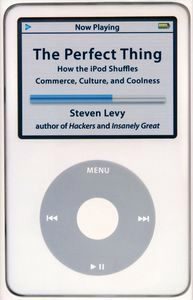
  • The Perfect Thing, Steven Levy

    The Perfect Thing, Steven Levy

    Simon & Schuster, 2006, 284 pages, C$32.00 hc, ISBN 978-0-7432-8522-3

    I am not an Apple fanboy.  In the great PC/Mac debate, I will forever be against the paternalistic walled-ecosystem paradigm represented by Apple.  I held out as long as I could before buying an iPod Touch, and it was only because I had to admit that it was the best PDA available on the market.  But you know what?  I love my iPod.  I jailbreak it as soon as I can as a matter of principle (I feel entitled to access the file system of every computer I own), but I love it.  It does what I expect of it, and quite a bit more.  I started ripping MP3s in 1999 and have owned a variety of MP3-playing devices from the RioVolt SP250 to the Palm Tungsten T2, but my iPod Touch 2G (and now, 4G) has easily been the best.

    Such a sentiment is widespread enough that it is the bedrock of Steven Levy’s The Perfect Thing, a book dedicated to what was then the iPod in its classic scroll-wheel form.  (Not even the touch version, introduced a year after the book.)  Levy, a technology journalist with an interest in cultural issues, makes a convincing case that the iPod represents a fundamental shift in our relationship with music, and doesn’t miss a facet of the iPod culture in the way he studies the history and development of the iPod, its impact on music listening and its consequences on our own individuality.

    Levy is so fascinated by the concept of “Shuffling”, in fact, that The Perfect Thing comes in numerous versions, with autonomous middle chapters “shuffled” in a different order from one copy to the other.  (We are wisely warned of this in the book’s opening “Author’s Note”.)  However novel, this idea ends up being a clumsy experiment.  As a reader, I believe in the development of ideas, in arguments building atop each other, in context being established before an explanation of consequences.  However independent Levy has designed his chapters, some of them still read as out of order in my copy of The Perfect Thing: The “Apple” chapter describing Apple and Steve Jobs come late in the book, setting up Job’s formidable reputation too late to be effective; tragically, it follows the Origins chapter that details how Jobs’ incessant attention to detail was a major factor in the iPod’s polish.  Some chapters about the second-order effect of the iPod’s feature are at the beginning of my copy of the book, which takes away from the development of Levy’s thesis.  So, conclusion: no shuffling in books, okay?

    This nit put aside, The Perfect Thing is, even five years and two technological generations later, still one of the ultimate books about the iPod.  It’s filled with interesting, even little-known information.  It draws conclusions about the behaviour of iPod users that have been validated by the time since then.  In fact, I suspect that the book is so good that it makes assumptions that are completely self-obvious now.  One of the most interesting things about consumer electronic progress is the way their constant daily use quickly overwrites our memories of how things used to be.  Say that the iPod was not for sale until the end of 2001 and your audience will furrow their brows and say “Really?” The iPad?  Introduced in April 2010, not even 18 months ago as I edit this review.  The iPod and its inspired competitors have been a part of our daily lives for so long that it’s hard to remember previous modes of music consumption.  Shuffle, as Levy loves to point out, is an almost-entirely digital-music concept: Before then, you were lucky (and well-off) if you owned a CD jukebox that could slowly shuffle between five or ten CDs.  Otherwise, it was a strictly linear listening experience, even if you were a mix-tape whiz.  (I had to laugh in recognition when Levy described how memories of one song could blend with the memory of the transition between the previous and next song on the same disc)

    The chapter on the development of the iPod is a crystal-clear example of good tech journalism, and it’s an eloquent testimony about the need for end-user polishing in the development cycle.  Levy builds the product’s features into a platform that changes the way people think of themselves and others (especially if music is an important part of their self-identity), the way Apple have taken existing technological trends to fashion a workable ecosystem for media delivery (something that’s even truer now than in 2006) and the self-expression possibilities of the podcast, something now obvious that wasn’t even practical to any but a privileged few a decade ago.

    The proof of The Perfect Thing’s thesis and conclusions could be found all around me as I enjoyed reading the book on my daily bus commute.  It took me six rides to read the book, and every single time, in the small universe of the twenty people lodged at the back of the bus where I sit, I could never see fewer than two (and often as high as seven) personal devices either branded Apple or inspired by it.  The iPod is indeed the perfect thing of our time.

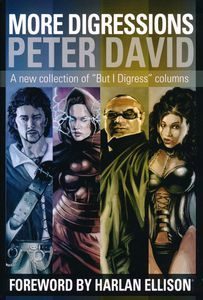
  • More Digressions, Peter David

    More Digressions, Peter David

    Mad Norwegian Press, 2009, 408 pages, $24.95 tp, ISBN 978-193523400-5

    I don’t know much about the mainstream superhero-oriented comic book industry, but I do know that Peter David is one of the most entertaining “Writer of Stuff” (his own tagline) out there.  Some writers’ bibliography read like a short list of novels published at yearly intervals.  Peter’s own bibliography reads like a multimedia tour through the last twenty years of American pop culture: Aside from his own original work, his tie-in work ranges from Star Trek novels, ten superhero movie novelizations, a Babylon5 TV scripts, scripting runs on superhero comics such as Spider-Man, The Hulk and Supergirl… and much, much more.

    Tying much of this work together are the regular “But I Digress” columns published in the Comics Buyer’s Guide.  Given full blessings to write about whatever he wants, Peter uses his column to discuss his life, his work, the state of the comics industry and the world at large.  I had exceptionally fond memories of the first But I Digress collection published in 1994, so it wasn’t much of a sell to make me pick up this follow-up once I was made aware that it existed.

    Collecting material published between 2001 and 2008 (leaving an uncollected gap between 1994 and 2001), More Digressions is exactly what it says on the cover: “a new collection of ‘But I Digress’ columns”.  Roughly arranged in thematic sections with titles such as “Life. Don’t Talk to Me about Life”, “The Business of Comics”, “BFFs” and “Fandomonium”, the essays cover much of David’s life and work during the past decade.  David being outspoken even on the calmest of days, it’s no surprise if the book also ends up being a collection of arguments, controversies, daring proposals and public score-settling.

    The first thing I realized reading More Digressions was that I had little business reading the book.  Let’s face it: the American superhero comics industry is so insular that keeping track of its mythology is a full-time hobby.  The columns collected here were published in a trade publication, aimed at readers who were fully aware of the slightest twitches and grunts of the various publishers and series.  For a very casual fan like me, parts of More Digression read like intense but meaningless squabbles about subjects that must be really important to the people involved in the discussions, but close to meaningless for anyone who’s not a comic-book store regular.  The learning curve here was steep, and I have to admit that Wikipedia helped a lot.  (Even more casual readers who feel that a book should not require Wikipedia as a reading companion may have a point, but then again every book has a specific target audience.)

    Still, knowledge is one thing, and attitude is another.  From afar, reading David talk about the comic book industry and its fandom can be cause for bafflement and concern.  The comics industry is currently in crisis: it’s suffering from the rise of the paperback collection as a preferred buying format, it’s under siege from those who want to “widen” the material to appeal to the audiences hooked by Hollywood superhero movies, and it’s reaping the results of decades’ worth of catering to an obsessive 18-to-34 geeky male audience.  For creators such as David, this situation has translated into two recurring motifs: the sometimes counterproductive marketing strategies of the industry, and the rabid self-entitlement of the fans.  Reading about the dysfunctional nature of the industry and stories of fannish abuse, I felt more compelled than ever to stay as far away from the craziness of superhero comics fandom.

    Of course, this is the comics universe as seen from Peter David, and that he’s perfectly entitled to be critical in his own column.  Plus, More Digression isn’t all about the business and fandom of comics: His essays about his own life and creative process are a good read, and in talking about his best friends, we get a look at such notables as Harlan Ellison (who contributes a typically self-absorbed introduction to the book), George Takei or Neil Gaiman –further proof of David’s interesting life.

    More Digressions is a collection of opinions and recollections, and it’s normal that not everything works at the same level, or reaches the same interest.  I found some columns weaker than others, including a naïve take on racism that had me wincing at the lessons from the painful RaceFail debate that shook the online SF community in early 2009.  But it is Peter David’s soapbox, and there’s a lot of interesting stuff here for whoever can follow along, forgive some self-justifying entries and ignore minor trade squabbles since then forgotten.  It’s a portrait of a unique columnist, and an unvarnished look at a sometimes-demented subculture.  It’s not for everyone, but it’s exactly what it tries to be.

  • The Business of Science-Fiction, Mike Resnick & Barry N. Malzberg

    The Business of Science-Fiction, Mike Resnick & Barry N. Malzberg

    McFarland, 2010, 269 pages, ~C$35.00 tp, ISBN 978-0-7864-4797-8

    Reading books about how to write are one of my not-so-secret vices.  Jaded by endless convention panels repeating the same advice, I don’t read them to learn how to write as much as to learn how other writers write.  A good how-to-write book is usually a window into an author’s career, or an inside look in the publishing business.  The best of such books will tell stories, teach real-world pitfalls and be entertaining as well.

    The Business of Science-Fiction is a collection of twenty-six columns published in the Science-Fiction and Fantasy Writers of America’s (SFWA) trade journal “The Bulletin”.  SFWA is where speculative fiction writers go to talk shop, and it’s hard to get closer to the SF&F genre than to read its internal house publication.  For more than a decade, Mike Resnick and Barry N. Malzberg have been jointly writing a column on various aspects of SF writing and publishing.  Those columns take the form of exchanges between the two of them; Resnick usually plays the role of the optimist, with Malzberg’s gloomy outlook balancing the dialogue.

    To SF fans with short memories, Resnick and Malzberg may not be the obvious choices to write authoritative columns on the current state of SF writing.  While Resnick regularly gets nominated for the shorter Hugo Award categories, it’s usually for cloying stories that seem designed to appeal to SF fans’ sense of nostalgia rather than try anything new.  Meanwhile, Malzberg’s heyday as an author dates back to the seventies, without much of a public profile since then.

    But that’s being myopic.  Resnick has been tremendously influential in discovering and encouraging newer writers.  If his own fiction is a bit bland, it’s usually solidly bolted together and as we discover through the columns, he has proven uncommonly effective at reselling his stories to markets other than first-run English-language paper publication.  Few other writers in the genre are as knowledgeable about the business aspect of Science-Fiction.  Meanwhile, Malzberg has developed a reputation as a cranky historian of the field: His Breakfast in the Ruins non-fiction collection brought together a number of highly astute pieces about the state of Science-Fiction over the past decades.  Reading the columns, it’s difficult not to be impressed by the depth of his historical knowledge of the field.  More crucially, readers may not see his continuing work for the Scott Meredith Literary Agency, which has let him keep an insider’s view of the business throughout the years.

    The columns collected in The Business of Science-Fiction, taken together, show a snapshot of the changing publishing industry in the first decade of the twenty-first century.  Resnick and Malzberg discuss the state of the business with the benefit of long memories, but they don’t forget to question themselves in trying to figure out what is changing along the way.  They can also, writing for a professional audience, allow themselves to discuss “the next question” and pick up arguments aimed at professional writers rather than beginners.  The references they make to SF publishing’s long history are filled with interesting details, and the advice they provide feels fresh and uncompromising.  (SF convention organizers won’t like reading what they say about whether authors should attend conventions.)  The dialogue format can be entertaining to read, especially when both of them are aware of the role they have picked for themselves.  (Both refer to Malzberg as “Eeyore” more than once.)

    Given that this is a re-packaging of existing content, it’s no surprise if some material and stories echo throughout the book, or that it’s not a good idea to read more than a few of the 4,000-word columns at a time.  Academic publisher McFarland has done a fine job putting the collection together, not the least feature being a complete index at the end of the book.  What’s missing, unfortunately, are dates of publication attached to each column: In discussing rapidly-changing topics such as e-books or the Google Settlement, for instance, it’s vital to know whether these are facts and opinions from 2003 or 2008.  I also can’t help but be amused at the cover design, which takes some Shutterstock stock art to suggest a dialogue between the two authors: Having seen both Resnick and Malzberg in real life more than once, it’s obvious to me that neither of the silhouetted figures are even close to them in physical appearance.

    But the book does live up to its subtitle as “Two Insiders Discuss Writing and Publish”, and the quality of the advice here is good enough to justify its Hugo nomination in the non-fiction category.  Both are charming and witty to read in print, and the advice has some real-world relevance.  What more would you want from a how-to-write book?

  • Watch, Robert J. Sawyer

    Watch, Robert J. Sawyer

    Viking Canada, 2010, C$30.00 hc, ISBN 978-0-670-06742-8

    Second volumes in trilogies are the hardest to review, in part because they offer no compelling questions to answer.  First volumes?  Easy: Reviewers can get by with a simple description of the premise, the tone, the style, the characters and end on a note that wonders about where the trilogy is going.  Final volumes?  Again, easy: The reviewer can simply say whether the final volume deviate from the style established in the series and whether it fulfills expectations.  But second volumes… In today’s highly-optimized, heavily-managed genre publishing environment, second volumes aren’t much more than bridges meant to take readers from first to final volume.  The trilogy usually being sold to the publisher and the reader as a unit, it’s in the author’s and editor’s best interest to make sure that the approach remains consistent with the first volume, and that any dramatic differences are toned down.  At best, second volumes offer a few answers, plot points and character development.  At worst, we simply turn in circles until more plot coupons are collected.

    Since “What Would Robert J. Sawyer Do?” has become one of the most reliable barometers of professionalism in the written SF field, you can bet that Watch (aka WWW: Watch in the US market) does not take any radical departures from the approach and theme set in Sawyer’s previous Wake.  The series is meant to be a procedural SF thriller describing the development of an artificial conscience from the World Wide Web, and this second volume simply pushes the plot a bit further along.  After revealing itself to blind teenage prodigy Caitlin Decter, emerging AI Webmind continues to learn about humans.  What’s new in the volume are the first hints of conflict, as an American government organization notices something strange on the Internet and starts wondering whether Webmind is a threat to national security.  Meanwhile, another plot threads converges to reinforce the trilogy’s theme of non-human consciousness.

    In terms of stylistic approach and tone, Watch seamlessly integrates with Wake, which is to say that everything good and bad about the first volume extends here: Further observations on Canadian/American differences, awkward pop-culture references, facts so obvious dumped as exposition as to qualify as hand-holding, the portrait of a bright blind teenager and the restraint with which Sawyer circles a familiar idea to Science Fiction readers.  You can re-read my review of the first volume and re-apply it in its entirety to this follow-up without being led too far astray.

    As a reviewer, this leaves me stuck with an unusual, almost daring tactic for reviewing Watch: Focus, for once, on Sawyer’s strengths as a writer.  What does work in Sawyer’s fiction… as exemplified by Watch?

    The first strength that does come to mind is clarity: Sawyer’s prose is unusually easy to read even in the most challenging public-transit environments.  His characters are sharply defined, the issues are clear, plotting ambiguity is kept to a minimum (he’s reliably more nuanced in matters of moral ambiguity) and his classical approach to plotting means that it’s not hard for readers to locate themselves within the structure of the novel.  The sometimes-infuriating hand-holding for readers less used to SF’s idioms and common references is a deliberate aspect of this stylistic choice, and it helps Sawyer reach audiences well beyond SF’s usual readership.

    This clarity of execution usually comes bundled with a somewhat more ambitious speculative intent meant to deliver satisfaction for SF genre readers.  If you read Watch’s Chapter 42 carefully, for instance, you’ll find an explanation for advanced consciousness (ie: “it overrides evolutionary pressures, preventing a race to the bottom”) that can be interpreted as a counterpoint to the somewhat more sombre conclusions reached by fellow Torontonian hard-SF authors Karl Schroeder (Permanence) and Peter Watts (Blindsight).  This specific example is also an illustration of Sawyer’s quasi-constant optimism: his novels seldom feature outright villains (the universe is antagonistic enough, especially when there are ideas to discuss along the way), his protagonists are rarely defeatists and his endings usually point the way to a better tomorrow.  Given the sad chorus of doomsayers that seem to dominate much of the contemporary SF scenes these days, it’s easy to see why Sawyer’s fiction can reach an audience looking for something that won’t encourage them to put together a survivalist stockpile.

    For worse or for better, Watch is a typical Sawyer novel that plays to his usual weaknesses and strengths.  As an exploration of non-human consciousness, it’s more detailed than the usual SF hand-waving.  Its protagonist Caitlin is still as sympathetic as she was in the previous volume, and it sets up the required pieces in time for the final volume of the trilogy.  It’s a second volume that does exactly what it’s supposed to do, and readers who made it to this second tome are sure to pick up the third volume Wonder.  As for critics of Sawyer’s usual approach, let’s take a page from his prose and blow our fragile little minds with the little-known proverb “Dogs bark, but the caravan goes on”…

  • The Dervish House, Ian McDonald

    The Dervish House, Ian McDonald

    Pyr, 2010, 358 pages, C$32.50 hc, ISBN 978-1-61614-204-9

    I was about to begin this review by writing that I didn’t know when Ian McDonald went from “an uneven writer” to “buy-on-sight” in my reviewer’s mind, but that’s not true: I happened sometime in 2005 during my reading of River of Gods, a novel that has since gone on to become a minor SF classic of the last decade.  River of Gods took MacDonald’s interest for non-western cultures and combined it with a more disciplined reader-friendly approach than many of his more experimental novels.  Taking place in future India, the result was also billed as the first in a loose thematic “emerging superpowers” trilogy.  Brasyl followed in 2007 by doing justice to the South American country, and now The Dervish House takes on the growing importance of Turkey as a bridge between Europe and Asia.

    From the novel’s first moments, we’re thrown into near-future Istanbul, during a torrid week in which six characters will see their entire lives change.  Through McDonald’s sure-footed narration (which begins with a literal bird’s eye view of the city), we’re introduced to the six characters and subplots that will form the strands of the novel’s plot.  It’s obvious from the get-go that MacDonald has done his research, and that he’s able to weave it into a compelling number of narratives.  Before long, we’re asked to care about emerging nanotechnology, corporate malfeasance, century-old legends, terrorism and everything else in the characters’ lives.  MacDonald seems equally at ease telling honey-infused fables or describing how a corporation can be shut down by the state.  The Dervish House is a novel that’s wider than it is deep, and it’s this variety of mood, styles, stories and characters that make up most of the book’s interest.

    After the stylistic and subject matter pyrotechnics of Brasyl, The Dervish House feels quite a bit more grounded in reality.  Turkey, after all, is not Brazil, and MacDonald’s stylistic approach tries to be appropriate to the Turkish future he’s describing.  (The Dervish House isn’t about plot as much as it’s about setting.)  So it is that The Dervish House shows a country trying to embrace both a proud tradition and the possibilities offered by new technologies.  Istanbul not only bridges two continents, it acts as a passage from the past to the future.

    This being said, my praise comes with a few slight caveats.  For one thing, the unconnected six-strand narrative means that not all sequences are equally interesting –a number of readers will find themselves flipping impatiently through some passages while they await the next one to interest them.  (More than once, I found myself waiting to go back to the art-dealer’s quest to find the possibly-mythical Mellified Man.)  I also wonder if the broad nature of the novel makes it more difficult to follow than one that focuses on a strong plot line.  Not every reader is going to react as positively to a novel that features a city more prominently than human characters, and some SF fans will be disappointed at the novel’s low-octane technological speculations.  By taking on a near-future world dealing with the first practical applications of nanotechnology, MacDonald reins in his extrapolations and tries to ground them to a believable reality: it does feels like a mild let-down after the strong-AI speculations of River of Gods and the wild parallel universes of Brasyl.

    Yet the result in an impressive entry in a bibliography that only seems to become stronger with time.  MacDonald has, in-between River of Gods and this most recent novel, re-established himself as one of the most interesting SF writer currently working.  The Dervish House is a prototypical Big Science Fiction novel: Dense, well-researched, well-written and intellectually hefty.  It’s a good example of the kind of worldwide horizons the genre has taken on over the past decade, and not even its built-in flaws can distract pundits from affirming that it’s one of the best novels of the year.  It got a well-deserved Hugo Nomination and outclasses the other novels on the ballot.  Few “Best-SF books of 2010” lists won’t include this novel.

  • Feed, Mira Grant aka Seanan McGuire

    Feed, Mira Grant aka Seanan McGuire

    Orbit, 2010, 574 pages, C$12.99 mmpb, ISBN 978-0-316-08105-4

    Hugo Nominee season can be tedious, frustrating or surprising, depending on one’s expectations about the actual nominees.  I was primed to dislike Mira Grant/Seana McGuire’s Feed almost from the time I held it in my hands.  Count the strikes: Not only is it another gosh-darn zombie novel, it’s also the avowed first in an trilogy and is printed in the more expensive tall-paperback format that I irrationally dislike so much.  Three strikes, right there.

    Hence my surprise, a few dozen pages in, to realize that I was actually enjoying the novel.  Never mind the tall-paperback format, which is an idiosyncratic antipathy of mine; I can even deal with the first-in-a-trilogy factor when a novel is reasonably complete by itself.  But even the zombie aspect eventually won me over.  While this isn’t a new World War Z, Feed manages to do a few interesting tricks with its concept.  For one thing, this is a science-fiction novel as much as it’s a horror one.  In practical terms, this means that Feed takes place twenty years after a world-wide zombie outbreak (caused by a mutant virus that still courses through everyone’s veins), and that it shows us a world that has reached an accommodation with the fact that just about anyone is liable to turn into a zombie at a moment’s notice.  Feed takes the time to describe how its teenage protagonists have gotten used to the constant threat, and the ways in which society has implemented the necessary safeguards.  There’s a fair amount of speculative content here that goes beyond what a routine horror novel would have been expected to deliver, and much of my appreciation of the novel is based on the resulting world-building.

    The other facet that works relatively well is the characterization of the story’s protagonist.  Our narrator is Georgia Mason, an articulate blogger who has managed to earn media credentials for the 2024 presidential election.  Along with her impulsive brother Shaun and a number of collaborators, they get to follow a candidate, suffer through random acts of violence and expose a massive conspiracy.  What fun!

    Still, Georgia is an engaging narrator, and Shaun proves to be a competent foil once we go beyond his daredevil façade.  The other characters are handled with a decent amount of skill, and the novel is almost utterly readable from beginning to end.  Strong sequences punctuate the novel at regular intervals, whereas the mechanics of a post-zombified blogging network prove more interesting than expected.  There are a few unusual plotting twists toward the end of the story that both kick it up a notch and raise structural questions about what should have been kept in stock for the second novel.  I closed Feed with the surprised satisfaction of a reader who got more than expected out of an unpromising title.

    Don’t think, however, that I’m completely happy with the novel.  The blogging triumphalism of the novel would have felt fresh and fascinating in, say, 2004.  In 2010, however, it feels dated, ignoring the way blogs have been re-integrated in mainstream media and how little original content is actually being produced by the blogosphere.  I understand that Feed exists at the borderline between a Young Adult novel and an adult one, and that the blogging conceit is a really smooth way to land teenage protagonists into a high-stakes political showdown.  Still, bit and pieces of the novel’s background don’t feel as credible as the rest, and small dings like those accumulate, especially in a novel that depends so much on the illusion of a credible world.  I was also less than convinced at the way some of the background came together, some unquestioned assumptions clashing with what we were told about the nature of the world.  (Think real hard about either restaurants or political rallies in a world where people are liable to spontaneously turn into zombies.)

    So it is that even though I like Feed quite a bit more than expected, I feel almost forced to qualify this recommendation with a dash of indulgence and warning.  A good read; sure.  A Hugo nominee?  Well, 2010 wasn’t such a good year… and Feed easily outclasses at least three of the five other current nominees.  It’s been a weak enough year that any half-satisfying book is good enough for me.  I will even read the sequel.

  • Blackout/All Clear, Connie Willis

    Blackout/All Clear, Connie Willis

    Blackout: Bantam Spectra, 2010, 491 pages, C$18.00 tp, ISBN 978-0-345-51983-2
    All Clear: Bantam Spectra, 2010, 640 pages, C$30.00 hc, ISBN 978-0-553-80767-7

    I had little intention of reading Blackout/All Clear before it was nominated for this year’s Hugo Awards.  I quite like Connie Willis as a person (one of my proudest achievements as a panellist at SF conventions was making her laugh at the other end of the table), but I’ve had mixed reactions to her fiction and the sight of a story big enough to run over two thick separate volumes wasn’t reassuring to me after her overlong 2001 novel Passage.

    Then it got nominated for the Hugo Awards, as Connie Willis fiction usually is.

    But now that I’ve read the diptych, I trust my first instincts more than ever.  Another rethread in her “Fire Watch” universe in which innocent time-traveling historians get lost in history due to academic incompetence (and subsequently have terrible things happen to them), Blackout/All Clear showcases the British experience during World War 2.  It plays in a sombre key and, judging by its length and scope, is clearly meant to be a major entry in Willis’ bibliography.

    The set-up will be familiar to anyone who has read Willis’ 1992 Hugo-Winning Doomsday Book: By 2060, the Oxford History department may have a time machine, but they’re woefully disorganized, can’t seem to get the knack of twentieth-century wireless communication devices, and seem content to let academic incompetence run the show.  The rest of the story is just as obvious: When three historians are sent to World War 2 and seem to be prevented from making it back to their rendezvous point to return to 2060, something is afoot.  Is it simply coincidence or the fabric of time getting unravelled?  Are our protagonists stuck forever in the 1940s or will they find their way back home?

    Not to spoil anything, but there are three possible answers to what can happen to misplaced time travelers.  They can either come back home the easy way (via time machine), come back home the hard way (which involves a lot of waiting) or they can die.  There are three historians.  You can guess what’s likely to happen to each of them.

    What’s harder to figure out, however, is how or why an established institution like Oxford can’t arrange a time-travel post office somewhere in its vaults for stranded travelers to send messages forward in time.  But then again, idiot plotting has often been a staple of Willis’ fiction, and we get a lot of it stretched over the story’s 1,200+ pages.  People not communicating essential information to each other; so-called trained historians not knowing basic facts about their era of study; woefully misused technology; fake suspense due to authorial intervention… Blackout/All Clear often shows the not-so-hidden hand of the writer moving her pieces on the chessboard, not out of organic plot development, but out of arbitrary decree.  The lengthy result, properly edited, could have been much shorter.

    But Willis has clearly researched her subject in detail, and seems determined to make readers suffer for that accumulation of knowledge.  The day-to-day details of life in WW2 London are described at length, almost as if Willis couldn’t decide whether she wanted to write a Science Fiction novel or a historical one.  In light of this over-accumulation of detail, it’s ironic that a number of other online commentators have commented (also at length) about the various inaccuracies in the book.  As a Canadian who traveled to London exactly once, I couldn’t make the difference most of the time… but even the colonial bumpkin that I am raised an eyebrow at the mention of the “Jubilee line” [All Clear, p.315], which wasn’t finished until 1979 and named after an event that took place in 1977!

    The pacing of both books is glacial, and the suspense in following the characters as they seem to have been stranded in time through the whims of a capricious universe feel increasingly hollow as the plotting rests on a heap of contrivances.  One character seemingly dies so many times that by the time the Big Finish finally happens, we feel incredulous, cheated and unsatisfied.  The big cosmological question that obsesses our characters about their time-traveling slippage deflates to almost nothing by the end, while the romantic opportunities offered by time-travel and a mismatched couple seem to disappear underneath the rest of the novel’s endless course.  There is, to be fair, a good novel buried somewhere in Blackout/All Clear:  A short 400-pages novel, ruthlessly edited to actually focus on something.  Willis, alas, has now escaped most editing rigor.  While I can’t say that I disliked Blackout/All Clear that much, I did feel as if it was purposefully wasting my time.

    [August 2011: Well huh: Blackout/All Clear won this year’s Hugo Award for best Novel.]

  • Sensation, Nick Mamatas

    Sensation, Nick Mamatas

    PM Press, 2011, 198 pages, $14.95 tp, ISBN 978-1-60486-354-3

    One of the things I most enjoy about Nick Mamatas’s writing (fiction and non-fiction alike, including his blog) is a sense of being challenged.  He sees outside mainstream conventions, whether you’re discussing genre fiction protocols, market expectations, political beliefs or social niceties.  To faithful Mamatas readers, Sensation reads exactly like the kind of novel that only he could write, which is to say something different from anything else he’s done so far.

    A plot summary does no service to the book: If you need plot, Sensation is loosely about an age-old war between spiders and wasps in which humans are dupes, and a woman leaving her lover to become the vanguard of a radical yet indefinable political movement.

    But frankly, Sensation is about other things than plot.  It’s about political revolutions and internet memes.  It’s about relationships and the way people hurt each other.  It’s about first-person narration from the viewpoint of a vastly-distributed hive intelligence.  More than anything else, it’s about prose and how it doesn’t necessarily have to be a support for plot in order to be interesting.

    As an old-school genre reader, I’m not typically a good public for that kind of experiment.  But Sensation somehow works, in part because it’s a rollercoaster of good bits and in other parts because it goes fishing so widely for its references.  Like one of the good-old spoof comedies in which the plot served as a clothesline for the choice gags, Sensation goes from one striking piece of writing to the other, using just enough plot to make sure it still hangs together.

    But even as an old-school genre reader, I also found plenty to like in Mamatas’s display of ideas, set-pieces, form-shifting and other kind of narrative experimentation.  Sensation’s straight-ahead base narrative occasionally breaks into text messaging, interview transcripts, news articles, screenshots, typographic play and other unconventional ways to tell a story.  Mamatas is able to write fluently about matters technical, political and emotional: detailing the breakup of a relationship in one passage, explaining how to marginalize dissent in another, or describing how the World Wide Web is taken down in a third.  Deeply steeped into the pop culture references of the net-savvy, Sensation does feel like a novel that couldn’t have been written ten years ago or ten years from now.

    Not being a regular reader of even mildly experimental fiction, I suspect that Sensation isn’t all that daring: It’s still understandable, for one thing, it’s remarkably funny at times, and thanks to its core premise there’s no denying that it’s a Science Fiction novel.  Not that I’m complaining –in fact, I think that by setting Sensation in a middle ground between genre and experimental fiction, he’ll be able to grab readers from both spheres without scaring them with too much weirdness.  (I suspect that the hard sell won’t be the SF to the experimental readers, but the experimentation to the SF readers.)

    But as funny, insightful or clever as Sensation can be, it’s not exactly a comfort read, or something to mindlessly whittle away the minutes spent on the morning commute.  I found myself reflecting on my own assumptions and biases along the way, recognizing myself in the duped masses that Mamatas describes in Sensation’s margins.  It’s engaging, smarter than its average reader and immensely self-confident in its willingness to dare audiences to keep up.  (Kind of like Mamatas himself, actually.)  Could it have been stronger in its plotting, easier to follow or less flashy in its tweaking of conventions?  Sure, but then we wouldn’t have the novel that Sensation wants to be.

  • Soulless, Gail Carriger

    Soulless, Gail Carriger

    Orbit, 2009, 365 pages, C$9.99 mmpb, ISBN 978-0-316-05663-2

    Consider, if you will, the notion that reading fiction is like living in a big city.  Each genre and subgenre maps out to a neighbourhood where people choose to live, visit or avoid.  Everyone, sooner or later, goes downtown to have a look at the bestsellers.  The classics make up most of the old city near the docks.  Award-winning literary fiction holds the classy neighbourhood.  Genres make up most of the suburbs.  And while most people have their own habits and favourite haunts, it happens from time to time that some readers take a turn into unfamiliar territory and so find themselves in unusual neighbourhoods.

    So it is that I ended up taking a walk down a strange alley in reading Gail Carriger’s Soulless, the first volume in a series blending elements of Victorian science-fiction, supernatural romance, fantasies of manner, gentle humour and suspenseful adventure.  As the novel begins, spinster heroine Alexis Tarabotti gets involved in a conflict between the vampires and werewolves living in London.  In her world, both types of creatures are commonly accepted even as Alexia herself is regarded with suspicion as she is said to have no soul, granting her a few special powers over unnatural creatures.  As the plot thickens, Alexia gets to know a darkly handsome vampire, uncover a plot against the Empire and do the things that common steampunk romance heroines are expected to do.

    Being neither an ardent fan of steampunk, Victorian-era comedies of manner, urban fantasy or supernatural romances, I found myself far from my comfort zones in reading Soulless.  Dawdling down the streets of paranormal romance, I couldn’t help but notice and be left unconvinced by the unsubtle shape of the plot, the manufactured oppression of the heroine, the unadventurous re-use of familiar genre elements and the forced humour.  I shouldn’t have been surprised: Every genre neighbourhood operates according to its own broadly-accepted set of rules, leaving bewildered outsiders wondering how, exactly, did such flimsy assumptions become accepted part of the scenery.

    It doesn’t take much more than this lack of familiarity to foster a sense of irritation and alienation.  I seldom notice stylistic tics, but by the third chapter I was ready to climb up the walls as the narration itself kept switching back and forth between “Alexia” and “Miss Tarabotti” in designating the protagonist.  Soulless keeps trying to jam modern prose into a Victorian framework, and the results either feel grotesque or half-hearted, depending on your mood of the moment.  By the time the mad scientists are uncovered, the fantastic machines have been deactivated and the empire has been saved, the impression left is one of insubstantiality –a trifle of a novel, unambitious and solely meant to entertain.

    Still: Even without Bookscan numbers, there are at least three good hints that Soulless has done exceptionally well commercially (Sixth printing; hundreds of reviews on Amazon; “New York Times bestseller” status from the second novel onward) and that, clearly, a lot of people are enjoying these books.

    Indeed, looking around Soulless’s neighbourhood, it’s obvious that this is a popular part of Fiction-town: There’s a lot of foot traffic and discussion, a growing body of work, plenty of marketing and signs that the area is booming.  For reviewers from other part of town, it’s a gentle clue that paranormal romance, or urban fantasy, or low-grade steampunk, or whatever it’s called, is fulfilling a number of expectations for many people… and that those who are unwilling or unable to accept the rules of subgenre may want to leave it alone and visit other areas of Fiction City.

    So, as this reviewer leaves the neighbourhood behind, it’s hard not to notice that it seems like a perfectly welcoming place, and even a comfortable one for its residents.  I may not read any of Soulless’ sequels any time soon, but I appreciate that they exist… and I hope they’ll take good care of their part of Fiction-city.  I may not belong here, but other readers do, and they deserve the best they can get for their own tastes.

  • Fuzzy Dice, Paul Di Filippo

    Fuzzy Dice, Paul Di Filippo

    PS Publishing, 2003, 296 pages, $50 hc, ISBN 1-902880-66-8

    What a stroke of genius for PS Publishing to ask Rudy Rucker to write the introduction for Paul Di Filippo’s Fuzzy Dice.  It makes every reviewer’s opening statement “This Paul Di Filippo novel is a lot like a Rudy Rucker novel!” feels trite and obvious.  On the other hand, well, who else but Rudy Rucker to appreciate Fuzzy Dice?  It’s a lot like Rucker’s novels: anarchic, playful, grounded in hard SF concept while being almost completely unhinged.  It plays not only with Science Fiction concept, but with SF itself.

    The basic set-up of the novel couldn’t be simpler: A down-on-his luck bookstore clerk is contacted by advanced intelligence and given a way to travel to parallel universes of his choice.  It doesn’t take much more to provide di Filippo with excuses to romp through a series of richly-imagined parallel realities, while putting his narrator through various adventures.

    Along the way, we see narrator Paul stuck in 1970s hippie utopia; in a two-dimensional universe written as homage to Conway’s game of life; in a matriarchy; in an old black-and-white kid’s TV show; in universes where individuals are parts of a predefined group personality; in even weirder universes where learned traits are passed to kids, or where ideas are contagious.  (Hilariously, one of the late-novel comments by the entities that enabled Paul to travel at will between dimensions are that his choices have been appallingly unimaginative.)

    Like Rucker’s fiction, Fuzzy Dice is very, very weird.  And yet, unlike much of Rucker’s fiction it still makes sense throughout, and isn’t overly mean to its characters.  This may not sound like much, but it’s enough to give me a warm fuzzy feeling about Fuzzy Dice, whereas most of Rucker’s fiction somehow leaves me feeling confused and misanthropic.  Di Filippo seems compassionate even in sketching a remarkably self-deprecating protagonist.  Throughout the novel’s adventures, Paul grows, learns, and even makes progress of some sort.  His companions along the way aren’t simply discarded, and some of them even show signs of having actual independence.

    The sustained progress from one adventure to another is important in avoiding the trap so common to picaresque novels like Fuzzy Dice: Once it becomes clear that this twelve-sided adventure is going to go through twelve universes, each one given twelve sub-chapters, there’s a real risk that the novel becomes an imposed exercise.  And while Fuzzy Dice doesn’t avoid built-in repetitiveness thanks to its rigid construction, it makes the most out of it by carrying some characters from universe to universe, and allowing Paul to revisit some past choices toward the end of the book.

    Like much of Di Filippo’s fiction, it’s very playful, not only in storytelling voice (which is loose and not to be taken seriously at all), but also in the elements it chooses to use.  There are quite a few metaphysics, mathematics and computer science-related gags along the way: The opposing sides in the great AI war that Paul dimly discovers are the Moraveckians and the Minskyites, with a throwaway mention about Drexleroids.  Much of the novel’s quirkiness is in presenting literal representations of purely theoretical concepts.  The overarching metaphysical conflict in which Paul becomes a player is based on a perennial debate within the AI community, and part of the fun is seeing DiFilippo taking down hallowed concepts by having the character understand them through a puff of mind-altering substances, or referring to things like “Artificial Insanities” or the all-important “Ontological Pickle”.  I’ll leave smarter scholars tackle how, as a genre, Science Fiction is unique in allowing a writer like Di Filippo full opportunities to play with such specialized scientific concepts.

    Fuzzy Dice’s somewhat rarefied audience may be reflected in the novel’s unconventional publication history: Until recently, it had been difficult to purchase in its limited editions, but a recent mass-market re-edition ensures that it will be available once more.  It’s not as if the book is about to date itself out of meaning: Who doesn’t want to have a few laughs while reading a science-fiction novel that not-so-seriously ponders the nature of the multiverse?

  • The Life, Steve Paikin

    The Life, Steve Paikin

    Penguin Canada, 2002 paperback reprint of 2001 original, 326 pages, C$24.00 tp, ISBN 0-14-029370-1

    As I write this, Canadians are in the middle dog-days of a federal election, and the first of the political party leaders’ debate is playing on the TV screen.  By this time in the process, even die-hard political junkies such as myself are nearing exasperation.  The modern electoral campaign is a carefully staged ritual designed to minimize surprises.  Since the beginning of this year’s election, the leaders are saying the same things, polls haven’t moved an inch and we’re left to contemplate politics at their most partisan, which is pretty much the same as saying politics at their dullest.  The debate is a case in point, as leaders once again trot out the same tired arguments, cross-talk without engaging in meaningful “debate” and manage to use many words to say very little.  The kabuki ritual of elections isn’t fooling anyone, and it’s enough to make you wonder why anyone would ever want to go in politics.

    It’s exactly at times like these that Steve Paikin’s The Life becomes essential reading.  Paikin, who has long worked for Ontario’s public broadcaster TV Ontario, is not your usual pack political journalist: He hosts current-affair shows, interviews guests, writes books and produces feature length documentaries.  He’s respected enough to have been asked to moderate the federal leaders’ election debate three times.  A long-form journalism specialist, Paikin has the advantage of studying politicians without being caught in the trap of daily news cycles.

    In The Life, Paikin deliberately steps away from the cynicism with which most people regard politicians to ask Why would anyone want to get into politics?  Most of the book is a series of linked profiles, based on interviews and press clippings, describing the political life of Canadian politicians no matter their level or political affiliation.  Since Paikin is based in Toronto, it’s no surprise to see that most of the profiles are about Toronto and Ottawa.  In the opening chapter of the book (“The Crusaders”), for instance, Paikin discusses the careers of Lewis MacKenzie (PC/Federal), Frances Lankin (NDP/Ontario), Pam Barrett (NDP/Alberta) and Derwyn Shea (PC/Ontario).

    Each politician’s life and career is told crisply, with readable prose and a storyteller’s skill.  Don’t be surprised if everyone in the book comes across as a better kind of politician than you may expect: Paikin may not completely indulge in hagiography, but his aim is to present the politicians’ side of the story.  The long hours campaigning, the unfair reversals of fortune due to no fault of their own; the bitter choices faced by people in power…  The Life aims to present politicians as regular people stuck in a high visibility job with considerable downsides.

    It’s useful to note that ten years after publication, The Life may be more interesting now than ever before.  Paikin’s examples are drawn from 1960 to 2000, which may reduce the partisan sting of some of his subjects to 2011 readers.  Ten years is practically forever in politics, and Paikin is careful never to assume too much political knowledge from his readers: he provides balanced context and tells stories as if readers were reading them for the first time –not an unreasonable assumption for a work of long-form journalism.  I was particularly interested by the stories surrounding Bob Rae’s NDP government in the early nineties: while I may have lived through the era, Paikin presents it according to the people who lived through the tough choices of the time –his description of the anguish of NDP backbenchers forced to vote on a “Social Contract” many didn’t believe in is particularly poignant in presenting the kind of impossible choices that regular politicians must face… and pay for.

    Other highlights of the book are a joint comparison of the lives of provincial premiers William Davis and Peter Lougheed; a chapter on unelected “backroom boys”; the inspiring story of Alvin Curling, first black MP in Ontario’s history; and a momentous description of how Brian Mulroney gave “Eighty Minutes” of his time to Paikin.

    It goes without saying that The Life presents politicians at their best and their most amiable, but their story often kept going after the book was published.  From 2011, we know the Alvin Curling’s tenure as Speaker of the House wasn’t without controversy; more crucially, we now know quite a few more things about Brian Mulroney and the Airbus/Schreiber affair than we did in 2001.  (Three words: “brown paper bags.”) Do these latter-day developments invalidate Paikin’s book?  Absolutely not.  The point of The Life is to make us consider the possibility that politicians may be human.  That despite our resentment for the power they hold (however tenuously) over our lives, they too can be regular people trying to do a job in trying circumstances.  It’s to Paikin’s credit that he’s able to deliver this thesis without appearing to fawn over his subjects, by simply telling their story from their point of view.

    It amounts to a book that, well, may make you look at politicians differently.  As I edit this review weeks after the surprising end of the 2010 federal elections (in which Conservatives won an unexpected majority, the NDP became the unexpected official opposition and both the Liberal and the Bloc Québécois unexpectedly lost a significant chunk of votes), I do so with the renewed appreciation that elections can be exciting and campaigns may produce unexpected results.  As a number of brand-new federal MPs (one of them still in his teens) swear allegiance and take on a four-year term, I can’t help but think about the lives in The Life and wonder how they feel as ordinary people thrust in the spotlight.

    [June 2010: Steve Paikin’s follow-up The Dark Side purports to tell us about the less-glamorous side of the political life, and it’s reasonably effective in doing so as it tells us about political betrayals, losses and scandals.  The style and tone of the book is very similar to The Life, presenting linked profiles in successive chapters.  But don’t let the title lull you toward false expectations: Paikin is too much of a nice guy to present the darkest stories of Canadian politics: many times, he’ll follow the defeats of his subjects by their redemption or their success in other fields.  While the book features the powerful story of Paul Dick (who attended 144 job interviews after losing his seat in the 1993 federal elections before re-entering the workforce as an entry-level stockbroker), most of the other stories seem far more optimistic.  Since the book remains interesting no matter what, this isn’t much a criticism.  Other the other hand, there’s a feeling that there remains a more scathing book to be written about the dark side of Canadian politics.]