Reviews

  • Tremors: Shrieker Island (2020)

    Tremors: Shrieker Island (2020)

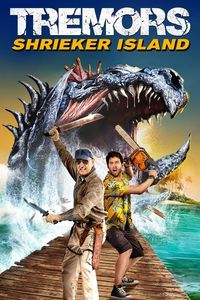
    (On Cable TV, March 2021) While it is a truth universally acknowledged that the first Tremors is an all-time monster horror/comedy, few will disagree that its sequels were terrible. Expectations for Shrieker Island were accordingly low… which may serve to explain why this seventh entry is actually… not too bad? Of course, we’re still grading on a curve here: “not too bad” may be as modest as holding our attention for the running time and have a few set-pieces along the way. Here, the film seems to take its cues from Kong Island by moving the production to Thailand and then pumping up the creatures to skyscraper height. Michael Gross is back as series protagonist Burt Gummer, and he’s actually one of the best parts of the film — taken out of retirement to investigate creatures on a tropical island with rich game hunters. Time will tell if Shrieker Island ends up being as concluding an instalment as it’s meant to be, but to its credit, the film plays that moment absolutely straight, as if there would never be another movie. The CGI-fuelled action beats are limited by a budget, but generally allow for some acceptable action sequences, and the amount of worldbuilding around Grummer’s status as a monster-hunting legend is not bad. It doesn’t make Shrieker Island any more than a monster film, but it’s not unwatchable, and that’s roughly all we’re asking for.

  • At Home in Mitford (2017)

    At Home in Mitford (2017)

    (On TV, March 2021) How much do I like Andie MacDowell? Apparently well enough to look forward to stereotypical Hallmark TV romantic comedy At Home in Mitford, the kind in which a successful career professional comes back to her childhood small town and goes through the whole romantic-triangle experience. (But not too much lest moral complexity intrude.)  The narrative is familiar—but, as usual, the fun is in the nuts and bolts: MacDowell (magnificent in her late fifties) plays a divorced children’s book writer who goes back to a small town to find inspiration and sell her uncle’s house. Of course, romance walks in under the guise of the local episcopalian priest, who inspires her again, takes care of a boy left without family, is a friend to dogs and in all aspects outshines the real estate agent who would otherwise be the other romantic suitor. The small-town atmosphere of this kind of film is portrayed with enough unrealistic nostalgia to be charming, and no serious problems show up on the way to the ending. It’s interesting that the film plays both of its leads (she in her late fifties, he in his late forties) as at least 10–20 years younger — they have concerns and past histories more typical of late-thirtysomething folks rather than the more interesting romance that people their age would otherwise have. But that’s part of the strong fantasy of those kinds of films — perhaps the only surprise is that it doesn’t take place at Christmas. Is At Home in Mitford a good film? No! Absolutely not! It’s terrible! But it’s comforting, unchallenging and deliberately as innocuous as possible. I am somewhat amused that the most vicious IMDB reviews are from readers of the novel on which the film is based — apparently, it’s got it all wrong.

  • Reckless (1935)

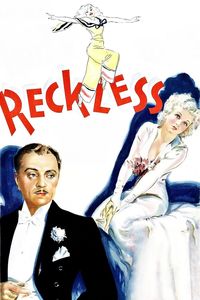
    Reckless (1935)

    (On Cable TV, March 2021) Discussing Hollywood’s refusal to acknowledge the Depression is probably not best tackled in discussing slight drama Reckless, but watching the film in all of its rich-person melodrama leads to thinking about the lifestyle that much of Hollywood presented as normal during that decade’s movies. Offering escapism to a cash-strapped nation, Hollywood spent far much more time talking about the problems of the Manhattan upper-class than the working people, and that was somehow completely acceptable. So it is that Reckless features famous signers, oil billionaires, regrettable marriage, sudden suicide, public scorn and musical numbers — in other words, nothing like life. It definitely feels artificial, and the charm of stars Jean Harlow and William Powell (who were a real-life couple at the time) doesn’t do much to save the results — both of them were far better used in comic vehicles rather than overwrought dramas such as this one, and as a result Reckless feels like a joyless production, another studio product with very little heart to it. The star-power does make the film more interesting, but only just.

  • Quatermass 2 (1957)

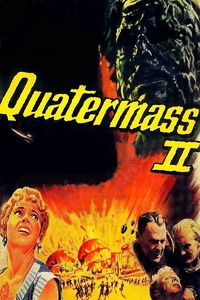
    Quatermass 2 (1957)

    (In French, On Cable TV, March 2021) You wouldn’t necessarily expect a 1950s British movie based on a TV show to be still interesting, but the Quatermass series remains remarkable for how it reaches for a more intellectual kind of filmed Science Fiction than its contemporaries, creating a more credible backdrop for adventures that played off familiar tropes in better-than-average fashion. So it is that Quatermass 2 contemplates a somewhat typical alien invasion (and possession) story, but one that’s handled with more dexterity and subtlety than many of its contemporaries or, indeed, later examples of the form. It’s executed in stereotypically British fashion, all the way to the stoic attitude, political details and mild-mannered details, and that’s what makes it fun even today. Production values are adequate, although (as one may expect) the black-and-white cinematography and middle-grade special effects ensure some distance. Still, I was more pleasantly surprised than disappointed by the results. Quatermass 2 is the second Quatermass film I’ve seen (I seem to be going backwards in seeing them) and I’m starting to understand why the series is so appreciated in some circles. In fact, now I’m beginning to wonder why there hasn’t been a more modern take on it.

  • Tarnished Angel (1938)

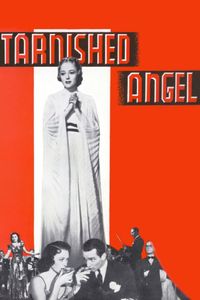
    Tarnished Angel (1938)

    (On Cable TV, March 2021) Tracking down an interesting actor’s filmography can take you places you don’t necessarily expect, and that’s how recording a day’s worth of Ann Miller movies can land you in the middle of Tarnished Angel, a 1930s crime drama lambasting religious swindlers. The story begins in Manhattan, in a nightclub where the entertainment (including a young Ann Miller, playing the sidekick) is scared off by a police raid. Unwilling to subject themselves to such further shenanigans, the protagonist (Sally Eilers) flees town and eventually decides on a new career: religious faith-healer shows, helped by “cripple artists” and some showbiz flim-flammery. This is not meant to be a particularly dramatic film—even the most suspenseful moments are handled in a broad audience-friendly way—but there’s some substance underneath the plotting. Watching the film for Ann Miller is not particularly rewarding, but then again—she was at the beginning of her career here, playing in supporting roles that didn’t account for much cumulative screen time. At least she gets to open the film strong with a good singing number before fading into the background as the third wheel in the protagonist’s entourage. There’s a quick conclusion that upends the idea of the charlatan, but much of the film’s best moments are spent dealing with an unscrupulous heroine amazed by the success of her own racket. Tarnished Angel is watchable, even intermittently fascinating in its depiction of 1930s faith healers, but not exactly an enduring classic.

  • Sherlock Gnomes (2018)

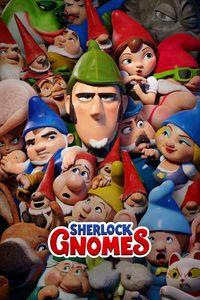
    Sherlock Gnomes (2018)

    (On TV, March 2021) It takes a special kind of twisted inspiration to make a Sherlock film with garden gnome characters, but considering that Sherlock Gnomes is a sequel to Gnomeo and Juliet, inspired lunacy is expected. Moving from small-town England to London to accommodate its premise, Sherlock Gnomes reuses (some) of the previous film’s characters as a way to spin off its own Sherlock Holmes parody, investigating a mystery and confronting an antagonist along the way. It’s not exactly a top-notch animated film, but it’s pleasant and funny enough to watch. There’s a bit of Elton John magic to the soundtrack, and some of the jokes as the film gets into some Sherlockian minutiae can be somewhat amusing. (Mary J. Blige as Irene? Yes, that works.)  As weird as the side-step into action/mystery can be, it does position Sherlock Gnomes as being sufficiently different from its predecessor to avoid the impression of the same thing repeated too closely. It’s still very much playing in the idiom of late-2010s animated films (songs, jokes, action sequences), but it’s a strong formula, and one quite resistant to missteps.

  • Jewel Robbery (1932)

    Jewel Robbery (1932)

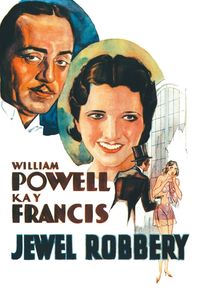
    (On Cable TV, March 2021) The reason why William Powell still has legions of fans even today is that his specific skills as an actor could be magic provided the right material — and Jewel Robbery is very close to being an ideal Powell vehicle. Playing that most cherished of old-school characters, the gentleman thief, Powell goes for his best suave persona: impossibly refined, smooth, irresistible to the ladies and very good at his chosen trade, he easily shines whenever he’s on-screen, although he gets a run for his money from frequent co-star Kay Francis. The theatrical origins of the film can best be seen in impeccable dialogue that takes advantage of the freedoms of its Pre-Code production — most notably in its “funny cigarettes” (ever wanted to see 1930s stoner comedy?), its adulterous heroine, but also having a criminal as a protagonist, and making sure he gets a happy ending. There’s a strong kinship between Jewel Robbery and contemporary Trouble in Paradise, but also with later generations of charming criminals equally successful in larceny and in love. It’s a shining example of the kinds of great movies that the Production Code took away for thirty years, and yet another showcase of Powell’s charm. This being said, Jewel Robbery stands up quite well on its own: it’s a slyly sexy, frequently funny, completely likable crime comedy romance, and it’ll make Powell fans of anyone who doesn’t already know him.

  • Sorority Babes in the Slimeball Bowl-O-Rama aka The Imp (1988)

    Sorority Babes in the Slimeball Bowl-O-Rama aka The Imp (1988)

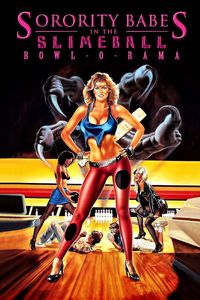
    (In French, On Cable TV, March 2021) Look at that tile. No, don’t just look at it. Take it in. Revel in its greatness. Sorority Babes in the Slimeball Bowl-O-Rama. Don’t dwell too much on how the film will never equal the promise of its title. Chuckle at how it’s also known as The Imp, which is one of the shortest titles on record. Yes, it’s possible to see a film based on a title alone. Alas, expectations quickly get tempered once the Full Moon production logo shows on-screen — this isn’t a company known for good movies, and even their so-bad-they-re-good titles aren’t a substitute for, you know, actually good movies. This being said, Sorority Babes in the Slimeball Bowl-O-Rama does deliver at least half of what its title suggests—it’s a silly horror comedy that does bring together much of what made 1980s horror films so interesting—dumb premise, college-aged protagonist, buxom nudity, rubbery special effects, unconvincing violence and nonsensical plot developments. The silliness has something to do with six young people breaking into a bowling alley and being held captive by a wish-granting imp, but if you expect everyone to walk away with their fondest desires made real, then you’re not paying attention to how this is a cheap horror film. It’s watchable — and while this sounds like faint praise, it’s actually much better than many of its humourless, overly grim contemporaries. On the other hand, I’m stopping well short of calling it something worthy of being a cult classic or a hidden gem. Director (and Full Moon stalwart) David DeCoteau moves through the motions. The film probably contributed quite a bit to the genesis of later Full Moon production Evil Bong, but doesn’t quite make the most of what it has at its disposal. Sorority Babes in the Slimeball Bowl-O-Rama is a disappointment only if you compare it to the genius of its title or any of the characteristics of a good film — but it does much better when put against other cheap 1980s horror films.

  • It Happened to Jane (1959)

    It Happened to Jane (1959)

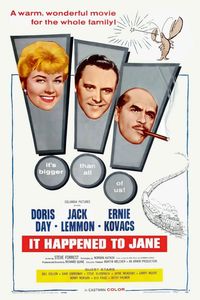
    (On Cable TV, March 2021) I’m almost certain that I will forget the title of It Happened to Jane tomorrow, but I won’t so quickly forget that the film co-stars Doris Day and Jack Lemmon, or that its plot revolves around lobsters and trains. As a romantic comedy, it gets going when a lobster processing plant owner (Day) sees her shipment ruined by the neglect of a railroad company — the fun starts when she gets a friendly lawyer (Lemmon) to successfully sue the railroad and earns as payment… a train. The respective charms of both actors are well used, as they each play within their screen persona. The flip-side of this degree of comfort is that the film itself quickly becomes unremarkable. This is a middle-of-the-road effort for both of them, and it’s hard to say whether the finished film would have been better if it had played more seriously or more absurdly. (The smile we get in seeing Lemmon shovel coal in a train is a strong hint, though.) It’s pleasant to watch but curiously insubstantial, which is a weird thing to say given its plot elements and the quality of its stars. It doesn’t help that Day (an actress I find mildly likable but saddled with a bland persona) pales in comparison to Lemmon’s frequently-frantic antics. The final result is perhaps most interesting for its bucolic northeastern setting and winks at the burgeoning TV landscape rather than for how well it executes a lacklustre plot. If you accept that It Happened to Jane is an average comedy of its time, you also have to acknowledge that late-1950s comedies were in an odd place — too late for the golden era of musicals, but too early for the reinvigoration that the permissiveness of the 1960s would bring to the genre.

  • I Care a Lot (2020)

    I Care a Lot (2020)

    (Amazon Streaming, March 2021) Even the most cynical “OK Boomer” critics will have a hard time not getting incensed over I Care a Lot’s protagonist in the opening moments of the film, as it shows a hardened “caretaker” deliberately engineering the takeover of a retired woman’s life in order to lock her up in a retirement home with no communication privileges, and liquidate her assets for profit. All legal, all ethical, she maintains — but as the attempted assault that begins the film shows, it’s a reprehensible racket. Rosamund Pike, in full-blown ice queen mode, truly sells the character and, along the way, earns our complete enmity. If you’re still around after that infuriating opening, things get far more interesting when it becomes obvious that the charming old lady that was taken away from her own life is revealed to be the mother of a ruthless crime boss (Peter Dinklage, quite good), who stops at little in order to get his mom back and ruin the life of the protagonist. As the responses and counter-responses escalate, we’re left hoping that no one will be left standing by the end of the film — while the homicidal mob boss is a terrible human being, our retiree-exploiting protagonist feels even worse. Alas, I Care a Lot has its own ideas about who should be the hero of this story, and it doesn’t earn itself any favour by giving all the breaks to its sociopathic protagonist cloaking herself behind gendered rhetoric. I know, I know — anti-heroes are in at the core of black comedies, and it does build to an ironic comeuppance of sorts. Still, I’m left more annoyed and unsatisfied by the result — I’d have plenty to say about cinematic amorality and how it’s now frequently presented as a progressive triumph when it bolsters traditionally downtrodden demographic segments, but I’m going to keep poking at that thesis until I get something more useful than reactionary out of it. In the meantime, what else to say? I Care a Lot is competent filmmaking from writer-director J. Blakeson with a pair of great performances at its centre, but any film that builds itself up on pure hatred for its protagonist shouldn’t be surprised if it finds itself in the cold.

  • The Midnight Sky (2020)

    The Midnight Sky (2020)

    (Netflix Streaming, March 2021) As someone with great affection for Science Fiction that plays by the established rules of physics, there’s a strange mixture of hard-science moments and cheap plotting tricks at play in The Midnight Sky, and if I can really like some of its scenes, I’m far cooler on the overall film. Maybe the source of the problem lies in the original book — but it’s not as if Hollywood hasn’t changed whatever it wanted when adapting existing works. Director-star George Clooney is better than the mess of a script, as his magnificent old-man beard commands attention whenever he’s on-screen. Set against a frustratingly vague global catastrophe, he’s apparently the last survivor on Earth, and he happens to have the right mixture of skills and equipment in his polar hideout to be able to communicate with the returning crew of a Jovian expedition — and warn them not to land. (As if they couldn’t see it for themselves?) At times, such as when the space ship crew goes outside to fix a communication problem, the film is about as hard-SF as it gets — bringing back fond memories of Gravity and other successful space adventures sticking to realism. At others, such as when it discusses a habitable (but hitherto unknown) Jovian moon, slides into Adam-and-Eve territory, concludes on coincidental parentage, or goes for the now-exasperating fictional-character trope, The Midnight Sky looks like a bunch of naïve clichés strung together, sorely testing the patience of those expecting more substantial material. It’s hard not to play the spot-the-inspiration game in cataloguing which films did all of this earlier and better. I’m marginally kinder to Clooney’s directorial skills — the film fluently uses terrific visual effects and strings together a number of intelligible action sequences, expanding Clooney’s technical range beyond his previous more intimate films. Still, The Midnight Sky is a film that goes for a narrative-heavy experience (although not a dialogue-heavy one: several sequences play out wordlessly) but creates an unpleasant mismatch between the credibility of its execution and the unbelievability of its plot. There are reasons why those clichés are done or on their way out — while the film goes for an “uplifting rebirth of the human race” conclusion, more realistic viewers will recognize that humanity is doomed even if it wasn’t heading back to a terrifyingly dangerous outer planet. It does betray a film that really hasn’t thought through the consequences of its narrative choices, and it’s hard to trust the result after that.

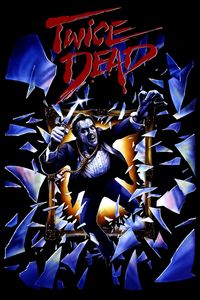
  • Twice Dead (1988)

    Twice Dead (1988)

    (In French, On Cable TV, March 2021) While I’m usually sympathetic to movies that attempt to blend various subgenres together, I still insist on a minimal level of competence in the execution of the result, and Twice Dead doesn’t even get there. At first glance, it tries to blend together three or four big horror tropes in one single mix: A haunted-house story, a ghost story, a reincarnated lover story and a home invasion story. It’s an ambitious intention, but the results are less substantial than you’d expect. A 1930s introduction in which a Hollywood actor hangs himself after heartbreak sets things up for a late-1980s haunted house story, as an ordinary nuclear family moves into a dilapidated Hollywood house with a squatter problem. Before long, the plucky teenage heroes discover the sordid past of the house, are attacked by a bunch of ne’er-do-wells and get some help from the house’s ghost eager to protect the apparent resurrection of his old flame. It’s hard to see how any screenwriter could mess up this mixture. But writer-director Bert L. Dragin didn’t have nearly as much talent, and the film simply lumbers from one thing to the other, missing obvious opportunities to create depth and far too often retreating in botched horror tropes. Even the 1930s subplot is limply handled, and the reincarnation stuff falls short of what could have been. By the time there’s a sex scene that climaxes with electrocution (featuring a cowgirl with the worst peripheral vision in history), the film is not ridiculous as much as it’s unredeemable. Clearly outmatched by the potential of its premise, Twice Dead can be worth a watch if you want to study a narrative engine that’s clearly more powerful than the people handling it — but otherwise, it’s just another disappointing cheap 1980s horror film.

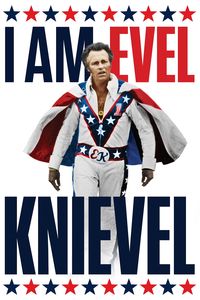
  • I Am Evel Knievel (2014)

    I Am Evel Knievel (2014)

    (On Cable TV, March 2021) As with most Canadians with a Cable TV subscription, I have seen an almost-endless series of “I am [Dead person’s name]” movies scroll in the program guide, but never watched one before I Am Evel Knievel. I may have let an interesting series pass me by — As a documentary, I Am Evel Knievel is a very entertaining look at a multi-decade life with a clearly defined arc. Knievel started out as nothing much more than a hoodlum, accumulating an extensive criminal record before discovering a talent for motorcycle stunts and self-promotion. Jumping over increasing distances with a stock motorcycle, Knievel grew to national fame thanks to some fruitful relationship with good promoters and producers, and by the early 1970s was commanding large audiences, TV shows, substantial merchandizing profits (much of it spent on frivolous pursuits) and even a movie featuring “him.”  (Viva Knievel! is, frankly, what rekindled my interest in I Am Evel Knievel — you can’t watch it in all of its unabashed awfulness and not want to know more about the character.)  This all came crashing down in the mid-1970s thanks to a combination of bad crashes and the ill-advised physical assault against a promoter who wrote an unauthorized book about him. Later years in Knievel’s life were spent becoming a better person, rediscovering faith and being focused on others. This is all told through an effective blend of documentary footage and interviews with acquaintances and friends blending together in a kind of oral history. The film is rarely as entertaining as when it blends snippets of interviews to give a richer account of specific events in Knievel’s life, such as when he was assaulted by a Hells Angel at the end of a show and several people came to his rescue. Knievel was a grander-than-life character and the film does lean into this mythology. It’s important to note that the drawback to a friends-and-family oral history is that you don’t get much of a critical perspective—while Knievel’s faults are acknowledged, I Am Evel Knievel presents them with a wink and a nod—he was a former felon, a womanizer, a spendthrift, and an alcoholic but (wink-nod) that’s what made him great, right? Alas, this means that he often gets a pass on things that should not be forgiven — the baseball bat physical assault that drove his victim to the hospital with broken bones and precipitated the end of Knievel’s lucrative sponsorship deals is actually defended by many interviewees in the film’s lowest point. Knievel’s naïve conservative worldview is hailed as admirable (reinforced by trite quotations shown on-screen) and there’s an anachronistic “here’s a real man, the likes of which we’ll never see again” atmosphere to the entire thing. Celebrities interviewed for the film include Matthew McConaughey, Kid Rock, Michelle Rodriguez and Guy Fieri. The film is on much stronger grounds when professional motorcycle stuntmen explain the immense risks Knievel took in jumping with a stock motorcycle, not bothering with the risk-reducing techniques and equipment that modern daredevils use to protect themselves. Furthermore, I am Evel Knievel does manage to cram enough information on-screen to allow viewers to make up their own minds — even if it’s a mildly critical line or two that is not seriously followed-up in the hagiographic whole of the film. Even if you’re not quite seduced by the character, it is a biography that does justice to a fascinating life.

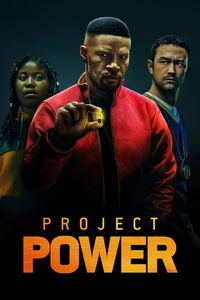
  • Project Power (2020)

    Project Power (2020)

    (Netflix Streaming, March 2021) I’m not at all happy with the contamination of current science fiction films with comic-book thinking. Yes, there is a difference: The platonic ideal of Science Fiction starts with an imaginative premise, and then exploring it in depth with rigour. Comic book thinking, on the other hand, is usually far more superficial and focuses on surface-level action at the expense of ideas. (Yes, there are exceptions; yes, those exceptions are the comic book movies I like best.)  So it is that Project Power does have an idea at its core. Unfortunately, it’s a dumb idea — a drug that gives you five minutes’ worth of physics-breaking superpowers. Always the same superpower, but you don’t know which one until you take the drug for the first time, at which point you do risk death if you get a “bad” superpower. It’s an idea that makes no logical sense — and it gets even more nonsensical when the film sputters some kind of justification having to do with evolving animal powers, as if animals could burst into flame like the superhumans here do. Naaah — this is a comic-book movie with comic-book inspired plot devices and surface-level comic-book narrative qualities. This isn’t to say that Project Power can’t be intermittently enjoyable on its own terms: there are plenty of decent action sequences once the superpowers take effect, there’s some pleasure in seeing Jamie Foxx go up against Joseph Gordon-Levitt (with an impressive supporting turn from Dominique Fishback), and some sequences do tickle at the thematic potential of its premise. Alas, whatever Project Power does mildly well only underscores the gap between what it is and what it could have been. Perhaps the biggest gap is its tantalizing parallels between superpowers and real social power — there’s a socially conscious cry for justice here that is merely suggested (and badly suggested at that, with characters dismissing the traditional path to success and social change in favour of luck-based stardom) and then forgotten as we move toward the fights-and-explosions part of the film. A real science fiction film (or a superior comic-book film) would have dug down deeper into those parallels, found interesting thematic resonance and provided some better material to make us believe in the film’s premise. As it is, Project Power runs on surface impact and its lead actors’ screen persona — it’s not terrible, but it falls short of what it could have done with its innate… power.

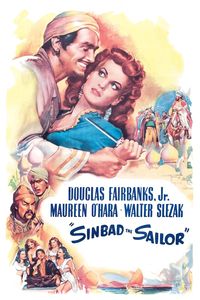
  • Sinbad, the Sailor (1947)

    Sinbad, the Sailor (1947)

    (On Cable TV, March 2021) Presented as part of TCM’s lineups of “Reframed: Classic Films in the Rear-view Mirror’” of March 2021 (i.e.: Popular films from the Hollywood golden age that, when seen from a contemporary perspective, contain problematic elements that would not pass without criticism today), Sinbad, the Sailor clearly belongs to that category for its stereotypical depiction of Arabic characters and culture. Not only do you have Caucasian Douglas Fairbanks, Jr. playing Sinbad in dark makeup, you also have a festival of clichés in its Arabian setting, lines that would be considered blasphemous to Muslim viewers, fake-Arabic dialogue and cultural misappropriation galore. It’s a lot to take in, but little of it actually distracts from the swashbuckling effectiveness of the film. Shot in lush Technicolor to take advantage of the colourful sets and costumes, it’s an adventure film with lavish production values and a scope to match. Telling us about Sinbad’s “eighth voyage,” it’s a trip featuring villains (Anthony Quinn!), damsels in distress (Maureen O’Hara!), sword-fighting and deliciously florid dialogue delivered with gusto. In other words — yes, it’s dated, but dated in interesting ways… and I’m not the right audience to ask about whether I should be offended by a work of pure fantasy. This is, to be fair, really not Hollywood’s worst offender when it comes to Arabic culture: Have a look at The Thief of Baghdad or any of the versions of A Thousand and One Nights to realize that Hollywood used Middle Eastern settings as a fantasy playground throughout much of its early history. Meanwhile, Sinbad, the Sailor is mildly enjoyable — not a swashbuckler of the highest order, but something reasonably entertaining, with a spirited performance by Fairbanks and plenty of visual delights. Even though it’s not possible to exonerate it, I can think of some far more problematic films.