Reviews

  • The Sword and the Stone (1963)

    The Sword and the Stone (1963)

    (On DVD, September 2018) Released in-between One Hundred and One Dalmatians and The Jungle Book, it’s easy to see why The Sword in the Stone doesn’t have the best reputation—not only does it pale in comparison to its better-known siblings, taking out the Arthurian legend for a juvenile comic spin is a marked step down from what could have been possible with such source material, and the execution leaves much to be desired. The comedy is aimed at kids, without much narrative substance for adults. Narratively, it doesn’t help that much of The Sword and the Stone is a series of episodes aimed at showcasing a visual gag or an animation challenge—it often looks good, but there’s no sense of build-up. Still, the film still does have its strengths. Merlin, as a magician unstuck in time and bringing back anachronisms in an Arthurian setting, is quite likable as a character. The final fight is notably inventive, and the squirrel sequence gets points for being a squirrel sequence (even if it ends with heartbreak). It’s not a whole lot to go on, but it is something. Definitely second-tier material (and maybe teetering on the lowest tier), The Sword and the Stone doesn’t have the staying power of its Disney contemporaries, but it’s worth at least a watch to see the sheer artistry of the Disney animators even in tackling substandard material.

  • The Sand Pebbles (1966)

    The Sand Pebbles (1966)

    (On Blu Ray, September 2018) It seems remarkable that The Sand Pebbles’ themes and overall attitude would dovetail so neatly with the then-worsening Vietnam War—adapted from a novel written years before and produced throughout 1965–1966, The Sand Pebbles does seem like a commentary on the American adventure in southeast Asia. Taking place aboard a gunboat tasked with patrolling the Yangtze River during the Chinese civil war, the beginning of the film isn’t overly dark but it does take place under a cloud of unease that’s far from the triumphant war movies of the 1960s—our protagonist (Steve MacQueen, in an unusually dramatic performance) makes few friends as he badly integrates with the crew, and many sailors are portrayed in an unusually negative way. Then the film turns into its second half, and things quickly get worse—our hero is accused of the murder of his deceased friend’s wife, with riots leading to a near-mutiny. Then, when tasked with rescuing American expatriates, the ship suffers heavy losses, all to find out that the missionaries are resisting their evacuation. Many people die on the way to the dark and fatalistic ending that suggests that Americans have no place over there. Many sequences are quite good—the near-mutiny alone is a small masterpiece of sustained tension. The Sand Pebbles may not be as exhilarating as many of the WW2 adventures of the time, but it clearly prefigures the much darker approach that war movies would take in the following decade with Vietnam being on everyone’s minds.

  • Persona (1966)

    Persona (1966)

    (Kanopy streaming, September 2018) I approached Persona with a great deal of wariness—I’m already cool on Ingmar Bergman, on European art-house, on audience-supplied-narrative, on pretty much everything that Persona is said to exemplify. That it comes preloaded with a reputation as a movie where any interpretation has been dissected and found plausible didn’t help my mindset at all. On the other hand, my lowered expectations may have helped, because I found Persona to be reasonably interesting. It only takes a few moments for the aggressive opening sequence to quasi-subliminally show an erect phallus on screen—from then on, anything can happen and it’s almost a relief not to try to make sense of it as the film multiplies its show-off moments. There’s fourth-wall breaking, images of the physical film snapping, a high-energy interlude, a scorching-hot erotic monologue, great performances by Bibi Andersson and Liv Ullmann, deliberate confusion about the identities of the characters (or even whether they’re distinct characters) and a tone that leads you to expect the worst even if nothing much happens. In short, it’s an experience more than a story, and it works much better if you just let it wash over you. I still don’t like this kind of movie and wouldn’t necessarily recommend Persona unless I was sure that this is the kind of effect the viewer was looking for, but I’m satisfied to call my viewing of the film at least a draw in terms of enjoyment, which is much better than what I was expecting. Onward to other Bergman movies, I guess…

  • The Man from Earth (2007)

    The Man from Earth (2007)

    (Hoopla streaming, September 2018) At first glance, there are many reasons why The Man from Earth shouldn’t work as a movie — In the first five minutes, we’re confronted with substandard filmmaking with the dull cinematography, pedestrian dialogue, mediocre direction and over-emoting actors that are the hallmarks of a low-budget production. (Although, to be fair, the most over-emoting actor is playing a deliberately annoying character who calms down throughout the film.) But as the film unfolds, the dialogue creates a fascinating premise—what if a prehistoric man, somehow immortal, had survived until now? Then the film has the characters wrestle with the implications of that premise and director Richard Schenkman’s The Man from Earth becomes that rarest of creations—an entirely idea-driven movie, with bare-minimum filmmaking supporting the high-end concept being explored through conversations and questions. Fans of written science fiction have known this feeling for decades, but it’s a remarkably rare choice for movies—no wonder that the film is adapted by SF writer Jerome Bixby from his moderately well-known short story. The Man from Earth does take a few storytelling risks toward the end, tying one of its characters to a historical figure and then finding an unexpected link with another character. Both of these choices stretch credibility, and I would have preferred a more qualified approach to those revelations (picking Judas as the historical figure, for one thing, and perhaps stating the deliberate nature of the two characters’ proximity) but they don’t really harm the movie. Suffice to say that The Man from Earth is a unique movie, and one that will appeal to people who aren’t always fans of the Hollywood factory approach to science-fiction films. No wonder that the film became a substantial success on file-sharing sites after a quasi-non-existent theatrical exhibition and a small-scale video release: it appeals to people most likely to be file-sharing enthusiasts. Finding it legally can be a challenge (don’t expect a TV showing: other than the expensive DVD editions, I eventually found it on a library-sponsored streaming site) but it’s worth the effort of tracking down.

  • The Fog (1980)

    The Fog (1980)

    (On DVD, September 2018) Appropriately enough, The Fog is very atmospheric—the portrayal of a small coastal town being besieged by a supernatural fog carrying ghostly avengers is very well made, and count for much when the script struggles to make sense. After Halloween’s success, director John Carpenter was still trying out the breathing room allowed by slightly bigger budgets and the added scale of The Fog does count for much. It’s always a pleasure to see prime-era Adrienne Barbeau on-screen, and she does have a fascinating role here as a local radio DJ able to keep watch on the town but being unable to do much about what she sees—there’s some genuine suspense fuelled by her inability to be there to protect her son as she sees the fog engulf the town late in the film. Otherwise, the script does fall a bit apart when you look at it closely—and there’s an inevitable let-down when the mysterious fog gives way to more ordinary murderous undead pirates. (Wow, it sounds so unfair when I say it like that…) Still, The Fog is a better-than-average film for its era, exploring something slightly different and indulging in the possibilities offered by its blend of premise and location. It’s memorable for the right reasons.

  • Tora! Tora! Tora! (1970)

    Tora! Tora! Tora! (1970)

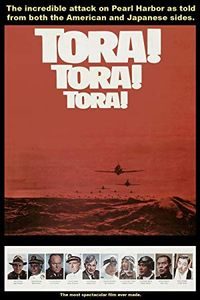
    (On Blu Ray, September 2018) Looking at Pearl Harbour from American and Japanese perspectives (and co-directed by Richard Fleischer, Toshio Masuda and Kinji Fukasaku, with script contributions by Akira Kurosawa), Tora! Tora! Tora! has aged remarkably well. There’s a credible verisimilitude to the entire film that is enhanced by the careful character development of characters on both sides of the war, with the Japanese even coming across more favourably than the Americans at times. The various tactics, strategic objectives and errors made by the characters are well identified, and we almost feel as if we’ve learned something from the entire film by the end of it. 1970 was an … interesting year for war movies (with anti-war statements MASH, Catch-22 and Kelly’s Heroes being released the same year) but Tora! Tora! Tora! manages to feel distinct from the other ones by being more analytical than satirical in going beyond the jingoism of earlier eras. Seventies special effects standards mean that the film does have great battle sequences—sadly, they may feel underwhelming to those who grew up on Michael Bay’s typically bombastic Pearl Harbour. Tora! Tora! Tora! does have the edge in terms of character, though, even if Pearl Harbour does just a little bit in providing closure with the Doolittle bombings. In my mind, I have a pretty good mash-up of both movies combining the authenticity and cleverness of Tora! Tora! Tora! with the special effects and story structure of Pearl Harbour (with maybe the beach scene from From Here to Eternity thrown in). Prepare an extra-large bowl of popcorn to accommodate seven hours of movie-watching and see them both as a complementary double feature.

  • The Spy Who Loved Me (1977)

    The Spy Who Loved Me (1977)

    (Second viewing, On Blu-ray, September 2018) Now that’s more like it. The Spy Who Loved Me, third Roger Moore outing as James Bond, finally puts all of the elements of Moore’s sub-formula together: Good action sequences, interesting plot (even if reprised from You Only Live Twice), a strong Bond Girl and, perhaps more than everything else, Moore’s debonair charm used to good purposes. His Bond here is far funnier, much less violent (although there’s one execution-by-tie that still rankles), better behaved around women (not by much, but the pairing with an almost-equal works in favour of a more balanced relationship) and unflappable in the face of crises. The globetrotting takes us to Egypt and the Mediterranean, while the gadgets include the classic submarine car, Union-jack parachute and personal Jet Ski. The film manages to hit just the right balance between a simplistic but not completely stupid plot and the silliness that we’ve come to expect from the Moore years. It’s not fancy, but it works. The villain’s lair is truly spectacular (in fact, there are two of them) and the action sequences have some kick—the car chase is particularly enjoyable. I won’t pretend that it’s a perfect film: The Bond girl is still used as a plot device to be rescued at the end, the Bond seduction shtick has worn thin, and there are more than a few instances of villain stupidity. Still, it works surprisingly well and presents a sharp return to form for the series after a lengthy fallow period—it’s probably the best Bond since On Her Majesty’s Secret Service. I saw the film as a boy (I was introduced to Bond between Moonraker and For Your Eyes Only) and had forgotten much of the details—it’s fascinating to see what sticks in mind and what doesn’t, and how I was sometimes able to anticipate the gist of the next thirty seconds of the film without quite knowing exactly why.

  • Hercules in New York (1970)

    Hercules in New York (1970)

    (In French, On Cable TV, September 2018) Putting the documentary Pumping Iron aside, Hercules in New York is notable for being Arnold Schwarzenegger’s big-screen debut (as “Arnold Strong”). It would take a long time until he struck big with 1982’s Conan the Barbarian, but we can already see Schwarzenegger’s charisma outshining, well, nearly everything else about the film. Conceived as a cheap comedy, Hercules in New York has the hallmark of a modestly budgeted film not trying too hard to tell a coherent story. It has something to do with a Greek titan experiencing New York City, which really means another fish-out-of-water comedy with an unusually strong character. The plot is dumb, the characters are idiots, the production credentials are cheap, the love interest thing gets dropped unceremoniously well before the end, and the jokes are not refined … but there is Schwarzenegger shining through in coarse fashion. The film’s other highlight is a chariot race through Manhattan and Times Square (snapshots of which have been endlessly reprinted in just about every single illustrated biography of the actor), but no matter: The only reason to watch the film today is as an early showcase for Schwarzenegger. He’s far more memorable in Pumping Iron, but at least you get an idea of how they’d shape his persona later on for his extraordinary string of roles in the 1980s.

  • The Man with the Golden Gun (1974)

    The Man with the Golden Gun (1974)

    (On Blu Ray, September 2018) Roger Moore’s second outing as James Bond isn’t particularly good, clearly showing how the producers didn’t yet understand how to best use Moore’s debonair natural charm. The Man with the Golden Gun doesn’t manage to control its comedic impulses, sometimes trying to bring back the written Bond’s violence and at other times going way too far in silliness. It starts with a disappointing theme song that can’t manage to do honour to its fantastic signature riff (à la Live and Let Die) with on-the-nose silly lyrics and a weak vocal performance. The odd thing about the film is that it does have undeniable strengths: Moore is naturally likable, Scaramanga is a fantastic idea for a villain, Christopher Lee is exceptional as the antagonist and the corkscrew jump two thirds through the film is easily one of the most spectacular shots in Bond history. Alas, each one of those aspects is undermined by filmmakers who don’t quite understand how to showcase their assets: Bond is too often unnecessarily aggressive or rough, Scaramanga’s build-up isn’t matched by the third act, Christopher Lee isn’t given much to do, and the stunt is accompanied by a stupid slide whistle sound (and wrapped in dumb dialogue between Bond and one of the worst characters in the series), deflating the impact of the shot. The entire film is like that: Bond Girl Britt Ekland makes a strong first impression as a Foreign Service agent able to verbally spar with Bond, then devolves into an idiotic damsel-in-distress throughout the movie. The film’s third act sputters through an anticlimactic duel and a butt-activated solar death ray. Even the film’s attempt to cash on the early-seventies kung fu craze (after doing its best with Blaxploitation in the previous instalment) feels like an extraneous afterthought with an incredibly dumb payoff. I still have some enduring sympathy for the Moore-era Bonds because that’s when I first encountered the series (between Moonraker and For Your Eyes Only), but my patience was sorely tested with The Man with the Golden Gun—In fact, I almost snapped at the film’s iteration of the series’ frankly insulting seduction plot device. At least there’s a bit of a bedroom farce to take the edge off, but despite the winged cars, exotic trips through Southeast Asia and the great idea of using the Queen Mary wreck as a secret base, The Man with the Golden Gun is just frustrating. Fortunately, the next instalments of the series would learn how to best use Moore’s specific take on the character.

  • The Longest Day (1962)

    The Longest Day (1962)

    (On Blu Ray, September 2018) I often complain about excessively long movies, but even at nearly three hours, I found The Longest Day riveting throughout. A meticulously detailed overview of the Allied landing in Normandy during World War II, this film takes a maximalist approach to the event: It features dozens of speaking roles in three languages, as it tries to explain what happened from the American, British, French and German perspective. Character development gets short thrift, but that doesn’t matter as much as you’d think if you consider the event as world-sweeping history featuring four nations. An all-star ensemble cast helps propel the story forward with some sympathy, as the personas of John Wayne, Richard Burton, Robert Mitchum, Sean Connery (in a very funny pre-Bond role), Sal Mineo and may others guide us through the war. The black-and-white cinematography is gorgeous, and hits anthology levels with a sweeping minutes-long uninterrupted shot of urban warfare. (There’s also a great camera movement early in the film that shows the beach landing and many of the 23,000 soldiers used during filming.) While Saving Private Ryan has eclipsed The Longest Day as the definitive portrayal of D-Day, this 1962 production remains important as a historical document in itself: Many cast and crew had been in Normandy twenty years later, to the point where some actors were portraying people close to them when it happened. (Richard Todd was offered his own role and ended up taking that of his then-superior officer, and ends up speaking “to himself” during the movie.) Visually, the movie remains spectacular even fifty-five years later, and it gets better the more early-1960s stars you can spot. (This also works for historical figures—Omar Bradley is instantly recognizable in a one-shot role.) It’s an exceptional tribute to the events of June 6, 1944, a thrilling adventure story and its relatively bloodless nature doesn’t undercut its portrayal of war as being hell where anyone can die at any time. It’s quite a rewarding film, and it’s even better when you can understand more than one of the three spoken languages.

  • Two Mules for Sister Sara (1970)

    Two Mules for Sister Sara (1970)

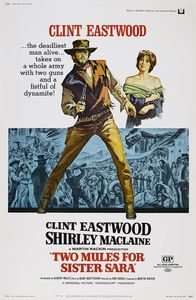
    (On TV, September 2018) There’s nothing particularly fancy in Two Mules for Sister Sara than a by-the-numbers Western adventure featuring Clint Eastwood, Shirley MacLaine, Mexican rebels and French antagonists. But the details are what matters, and especially the interplay between two actors in fine form. Peak-era Clint Eastwood more or less reprises his man-with-no-name role as a capable loner who comes across a woman being assaulted by bandits. Compelled to help her by her nun’s habit, they then both go on various adventures that end with the defeat of the invading French forces. I’m not a big fan of MacLaine, but she’s pugnacious and likable here as a two-fisted nun. The film does a nice job at pacing its adventures, and features one spectacular train derailment to keep things interesting. Most of Two Mules for Sister Sara has been seen elsewhere, but it’s executed so well that it feels fresh again.

  • Catch-22 (1970)

    Catch-22 (1970)

    (In French, On Cable TV, September 2018) Coming in toward the end of the Vietnam quagmire, 1970 was a strange year for war movies. On the one hand, you have the blockbuster example of Patton, with its portrayal of a grander-than-life soldier’s soldier against the noble backdrop of World War II and sweeping tank battles. Then there is the satirical trio of Kelly’s Heroes, MASH and Catch-22, all of which took a jaundiced satirical look at war, taking potshots at the very ideals that earlier movies such as The Longest Day would have promoted a few years earlier. (Even Patton isn’t immune to the critical re-evaluation, as Patton himself is portrayed as exceptionally flawed and prisoner of his own nature.) Catch-22 betrays its literary origins through elaborate dialogue sequences often taking over the cinematic qualities of its sequences—most spectacularly during a sequence in which some inane dialogue takes place over the crash landing of a plane behind the characters. This being said, there’s an admirable commitment to historical recreations in Catch-22—the film put together a bomber air base just for shooting, and the results are some impressive sequences with real military hardware and none of that fluffy CGI stuff. An all-star cast is enough to keep things interesting—from Alan Arkin’s too-sane protagonist to Orson Welles turning up as a military commander. Much of the film has a compelling twisted logic to it, pointing out the limits of military thinking in exceptional situations. While the result could have been tighter, more focused and perhaps just a bit less talky, it still amounts to a compelling anti-war statement.

  • Live and Let Die (1973)

    Live and Let Die (1973)

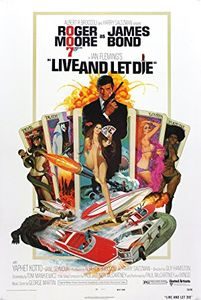
    (Second viewing, On Blu-ray, September 2018) And so the Roger Moore Bond years begin in Live and Let Die, without SPECTRE, but with tarot, voodoo and tons of Blaxploitation. The globe-threatening antics of previous films are reduced to a drug trafficking movie, albeit with a considerable amount of early-seventies flair. Moore’s performance is not quite Moore’s Bond yet: His approach is still more intense than debonair, his quips are restrained and he still feels like a holdover from the Connery era. The film around him, however, is a clear relic of its time: I happen to like Blaxploitation a lot, so it’s not as if its intrusion on Bond territory is not welcome—on the other hand, this is clearly a black-focused film written by white people, so the folkloric aspects of black culture are played up and character stereotypes abound. It’s also missing a lot of what made Blaxploitation feel fun—no funk, no going up against the man on behalf of the black man. Oh well; we couldn’t really expect much from such a combination. Elsewhere in the movie, the ludicrousness abounds: there’s an uncomfortable aura of supernatural floating around the film, even when you can explain most of it rationally through dramatic plotting, impossibly clever schemes and an impressionistic final shot. It does dovetail with the increasingly silly nature of the Bond series going into the Moore years, especially when tarot and voodoo are used as exotic window-dressing for the series’ globetrotting. Speaking of which: It does feel like an overdose to go back to America in back-to-back Bond movies, even if New Orleans isn’t the same as Las Vegas. (I saw Live and Let Die as a teenager, but I had forgotten all about Bond’s detour in New York City. I did remember the tricked-out card deck, though.) I’m not particularly impressed by the film’s action showpieces, especially the boat sequence which, while containing some spectacular moments, doesn’t seem to build to something as much as it just strings stuff along until it runs out of its budget. Jane Seymour is one of the most intriguing Bond Girls as Solitaire, but I’m not sure that she actually fits in the Bond universe. Yaphet Kotto is not bad as the villain, although one wonders how busy his agenda is in-between the ruling, the trafficking and the evil plotting. Among bit players, David Hedison is great as Felix Leiter, Geoffrey Holder is terrific as Baron Samedi, Madeline Smith is cute as the Opening Bond Girl and Gloria Hendry is welcome as the Bad Bond Girl. Alas, Sheriff Pepper is intolerable, Q is missing and the plot is a bit dull, suggesting once again that the Bond series is at its silly best when it goes bigger-than-big. Speaking of which, Paul McCartney’s title song is terrific, probably my favourite of the series. Otherwise, Live and Let Die is a formula Bond movie, perhaps more interesting as a period piece and as a transition point for the series rather than by itself.

  • The Great Race (1965)

    The Great Race (1965)

    (On Cable TV, September 2018) I sometimes do other things while watching movies, but as The Great Race went on, I had to put those other things away and restart the film. There is an astonishing density of gags to its first few minutes (from the title sequence, even) that require undivided attention. While the first act of the film does set up expectations that the second half fails to meet, it does make The Great Race far more interesting than expected. Clearly made with a generous budget, this is a comedy that relies a lot on practical gags, built on a comic foundation that harkens back to silent-movie stereotypes. Making no excuses for its white-versus-black characters, the film features Tony Curtis as an impossibly virtuous hero, facing the comically dastardly antagonist played with gusto by Jack Lemmon in one of his most madcap comic performance. Meanwhile, Natalie Wood has never looked better as the romantic interest (seeing her parade in thigh-high black stockings unarguably works in the film’s favour) and both Peter Falk and Keenan Wynn are able seconds. The film’s visual gags are strong, and so is writer/director Blake Edwards’s willingness to go all-out of his comic set pieces: The legendary pie fight is amusing, but I prefer the Saloon brawl for its sense of mayhem. There is a compelling energy to the film’s first hour, as pleasantly stereotyped characters are introduced, numerous visual gags impress and the film’s sense of fun is firmly established. Alas, that rhythm lags a bit in the last hour, with an extended parody of The Prisoner of Zenda that falls flat more than it succeeds (although it does contain that pie fight sequence). Still, it’s a fun film and the practical nature of the vehicular gags makes for a change of pace from other comedies. I liked it quite a bit more than I expected.

  • Popeye (1980)

    Popeye (1980)

    (Popcornflix streaming, September 2018) I grew up on Popeye cartoons (in French, mind you), but somehow hadn’t seen the live-action adaptation until now. I can’t say I missed much, because for all of director Robert Altman’s skill in recreating a cartoon-inspired seashore village, much of Popeye simply falls flat with simplistic character motivations, too-long musical numbers and an overall impression of … dullness. It’s not all bad: Robin Williams is good as Popeye, but Shelley Duvall is terrific as Olive Oyl and Paul L. Smith is remarkable as Bluto. The sets are splendid (almost too good, in fact—we don’t really want to spend any more time there) and there is some occasional good staging for the physical comedy. But otherwise, Popeye remains surprisingly boring: The film feel self-satisfied, prone to excessive sentimentalism and unwilling to make its narrative advance. Williams’ constant mumbling of malapropisms as Popeye in in-character, but that doesn’t mean it’s any less annoying. In some ways, Popeye also seems made for those who already know Popeye—I’m among those, but we’re literally a dying breed and I wonder what audiences new to the character would make of the film. I certainly had to pause and think a bit about those Saturday morning cartoons to be reminded of why the film followed a certain path, who those annoying people were and why it was so stylized. Overall, I’m disappointed at the result.