Reviews

  • Bienvenue chez les ch’tis [Welcome to the Sticks] (2008)

    Bienvenue chez les ch’tis [Welcome to the Sticks] (2008)

    (On DVD, December 2009) It’s probably best not to focus on the fact that Bienvenue chez les ch’tis is one of the highest-grossing French films of all times, otherwise it’s almost de rigueur to question what makes this film so special.  The answer is close to “not much”: As with so many fish-out-of-the-water comedies in which sophisticated characters are thrust in rustic locations for an extended period, you can almost see the clicks of the well-worn plot mechanics at work in this film as scene after scene does its job.  Of course, the much-derided place is full of heart-warming characters with real qualities and problems.  Of course, the lead character comes to love the place.  Of course, there are a few complications.  Perhaps the most amusing element of Bienvenue chez les ch’tis is the excessive setup in which “Le Nord” is depicted, via the usual stereotypes, as a horrible place; the flip side of that setup is the elaborate deception that the lead character ends up entertaining in order to placate his incredulous south-bound family.  Props also go to the willingness to show the epilogue of the tale, something that other films would have avoided.  Otherwise, it’s by-the-number comedy filmmaking.  Well done, amusing and mechanical.  Kad Merad and Dany Boon make up a decent comedic pair, playing off southern/northern stereotypes with energy.  This isn’t a strikingly original film, especially not when every regional cinema seems to have a variation of the same story (For French-Canada, check out La Grande Séduction).  But reasonably well-made films can be a joy to watch even when they follow familiar templates, and this is another one of them.  Millions of Francophones can be unadventurous, but in this case they’re not necessarily wrong.  (But they will want to turn on the subtitles.) The DVD contains an overly long blooper reel, and a slightly amusing featurette in which the film’s two leads try to go back incognito to the village where the film was shot.

  • Låt den rätte komma in [Let the Right One In] (2008)

    Låt den rätte komma in [Let the Right One In] (2008)

    (On DVD, December 2009) “Cold and restrained Swedish film” may seems like an oxymoron, but when it comes to vampire movies, ice-cold restraint can work wonders at telling us a vampire story we haven’t seen before.  There’s no glamour or sublimated eroticism here in the snows of wintertime Sweden, alongside a troubled boy-protagonist who befriends a tween vampire who looks about 12 (but acts 200).  There’s little comedy either as we follow a caretaker who kills strangers to get blood for his vampire protégé, or the bullies who pick mercilessly on the lead character.  But there’s a lot of skill in the way the story is presented, sometimes obliquely, sometimes ironically, sometimes brutally.  (The ending is a pure nightmare, simply due to a camera angle.) At a time where vampire films glitter in the sunlight, Let The Right One In is a welcome reminder that it only takes a bit of imagination to rekindle interest in the sub-genre.  While the film isn’t an unqualified success (it’s slow, it has its share of silly scenes such as the cat-attack one or indeed that entire subplot, and I can’t imagine willingly re-watching this film for fun in anything less than five years), it’s good enough to be noticed, and striking enough to earn modest praise from genre and non-genre audiences alike.

  • The Mist (2007)

    The Mist (2007)

    (On DVD, December 2009) Stephen King’s “The Mist” having been a favourite story of mine ever since reading it in Skeleton Crew, I was apprehensive about seeing a big-screen adaptation.  Despite the track record of screenwriter/director Frank Darabont, what would become of the story?  As the film gets going, a number of things don’t quite seem to work: The dialogue seems forced, the intensity of the drama seems to jump prematurely, seemingly driven by anticipating the next plot beat rather than evolving organically.  But at the mist engulfs the characters and the monsters slowly appear, The Mist settles down and the bigger problems fade away.  Smaller problems remain: characters make stupid decisions (why, gee, golly yes: insects are attracted to light during night-time), keep making stupid decisions (when you hear “something” in a murderously monstrous environment, the time has come to run) and then make some more stupid decisions.  I also had mixed feelings about the film’s human antagonist, which goes so far into pious-evil territory that she becomes exasperating more than threatening: there’s a difference between hating a character and wanting other characters to hit her on the head with a shovel.  But the film gradually redeems itself with better and better material as it goes along, culminating in a pitch-dark ending that manages to one-up the novella’s original conclusion.  It all amounts to a fairly decent horror film, filled with disgust and terror and bleakness, not to mention tentacled monsters jousting for disgust with dangerous humans.  As an adaptation, it respects the original despite a few early issues.  While those flaws are a bit too annoying to make The Mist anything more than a modest success, the overall result is a respectable entry in the Stephen King adaptation canon.  The DVD has a charming audio commentary by Darabont as well as a featurette on artist Drew Struzan that eventually becomes quite pretentious, but skimps short on the special effects documentaries.

  • Futurama: Bender’s Game (2008)

    Futurama: Bender’s Game (2008)

    (On DVD, December 2009) Even sub-standard Futurama is better than no Futurama… or at least that’s what’s worth remembering when seeing this third straight-to-DVD feature revival of the TV series.  While there’s little that’s specifically wrong with Bender’s Game, it does seem to lag compared to the other films, and never more so during a third act that takes place in a fantasy world take-off on Dungeons and Dragons.  The jokes seem muted, and depend more on recognition of Lord of the Rings references than anything else.  It’s geeky humor of another sort, of course, but it does seem a bit more off-kilter than the series at its best.  Otherwise, the Futurama mythology is further explored with Dark Matter exploitation details, more of Nibbler and Farnsworth’s history, and another showdown with Mom.  Fans will watch it anyway, but the result is merely entertaining, just not exceptionally so. The DVD adds an entertaining audio commentary track that actually makes the film fun to watch a second time, as well as a few short features that show how much fun it was to work on the show. The best extra, however, is a short anti-anti-piracy PSA featuring Bender, willing to steal, well, anything.

  • Futurama: The Beast with a Billion Backs (2008)

    Futurama: The Beast with a Billion Backs (2008)

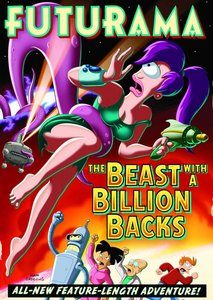
    (On DVD, December 2009) This second made-for DVD movie featuring the Futurama crew doesn’t seem quite as successful as Bender’s Big Score, but it does manage to hit a few high points along the way.  Much of the film’s most amusing sequences seem to revolve around the rivalry between scientists, which also gives a chance to the writers to include a bit of nerd humor.  Much of the problems with the film seem to revolve around a structure that doesn’t quite seem what to do with 90 minutes’ worth of running time: The story goes from one setup to another, adding rather than building.  This being said, some of the thematic material makes sense: The resonances between polyamory, robot exclusion and the all-encompassing beast at the heart of the plot work to its advantages, but the sauce is thin by the end of the story.  Still, Futurama can usually depend on laughs even when its premise falters, and this second film does deliver its share.  Fans will be happy. The DVD contains a somewhat interesting audio commentary (great for catching a few more of those obscure jokes), as well as a “lost” Futurama script made for a 3D game that’s more conceptually interesting than enjoyable to watch.

  • Up in the Air (2009)

    Up in the Air (2009)

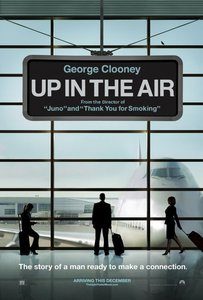
    (In theaters, December 2009) Hollywood is so often geared to kids, teens and family that film made for an adult audience are now rare enough to be remarkable.  So it is that this tale of a professional downsizer confronting professional distress and personal attachment is perhaps more enjoyable for its change of pace than for what it actually delivers.  George Clooney is splendid as a protagonist who comes to reconsider a lifetime of non-attachment, and he has the good fortune of playing against two actresses, Vera Farmiga and Anna Kendrick, who do just as well in their own roles: The best scene of the film is a simple three-way conversation in a hotel lobby.  The script itself (which bears only a passing similarity to Walter Kirn’s original novel) seems to be exactly in tune with the times, in-between massive layoffs and widespread hatred of commercial airlines.  Many of the film’s individual moments are oddly amusing, the peek at the life on an ultra-frequent-traveler is interesting and there are clear echoes of Juno in the off-kilter structure of writer/director Jason Reitman’s script.  (Not to mention much of Thank you for Smoking in its cynical premise.)  But there also seems to be an upper limit to Up in the Air’s effectiveness, and the lacklustre third act has something to do with it: After a lengthy detour in Wisconsin, the script more or less goes back to business but studiously avoids wrapping up its threads.  Writer/director Jason Reitman would rather drag things on long enough to diffuse the impact of a more definitive ending, then ends up apparently one of two scenes too early.  Sure, the point is informed character non-growth –which is gutsy enough at a time where “protagonist learns a lesson” is ingrained in Screenwriting 101.  But the ending also deflates some of the film’s prevailing charm… leaving viewers, well, up in the air.  Sometimes, even achieving one’s objective is criticism enough.

  • The Wheel of Darkness, Douglas Preston and Lincoln Child

    The Wheel of Darkness, Douglas Preston and Lincoln Child

    Vision, 2008 reprint of 2007 original, 495 pages, C$9.50 mmpb, ISBN 978-0-446-61868-7

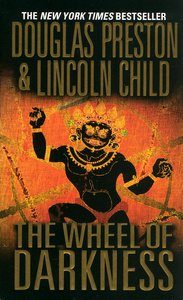
    Another day means another thrilling adventure for FBI special agent Aloysius Pendergast!  After the triple-punch of the Diogenes trilogy, both Pendergast and his protégée Constance Greene take a break of sorts in a lightweight seafaring adventure.  The result may be a minor Preston/Child novel, but it’s not without a few stronger moments, and it definitely won’t hurt the writing duo’s reputation.

    A plot summary almost reads like a parody: “After the events of the previous books, Pendergast and Constance go for a cruise.”  Of course, you then have to add that they board an ocean liner on its maiden voyage so that they can catch a murderous thief that has stolen a dangerous artifact, but where’s the fun in that?  After a hundred pages, though, the cruise beings and Pendergast’s shipboard activities grows to include things like defeating blackjack cheaters in the ship’s casinos, tracking down a serial killer, helping the crew take down an insane mutineer and losing his mind so that he can enjoy some deep-seated misanthropy.

    Wait, wait, what’s that about turning crazy?  I’m revealing one of the novel’s better moments here, but don’t worry: By this time in the Pendergast series, seeing him act out of character is a treat in itself.  Crazy Pendergast, affected by said dangerous artefact, rivals his brother for contempt of humanity, and that’s when Constance -who gets a fairly generous role throughout the novel- gets to play foil to the even-more outlandish Pendergast.  His state of mind is restored in a way that will strike some as profound and others as amusing, but definitely show how far Preston/Child are willing to go in hocus-pocus mysticism while still claiming to write realistic novels.  Still; one of the better reasons for reading The Wheel of Darkness is for the portrait of Pendergast turning insaaane.

    That’s partly because the rest of the story is mundane stuff.  Sure, Pendergast gets to play James Bond in out-cheating a band of professional blackjack card-counters (their techniques are straight out of Ben Mezrich’s Bringing Down the House).  Of course, we get a look at the way an ocean liner works when it has to cater to a few thousand passengers.  Fine, we have a crazed serial killer eviscerating victims.  But in the context of Preston/Child’s high-adrenaline series, it all becomes routine.

    By the time we’re being told that this is the best, biggest, most massive ocean liner in the history of the world, that this is its maiden voyage, that the company will tolerate no delays and that, well, there’s a tiny storm along the way, readers may start laughing to themselves in anticipation.  There are, fortunately, no icebergs.  But everyone can still guess that this is one maiden cruise that will end badly for many passengers.

    But that’s the way it goes, one supposes, for the type of formula thrillers that Preston/Child have been writing together for more than a decade.  As a conceit, the “ocean liner” one isn’t bad, and most readers are bound to like it.  It’s just that after the triple-punch of the Diogenes Trilogy, this one feels like a far more sedate novel, one that doesn’t change much in the course of the series.  Even Constance’s big final-chapter revelation just confirms the last line of the previous book (as if there was any doubt of where that was going); readers in a hurry are not going to miss much by skipping over this volume in the series.

    But not every volume can be a game-changer, and so The Wheel of Darkness (what’s with Preston/Child’s generic titles, lately?) does manage to fulfill expectations for Preston/Child readers.  The writing is limpid, the three-ring circus of events is efficiently managed, the details of shipboard operations are absorbing and the resolution does take place during a big storm.  What else could we possibly want?  Until the next novel, this one will do.

  • Bikur Ha-Tizmoret [The Band’s Visit] (2007)

    Bikur Ha-Tizmoret [The Band’s Visit] (2007)

    (On DVD, December 2009) How you react to The Band’s Visit may depend on your tolerance for unconventional scripts.  The Band’s Visit proceeds from a conventional fish-out-of-water premise (On their way to another destination, an Egyptian police band finds itself marooned overnight in a small Israeli settlement), but ends up delivering a story built on discomfort, twisted agendas and lengthy static shots.  It’s refreshingly original, heart-warmingly human and all of those coded reviewer-speak expressions for “You should feel ashamed of yourself if you don’t enjoy this” but it doesn’t make The Band’s Visit any faster-paced or accessibly rewarding.  The characters are all damaged in their own ways, and their intentions are rarely noble: One’s generous offer of shelter may mask loneliness and attempts to create jealousy, for instance.  Fortunately, the film can depend on good actors to pull it off: Acting-wise, the film belongs to the dogged weariness of Sasson Gabai and Ronit Elkabetz, both of them unconventionally compelling as the leaders of their own groups.  The single-camera scenes drag on, and much of the film occurs in silence.  Which is fairly amusing considering how naturally language is weaved into the script as the two groups of characters converse in their own language between themselves and have to resort to English in order to understand each other.  The ending offers no grand triumph, but a series of small victories that reward without being overwhelming.  Such small and overarching touches do help a lot in making this film interesting and entertaining, but they also push it further into the “foreign curio” category, with a side order of exasperation when the thin plot seems to go nowhere.  The DVD doesn’t contain much except for a thin making-of documentary that affirms that, yes, the film is meant to be slow.

  • Ice Age: The Meltdown (2006)

    Ice Age: The Meltdown (2006)

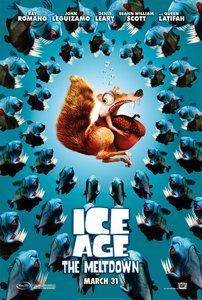
    (On DVD, December 2009) Given my indifferent reaction to the first Ice Age, it’s not surprising that it took me years, a free DVD and a lack of other distractions to get to watch the sequel.  It’s not any more surprising that I still dislike the very things that I disliked in the original: The ugly character design, the voice actors, the lowest-denominator script… all of which are back in this installment.  This time, the ice is melting away and there seems to be a lot more animals, but this kid’s film offers little to the grown-up audiences.  Much of the film’s emotional beats are obvious, and the ending drags on far too long.  At least the animation seems fair, and Scrat’s nut-gathering antics are entertaining in-between the rest of the film.  It’s not enough to make Ice Age 2: The Meltdown any better, but it’s a bit better than nothing, I suppose.  The DVD contains a number of features aimed straight at younger audiences, although the pretty good bonus short film, “No Times for Nuts” has at least two unsettling Twilight-Zoneish elements that will resonate with older audiences.

  • Doomsday (2008)

    Doomsday (2008)

    (On DVD, December 2009) I suppose we shouldn’t begrudge the boys a bit of fun when then set out to make a Scottish post-apocalyptic horror/action film featuring a gun-toting babe.  Still, Doomsday most often feels like a tedious rehash of about half a dozen far better films, made with mechanical skills and little inspiration.  The plot points are so painfully contrived that they create resentment and very little viewer buy-in.  (A plague contained by locking off Scotland?  Uh-huh.)  By the time we reach the cannibalistic barbarians inspired by Prodigy videos and then a pseudo-medieval tyrant, it’s obvious that if Doomsday has anything left to show us, it will be in bits and pieces of direction, not in the overall script or end result.  Director Neil Marshall (Dog Soldiers, The Descent) is lost in the woods during most of the film, but from time to time there’s a striking shot or action set-piece that reminds us of his past successes and makes us wish this was a far better film.  Rhona Mitra (presumably standing-in for Kate Beckinsale) is the only one besides Bob Hoskins who emerges from this film with even a smidgen of respect left.  The action tends to be on the splattery side, something that the “unrated” DVD version tends to maximize to very little improvement over the theatrical version.  After a ludicrous car chase that is still better than most of the film, the ending fizzles off –much like the rest of Doomsday.  It is what it is, one supposes –but there’s a reason why it disappeared from North American theatres in mere days. The DVD extra features make it clearer that the picture was aiming for a deliberate hommage to SF exploitation pictures and is reasonably entertaining in describing how to do wide-scale action on a budget… but don’t redeem the end result.

  • Invictus (2009)

    Invictus (2009)

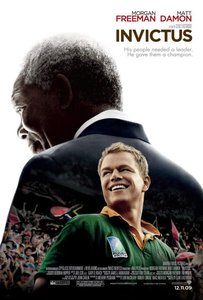
    (In theaters, December 2009) Perhaps the boldest chance taken with this film is the concept of slowly transforming a political thriller into a sports film.  Picking up moments after Nelson Mandela’s 1994 election as the first post-Apartheid South African president, Invictus goes from nation-building drama to underdog sport film in steady increments, placing more and more weight on sports until political issues becomes subordinate to the results of a rugby tournament.  Fortunately, the film is made by skilled technicians: security issues are used as a way to peek into racial reunification, the legend of Nelson Mandela gets a polish, and we’re shown a nation uniting behind a national sports team.  It’s all curiously enjoyable: The South-African setting and accents are different enough to keep us interested (although I couldn’t help wishing for a big spaceship to appear over Johannesburg), there are plenty of misleading thriller cues (one of them leading up to a thrilling CGI flyby), Morgan Freeman is mesmerizing as Mandela (think “role of a career”), Matt Damon is unexpectedly convincing as a rugby player and Clint Eastwood’s direction is as coolly efficient as always.  Even the clichés (such as more and more slow-motion segments as the game gets closer to completion) and the unequal pacing don’t look as bad when dealt by such experienced hands.  For all of its calculated humanity, Invictus does get viewers to feel better about sports, films and mankind in general, which has its own attraction especially in the usual field of Oscar-baiting films.

  • The Audacity of Hope, Barack Obama

    The Audacity of Hope, Barack Obama

    Three Rivers Press, 2006, 375 pages, C$19.95 tp, ISBN 978-0-307-23770-5

    Well before he was nationally known as a rising star in US national politics, Barack Obama impressed a number of readers with Dreams From My Father (1994), a memoir dealing with race, a complex multi-cultural upbringing and a son’s quest to learn more an absent father.  Well-written and having little to do with politics, Obama’s first book was rediscovered a decade later as Obama became an increasingly familiar face on the evening news.  It was followed in 2006 by The Audacity of Hope, a frankly more political book written in-between Obama’s accession to the US Senate and his successful presidential campaign.

    While Dreams From my Father was generally apolitical (although not entirely so, given how Obama was already eyeing a career in politics in 1994), The Audacity of Hope is a different beast.  It’s more easily classified as “pre-electoral”, those books by politicians that pop up whenever they’re thinking about running for high office.  Those books are usually a mixture of political autobiography and vague political program, carefully designed to be read by a literate electorate hungry to learn more about their chosen one.  You can run down the list of nearly every presidential candidate in recent memory to find one of those, usually with subtitles such as “A plan for a new America”.

    This doesn’t necessarily make The Audacity of Hope a bad or calculating piece of work.  It does however place it under very different standards than his first book.  It makes it easier to read as a clue to understand what’s going on in the head of now-president Obama.  It also makes chunks of his books practically irrelevant to non-US audiences.

    Let’s tackle the dullest part of the book first: the vague political program.  In pre-electoral books, those are the parts where the candidate demonstrates his keen understanding of America’s problems and then proposes a number of solutions, designed for wide popular appeal, in order to resolve said problems.  Expect paragraphs of statistics mixed with campaign trail anecdotes illustrating key concepts.  Expect a lot of expensive platitudes such as “more/better defence”, “more/better education” and “lower/better taxes”.  Expect an appeal to new ways of doing politics, away from the current partisan divide.  The Audacity of Hope certainly meets those expectations, as we get a glimpse of Obama’s early platform, untainted by brutal contact with political and fiscal realities.  For non-US audiences, those aren’t the most gripping segments of the book: issues such as racism, for instance, as so specific to the US that strategies to deal with them are alien even in countries as close to the US as Canada.

    Fortunately, there’s more than simply a policy program in The Audacity of Hope.  The most compelling sections of the book are those in which Obama-the-man reflects on his life, his political experience and his early days in federal politics.  Those are the sections in which we learn about his life, his family, what he has learned as a politician so far and what he fears as he sees the rest of his political career in front of him.  Here is where we get to read about his fears about becoming less of a member of the population he’s meant to serve, and more of a professional politician embedded in the traditions of his office.  In-between a too-short account of his romance with Michelle and the affection he has for his daughters, Obama projects the image of a very intelligent man who understands the trade-offs that will be required of him as a politician.

    It also confirms what many people have been suspecting about him despite the “Change” rhetoric: Obama may run on the image of a populist, but he’s a far more intelligent, nuanced and careful politician.  Everything we’ve seen in the 11 months since his inauguration fits his book more than his campaign promises: Obama has an uncanny ability to acknowledge problematic issues in ways to make fans claim “Wow, he gets it”, but his willingness to take action will be calculated to the most minute political consequence.  It actually makes him a far better politician than the alternative (despite partisan cries, politics is really a game of incremental inches: Obama will accomplish a lot more as a careful tactician than a firebrand populist) and reading the book’s passages on the tradeoffs required of professional politicians is a reminder that it’s a deliberate choice.

    So, no, The Audacity of Hope isn’t quite the soaring, lyrical work that Dreams From my Father was.  Nor is it entirely interesting and compelling.  But once you dispose of the pre-electoral fluff and focus on the rest, it’s actually a pretty handy book to understand Obama-the-President.  Which isn’t too bad, as pre-electoral books go.

  • Quarantine (2008)

    Quarantine (2008)

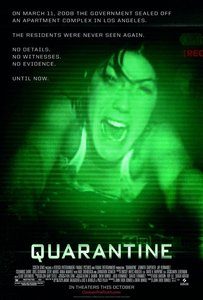
    (On DVD, December 2009) Taken on its own terms, Quarantine is a pretty good horror film: Original, tense and effective enough to distinguish itself from so many forgettable bloody movies.  If you’re lucky enough to come across the film completely cold, without any prior knowledge whatsoever, go and have a good time.  Unfortunately, two things killed much of Quarantine for me: the knowledge that it was a remake of a Spanish horror film called Rec and the film’s entire promotional strategy.  If you’ve seen the trailer’s final moments, its poster or even the cover of the DVD, then you have already seen the very last shot of the film –and you will be waiting for it!  Having deliberately seen Rec moments before watching Quarantine, I spent most of my time during the second film trying to spot and analyse the differences between the two –a task simplified by Quarantine’s perfectly justified decision to ape almost every single shot in the original and add to it.  To spoil my conclusions, they boil down to “overproduction”:  The sparse and clean elegance of Rec has been overlaid with a far busier lighting scheme and constant sound effects.  Helicopters shine spotlights and roar outside the building, adding to the creaking pipes that create much of the film’s soundscape.  Elsewhere, Quarantine’s bigger budget has both good, neutral and bad impacts:  Extra scenes have been added to flesh out existing and new characters, which doesn’t add or remove anything, except when Rec’s meticulously calculated rising tension is suddenly disrupted by two sudden deaths (the elevator attack and the death-by-camera) that feel too gruesome for where the plot is at that moment.  More happily, Quarantine gets to include two shots that should have been in the original film: A fleeting look at the situation outside, as well as a staircase fall that seems perfectly well-integrated in the action.  It all amounts to a fair remake, both taking and adding to the original without necessarily “betraying” anything: I may have been disappointed by some additions, but it’s very recognizably the same film with the same strengths, up to a point where Quarantine has few surprises for fans of the original.  The DVD contains an entertaining director/producer’s commentary and instructive making-of features that detail the film’s intense production scheme, it also wilfully avoids even mentioning Rec anywhere –an omission that becomes particularly maddening when it comes the time to discuss the story’s origin and the tweaks made for the American version.  Booo!

  • [Rec] (2007)

    [Rec] (2007)

    (On DVD, December 2009) Now that Rec has been remade for American audience as Quarantine, you may think that there’s little reason to seek out a small-budget foreign horror film.  But there’s a reason why Rec was chosen for remaking, and the original film remains a strikingly effective piece of horror cinema.  Another first-person camera chiller, Rec proceeds from the elegant premise of a TV camera crew following firemen for a slice-in-the-life fluff program and then getting trapped in a building as increasingly disturbing events occur.  As this meticulously-paced film advances, we come to realize that the situation has escalated all the way up to a claustrophobic zombie thriller… and it just keeps getting worse.  Manuela Velasco is magnificent as a ditzy reporter stuck in an impossible situation, but it’s really co-directors/writers Jaume Balagueró and Paco Plaza who deserve the credit for a slick horror film that knows exactly what it’s doing: the bright clean cinematography is gradually stripped away, and the conceit of the filming camera is handled with a great deal of cleverness.  There are shocks, there is a growing sense of dread and the terrific final images are strong enough that they were co-opted for the entire American remake’s marketing strategy.  It’s nothing short of a perfect treat for the horror fan, even those tired of the current zombie craze.  If you can manage it, try to see Rec just before Quarantine for an instructive comparative lesson in how a lot more money thrown at a premise doesn’t necessarily result in a markedly better product.  The Canadian DVD contains the film in Spanish, French and English, but few other extras.

  • Hey Rube, Hunter S. Thompson

    Hey Rube, Hunter S. Thompson

    Simon & Schuster, 2005 reprint of 2004 original, 246 pages, C$17.95 tp, ISBN 978-0-684-87320-6

    So this is it.  Hey Rube marks the end of my 2009 Hunter S. Thompson Reading Project: All of Thompson’s work read in a year, marking twenty books, thousands of pages and fifty years of American history along the way.

    A collection of sports columns written for ESPN’s web site between 2000 and 2004, Hey Rube marks a trip back to Thompson’s first job as a journalist, covering sports for a military newspaper.  It’s also a wrap-up of sorts, as it brings together many of the elements that defined his career: Digressing often in politics, his life in Woody Creek, excesses and celebrity friendship, the columns take on a more vital quality in the wake of 9/11, as Thompson was one of the first to see clearly beyond the fear and loathing that took over his country at the time.  When the going gets weird, the weird turns pro, and so in times of apocalypse, you could depend on Thompson to be the most reliable commentator.

    For Thompson readers, this collection is 246 pages of indulgence.  Thompson’s writing tics have never been so obvious, what with the Capitalized Words, recurring exclamations (“Selah!”) & ampersands.  Only someone with his reputation and few editing restraints could get away with such quirks. As for themes, his columns often (and by often, I mean “nearly always”) turn to gambling, fictionalized stories of his life on the mountain, vicious rants against the Bush administration and a satisfied tone of “this world is going to hell, and I’ve told you so.”  Some of the material endures, although the sports references are instantly dated and the political references will soon follow as we shake memories of that bad decade.  It’s a book for Thompson fans, and it’s short enough to be considered a nice concluding volume.

    Not that it’s likely to be the final word from Thompson: a third volume of his letters have been announced (and delayed many times, from a 2008 release to February 2011 as of this writing), while reading between the lines of his biographers it’s obvious that there’s enough material left in the Thompson archives to fill at least another collection of material.  Rumours abound about finished but unpublished manuscripts, from The Gun Lobby to The Night Manager to Polo is my Life to early novel Prince Jellyfish… and others.  Whether those are publishable is an entirely different matter, but like many cult writers, Thompson seems poised to be a more reliable author in death than in life.

    Still, “Hunter S. Thompson’s last book” offers an opportunity to summarize what I’ve learned from my reading project.

    The first is a cautious agreement with fans and biographers who say that Thompson’s golden age was a brief period between 1970 and 1974, sometimes between “The Kentucky Derby Is Decadent and Depraved” and “The Great Shark Hunt”.  Sure, you would have to add Hell’s Angels (1966) and quite a few short pieces between 1975-2005, but much of the essential Thompson fits between four covers: Fear and Loathing in Las Vegas, The Great Shark Hunt, Hell’s Angels, and Fear and Loathing: On the Campaing Trail ’72.  After 1975, he became stuck in his own celebrity, content to turn the same tricks –or not write at all.  Drugs gave a lot to Thompson… but they may have taken much as well.

    My second conclusion is that while Hunter S. Thompson is one of the great personalities of twentieth-century America, it’s clear that I really couldn’t have tolerated him in real life.  His profiles all describe someone unable to function in society, an aggressor who didn’t really care about other people.  How much of this was a legend designed to get other people to leave him alone was debatable.  Still, if you’re not convinced, you have your pick of essays.  Wenner and Seymour’s oral biography Gonzo is crammed with fantastic stories about him, while William McKeen’s Outlaw Journalist offers the best and more nuanced biography of him and Simon Cowan’s Hunter S. Thompson is a revealing look as seen by a close friend.  Read those and you too will be able to say whether you would have liked to meet the man.

    My third Grand Statement about my year spent in Gonzoland is that through Thompson, I got to learn a lot more about America from the sixties to 9/11: Between 1965 and 1975, Thompson found himself at the epicentre of radical social changes and, though his coverage, was able to write down what it felt to be there at the time.  Fear and Loathing in Las Vegas endures even today as a great book because of this sense, and the portrait we get of America from Thompson’s fanciful gonzo journalism is perhaps more truthful than most objective accounts of the time.  If you start tracing connections from Thompson to other works and writers, you can get an unconventional crash-course in modern history.

    There will never be another Hunter S. Thompson.  That, as much, is obvious.