Ken Russell

  • Lisztomania (1975)

    (On Cable TV, February 2022) Circumstances dictated that I ended up watching writer-director Ken Russell’s Lisztomania in two halves, interrupted in the middle of the film’s best-known scene featuring more phallic imagery than any thousand randomly selected films. If Russell had rolled to credits right after that, I would have given Lisztomania a far more positive review than this one. Alas, the film keeps going, and going, and going… and it’s clear that, for all of the dizzyingly comic razzle-dazzle of the film’s first third, there’s not much of a focus to it all: this wildly dramatized biography of 19th century musician Franz Liszt may have a lot of energy, but it’s not sustained nor tied together. Some things work really well, though: the idea of treating Liszt like a rockstar may not be as fresh today, but it’s given a maximalist treatment that bounces from erotic excess to absurdist humour. There’s clearly a 1970s rock aesthetic to the entire thing, what with rock star Roger Daltrey (of The Who) as Liszt, and Ringo Starr popping up late in the film as none other than The Pope. It gets wild. As Wikipedia says, and I can’t encapsulate it better than this quote: “Liszt and the women decide to fly to Earth in a spaceship to destroy Wagner-Hitler, who has now ravaged Berlin in a fiery machine-gun frenzy.” And yet, at the same time, it doesn’t: at 103 minutes, the film outstays its welcome and can’t quite cash the checks it wrote during its first half. The delirious scene-to-scene invention can’t be sustained or linked together, and that eventually starts to grate. The film’s production history partially accounts for this disconnection: Russell, never a particularly disciplined director, went through the film without a finished script, regularly ran out of money, and grossly ran out of time in a difficult situation with investors. There’s clearly a lack of control here that often spins the surrealist outrageousness into a dull bore. Despite some real admiration for Lisztomania and a feeling that it hasn’t aged as badly as some other mid-1970s productions, it’s clear that the film could have been much, much better if Russell had managed to control his worst impulses.
  • Trapped Ashes (2006)

    (In French, On Cable TV, January 2022) Perhaps the most difficult trick in writing horror movies is making you believe in the impossible—the necessary suspension of disbelief in order to accept that there’s a supernatural entity hunting our characters, or that occult forces are influencing the plot. Much of this willingness to play along is helped by what viewers want to see: if we’re paying to see the monster, the monster can’t make it on-screen fast enough. But horror can take this suspension of disbelief for granted, and any film that doesn’t put in the necessary work to make us believe places itself in trouble. The problem with horror anthology Trapped Ashes isn’t necessarily the over-the-top nature of its segments, its copious nudity or inconsistent tone—it starts in the framing device, as a bunch of strangers visiting a movie studio are lazily brought to a locked room and asked to spill their secrets. Nothing about the framing device makes sense, especially the passing tourists’ eagerness to go when they should not and unanimously get trapped on a set. Henry Gibson may be a lot of fun as a tour guide, but he’s also stuck in a script that doesn’t even put in the minimal effort to make us believe. Things don’t get better once the segment starts: in the opening one, an ambitious starlet doesn’t even blink when told that her breast implants are made out of human tissues. When, later on, her breasts start exsanguinating her intimate partners (don’t think too much about the mechanics of that), we viewers shrug, having done the whole, “Are you kidding? What did you expect?” thing a few minutes earlier. Horror fans will note that a number of cult-favourite genre directors are involved in the anthology: Joe Dante does the framing segments, Ken Russell does the bloodthirsty breasts one (which may explain a lot), Sean S. Cunningham goes to Japan for ghostly hijinks, and SFX supervisor John Gaeta turns in a tale that draws parallels between pregnancy and tapeworms. The one promising segment that should have worked well, about a filmmaker and his undead lover, falls flat on screen. Not that it’s a lone misfire: The Gaeta segment never takes off despite a squirm-inducing premise and the Japan-set segment doesn’t go anywhere either. The Russell one may be weird and poorly justified, but at least it does have an odd sense of humour. As for Dante’s contribution, it has good bits and pieces even if it doesn’t manage to put them together effectively. In that, the framing device does feel representative of a film that could have been much better but appears satisfied to coast on audiences doing most of the work for them. Trapped Ashes is not a film that works on anyone with slightly higher expectations than basic horror tropes.

  • The Lair of the White Worm (1988)

    The Lair of the White Worm (1988)

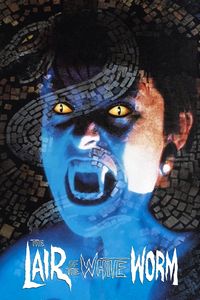
    (In French, On Cable TV, April 2021) I clearly wasn’t prepared for the sheer wondrous weirdness of The Lair of the White Worm and seeing Hugh Grant’s in the credits actually misled me further. This is not your Hugh Grant movie of later years: in the hands of legendary director Ken Russell, this is a crazy horror/comedy that goes all-out on grossness, gore, fetichism, and folk horror. Peter Capaldi (!) joins Grant in adding further casting interest to the result, which is really not the film you’d expect. While not a marquee name these days, Amanda Donohoe is probably the film’s highlight as the sultry evil Lady Sylvia. This is the kind of off-kilter work where a dream sequence featuring the film’s two female leads fighting aboard an airplane is the kind of thing that you take in stride. (Plus vampire teeth that look as if they’d lacerate anyone’s mouth in moments.)  It features quite a bit more kink, phallic symbols and nudity than you’d expect from a film of its time and place. The visuals are more daring as well, and the result has this crazy mixture of horror and comedy that works surprisingly well (because it usually doesn’t). You can see why The Lair of the White Worm has earned a bit of a cult following over the decades — I’m probably going to want to watch it again in a year or two just to make sure that what I remember from the film is indeed what happened.

  • Altered States (1980)

    Altered States (1980)

    (Google Play Streaming, December 2019) As someone who watches way too many movies, one of the best things I can say after seeing one is “Wow, that was weird.”  It doesn’t always link with quality, but it does correlate with memorability. Altered States is one weird movie, especially seen outside its 1980s sociocultural context. Circa-2020 society has plenty of issues, but it does feel as if we’re less likely to believe woo-woo parasciences than in 1980, and Altered States depends on taking these things seriously in order to work. There’s plenty of psychobabble as the film sets up a premise in which American academic parapsychologists start messing with isolation tanks and take heroic quantities of drugs in order to unlock other states of consciousness. This being a thriller, it goes without saying that the efforts are successful and homicidal as one of the characters physically regresses to an earlier species and naturally starts murdering people. The final act is a trip put on film as hallucinogenic visions (as executed by dated special effects shots) represent how the protagonist is slipping in and out of reality, endangering his family along the way. It’s bonkers, and it’s that crazy quality that makes the film compelling even as not a single word of it is credible. According to legend, director Ken Russell and screenwriter Paddy Chayefsky clashed during the film’s production (to the point of Chayefsky being credited under a pseudonym), and this tension can be seen in the contrast between the script’s earnestness and the wild colourful direction. If wild movies aren’t your thing, consider that the film has early roles for William Hurt and Drew Barrymore, as well as a turn for Bob Balaban. Altered States is not good Science Fiction: In the biz, we’d call it “not even wrong” for its delirious depiction of science and scientists at work. But it’s an over-the-top hallucination and as such is likely to stick in mind far longer than more sedate works of the period.