Loretta Devine

  • Madea’s Big Happy Family (2011)

    (On Cable TV, February 2022) You can feel the irony of Madea’s Big Happy Family titling very early on. Not just because happy families don’t make for good movies, but because writer-director-producer-star Tyler Perry is once again being as unsubtle about it as anyone can humanly be. As a mother receives a terminal cancer diagnosis, her attempts to tell her family about her condition are all sabotaged by unruly characters, simmering resentment, long-held secrets and cheap screenwriting tricks. Madea comes in to save the day with some tough love, but she doesn’t quite get it all right, and as the film goes through Perry’s atonal storytelling, there’s a big tragic moment to make the film come into focus. How you feel about the result will depend on your familiarity with what Perry is doing and your ability to like it even in small bits and pieces. He has his moments as a writer-director—the “Byroooooon” thing is as crude a comic device as possible, but it gets a laugh nearly every time. (Props to Lauren London for committing to such a character.) Madea’s overreach this time gets her to drive through a restaurant window, which also gets a laugh even if it’s an expected one. Perry’s theatrical background serves him well in structuring the narrative, in which tension points are gradually exposed and pressured. He also gets the atmosphere of a fractious Atlanta-area family and some decent character work from a variety of actors—including Loretta Devine as the ill-fated mother. As far as Perry movies go, Madea’s Big Happy Family is somewhere in the middle of a fairly narrow band—good if you like his material despite its flaws, but not something different enough to make converts.

  • This Christmas (2007)

    (On TV, February 2022) Considering the all-Christmas-movies-all-month-long nature of the BET channel in December, it’s worth asking why this Christmas would find a spot on its January schedule. Aren’t we satiated until at least mid-November after such an overdose of Christmas cheer? The BET channel, after all, believes in quantity more than distinction in scheduling its holiday films: anything goes as long as Christmas is somewhere in there. Part of the suitability of this later scheduling can be found in This Christmas’ pedigree: Compared to the usual “BET original” Christmas movies, This Christmas has a budget at least a magnitude larger, with competent cinematography, decent technical credentials, a successful theatrical release and a roster of well-known actors. No, Loretta Devine doesn’t count—she’s practically a BET original mascot at this point. But Delroy Lindo, Idris Elba and Regina King are something else, and so this Christmas aims to be a well-crafted Christmas film with theatrical aspirations, at least one or two levels of quality higher than the channel’s original films. The difference is mostly in execution: the cinematography is fine, the actors are good and the film feels lived-in. The plot, unsurprisingly, isn’t that much better: yet another story of a fractious family finding peace at Christmas. Not that it matters all that much: Christmas movies, more than perhaps any other subgenre, rely heavily on comfort and reassurance that everything is going to be all right in time for the end of the big holiday get-together. Familiarity and predictability are key. No matter the budget or the pedigree.

  • Christmas Déjà Vu (2021)

    Christmas Déjà Vu (2021)

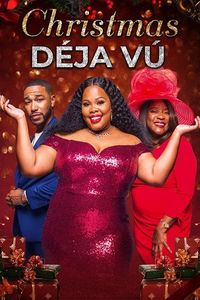
    (On TV, December 2021) Yes, there is indeed something very familiar about Christmas Déjà Vu, as it focuses on a young woman’s dreams of fame and fortune as a signer, and enables the what-if through the intervention of an angel. Waking up a celebrity, our protagonist realizes (as these things usually go) that there’s some upside to a modest life and working hard to reach your goals. As Christmas movies go, Christmas Déjà Vu goes for sentimental epiphany rather than laughs or romance. Anchored by a remarkably polyvalent performance from Amber Riley (utterly de-glammed in the film’s opening moment, but able to step into the glitzy life of a celebrity later on), the film doesn’t go for any new narrative ground but does well with the limited means it’s working with. The subplots are familiar (of course her new husband is unfaithful) and so are the big realizations of the climax, but writer-director Christel Gibson knows what she’s going for, can benefit from good actors (including Loretta Devine as the protagonist’s mother) and makes the most of a low budget. It’s certainly not It’s a Wonderful Life, but Christmas Déjà Vu is an acceptable background feature as you decorate the house for the holidays.

  • Spell (2020)

    Spell (2020)

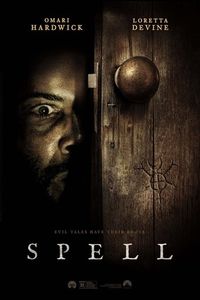
    (On Cable TV, November 2021) There’s something almost interesting in Spell’s blend of folk horror, evil hoodoo and deep-Appalachian setting. After some rather meaningless throat-clearing, the film starts in earnest after a small plane crash brings a middle-aged black family man (Omari Hardwick, nod bad) into the care of a backwoods witch doctor (Loretta Devine, surprisingly good) who places a lot more emphasis on being a witch than a doctor. This is all very spooky, of course, especially considering that the man’s family (which was also in the plane) is nowhere to be found, that he’s got a debilitating foot injury and that our witch doctor seems to have perfected the art of dark magic. The result does have its moments (including two gruesome scenes of body horror —ugh, that nail—that harken back to the obvious Misery comparisons) but they remain moments — there’s some horror, some dark humour, some suspense, and some drama, but they feel like bits and pieces of a first draft before the work begins to make the entire thing cohesive and tonally consistent. While it’s almost a relief to see the all-black cast evacuating the racial question, the result is so limp that you have to wonder if Spell would have benefited from some obviousness, or being more daring in tackling social issues. There’s this impression that director Mark Tonderai is barely holding all of this together, so scattered does he seem to be going from one element to another without a focal point. The repetitiousness of the middle act doesn’t help and the ending seems curiously familiar, not really bringing any of the plot threads to a satisfying conclusion. (Bizarrely, the script is from Kurt Wimmer—who’s usually a far more energetic writer.) In other words, the promising elements of Spell never comes into focus, and the result is disappointing no matter which angle you prefer. There’s a much better film to be made out of this, but this isn’t it.

  • For Colored Girls (2010)

    For Colored Girls (2010)

    (On Cable TV, September 2021) Adapting a theatrical play that relies on the strengths of that medium to the big screen in a risky exercise, and writer-director Tyler Perry doesn’t make things easy for himself in choosing to impose his vision on a fiercely feminist work. You can certainly feel the clunkiness at play when the film shifts gears from a rather straightforward (if harsh) melodrama to flights of eloquent soliloquies as the characters give voice to their innermost thoughts. As an ensemble movie with many ongoing subplots, For Colored Girls gets both the benefits of the form and its drawbacks — it can boast of a stellar cast in Janet Jackson, Loretta Devine, Thandie Newton, Kerry Washington and Whoopi Goldberg, plus a pre-stardom Tessa Thompson… I mean, wow. On the other hand, with no less than ten lead characters, the development of the subplots can be abrupt and sketchy. Coupled with Perry’s intentional lack of directorial flair and sometimes on-the-nose writing, it does make the film creak in places, and the accumulated melodrama (which gets absurdly dark in places) flirts dangerously with unintentional amusement. The biggest irony is that the film truly becomes magical in its most theatrical moments, as the women give voice to the stage soliloquies and unload the meaning of the stage play’s original title for colored girls who have considered suicide / when the rainbow is enuf. (You can read some of the soliloquies, but they’re far from being as effective as when heard from actresses who get the cadence of the words.)  If nothing else, the film will make you wonder if you can find and listen to the original. It would be easy to focus on the film’s structural and directorial shortcomings — there’s something in Perry’s traditionalism that feels out of place (it’s hard not to notice that the film’s sole gay character is a self-loathing liar who gives AIDS to his wife — yikes) even as the film is a powerful progressive work by itself. Some of the weirdness even comes from the original play — it makes sense for all of the male characters (at one minor exception with little screen time) to be evil and destructive, considering the intent of the work to focus on women’s lives at their lowest point. Still, I rather like the result: It’s a wonderful showcase for the actresses involved, and when the film takes flight, it does carry the power of the original work. Even a decade and many more black-women-focused films later in a far more diverse cinematic landscape, For Colored Girls still packs some punch.

  • Waiting to Exhale (1995)

    Waiting to Exhale (1995)

    (On Cable TV, January 2019) While Waiting to Exhale isn’t that significant a movie in film history, it still plays so often on cable that it wore me down. I gave up and finally recorded it, although not out of exasperation. My intentions in watching it were not noble at all: Whitney Houston, Lela Rochon, Loretta Devine and Angela Basset headlining the film? I’ll watch that. An episodic story focusing on four women’s attempt to find love in spite of bad partners, Waiting to Exhale also features the directorial debut of Forest Whitaker, who imbues the film with odd stylistic choices that, perhaps unfortunately, precisely date the movie to the mid-1990s. Still, the movie itself is quite a bit of fun to watch. Our heroines don’t take cheating and romantic disappointment very well: in the film’s most memorable sequence, one sets fire to her cheating husband’s car, his clothes inside. While the episodic nature of Waiting to Exhale means that it has high and low points, the acting talent brought together here remains notable. Angela Basset, in particular, is at her best here with a powerhouse performance. The all-black casting is so successful in that by the time a white woman shows up (as a romantic rival, no less) late in the movie, the effect is definitely jarring. Among the male cast, Dennis Haysbert and Wesley Snipes have good roles, but viewers should be forewarned that this is not a movie in which men get the most admirable characters—this is female empowerment, and much of Waiting to Exhale’s success can be found in how completely and solidly it makes viewers (even white men such as myself) identify with the four black women protagonists.