Marilyn Monroe

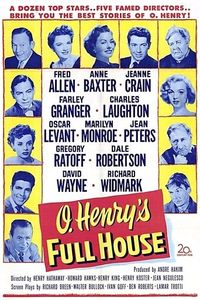
  • O. Henry’s Full House (1952)

    O. Henry’s Full House (1952)

    (On Cable TV, December 2021) Although far less famous now, O. Henry (a pseudonym of William Sydney Porte) was a steady fixture of English textbooks throughout the twentieth century, his deeply ironic short stories being the kinds of things teachers could use as examples of literary devices that students would enjoy reading. (“The Gift of the Magi,” in particular, still has some power.) The flip-side of that popularity is that some of his stories have now fallen into easy cliché, so a film adaptation of five of his best-known tales does often seem far more conventional than intended. O. Henry’s Full House does have a few other things running for it, though: It features none other than John Steinbeck as host, telling us about Henry and introducing each of the five segments. There’s also the matter of casting, with such notables as Marilyn Monroe, Charles Laughton, Oscar Levant… and Richard Widmark reprising his character from Kiss of Death. There are also some surprisingly good credentials behind the camera as well, with Howard Hugues directing one segment co-written by Ben Hecht. Still, the overall impact of the stories is good without being great: Since Henry’s narratives are often built around an ironic surprise ending, it doesn’t take long to learn to accurately guess where the segments are going. (And that’s not counting the cases where we already know how the stories will end.)  Still, the execution is not bad, and everything can be watched rather easily. For English literature fans, O. Henry’s Full House is an intriguing film not just for the Henry adaptations, but also for Steinbeck’s only movie appearance.
  • Ladies of the Chorus (1948)

    (On Cable TV, November 2021) If you ever wonder what happens to a film when one of its secondary actors strikes it big, then Ladies of the Chorus is one of the exhibits for your edification. A rather ordinary showbiz romantic comedy musical, it just so happened to feature Marilyn Monroe in a supporting role as a burlesque dancer. The original top billing went to Adele Jergens (now a Classic Hollywood footnote at best), but when Monroe struck it big, the film was re-issued with revised opening credits, putting Monroe above the title, which remains the definitive edition of the film. (Just so we’re clear: Monroe’s role is significant here — it’s not a case of trying to hype a two-scene supporting appearance.) This kind of thing is not uncommon (especially in the direct-to-video, now streaming world where metadata reigns supreme) but it’s still an amusing anecdote about a film that, frankly, wouldn’t otherwise warrant much discussion. Ladies of the Chorus is, Monroe aside, a pleasant and familiar film of its genre: it’s got a few musical numbers, a few romances, a look at the thrills (and the backstage) of live performance, and goes about delivering a happy conclusion for everyone. There are at least a dozen very similar films… but only one of them features Monroe in her singing-and-dancing debut.

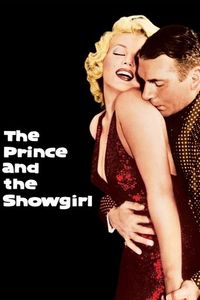
  • The Prince and the Showgirl (1957)

    The Prince and the Showgirl (1957)

    (On Cable TV, July 2021) In many ways, the trivia about The Prince and the Showgirl (Marilyn Monroe meets Laurence Olivier!) is more captivating than the film itself. There’s even a movie, My Week with Marilyn, that revolves around its production. But The Prince and the Showgirl itself is surprisingly dull, especially if you’re familiar with movies in which commoners hobnob with aristocracy. It doesn’t help that the film has a strong nostalgic attachment to the trappings of classic European aristocracy (the story takes place in 1911), which can be of very limited interest to twenty-first century audiences. In all fairness, the film does hold back on the clichés, especially toward the end, which is more along the lines of “things are looking up” rather than “…and they lived happily ever after.”  Lavishly produced in colour to take advantage of the sets and costumes, it does carry the weight of that overwrought production: the directing can be stultifying at times, moving glacially through moments that should have the fast pacing of a light comedy. Monroe herself is not particularly interesting here — the heaviness of the production holding back her natural comedic skills — while Olivier (who stars and directs) seems most to blame for the ponderousness of the result. Surprisingly underwhelming, The Prince and the Showgirl ends up being more interesting to the meta-narrative of Monroe’s career. Even though she produced it, there’s a sense that she would have been happier without it.

  • The Misfits (1961)

    The Misfits (1961)

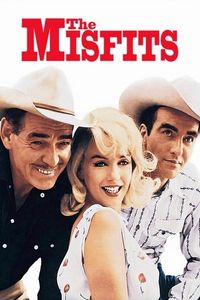
    (On Cable TV, July 2021) To twenty-first century audiences, The Misfits does come with an outsized baggage of expectations: It’s the final film of both Clark Gable (who suffered a heart attack two days after wrapping up shooting, and died shortly thereafter) and Marilyn Monroe (whose next two years would be troubled, all the way to her death from barbiturate overdose), and the film does pair them up, presenting a transgenerational star attraction. The film’s production does make for fascinating reading, what with the script being intended as a gift from playwright/screenwriter Arthur Miller to Monroe in order to showcase her dramatic talents, but then clouded by their dissolving marriage throughout the production. While twenty-first century reviews have been positive, The Misfits’ initial reception, both commercial and critical, was underwhelming — a noted box-office bomb, it also got tepid reviews. Unusually enough, I find myself on the side of the 1961 reviewers — while there’s some meta-dramatic heft in seeing Monroe and Gable sharing screen time for the last time (even despite the significant age difference), the film is a slog to get through. Dramatic but overdone, small-scale and often desolate in its black-and-white cinematography, it’s trivial to the point of meaninglessness. Monroe is serviceable in her dramatic role, which is both not bad and not enough. You can certainly see some end-of-an-era echoes in the films’ themes, what with a cowboy in 1960 America capturing wild horses so that they can be turned to food. Still, The Misfits feels glum and overlong, not quite worthy of the spotlight placed on it by dint of being two icons’ final movie.

  • How to Marry a Millionaire (1953)

    How to Marry a Millionaire (1953)

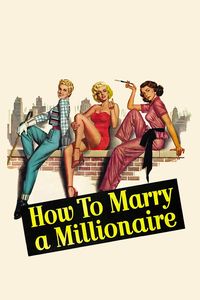
    (On DVD, March 2021) There are many, many reasons why How to Marry a Millionaire is a reprehensible film by today’s sensibilities (and perhaps even to the sensibilities of its time), but just as many reasons as to why it doesn’t really matter. The powerhouse cast is a good chunk of it: with Lauren Bacall, Marilyn Monroe and Betty Grable playing three women with devious schemes to snag themselves a rich husband (at a time when millionaire meant real money — roughly 10 times as much), the film is a snapshot of early-1950s sex symbols. Bacall is magnificent as the brainiest of the bunch, renting an apartment from a tax-evading millionaire and selling off the furnishings to meet her operational costs. Betty Grable may no longer have the cachet that she did at the time, but she’s also a lot of fun as the energetic Loco. Meanwhile, well — I’ve never been that big of a Monroe fan, but she’s in her best element here in a comedic role, and seeing her spend much of the film wearing cat eye glasses (leading to a very funny scene of mutual myopic flirting) is enough to make me marginally more interested. The other actor worth noting is William Powell, turning in one of his last suave performances as (what else?) a debonair multimillionaire targeted by one of the women. The gold-digging aspect would be far less amusing had it featured in a worse film. Here, however, the script is good enough and the characters are likable enough to overcome any ethical concerns we may have. Romance, in the end, triumphs —and Powell plays the character with enough disposable income to make all inconveniences go away as an amusing trifle. Shot in what would become the classic 1950s widescreen Technicolor sheen, How to Marry a Millionaire is bolstered by great vignettes of New York City, excellent individual scenes, winning performances, and a lighthearted tone that still works very well today. It remains a delight.

  • Clash by Night (1952)

    Clash by Night (1952)

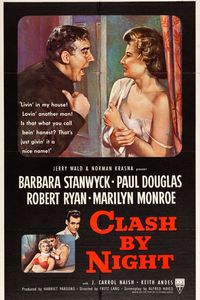
    (On Cable TV, February 2021) On paper, Clash by Night feels like a must-see film: An intense small-town drama directed by Fritz Lang, featuring a late-career performance from Barbara Stanwyck and one of the first featured turns from Marilyn Monroe? Who can resist that? Alas, the film itself is not quite as gripping. While the drama’s bubbling into melodrama can be momentarily intense, the film feels poorly paced, with numerous lulls, overdone moments and an unsatisfying conclusion. The relatively small stakes (in a small coastal town setting) don’t add much more, and you can almost feel Lang itching to take the film firmly into noir crime thriller territory, while being held back by the material stemming from a realistic Broadway play. In other words, Clash by Night feels far from being even the sum of its parts — not a particular highlight for its time, and a minor entry in everyone’s filmography.

    (Second viewing, On Cable TV, August 2021) It’s not so easy to assess films that competently do something that you just happen to not like very much. So it is that Clash by Night does have a clear intention in mind, as it follows a woman coming back to a small town after years living in the big city. The film is clearly split in two acts, and the melodrama inherent in the premise means that no one will be all that happy with the ending. It’s a story about picking between a dangerous but exciting man and a safe but dull one, set against a small fishing community. As the lead, Barbara Stanwyck here clearly demonstrates why she’s widely considered one of the best actresses of Classical Hollywood, and then there’s a younger Marilyn Monroe doing well in a supporting role. Robert Ryan and Paul Douglas play the poles of masculinity that the lead gravitates to. The small-town atmosphere is effective and clearly weaved into the plotting. Fritz Lang’s direction is straightforward, and perhaps less beholden to the film noir style he was using in other movies at the time. That drama is strong (fittingly for a film adapted from a play) even if it frequently dips into what twenty-first century viewers will see as melodrama with a woman making poor choices and creating all sorts of problems for herself. Of course, that’s the point of the film: the lack of temporal unity is deliberate, as are the theatrical anguish, overdone antagonist and manipulative elements of the conclusion. All of which may explain why I end up appreciative but generally cool to the results – Clash by Night is a fine melodrama with good performances, but I’m having a hard time mustering any enthusiasm about it.

  • Niagara (1953)

    Niagara (1953)

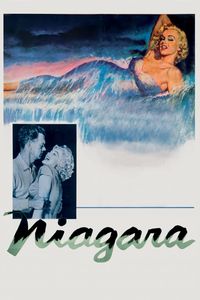
    (On Cable TV, January 2021) Among cinephiles, Marilyn Monroe is far better known as a gifted comedienne—seeing her in the middle of a glum film noir such as Niagara is a bit of a stretch, but not an unwelcome one. Playing a villainous character saddled with an antagonistic relationship with an abusive husband, Monroe remains the draw here even though she’s a supporting character in a film headlined by Joseph Cotton and Jean Peters. Our protagonists are average Americans heading to Niagara Falls for a delayed honeymoon (earning a wink and a nod from a Canadian Customs official), but see their dream holiday go off the rails when they’re introduced to a volatile couple whose antics draw them in. Monroe plays a wife with a lover on the side and dark plans to get rid of her husband. It’s a laugh to see her phone and ask for bus tickets to Ottawa—but the film itself is as noirish as it gets despite the colour cinematography of the falls. She plans on having her lover get rid of her husband, but things don’t go as planned, and our bland likable lead couple soon gets caught in the escalating madness. As a thriller, Niagara is fine enough, but I suspect that one of the aspects of the film that grows with time is an expansive look at early 1950s Niagara Falls from both sides of the border. There are far many more on-location scenes than you’d expect. The downplayed Canadian aspect of the setting was apparently a topic of contention behind the scenes, but I’ll be glad for what we do get. In any case, the intersection of 1950s tourism, noir tropes and Monroe in a very atypical role makes Niagara worth a look if any of those elements prove to be of interest. Who knows what Monroe’s latter-day career would have ben if she hadn’t died so soon? Maybe Niagara holds part of the answer.

  • Bus Stop (1956)

    Bus Stop (1956)

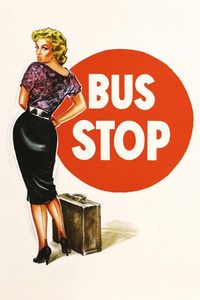
    (On Cable TV, September 2020) For movie buffs, Bus Stop is probably best known for being one of Marilyn Monroe’s few dramatic roles, following her year spent studying acting at New York City’s Actors Studio. It does demonstrate some range from her, although she does remain more memorable as a comedienne than a dramatic artist. The film itself shows a romance between two imperfect people, a naïve cowboy and a small-time signer—best showing its theatrical roots through a heavy reliance on two people verbally interacting through their own character growth. There’s an interesting aspect to the film in how it plays with some classic western tropes while in the setting of 1950s America—there’s a strange blend of cowboys and buses, saloon singers and telephones. On a visual level, the film couldn’t be more of a 1950s Technicolor film if it tried: If you came across the film cold, you’d be surprised at the blue-and-yellow flesh tone—it’s worth wondering if the film, as shown, has even been restored properly. As a romantic drama, Bus Stop does rely on very dramatic moments, and any appreciation of the film will hinge on whether those moments are believable or not. But there’s an interesting simplicity to the result, focusing more and more intently on the two lead characters until the climax that brings it all together.

  • River of No Return (1954)

    River of No Return (1954)

    (On Cable TV, September 2020) It took a lot to combine Robert Mitchum, Marilyn Monroe and director Otto Preminger on the set of a colour widescreen Western shot in Canada. But was it worth it? Watching River of No Return and then reading about its eventful production history suggest that a film about the making of the film would be more interesting than the film itself. While not strictly a failure, this is a movie that seems oddly conceived, awkwardly executed and barely worth the trouble. Mitchum stars as a taciturn farmer who’s robbed and forced to race to town on a raging river, alongside an estranged son and a saloon singer (Monroe). A very 1950s script doesn’t make things better, considering that it includes a near-rape scene between “hero” and “heroine” and a retrograde portrayal of Native Americans. Technical aspects have not aged well, with obvious differences between studio footage and on-location shooting (which is the kind of thing you learn to tolerate from period films, except this one tries to be an action movie). In the end, River of No Return barely claws its way to mediocrity, which is a far deal less than what we could expect from the talent involved. If you’re even remotely familiar with Mitchum, Monroe and Preminger, then the feeling that all three are out of their urban environment persists throughout River of No Return—and reading about the troubled production of the film only reinforces the idea that there was no way this was going to turn out to be a good movie. As a Mitchum fan, I’m not impressed; as someone who’s not a Monroe fan, I am still disappointed; and as a Preminger fan, I understand why he walked away from the film in post-production.

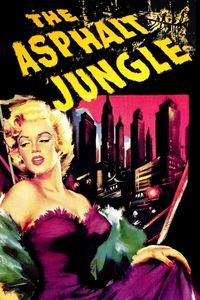
  • The Asphalt Jungle (1950)

    The Asphalt Jungle (1950)

    (YouTube Streaming, May 2020) There is something both familiar and comfortable in the very enjoyable film noir heist movie The Asphalt Jungle. It was a bit of a sensation at the time—a film that stripped away the glamour of Hollywood to approach cinema-vérité and spent more of its running time with the criminals planning a heist than the policemen hunting for them after the crime. Those are now standard features of crime movies, of course—and this may mask some of the impact of the film as it was perceived back then. Fortunately, John Huston’s direction here is masterful and has aged very well. While The Asphalt Jungle can’t escape a certain scattered effect in the midway section, it tightens up in time for the conclusion. The mid-century Midwest atmosphere is very convincingly rendered, and it’s supplemented by the corrupt characters and unescapable fatalism so beloved of the film noir genre. Sterling Hayden turns in one likable lead performance in an otherwise fairly grim cast—although there’s an early turn by Marilyn Monroe to make things even more interesting. The Asphalt Jungle makes for compelling viewing even with the familiarity of its narrative—when something works, it works well enough decades later.

  • The Seven Year Itch (1955)

    The Seven Year Itch (1955)

    (On Cable TV, December 2019) The interesting thing about The Seven Year Itch is that I could reliably predict how much I’d like it based on other movies. Like writer-director Billy Wilder’s other comedies, it navigates a tricky path between tones, pushes the envelope a bit and shows his clear gift for humour. Like other movies featuring Marilyn Monroe at her best, it shows her as a comic actress first and a sex-symbol second. Like other brightly lit comedies of the mid-1950s, it offers us a colourful, nearly fabulist look at a society long gone. Beginning with a sardonic interlude describing the timeless ritual of men packing their family for summer trips while they get to enjoy themselves at work and at home during the summer, The Seven Year Itch quickly gets down to business as it relates the flirtation between a married man alone for a few weeks and his new sexy upstairs neighbour. It all takes place in 1950s Manhattan, as fun as a playground can be for this kind of thing. While quite tame by today’s standards, we shouldn’t underestimate the delicate way Wilder daringly tackled tough issues in the far more prurient 1950s, acknowledging a few base instincts that weren’t proper to acknowledge back then. Monroe can be very, very funny at times, although those who are attracted to the film for the infamous “dress pulled up by subway venting” shot will be very surprised to find that it’s nowhere in the film—that sequence is carefully framed to pull down from her head to the subway grate without offering a single overall shot of the pose, and the photo that people remember is a recreation of the scene made sometime later as a publicity shot. Protagonist Tom Ewell pales in comparison to Monroe, but he still acquits himself well, even when saddled with a narrative monologue that straddles an awkward line between voiceover and mumbling to oneself. The conclusion of the film is a forgone conclusion given the Production Code that limited all Hollywood movies at the time—as much as the film pushes at the edge of the permissible envelope, it will never rip it and maybe that’s why we feel so safe watching it. I much prefer the other Wilder/Monroe movie Some Like it Hot, but I did have quite a bit of fun playing a tourist in mid-1950s summertime Manhattan in The Seven Year Itch.

  • Let’s Make Love (1960)

    Let’s Make Love (1960)

    (In French, On TV, November 2018) I’m on a quest to watch pretty much everything that George Cukor has directed, and for Let’s Make Love to feature Marilyn Monroe is just extra incentive. Coming at this film with expectations raised too high may be a problem, though: despite a few cameos and occasional flashes of wit, the result is decidedly average and not quite what we’d expect from the cast or the opening moments. The first few minutes of the film do set up a far funnier film than what we get, through narration explaining the family history of the lead character (played by Yves Montand), a Franco-American billionaire who ends up playing himself in a satirical play in order to get close to Monroe’s character. The difficulties in having a businessman attempting to become a stage sensation soon lead him to the film’s most inspired sequences, namely hiring Milton Berle for comedy tips, Gene Kelly for dancing lessons and Bing Crosby to learn how to sing. The three men play themselves, leading to a few cool moments if you’re already a fan of these entertainment legends. Otherwise, though, the film is surprisingly underwhelming. The traditional romantic comedy hijinks aren’t executed particularly well when Montand looks lost (thanks to language difficulties), Monroe is fine but doesn’t have much of a character besides looking pretty (this was at a point in her career when she was gathering a reputation for being unreliable), and the casting definitely seems off. High expectations make this film a disappointment, so do try to keep them under check: it’s not as good as you think it will be from reading the cast list, and the behind-the-scenes drama of making the film (what with an affair between the two leads even as they were married to other high-profile celebrities) is arguably more interesting than what shows up on-screen. [December 2018: My opinion of Let’s Make Love went up a small notch after catching an English-language broadcast of the film: The French version not only has some very awkward transitions between English-language songs and interstitial French dialogue, but has the gall to cut off some of the Berle/Kelly/Crosby material that is the highlight of the film. French dubs are usually much better than this.]

  • Gentlemen Prefer Blondes (1953)

    Gentlemen Prefer Blondes (1953)

    (On TV, November 2018) As someone who doesn’t go crazy for blondes, I’m less susceptible than most to Marilyn Monroe’s charms. But she could be a hilarious comedienne when given the right material, and Gentlemen Prefer Blondes (nonsense!) is as good a showcase for her brand of humour as anything else I’ve seen her in so far. Helmed by the always-excellent Howard Hawks, this is a Hollywood musical from the golden age, as two women make their transatlantic way to Paris in search of husbands and their fortunes. “Diamonds Are a Girl’s Best Friend” and Monroe’s Pink Dress are set-pieces of the film, the song reprised more than once. Monroe is very, very funny as the ditzy but clever heroine, while Jane Russell is spectacular as her brunette friend—her “Ain’t There Anyone Here for Love” number (complete with a surprising amount of cheekiness) is a highlight. Maybe a bit lighter on songs than you’d expect from a 1950s Hollywood musical comedy, Gentlemen Prefer Blondes (nonsense!) is heavier on comedy. All of this plays quite well to Monroe’s comedic talents—the film is her showcase even if I prefer Russell on general principles. The gender roles of the film are hopelessly dated, of course (the film is based on a 1940s Broadway musical itself based on a 1920s comic novel, explaining some of the material such as crossing the Atlantic on an ocean liner) but once you get into the 1950s frame of mind, anyone will realize that the heroines are really the masters of the plot, playing their hands as skillfully as they can. That kind of agency (need we go over the Hawks woman archetype again?) certainly helps Gentlemen Prefer Blondes (nonsense!) survive well through the decades, offering many of the same pleasures that audiences of the 1950s enjoyed while watching the film.

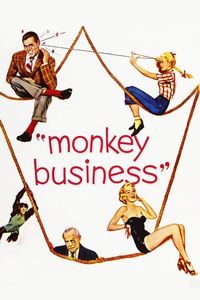
  • Monkey Business (1952)

    Monkey Business (1952)

    (In French, On Cable TV, May 2018) It’s easy to see why Monkey Business is often considered to be a loose follow-up to Bringing up Baby—Howard Hawks is back with a fast-paced comedy, Cary Grant reprises his silly intellectual mode, Ginger Rogers steps in as the wilder female partner and the film is at its best when it’s just goofing around. Thanks to a high-concept premise (what if a serum gave you back your youth … or at least made you regress back in age mentally?), there are plenty of opportunities for random silliness. The film never gets better than seeing Day play at being a bratty schoolgirl, although seeing Marilyn Monroe vamp it up as a voluptuous secretary is also fun. While it’s technically a science-fiction film, Monkey Business is best seen as a farce reteaming Hawks and Grant together and just having fun along the way. (This being said, the film’s best laugh comes early on in the opening credits sequence, as the director tells Grant “not yet” and to go back behind the door before making an entrance. Alas, the film doesn’t go back to metatextual comedy.)  It’s really not quite up to Bringing up Baby’s standards—the film is occasionally annoying (the monkey), occasionally dull (anything with the scientists), occasionally offensive to modern sensibilities (never mind “the secretary”; I have in mind the “Indian scalping” schoolyard playing.)  It’s still not a bad time thanks to the aforementioned goofing off, but it could have been better.

  • All about Eve (1950)

    All about Eve (1950)

    (On Cable TV, March 2018) There’s a deliciously impish quality to All about Eve that becomes apparent only a few moments in the movie, and remains the film’s best quality throughout. It’s a cynical look at showbusiness, triangulated between actors, writers and critics. Writer/director Joseph L. Mankiewicz can use rich material in his exploration of the dirty side of theatrical showbusiness, and his actors, in-between Bette Davis, Anne Baxter and George Sanders, are all up to the challenges of his vision. (Plus, a small role for Marilyn Monroe.)  All about Eve has a lot to say about fame, acting, age and even a touch of closeted homosexuality. It does so with considerable wit—the film is good throughout, but it improves sharply whenever George Sanders shows up as a waspy critic acting as an impish narrator. The film still plays exceptionally well today: showbusiness hasn’t changed much, and much of the film doesn’t deal in easily dated artifacts … although some of the social conventions have thankfully moved on. A bit like contemporary Sunset Blvd, All about Eve is a film built on wit and a great script, so it’s no surprise that it would stay so engaging sixty-five years later.