Milton Berle

  • Always Leave Them Laughing (1949)

    (On Cable TV, July 2022) As someone with a higher-than-average interest in stand-up comedy and its backstage drama, I could appreciate the good hook in Always Leave Them Laughing’s premise—following a second-rate comedian with a propensity for stealing jokes and wives from other comedians on tour. Milton Berle stars, which is the kind of thing that will also appeal to those with an interest in American comedy history—while relatively forgotten today, Berle was sometimes touted as America’s foremost comedian around 1950 (check his reverential appearance in 1960’s Let’s Make Love) and the film clearly plays on that additional context for casting. It’s probably why the film can feel so free to lambaste its character as a bit of a hack, and play with the darkness behind the performer (or at least as much as it could in 1949—this isn’t a warts-and-all portrait at all, just a mild amount of backstage drama to go with the comic routines). Berle is in his element when on a stage, but perhaps not so much a good romantic lead whenever the lovely Virginia Mayo or Ruth Roman are on-screen. There are also a few pacing issues, and comparing Always Leave Them Laughing to later films truly digging into the comedy backstage can be disappointing. But at least you get the sight of Berle in his prime, captured on film for posterity.
  • Going Overboard (1989)

    Going Overboard (1989)

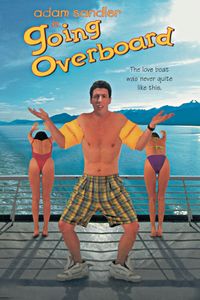
    (On TV, January 2021) Nearly every superstar has their early embarrassments, and Going Overboard would probably be even more of an obscure title today if it wasn’t for the fact that it’s Adam Sandler’s first starring role, prior to his tenure on Saturday Night Live. It has not aged well, but then again, it’s probably amazing to its filmmakers that we’re still talking about it thirty years later. Executed on a shoestring budget (something proudly highlighted in the film’s first moments), it’s a low-effort, low-energy, low-laughs comedy about a cruise ship crewmate aspiring to become the ship’s stand-up comedian. Terrorists and Miss World contestants become involved. Billy Bob Thornton also pops up, along with a late-career cameo from the legendary Milton Berle. The narrative is often punctuated by fourth wall breaks (probably the funniest material that the film has), and by gratuitous shots of pretty women—anyone talking about the obvious male gaze will be surprised to find out that the film was directed by a woman, Valerie Breiman. While Going Overboard is not terribly good, I wouldn’t go so far as to steer people away from it. For one thing, it shows how Sandler’s early screen persona is surprisingly similar to his later one; for another, the film does manage a few funny moments. It’s a bit of a capsule of 1980s issues (notably in designating Noriega as an antagonist, and in using as premise cruise ship terrorist attacks) and it does have a smattering of interesting actors slumming away. Heck, there are many worse movies than Going Overboard in Sandler’s own later filmography.

  • Let’s Make Love (1960)

    Let’s Make Love (1960)

    (In French, On TV, November 2018) I’m on a quest to watch pretty much everything that George Cukor has directed, and for Let’s Make Love to feature Marilyn Monroe is just extra incentive. Coming at this film with expectations raised too high may be a problem, though: despite a few cameos and occasional flashes of wit, the result is decidedly average and not quite what we’d expect from the cast or the opening moments. The first few minutes of the film do set up a far funnier film than what we get, through narration explaining the family history of the lead character (played by Yves Montand), a Franco-American billionaire who ends up playing himself in a satirical play in order to get close to Monroe’s character. The difficulties in having a businessman attempting to become a stage sensation soon lead him to the film’s most inspired sequences, namely hiring Milton Berle for comedy tips, Gene Kelly for dancing lessons and Bing Crosby to learn how to sing. The three men play themselves, leading to a few cool moments if you’re already a fan of these entertainment legends. Otherwise, though, the film is surprisingly underwhelming. The traditional romantic comedy hijinks aren’t executed particularly well when Montand looks lost (thanks to language difficulties), Monroe is fine but doesn’t have much of a character besides looking pretty (this was at a point in her career when she was gathering a reputation for being unreliable), and the casting definitely seems off. High expectations make this film a disappointment, so do try to keep them under check: it’s not as good as you think it will be from reading the cast list, and the behind-the-scenes drama of making the film (what with an affair between the two leads even as they were married to other high-profile celebrities) is arguably more interesting than what shows up on-screen. [December 2018: My opinion of Let’s Make Love went up a small notch after catching an English-language broadcast of the film: The French version not only has some very awkward transitions between English-language songs and interstitial French dialogue, but has the gall to cut off some of the Berle/Kelly/Crosby material that is the highlight of the film. French dubs are usually much better than this.]