Peter Lawford

  • Son of Lassie (1945)

    (On Cable TV, June 2022) Oof. Or rather: Woof, because if you thought the original Lassie was a dumpster of dog-propagandizing British-boosterism overly sentimental claptrap, you have no idea what the sequel does with the next generation and Nazis. The story has to do with Laddie, son of the famous Lassie, and the adventures he gets into once he hops on board his master’s plane (the grown-up boy hero of the previous film, now played by Peter Lawford) and they both get shot down over Nazi-controlled territory. Will they be able to escape the prisoner camp, stay together and make it back to England? Well, what do you think? Filmed in rather good Technicolor, the film doesn’t make any attempt at hiding its sickly-sweet blend of patriotism (despite being an American-produced, Canadian-shot film, it carries the British flag proudly), doggy-love and filial pride. It’s pretty much what it wants to be, and there was clearly a good audience for this kind of material in 1945, and still today.
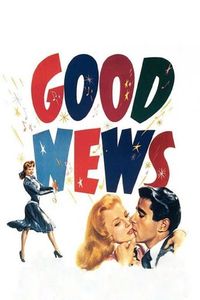
  • Good News (1947)

    Good News (1947)

    (On Cable TV, July 2021) In many ways, Good News is a wholly unremarkable musical — it doesn’t have the top stars of the genre (I mean — yes, June Allyson and Peter Lawford aren’t unknowns but they don’t compare to some of the other people working in musicals at the time) and it doesn’t have memorable tunes other than “The Best Things in Life Are Free.”  It has adequate but not exceptional choreography and doesn’t quite distinguish itself with a campus narrative that draws in football with academics. On the other hand, it’s an infectiously cheerful romantic comedy— it’s practically impossible to stay grumpy once the film gets started and the silliness starts to fly between its football jock male lead and its French-tutoring female lead. Producer Arthur Freed’s touch is evident in the film’s accessibility and moment-to-moment fun. It’s peppy, colourful (thanks to some well-done Technicolor) and remains fun until the predictable end. As a French speaker, there’s some added interest in seeing Good News leads struggle with the language, either as they sing through “The French Lesson” or in hearing their spoken French oscillate between flawless and garbled in the span of a few syllables. (Ironically, Lawford’s French is pretty good, whereas Allyson’s isn’t.)  All of this doesn’t make Good News anywhere near the list of essential musicals. But it’s probably one that I’ll watch again with some pleasure later on — it’s perfectly serviceable in its own way, and a joy to watch even if it’s not a top example of the form.

  • It Should Happen to You (1954)

    It Should Happen to You (1954)

    (On Cable TV, June 2020) No matter whether you’re talking about 2020s influencers or 1950s aspiring actresses, the lure of instant fame is evergreen, and It Should Happen to You offers a time capsule of what that looked like in mid-twentieth century America. The hook lies in having an obscure young woman taking out a billboard in her name, hoping that the publicity will lead somewhere. Against all odds, it works—and she quickly finds herself in a romantic triangle between a well-off executive and a more modest filmmaker. The unusual premise quickly leads to a far more conventional romantic comedy, but there are enough known names in the production to keep things interesting. Under George Cukor’s direction, we have Judy Holliday as the young not-so-smart ingenue, being wooed by Peter Lawford and Jack Lemmon in his movie debut. While some of the film’s initial intentions get lost in the shuffle, the film ends on a funny and romantic note. The black-and-white cinematography highlights It Should Happen to You’s old-fashioned atmosphere (at times, it feels like a late-1930s film): Maybe Cukor, as competent as he was, couldn’t quite bring himself to shoot the material in colour and reflect the slightly dourer 1950s—ah, colour footage of those Manhattan locations would have been something to see! The actors are all charming in their own way: while I’ll confess never quite getting the fascination for Holliday’s persona, she does well here. While not a waste of time, It Should Happen to You certainly does feel as if it’s restraining itself—although, considering that it’s about advertising in the mid-1950s, we’re already getting quite a lot.