Richard Attenborough

  • Magic (1978)

    (On Cable TV, February 2022) I certainly did not have “seeing Anthony Hopkins as a mad ventriloquist” on my list of things to do when I woke up this morning. But that’s the wonderful thing about exploring cinema history, especially as you leave the classics behind and start poking at lesser-known work. Not that Magic is obscure, exactly: Directed by Richard Attenborough, featuring no less than Anthony Hopkins and Ann-Margret, and written by William Goldman from his own novel, it wasn’t meant as cheap exploitation—although the horror/psychological thriller angle certainly doesn’t make it an awards-seeking film. After a rather long period of throat-clearing, the story really begins once our protagonist, a ventriloquist with some severe mental health issues (Hopkins), flees impending TV fame to seek refuge in his hometown, where he picks things up with a long-time crush (Ann-Margret, quite good even when subdued) and lets his dummy do the talking… and the killing. Literalizing the metaphor by having the dummy kill anyone who displeases the hero, Magic steadily becomes darker and darker, poking at the notion of a dummy’s personality taking over that of the ventriloquist and the only option left for the ventriloquist’s escape. It’s not great material (and it’s clearly not meant to be supernatural even when the dummy is doing the sarcastic stabbing) and it often feels too long at even 107 minutes but there are a few good moments here and there, especially as the film wallows in the characteristic gritty darkness of the 1970s cinematic palette. It does leave an impression, though, because let’s face: Hopkins conversing with a killer dummy is strange enough to be memorable. Magic may not be that different from any other killer-dummy movies, but it does have casting on its side.

  • 10 Rillington Place (1971)

    (On Cable TV, January 2022) Everything about 10 Rillington Place is terrible and uncomfortable, and you may use this as a recommendation if you want. Telling us about the real-life crime story of a serial killer at work in post-war England, this film has the unfortunate characteristic of coming from the early-1970s… meaning that when it gets dark, it gets really dark in look and subject matter. I could continue describing it, but it’s just going to get more and more depressing. The historical facts are bad enough: the killer looked like a kindly older man pretending to be a doctor, but he was really a serial killer necrophile who counted his wife among his victims and disposed of the corpses of his victims in his garden, or stuffing them into the walls of the flat he was living in. Awful stuff, but it doesn’t stop there, as an innocent neighbour was framed by the killer, accused of some of the crimes and hanged by the British judicial system before the truth was revealed. If that dry recitation of facts isn’t dispiriting enough, consider that 10 Rillington Place itself pulls few punches, and revels in the grimy, damp realism of its presentation. You may want to take a shower at the end of it… if you make it to the end, that is, because it just gets worse and worse the longer it goes on, with a written epilogue barely bringing some closure to the entire awful affair. This true-crime story makes few concessions to good taste, restraint or genre elements—it feels as terrible as the real story was. Richard Attenborough will surprise a few twenty-first century viewers by his portrayal of the killer, with John Hurt playing the patsy unjustly hanged for the murders. 10 Rillington Place is certainly not a terrible film, but if you’re already refractory to early-1970s cinema for its deep and unrelenting grimness, this is not the film that’s going to change your mind.

  • The League of Gentlemen (1960)

    The League of Gentlemen (1960)

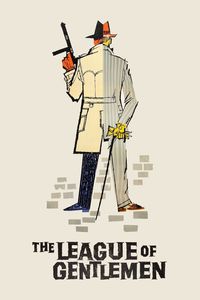
    (On Cable TV, June 2021) As far as competent and entertaining crime capers go, The League of Gentlemen feels like a successful prototype of something that would be perfected in later years. The premise of having an ex-military officer recruit fellow veterans to organize and carry out an ambitious robbery is something that would often be reused on both sides of the Atlantic (starting the following year with the Las-Vegas-set Ocean’s Eleven and extending—so far—to 2021’s Wrath of Man), but it’s interesting to see a variation of that formula at that stage of history, clearly playing on the British male audience’s memories of WW2 fellowship and past glories. The production date does mean that they don’t quite get away with a purely happy ending, but no matter — the film is executed with some flair, and the ensemble cast (including Richard Attenborough, Jack Hawkins and Nigel Patrick) makes it work. The other thing that’s not quite there is the humour of the modern(ish) caper film — as a justifiable lesser crime against rich people and institutions that clearly deserve to redistribute those riches among the poor. You can further evaluate the roughness of the emerging formula by how the supporting players are introduced — not just as veterans, but with a proven track record of deviancy that enables them to commit another crime. Such deviations from the increasingly polished formula of genre movies are what makes films such as The League of Gentlemen so interesting: they play to expectations… up to a point and while the result may frustrate audiences used to the refined formula, it can be interesting to be surprised from time to time.

  • Miracle on 34th Street (1994)

    Miracle on 34th Street (1994)

    (On Cable TV, December 2019) If there’s a time for being sappy, nostalgic, and sentimental, then Christmas is it. Consequently, there’s no use getting mad at a Miracle on 34th Street remake being sappy, nostalgic, and sentimental: That’s the point of it. Polishing the 1940s original by giving it an antagonist, a slightly different ending and not obsessing so much about a character being a divorcee, this remake (penned by John Hughes) does a creditable job bringing the story forward nearly fifty years while keeping its core sentimentality. Briefly summarized, it’s about the judicial system trying to prove whether an old man is indeed Santa Claus—the answer is unsurprising, but it’s getting there that’s important. The Manhattan setting of duelling department stores is oddly comforting, although adding an explicit antagonist does nothing good to the story. I’m divided on the decision to replace the original’s, “bags of letters” resolution in favour of a more abstract “in God we trust” climax, but that may just be the separation-of-church-and-state rationalist in myself speaking—and rationalists need not apply to this movie. At least the acting credentials are fine—Richard Attenborough gets the role of a lifetime playing Santa (was that a spoiler?), while Elizabeth Perkins and Dylan McDermott make for a cute romantic lead. There’s something noteworthy in the film’s cinematography, in that it really does go for the full “soft Technicolor” mood of earlier eras, with characters being shot in diffuse light and strongly backlit to stand out. More accessible but less magical than the original film, this Miracle on 34th Street is fine—we can quibble on the details and its more markedly mercenary intention, but it still works relatively well, and completely understands what it’s trying to be.