Victor Mature

  • Dangerous Mission (1954)

    (On Cable TV, August 2022) You could reasonably argue that Dangerous Mission is a film that’s interesting in spite of itself—a strange blend of one good casting choice, a demonstration of proto-action-movie mechanics, and an example of how far thrillers have come in execution. Part of the film’s mixed impression has to do with how ambitious it was in the first place. Not only was it shot in colour at a time where mid-range thrillers usually weren’t, it was also created for the first wave of 3D movies, and set itself up for greater scrutiny by largely taking place in outdoors setting—the Glacier National Park. Twenty-first century viewers will not be convinced by any of it—the fakeness of the studio shooting clashes with the actual exteriors and the technical stiffness of the production is the kind of thing that calls attention to itself after fifty years of much-superior production techniques. (And I’m not even going to touch the stereotypical portrayal of the Native American character.)  One thing does work rather well, though, and it’s the presence of Vincent Price as a character who—SURPRISE!—turns out to be a villain tracking the female protagonist—he’s far more interesting with his silky-voiced villainy than the bland federal agent played by Victor Mature, or the adequate Piper Laurie as the witness-on-the-run. The premise of the film still generally holds up—there’s something inherently fascinating in setting a thriller in a lodge in the middle of nowhere. But this early Irwin Allen production, directed by Louis King, simply doesn’t have what it takes to do justice to what it intends to do, and the years have not been kind to the result. (Never mind not having access to the 3D version of the film.) Dangerous Mission is not terrible, but it’s often disappointing, far more so than many other urban-set black-and-white thrillers of the time that knew how to work within their limitations.
  • Samson and Delilah (1949)

    (archive.org streaming, May 2022) Director Cecil B. DeMille could be counted upon to deliver quality spectacles throughout most of his career. Samson and Delilah is no exception… as long as you’re willing to be patient, that is. Anticipating the biblical adaptation craze that would dominate the 1950s box-office in an attempt to convince people to watch something other than TV, this colourful adventure goes back to the ancient Middle East to tell us about the Samson and Delilah of legend – he is a strongman without peers; she is a rare beauty with a duplicitous streak. DeMille fans are liable to be disappointed by much of the film, as very obvious studio sets act as unconvincing background to several endless discussions. There’s a lion-wrestling sequence to keep things going, but otherwise much of this biblical epic is talk-talk-talk. Let’s not be overly critical: this is a 1940s film after all – decades before the Hollywood spectacle formula was revised to include a big jolt every twenty minutes. It’s not as if there’s nothing to admire in the interval – after all, Delilah is played by none other than timeless beauty Hedy Lamarr, and Victor Mature incarnates Samson… alongside such notables as George Sanders and Angela Lansbury. And then, well, there’s the temple-shattering climax of the film’s conclusion, in which full-scale sets and big models are used to portray the complete collapse of a Philistine temple. If you’ve been waiting for this long, you deserve the treat at the end of the film. I would not recommend Samson and Delilah as one of DeMille’s best films, though – too talky, too fake, too unbalanced in its structure. But it’s watchable – Lamarr and colour cinematography help a lot – and it offers an interesting object lesson in how Hollywood was ready to go for even bigger spectacles in the years to follow.

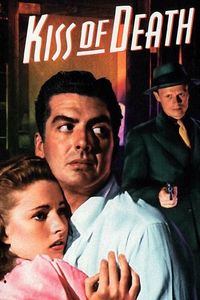
  • Kiss of Death (1947)

    Kiss of Death (1947)

    (On Cable TV, July 2021) Often hailed as one of the classic film noirs, you can see in Kiss of Death something that did not often exist in prior movies: Richard Widmark’s psychopathic performance (in his film debut!) as a two-bit hoodlum, with a wide-eyed smirk and sadistic laughter right before sending an old lady tumbling down a staircase. It’s a performance that does wonders with an underwritten part, and film historians tell us that this marked a turning point in the history of movie villains. (Widmark got an Academy Award nomination for the performance, and you can find echoes of it all the way to Heath Ledger’s Joker.)  Surprisingly enough, it still works well even after decades of psycho killers in films far worse than this one — and much of the effectiveness goes in establishing the protagonist as someone with a lot to lose, with two daughters and a new wife to protect against the evil antagonist. But it’s hard not to be impressed by most aspects of the film’s production — from a screenplay by classic Hollywood legend Ben Hecht to a credible use of location shooting to a result filled with procedural details and cynical dialogue, Kiss of Death is already a superior noir from the moment the actors step on set. Victor Mature does a good job in the lead role, a protagonist dealing with the suicide of his first wife while he’s in prison and turning informant in order to protect his two daughters sent to an orphanage. Colleen Gray provides the narration and some further dramatic heft to the film as a babysitter turned wife. It all wraps up in a good package, with a happier ending than is the norm in noir.