Year: 2010

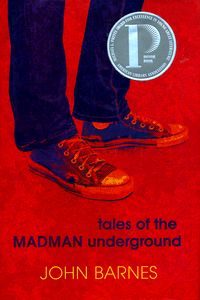
  • Tales of the Madman Underground, John Barnes

    Tales of the Madman Underground, John Barnes

    Viking, 2009, 532 pages, C$23.50 hc, ISBN 978-0-670-06081-8

    One of the paradoxes of genre publishing is that it can be as comforting in its ghetto-like nature as it can stifle those looking to try something new.  Genre fans can provide a certain predictable sales baseline, but convincing them to try something outside the boundaries of the genre can be difficult.  For every Dan Simmons able to write equally well in science-fiction, horror, fantasy and mainstream, there are a plenty of other SF writers getting no success trying to sell techno-thrillers.

    Then there are those who seem to relish breaking genre conventions.  John Barnes is, in many ways, the model of a mid-list SF genre writer, but his lengthy bibliography is filled with oddities and small surprises.  In addition to a solid core bibliography of Science Fiction novels written for adult and young adult audiences, Barnes also wrote less conventional speculative fiction: From a trilogy of men’s adventure thrillers to a light-hearted fantasy to a meta-SFictional tall tale to hard-SF novels written in collaboration with Buzz Aldrin, Barnes manages to defy and subvert expectations once every two or three novels.  I’ve got most of his bibliography (Heck, I even have his early obscure “Time Raider” trilogy in my stack of things to read) and I’m still surprised by what he dares to do.

    Now, with Tales of the Madman Underground, he turns his attention to mainstream young adult fiction.  Taking place in 1973 Ohio, this YA novel shows a few hints of Barnes’ SF pedigree: The main character read Philip K Dick and has to turn to a convention-going classmate for explanations.  A few other references can be read as reassuring winks to Barnes’ existing audience (who may be familiar with Barnes’ other young-adult Science Fiction novels), but Tales of the Madman Underground is otherwise a completely mainstream teen novel.

    It takes place over the first six days of Karl Shoemaker’s senior High School year.  He has the best of intentions: To be normal.  “Normal”, in Karl’s case, is a challenge.  Not everyone lives with an unstable widowed mother and dozens of quasi-feral cats.  Not everyone works five jobs and has to hide their money from their flighty mom.  Not everyone is a recovering alcoholic teen.  Not everyone has been branded a psychopath, sent to group therapy and pre-emptively condemned to a permanent psychological record.  Karl’s goal is to take his last year one day at a time, and be as normal as possible to avoid returning to “the Madman Underground.”  It’s not that his best friends aren’t Madmen… but he’d rather try to be normal for a while.

    I’m not going to attempt guessing how much of Tales of the Madman Underground is nostalgia for Barnes (who was 16 in 1973); it’s more useful to note that this is a novel by an experienced novelist, and that the result is a solid success.  The atmosphere of a small Midwestern town is described with idiosyncratic flavour and the characters that surround Karl are richly sketched.  The titular Madmen may have been designated as broken minds by the system, but the novel shows how even the most distressed of them can depend on each other for support and so deserve our sympathy.  (In one of the book’s best scenes, they show up the school’s newest therapist… and find out that she’s an unexpected ally.)  Karl himself is a likable protagonist, emboldened and hardened by situations that others would find desperate.  We root for him to a rare degree, and the small victories that constitute his ultimate triumph are earned many times over.

    Karl’s narration is direct, suitably profane, and addictive from the very first few pages.  The terrific dialogue is a joy to read, making the 500+pages book seem much shorter.  The narrative flow isn’t complicated, but it’s enlivened by numerous subplots (many of them relating to Karl’s numerous side-jobs) and a series of stories about the Madman Underground’s most memorable adventures.  Set in 1973, it seems just as relevant today.

    Anyone who has read more than two Barnes novels knows that he can write dark-and-repulsive like the worst of them.  And while Tales of the Madman Underground has its share of uncomfortable moments (including a sequence where we’re temporarily brought to doubt the reliability of the potentially-psychotic narrator), it features one of Barnes’ most sympathetic character yet and it leads to an unusually triumphant conclusion.  The obstacles facing Karl are formidable, but they’re overcome fairly and the last few pages are smiles upon smiles.  It adds up to one of Barnes’ most enjoyable books yet, and a rare one of his that can be described as unabashedly upbeat.  Even die-hard genre SF fans willing to genre-hop and follow Barnes in his historical adventure will get much out of it.
  • Skyline (2010)

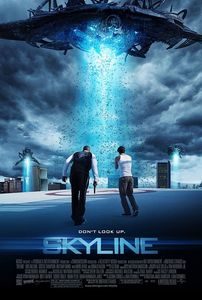
    Skyline (2010)

    (In theaters, November 2010) First of what seems to be a long list of alien-invasion films to appear in 2010-2011, Skyline takes a low-budget high-concept approach to a well-worn story: Aliens attack Los Angeles, and a few human characters are stuck in a high-rise apartment watching the action.  Perhaps the most astonishing film about Skyline is its reported cost of about ten million dollars, only half a million of which was spent on principal photography.  The rest is all CGI, and the on-screen result veers between digital home-movie quality and feature-film CGI effects.  It’s an audacious bet, but the film does feel a lot bigger than its budget.  Unfortunately, intentions aren’t the only thing that matters, and so Skyline missteps badly in about three major ways, two of whom are related to its ending.  (Spoiler ahead!)  The first issue is the lack of interest in the characters, none of whom have enough personality to be sympathetic.  Their self-indulgent dialogue is annoying, and there’s not a lot of sympathy to be felt for overgrown teenagers living large in a luxurious condo.  Skyline laboriously sets up its first act and then slowly moves through its second one; only the last thirty minutes truly move.  But the film’s most interesting characteristic is also the one that kills it: Anyone criticizing why alien-invasion movies always end up with the humans winning may want to take a look at Skyline to understand why it’s a better story to cheer for the human underdogs rather than letting the aliens do whatever they want anyway: it’s the difference between a short film and feature-length one: Don’t turn around in circles for 90 minutes to say something patently obvious from the moment the film’s premise is explained.  Skyline’s final problem stems from the second one in that it stops at an awful moment, either five minutes too late or fifteen minutes too early, ending with a futile nihilism that will make viewers turn against the film in its entirety.  (I’m not even going to comment on the patently absurd rationale of why the aliens seem to invade.)  Oh, there are plenty of things to like in the film’s individual moments: The special effects are often as good as any other alien-invasion film put on-screen.  (It helps that the Strauss Brothers writers/directors have an extensive background in visual effects.)  In the end, however, we’re left with a poisoned alien-invasion candy, not worth revisiting again knowing how it ends.  Skyline makes marginally more sense as a horror film rather than a science-fiction one, but not that much… and not enough to care.

  • Under the Dome, Stephen King

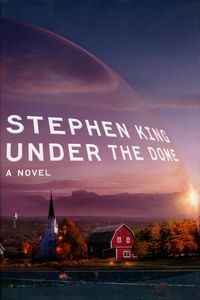
    Under the Dome, Stephen King

    Scribner, 2009, 1074 pages, C$39.99 hc, ISBN 978-1-4391-4850-1

    Frankly, there’s just one thing you need to know about Stephen King’s Under the Dome:  It’s big.  It’s really, really big.  Count the pages and recall the two other King novels of similar heft: The Stand and It.   The page count shows that Under the Dome is King’s third-longest novel, and it certainly feels epic.

    The premise is simple: When a small Maine town is cut off from the world by an invisible but impassable barrier, its residents struggle to understand what’s going on and survive the experience.  But such a plot summary glosses over the totality of King’s presentation of the event.  He’s got two thousand viewpoints to play with, and if the action wisely focuses on half a dozen main protagonists, at times it feels as if the omniscient narration gives us a glimpse of every single citizen of Chester’s Mill.  The first chapter alone takes a kaleidoscopic view of what happens when the dome falls, with crashing vehicles, cut-off body parts, interrupted streams, accidents of fate locking some people in or out and other assorted phenomenon.  The omniscient narration can be chatty, but it also goes quiet when it’s time to focus on the main characters.

    Because there’s a lot more to Under the Dome than a town physically cut off from the rest of the world: Chester’s Mill has its share of bad apples, and they control the place.  When media attention brought on the city following the fall of the dome threatens to expose secrets that the guilty would rather keep hidden, the dome itself becomes less dangerous than the people inside … Psychotic murderers, crystal-meth entrepreneurs, power-crazy policemen and panicked citizen all show their true colours during the days that follow the fall of the dome.

    But it’s the details through which King tells his story that make Under the Dome such an impressive and frustrating book.  On one hand, there is enough time and space here for elaborate plotting, reversals of fortune, copious inner monologues and ample character growth.  When King activates his omniscient narration, it’s like floating above a small town and having direct access to two thousand minds in all their diversity.  On the other hand, that amount of verbiage slows the action down and frequently makes readers wish for the next plot point.  King pulls a bit too obviously on familiar plot threads about religion, serial killers, corrupt authority and civil unrest to avoid a feeling of familiarity throughout much of Under the Dome.

    There is, however, quite a bit of allegory going on under the surface of the text.  It doesn’t take much of an imagination to see the parallels between an isolated and paranoid Chester’s Mill and Bush-administration America.  The division of power between a ruthless sheriff and incompetent politicians has real-world parallels, and much of the popular hysteria cuts a bit too close to headlines of the last decade to be entirely accidental.

    Where Under the Dome doesn’t do so well is in its ultimate justification for the Dome.  It moves the novel from the Horror to the Science Fiction genre.  This is not by itself a bad thing, but it will make a number of more rigorous readers cringe given the thinness of the premise and the somewhat arbitrary way the novel is resolved.

    Still, that ending is preceded by an apocalyptic sequence that leaves few people standing, so it all evens out.  While Under the Dome can occasionally be exasperating, annoying and underwhelming, it’s also a novel that disappoints because it attempts so much: Even if he misses a few targets along the way, King still manages to hit plenty of them.  The result may not have the quasi-mythical heft of The Stand or the tight focus of “The Mist”, but it’s the kind of wide-screen horror/thriller that has become a bit too rare lately.  King being King, it’s also a book written with clean prose, compelling characters and a thicket of plot developments.  It is, in short, a perfect book for those who want to sink into a lengthy reading experience and blink their eyes back to reality a long time later.

    In its own four-pounds fashion, it’s also a powerful advertisement for ebook readers.

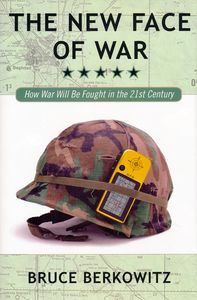
  • The New Face of War, Bruce Berkowitz

    The New Face of War, Bruce Berkowitz

    Free Press, 2003, 257 pages, C$41.00 hc, ISBN 0-7432-1249-5

    Released in March 2003, just as Americans were invading Iraq, Bruce Berkowitz’s The New Face of War is already showing a bit of its age.  Seven year later, thanks to two ongoing wars involving the most powerful military force on planet Earth, we’ve seen the new face of war: It’s about IEDs and insurgency and asymmetrical force projection and wireless communication and missile-armed drones.  Then again, age can also mean respectability: How best to evaluate a book dealing with future war than to measure how right it has been years later?

    Perhaps the first thing to do is to ignore the all-encompassing title.  The New Face of War doesn’t present a set of prescriptions and predictions for future warfare as much as it focuses on the changes already imposed by information technology.  It doesn’t get down into the nitty-gritty of what weapons soldiers will be using in the future as much as it charts how military forces have been refining their use of information technology to shorten their decision cycle, read enemy messages, or mount elaborate deceptions.

    For a book dealing rather heavily in abstract strategic concepts of no use to most lay readers, Berkowitz does an impressive job at vulgarizing his subject matter and offering interesting ways to ease into his most esoteric concepts.  In order to explain how information technology is revolutionizing warfare, he starts by drawing an analogy between NASCAR and Formula One, illustrates his point with a lengthy description of the Gulf War’s logistics innovations, touches upon the creation of ARPANET and ends up summarizing his main points about “the new face of war”. [P.75] It takes a special kind of military nerd to jump enthusiastically into a book that draws parallels between the Internet and warfare, but Berkowitz makes it easy with plenty of illuminating links and a helping of wry humour.

    Berkowitz knows his stuff, and the book goes deep in historical examples that are fascinating in their own right.  Perhaps the most interesting parts of The New Face of War are the illustrative digressions taking a quick trip down military history in order to show the evolution of information in warfare.  There’s a fascinating side-note about the development of torpedoes, for instance (including how they relate to The Sound of Music), and a much longer explanation of how accurate positioning systems were developed (from finding a reliable way of determining longitude to the post-Gulf War civilian co-optation of the GPS).

    It probably goes without saying that Berkowitz writes from the paranoid school of military analysis: His view of the world presupposes that America is constantly threatened and that most means are subordinate to the cause of maintaining American superiority.  This can be a bit annoying for foreign readers, or people who don’t have a built-in terrorism persecution complex.  On the other hand, Berkowitz can be reasonable in his analysis: A chapter-long discussion of the ethics of strategic assassination ends up concluding that there is no defensible rationale for it –a far cry from the right-wing pro-torture apologists who seemed to bloom so bloodthirstily during the second half of the Bush administration.

    In evaluating whether The New Face of War had survived the past seven years without losing too much credibility, the conclusion is that the book remains just as interesting and through-provoking now than in 2003.  Events since then have suggested that the information component of warfare remains crucial –US forces in Iraq and Afghanistan vastly out-powered their opponent, but local knowledge allowed insurgents to strike back effectively through very different tactics.  In dealing with a conventionally powerful enemy, insurgents have understood that they must attack in ways designed to take advantage of their strengths and minimize their exposure –a point that Berkowitz explains through the example of terrorist strikes.  Perhaps most striking is what has not happened since the book’s publication.  Berkowitz, despite spending much of his time discussing information warfare, remains sceptical about “cyber-war” and the myth of hackers bringing down modern civilization (or at the very least power plants) through the web –and in fact, there have been no significant incidents of the type since 2003.

    In this light, the years have been kind to Berkowitz’s theses as developed in The New Face of War.  The only disappointment in reading the book is to find out that the author doesn’t seem to have a blog or web site on which we can read about his latest publications.  One wonders what he’s thinking these days…

  • Worth Dying For, Lee Child

    Worth Dying For, Lee Child

    Delacorte, 2010, 384 pages, C$33.00 hc, ISBN 978-0-385-34431-9

    Lee Child’s fourteenth Jack Reacher novel, 61 Hours, ended in a cliff-hanger of sorts, with the plot resolved but Reacher desperately running for his life.  An epilogue took delight in suggesting that nobody had survived the climactic explosion that ended the novel, worrying fans of the series: Would Reacher be back?

    Of course he is.  As Worth Dying For begins, Reacher is once again travelling through small-town America, this time in the flat wilderness of wintertime Nebraska.  The narrative is obviously taking place after 61 Hours: Reacher is not only bruised and battered; he’s also heading to Virginia in the hope of meeting a character introduced in the previous novel.  Unfortunately, we only get a partial explanation of how Reacher made it out of the dire situation at the end of the last book –if you’re expecting a full answer, you may have to wait until he makes it to Virginia.  The rest of Worth Dying For has nothing to do with 61 Hours.

    In the meantime, Reacher’s got problems to solve in Nebraska.  Outraged by the sight of a beaten-up housewife, Reacher can’t help but investigate the situation and eventually understand how the small community around him has been completely taken over by a family of abusive men.  Add to that a decades-old mystery about a long-missing girl, and Reacher can’t leave such situations alone.  But there’s nowhere to hide in the flat prairies of Nebraska –especially not when multiple teams of enforcers are sent to take care of him.

    Reacher fans won’t be disappointed by this new entry, as routine as it can be at times.  Once you forgive the awkward bridge between 61 Hours and Worth Dying For, it’s another typical adventure for Reacher as an errant knight travelling throughout the US, helping those in distress and dispatching whoever tries to stop him.  He’s a quasi-supernatural protagonist, and it’s sometimes better to consider him as a semi-mythic incarnation of righteous fury than a believable character.

    Still, Child plays the thriller game almost better than anyone.  If Worth Dying For is a bit more stylistically straightforward than the previous clock-ticking 61 Hours, it’s still as good as it can be in describing Reacher’s mixture of brawn and deduction.  In a weakened state, Reacher is more dependent than ever in anticipating his opponents’ actions and the outcome of his duels (one of them pitting him alone against a truck in a field) is highly satisfying.  Anyone worrying about a weakened Reacher just has to wait until he kills a bad guy by punching him in the heart –a medical factoid transformed into a feat of utter machismo that even seems to amaze the protagonist.

    One thing that the novel also does well is exploiting the characteristics of such a desolate location.  There are only two dimensions in late-winter Nebraska, and every single point of human interest within dozens of miles is easily identifiable: When Reacher tries to act, he finds himself limited by a visible lack of options.  Cars are essential to go from anywhere to anywhere, and there are no secrets when human figures and car headlights can be spotted from such great distances.

    Otherwise, there’s not much to report, and that’s part of the novel’s let-down.  For such a grandiose title, Worth Dying For deals in small potatoes: small town, evil family, generic henchmen, desolate settings.  For Child, it’s an achievement to wring that amount of entertainment out of such limited elements, but it comes soon after the small-town drama of 61 Hours, and doesn’t stick in memory like other novels in the series did.

    Still, Worth Dying For is a good standalone entry even despite the disappointing transition between the previous novel and this one.  This being Reacher’s fifteenth adventure, his fans won’t be too disappointed yet, and Child’s continued ability to charm readers is nothing short of admirable.  But 2010 marks the first calendar year in which two Reacher novels were published, and if the results confirm that this is still the best thriller series out there, enough questions have been raised by 61 Hours’ cliff-hanger to suggest a bit of caution.

  • Red (2010)

    Red (2010)

    (In theaters, November 2010) By now, the action/comedy genre is so familiar that everyone should cheer whenever a quirky off-beat project tries to do something differently.  While originality isn’t always an advantage (Knight and Day showed that quirkiness can’t replace solid screenwriting), films like Red can tweak the usual formula and make it feel just a bit fresher than usual.  The story is familiar (a renegade secret agent tries to find out who wants him dead, accompanied by a reluctant love interest), but the details aren’t as overused:  The agent is retired, his allies are old and paranoid, his enemies are deep within the government and his would-be girlfriend initially has to be tied, drugged and dragged along before she comes to appreciate the action-comedy lifestyle.  Red flies around the United States, literally showing postcards along the way –which may give you an idea of its particular sense of humour.  Bruce Willis may be the Red’s headliner, but the real appeal of the film is through Mary Louise Parker’s wide-eyed evolution from house-bound kitten to adrenaline junkie.  Helen Mirren is delightful as an aging assassin, while John Malkovich has a typical turn as a deeply paranoid retiree.  Action highlights include a shootout in New Orleans and the use of heavy artillery in a Chicago hotel parking lot.  Much of the plot is routine, but the film is a lot more enjoyable during the comedic moments between the characters.  Fans of the original comic book may want to forget all about the source material, because Red is quirky and light-hearted whereas Warren Ellis’ story was sombre and nihilistic.  While Red often goes spinning too fast in all sorts of directions to be truly effective, the result isn’t too bad as long as you don’t expect the sort of straight-ahead action-with-quips blockbuster: Red is handled with another kind of sensibility, and if the result is often a bit too off-beat to be fully enjoyable, it delivers what is expected with a little bonus that no one asked for.

  • Memory, Lois McMaster Bujold

    Memory, Lois McMaster Bujold

    Baen, 1997 mass-market paperback reprint of 1996 original, 462 pages, C$9.50 mmpb, ISBN 978-0-671-87845-0

    Given how much I like Lois McMaster Bujold’s Science-Fiction novels, I was recently surprised to realize that I hadn’t read all of them.  I was particularly embarrassed to remember that I hadn’t even read Memory, often considered by fans to be one of the major books in Bujold’s Miles Vorkosigan series.  I had read most of what came before and all of what followed, but never that particular novel.

    It’s a mystery as to why I waited this long to finally read it.  Much of Bujold’s SF writing is set in a single universe, revolving around the character of Miles Vorkosigan and his extended family.  Not every Vorkosigan story is told in the same mode or has the same importance: They range from military SF to romance, and they can go from simple entertainment to gut-wrenching drama.  Memory is one of the key texts in the Vorkosigan saga: Deceptively summarized by the publisher as “Miles hits thirty: thirty hits back”, it’s a major novel that marks a definitive transition in Vorkosigan’s life and in the makeup of the series.  There’s definitely a pre- and post-Memory era in the Vorkosigan saga.

    As Memory begins, Miles is still having fun as his alter-ego “Admiral Naismith”, leading his own fleet of mercenaries through dangerous adventures. For him, it’s definitely a more interesting life than being stuck at home as Lord Vorkosigan in a rigid aristocracy.  But things aren’t necessarily going well: Miles is feeling the consequences of a major medical trauma, and is liable to suffer unpredictable debilitating seizures.  This has serious consequences during a hostage rescue mission, and Miles finds himself temporarily grounded as superiors and colleagues review his actions.  Throughout Memory, Miles has to confront the end of his boyhood fantasies, liquidate his invented alter-ego and finally face his future as himself.

    Coming-of-age novels usually feature younger characters breaking out of childhood into something like adult maturity, and the Science Fiction genre certainly has its share of such stories.  But growing up isn’t a binary condition: Kids don’t suddenly turn into adults until the end of their lives: Even adulthood has its stages, and Memory squarely confronts a tricky transition.  It’s a difficult assignment made even more so by the dramatic demands of an action-adventure SF series: Having Miles run around the galaxy blowing stuff up is certainly more exciting than seeing him confront his obligations as part of the aristocracy.  Bujold took huge risks in removing the exciting half of Miles’ identity and definitely scrapping those plotting avenues.

    It also forces Memory to take place largely within Miles’ head.  Oh, there’s a mystery for him to solve in trying to piece together who’s trying to sabotage Imperial Security’s leadership –but that’s thematic underpinning for Miles’ own personal reintegration.  The novel’s most satisfying moments are in seeing Miles come to grip with his life, deciding to get rid of a crutch he had created to fulfill outdated needs, and joining a more challenging society of peers.

    Perhaps the most surprising aspect of Memory is how Bujold is able to create a gripping novel out of self-contemplation.  This isn’t a surprise, of course: Bujold has long been one of SF’s most gifted writers, and the depth of the characterisation she brings to Memory, even through its tangle of subplots, is what fans can expect from her –but the result is satisfying to such a degree that it still feels like a minor achievement.   The self-awareness of the central character is scathing (rare enough in a sixth book in a series) and the process through which he comes to realize how best to live his seemingly diminished life is a crucible that feels just as real to the reader.

    I’m not in a position to suggest how accessible Memory can be to those who haven’t read the rest of the series.  It surely means most to those who care about Miles and his adventures, but my own memories of the series were dated and fuzzy, and the first few chapters of Memory do a fine job at re-establishing the important relationships required to understand the shifting that occurs later in the novel.

    While the mystery aspect of Memory isn’t much of a mystery, the rest of the book’s subplots and central dilemma easily make this one of the important entries in the Vorkosigan series.  Everything clicks, from the plotting to the characters to the prose to the impact of individual scenes.  It ends not with a sense of closing options, but with new opportunities and revitalized characters.  More series should go through this type of premise-defying shakeups.

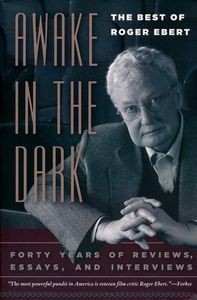
  • Awake in the Dark, Roger Ebert

    Awake in the Dark, Roger Ebert

    University of Chicago Press, 2006, 476 pages, $18.00 tp, ISBN 978-0-226-18201-8

    A few months ago, I concluded my review of Roger Ebert’s bad-movies-reviews compendium Your Movie Sucks by promising that I would follow up with a book about his great movies.  Hence Awake in the Dark: The Best of Roger Ebert, a retrospective collection bringing together forty years of interviews, reviews and opinion pieces about cinema.  If nothing else, this collection shows the depth of material available from someone who’s been writing about movies for such a long time.  Even devoting large sections of the book to specific material (such as reprinting his “best movie of the year” reviews), there are enough treats here to surprise and delight.

    The introduction sets the tone, as Ebert describes his first experiences with cinema, and early adventures in the newspaper trade.  A number of interviews follow, most of them from the earlier part of Ebert’s career when he spent more time doing feature pieces.  (An explanation for that is found later in the book, in discussing the stranglehold that press agents now have on serious film journalism.)  Then it’s off to a selection of Ebert’s favourite movies of every year, from 1967’s Bonnie and Clyde to 2005’s Crash.

    I skimmed over the next two sections, about foreign films and documentaries, and didn’t read everything in the overlooked and underrated films segment –but the following “Essays and think pieces” are all interesting, and present a sampling of issues that have infuriated Ebert over the years: the inequality of black actors, colorization of black-and-white films, the lack of a truly-adult film rating in the United States (with consequent infantilization of American cinema), and the appeal of celluloid over digital projection.  The last section, “on film criticism” features a virtual symposium between critics Richard Corliss, Andrews Sarris and Ebert on the future of film criticism.  The coda of the book discusses the early stages of Ebert’s cancer that would eventually rob him of his voice and give him a new one as a top-notch online writer.

    It’s not exactly useful to rate the book on whether you agree with Ebert:  I certainly don’t, especially when he starts feeling nostalgic about the quality of celluloid films over new digital projection technologies.  And I just have to browse the list of his “films of the year” to start rolling my eyes at some choices.  (Crash?  Ergh.)  But the true mark of Ebert’s value as a professional writer is how pleasant to read his pieces remain even when they present disagreeable viewpoints.  It helps that despite decades of experience reviewing films, Ebert still sees them with the eyes of an ordinary filmgoer: It’s not difficult to understand why he still likes the movies, why some of them work better than others, and how much he wants every film to be successful.  Reading a selection of the films he loves is reading about a fulfilled Ebert –quite a different experience than reading one angry pan after another in Your Movie Sucks.

    Trying to fit a forty-year career between two covers is a tough assignment, but the editors responsible for selecting the pieces in Awake in the Dark have done a good job, and while this won’t be the final word on Ebert for a while (especially given the astonishing quality of his current online writing), it’s about as good a career retrospective could be as of 2006.  There’s a lot of fine reading in there –although, since much of the book is made of short reviews or essays, Awake in the Dark is best read in small chunks spread over a long period of time.

    For movie lovers, film reviewers, Ebert fans and anyone interested in critical cinema commentary, Awake in the Dark is an eloquent achievement: An entire life spent watching films, glimpsed throughout hundreds of short essays. It may not be as bitterly amusing as reading six years of awful movie reviews, but it’s far more interesting –and it shows Ebert at his best while discussing the best.

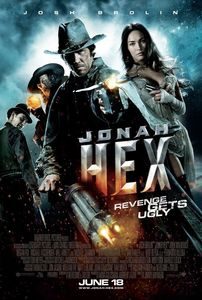
  • Jonah Hex (2010)

    Jonah Hex (2010)

    (On DVD, October 2010) “Not as terrible as rumoured” isn’t much of a positive review, but given how Jonah Hex was savaged upon release as one of the worst big-budget release of 2010 (with rumours of a very troubled production), it’s almost a relief to watch the film and notice a few worthwhile things.  Much of those, alas, are conceptual rather than actual: It’s a movie that sounds a lot better than it plays largely because it ineptly executes its most interesting ideas.  Part of the problem is the script’s middle-of-the-road commitment to the Hex comic book mythology’s most outlandish aspects: The resulting film feels as if it never commits to full-blown fantastical concepts, and its occasional anachronism feel like weak sauce in today’s steampunk-knowledgeable media universe.  It’s not often that Wild Wild West is held up as an example to follow, but it –at least- didn’t forget to have some fun in introducing anachronistic concepts in a Western setting.  Worse yet is Jonah Hex’s execution of what it chooses to embrace: Thanks to the scattered direction, It’s not rare to figure out after the fact what the film was trying to do, and think that there was a far more coherent way to achieve it.  It’s violent without being gory, and yet displeasingly so in a film that otherwise seems suited for an escapist romp.  As such, Jonah Hex limps along from one semi-interesting scene to another, and it ends (after a mere 80 minutes) with an underwhelming, overly-familiar whimper.  So, what are its good points?  While Megan Fox’s character is useless and John Malkovich is wasted as the antagonist, Josh Brolin does a fine tortured Hex.  There are occasional flourishes of direction in, say, resorting to comic-book panels to show what would have been unbearable to watch as live action, and there is some interesting twisted western imagery in the mix.  But even with those advantages, Jonah Hex goes in the “almost” category: almost interesting, almost good and almost worth watching.

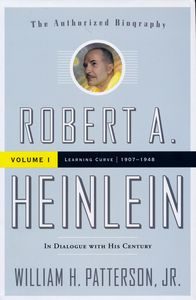
  • Robert A. Heinlein: In Dialogue with His Century: Volume 1, 1907-1948: Learning Curve, William H. Patterson Jr.

    Robert A. Heinlein: In Dialogue with His Century: Volume 1, 1907-1948: Learning Curve, William H. Patterson Jr.

    Tor, 2010, 622 pages, C$35.99 hc, ISBN 978-0-7653-1960-9

    You don’t have to be a Science Fiction historian to understand the massive influence that Robert A. Heinlein had over the genre.  His writing techniques set an example for all writers to emulate (or repudiate), his personality challenged readers to become better human beings and so it’s no exaggeration to state that entire generations of SF enthusiasts have been led by Heinlein’s example.  As a writer, a personality, and a towering figure in the SF community even more than two decades after his death, he is one of the few SF writers of the twentieth century to deserve a massive two-book biography.

    What we get with William H. Patterson Jr.’s Robert A. Heinlein: In Dialogue with His Century: Volume 1, 1907-1948: Learning Curve (count those colons!) is… something impressive, even as the first half of a bigger project.  Alas, it’s not the single best possible account of Heinlein’s life.  Like most authorized biographies, it benefits from generous access to primary sources, but suffers from a lack of critical perspective.  The author has accomplished a herculean task of bringing together a mass of information about Heinlein, but he hasn’t always been able to condense this data into a readable or insightful portrait of the man.

    It may be that the SF community has been spoiled by Julie Phillips’ extraordinary biography of Alice Sheldon, James Tiptree Jr., a fusion of fact and interpretation that remains the gold standard for SF writer biographies.  (Outside the genre, there’s also William McKeen’s biography of Hunter S. Thompson, Outlaw Journalist, to consider.)  Compared to Phillips’ work, this first volume feels flat and bloated, afraid to take a dispassionate stand about its own subject while having a hard time distinguishing between trivia and detail.  Why else spend a page detailing speeches at an Army-Navy game in which Heinlein was only peripherally involved? [P.81]

    We shouldn’t be ungrateful for the sheer amount of detail: This is a “Life and Times of” kind of biography, and if nothing else, readers will come away from the book with a meticulous understanding of 1920s Annapolis, 1930s California Progressive politics and 1940s stateside war efforts.  But if you’re getting the sense that you have to be enthralled by Heinlein before reading the book (rather than let the biography do the convincing), then you’re right.

    Readers without a deep-set case of Heinlein worship are advised to grit their teeth, skip the rah-rah-RAH introduction (in which the death of Heinlein is compared to the assassination of JFK, the Challenger explosion and 9/11) and start reading on Chapter One, which sets the tone for a book that is a great deal more factual that its hagiographical opening would suggest.  Not that the fawning tone entirely disappears later on: Patterson has a tendency to exculpate Heinlein from various errors and lapses of judgement, blaming his wife for a bad signature, not questioning official medical records and generally presuming that Heinlein knew best.  I’m also troubled at how much of the sourcing goes straight back to recollections by Heinlein’s third wife –that is, unchallenged hearsay by a highly biased source.

    This occasional fusion of overwhelming minutia and unquestioning Heinlein fanboyism makes the book feel considerably less accomplished than it actually is.  From various reports on and off-line, I understand that the editing process for the book wasn’t simple (nor, apparently, friendly) and that the result is considerably shorter than the manuscript initially submitted for publication.  The result remains a bit frustrating… about as much so as trying to make sense of the hugely complicated man that was Heinlein.

    Still, having vented my frustrations about the book, here’s why it deserves to be read widely, discussed passionately and nominated for next year’s Hugo Awards: It’s a significant piece of work, it presents new information about Heinlein and it manages to describe the broad strokes of Heinlein’s life during a very badly documented period.

    Even confirmed Heinlein fans will learn quite a few things out of this biography: Heinlein’s first-of-three marriages; the particular nature of his second one; the way he got to Annapolis; his fascination with the occult; the episode in which he nearly became a Rhodes scholar; his unpleasant first Guest of Honour experience at the 1941 Worldcon; the details of his unsuccessful electoral bid; and so many others.  Even dirty gossip gets a bit of space, as we learn of a possible affair between L. Ron Hubbard and Heinlein’s second wife.  (Read the endnotes!)  There is a lot of information here that, to my knowledge, has never received wide publication.  The magnitude of Patterson’s achievement in chronicling the first forty years of Heinlein’s life is magnified by the difficulty of getting this information, by dint of historical distance or by deliberate erasure.  (Heinlein burnt much of his own personal papers in 1947.)  To find so much information unearthed (even via unreliable sources) is a minor miracle and for that reason alone, this biography is a major piece of work that will become a significant starting point to any further Heinlein assessment.

    There’s also quite a bit of merit in how Patterson is able to trace Heinlein’s formative influences, from the rigour of his naval background to his liberal politics within Upton Sinclair’s faction of the California Democratic Party to his post-war reassessment of his political affiliation given the threat of nuclear warfare.  Heinlein’s fiction can argue opposite sides of issues in successive novels, and this biography does a fine job at showing how widely Heinlein’s experience differed from the American norm of the time.   For SF fans, I suspect that the last section of the book, after Heinlein starts selling fiction professionally, is a fascinating look at the development of the SF field at a crucial period.  There are familiar names (Campbell!  Pohl!  Hubbard!  Asimov!) and a strong sense of what the community must have been at the time.

    I also suspect that quite a few early Heinlein devotees will be astounded to read about the genesis of some stories.  One of my first significant SF reads was Heinlein’s Space Cadet, for instance, and I was stunned to learn of the circumstances in which the novel was written –Heinlein practically living as a nomad, in-between marriages, fighting rumours spread by his second wife and desperately trying to make ends meet in difficult circumstances.  Who knew?

    One thing is for sure: This book has created a lot of brisk discussion within the SF field, and will continue to do so for a while.  As with all things Heinlein, the biography is attracting passionate commenters from all persuasions, and some of the best results of the online fur-ball are a good erratum for the biography, and an informed reassessment of Heinlein’s stature within the field.  It’s a significant reminder of Heinlein’s influence still.

    The end result is a complex, meaty, substantive biography that has a number of weaknesses, but still represents the best and most complete look at Heinlein’s early life than we’ve been able to read so far.  It’s not the best Heinlein biography imaginable (I challenge anyone to do better), but it’s assured of a spot on next year’s Hugo Awards short-list, and a long half-life as an significant work of SF scholarship.  Better yet; it prefigures a second volume that will really dig into Heinlein’s fully-matured period.  That one will be a heck of a read, even –especially- if it’s as frustrating as this first volume.

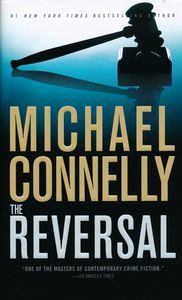
  • The Reversal, Michael Connelly

    The Reversal, Michael Connelly

    Little, Brown, 2010, 389 pages, ISBN 978-0-316-06948-9

    The sheer number of Michael Connelly book reviews on this site will confirm that I’m a fan of the author: Connelly writes crisp, efficient crime thrillers, and even average efforts from him feel like top-notch novels compared to the work of other authors.

    For fans, the good news is that The Reversal once again pairs up two of Connelly’s lead characters.  If “Mickey Haller works again with Harry Bosch on a case!” means nothing to you, then go read other Connelly books first (I recommend The Poet).  But if that tagline means everything, then The Reversal is written just for you.

    It starts with, well, an unusual reversal of roles, as defense attorney Haller is offered a temporary prosecution job: An old case involving the kidnapping and murder of a child is being re-opened decades later due to new evidence, and Haller is the best chance to try the case from a fresh perspective.  This soon turns into an extended family affair as Haller gets to collaborate with his ex-wife and gets his half-brother Bosch as lead investigator.  As usual in Connelly thrillers, complications soon pile up.  Haller realizes that his case is tainted and that he’s being set up for a failure.  Meanwhile, Bosch keeps a close track on the newly-freed suspect given the troubling nature of his night-time habits.  It all leads up to a courthouse drama, but one that won’t go according to accepted procedures…

    As with other Connelly thrillers, The Reversal features a mesmerizing mixture of solid plot mechanics, credible procedural details, well-sketched characters and clean prose.  As would suggest the hybrid nature of a novel starring a lawyer and a policeman, The Reversal is somewhere between a courtroom drama and a police thriller, drawing upon each subgenre to complicate the action.  The interaction between both half-brothers seems a bit more hopeful than most of Bosch’s previous collaborations–which inevitably ended with enough bad sentiments against Bosch to make further collaborations unthinkable.  This time, both step-brothers get along reasonably well and even discuss how their daughters could play together.  Other characters such as Rachel Walling briefly show up as reminders of the expansive nature of the Connellyverse.  Meanwhile, Haller’s musings about being on the other side of the courtroom are fresh enough to bring another angle to the usual police-driven Connelly perspective.

    Where The Reversal falters is in its final fifty pages, when the meticulously constructed courtroom drama abruptly goes down in flames as the suspect does something unpredictable.  Abruptly, the novel switches gears to a disappointing ending in which gunplay takes precedence over procedure, and enough action happens off-screen to make us feel as if the novel was concluded in a rush.  A number of threads are left untied, adding to the unfinished impression.  This disappointing finale, added to a novel that doesn’t really attempt anything new, is enough to make even enthusiastic readers conclude that this isn’t one of Connelly’s best efforts.

    Fortunately, it’s still good enough to keep most readers happy and satisfied.  Connelly’s latest few books, however, have generally been underwhelming as well: There’s a limit to what he can do with Bosch (Nine Dragons showed how far he could push it) and few of Connelly’s experiments with other protagonists, including a return engagement for Jack McEvoy in The Scarecrow, have been particularly successful.  While there’s no cause for alarm yet, it’s probably best to put Connelly on some kind of advance-warning watch-list for authors stuck in their own formula.  Sure, he’s doing well with routine entries… but how long can he maintain this streak?

  • Never Let Me Go (2010)

    Never Let Me Go (2010)

    (In theaters, October 2010) Kazuo Ishiguro’s Never Let Me Go is generally acknowledged as a Science Fiction novel coming from outside the SF genre, and as such pays more attention to fine prose, character development and inner monologue than SF devices, coherent word-building or narrative excitement.  As an adaptation, Never Let Me Go feels a lot like that, with a thin plot, leisurely pacing and constant focus on the three lead actors.  (Carey Mulligan, Andrew Garfield and -to a lesser extent- Keira Knightley all do well with their roles.)  The muted colors of the cinematography reflect the restraint with which the characters react to their fated lives, and the lack of urgency in the telling of the story is designed to let everyone reflect at lengths about the situation.  It’s one of those rare (and largely mythical) SF movies without obvious special effects, and as such should earn a bit of respect from the genre-reading crowd.  On the other hand, that genre-reading crowd will be more likely to recommend the film to others as accessible-level SF than to appreciate the film for themselves, given how it vaguely sketches the alternate-reality of the story’s universe, and features largely passive characters whose role is to stare into the face of inevitability.  There is, however, something very interesting in the film’s emphasis on sub-culture mythology, with a series of ill-informed rumours (all of them knocked down one after another) forming a good chunk of the characters’ inner landscape due to the absence of more reliable information.  (The final revelation perfectly fits into this motif.)  Does the world of the film hold together?  Absolutely not, but it doesn’t even try to address plausibility, betting instead on the real emotional core of the trio at the middle of the film.  Never Let Me Go will be a bit too slow and thin for some, but it’s a success in the same way that Atonement and other middle-brow character dramas can be.  Don’t let the “Science Fiction” label create false expectations…

  • 61 Hours, Lee Child

    61 Hours, Lee Child

    Delacorte, 2010, 383 pages, $34.00 hc, ISBN 978-0-385-34058-8

    Lee Child’s eminently capable hero Jack Reacher has been in a number of desperate situations before, but I don’t think he’s ever been as cold as in 61 Hours.  Taking place in wintry South Dakota, this fourteenth Reacher novel does for sub-zero temperatures what Echo Burning did for the Texan heat.

    The set-up is ingenious: A lawyer is instructed by his incarcerated client to set up a series of events that will end up shaking a small community.  But in his driving haste, the lawyer causes an accident that strands a busload of passengers in the nearby town of Bolton.  Among the passengers is Jack Reacher… and he quickly concludes that the local police force is no match for what’s about to happen.  Asked to protect a crucial witness, Reacher realizes that there’s a lot more going on in this community than anyone could expect… and that many of the answers lie underneath a mysterious military installation not too far away.

    As with previous Reacher thrillers, the chief attraction of 61 Hours is in seeing the hero react to his environment, understand the situation, call upon new friends, use his prodigious powers of deduction, and being slowly led to confront the real threat.  It takes a while for the true plot to reveal itself, and the masterful way in which it takes shape is one of the reasons why Child remains one of the best thriller writers currently in the business.  Lesser authors will envy the skill in which the first chapter is set up, with enough procedural detail, purposeful mystery, powerful narrative hooks and ticking clock.  It’s all there in the first few pages, and Reacher fans will just want to let themselves sink in a good chair and enjoy the rest of the book.

    Most of what follows is just as good as other novels in the series.  After the frantic urban frenzy of Gone Tomorrow, Child is back to heartland America with his depiction of a cold small Dakotan community.  The presence of a supermax prison not too far away sets up a few delightful complications, whereas the nearby abandoned military base is also a rich magnet for revelations.  It climaxes in a fight in which Reacher’s usual advantages are negated, further proof that Child is still interested in mining all sorts of possibilities from his series.

    Barely worth noting is a brief reference to Reacher being identified by the Army as an aggression child prodigy; that, like his freakish gift for numbers in Bad Luck and Trouble, probably won’t ever be referred to again.   Also worth forgetting is the revelation of a criminal informer within friendly ranks: Either Child is getting predictable or he tips his hands way too early, because the mole is far, far too easy to identify even as events are occurring.

    Stylistically, 61 Hours is notable for the dramatic countdown announced by its title: All chapters end up with a reminder of the current time, and how many hours/minutes are left before… something.  That something, alas, ends up being a cliff-hanger ending.  And if you don’t want to hear more about the biggest misstep in the Reacher series since the hypnosis nonsense in Running Blind, skip the next two paragraphs:

    It’s not entirely a cliff-hanging ending: The main plot is wrapped up, the antagonist is punished and the revelations are exhausted.  The only thing left hanging, in fact, is Reacher’s fate: The story concludes with him desperately racing toward an exit, whereas the epilogue describes in rich and meticulous detail why no one could have survived his predicament.  The novel ends without Reacher in sight, most surviving characters concluding that he’s definitely dead.

    But is he?  Peeking ahead to the next Reacher novel, Worth Dying For, reveals an infuriating answer: Reacher is alive (no surprise here), but the explanation of his survival is so vague as to be useless: the various obstacles described in 61 Hours’ epilogue are not acknowledged, and so we’re left with an unfulfilled mystery.  A latter book may fill in the blanks (there are indications that Reacher sets out to meet a character introduced in 61 Hours) but who knows?  Why conclude the book in this way if it’s not going to mean anything?

    If readers can stomach its meaningless cliff-hanger, 61 Hours is another decent entry in the Reacher canon, and further proof of Child’s ability to wring thrills out of small American towns.  The chills felt by readers won’t necessarily be caused by the novel’s glacial setting.

  • The Time that Remains [Le Temps qu’il Reste] (2009)

    The Time that Remains [Le Temps qu’il Reste] (2009)

    (On DVD, October 2010) What an odd, odd film.  It starts by tackling a subject from a perspective unfamiliar to most western viewers: The occupation of Palestine during the 1948 foundation of Israel, and the life of Palestinians ever since as seen by the Palestinians themselves.  Writer/director Elia Suleiman chooses to divide his film in four distinct periods (1948, 1970s, 1980s and 2000s), following a family in attempting to describe the impact of Israeli rule over Palestinian culture.  By the last period, the last links to the past are dying, people can’t get out of their houses without a tank tracking their every movement and criminals are leading the police around.  It’s fiercely political, but in a way that shies away from outright confrontation: The Time that Remains rather adopts a curiously comic tone that defies description.  There are enough stylistic choices here to fill a much lengthier review, but the two that stand out the most are the obstinately static camera and Suleiman’s absurdly one-note performance as a silent man constantly stuck in the same body language.  There is little here in terms of conventional movie-going enjoyment: The rhythm of the film is mortally slow (something that the fixed camera doesn’t soften), the comedy refers on cultural references that feel completely lost in translation, and the off-beat script means never having any idea how to react to the film.  But it does have a lot to say, even though you may need to trawl smarter people’s reviews of the film to figure them out.  It is, in other words, quite an experience: I don’t think there’s any film quite like it, and that’s already a divisive recommendation in itself.  The Region-2 French DVD features an equally-mystifying short film and an interview that gives a glimpse in Suleiman’s artistic process.  (Note that the film’s production origins are a hodgepodge of financing and production companies: I’m not sure what the real title or country of origin of the film actually is, and have tagged it as an English-titled film from Israel as an ironic convenience.)

  • Zatôichi [Zatoichi: The Blind Swordsman] (2003)

    Zatôichi [Zatoichi: The Blind Swordsman] (2003)

    (On DVD, October 2010) Even though it’s hard to mistake a film in which dozens of people get killed by a katana-wielding swordsman as anything but an action movie, Zatoichi is so off-beat in its approach to the genre that it escapes clear-cut designation.  This difference starts with the lead character, a blind masseur who is quickly revealed to be a supernaturally gifted swordsman, with other senses giving him all the edge he needs against his enemies.  Though the film does itself no favours with a deliberately slow first act, it eventually moves on to present an alliance between the blind swordsman and two orphans trying to find their parent’s killers.  The historical recreation of rural Japan is convincing, but it’s the film’s constantly unconventional nature that provides much of the entertainment in-between CGI-enhanced bloody deaths.  I’ve been meaning to see anything by writer/director Kitano “Beat” Takeshi for a while now, and this film is as good an introduction as I needed.  Eschewing traditional action movie pacing and tone, Zatoichi often whimsically stops its plot for a contemplative moment or two, going back and forth between high art and low comedy (and even lower violence) as it chooses.  Even fans of more traditional Asian action cinema will be caught off-guard by the film’s refusal to play by the usual genre conventions.  Still, there is a lot to like here, in-between striking images, a compelling title character and the charming out-of-nowhere final dance number that wraps up the film more effectively than any triumphant finale.