Year: 2010

  • Tell-All, Chuck Palahniuk

    Tell-All, Chuck Palahniuk

    Doubleday Canada, 2010, 179 pages, C$29.95 hc, ISBN 978-0-385-66631-2

    Sometimes I wonder how many books it takes for an author to get scratched off from my “buy on sight” list.  I don’t have a definitive answer yet, but I will soon going to have another data point to consider if Palahniuk keeps going like that.  I’m not sure what happened after Rant, but everything he’s done since then has been underwhelming: Snuff couldn’t out-weird its own porn-star inspiration and Pygmy was an unreadable mess.  Tell-All manages to be a bit better than Pygmy, but not by much… and not enough to escape the feeling that Palahniuk may be due for an extended holiday.

    The novel is written as a tell-all from a woman who has spent her life caring for one of Hollywood’s biggest stars.  The stylistic devices that accompany this conceit are a deliberate appeal to movie-script lingo (“Act II, Scene One: For this next scene, we open with a booming, thundering chord from a pipe organ” [P.149]), direct addressing of the reader, repetition of a few barnyard noises, as well as the gossip-column-inspired boldfaced name-dropping of every new person, title, brand or group.

    It’s a measure of how disappointing Tell-All can be that none of the devices seem all that original; that the story itself seems familiar; and that it all feels like a faded black-and-white copy of earlier Palahniuk novels.  The opening sting of the book is “Boy meets girl.  Boy gets girl. Boy kills girl?” and even then you can hear the weary sigh of fans realizing that Palahniuk hasn’t reached any deeper in the bag of plots that the one that drives nearly any romantic suspense ever made.  A quick read through the book only confirms the impression: this is weak stuff and no amount of tepid stylistic tricks can masquerade that lack of interest.

    The execution isn’t entirely dull, but that’s not really high praise coming so soon after the unreadable Pygmy.  It’s not that Palahniuk has been lazy: The novel, taking place around 1960, is peppered by references to long-faded fifties stars.  That does have its own educational value (it reflects badly on me that I had to look up Lillian Hellman to realize that she wasn’t a fictional character), but Tell-All’s historicity offers little other than plenty of whooshing references, wasted winks and further distancing from the novel.  The appeal to nostalgia is undermined from the very first few pages by Palahniuk’s Gen-X sarcasm: I suppose that it makes sense to go back to pre-Technicolor days for a well-mannered story of fatal screen glamour, but he displays too little affection for the time and too much mean-spirited sniping to qualify for the nostalgia bonus.

    For better or for worse, Palahniuk has conditioned his fans to expect more.  Clocking in at a bit less than 200 pages, Tell-All feels both insubstantial and overblown. There isn’t much to gnaw upon, and at the same time it feels too long even midway through.  It’s a short story that has been padded to (barely) novel-length… for which we’re supposed to pay thirty dollars.  Clearly, Palahniuk’s entertainment-for-money ratio has declined precipitously in the past few years.  A quick curious look at the novel’s Amazon rating shows three-stars-out-of-five (with a histogram that peaks at two-stars-out-of-five), which is really scraping the barrel as far as Amazon rankings go.

    At some point, maybe now or maybe next book, it will be useful to start thinking about whether Palahniuk himself is in irreversible decline.  His shock-shtick has peaked in Haunted, and one wonders if the young post-adolescent males most likely to go nuts for his books aren’t turning to uncensored online forums for savage satisfaction.  Sometimes, a writer runs out of things to say and starts coasting on his reputation, and soon it will be appropriate to start wondering if Palahniuk is at that point.

    But now, though, it’s enough that Tell-All is better than Pygmy, in much the same way that a clearly suicidal person has at least taken a step away from the ledge.

  • The Town (2010)

    The Town (2010)

    (In theatres, September 2010) Who would have thought that barely seven years after the nadir of Gigli, Ben Affleck would re-emerge as a significant director of Boston-based crime dramas?  Strange but true: After wowing reviewers with Gone Baby Gone, Affleck is back with another Boston thriller in The Town, this time taking a look at a gang of professional bank robbers as one of them begins a relationship with an ex-hostage of theirs.  Deceptions accumulate alongside complications as the gang keeps planning heists, the FBI is tracking them closely and the lead character wants out of his own life.  It’s the complex mixture of crime, action, romance and drama that makes The Town work, along with a clean direction, a good sense of place and a few capable actors.  Jeremy Renner is once again remarkable as a hot-headed criminal, whereas Jon Hamm gets more than his fair share of good lines as a dogged FBI agent.  The script feels refreshingly adult, full of difficult entanglements, capable performances and textured moral problems.  The adaptation from Chuck Hogan’s novel is decent, although most readers will be amused to note that a movie theatre heist has been replaced by something else entirely.  More significant, however, is the flattening of the FBI agent character and the far more optimistic conclusion of the film –in the end, the movie feels more superficial in general but also more satisfying in its closure.  The Town isn’t flashy, though, and this may be what separates it from a longer-lasting legacy.  No matter, though: it’s a good a satisfying film, and one that confirms what Affleck is now capable of accomplishing.

  • The American (2010)

    The American (2010)

    (In theatres, September 2010) Art-house character drama and audience-baiting hit-man thriller collide unhappily in this glacially-paced adaptation of Martin Booth’s novel A Very Private Gentleman.  (The re-titling of the adaptation as The American is hilarious in itself, as the book’s narrator pays painstaking attention to not revealing his precise nationality.)  While the book is a study of a character who happens to be a recluse gunsmith for assassins, with little in terms of action or thrills, the film rearranges, changes or adds elements in order to pump up the suspense (even flipping the book’s character to suggest that he is primarily an assassin with a sideline in gunsmithing), a manoeuvre that doesn’t manage to overcome the loose plotting, lengthy silences and static shots of Anton Corbijn’s direction.  The American feels like a very European film thanks to its contemplative mood and frequent female nudity, but it’s lessened by attempts to momentarily turn it into a genre picture when it’s most comfortable at a slower pace.  George Clooney is good and slightly atypical as the lead character, but it’s Violante Placido who’s the film’s revelation in a somewhat friendlier role.  The American is far better as a placid character piece than a limp action thriller: Either adjust expectations accordingly, or skip the film entirely.

  • Divine Misfortune, A. Lee Martinez

    Divine Misfortune, A. Lee Martinez

    Orbit, 2010, 307 pages, C$24.99 hc, ISBN 978-0-316-04127-0

    I have read practically everything by A. Lee Martinez, but only reviewed a few of his books: While his premises are almost always interesting, what he does with them isn’t always worth talking about.  He seems to have one favourite plot structure in his bag of tricks: show a few ordinary oddball characters in amusing genre situations and reveal one of them to be a hidden god fit to do battle against a terrible enemy beyond space and time in a bid to control all of the multiverses.  It’s not a bad plot per se –but like so many other overused things, it really starts grating when it happens over and over again.  A Nameless Witch particularly suffered from this plot device overuse, as did Monster.  Adding to the problem is that Martinez is never as enjoyable as when he’s writing about ordinary people stuck in extraordinary situations: the moment he reaches for the overblown, the metaphysical or the multiversal, I could hear my interest in his books falling to the floor… to remain there.

    With Divine Misfortune, he revisits this familiar plot, as our lead characters are once again stuck in-between warring gods.  But wait!  The premise is, for once, used effectively.  There are fewer surprises on the way from mundane strangeness to all-out divine combat.  Our ordinary character courts divine intervention from the get-go and the framework of the novel’s universe is suitable to such things.  After all, Divine Misfortune takes place in an alternate dimension in which gods are real and can be courted by mortals.  Their influence comes directly from the number of worshipers they have and if everyone wants a piece of Zeus or Yahweh, there are thousands of other gods willing to pay just a bit more personal attention to you if you can prove to be an effective worshiper.  There aren’t many differences between our contemporary North America and theirs, except for video-matching services for suburban go-getters looking for an extra advantage in life.

    People like Teri and Phil, for instance: ordinary white-collar workers looking for a bit of help for their commute and mortgage.  Teri’s never been one to worship a domestic god, but Phil thinks it’s a splendid idea, and before long the couple has settled upon Raccoon-shaped Luka, a minor god of prosperity who will make things go their way… as long as he can crash on their couch for a few days.  The welcome-in party, at least, gets epic as soon as Luka invites his friends…  and some of them start hanging around.  Divine Misfortune may be the only novel so far in which we get a laugh out of Hades being beaten at Death Ninja 3, and at Quetzalcoatl lounging on the couch, “watching telenovellas”.

    In between divine domesticity, we get glimpses at other gods, some of them definitely nastier than others.  So when Phil starts fighting off unusually violent squirrels and being used as a Job-like figure between warring gods, we’re ready for the escalation and the result feels like a logical plot development rather than something thrown in there to lead the story somewhere.  The big finale uses so many gods that it starts feeling like a comic-book cross-over event, but Divine Misfortune never quite completely loses its connection with its ordinary characters, and that’s one of the reasons why it succeeds at the exact point when some of Martinez’ other novels became less and less interesting.

    It goes without saying that the novel is joy to read, in-between the light-hearted details of a universe in which gods can directly influence human destiny.  It’s not a laugh-riot, but it’s good enough to keep up a smile during most of its duration.  While Divine Misfortune doesn’t have the mythological weight of more ambitious fantasy such as Gaiman’s American Gods, it’s after a different kind of impact and it succeeds quite a bit better than many of Martinez’ other books.  It’s probably still a bit too scattered (some of the scenes involving the antagonist felt too long and laugh-free compared to the rest) and the last act gets a bit too dark, but it’s better-handled than most of the author’s other novels –and there’s more basis for comparison there than the usual.  This is Martinez’s best since The Automatic Detective and Gil’s All-Fright Diner; I just hope that he’s got the sense to realize that he’s done the “fights between gods” shtick as well as he possibly can, and that he can now move on to something else.

  • Takers (2010)

    Takers (2010)

    (In theatres, September 2010) Keeping expectations low is one way to best appreciate Takers given how this surprising California-noir crime thriller recycles a bunch of familiar elements into a watchable whole.  The story, about a crew of Los Angeles professional bank robbers pulling off one last heist even as the FBI is closing on them and dissention strikes within their ranks, is so generic as to approach cliché: You can pick bits and pieces of Heat, Cradle 2 The Grave and even The Italian Job out of the finished result and it’s not as if the dialogue is anything special.  Worse yet is the direction, which feels forced to use an incoherent shaky-cam style every time something interesting is happening, undercutting our ability to make sense of what’s going on.  But despite the problems, it works: Takers features a fine multiracial cast (with special mention of Idris Elba, Michael Ealy and Paul Walker), a snappy rhythm, a few surprising stunts and a compelling sense of place for Los Angeles.  What may sour the impression left by the film is a curiously off-balanced moral center, with fairly unpleasant cops taking on glamorous criminals with crime-financed luxurious lifestyles: The ending provides plenty of bloodshed and little reassurance as to who, if anyone, actually fulfilled their objectives.  Still, if Takers may not be original… it’s entertaining enough.

  • Machete (2010)

    Machete (2010)

    (In theaters, September 2010) When a trailer for then-fake film Machete appeared attached to Grindhouse three years ago, the joke worked pretty well.  But would it survive being turned into a feature-length film?  As it turns out, Machete the film is what Machete the fake-film trailer had promised: A fully entertaining mixture of exploitation filmmaking, populist indignation and self-aware cinematic winks.  Bolstered by one of the most amazing cast in recent memory, Machete finally gives a much-deserved featured role to the mesmerising Danny Trejo, with fun parts for such notables as Robert De Niro, Steven Seagal, Lindsey Lohan, Jessica Alba and Michelle Rodriguez.  Everyone looks like they’re having fun, which is in keeping with the film’s mexploitation theme: if you’re going to make a movie that plays to the audience’s bases desires for nudity, action and revenge, why not do it well?  Writer/Director/Editor Robert Rodriguez certainly knows what he’s doing: the editing lingers on the nudity, stays long enough on the action and flashes past the goriest violence so that we can enjoy the film’s dark humour without being repulsed by its excesses.  (Rodriguez may not have been the film’s sole director, but it’s unmistakably his film.)  It’s a terrific piece of grindhouse cinema, but it comes with quite a bit of populist decency.  The Latino diaspora is colourfully represented by food, more food, Catholic symbolism and a distinctive aesthetics: Add to that a striking case for respecting immigrant rights, and Machete becomes a film that speaks loudly about basic human rights while still delivering a hefty dose of disreputable entertainment.  In short, it’s a film that works on a number of levels, not the least of which is a considerable amount of sheer movie-going pleasure.  Knowing Rodriguez’s considerable personal charm and fondness for explaining the movie-making process, I can’t wait until it comes out on video.

  • The Pillars of the Earth, Ken Follett

    The Pillars of the Earth, Ken Follett

    Signet, 2007 reprint of 1989 original, 983 pages, C$8.99 pb, ISBN 978-0-451-16689-0

    This isn’t quite an application of the Baader-Meinhof Phenomenon (“the phenomenon where one happens upon some obscure piece of information– often an unfamiliar word or name– and soon afterwards encounters the same subject again, often repeatedly.” to quote damninteresting.com), but once I started hearing about Ken Follett’s The Pillars of the Earth, I started hearing about it everywhere.  Idle musing on which “big thick paperback” to carry along with me on a two-week trip to Australasia netted me two independent recommendations for the novel.  Then the TV miniseries went on the air, which probably in turn explained why I spotted another airplane passenger reading it in the next row.  For a book I hadn’t noticed until a few weeks ago, that’s quite a series of coincidences.

    Oh, I did know about Ken Follett –but until then, I had him pigeonholed as a writer of not-overly-interesting suspense novels, many of them featuring characters for which I couldn’t feel any sympathy.  But The Pillars of the Earth is something very different: An epic historical novel taking place from 1123 to 1174, featuring a large cast of characters all somehow involved in the building of a massive cathedral.  Not my usual kind of novel either but hey –it was big, thick and looked as if it could keep me interested during no less than eight plane flights in seventeen days.

    The risk, of course, was that the novel would prove to be a dud, and that it would fall from my hands after a few dozen pages.  Then I’d be stuck with it for a seemingly endless time.

    I shouldn’t have worried: From the very first pages, Follett does an exemplary job at establishing his characters and throwing them into difficult situations.  In the first chapter, in fact, one of our characters has his most precious property stolen, kills the thief, loses his wife in childbirth, abandons his child, sleeps with another woman and discovers that his newborn has been rescued by a monastery.  This is hard-core shock plotting, and it works unbelievably well at establishing the tone of the novel: The Pillars of the Earth is epic, harsh and pulls no punches in its depiction of twelfth-century England.  There’s as much violence as there are sex scenes –and a number of those sex scenes are violent as well.

    As with many good historical novels, The Pillars of the Earth is a mixture of modern values and historical attitudes.  The strong female characters clash with the restrictions of the era, the powerful church routinely interferes with the weak kings (it’s not as if there’s just one of them either) and a number of the things we take for granted (say, the rule of law) are still hundreds of years in the future.  Follett gives a good idea of how it must have been to live at the time, and the result is absorbing from beginning to end.

    As far as plotting is concerned, it’s a mixture of dastardly villains, pure-hearted heroes, sins committed for pure reasons and spiteful accidents.  Many characters die (some of them unexpectedly), but pretty much everyone gets what they deserve in the end.  The cathedral around which the plot revolves is built, abandoned and rebuilt more often than you’d think.  There are some coincidence-dependent plot junctions, but they don’t feel as arbitrary as predestined.  The pacing only flags during the last section of the novel, which tends to diffuse itself rather than end on a high note once the plot-lines are resolved.

    But it all amounts to an extraordinary reading experience, indeed one that is only available from big thick books such as this one: The Pillars of the Earth is an epic in the unadulterated sense of the term, and readers will be able to be comfortably absorbed by the novel until it ends.  It lives up to my friends’ hype as an amazing novel… and one that’s well worth taking along on a lengthy trip.

    For Follett, it also represented a radical shift from his more familiar cookie-cutter thrillers, and one that he still seems to enjoy: The Pillars of the Earth was only followed by sort-of-sequel World without End in 2007, but Follett now seems to be in the middle of writing a trilogy of historical novels covering the entire twentieth century.  It’s heartening to see an author taking such a chance and being rewarded for it: Another proof, if any other was needed, that it’s a good idea to write whatever you want and worry about market expectations later.

  • Exit Through the Gift Shop (2010)

    Exit Through the Gift Shop (2010)

    (In-flight, September 2010) The facts, as presented by Exit Through the Gift Shop, seem to be these: Thierry Guetta, a Frenchman living in Los Angeles starts following graffiti artists with a video-camera as the “street art” scene gets going, gathering the trust of such notables as Banksy and Shepard Fairey.  Challenged by Banksy to make art, our hero-videographer reinvents himself as “Mister Brainwash” (MBW) and designs his emergence on Los Angeles’ art scene through a staggeringly deliberate show in which most of the actual art is sub-contracted to a team of artists working to his specifications.  The impression left by the film is one of tables being turned; the videographer making a film about Banksy turning up as the subject of a Banksy documentary.  It’s a terrific story, but is it true?  There are enough niggling details to make a sceptic out of even the most forgiving viewer: This is, after all, “a Banksy film”, and the horror-show of a sufficiently driven non-artist manufacturing themselves as a major talent in today’s contemporary art scene has a very Banksyan quality of subverting bourgeois artistic assumptions.  The film asks us to believe in a uniquely driven amateur videographer assembling footage in bulk, but who is truly making the documentary?  The result, on screen, at least has an irresistible quality, both as a privileged look at the street art scene, as a cautionary tale about the insanity of commercializing art, or even (if rumours of a hoax–or at least engineered performance art–are confirmed) as an ambitious piece of faux-cinema.  Guerra alone is a character in maybe two senses of the term, and his antics alone are a reason why Exit Through the Gift Shop deserves a look.  It’s certainly eloquent: I pretty much hate graffiti, yet still ended up purchasing Banksy’s first art book after seeing the film.

  • The Girl Who Kicked the Hornet’s Nest, Stieg Larsson (translated by Reg Keeland)

    The Girl Who Kicked the Hornet’s Nest, Stieg Larsson (translated by Reg Keeland)

    Viking Canada, 2009 translation of 2007 original, 563 pages, C$32.00 hc, ISBN 978-0-670-06903-3

    The story surrounding Stieg Larsson’s Millennium trilogy is often as interesting as the trilogy itself: Larsson, a left-wing Swedish journalist known for his anti-fascism investigations, turned to fiction writing late in life and delivered the first three books of a series before dying of a heart attack.  The books became a sensation throughout the world, finally landing in North America in 2009-2010 alongside their own movie adaptations.  While rumours abound that a fourth semi-finished manuscript exists, it does so on a computer belonging to Larsson’s long-time partner, who is now locked in a legal battle with the rest of Larsson’s family for a piece of the author’s estate.

    This has little relation to what a review of the third volume of the trilogy should be talking about, except for the open-ended question of whether this is truly the final volume of Mikael Blomvkist and Lizbeth Salander’s adventures.  The Girl Who Kicked the Hornet’s Nest picks up moments after the events of the second volume, as a badly wounded Salander is airlifted to one of Sweden’s best hospitals.  Drama follows when her equally-wounded father/enemy ends up in a room not too far away.  If the previous volume The Girl Who Played with Fire was about revenge, this one is about the consequences of going after one’s enemy with an axe, as the question of whether the Swedish state considers Salander capable of acting on her own comes back to the forefront.  It doesn’t help that she has earned the attention of a powerful faction within Sweden’s own secret services, and that they won’t stop at anything to eliminate the threat…

    Readers who have made it this far in Larsson’s series will be pleased to note that this third volume delivers everything they’ve come to expect from him: A lavishly detailed procedural novel written from an activist point of view, criticizing the underbelly of the Swedish Social-Democratic model –particularly the way it treats women.  Blomvkist once again feels like a Gary-Sue idealized representation of the author (he manages to seduce another female character without doing much more than showing up), and even gets an action scene of his own.  Salander is up to her usual tricks, except for having forgotten her Fermat Theorem Proof in the aftermath of surviving a bullet in the head.  (It’s amusing how insane this sounds once summarized from Larsson’s multi-page explanations.)  It all leads to courtroom drama, and a conclusion that not only provides a happy ending for Salander, but obliterates all of her enemies.  Given the black-and-while nature of the series so far, few will be surprised when it’s revealed that people who oppose her are all violent, stupid, and/or guilty of horrible other offenses.

    The conclusion is curiously satisfying when it shows the Swedish state activating its own self-policing mechanism: the conspiracy is taken down by the proper authorities, and not through some American-style idealized personal vendetta.  It’s one of the challenges of left-leaning writers to portray an effective and compassionate state when the unspoken rule of thrillers is that official corruption always runs deep: Larsson manages quite a deft success in portraying how even the heroes can benefit from some official help.

    Fans of the films will note once again note how much more material is in the book, from a top-level meeting for Blomvkist to an entire subplot taking place at another newspaper.  But that amount of new material also betrays Larsson’s biggest problem: An inability to tell a story efficiently.  There is no need, for instance, to begin the book by spending two pages describing how an American neurosurgeon is asked to assist in Salander’s brain surgery.  At times, the book feels like a lengthy third act to a story that could have been published as a single volume.  It’s exasperating, and the amount of stuff never shown and never missed in the leisurely-paced films adaptations suggests how much fluff there is in the series.

    Alas, we’ll never know for sure if Larsson would have written the other planned volumes in his series in a more economical fashion.  It’s ludicrous to believe that this will remain the final Millennium volume: At a time where napkin premises from long-deceased Robert Ludlum are being expanded in entire trilogies written by other authors, there will be other adventures for Blomvkist and Salander.  They may even be based on Larsson’s actual notes.  But they won’t have the surprise kick that propelled them to such popular attention.

    Considering that Larsson’s books were reportedly the first translated novels to hit the top of the English market’s best-selling list, it’s not as if he has anything left to prove, even posthumously.

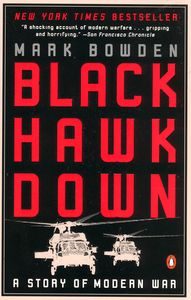
  • Black Hawk Down, Mark Bowden

    Black Hawk Down, Mark Bowden

    Penguin, 2000 revision of 1999 original, 392 pages, ISBN 0-14-028850-3

    Even casual collectors know that the first edition of a book is almost always worth more than any subsequent printing, even more so when the book has enjoyed some success.  The first edition presents the book as it first arrived in the world, without too many expectations or any idea of its true impact.  A nice signed first edition copy of Chuck Palahniuk’s Fight Club or Barack Obama’s Dreams of my Father (to pick two high-profile examples) could have, at their author’s peak popularity, netted you a few thousand dollars.

    But for readers, sometimes it’s better to get a latter, updated edition –especially with nonfiction books: They can include updated information and conclude the narrative arc a bit more firmly.  So it is that a fine first edition of Mark Bowden’s Black Hawk Down will cost you a few dozen dollars, but a far cheaper paperback edition will get you an updated afterword that explains how the book became not only a commercial success, but a classic of military writing and an enduring epitaph of its subjects along the way.  After all, many readers of this review will have heard about Ridley Scott’s 2001 movie adaptation, and associate the city of Mogadishu with what the back cover of the book describes as “the longest sustain firefight involving American troops since the Vietnam War”.

    Which isn’t all that bad considering that when Bowden set out to write the book, the events were on their way to collective oblivion: Americans don’t like to think about their military defeats, and their intervention in Somalia practically qualified as such. As one of the more acute manifestations of the US’s self-image as the world’s policeman following the end of the Cold War, Somalia interrupted the triumphalism of the Gulf War and pushed Americans toward a more cautious foreign policy… at least until 2001.  The turning point of that Somalian adventure was the battle that Bowden describes in Black Hawk Down: a routine capture mission that turned spectacularly wrong when two helicopters were downed and American forces had to fight their way into the city to rescue their own.  The engagement lasted for hours and by the end of it, Americans had suffered nearly a hundred casualties –and left ten times as many Somali dead or wounded.

    Black Hawk Down tells the story of that engagement as a narrative: Based on personal recollections, recordings of the events, contemporary documentation and other sources familiar to investigative journalists, Bowden meticulously reconstructs the battle from as many perspectives as he can, then attempts to present the events as a story with recognizable characters.  The result isn’t just an exceptional piece of reporting: it’s a suspenseful, compulsively readable account of what it feels like to be under fire.  Bowden is able to get in the soldiers’ heads and portray the strange mixture of excitement and terror that comes from mortal danger.  Such credible portrayals are rare, and it’s no wonder if Black Hawk Down became mandatory reading for a generation of American military officers.  The decade since its publication may have been tumultuous in terms of geopolitics, but its impact remains: The images that we get from reading the book aren’t that different from the ones broadcast during the American invasion of Iraq.

    When Bowden started working on Black Hawk Down in the mid-nineties, he wasn’t the most likely writer to attempt such a project: An investigative reporter for the Philadelphia Inquirer, he had none of the military knowledge or unofficial connections one would presume from the final result.  But as he explains in the revised edition’s afterword, he attacked the subject like the reporter he was, and it may be this outsiders’ perspective that makes the book so accessible to various kinds of audiences.

    What’s more, Black Hawk Down has found another niche as an enduring remembrance of everyone who was involved in the events.  For a military engagement that seemed destined to be forgotten, the “Battle of the Black Sea” has, thanks to Bowden and the film adaptation of his work, now been given it due.  And the book remains as an acknowledgement of what soldiers go through in modern military engagement, portraying them at their best when confronted by the worst.  More directly, though, Black Hawk Down is a perfectly-mastered book that will continue to astonish readers for a long time, no matter which edition they can get.

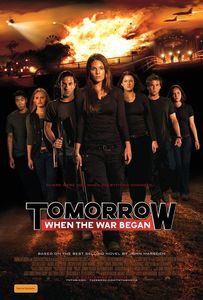
  • Tomorrow, When the War Began (2010)

    Tomorrow, When the War Began (2010)

    (In theaters, September 2010) Chances are good that you will never see Tomorrow, When the War Began in North-American theaters: Despite its generous production values and good action sequences, this is an Australian production based on a series of young-adult books largely published for Australian audiences.  (I was lucky enough to be in Australia when it was released, with a strong marketing push that included public transit buses plastered with the film’s promotional art.)  A quick summary of the film would probably be something like “Red Dawn for Australian teenagers”, as a group of plucky teen protagonists comes back from a quick bush holiday to discover that their country has been taken over by a foreign invader.  Stuck behind, they strike back… with the expected action sequences and fast-paced growing-up that active resistance involves.  As such, it’s really not bad: Some of the writing feels forced and everyone keeps making stupid decisions to advance the plot, but the entire film is entertaining, and many sequences pack some punch.  The characters are sympathetic, and the development of the links between the six protagonists is fascinating to watch.  A few details feel different from the Hollywood standard: The emerging leader of the group is female, she gets involved in a romance with a male of Asian origins, and the ending isn’t a triumph as much as it’s a victory with potentially dramatic consequences.  As a piece of slick blockbuster entertainment, Tomorrow, When the War Began is ripe for worldwide success… pending distribution deal and favourable word-of-mouth.  As for the rest of the series, there are five more books in James Marsden’s “Tomorrow” cycle and three more in the “Ellie Chronicles”: even if the rest of the series isn’t adapted, the story as written will always be there.  Will the film ever make it to North America, even as a straight-to-DVD film?  I’d bet on it.  There’s certainly many worse home-grown movies out there.

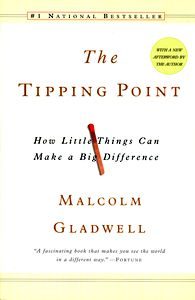
  • The Tipping Point, Malcolm Gladwell

    The Tipping Point, Malcolm Gladwell

    Back Bay, 2002 revision of 2000 original, 301 pages, C$21.95 pb, ISBN 0-316-34662-4

    Ten years after publication, I come to Malcolm Gladwell’s The Tipping Point like a teenager trying to get to a wild party the morning after: The event is over, everyone has gone home, every scrap of nourishment or entertainment has been picked clean and even those who were arrested for disorderly conduct are now home after making bail.

    OK, that metaphor overextended itself, but my point is that there’s really nothing new to say about Gladwell’s book debut that hasn’t already been said by other smarter reviewers.

    By now, for instance, Gladwell’s modus operandi is well-known: He will consider an off-beat idea, bolster it with anecdotes, refer to some real academic work on the subject, link it thematically to other known examples and wrap up everything in accessible, even compelling prose.  Gladwell wasn’t the first socioeconomic vulgarizer, but it’s worth wondering if his popularity hasn’t been largely responsible for Freakonomics and its endless cohorts.  You do feel smarter after reading Gladwell and his colleagues, but it’s never too clear if it’s just an impression.

    Most of those overall qualities are obvious from his book-length debut The Tipping Point, a book that studies how an accumulation of small changes can abruptly produce a dramatic effect.  Despite Gladwell’s assertions that this is a counterintuitive idea, it really isn’t new –having been enshrined in popular culture through expressions as common as “the straw that broke the camel’s back” and, indeed, the “tipping point” of the title.  It’s a bit of an achievement that Gladwell never once mentions catastrophe theory (“sudden shifts in behavior arising from small changes in circumstances”), despite decades of mathematical research in such matters.  But that’s OK: Gladwell is in the business of selling books (many of them to so-called serious decision-makers), so it’s in his interest to pretend that this is all new stuff.

    On his way to a demonstration of his topic, Gladwell takes many roads, many of them eloquent in the narrative power of anecdotes rather than convincing research supporting his assertions.  Some scepticism, obviously, is warranted… especially in soft-science fields in which conclusive proof is so difficult to obtain.  For Gladwell, data seems to be the plural of anecdotes, and the stories he chooses to illustrate his sub-theories are often so much fun to read that readers can be expected to overlook that they are merely a few successful instances of his book’s thesis.  Tales in The Tipping Point include a look at the success of the novel Divine Secrets of the Ya-Ya Sisterhood, the resurgence in Hush Puppies, the Sesame Street / Blue’s Clues model of television shows and Airwalk’s destructive flirtation with mainstream success.  It’s wrapped up in enough psycho-babble to convince anyone that these are examples to emulate.  You can almost picture businessmen studying the book, stroking their chins and thinking Yes, this book will lead to increased sales!

    But this cynical take on Gladwell’s narrative strategies minimizes the reading pleasure of his prose.  His writing skills, honed after years in the newsroom, are able to grab readers’ attention quickly and guide them through a series of complex arguments.  Among other successes, The Tipping Point features a crystal-clear explanation of the Broken Windows theory of social decay, and the wide variety of sub-themes is enough to make intellectually-curious readers race through the book in search of the next big memetic discovery.

    I’m certainly not immune to the springboards that Gladwell builds in his book.  A brief explanation of how ethics are often largely circumstantial had me thinking out loud about making a moral argument for proper planning and preparation: Someone in a hurry or without alternatives is often forced to make choices that run counter to ethics, thrift or good social graces.  In this context, being prepared is one way to ensure virtuousness.  (But I say this as a former Boy Scout…)  Anyone reading The Tipping Point next to friends and loved one should be aware that they’re liable to keep up a stream of quotes, paraphrased ideas and grunted hunhs fit to annoy anyone within earshot.

    Fortunately, it’s this quality that makes The Tipping Point such an essential read even after ten years of being picked apart by various people.  It’s a fascinating launching pad for ideas of your own, it connects together different fields in fascinating ways and it remains a highly readable work of pop sociology.  It’s also a great introduction to the rest of Gladwell’s work: given his pre-eminence as a public intellectual, you might as well start somewhere in reading everything he’s done, right?

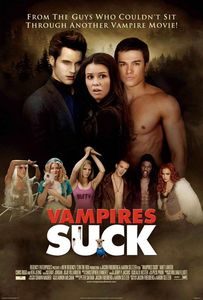
  • Vampires Suck (2010)

    Vampires Suck (2010)

    (In theaters, August 2010) Given that Jason Friedberg and Aaron Seltzer have one of the most pitiful filmographies in cinema history, any savvy filmgoer willingly choosing to go see their fifth film has only themselves to blame if it ends up a terrible experience.  (Even if one’s excuse is, ahem, “I’m on a different continent, I want to see a movie and I’ve seen all of the others at the neighborhood theater.”)  Their concept of “spoof comedies” is closer to “dumb retelling”, and even if Vampires Suck takes on the much-deserving Twilight series as a target, it’s not necessarily any more interesting than its Epic Movie or Disaster Movie predecessors.  They simply re-create a few key sequences, add in more profanity, violence and pop-culture references and expect that the simple shock of recognition is enough to make audiences laugh.  There is little commentary on the source material: both times that Vampires Suck attempt to say something insightful about Twilight, it’s instantly followed by self-congratulatory “I’m so smart!” punch-lines that makes it feel dumber.  Otherwise, the film jerks from one familiar reference to another, occasionally scoring a smirk in the same way a thousand shots from a thousand shotguns will eventually hit something worthwhile.  (That the source material is so poor and so ripe for satire isn’t much of an advantage: I have seen several Livejournal posts from fans getting better laughs out of the series’ problems.)  What’s most striking, I suppose, is the poor quality of the humour and the imagination surrounding the parody: The actors do OK (Jenn Proske is particularly on-target spoofing Kristen Stewart-as-Bella) and the technical qualities of the film are good enough given its budget, but both the writing and direction aren’t anywhere near feature-film quality.  The good news, writing this review after weeks of therapy, is that Vampires Suck didn’t make all that much money: Reviewers can bark and growl impotently, but studio executives looking at financial statements can be far more effective in ensuring that we never see anything from Friedberg/Seltzer again.

  • Piranha 3D (2010)

    Piranha 3D (2010)

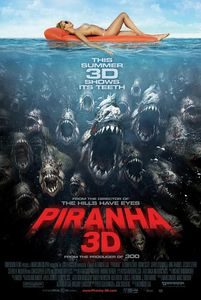
    (In theaters, August 2010) I can appreciate a good monster film despite not being much of a gore-hound, but Piranha 3D caters far too much to that latter crowd to feel like an entertaining experience for all.  Oh, it starts out promisingly enough: The first half-hour sets up a light-hearted monster movie in purely classic fashion: A few plucky heroes, a town threatened by monstrous creatures, the promise of plentiful T&A and a tone that lets you know that this is all going to be awesome.  The pacing may be a touch too slow, but the direction is sure-footed and the genre’s plot structure is faithfully followed.  Where Piranha 3D is a bit more explicit than usual is in its exploitation factor: Viewers are treated to an artful underwater Sapphic interlude (in three dimensions, no less) and promising portents of doom at the intersection between Spring Break bacchanalia and flesh-eating monster fish.  Self-aware and unrepentant, it initially feels like a good old-fashioned monster feature, good for a few shocks and plenty of blood.  Ironically, it’s what Piranha 3D does too well that kills it: When the Big Scene comes around to show the piranhas attacking the spring break students, the result is so bloody, so gory and so mean-spirited that the cumulative impact of the ten-minutes sequence is more stomach-churning than horrific, let alone entertaining: It put me in the frame of mind of seeing a documentary about a massacre rather than an unpretentious monster film, and enjoying the film after that moment became an exercise in futility: the fun of Piranha 3D had been leeched out as soon as people started being gutted, scalped or gnawed to the bone.  (And that’s not even saying anything of the pacing let-down of the film’s last act.)  But, to repeat myself, I’ve never been a gore-hound –and I’m aging out of that market segment no matter what.  Despite recognizing a good chunk of the film’s up-to-the-moment soundtrack (it even features Hadouken!), I’m getting far too old for gore-fests such as Piranha 3D –and if this is the kind of nihilistic meat-grinder “entertainment” that I’m going to be “missing” from now on, I’m looking forward to old age.

  • For the Win, Cory Doctorow

    For the Win, Cory Doctorow

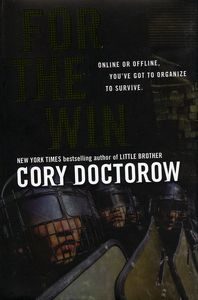
    Tor, 2010, 475 pages, C$19.99 hc, ISBN 978-0-7653-2216-6

    Trying to summarize Cory Doctorow’s latest novel For the Win in a few words is an exercise in frustration, because with every “didactic” comes along a “fascinating”.  It’s a logical extension to Doctorow’s bibliography so far… except that it sometimes appears to flip over the libertarian ideology of Makers.  It’s perhaps Doctorow’s least pleasant reading experience so far… except that when it stops telling a story, it can be really good.

    For the Win is Doctorow’s second novel for the Young Adult market, and like Little Brother it’s using that readership to indulge in some blatant speech-making.  It can’t help but try to explain how the world works, and those interludes are often far more interesting than the plotting surrounding them.

    Briefly summarized, For the Win is about online multiplayer games and the strange economic phenomenon surrounding them.  The uninitiated may find this a trivial subject for discussion, but there’s a lot more under the surface that it may appear at first.  Consider that the target audience for those games are often first-world gamers with more money than time.  Combine that with gaming mechanics that are designed to keep players coming back to “grind” their way up in search of infrequent payoffs and you already have the raw elements for global exploitation, via the use of third-world workers (often children) who have a lot more time than money… and none of the protections afforded to employees in developed countries.  Could it be time to unionize?  Mix well, and you’ve got the elements of Doctorow’s uniquely contemporary thriller.

    Does it work?  In many ways, For the Win is so admirable that it doesn’t really matter if it does.  Take, for instance, that none of the main teenage characters in the novel are purely American –the only one who hails from California is such a Sinophile that he adopts a Chinese name throughout.  The rest of the characters are largely from developing countries, lending a pleasantly globalized feeling to the entire novel.  Not that it could have been otherwise, given the networked nature of its plot devices and the globetrotting scope of the narrative.  For the Win inhabits the world of the present, not some fading refraction of yesterday’s futures.

    It gets even better once Doctorow starts making links between the nature of gaming, the illusion of modern economic derivatives, the inadvertent exploitation of third-world teens by clueless first-world gamers, and the opportunities that well-connected youth have in bettering their lot in life.  Politically, I couldn’t help but be struck by the way For the Win espouses a leftish drive for unionization and tries really hard to make it fit with the increasingly swim-or-sink nature of Doctorow’s latest Makers.  There may not necessarily be a conflict once you can reconcile information-network libertarianism with worker’s right regulation, but it amounts to a complex multi-book political exploration for Doctorow, one that recalls (gasp) Heinlein’s ability to argue several points of views in successive novels –and one that also follows in Heinlein’s didactic footsteps.

    Snappy exposition aside, For the Win‘s highlights also includes a number of showcase sequences that stick in mind not for their narrative content, but for their geek wish-fulfillment power.  For instance, Doctorow lavishly imagines what it would be like to engineer your own transpacific trip via a shipping container custom-modified to act as a long-haul dwelling… complete with high-speed Internet access.  It’s the kind of bravura sequence that doesn’t really need a story, which is just as well given the lessened interest that much of the book’s plot can hold for some readers.  For the Win is full of fascinating bits, but the structure holding them together is more interesting for what it allows than the way it bolts it all together.

    But does it matter?  Doctorow’s fans are unlikely to be put off given how closely For the Win follows on the footsteps of his previous works.  Reviewers are unlikely to give the novel less than good notices for everything it does right, even though much of the story itself may lack narrative excitement.  Meanwhile, critics will jump on it and delight at whatever meaning they can tease from its chapters and links with other up-to-the-moment fiction like William Gibson’s Zero History.  Oh, and teenagers will love it.  Given all of those wins, why hold on to old-fashioned narrative values?