Month: February 2018

  • The Poseidon Adventure (1972)

    The Poseidon Adventure (1972)

    (On Cable TV, February 2018) Considering my criticism of the Poseidon remake, I find it almost amusing that much of what I don’t like about the original The Poseidon Adventure is what didn’t work decades later. Much of the film feels like a repetitive loop as the survivors of a capsized cruise ship try to make their way out of the wreck: Encounter an obstacle, lose a member of the cast, and proceed to the next obstacle. There’s a high point during the initial disaster, and the plot does get slightly more interesting in the last half-hour, but much of The Poseidon Adventure feels too long and repetitive. The premise does have a whiff of originality to it (arguably extinguished by the remake), and it’s mildly interesting to see Leslie Nielsen pop up in what could have been a major role in any other movie. Otherwise, Gene Hackman is not bad as a priest questioning his own faith, and Ernest Borgnine makes for a capable foil throughout the ensuing adventures. The special effects are occasionally good, although the CGI achievements of the sequel clearly outshine the original in that area. There is a characteristic early-seventies feel to the entire film that some viewers will like. As for which version is better I’m curiously ambivalent—I usually prefer the originals on ideological grounds, but what I’m finding here is that the original The Poseidon Adventure doesn’t have much to recommend over its remake.

  • Z (1969)

    Z (1969)

    (On Cable TV, February 2018) Most movies are almost entirely separate from reality, but Z is a shining exception. Based on real and infuriating events, Z also led to real changes in Greece years after its release. The line between fiction and reality is further blurred by an aggressive cinema-vérité style, taking us in muggy streets as protests between left and right-wing groups lead to aggression and, eventually, the death of an anti-war politician. The investigation in the events ends up triggering a national crisis, and the film ends on a sombre note as investigators are killed or marginalized after a military coup. The ending is both grim and darkly amusing as the film lists the items forbidden under the new regime (including the letter Z, which symbolized resistance). While real-life events had a happier ending (the junta was overthrown a few years after the movie, and its investigator protagonist became president of the country a decade and a half later), Z the movie itself is oppressive and gripping, still powerful in the way it presents a thoroughly deglamorized portrait of street violence for political goals. Director Costa-Gavras has since become an exemplar of a director-provocateur, and Z is as successful as politically engaged features can be. While long, the film steadily improves as it advances, and as its dark humour becomes even darker. It’s still very much relevant, as we hope that it doesn’t become even more relevant in today’s semi-insane American politics.

  • All the King’s Men (2006)

    All the King’s Men (2006)

    (On DVD, February 2018) Watching the original 1949 All the King’s Men quickly led me to this remake, languishing on my unseen-DVD shelves. While undoubtedly slicker than the original, this remake has issues of its own. Despite a terrific cast, fantastic atmosphere and Steve Zaillian’s moody direction (wow, that use of an engraved floor map of the state in the opening and closing sequences…), the film struggles with time, with motivations, with having something interesting to say at a time when political movies all seem to turn around the same ideas. The film was a notorious flop, which is too bad, because it does have quite a few things going for it: the cast alone is amazing, and comparing the slickness of the film’s production with the rough-hewn charm of the original is incredibly eloquent regarding the evolution of Hollywood movies in fifty-five years. Sean Penn isn’t particularly well cast as the lead—we can believe in him as a corrupt politician, but he somewhat misses the mark in the film’s first-act evolution of an idealist into a political machine boss. The film also misses the mark by compressing decades-long events into a mere few years: while the protagonist’s arc is a bit tighter, it’s far too fast for describing the corruption of an idealist populist. Otherwise, there’s a lot to like in the way the film looks, from costumes to sets to the overall atmosphere. Still, when you take it all in, this remake of All the King’s Men feels sluggish and overwrought. It certainly doesn’t replace the original film.

  • The Hustler (1961)

    The Hustler (1961)

    (On Cable TV, February 2018)  As I go through the classic-film catalogue, some of them hit and some of them miss … and The Hustler does feel like a perceptible miss. Part of it has to do with my near-complete lack of interest in pool—given that the film has lengthy sequences of pure pool play, which may explain my difficulty connecting to the film. Of course, there is a lot more to The Hustler than pool—its central sport is almost irrelevant to its portrait of an incredibly ambitious protagonist, someone who has to confront a loss in the pursuit of victory. There’s a lot of drama along the way to a glum conclusion, but it feels as if The Hustler is simply too long for what it has to say. Paul Newman is very good, of course, and Jackie Gleason is also remarkable as “Minnesota Fats” while Piper Laurie is the film’s emotional centre. Even if film historians have a lot of praise for what the film brought to the table in the early sixties (it almost feels like a 1970s film at times), much of what The Hustler has to say has become well-worn territory, including its grim and realistic approach to character-driven drama. It still plays like a mature drama, but it can feel dull and exceptionally long at times.

  • La piel que habito [The Skin I Live in] (2011)

    La piel que habito [The Skin I Live in] (2011)

    (In French, On TV, February 2018) Pedro Almodovar’s body of work (or at least the half-dozen films of his that I’ve seen) defy easy characterization: comedy, drama and thriller, all in the same films, all using refreshingly unfamiliar narrative structures … and seeing La piel que habito doesn’t help in clarifying things, as it blends mystery, horror and twisted romance in an occasionally-grotesque result. Knowing that it’s a twisted film, you can anticipate the worst once it becomes clear that the film is about a genius-level plastic surgeon, a captive woman and sombre disappearances in the back story. The film’s secrets are far wilder than most people would dare imagine. At that point, it becomes tricky to assess the film fairly: it’s certainly odd and well executed, but is it good? It’s certainly unpleasant, but was it worth watching? Almodovar fans will be best placed to answer these questions for themselves. In the meantime, there’s a good performance here from Antonio Banderas, some clever directing and a script that doesn’t spoon-feed some extreme material. It’s certainly not for weak stomachs—the blood alone is bad enough, but the themes are even worse.

  • The Odd Couple (1968)

    The Odd Couple (1968)

    (On Cable TV, February 2018) The premise of The Odd Couple is universal to the point of nearly being a cliché fifty years later: A neat freak and a slob having to cope with each other in a single apartment? Sure-fire laughs. After seeing the same variation a few dozen times, however, it’s not surprising that the original The Odd Couple would feel so familiar. The film seemingly takes forever to establish what seems already obvious, and some plot points (especially during the third act) now feel forced more than organic. Fortunately, other elements rescue the film from those weaker moments: Both Walter Matthau and Jack Lemmon are quite good in the lead roles, and the beauty of The Odd Couple’s classic structure means that the film is almost bound to be satisfying from the beginning to the end. But the film’s biggest asset remains Neil Simon’s terrific dialogue, as witty now at it was then and adding much to the now-standard formula. The result may not feel particularly fresh, but it continues to get laughs.

  • Bon Cop Bad Cop 2 (2017)

    Bon Cop Bad Cop 2 (2017)

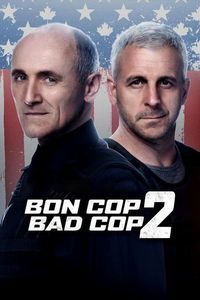
    (On Cable TV, February 2018) I had reasonably high hopes for this sequel to the 2009 bilingual thriller Bon Cop Bad Cop. The original was a clever look at Canada’s two linguistic communities, straddling language and culture in the service of a comic thriller. This sequel manages to get both Patrick Huard and Colm Feore to reprise their roles (no mean feat, given both actors’ busy schedules) but seems to forget much of what made the original work so well. The theme of the original film, so cleanly focused on French/English relationships, was clear and compelling—the sequel, alas, muddles along with a half-hearted look south of the border. Taking the plot to the United States is a logical step forward, but some of the America-bashing does get cheap and tiresome. The character work is fine in theory, except that we don’t particularly care about many of the secondary characters, and the film has the bad idea of giving a terminal illness to one of its protagonists, leading to one good death-wish scene but a whole lot of cumbersome emotional baggage to the film’s conclusion (not to mention a possible third film). Bon Cop Bad Cop 2 also falls prey to the easy lure of police brutality—it’s hard to cheer for nominally sympathetic and comic protagonists when they start manhandling and torturing suspects. Too long for its own good, Bon Cop Bad Cop 2 ends up feeling like a chore rather than a fun film … and given that the point of it is a fun film, the disappointment is palpable. I still like much of the film—Huard and Feore are likable, Mariana Mazza makes a remarkable (but almost overdone) appearance as a hyperactive computer specialist and some of the stunts are spectacular enough. But there is a lot of untapped or misplaced potential in the film’s execution as it loses its way, sabotages some of its own goodwill and ends up on a less than fully satisfying note.

  • Wonder Woman (2017)

    Wonder Woman (2017)

    (On Cable TV, February 2018)  Now that the modern superhero film genre is nearly old enough to vote (not-so-arbitrarily ignoring 1997’s Blade and anointing 2001’s X-Men as the first of its subgenre), there is a real risk of superhero fatigue—in particular, the tendency for lead superheroes to be white men is getting particularly annoying—where are the alternatives, the diverse voices, the ways to use the superhero genre to poke at other kinds of issues beyond power fantasies? Then there is the dismal results of the so-called “DC Cinematic Universe” movies, deadened by disappointing films in the wake of Man of Steel. Expectations were mixed about Wonder Woman, hoping that the film would take advantage of the heroine’s gender (especially given director Patty Jenkins as a rare female director taking on the reigns of a blockbuster production) but not expecting much from the DCU track record. The result, fortunately, is quite a bit better than expectations. While Wonder Woman ultimately does not deviate all that much from the usual super-heroic template all the way to the final apocalyptic battle, it does have a few nice moments of doubt and confusion along the way, augmented by wonderful character moments and great period detail along the way. Gal Gadot truly stars as Wonder Woman, bringing looks, humour, action proficiency and quite a bit of charm to a role that requires some deftness in bringing it all together. Good writing makes the middle London-set “fish out of water” sequence curiously enjoyable. Chris Pine is quite good as the love interest, with noteworthy appearances by Danny Huston, Robin Wright, David Thewes and Lucy Davis along the way. It’s hard to underestimate the difference made by not having a male gaze on the entire film—thanks to director Jenkins, we get a female heroine (and supporting cast of amazon) that is credibly fierce on its own terms, and not necessarily presented as a male fantasy—although it can also work as such. Serious but entertaining, as earnest and non-cynical as a modern superhero movie can be, Wonder Woman is the best film so far in the DCU by a significant margin (it helps that it doesn’t tie itself too tightly to a mega-continuity), and a definitive affirmation of why we need more diverse voices in mainstream blockbuster filmmaking. 

  • An Officer and a Gentleman (1982)

    An Officer and a Gentleman (1982)

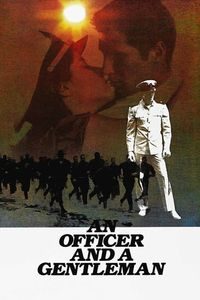
    (On DVD, February 2018) I’ve got a soft spot for academy movies, or more specifically movies in which our protagonist matures by attending a tough school. And while that certainly doesn’t describe all of An Officer and a Gentleman, it certainly covers what’s most interesting in the film—as the no-good son of a sailor enlists in a military academy to become an officer. The training is merciless, and that’s not even getting into the issue of repeating his parents’ mistakes in romancing local girls. Richard Gere (at times with a crew cut) stars as the protagonist, while Debra Winger plays a strong love interest with issues of her own and Louis Gossett Jr. is a rough instructor. There’s a fairly predictable B-couple romance meant to illustrate the worst-case scenario as well, but never mind—much of the film’s entertainment comes from the hero undergoing the rigours of training, and much of the film’s emotional power comes from its romance. Firmly establishing itself in a grimy reality from the first few moments, the film does exemplify a certain seventies/early eighties rawness that makes the latter triumph more meaningful. While I shouldn’t exaggerate An Office and a Gentleman’s effectiveness (there isn’t much here that hasn’t been done elsewhere), it does nicely click together and works better than expected.

  • On the Town (1949)

    On the Town (1949)

    (On Cable TV, February 2018) At face value, On the Town is a ridiculous film. Following three sailors on leave in Manhattan through a day of gentle debauchery, it has unbelievable coincidences, a pat ending, generic characters and some astonishing lengths, including an entirely optional dream sequence. But here’s the thing: it’s a musical, and like many of the musicals closely associated with Gene Kelly, it knows it’s a musical. It doesn’t even waste any time telling us that it acknowledges its own absurdity, from the impossibly full morning tourism of the characters, to three cabarets reprising the same ditty, to the consciously ridiculous meet-cute romances. Gene Kelly and Frank Sinatra make for fantastic leads, and the visual polish of On the Town is often eye-popping: If I liked Ann Miller best of all the film’s dames, it may have something to do with the fantastic green dress she wears throughout “Prehistoric Man.”  The film is, from “New York, New York” on, a joy to watch: Cheerful, exuberant, unconcerned with plausibility and rather racy in some implications, it’s also a delightful romanticized time capsule of post-war New York City in full Technicolor. The location shooting (a rarity at the time), as short as it was, brings a lot to the film. I’m not terribly fond of the dream sequence, except that it does show the possibilities of ballet in a non-traditional setting … like many of Gene Kelly’s films. All in all, I was pleasantly surprised by On the Town—it’s much better than a summary would suggest, and simply a lot of fun.

    (Second viewing, On Cable TV, August 2020) Two-and-a-half years and several dozen musicals later, I still like On the Town a lot — it’s self-aware, visually imaginative, can depend of the combined talents of Gene Kelly, Frank Sinatra and Ann Miller and does create the bubble of fantasy that many musicals rely on.  A second look highlights a few things that hadn’t necessarily focused upon the first time — such as the underhanded agency of the female characters, and the fact that our male protagonists are slightly idiotic.  Once past Ann Miller, I also have plenty of nice things to say about Vera-Ellen, Betty Garrett and even Alice Pearce in a clearly comic role.

  • All The King’s Men (1949)

    All The King’s Men (1949)

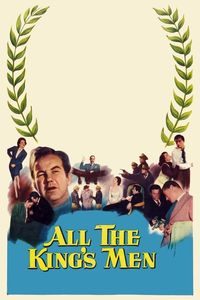
    (On Cable TV, February 2018) Americans have a long history of examining their political system through popular entertainment, and All the King’s Men (an adaptation of a popular 1940s novel) endures even today given its subject matter, tragic arc and acknowledgment of how power corrupts. The tale of how an idealistic lawyer becomes a corrupt governor, as narrated by a journalist turned political operative, this is a story that stands on its own in addition to being a roman-à-clé about Louisiana governor Huey Long. It spans decades, charting corruption as it transforms the protagonist of the story. It’s a clear-eyed view of the political system that still holds a lot of resonance today, and it’s told well enough to still be interesting. Some of the montage sequences have a very modern feel (the film was nominated for an editing Oscar), supported by clever cinematography that goes from pastoral to noir as the mood of the story changes. Broderick Crawford is very good as the character at the centre of the story, equally credible as a young populist and as an older corrupt politician. Writer/director Robert Rossen does spectacular work transforming a novel in a solid movie (although we’re told that merciless editing saved the film), with good supporting work by Mercedes McCambridge (as the dour yet lovelorn Sadie) and John Ireland as the self-effacing viewpoint character. All the King’s Men was remade in 2006 but the remake, despite very polished visuals and an astonishing ensemble cast, doesn’t quite manage to capture the energy of the original.