Month: May 2020

  • Howard Lovecraft and the Kingdom of Madness (2018)

    Howard Lovecraft and the Kingdom of Madness (2018)

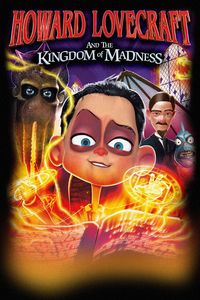
    (On Cable TV, May 2020) It’s weird enough that there would be one animated kid’s movie featuring a boy H. P. Lovecraft and his pet Cthulhu as a sidekick, let alone three. Howard Lovecraft and the Kingdom of Madness further delves into Lovecraftian lore by featuring an “uncle” who looks a lot like the adult Lovecraft, and his pet “Spot” being explicitly renamed Cthulhu as the main antagonist. A character is named Jeffrey West, another is voiced by Jeffrey Combs, and the film eventually leads us to Antarctica’s mountains of madness. Even as a third entry in the series, Kingdom of Madness is visibly a very low-budget film, although some of the voice talent (Hamil, Plummer, Wolfhard) is well known. Other annoyances from the previous films persist: the eye-shadow-heavy character design is still grotesque, but why change now? More serious is a lack of harmony between the grotesquerie and the cuteness I would expect from a kid’s movie—the visual design does not reach a pleasant middle ground, and that certainly limits the visual appeal of the result. On the other hand, some things are better this time around: The all-star reunion of Lovecraft’s characters (including Armitage) clearly underscores the grander nature of this trilogy-capping instalment, while a lot of nightmarish imagery, world-ending prophecies and characters getting slapped to the ground seem unusually intense for a kid’s film. Kingdom of Madness is also more engaging than previous instalments in that the plot is more interesting, and it allows young Lovecraft to confront himself and become somewhat less glum in the process. Still, this does feel like a series of films with a fuzzy audience: is it meant as an ironic romp for Lovecraft-loving hipsters? Is it for Lovecraft-loving parents to show their kids? Is it even for kids?

  • Tape (2001)

    Tape (2001)

    (On Cable TV, May 2020) Part of the reason why I’ve warmed up considerably to Richard Linklater over the past few years has been to recognize that he’s very much an experimentalist—his films are rarely the same, and he has messed with enough unusual tones and structures that we can even see him as a playful filmmaker. In that vein, Tape makes perfect sense—it’s a one-location, three-character, real-time drama shot on videotape (although, thankfully, not from a fixed viewpoint). Based on a play, it watches as three “friends” get together in a hotel room, past secrets are revealed, and confessions are extracted. The image quality, having been filmed on a turn-of-the-century video camera, is nothing short of atrocious — but the intensity of the drama is high and the formal experimentation of the film is interesting. It’s clearly a formalist low-budget experiment, but one that’s somewhat successful (although sometimes better listened to rather than watched). Linklater stalwart Ethan Hawke stars, with Uma Thurman delivering a stripped-down dramatic performance alongside Robert Sean Leonard to complete the cast. As with most theatre-based dramas, the first half sets up the conflicts and the second half detonates them, with plenty of triggers, reversals and revelations. Tape, for all of its self-imposed limitations, certainly has an interest that goes beyond the formalist experiment.

  • A Slight Case of Murder (1938)

    A Slight Case of Murder (1938)

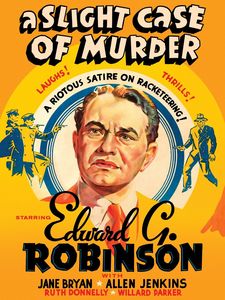
    (On Cable TV, May 2020) By the end of the 1930s, a few things had to be true for A Slight Case of Murder to exist — The lessons of the post-Prohibition era were getting clearer for everyone; Gangster movies were getting a bit overexposed and in need of some fresh angle; Edward G. Robinson was getting tired of his (admittedly great) numerous performances as a gangster; and the play “A Slight Case of Murder” had a modest Broadway run from September to November 1935. Combining all of these together meant a Warner Brothers gangster film adapted from the comic play, starring Robinson in a somewhat atypical but very satisfying turn playing a funny mobster. The premise has him turn to legal brewing after Prohibition, only to realize years later that he’s not good at being a legitimate brewer (not drinking his own beer makes him blind to how terrible it is). Further complications arise when his daughter brings back home a boyfriend employed as a policeman, and when he finds four dead rival gangsters in his living room. To be fair, A Slight Case of Murder is not that funny—it’s a comedy, but it aims for a few laughs and plenty of smiles rather than overdoing it. As a result, it’s not great but it’s certainly watchable. Robinson is remarkably at ease sending up his own image as a gangster, and the film is best seen as audiences of the time did—once you’ve become a bit too familiar with his other mob boss roles.

  • Mujeres al borde de un ataque de “nervios” [Women on the Verge of a Nervous Breakdown] (1988)

    Mujeres al borde de un ataque de “nervios” [Women on the Verge of a Nervous Breakdown] (1988)

    (In French, On TV, May 2020) I will eventually see all of Pedro Almodóvar’s filmography, good and bad movies alike. I seldom completely agree with his films—there’s a crucial difference in age, context, language and all—but they’re interesting even when they don’t quite achieve what they’re going for. Almodóvar can combine a quirky premise with sure-footed execution and the result is worth a look even if the screaming is all in Spanish. Women on the Verge of a Nervous Breakdown, considered one of his top-tier films, is a good illustration of this—it has an interesting hook (a dubbing actress sets out to understand why she was dumped) and then things get complicated with spiked gazpacho, Shiite terrorists, things thrown out of windows, gunpoint motorcycle hijacking, and a climax set at an airport (plus a priceless coda set at the protagonist’s apartment). It’s a farce but also an empathic examination of women under pressure, a cinephile’s homage to the form, a feminist statement and everything in between. It’s quite likable both at the film level and the character level—or the actor level, even: Rossy De Palma is mesmerizing here. The steady revelation of secrets helps keep this interesting, and the look at how dubbing professionals worked in the 1980s is evocative. Women on the Verge of a Nervous Breakdown may not be constantly hilarious, but it is consistently amusing. It’s a very strong piece of motivation for those seeking out the rest of Almodóvar’s filmography.

  • Bad Channels (1992)

    Bad Channels (1992)

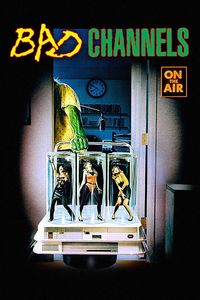
    (In French, On Cable TV, May 2020) Even by the lax standards of early 1990s horror comedies, Bad Channels isn’t any good. I’m not sure if there was any potential in its premise about aliens using a radio station to kidnap women, but bad control of tone and pacing from director Ted Nicolaou (admittedly working from a script co-written by Charles Band) mean that we’re either bored or dumbfounded. At least it’s not mean-spirited or gory (which helps a lot) but there’s a constant nagging feeling that it could have been much better. Much of the plotting feels arbitrary in order to hit the scenes that they were really going for. Even cute girls in fetching early-1990s outfits sadly can’t save this. Grotesque special effects don’t add much but clearly re-establish this as one of Band’s bargain-basement Full Moon Productions. For a film revolving around a rock station, the soundtrack is unsatisfying, badly integrated and eventually forgotten on the way to the conclusion. Considering that Bad Channels is coming from Charles Band, the question is open as to whether it could have been any better—the awful result seems on-brand for his production company, and we have to acknowledge that maybe no one wanted it to be any better. If you’re looking for a much better movie about a radio DJ confronting a world-ending menace, have a dose of Pontypool and don’t look back.

  • RKO 281 (1999)

    RKO 281 (1999)

    (In French, On Cable TV, May 2020) It makes perfect sense that one of the most famous movies of all time would spawn its own making-of TV movie. No, not a documentary—a full scripted drama with enough good actors to make this a prestige TV event. Yes, RKO 281 is a slick dramatization not only of the making of Citizen Kane, but the subsequent thunderstorm of disapproval that came from media mogul William Randolph Hearst, who was convinced the film was an attack on him and his girlfriend Marion Davies. As someone with a fair amount of knowledge about the film and its era, I was very happy with the result, even if I knew where the story was going. Some very impressive means have been spent to come up with convincing period details, and the cast is almost pitch-perfect for their roles—Liev Schreiber as Orson Welles? John Malkovich as Herman J. Mankiewicz? James Cromwell as William Randolph Hearst? Melanie Griffith as Marion Davies? RKO 281 is one wonder after another. Sixty years after the events depicted, the film pulls no punches: Hearst is the villain, and Hedda Hopper is the henchwoman. It all culminated, as film buffs know, in the dumbfounding decision to give that year’s Best Picture Academy Award to How Green Was My Valley—although this, curiously, is not in the film considering that RKO 281 ends soon after Citizen Kane’s premiere. (Maybe RKO 281 knew that biting the hand that hands over the Oscars was not a good idea, even for a 1999 TV movie.) It’s certainly not perfect (there are anachronisms and simplifications and not enough attention paid to the artistry of Kane) but it’s a decent dramatization, even if everyone will know not to take it as a documentary. Some special editions of Citizen Kane on physical media include this film as a bonus, and it’s a good one.

  • Varsity Show (1937)

    Varsity Show (1937)

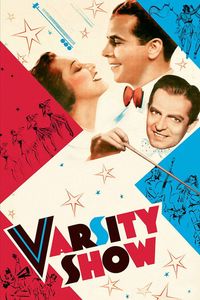
    (On Cable TV, May 2020) When measured against other musicals of the late 1930s, Varsity Show definitely comes across as a second-tier film. It doesn’t have snappy songs, barely ekes out a rousing finale thanks to Busby Berkeley, breaks no ground in matters of originality, and while it sports a fine Dick Powell, the rest of the cast isn’t particularly remarkable. (Well, except for Mabel Todd, very cute as a bespectacled blonde “class pest.”) On the other hand, Varsity Show does keep viewers’ attention and has a lot to offer if you’re willing to engage with it. Part of its fun is how it combines the archetypical “let’s put on a show” structure of a movie musical with the college campus culture of the 1930s—meaning that if you ever wondered what it would feel like to walk down a campus a few decades ago, then Varsity Show has a Hollywoodized answer for you. William Keighley’s direction is surprisingly interesting in the first few minutes, despite substandard actors—there are some Altmanesque ensemble cast-juggling and quick cuts to briskly introduce characters within the film’s 80 minutes. The first half of the film has strong comic moments, as students looking to put on a show hired an alumnus now on Broadway—while unaware that his last three shows have been a failure and he needs out of Manhattan fast. For twenty-first century viewers, there’s something utterly fascinating in seeing students from the 1930 complain about the stodginess of an authority proposing ideas that were in vogue back in the… 1910s.  The second half of Varsity Show cranks up the musical numbers as the troupe goes to New York City and the show does go on. It concludes with one of Busby’s signature epic numbers, where human figures are a mere component of something much bigger. Some of the film’s sauciest moments bring to mind pre-code film—I could have sworn at times that this was an early-1930s film. For all of those reasons—Varsity Show is not a great musical, but it’s a fun one as long as you’re indulgent.

  • Step Up Revolution (2012)

    Step Up Revolution (2012)

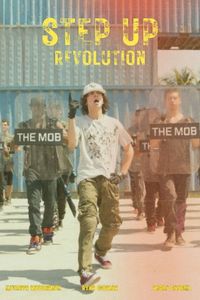
    (On Cable TV, May 2020) I’ve bounced all around the five-film Step Up series, from seeing the third in theatres to going home to watch the first and then the fifth and now the fourth. (Don’t worry—I’ll see the second soon.) The decision to locate Step Up Revolution in sunny colourful Miami is a good one, although the dubstep and flash-mob fascination date this film more solidly in 2012 than anything else I would have imagined. The plot itself, what with its promoter-destroying-neighbourhood hook, is rather jejune and more fitting to a kid’s movie starring a dog, but the point of the movie is the dance sequences, and there are quite a few good ones here. Never mind that our ragtag dance troupe requires props and costumes that would bankrupt any professional dance group. There are a few callbacks to the previous entries of the series (Moose shows up!), but Step Up Revolution generally stands alone. The calling card of the series is that it’s about as close as we’ll get to modern MGM musicals, and in that regard this fourth entry delivers the goods in energetic fashion: It’s best to look at it as a collection of dance numbers than a cohesive narrative. From that angle, the film’s highlights include a massive number on Ocean Drive, a cute bit at the Miami Museum of Fine Arts that pays homage to Miami’s art scene, a hilariously on-the-nose bit featuring a “businessman” flash mob and a finale set against a colourful stage made of shipping containers. The plot makes no sense, but the numbers are high-energy, Cleopatra Coleman has a supporting role, and the anti-capitalist message is good for the kids. All told, I can’t find any problem with Step Up Revolution. Why isn’t there a box-set of this series available for purchase?

  • 7 Faces of Dr. Lao (1964)

    7 Faces of Dr. Lao (1964)

    (On Cable TV, May 2020) Producer George Pal specialized in big special-effects heavy spectacles, and that’s how we ended up with SF classics such as Destination Moon, The War of the Worlds and The Time Machine. It’s also how we got the much stranger piece of western fantasy 7 Faces of Dr. Lao—and I here mean “western” as in “American west,” considering that the plot of the film gets started once the titular Dr. Lao stops by an Arizona town as it awaits the construction of a railroad. Lao isn’t a medical doctor—he’s a seven-thousand-year-old magician from the mysterious Orient (but played by Tony Randall under layers of makeup) with seven alter egos. All of them will be useful to untangle the romantic and financial complexity of the small town. Adapted from a fantasy novel by Charles G. Finney, 7 Faces of Dr. Lao ends up being another ideal special-effects showcase for Pal’s mixture of practical effects, heavy makeup, stop-motion animation and other visual effects tricks. Both the best and the worst thing about the film is that it’s almost chaotic in going from one special effect sequence to another. It’s definitely weird by the standards of Hollywood cinema at the time, and it clearly hasn’t aged particularly well in a CGI era. One can imagine 1964 audiences being wowed by the effects, although nowadays they’re often more grotesque than anything else. Randall is problematically cast as the Asian Dr. Lao but throws himself entirely in the seven (ish) roles required by the script. There’s something to be said about a “man comes into town” story in which said man isn’t a gunslinger but a magician with near-infinite wisdom. Sometimes, weird is a virtue in itself when it comes to Hollywood.

    (Second Viewing, On Cable TV, November 2020) Director-producer George Pal was always about spectacle, and it’s not because 7 Faces of Dr. Lao constrains itself to a small wild west town that it’s any less intent on wowing the rubes than Pal’s other more outlandish movies. Here, we have a one-man travelling circus rolling into town, what with a mysterious and desperately stereotyped Dr. Lao promising untold wonders to the local newspaperman while taking notes on the local controversy. It feels like small potatoes compared to the time-travelling, world-altering, lost-continent-sinking scope of previous Pal movies, but the draw here is still on the special effects as the circus springs up and multiple special effects are presented in episodic segments. Tony Randall is arguably the film’s central special effect, as he plays more than a handful of roles under heavy makeup. The film plays off spooky circus tropes, with a heavy dose of now-uncomfortable ethnic clichés. The result may be worth a look for visual purposes (it did well in Academy Award technical categories), but as an overall film or story, it’s scattered, offensive, dull and overdone in rapid intervals. 7 Faces of Dr. Lao is interesting because of its uneven tone and its special effects, but I will stop short of a recommendation.

  • Nightbreed (1990)

    Nightbreed (1990)

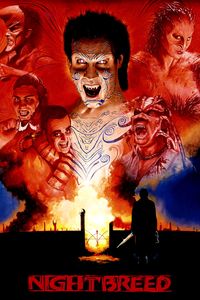
    (In French, On Cable TV, May 2020) There is something far more interesting than usual in Nightbreed when compared to most other horror films of that era. It has authentic sympathy for the monsters that would be antagonists in other horror films, and much of the protagonist’s journey is joining and protecting those monsters from human opponents. (As per Wikipedia, there’s an entire queer subtext to Nightbreed that flew over my head upon watching the film.) When writer-director Clive Barker set out to make the film, he was aiming for a menagerie of creatures on par with Star Wars, and a quasi-mythological resonance to the story. He doesn’t quite get there, but his intentions certainly resonate in the final result. The version I was the much-decried original cut of the film rather than the more definitive “Cabal Cut,” so quite a bit got lost—The serial killer subplot does make the film far trashier than it should have been and the result isn’t quite as interesting as the creatures it features. As an American backwoods gothic, Nightbreed brings to mind an approach not dissimilar to Guillermo del Toro’s love of monsters and empathy in approaching the other. If you’re looking for another reason to watch the film, there’s David Cronenberg playing the antagonist, which is good for a chuckle or two. Still, and perhaps to the chagrin of Nightbreed’s considerable cult following, this film is more one of missed opportunities than outright success—it doesn’t quite work, and I’m not sure that even a recut version would be significantly better.

  • Warlock (1989)

    Warlock (1989)

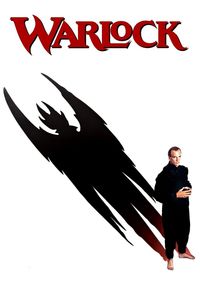
    (In French, On Cable TV, May 2020) By the standards of late-1980s horror, Warlock is both different and somewhat sedate. It follows the titular warlock (Satan’s son, we’re told) as he’s propelled from 18th-century Boston to circa 1989 Los Angeles, pursued by a witch hunter. While some of the details used in the narrative (the use of salt, notably, or some fish-out-of-water comedy from the two 18th century characters in modern times) are lively and show some imagination from screenwriter David Twohy, much of the film is a shrug-inducing battle between good and evil involving spells, magic artifacts and incomprehensibly end-of-the-universe high stakes. What does work well, however, is Julian Sands’ very charismatic performance as the warlock. While not horrible and tastefully restrained in matters of gory violence, Warlock is a bit of a snooze—it doesn’t come together as anything more than a middling fantasy/horror. It probably would have done better had it leaned more into comedy, or drama, or horror—but not in its current indecisive state.

  • The Reckoning: Hollywood’s Worst Kept Secret (2018)

    The Reckoning: Hollywood’s Worst Kept Secret (2018)

    (On Cable TV, May 2020) Surely, I can’t be the only one who’s uneasy watching ripped-from-the-headlines crime documentaries? Oh, I’m fine with seeing powerful Hollywood figures finally facing justice for their crimes and terrible actions. And I’m fine with victims telling us their stories—truth will out, and truth cleanses. What I’m not too enthusiastic about is the idea of a documentary produced so soon after the events—before the verdicts, before the dust falling down, before being able to take a look at all of it and extract lessons and conclusions from it all. Veteran documentarian Barry Avrich takes on a topic that’s both touchy and obvious in The Reckoning: Hollywood’s Worst Kept Secret—starting with Harvey Weinstein in exploring a culture of sexual abuse within Hollywood. I say “obvious” because it’s been impossible to take in entertainment news since 2017’s #MeToo hashtag and ignore that several high-profile actors, directors, comedians and producers have been accused of sexual harassment and worse. Barely a few months later, The Reckoning is jockeying for relevance, with newspaper headlines still revealing details about the many accusations and ongoing investigations. At the same time, it’s a live wire of a topic—it illustrates not only the criminal actions of the accused, but also the bad behaviour of those around them that enabled, tolerated or ignored the sordid actions of the aggressors. But what we get is a sketch of what will eventually become the final story: As of this writing, Weinstein has just been convicted in New York state, and awaits another trial in California—meanwhile, other investigations are still pending on other accused abusers. As to what this means in general, we don’t know: the optimists believe this will help purge Hollywood of its offenders, while cynics state that the rot will always be there. Whoever’s right will only be determined much later, possibly in a documentary with more facts and conclusions at its disposal. Until then, The Reckoning, even as good as it is, feels like a newspaper—vital upon publication, but increasingly obsolete every following day.

  • Natalie Wood: What Remains Behind (2020)

    Natalie Wood: What Remains Behind (2020)

    (On Cable TV, May 2020) Considering the richness of Natalie Wood’s life (the films, the forty-year-long career, the child star, the beauty, the men she dated, the family, the clashes with the studios, the awards) and the tragic circumstances of her death in 1981, any documentary about her has an embarrassment of material to showcase. Documentarian Laurent Bouzereau chooses a middle path in Natalie Wood: What Remains Behind, trying to strike a balance between the film that her daughter Natasha Gregson Wagner (the film’s defining voice) wanted to see as a celebration of her mother’s life, and the more sensitive discussion of her death, which is what most viewers are interested in. After the rapid-fire overview of her career, the film moves to a climax of sorts when Gregson Wagner interviews her stepfather, Robert Wagner, about what happened on the boat the night Wood died. While Wagner’s responses are emotional, they’re also incomplete and don’t reveal anything new. While clearly designed to exonerate Wagner of any wrongdoing, the film ends up being this semi-hagiographic, semi-regurgitated look at Wood that packages her life and one version of her death into content fit to feed into the streaming maw — but does not bring any new light on the topic. So, Wood fans, keep your expectations in check and take the documentary for what it is—a reminder of a vivacious screen presence gone too soon, a celebration of her less-visible facet as a mother, and a public statement by her family. Considering that of the four people that were on the boat that night, two are dead and the two others are Christopher Walken and Robert Wagner, maybe we’ll eventually get a more satisfactory answer. But then again, maybe not. One thing’s for sure—if you’re looking for a more even-handed approach to Natalie Wood’s life and death, read a book.

  • Tirez sur le pianiste [Shoot the Piano Player] (1960)

    Tirez sur le pianiste [Shoot the Piano Player] (1960)

    (On Cable TV, May 2020) Many cinephiles think the world of François Truffault’s debut feature Les 400 coups, but for me he starts hitting his marks with Tirez sur le pianiste, where (having said what he had about his childhood in his first film), he starts playing with the topics that he would then revisit over and over in his career—Hollywood homage to crime films with gangster subplots and a murder somewhere in the narrative; complex unglamorous relationships between his protagonist and women; the stylistic hallmarks (jump cuts, guerilla-style shooting, voiceovers, nonlinear storytelling) that would mark the French cinema for the next two decades. Tirez sur le pianiste explicitly looks at the United States for inspiration (film noir for style, an English-language novel for the plot) and blends it into its own execution. The mixture of crime thriller and talky French romantic drama is in line with the entirety of French cinema, from poetic realism to the impending nouvelle vague. A young Charles Aznavour (yes, him) is remarkable as the protagonist, a piano player trying to escape his dark past. Amazingly enough for French Canadian viewers, the soundtrack features some Felix Leclerc! While not flawless (it’s long, sometimes dull), Tirez sur le pianiste is generally better than many similar examples of French cinema at that time, and clearly announces Truffaut as the director he wanted to be.

  • Mixed Nuts (1994)

    Mixed Nuts (1994)

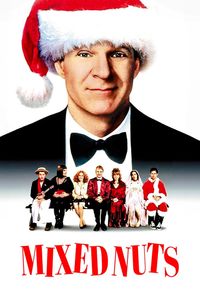
    (In French, On Cable TV, May 2020) I’m somewhat nonplussed by Mixed Nuts. It’s a weird, very Americanized adaptation of the pitch-black French Christmas comedy classic Le père Noël est une ordure (which I haven’t seen in ages), set in snowless Los Angeles on Christmas Eve. Much of the weirdness is due to it being pulled in two different directions—the very dark comedy of the original (which ends with body parts of a serial killer being wrapped up in Christmas packaging and fed to zoo animals) and the innocuous audience-friendly style of writer-director Nora Ephron. I mean—this doesn’t feel like an appropriate match, and it isn’t. What were they thinking? This is the kind of premise (dark comedy hijinks at a suicide prevention hotline on the day before Christmas) that calls for a low-budget anarchic approach, not a glossy Ephron-style comedy. This is nowhere as dark as it should be, and it’s wrongly engineered for guiltless Christmas cheer. The high-budget slick approach also ensures that the film is made to be safe, and that, in turns, means that its approach to two sensitive topics—mental health and transgenderism—now feels half-outdated rather than transgressive. (It’s not as bad as it could have been—Liev Schreiber’s transwoman character is treated with some respect—but it clearly wouldn’t be remade the same way today.) As a result, the comedy feels both forced and neutered, and the laughs usually take the form of mildly amused smiles. But even then, as the film’s title jokes on my behalf, Mixed Nuts is also a grab-bag of other, more interesting bites: The cast is admittedly impressive, with a mixture of names that were familiar at the time (dark-haired Steve Martin as the hotline director, Rita Wilson as the attractive co-worker with a crush, Juliette Lewis, Madeline Khan and Rob Reiner), and other ascending actors used in sometimes small roles (Adam Sandler doing ukulele, a Steven Wright cameo, Parker Posey and Jon Stewart as rollerbladers, Haley Joel Osment and others.) Martin and Wilson, in particular, get nice roles even in the middle of a confused comedy. Still, The biggest takeaway I’m getting from Mixed Nuts is that I need to re-watch Le père Noël est une ordure soon.