Author: Christian Sauvé

  • The Concrete Blonde, Michael Connelly

    St. Martin’s, 1994, 397 pages, C$7.50 mmpb, ISBN 0-312-95500-6

    Regular readers of these reviews already know that when it comes to crime thrillers, I’ve had it up to here with serial killers. The Silence of the Lambs was the worst thing that could have happened to the genre: suddenly, everyone and their childhood bullies were writing serial killer stories, using just the “serial killer! booga-booga!” line as a crutch for unconvincing characters, lousy plotting, tepid style and a complete lack of understanding of police procedures.

    (You could say that my complaints have more to do with lousy fiction than serial killers per se, but that would distract from my argument and minimize my disgust at the umpteenth serial killer novel I read in which the would-be-last victim of the killer is someone near and dear to the detective. See Reich, Kathy: Déjà Dead.)

    The Concrete Blonde is a serial killer novel. Fortunately, it’s nothing like anything I’ve read to date, and fortunately so. It proves that a really good author can still do something worthwhile with those same elements that seem so tired in amateur’s hands.

    If you read crime fiction on a regular basic, you already know Michael Connelly. Loved by critics, acclaimed by fans, he’s at the top of the genre. I’ve been slowly reading his work, averaging one or two books per year, with the same care as a wine enthusiast will slowly stretch out his collection, secure in the knowledge that there’s more of the good stuff locked in his basement in case of a quick fix. Some authors are like that: Why hurry to completion when you know you’re going to read all of them sooner or later?

    Connelly 1994’s novel was his third one, and it starts unconventionally; detective Harry Bosch thought he had solved the “Dollmaker” case –with a single bullet. Now, years later, even as the widow of the Dollmaker sues him for shooting her husband, another victim appears, and it’s got all of the hallmarks of the Dollmaker. Again. Did Bosch get the wrong man? Was the Dollmaker a team? Ta-dum-dum, the investigation begins again.

    But nothing is simple, and so The Concrete Blonde offers the unique spectacle of a policeman enduring a civil lawsuit even as he’s investigating the very same case being argued in court. We are, quite fortunately, spared the entire first Dollmaker investigation: the novel begins in mid-story (where, indeed, most serial killer novels end), and the effect of this structural choice are dazzling, alternating between (and then intermingling) courtroom drama and police procedural. Woof!

    Fortunately, structure isn’t all that Connelly has on his side: The Concrete Blonde, like the author’s other books, is deliciously written in a no-nonsense style whose elegance nearly disappears behind its accessibility. The pages turn, the chapters fly and pretty soon we’re caught up in a good mystery. Connelly takes delight in confusing the readers with top-notch red herrings; no resentment ensues. Procedure details are top-notch and so are the characters, even including the titular concrete blonde. I tend to use the word “crunchy” when describing substantial novels one can just bite through, and there’s no doubt about it: The Concrete Blonde is one crunchy book.

    Yes, this novel is a rare treat, an intelligent and suspenseful thriller, exactly the model of what good crime fictions should be. It remixes familiar elements in a brand new format, and goes it all in an unobtrusive style. Even weeks after reading it, The Concrete Blonde remains strong in memory, which is a lot more that I can say about other crime thrillers, good or bad.
  • The Matrix Revolutions (2003)

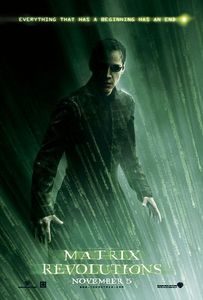
    The Matrix Revolutions (2003)

    (In theaters, November 2003) Sometimes, it’s best to take one’s inner fanboy and temporarily lock it in a cage. Otherwise, said fanboy would rant on and on about how, even with its problems, The Matrix Revolutions is one of the year’s most enjoyable film just because it so happens to be one of the very few hard-core SF films of 2003. Well, stuff the fanboy and let slip the vitriol of betrayed expectations. By far the most infuriating thing about this third episode in the series is how it doesn’t even answer the dozens of questions raised by the second film. It lets all the balls drop, one by one, until the juggler is left saying “sucker!” But the film’s flaws certainly don’t stop there: The elegant focus of the first film was diminished in the second and finds itself crudely forgotten here: all is chaos and confusion, whether you’re talking about the dialogue, the themes, the visuals or the direction. In the process, all of what made the first volume so worthwhile has been ignored. The characters are emotionless parodies of themselves. The dialogues are painfully predictable. The special effects aren’t half as spectacular as Tharini Mudaliar in her all-too-brief appearance. Then the conclusion sinks into the woo-woo morass that has afflicted so much anime in the past; a pointless fight which only concludes when the screenwriter simply decides so, and in which the viewer has to perform all of the intellectual justifying work. Ay, yay-yay, what an ignominious end for a trilogy that had started so well. The Wachowskis pretty much blew up all accumulated credentials with this misguided effort, and effortlessly proved the law of diminishing returns: However much money and chaos you put on screen, sometimes it’s just not worth the effort. It’s fitting, in so many ways, that even the Rage Against The Machine-less soundtrack is the lesser of all three films.

    (Second viewing, On DVD, April 2004) Nope, still haven’t changed my mind about the film: It’s a lousy end to a trilogy that had started so well, but there’s still enough pure Science Fiction content and images to make me happy. This initial DVD edition, however, has a lot of good stuff in reserve: Plenty of special-effects supplements (you won’t believe some of the stuff they had to use for the final fight!), some useless background material (including a badly-designed collection of stills and “historical” information) and an intriguing look at a on-line game that will probably look quite silly in two or three years. Die-hard The Matrix fans ought to get this, if only for the sake of completing the series.

    (Third viewing, On DVD, May 2005) I suppose that only the most ardent fans of the film will have the patience to watch both sets of commentary tracks on The Matrix Ultimate Edition trilogy. Those brave few who do, however, will get much out of “The Philosophers” commentary: Ken Wilbur and Cornell West each bring a perspective on the meaning of The Matrix trilogy that does much to add depth to the second and especially third segments. Don’t get me wrong: I still thing that this third volume is over-indulgent, long and falsely profound, but Wilbur’s idea about the trilogy being the story of the re-unification of disparate realms (body, mind and soul; blue green and gold; Zion, Matrix and Source) in a new trinity (a Neo/Trinity, one might say) brings a different light to it. Not bad, but still not recommended to anyone who’s not already a freakishly obsessive fan.

  • Master And Commander: The Far Side Of The World (2003)

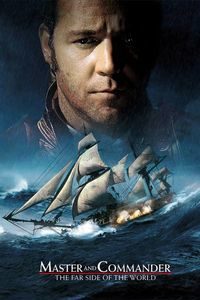
    Master And Commander: The Far Side Of The World (2003)

    (In theaters, November 2003) Yarr, matey! Step aboard this grandiose nautical adventure! Come alongside our twelve-year-old sailors as they learn to be men while battling certain death at sea! You say that you’ve already seen a nautical adventure this year in Pirates Of The Caribbean? Well hold your tongue, young lass! For Master And Commander is no barrel of laughter, and Russell Crowe can musket-whip Johnny Depp any day of the week! ‘Tis amusing, but not quite fitting that the park-ride movie would be the story-heavy champ of the two even as the literary adaptation would end up feeling like a series of adventures, but don’t let that drive you away, landlubber! There’s a lot to see here, from a corker of storm to a stop on the Galapagos Islands, along with enough sea combat to wet your whistle! No, I don’t know whence you’re from, but don’t worry; you’ll fit right in our indistinguishable cast. Of course, our ship is the co-star of the film! With today’s digital technology, we can simply board and pillage any previous film and present it all in glorious surround-sound! Granted, our good director Peter Weir can’t be bothered to cut a long sweeping take, but we still put up a pretty good fight in two quick cuts! Come in! Come in! We offer all of the advantages of safe cinematic time-travel without the drudgery of Timeline!

  • Genius, James Gleick

    Vintage, 1992, 531 pages, C$21.00 tpb, ISBN 0-679-74704-4

    There is a chapter, “In Search of Genius”, more than midway through James Gleick’s Genius, which dissects the nature of brilliance and asks where, in today’s world, are the dozens of world-shaking geniuses we could expect from a world packed with more than five billion humans. From a Western European pool of less than a billion souls, the past has produced Shakespeare, Newton, Mozart; where are today’s geniuses, and why aren’t they more distinctive? [P.313]

    It’s a disingenuous question in many ways (today’s world is more egalitarian, more complicated, more specialized, more susceptible to trivia, etc. than the times in which the afore-mentioned geniuses lived) but it’s a question well worth pondering whenever we’re considering the life of Nobel laureate Richard Feynman, a man who in many ways exemplified the type of genius everyone can recognize as such; he made significant contributions to modern physics, had a career that spanned from the Manhattan project to the Challenger investigation, including a significant rewriting of quantum theory. Showman to the Nth degree, Feynman cracked safes, played bongos, dated abundantly and tried to annoy whoever he could. And that’s just the back-cover version of his life.

    Genius is a curious book, an attempt to cover his life that deliberately avoids some of the better-known stories that Feynman himself wrote down in his own memoirs. (Which is useful only those those who have read Feynman’s memoirs, obviously.) James Gleick covers the scientist’s life from birth to death, with plenty of asides on the state of scientific knowledge during the twentieth century. The amount of material crammed in the book is awe-inspiring, and Genius thankfully comes complete with a comprehensive index as well as two separate (and extensive) bibliographies.

    It’s a fascinating read in no small part thanks to Feynman himself. Tragedy (his first marriage) and comedy (safe-cracking at Los Alamos), genius (how his drawers were packed with “substandard” research that would mean publication for other scientists) and conflict (his gentle feud with Schwinger over the dominant interpretation of quantum mechanics) all intervene at one time or another in his life, and the best that Gleick can do is to get out of the way and let the story tell itself.

    Let’s not kid around; you will need a physics degree to follow Gleick’s description of the spheres of science in which Feynman evolved. But that’s only a small part of his life: the rest of the book is unusually readable and accessible. Feynman makes a sympathetic hero, a genius that wasn’t without flaws (his romantic life after the death of his first wife, for instance, could be seen as an exercise in pure cynicism) but whose comprehension of the world did much to advance ours. The portrait of the various scientists with whom he interacted (Gell-Mann, Dyson, Oppenheimer, etc.) are just as interesting, but obviously we know who holds center-stage. The biography deftly balances science with life and gives a good portrait of a man as a scientist, not just the other way around. Inspiring reading, perhaps especially for physics students and other fledging scientists.

    Ultimately, Genius is a fitting tribute to one of the twentieth century’s foremost scientist, perhaps the last time someone could fly around from one part of physics to another and make key contributions in passing. Until the next genius, of course, for the question remains: Where are the other Feynmans? Worse; if there are Feynmans in the world today, will we have to wait until their death to know about them?

    [September 2004: Yes, Feynman’s own “Surely You’re Joking, Mr. Feynman!” is indeed a recommended prerequisite for Genius. Ironically enough, it’s more accessible, more representative and a great deal funnier than Gleick’s work.]

  • Proteus in the Underworld, Charles Sheffield

    Baen, 1995, 304 pages, C$7.50 mmpb, ISBN 0-671-87659-7

    During the last few years of his life, the late Charles Sheffield produced an astonishing number of novels (up to three or four a year!), some of them quite good and some of them quite dull. Fortunately, Proteus in the Underworld is one of the better ones, an irresistibly readable work of old-school science-fiction.

    In some ways, it’s not overly surprising given that it is the third volume in the “Proteus” trilogy, a decent follow-up to two novels (Sight of Proteus and Proteus Unbound, combined in the Proteus Manifest omnibus) that exemplified how old-style SF should be written; take a few neat ideas, wrap them in an engaging action-adventure plot seasoned with an upbeat attitude and let the reader have tons of fun.

    Proteus in the Underworld is a dignified heir to the series. Once again, super-scientist Behrooz Wolf (Bey Wolf to just about everyone) is called upon to serve the future; in a universe where extreme body modifications have become the norm, where the entire solar system is colonized and where social norms are somewhat weirder than today, well, Bey is a man of singular talents. One of the leading scientists of the form-change revolution, he’s still at the top of the game in more ways than one; even though he’s officially retired, every woman he meets seems intent on seducing him, for business purposes or simple pleasure. Whatta guy!

    One of those women is Sondra Dearborn, a novice agent at the Office of Form Control. A hot case has been dropped on her lap, and she doesn’t quite know what to do with it; a strange matter of feral forms passing human-detection tests, throwing a Really Big Wrench in hitherto-unchallenged assumptions. (Including, one will note, those of the Proteus series itself) Out of ideas and maybe even out of time, she calls upon Bey Wolf to help.

    But he’s retired, ga’dang it. Plus he’s got another offer on his plate; Multi-billionaire owner of one of the solar system’s biggest corporation Trudy Melford also wants to pay him for intellectual services. The only catch is that he’s have to go to Mars in order to do so, but why hesitate when interplanetary transport can be instantaneous?

    In short order, Sonya is forced to fend for herself on one of the cold outer colonies, Bey’s Mars contract proves eventful, conspiracies start to accumulate and we’re thick in a futuristic mystery novel. It’s all quite enjoyable; Sheffield’s style is here crystal-clear, with nary a dull moment in sight.

    Oh, it’s not perfect, mind you: much as the two previous volumes had a few rough spots (the first novel depended on “biofeedback” as a science, and the second featured a man whose crazy dances drove others to insanity!), Proteus in the Underworld is sometimes too simple; this type of one-corporation-rules, one-test-is-infallible, one-man-knows-all fiction isn’t particularly realistic. The real world doesn’t work that way. But such shortcuts can be fun, and that’s all we’re asking for when it comes to old-school SF.

    While the science can be wonky at times (this is adventure, not hard-SF), the mystery is satisfying, the prose is dynamic, the characters are terrific in their own way and the imagined future feels utterly comfortable. Combine that will a killer cover illustration by Gary Ruddell (Rwowrrr, Sondra!) and the result is one of Sheffield’s most enjoyable work, and a great third volume in a cool trilogy from an author that deserves to be fondly remembered.

  • The Prodigal Spy, Joseph Kanon

    Island, 1998, 537 pages, C$9.99 mmpb, ISBN 0-440-22534-5

    I don’t remember being particularly enthusiastic about Joseph Kanon’s first novel, Los Alamos, and for a good reason; thrillers should thrill, not bore. Kanon’s ponderous style, while not devoid of literary merit, certainly dragged down a story which already wasn’t sinning by excessive interest. But who knows? Anything can happen in a first novel. Unfortunately, if The Prodigal Spy proves one thing, it’s that Los Alamos‘s characteristics seem to be completely characteristic of its author’s writing style. Slow. Pondered. Somewhat dull.

    Once again, Kanon digs into twentieth-century American history for inspiration. The novel starts at the height of the Eugene McCarthy’s Red Scare, as a boy sees his father being interrogated by the House Un-American Activities Committee. The father may or not be a spy, but the boy thinks he’s got the proof of his father’s guilt. So he destroys it. But before anything more can happen, his father leaves into the night and passes on the other side of the Iron Curtain, never to return. His disparition is complicated by the death of a young woman upon whom much depended. For all of the novel’s latter faults, this is a pretty good beginning, especially given the portrait of the anti-Soviet witch-hunt through a boy’s eyes.

    Flash-forward more than a decade. The boy, Nick, is now a student on the tumultuous American campuses of the sixties. He’s contacted by a beautiful female journalist; his father has a message for him. He wants to see his son again, but he’ll have to come and see him. In Soviet-controlled Prague.

    So we’re off, and most of The Prodigal Spy will consist of one long Czechoslovakian travelogue as Nick makes contact with his father and is tasked with one mission; find the other Red agent in Washington, the one that gave away his father and killed the young woman to protect his secret.

    Upon his return to Washington, Nick will have to dodge the FBI (including a pair of meetings with Edgar J. Hoover, the first of which is easily the book’s best sequence), second-guess the police, piece together the truth and ultimately unmask his father’s betrayer. Alas, as in Los Alamos, Kanon’s mystery is not much better than his pacing, and the identity of the betrayer can safely be deduced within the first hundred pages. (And given the length of the book, that’s quite early indeed.)

    But is it fair to dismiss Kanon’s work as simply dull? Wouldn’t he be best compared to LeCarre, whose intricate novels of espionage also privileged atmosphere and characters over simple plotting and suspense? Well, maybe. Especially given how LeCarre’s novels were also dull and plodding. Older, more mature readers may enjoy this type of espionage thriller à l’européenne, but I myself couldn’t care less. It’s not because the Red Scare was important and is worth remembering that The Prodigal Spy is important and worth remembering. At least I’ll grant that the book has a few sex scenes.

    Is it at least better than Los Alamos? I wouldn’t be able to tell given my distinct lack of interest in both. The Prodigal Spy tends to be a little bit stronger in memory, but that may very well be because I’ve just finished it: Ask me again in a year, and I’m liable to answer you with a blank stare. Apparently Kanon has written a new novel since then. I’m not sure I’ll remember to check it out.

  • Hominids (Neanderthal Parallax #1), Robert J. Sawyer

    Tor, 2002, 444 pages, C$35.95 hc, ISBN 0-312-87692-0

    I was lucky enough to be in the audience when Robert J. Sawyer won the 2003 Best Novel Hugo Award for Hominids, the first tome in the Neanderthal Parallax trilogy. While everyone in the room got to hear a wonderful acceptance speech, pundits on the net weren’t so impressed: Over the next few days, anguished comments protested the decision and blames the local-area vote of sabotaging the results. Hey, don’t look at me: I didn’t vote for the book because I hadn’t yet read it, and I hadn’t yet read it because the three volumes of the trilogy hadn’t yet come out. It took another month for me to take a look at the book and find out for myself whether the furor was deserved. As it turns out, Hominids is a flawed book, and certainly still not my choice for the Hugo Award. But it is worthy of vitriol? Maybe. Let’s see.

    Plot-wise, this first volume is a thin introduction. A freak quantum science experiment on an alternate Earth sends Ponter Bodditt, a Neanderthal scientist, to our own present-day reality. In this universe, we struggle to understand what happen. On theirs, the unexplainable disappearance of Ponter leads directly to a murder trial for his lab partner. Both plot-lines are resolved when (as it was bound to happen), the link is re-established between the universe. All is well that ends well… maybe.

    But Hominids isn’t a story as much as it’s a series of discussions, demonstration and digressions on a bunch of topics such as parallel evolution, Neanderthal sociology, the legalities of extra-dimensional visitors, privacy-less societies, human follies and many other subjects. No wonder if some old-school SF readers will find themselves at home in Sawyer’s novel; the (pseudo-)integration of that didactic material will instantly be familiar to anyone who’s read his fair share of, say, Asimov.

    There is a lot of material discussed and references, so be prepared for a lot of false dialogues meant to convey pure ideas (not a quote: “We Neanderthals never developed agriculture” “Don’t you say!” “Our cities are very small” “No way!” “Our males and females live separately” “Get out!” “We all have implanted recorders taking automatic note of everything that happens in our lives.” “Shut up!”) I wasn’t convinced by many of the characteristics of the seemingly-monolithic Neanderthal society (High tech without an industrial base? Without density of population?), and neither were some of the characters: What’s more serious, though is that the objections are simply swatted aside as if they didn’t matter, or more likely to keep some stuff in reserve for the sequels.

    Fans of Sawyer’s previous work will here see many of the author’s tics, from explicit Canadian content (virtually all of the novel takes place in Ontario, in one reality or another) to a fascination with legal mysteries, along with slams at Mike Harris and organized Skeptics. Sawyer’s usually double-shot of theology and matrimony aren’t to be found here, but there are hints that those may be forthcoming in the two other volumes. (Otherwise, the volume is satisfyingly self-contained for a first of three.)

    One eeek-factor is worth mentioning, though: a disturbing rape plot sub-thread which ends up feeling exploitative despite all efforts to the contrary. But that just may be my own prejudices protesting, so pay no attention to this particular knee-jerk reaction.

    Fortunately, Sawyer’s prose is as readable as ever. It’s not seamless (the strictly-utilitarian prose feels more convenient than elegant), but it work well at what it’s supposed to do: Tell a story. It’s just a shame that there isn’t much of a story to tell.

    But I was entertained, and in the end that’s pretty much all I ask for. No, it’s not worthy of a Hugo, especially not given the competition in 2002. And if I wasn’t already preoccupied by other things, I’d probably vent about it and rail about the increased stupidity of Hugo voters. But you know what? At least Hominids is real, pure, indisputable science-fiction. And after two years of J.K. Rowling and Neil Gaiman going home with the award, well, at least that’s a step up.

  • Memento Mori, Shariann Lewitt

    Tor, 1995, 286 pages, C$31.95 hc, ISBN 0-312-85625-3

    One of the curses of moderating panels at science-fiction conventions is that you’re expected to pretty much know everything about a panel subject and the life’s work of the other panelists. So when I found out, a week before the event, that I was to moderate a panel about neurobiology (!) featuring -among other authors- Shariann Lewitt (!!), well, I knew I had some catching up to do.

    So I rushed to nearby bookstores and got copies of Rebel Sutra, about which I wasn’t particularly enthusiastic, as well as Memento Mori, which was an unexpected revelation.

    I should probably explain that I’m not fond of moody goths, tortured artistes or pseudo-intellectuals posers. I can’t stand people pathologically unwilling to be happy. Doom? Gloom? Not for me, thanks.

    Which is why I was pleasantly surprised by Memento Mori. At the very least, this is a novel that doesn’t waste a lot of time before fully embracing a downbeat tone. In the first chapter, a faraway planet cuts itself out of the rest of humanity for fear of spreading the local plague ravaging its population. The announcement is met with muted acceptance from our cast of characters, a bunch of young adults with nothing else to do but feel sorry for themselves. A toast is made to the Reis colony. Pages later, terrorists starts killing off those who manage to escape the plague, claiming senseless death as performance art. This is the end of the world, not just as they know it, and they don’t feel fine.

    If Memento Mori had a soundtrack, it would be a funeral dirge. The novel steadily moves toward implosion, as characters are slowly picked off by disease, murder, bad luck and other assorted mishaps. But here’s the most remarkable thing: Despite my built-in resistance to this type of story, I quickly found myself looking forward to the rest of the novel. The characters simply fascinated me: I couldn’t wait to see what happened to them next.

    Beyond the mystery of the plague (and the nutso RICE AI who, obviously, has something to do with all of this), beyond the surprisingly engrossing prose, beyond the intriguing portrait of a city falling apart under the strain of a common death-wish, I couldn’t get enough of the Memento Mori‘s characters. I found myself caring for the surprisingly vulnerable master of cool Peter Haas. I rooted for Senga Grieg, that precocious genius with nary a clue as to what what truly going on. My own namesake, Christian, had an intrinsic interest despite (or maybe because) him being a complete weakling. And what about poor Johanna Henning, stuck in a fatal crisis she understands all too well?

    This is not an ordinary SF novel, and neither was my reaction to it. This bleak book works even when it should not. The despair, the gradual collapse of the society described in the novel is inspires more awe than pity. It’s a glorious catastrophe novel, a pretty good read and an unexpected page-turner. The attention to detail is stunning, especially when it comes to character-driven elements. Obviously, the book wouldn’t work as well if it wasn’t for the personalities described, and how they react to the collapse of everything they know. The ending comes as a relief for all involved.

    In retrospect, my favorable reaction to Memento Mori may not be so strange as it may seemed. Even though the nihilistic poseurs of the book are poseurs, reality eventually sets in quite significantly. Ultimately, poseurs end up dying like the most heartfelt of them. Cool is not a salvation. And that, just maybe, may be the source of my satisfaction with the book. Hey, one of the side-benefits of moderating panels at a science-fiction convention is that sometimes, you get to make discoveries that you otherwise wouldn’t get to read.

  • War of Honor (Honor Harrington 10), David Weber

    Baen, 2002, 867 pages, C$41.00 hc, ISBN 0-7434-3545-1

    I bought David Weber’s War of Honor hardcover in October 2002 for a good reason; bundled within its pages was a CD-ROM containing the entirety of the Honor Harrington series in electronic files I could read on my PDA. While I’d picked up discontinuous pieces of the Harrington saga at used book sales over the years, this seemed to be an easy (and cheap) way to fill the blanks. I got books; my SF bookstore got C$41 and everyone was happy.

    One year later, I’m done with the series. And when I say I’m done, I mean it: Done. Finished. Will not revisit. For what had started as a light and enjoyable series of standard but entertaining military SF novels has turned into a contest of endurance. The first four books of the series were all less than 430 pages. The last four all exceed 530 pages, in a steady progression that shows no sign of abating.

    War of Honor is, let’s say it right away, not as dull and ill-conceived as its predecessor Ashes of Victory. All of the increasingly annoying tics of the series are there (emphasis on trivialities; off-stage developments; self-congratulatory conversations; omnipotent heroine; tepid pacing; cardboard villains, etc.) but there are also a few interesting elements that do much to soften Weber’s bad habits. Much like in Field of Dishonor, Harrington has to deal with nasty political battles. (Alas, they’re too easily resolved thanks to Harrington’s growing fan club in the Manticoran hierarchies) Much like in Honor Among Enemies, Harrington gets back in the field by hunting pirates in the Silesian sector, but without much of the desperate urgency felt back then.

    The treecats can now talk through sign language, though Weber wisely doesn’t spend too much time on that particular development. (They’ll probably sing opera by the next tome) The novel takes forever to rev up, dwelling for hundreds of pages on the totally unacceptable peace negotiations taking place between Manticore and Haven. The eeevil socialist Havenites then pull a complete fleet out of their hats and take a technological leap significant enough to seriously worry the Manticoran Kingdom. Meanwhile, said Manticoran Kingdom has been taken over by Liberals (boo, hiss, etc.) who have managed to completely neuter the military might of the Empire. This, in case you’re still unaware of the delicate subtleties of Weber’s universe, is a Really Despicable Thing. Few will be surprised to find out that some hostilities break out before the end of the novel. Even fewer will be surprised to find out that they happen off-screen and barely qualify as a “Skirmish of Honor”.

    Harrington is somewhere in the book, but as usual Weber can’t hold our interest whenever she’s away. The ridiculous fashion in which he paints everyone according to their political opinions (All liberals are traitors, all conservatives are saints, all treecats are, like, the coolest, and so on) is increasingly goofy whenever he attempts serious political fiction. And of course, in the presence of a larger-than-life heroine who, herself, has become larger than her imagined universe, the Honor Harrington series has nowhere to go.

    And that, ultimately, is why I’m not particularly interested in knowing what happens to Honor Harrington next. The next volume will be released someday, but I’ll be able to let it float by until we meet again at a used book sale. The Harrington series reaches its climax with the fourth or fifth book. You can even throw in the sixth one for an extra space adventure. But the last four entries have each been a big long bore. I’ve rationalized my C$41 purchase. Now I can sign off… and I’m not coming back anytime soon.

  • Sur Le Seuil [On The Threshold aka Evil Words] (2003)

    Sur Le Seuil [On The Threshold aka Evil Words] (2003)

    (In theaters, October 2003) I’m not much of an impartial audience whenever this film is concerned: I know Patrick Senécal, the author of the novel on which this film is based (he also co-wrote the script along with director Éric Tessier and has a small part in the film), I enjoyed the novel when it first came out in 1998 and as a member of the French-Canadian SF&F “milieu”, I closely followed the whole process leading up to the film’s release. This being said, there’s a lot to like about this, the first true full-length horror movie made in Québec. To its credit, it doesn’t go for the jokey tone that seems to have become the standard for horror nowadays, nor does it try to present a quasi-pornographic spectacle of gore. It’s not only true to the original novel, but it’s a decent movie in of itself; handled with skill by good technicians and decently brought to life by a group of good actors. Some are better than others: Michel Côté is the rock around which the film revolves, and people like Patrick Huard, Jean L’Italien and Albert Millaire all do fantastic jobs with the characters they’re given. The rhythm is steadily engrossing, and the story being told is quite original despite a passing (but coincidental) similarity with John Carpenter’s In The Mouth Of Madness. What I didn’t like so much about the film are a few problematic dialogue lines: Either too on-the-nose (“I’m not just a psychologist; I’m also a human being!”) or saddled by inconsistent language registers. That last is probably the film’s most persistent annoyance, especially given how it fades in and out during the film’s duration. I wasn’t much of a fan of the static camera work nor the constant over-saturation of the images, but some of that must be weighed against the ridiculous budget of the film. As for the script, well, non-francophones are unlikely to notice the shifting language registers if they see the film with subtitles. As it is, though, my reaction is one of relief; the film we’ve been waiting so long for is not only here, it’s actually quite good.

  • Confluence, Paul J. McAuley

    SFBC, 2000, 878 pages, C$30.00 hc, ISBN 0-7394-1271-X

    Note to self (1): Stay away from fat fantasy trilogies. Even when they’re not fantasy, not physically presented as trilogies and not particularly fat as far as fantasy trilogies go. Case in point: Paul J. McAuley’s SFBC omnibus edition of his Confluence trilogy (Child of the River, Ancients of Days and Shrine of Stars), which purports to be “sufficiently advanced” science-fiction masquerading as fantasy. While the background is undoubtedly a creation of nanotechnology and the tale eventually involves immortals, galaxies, massive celestial engineering and a bunch of other SFnal elements, the treatment is one of a classic fantasy quest. It begins as a child is mysteriously brought on a strange fantastical land (Confluence, evidently) and gets started as the now-teenager sets out to discover the world and the secrets of his origin. The usual adventures ensue, complete with revelations, escapes, bloodshed, battles, travels and betrayals.

    Note to self (2): It’s not because I liked one book by an author that I will enjoy all of his other books. If I had paid attention, I would have remembered my very mixed reactions to McAuley’s previous Pasquale’s Angels and Fairyland. Only The Secret of Life struck a nerve, and that was in an explicitly hard-SF mode. I should have read the Confluence‘s cover blurb more carefully before committing to it.

    Note to self (3): I have to face it; I’m just not suited to heroic fantasy. Even though Confluence is supposed to be a hard-SF world with a veneer of fantasy plotting, it’s probably more exact to speak of a heroic fantasy story with hard-SF details and justifications. The style of writing, the heroic progression of the protagonist, the serial nature of the plotting, the various medieval-era social structures are all unmistakable hallmarks of heroic fantasy. And try as I might, I just can’t get interested in this mode of storytelling. (No, I didn’t like Gene Wolfe’s New Sun cycle either.) The florid, often exasperating, prose should have been a tip-off. The episodic adventures and indestructible villains should have been another. But nooo, I kept slogging and that brings me to…

    Note to self (4): There is a problem if I spend more than two weeks on the same book. When I took Confluence from my bookshelves, the summer sun was still shining outside. While I slogged through the book, months passed, leaves fell along with the temperature, some actor had the time to announce his candidacy for the governorship of California —and get it. Yet I wasn’t making any progress through the book. I can easily do 500 pages per day if I want to. But this time, I just didn’t. Part of the problem, mind you, is that for the longest time the story doesn’t do anywhere either. And even what appear to be significant plot developments end up being, well, not so important in the grand scheme of things.

    Note to self (5): My stupid male pride has to go. I have to learn how to cut out my losses early. It’s not as if I didn’t know early on, even fifty pages in, that my chances of enjoying this book were becoming microscopic. But as other macho men may vow to spend weeks hunting that elusive elk, beating that world record or tuning that engine to a purr, my own feeble intellectual version of pure male obstinacy consists in never abandoning a book midway through. I have to learn how to get rid of that trait.

    Note to self (6): This is no reason to give up on Paul J. McAuley. Spring will come again, that actor won’t stay in office forever and McAuley will write other books. Should I stay away from them because Confluence was such a bore? Hardly. Any author capable of novels like The Secret of Life certainly deserves another chance. It just won’t be an expensive 800+ pages hardcover chance.

  • The School Of Rock (2003)

    The School Of Rock (2003)

    (In theaters, October 2003) Who would have thought that a rock musical set in a prep school could end up being one of 2003’s most family-friendly film? The beauty of The School Of Rock‘s success is not how well it fits a typical inspirational tale around a rock comedy, but how it takes a rock comedy (about “sticking it to The Man”) and sets it in a class of ten-years-old. Jack Black is flawless as the lead in this film, with plenty of bright moments as he struts his stuff (watch for a few long takes in which he manages to do, well, almost everything). But the kids are an integral part of this film’s success as it manages to juggle nearly a dozen secondary characters without forgetting any of them. While I wasn’t completely taken by the first half of the film (stories of deceptive identities just annoy me), it just keeps building until the very last moment, and by the time the last big concert rolls around, The School Of Rock isn’t anything less than adorable.

  • Scary Movie 3 (2003)

    Scary Movie 3 (2003)

    (In theaters, October 2003) The good news are that most of the the overly gross moments of the first two films of the series have been removed; what remains may not be too tasteful (decapitations, paedophilia and dismemberment are featured here and there) but at least it’s more palatable than before. Veteran spoof director David Zucker overuses slapstick over more amusing silliness (witness the “seven days” exchange), but Scary Movie 3 still feels a lot more respectable for it. Alas, the bad news are that the comedic highlights of the first two films have also been filed off, with an overall result that is a lot more tepid than it should be. The film floats from one grin to another, with few belly-laughs in between. The visual and cinematographic re-creation of the parodies (Signs, The Ring, 8 Mile, etc) is irreproachable, but the film often does next to nothing with the material it’s given. Leslie Nielsen, continues to be obnoxious with his usual shtick, though I wonder how many will get the joke of his last appearance in the film. All in all, a rather mixed effort that feels somewhat lazy. Not the bottom of the barrel (and certainly a step up from the past five year’s worth of spoof comedies), but still far away from the genre’s best efforts. Catch it on TV late at night.

    (Second Viewing, On Cable TV, October 2021) No one in their right mind will call Scary Movie 3 a good movie, or even a particularly fine example of a spoof: It’s loose, frequently witless and overly fond of a specific repetitive form of physical violence comedy. But at least it’s a step up from the second film: funnier, cleverer and far more even as well. Much of this can probably be attributed to a change in writers and directors, going from the inconsistent Wayan Brothers to spoof comedy veteran David Zucker (of ZAZ fame). The pacing is slightly better, the jokes aren’t as milked dry, and the film’s comic instincts aren’t as dumbfounding as previous films in the series. On the other hand, the occasional grossness, frequent vulgarity and constant physical violence used a punchline quickly get tiresome. Still, the main plotline, lifting equally from Signs and The Ring (among other movies added for flavour), is more chaotic and interesting. Anna Faris is back in blonde, with some surprisingly big names in cameos from Charlie Sheen to Leslie Nielsen. Regina Hall disappears from the film too soon, but there are so many brief roles from various familiar faces (including an early role for Kevin Hart) that there is a lot to see anyway. Scary Movie 3 is not a great spoof, but it is watchable and doesn’t have the lengthy laugh-free, slightly repulsive moments of its predecessor. As I continue my Scary Movie five-night marathon, I’m reassured that the fourth film is (if I recall correctly) more or less of equal quality than the third one.

  • Runaway Jury (2003)

    Runaway Jury (2003)

    (In theaters, October 2003) It doesn’t take much to make me happy at the movies, and this film has it all; a well-told plot, plenty of drama and action, taut pacing, good characters, a superb cast, interesting direction and top-notch editing. It’s adapted from John Grisham’s good novel, and “adapted” is the word; substantial changes made to the storyline end up delivering a better, more interesting plot. The cast is filled with great actors, from John Cusak to Rachel Weisz (woo!) to Gene Hackman to Dustin Hoffman: All of them have their standout moments. Particular props must go to director Gary Fleder, whose snappy style allows the film to steamroll any objection through sheer momentum. It’s rare enough to see a legal thriller so confidently helmed that it’s an extra-pleasing surprise to find out that Runaway Jury is actually quite good indeed. Only the ending sort of peters out, with a rather obvious revelation being dropped with the sound of a splat and a too-touching moment that distract from an otherwise quite cynical film. It’s not a masterpiece, but it’s a rare example of slick escapist entertainment, a completely successful attempt at suspense with none-too-obvious elements.

  • Out Of Time (2003)

    Out Of Time (2003)

    (In theaters, October 2003) There’s not a lot that’s special about this film, but frankly there is no need to be fancy when you’re doing a Florida crime story. In this case, director Carl Franklin simply lets his stars do the work, whether it’s the always-dependable Denzel Washington, ladies Eva Mendes and Sanaa Lathan (both scorching hot) or the lush Floridian scenery. The story of an adulterous sheriff manipulated in a very risky situation, Out Of Time depends on an ever-increasing pit of lies, a plot device which usually drives me nuts but doesn’t actually work out too badly here. The tension increases as a basically decent protagonist allows one mistake to drag him deeper and deeper in trouble. Some of it gets ridiculous (Fax machine thrills! Scanning software-fu! Power cable action! PDA-GPS denouement!) but the film as a whole moves swiftly to its formulaic conclusion with nary a pause. No crime classic, that’s for sure, but there’s more than enough here for good old-fashioned thrills and entertainment.