Author: Christian Sauvé

  • The Manly Movie Guide, David Everitt & Harold Schechter

    Broadway, 1997, 287 pages, C$16.00 tpb, ISBN 1-57297-308-0

    As the proud owner of the fantastic movie-recommendation guide Chicks on Film, the thought of buying The Manly Movie Guide was irresistible, if only for the kick of placing both books one alongside the other on my movie-reference shelf. As a bonus, maybe I’d get a cool book that would properly appreciate the aesthetic qualities of modern classics such as DIE HARD and HARD-BOILED.

    (Please understand that I do not jest when I say this; the artistic worth of action movies, to me, has been severely misunderstood. Pulling together a satisfying action sequence, for example, is an art, as a random selection of scenes from direct-to-video “action thrillers” will demonstrate. It involves writing, action editing, scoring and effects. The best of them demand a sense of pacing, a dramatic arc, a perfect integration of sight and sound as well as an emphasis on characters. Show me someone who can explain how the themes and aesthetics of TERMINATOR 2 re-enforce the kick-ass action scenes and I will show you a friend for life.)

    Alas, The Manly Movie Guide barely deserves to be put on the same shelf as Chicks on Film.

    It’s not as if it’s a worthless book. Any guide which puts GOODFELLAS in “Comedy” and NATURAL BORN KILLERS in “Romance” has something going for it. And any guide with the guts to dismiss THELMA AND LOUISE with a tart capsule review like

    Two suburban babes hit the road to become modern-day, gun-toting desperadoes. What’s goes on here? Aren’t Tupperware parties good enough for those chicks? [P.70]

    deserves at least a modicum of respect. Maybe not admiration, but respect.

    Alas, occasional mordant barbs don’t make a full-featured book worthwhile. It doesn’t help that the main conceit of The Manly Movie Guide is that the two authors are writing as if they were ignorant machos writing for a similar audience. (Get it? Get It? Ooh! Genius!) The whole package is there: Phobia of all things French, casual misogyny, disdain of intellectualism, love of firearms and strong homo-erotic fascination for John Wayne and similar icons. It’s easy to picture the audience tearing through cases of beer, slapping their girlfriends around and voting Republican.

    It’s meant to be satire, but there’s a limit to the enjoyment you can get from such shtick, especially when it’s dragged on for so long. A good number of their capsule reviews are interchangeable, and don’t be surprised if you find yourself overdosing on words like “virile”, “two-fisted”, “rugged” and the omnipresent “manly”. The book is best approached in very small doses; maybe a page a week.

    The authors aren’t fooling anyone with their dumb-and-dumber masquerade: occasional polysyllabic words slip by, and the old-school focus of the book (with a strong emphasis on westerns and films of the forties) is something what wouldn’t pass muster with a manly crowd deeply suspicious of black-and-white features. I don’t think I’ve heard about half the movies described in here and for the most cases, I now feel as if I don’t need to know any more about them.

    But that places The Manly Movie Guide in a strange demimonde (Ooh! Fancy French word!) with its ironic detachment working against both the high and the low-brow crowd. There’s too much sarcasm for real rednecks and too much repetitiveness for the film geeks like me. This is a strangely misguided book, its encyclopedic knowledge of “manly” movies (itself a very limiting restriction) being undone by an exasperating tone.

    In short, I’d rather read Chick on Film again for a series of recommendation influenced by a gender, but not limited by an artificial set of limits. The Manly Movie Guide may be without any adequate public, and that’s reason enough to leave it on the shelf. Alone.

  • The Good Thief (2002)

    The Good Thief (2002)

    (In theaters, May 2003) There’s really only one good reason to see this film, and it’s Nick Nolte’s lead performance as he transforms himself from a frumpy tired junkie loser to a high-rolling gambler with the world in his hand. It’s a great role, and one that few other actors than Nolte would have the required presence to achieve. Otherwise, well, the film isn’t nearly as compelling. Tchéky Karyo and the beautiful Cote d’Azure setting are good points, but they do little to compensate for the rest of this pointless film. The beginning is particularly laborious, as its meticulously paints the sordid Euro-trash existence of the lead protagonist. It’s only after he hits rock-bottom and has to plan ahead for One More Score that the film acquires any dramatic inertia. If you can forget about Nutsa Kukhianidze’s horrid performance as the mumbling, somnolent heroine (Hey, I know she’s supposed to be a Russian girl, but she can’t even be bothered to mumble properly!) the middle part of the film very slowly builds to a casino heist caper that promises a good time. But the film loses it in the last third, as three different operations take place at the same time without much relationship to one another, leading to a sentiment of diffuse dissatisfaction. Luck, not plotting, shapes the ending, leading to a supremely ironic finale that doesn’t quite know what to make of itself. See it for Nick Nolte, maybe, but don’t go looking for a good story in there.

  • El Espinazo Del Diablo [The Devil’s Backbone] (2001)

    El Espinazo Del Diablo [The Devil’s Backbone] (2001)

    (On DVD, May 2003) Cool little historical ghost story that may take a second viewing to fully appreciate. While the pacing may be slower than usual for a horror film, the strength and interest of the characters, coupled with some really good direction and cinematography, is more than than enough to make this a quirky little gem. A ghost story where the ghosts are victims and the real monsters aren’t ghosts, The Devil’s Backbone takes us back to an orphanage during the Spanish Civil War: But don’t worry; this isn’t a lesson in politics, and the relationships between the kids and adults abandoned in the middle of the Spanish desert soon grab our interest. The DVD will do wonders to enhance your enjoyment of the film, as it features a wonderful English-language commentary track with director Guillermo del Toro. His passion for the material clearly shows, and his explanations of the material (whose symbolism and setting may be unfamiliar to contemporary American audiences) are well worth listening to. Good little unpretentious horror film, with plenty of neat touches. Maybe a little slow, but well worth an attentive viewing or two.

  • Down With Love (2003)

    Down With Love (2003)

    (In theaters, May 2003) I’m way too young to recall the carefree naughty comedies of the early sixties, but, heck, I’ve seen Austin Powers and I’m a sucker for crackling dialogue. It only took “from director Peyton Reed” to get me in the theatre (his previous film was the wonderful Bring It On) and he doesn’t disappoint with this charming irony-free (well, mostly) throwback to another era. Ewan MacGregor and David Hyde Pierce are magnificent in their roles (unfortunately, Renée Zellweger is too thin), but it’s the direction which takes centre-stage, with a wonderful blend of inconsistent special effects, outlandish set design and effective camera work. The script is more fun than most other comedies you’ll see this year, with plenty of zingers, fresh dialogues and a mean twist or three at the end. Exceptional date movie. Good stuff; I can’t wait to hear the director’s commentary on the DVD.

    (Second viewing, On DVD, March 2004) I’m overly pleased to report that this, my favourite romantic comedy in a long while, remains as fresh and delicious than my memories of my first viewing indicated. Everything clicks in this film, from the performances to the direction, the script to the costumes. What is more apparent on a small screen is how much of a character is Mark Shaiman’s score, as it seamlessly underscores every single twitch, blink and nod on-screen. There hasn’t been a film so delightful in a long while, and it doesn’t play as much as it delivers a constant jolt of fun. I remain convinced that director Peyton Reed is one of the best new directors out there; certainly, the totality of his romantic vision for Down With Love is deeply impressive. The DVD is packed with good stuff, the best of which is a breathlessly interesting audio commentary by Reed himself. Tons of smaller documentaries (plus one useless HBO infomercial) complete the package. It’s a shame that this film couldn’t find much of an audience anywhere; in the meantime, it’ll stay in my DVD collection as a secret weapon to charm unsuspecting guests.

  • Bringing Down The House (2003)

    Bringing Down The House (2003)

    (In theaters, May 2003) It would be a misuse of frustration to blame movies for society’s ills, and especially inappropriate to single out a comedy as an offencive depiction of current problems. And yet, despite the slight gags and so-called comedic moments, watching Bringing Down The House remains a slightly unpleasant experience. So Steve Martin exemplifies the uptight white guy? Queen Latifah (who co-produced this thing, so it’s not as if she’s an innocent bystander) is all black womanhood? Yikes. We’re merely trading intolerant bigotry for stereotypical herding. In this light, the film’s unsubtle scorn of old-school bigotry is a particularly dishonest tactic. Now, if I let go of my cynicism for a moment, I can admit that all actors are relatively pleasant and that Eugene Levy once again steals the show as a jungle-fevered enthusiast of fine ebony flesh. But Bringing Down The House usually plays more like a low-level irritant than a particularly charming comedy. White men can’t jump, black folks have all the mojo and acting like a moron is a straight path to hipness. Yeeeah. Meanwhile, ebonics is seen as something noble and mobster’s bars are exclusively peopled with a darker shade of tan. This is what passes for progressive entertainment. White movie’s burden indeed.

  • The Moon Goddess and the Son, Donald Kingsbury

    Baen, 1986, 471 pages, C$5.50 mmpb, ISBN 0-671-65381-4

    The Cold War has been over for more than a decade, but the books of that era will continue to dog us for a while yet. When readers and critic discuss Donald Kingsbury, they usually talk about Courtship Rite, or even Psychohistorical Crisis, but most tend to forget that the capable Canadian SF author has written a novel in-between, The Moon Goddess and the Son. With good reason, mind you: While I can still imagine the previous two titles being read, discussed and enjoyed decades from now, it’s going to take some effort to even try pretending that his second novel was anything more than an overlong mess.

    No, I’m not going to try to pretend deep love and affection for the novel, despite all the personal respect I’ve got for the author and my usual bias for all things Canadians (or, in Kingsbury’s case, from the Montreal area) I’m feeling cranky, and that’s because dull books that take forever to establish a novella’s worth of story always make me cranky.

    Heralding from the Cold War’s last dying moments (hey, 1986 is already, what, more than fifteen years old), The Moon Goddess and the Son is a hodge-podge of Soviet philosophy, space boosterism, March-September romance (ew), clashing generations and attempts at a political thriller. It’s long, it’s rambling and if there are quite a few things to like about it, it takes forever to get to them.

    You may think, at first, that this is a story about a space-struck young girl who, when she’s abused by her father, escapes into fantasies about a famous astronaut. But don’t, because that’ll come into play only late in the novel (in pretty much the fashion you apprehend). Then again, The Moon Goddess and the Son may be about the famous astronaut and his difficult family relationships. But that’s not it either, at least not at first. Then again, this may be about a role-playing game designer at the end of his rope and the sadistic treatment he’s got in mind for his abusive boss.

    Now that may be a thread. Because the designer’s elaborate pain-and-punishment recreation of Russian history ends up being exactly what his boss is asking for in order to understand the Russian mind. Meanwhile, in another plot thread, our young star-struck teenager will sleep with the spaceman of her dreams as well as his son, helping out the family by doing so. Yes, it’s that kind of novel.

    But it’ll take forever to get to those plot points. Most of the novel is a pointless collection of scenes that does little to advance the story. Character do stuff; we don’t care. Saudi Arabia undergoes a revolution; we care even less. The Russians threaten to take over the world; maybe that would be best for all involved.

    Oh, it’s not as if it’s a total loss: The Russian national character is described with noblesse and respect, setting this novel apart from some of its contemporary ultra-paranoid fiction. Some of the technical details are interesting. It all amounts to a novella’s worth of story.

    But it will take special skills today to slog through this brick. Cold War-era politics are about as useful as Tzarist policies these days, and a lot of the cheering for space exploration seems identical from what we’re hearing these days. Coupled to the lack of sustained dramatic hard, it makes it hard to imagine that anyone but Kingsbury completists (and I’ll raise my hand at this moment) being willing to undergo this particular mild punishment.

    Maybe there’s a historical worth to this book, if only for a feel of 1986-era thinking. But then again you could just grab Tom Clancy’s Red Storm Rising and “get” the cold war. As far as Kingsbury is concerned, grab Courtship Rite, read it, treasure it, cherish it and skip directly to Psychohistorical Crisis. Anything else would just be a waste of time.

  • Ben-Hur (1959)

    Ben-Hur (1959)

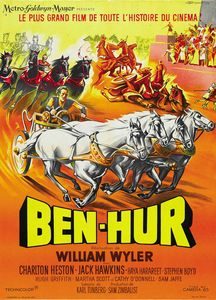
    (On DVD, May 2003) I know, I know; this film won a bunch of Oscars, enthralled generations and made a god out of Charlton Heston. But did it have to be so bloody long? Three hours and a half of monotonous, stilted, unrealistic discourse peppered with occasional moments of interest. Wake me up once it’s over. To be fair, two sequences still work really well; the galley sequence and the chariot race still stand out as particularly fine pieces of cinema, mostly because they move at such a good clip. The rest of the film is generally dull and overdone. The lack of realistic camera movement , lighting and staging may have been state-of-the-art back then, but even middling modern sandal epics such as Gladiator can jade today’s audience. There is nothing in this film that a good edit and a few camera moves couldn’t fix, but as it stands now, you’d better settle down comfortably, rest your hand on the bible and pray the phone doesn’t ring in order to go through Ben-Hur again. Goodness know now I’ve done it once, I won’t have to do so again. The DVD contains a rather more interesting making-of, which spends almost half of its time discussing previous incarnation of the “Ben-Hur” story before tackling the impressive making-of of this current version. Hey, maybe it’s time to do a remake…?

  • The Art Of War (2000)

    The Art Of War (2000)

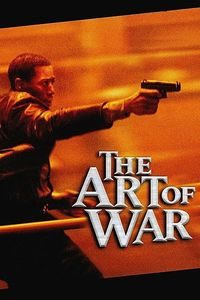
    (On DVD, May 2003) Well, well, well, isn’t that interesting: An American action thriller financed by a Canadian production company, directed by a French-Canadian, in which an African-American agent, along with a Chinese translator, must save the United Nations from the imperialistic plans of two white Caucasian Americans. Imagine that. The only anomaly is Donald Sutherland in a good-guy role –but then again he’s also a Canadian actor. Premise apart, the film itself is interesting but routine, a competent thriller with some visual flourishes and a few geopolitical twists. Wesley Snipes is rather good as the protagonist, and so it Marie Matiko as the bespectacled heroine all sinophiles will enjoy. Two particularly interesting sequences include a car chase with a nasty finish and a hallway sequence whose “visible bullets” effects seem directly inspired by The Matrix. (It’s a good scene, but its visual style isn’t found anywhere else in the film.) Moves at a decent pace and seems to think on a more global level than usual for an action thriller. Not a bad choice at all.

  • Agent Cody Banks (2003)

    Agent Cody Banks (2003)

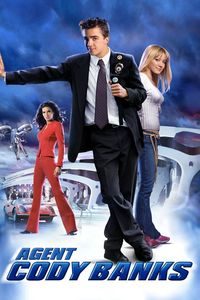
    (In theaters, May 2003) This isn’t the first teen James Bond parody, but it’s a good one… that is, until it forgets to be a parody and simply apes the convention of the Bond formula. Frankie Munez is quite good as a truly sympathetic teen character whobecomes an “agent in training” for the CIA without his parents’ knowledge. The film depends on him and his charm does more for the film than any of the special effects. His struggles to combine teenage life with his covert mission aren’t particularly imaginative, but they’re a lot of fun. (The sequence where the elite CIA operatives help out for the housework is a highlight.) At least the particulars of the Bond formula are followed: Girls, gadgets and even a touch of gambling. Angie Harmon is almost too hot to be in a kid’s movie, but at least it’s something for the older teens to look at while the plot slows down. The film as a while is energetic. Stupid, too, but not much more so than, say, the latest Bond ripoffs for so-called “adults” (hellooo, XXX!) Alas, the charming quality of the first hour wears thin as the third act becomes a thrills-free carbon copy of the typical Bond ending, complete with an exploding fortress and the grotesque death of the villain. The overall effect is a disappointment, especially given the overall high level of quality of the Spy Kids series. Oh well. We’ll be there for the sequel.

  • The Schrödinger’s Cat Trilogy, Robert Anton Wilson

    Dell, 1979 (1988 omnibus), 545 pages, C$13.95 tpb, ISBN 0-440-50070-2

    Robert Anton Wilson takes great care, early in The Schrödinger’s Cat Trilogy, to warn us that “contrarily to appearances, [it] is not a mere ‘routine’ or ‘shaggy shoggoth story’” [P.10] I beg to half-differ. While this trilogy isn’t routine, it certainly feels like a shaggy shoggoth story. Pleasant to read but frustrating in terms of conventional plotting, Schrödinger’s Cat can be lot of fun as long as you don’t expect anything resembling an ultimate answer.

    Nor any definitive plot, character, dramatic arc or conclusion, for that matter. The central conceit of the trilogy is that it studies the adventures of a few dozen characters in parallel universes. Some of them are more-or-less identical from one universe to another; others are rather different. The American political leadership of any given universe ends up having a substantial impact on the overall feel of each universe —though even Wilson couldn’t imagine the Reagan presidency.

    The genius of the trilogy is how the events in one universe inform our understanding of another. Characters are introduced in one timeline, explored in another and left as supporting players in yet another universe. The explanation to some events must be found elsewhere in the book as given situations are explored from other perspectives.

    It’s hard to say anything conclusive about the whole work (as Wilson seemingly takes delight in confusing the heck out of anyone even trying to make sense of the overall flow), but it looks as if every book of the trilogy covers an alternate universe, at the exception of the first volume which gives us a second timeline for free after the catastrophic end of the first one.

    Normally, I wouldn’t be very enthusiastic about such artistic attempts; I like my fiction straight and linear, and have no patience with books where the author tries to pass off indecisiveness as subtlety. But what reconciled me with this trilogy (aside from the emphasis on science and technology as Good Things) is how even if I wasn’t bothered to follow along with what may or not be a plot, there were enough amusing vignettes to keep me occupied. The narrative is filled with zingers, from the tyrannical “Unistat” empire to a literary critic talking about “Norman Mailer-than-thou”. The character sketches are sympathetic and effective. (Heck, even the author is a character.) The various pranks, events, anecdotes that make up the bulk of the trilogy’s vignettes are rather amusing when taken approached one at a time.

    Madness awaits anyone trying to make sense of it all, though. The Schrödinger’s Cat Trilogy isn’t a movie, and doesn’t follow a conventional A-to-B narrative. It may be best compared to an intricate surrealistic painting, where elements are disposed on a surface that suggests proximity but doesn’t necessarily represent affinity between the parts. Think hologram. Think author on acid. Think “read a random page, rip it out, repeat”. Think chapters in a blender.

    Yes, there’s no doubt that this is artsy-trippy stuff. I could understand anyone being reluctant to take it on. If you do, one piece of advice; read as much of it at once. The accumulation of background details is slight but noticeable, and you’ll get much more out of the trilogy if you do read a solid chunk of it in near succession. Some jokes play off each other, and the vast cast of characters may be obscure from time to time. (It also helps to have strong and fond memories of the Illuminatus! trilogy, given that elements of it, such as The Beast and Hagbard Celine, make a return appearance) As long as you don’t try to make too much sense out of it, it’s easy reading. But there are no big answers, no big finale, no puppet-master pulling the strings from the metaverse. It ends in mid-story. It probably warrants a re-read every couple of years.

    In short, this isn’t an ordinary book. It’s both fun and frustrating, easy to read and impossible to understand. Maybe I even completely misinterpreted everything. Yet I don’t care all that much. As long as I’ve been entertained, who am I to complain?

  • Operation Fantasy Plan, Peter Gilboy

    Morrow, 1997, 290 pages, C$30.00 hc, ISBN 0-688-15246-5

    Though it may be hard to imagine at this particular moment in time, there was a time, barely six years ago, where it was fashionable to think dark thoughts about the CIA. Rather than have this reputation as hard-working defenders of our Western freedoms, the CIA could be used in thrillers as a deeply corrupt agency with no compulsions whatsoever. If exploiting human weaknesses was what it took in order to secure access to information vital to the protection of American interests, well, so be it.

    For the longest time, protagonist Peter Gaines had been one of those operators, doing what was necessary in order to weasel information out of semi-cooperative agents. But everyone has his limits, and Gaines’ is reached when he’s put in charge of “Fantasy Store”, a high-class bordello in Bangkok. Here, every vice is catered to as long as cameras are rolling in order to provide good blackmail material. The more despicable the act, the better the blackmail. Gaines reacts poorly and is promptly fired for his excess of conscience.

    There is, naturally, a woman at the root of the problem: Songka, the newest recruit of “Fantasy Store”, the most beautiful woman Gaines has ever seen. He goes nuts for her, and his quest to find her again will take him back to Thailand even though the CIA is watching his every move. In this new civilian life, Peter has to learn that nothing is what it seems and every revelation might not be entirely truthful.

    Operation Fantasy Plan could have been written during the seventies by a British author and it would still be the same novel. The prose exudes an air of deep cynicism and of resigned weariness. The dour narration is interesting at first, taking us deep in a world of secrets upon secrets. The first few chapters are a crash-course in psychological manipulation, as Gaines recounts his training and the major incidents of his career. The first-person narration makes it impossible to hide or to distance ourselves from the narrative. Gaines isn’t much of an optimist, and the style of the novel reflects that.

    As the tale emerges, though, a few problems appear. For a die-hard cynic, Gaines moves deeper and deeper in sentimental territory that’s hard to justify, even for someone as smitten as he is. It’s understandable that this is written as a romantic story as much as a straight-up thriller, but the endless pining of the narrator for “his” Songka gets to be a bit much after a while.

    Then there’s the small-world cliché, in which every single person mentioned in the first five chapters end up being vitally important to the story resolution, with particular boos to “Vaal” as being the worst example of this.

    Plus there’s the novel’s declining interest once the “big secret” is out of the bag, maybe three-quarter of the way in the novel. The rest isn’t nearly as compelling, as we’re down to a who-trusts-who game that gets so twisty it’s tiresome. Compared to the rather fun first third, the third act is too long, too depressing and far too sentimental. What began as summer reading ends up in a heavy philosophical morass closer to John LeCarre than to Richard Marcinko. Some will be impressed; some will be disappointed.

    Not that anyone will have time to complain, I suspect. At a brisk and airy 290 pages, Operation Fantasy Plan is short enough that even the most demanding readers won’t lose too much time over this. The result is an adequate, but ultimately forgettable novel that simply doesn’t do much to distinguish itself from the pack.

  • Maelstrom, Peter Watts

    Tor, 2001, 371 pages, C$9.99 mmpb, ISBN 0-812-56679-3

    I had been mildly critical of Peter Watts’ first novel Starfish, but intrigued enough by his potential that it wasn’t much of a struggle to decide to read the sequel, Maelstrom,. Now it turns out that I’m similarly half-critical of the second novel, but for rather different reasons.

    Maelstrom begins not long after the cataclysmic events of Starfish‘s climax. (Don’t bother reading if you’re not familiar with the first book) The North American west coast has been trashed, and that only make a bad world worse. The whole global communication network is acting up, environmental collapse is well under way, gigantic corporations are up to their usual dirty tricks and a fractal death-wish seems to be affecting every aspect of the world, from single individuals to entire countries.

    In this situation steps in Lenie Clarke, the very very bitter (and very very powerful) surviving protagonist of Starfish. She wants answers. She wants closure. She wants justice. And very few people are going to be willing to stand in her way once she gets going. If she has to kill millions in order to fulfill her goals, well, most of these millions are already ready to die for her…

    If your SF diet has grown a touch too optimistic lately, it’s time to delve in the dystopian nightmare that makes up most of Maelstrom. Here, impending global cataclysm (from a variety of sources) is a backdrop to a series of very dark adventures in which an outbreak of primordial microbes is the least of everyone’s worries. The environment is trashed anyway. Violence is commonplace. Employees are guilt-tripped by their employers in acting in the best interest of shareholders, and the cure to that particular issue may be even worse than the problem itself.

    It’s not a cheery novel and this lack of cheer does eventually take its toll. The dense but generally dour prose style does little to propel the story forward. The book’s single biggest failing may be how it remains curiously indifferent to the events it describes. A more nervous, more direct writing style might have been appropriate considering the magnitude of the story. But Watts seems more content with a style that seems designed to depress even beyond what happens in the story. A most angst-ridden bunch of characters would be hard to find. It’s not obvious (nor even desirable, maybe) to emphasize with them.

    Fortunately, SF fans can look forward to a bunch of tasty little details. From marine microbiology to computer science and neurobiology, Watts reaches deep in background detail (a wonderful pure-science discussion/bibliography is helpfully provided at the end of the book) for plenty of cutting-edge concepts. And not just technical ideas either: Here, Québec has emerged as an important player on the geopolitical scene thanks to its massive hydro-electrical projects ensuring plenty of energy for sale. Resentment is palpable almost everywhere else.

    Indeed, perhaps the best thing about Maelstrom is how the scope of the story has expanded. For a cycle that had its beginning in a short story (“A Niche”) exclusively set on an underwater station, Watts has embraced the whole world (with a focus on Ontario) as a canvas for Maelstrom. The story lives up to the title, offering a shifting web of complex -sometimes even contradictory- alliances.

    In the end, the telling of the tale might not do justice to the content of the story, but Maelstrom certain has a lot to offer to readers with a a penchant for dystopian tales. In some ways, this is grown-up cyberpunk, with its usual clichés assimilated in a larger, more complex setting. It’s not a perfect book, but the good outweighs the bad by a significant margin. Heck, enough to make me interested in his next novel.

  • Big Red: The Three-Month Voyage of a Trident Nuclear Submarine, Douglas C. Waller

    Harper Torch, 2001, 448 pages, C$10.99 mmpb, ISBN 0-380-82078-1

    A few years ago, this book would have been impossible. Tensions ran high between the United States and Russia and the lurking presences of the nuclear-armed Trident submarines was an integral part of the United States’ nuclear deterrent. Even if Russia could target (and presumably destroy) all of the United States’ known terrestrial nuclear sites, it simply could not account for the submarine fleet. Automatically assured mutual destruction. Stalemate even before the game had been played.

    In such a context, releasing even a shred of information on the inner workings of a Trident submarine would have been foolhardy. That’s why the Trident program remained shrouded in mystery even as other areas of America’s military capabilities were endlessly hyped, such as in George C. Wilson’s Super Carrier —a book which meticulously described the latest and greatest Lincoln-class nuclear aircraft carriers.

    But things have changed, and even though several navies still maintain a submarine fleet, their capabilities remain ridiculous when compared to the American underwater might. As the back jacket suggests, the 18,500-ton, $1.8 billion Trident submarines are “taller than the Washington Monument and wider than a three-lane highway”. Oh, and they carries enough nuclear weaponry to glassify whole countries, if the American political leadership so chooses. (Meanwhile, Canada has problems ensuring hull integrity for the four used British-built submarines it just purchased.)

    In this context, explaining the inner workings of a Trident submarine serves two purpose: First, terrify any county even dreaming of going toe-to-toe with the Americans. There’s a good reason why fifty cents out of every defence dollar spent in the world today is American; maintaining even one of those submarines, let alone building it, would tax the capabilities of almost any other nation on Planet Earth. Second, an exposé of the Trident program might just ensure that such weapons remain in service at a moment where serious questions are asked regarding the need for an underwater deterrent.

    Certainly, few are going to remain unconvinced of the impressive professionalism of an elite Trident crew after reading this tell-all description of a typical Trident voyage about the USS Nebraska. Correspondent Waller takes us inside almost all areas of the ship, from the bridge to the trash disposal area, from the mess to the chambers in which the nuclear missiles are stored. Even in peacetime, don’t think that deployment are easy for the crew; it’s drills, drills, drills all the time, and the first few days of operation end up being mostly sleepless ones.

    Waller’s style is brisk, to the point and filled with fascinating details. It’s a telling comment than to point out that the most mundane elements of underwater life (food, entertainment, worship) are described in as many fascinating details as the more exciting trials, such as hostage-taking training scenarios, a description of the nuclear firing sequence and simulated war-games. A lot of attention is also paid to the men manning the machines, as dozen of sailors are interviewed and invited to discuss the paths they followed in order to serve aboard the USS Nebraska.

    All in all, Big Red will doubtlessly appeal to military buffs, engineering geeks, as well as anyone with a deep interest in one of the most secretive areas of the American military forces. The depth of reporting is thorough enough that the book will doubtlessly act a primary source for countless techno-thriller writers in years to come. In the meantime, Big Red truly stays the definitive layman’s text on Trident.

  • Fire, Sebastian Junger

    Morrow, 2001, 224 pages, C$35.99 hc, ISBN 0-393-01046-5

    It used to be a fashionable idea to think that the world was a safe place.

    We know better now, but the nineteen-nineties were seen by many (North-)Americans as an age where nothing serious was going on. And yet, you didn’t have to look far to see hot spots all over the world. Forest fires in the forests of North America. Tensions in Kashmir and Cyprus. Civil wars in Africa, Afghanistan, Eastern Europe… and those are merely the trouble spots covered by Sebastian Junger in his first non-fiction collection, Fire.

    It happens all the time in Science Fiction: a solid but underrated writer wins raves and awards with his latest novel. Suddenly, a collection of his/her short fiction is published after years of unsuccessful attempts (because they’re usually regarded as being commercially risky). As it turns out, success breeds the same ideas everywhere, so it’s not particularly surprising to see the success of Junger’s The Perfect Storm breed a market for a collection of his magazine articles. Fire brings together ten articles from 1992 to 2001, spanning the globe in an attempt to explain danger to comfortable land-lubbers like us.

    The book might as well have been titled Risk, because all of the articles involve men and situation that could have dire consequences. Only the first two scorching articles, about forest firefighters, truly reflect the title of the book.

    After that, well, it gets more dangerous. After a breather in which Junger describes the hair-raising job of “the last living harpooner” (there are plenty of good reasons why they’re extinct), we move in more disturbing territory. “Escape From Kashmir” describes one of the many consequences of a dirty little conflict between India and Pakistan, the kidnapping of a group of Western tourists, most of whom simply disappeared without a trace. One of them managed to escape from his captors, and the article is his story.

    From there, we go to to Kosovo for the first time (“Kosovo’s Valley of Death”), in a war piece that seems almost too shy to report on what is happening. (This piece is markedly more recent -1998- than the previous ones. All subsequent pieces were written between 1999 and 2001, signalling Junger’s shift in the major reporting leagues.) Then it’s off to Cyprus, torn between Greek and Turkish enclaves. Here, Junger (from the Greek side) shares reporting duties with Scott Anderson (on the other). Their joint “dispatches from a dead war” are a fascinating examination of a difficult issues, with a surprising conclusion.

    “Colter’s Way” is, initially, a historical account of a man thriving on the edge of danger, but it also serves as a springboard to the examination of modern life and self-induced risk. (resemblances between this subject and the book itself aren’t totally coincidental) Nice, but nothing compared to “The Forensics of Death”, which uses the Kosovo civil war as a way to talk about international war justice and the issues associated with it. “The Terror of Sierra Leone” could be an ideal background piece for a modern thriller, mixing diamond lore, an African civil war, private security firms and much more. The volume concludes with “The Lion in Winter”, the portrait of Ahmed Massoud, a reluctant Afghani revolutionary fighting against the Taliban. (You might remember his name; he was killed during by al-Quaeda operatives in September 2001, a fact that adds a tragic dimension to the piece.)

    All is described in Junger’s descriptive prose, with appropriate explanatory passages that give us a better idea of what it all truly means. Junger’s eye for detail is stupefying, and almost every page of this book contains one or two new thing you didn’t know about. Though the book could benefit from photographic material, this is nothing to be sneered at. A superior journalism book, telling us more about our dangerous world as it really is.

  • Little Green Men, Christopher Buckley

    Random House, 1999, 300 pages, C$34.95 hc, ISBN 0-679-45293-1

    I remember showing the bright-yellow jacket of this book to a colleague, who then asked the obvious question: “Are there any Little Green Men in it?” My first answer was “Well, with a title like this…”, but as it turns out, my colleague’s question was absolutely appropriate. Little Green Men is a rarity, a comedic thriller about UFOs that should satisfy both believers and sceptics alike. It also helps that for a humorous story of political intrigue, it’s about as non-partisan as it’s possible to be these days in the United States.

    Starring an unlikely protagonist named John Oliver Banion, Little Green Men is the story of a Washington talk-show host who is suddenly abducted by UFO occupants. A man of considerable intellect and reason, Banion has trouble coming to grip with his predicament. That is, until he’s abducted again. After that, he simply decides to become a crusader for all UFOlogists, with predictable results: His talk show is yanked off the air, Majestic-12 gets involved, his family and friends desert him and he becomes the coqueluche of the vast fringe-wing conspiracy. But what he’ll discover will defy both his imagination and yours… and spin wildly out of control as he finds himself with just a little bit too much power.

    I should probably avoid any further spoilers, because the pleasure of Little Green Men is how it twists the obvious developments and develops the obvious twists. As a confirmed sceptic regarding this whole UFO business, I approached the novel with guarded expectations, but what I got was considerably more interesting than what I first expected. It’s a remarkably clever little book, exploiting conspiracy hysteria in a fascinating fashion. Buckley Does Not Believe, and this detachment allows him to have a lot of fun with the material. (There are footnotes)

    Purists should note, however, that even though this is billed as a novel of political humour, there isn’t much in way of belly-laughs in the book. They’re scattered here and there, but for the most part, Buckley sticks to reasonable just-this-side-of-reality plot developments, avoiding obvious burlesque unless absolutely necessary. But to judge this novel on the number of laugh somehow misses the point, especially when it’s hard to wipe a sustained grin off our face as we read the novel. (Given the considerable sustained appeal of the prose, be prepared to grin from beginning to end.)

    Another note worth pondering: While you may get hints of known figures in the quick character sketches, don’t assume that Little Green Men has any link to pre-1999 political figures. In the first few pages, we learn that Saddam Hussein has converted to Catholicism, Robert McNamara was “addicted to mind-altering hair-restorative drugs the whole time he was escalating the war in Vietnam” [P.18], Israel annexed Jordan based on a new translation of the Dead Sea Scrolls and that our protagonist once co-authored a congressional committee report that “stuck a well-balanced tone between righteous indignation and cautious reform, between those who though that the United States had no business trying to poison Canadian prime ministers and those who, while disapproving of this particular instance, felt that the United States ought to reserve the right to dispatch troublesome Canadian PMs in the future, should circumstances warrant.” [P.16] In short, any resemblance between this reality and our is, hopefully, entirely coincidental. This lack of adherence to acknowledged reality is one of the elements making Little Green Men fun reading for conservatives and liberals alike.

    The evolution of this protagonist from a righteous bastard to a definitely more sympathetic hero is one of the novel’s chief delights, but hardly the only one. I’d end up recommending Little Green Men to just about everyone. Sagaciously plotted, deliciously-written and executed with more than a twinkle of amusement, it doesn’t need much more to get my recommendation. If you think that X-Files-inspired rants and government conspiracies have evolved in a less-than-amusing direction lately, well, this is the book for you.