Author: Christian Sauvé

  • The Gift (2000)

    The Gift (2000)

    (On DVD, December 2002) Low-key, but effective supernatural thriller with a bunch of big stars (Cate Blanchett, good as ever, but also a surprising Keanu Reeves, Katie Holmes, Greg Kinnear and Giovanni Ribisi) used to good effect. Sam Raimi’s direction is also understated, yet effective. Interestingly enough, the “gift” isn’t nearly as important as how the characters react to it. I didn’t think a hillbilly drama about a clairvoyant would grab me as much as this one did. The resolution is predictable, but the technique is sufficiently well-handled that it doesn’t matter much. At a time where supernatural thrillers are dumb and plentiful, it’s somewhat of a relief to find one that actually looks as if it cares about the story it’s telling. A small film, but a pleasant surprise.

  • The Popcorn Report, Faith Popcorn

    Harper Business, 1992, 268 pages, C$15.00 tpb, ISBN 0-88730-594-6

    Oh, I so do love futurists. They’re like stunted Science-Fiction authors who had all the imagination beaten out of them by MBA-holding Zen masters. Futurists say they explore new ideas and extrapolate from existing trends, but when you look at it ten years later, does their track record hold any better than SF writers of the time?

    Not really. Exhibit number one: The much-celebrated Popcorn Report, by Faith Popcorn. Written in the early nineties, it was supposed to give us pointers on the ten following years. Well, ding-dong, the decade’s up and it’s time to take a look at what she said then.

    Ten trends. Okay, here they are: Cocooning in a New Decade, Fantasy Adventures, Small Indulgences, Egonomics, Cashing Out, Down-Aging, Staying Alive, The Vigilante Consumer, 99 Lives and Save Our Society.

    Okay. Sure. Spot anything incongruous here? You shouldn’t.

    And that may very well be my point. Re-read The Popcorn Report today and while some cultural differences may have evolved, it’s not as if it’s totally alien. Neither particularly prescient nor exceptionally wrong, this book could be re-issued today with only a few dates rubbed out and it would still be publishable.

    So what does that say, exactly? That Popcorn was right enough ten years ago that she’s still on track? Or rather that by predicting bland middle-of-the-road generalities, you can’t go wrong? Of Popcorn’s “ten big trends”, a lot of them look like stuff consultants spout off to companies just to be one the safe side: “be honest or your customers will hate you.” Ooh. “They will pay more for a premium product.” Gee. “They love it when they get something that’s customized for them.” Wow. Smart thinking there, Einstein.

    Of Popcorn’s ten trends, you’d be hard-pressed to find one that’s not true today. But then again, it’s been the case for thirty years. Yes, everyone wants to save the environment. Yes, everyone wants to have a safe thrill or two from time to time. Don’t you say that people want to retire as soon as they can afford to? Heavens!

    Meanwhile, the Internet whooshes by Popcorn, who still goes bonkers for the oh-so-early-nineties virtual reality. But maybe I shouldn’t be too hard on her for that, as a lot of people didn’t see it coming either. ANd yet, that was the biggest business story of the decade. Whoosh. Business seers are ill-equipped to deal with technological discontinuities.

    At least it’s a dynamic read. If you’re familiar with espresso-laced business consulting literature, The Popcorn Report‘s writing style will be familiar: All pow-pow-pow rhetoric, “backed” by fringe anecdotes that might actually mean something if you believe everything you read.

    Please excuse my cynicism (or better yet; embrace it), but I have already seen far too many of those so-called “analyses” deceive over-eager “decision-makers”. By fishing extreme anecdotes as indicative of trends, Popcorn marginalizes her propositions for anyone used to seeing facts and figures. How about a poll tracking attitudes over a five-year period? Wouldn’t that be a more convincing method to prove or disprove how attitudes will evolve? But The Popcorn Report is heavy on stories and light on figures…

    Despite my skepticism, though, The Popcorn Report still makes for good wish-fulfillment reading. It’s argued in an interesting fashion, and probably stands best as a timeless reminder of ways one company can hope to distinguish itself from competitors. But the decade that has elapsed since the publication of the book certainly offers a more accurate assessment of the books true “predictive” worth.

  • Gangs Of New York (2002)

    Gangs Of New York (2002)

    (In theaters, December 2002) I don’t worship at the altar of Martin Scorsese, but after seeing what he did with this script, I’m now quite willing to attend the occasional get-together. Gangs Of New York is a sumptuous re-creation of a fascinating historical period, when the infamous Boss Tweed’s Tamany Hall reigned over a city that actually deserved its corruption. Immigrants against so-called natives, rich against poor; if America was born in the streets (as the film’s tagline suggests), then it had a difficult gestation. This story is your good old revenge plot, as a son vows to avenge his murdered father. This 1860ish New York is grimy, lively and completely alien to us, as firefighters fight it out for the right to loot a house and gangs can hack at each other in complete impunity. Leonardo DeCaprio fares well in a good bad-boy role, but he pales in comparison to Daniel Day-Lewis, who delivers a great performance as an oddly endearing villain. The film is worth seeing more for the direction and the historical re-creation than for the rather simple story: cinema geeks will love it for the pleasure of seeing a true artist move a camera around, with plenty of budget to realize his vision. The abruptly political ending is initially hard to swallow (it doesn’t help that it cheats us of a dramatic climax after a long buildup), but it does make a point. Who even remembered such events taking place in New York City? Dust those history books…

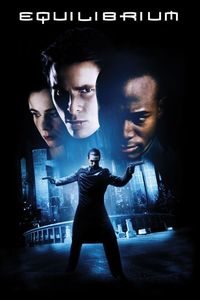
  • Equilibrium (2002)

    Equilibrium (2002)

    (Downloaded, December 2002) Now this is the best Science-Fiction film of 2002 you won’t see. Shamefully under-distributed in theaters (and not at all in Canada, hence leading me to, er, “alternate” distribution systems), this science-fiction film brings together an Orwellian techno-fantasy with some of the most amazing action sequences of the year for a science-fiction experience that’ll bore you, then kick your eyeballs with split-second fight scenes that will make you gasp “Did I really see that?” Equilibrium mixes martial arts with guns and a whole lot of style. I’d describe it as “Gattaca with gun-kata”, if you want a ready-made blurb. Yes, the first hour is slow (neither dumb nor pretentious, though… and that’s already quite a recommendation), but that last forty minutes… watch out! It all culminates in a deliriously cool hand-to-hand fight scene where both fighters fires guns at each other point-blank. Damn! I guarantee you haven’t seen anything like it. Christian Bale turns in one of his best performances as the uber-cool priest who turns to the good side. A bunch of other known actors also pop up here and there: Sean Bean, Taye Diggs, William Fichner as well as Emily Watson (who looks positively hot with a long wig) have small roles in this low-budget film. Writer/Director Kurt Wimmer has done miracles with what looks like a tight budget and an even tighter schedule. I can only wonder about what he could accomplish with the means to execute his vision. In the meantime, don’t fret or delay; get a copy of Equilibrium by any means necessary and get fired up!

  • Les Dangereux [The Dangerous] (2002)

    Les Dangereux [The Dangerous] (2002)

    (In theaters, December 2002) Yikes. I can understand that black comedy isn’t a familiar genre in French-Canada (where the preference goes more to crude popular comedy), but it’s not an excuse to mess up this film so badly. While the film enjoys a relatively flawless second quarter (which compares more or less with such films as Snatch), everything goes to hell as the movie advances toward its conclusion. This simple tale of kidnapping can’t be bothered to maintain an even tone throughout, nor to respect the intelligence of the audience: The staging become more and more ludicrous, the finale is extended beyond anyone’s reasonable patience and the whole thing ultimately ends in a muddled mess. Headliner Stéphane Rousseau grandstands without any adult supervision and Véronique Cloutier is allowed to torture viewers through two musical numbers. (On the other hand, she’s pretty cute… but not enough to make us forgive everything.) The stereotypes are unworthy of existing in a movie released in 2002, and so are some of the plot shortcuts used in lieu of clever plotting. (Can you believe the “lost glasses” shtick? Me neither.) Oh, it’s not as if the entire film is unpleasant, but the tremendous waste of potential here is almost offensive. We’ve got enough stupid American movies up here; we don’t need to make our own.

  • The Curse Of The Jade Scorpion (2001)

    The Curse Of The Jade Scorpion (2001)

    (On DVD, December 2002) Now here’s a good film destroyed by inappropriate casting. Hubris, even, as the miscasting in question is writer/director Woody Allen giving the protagonist role to himself. Awful choice, especially where we’re to believe that he’s lusted after by none other than, oh, Elizabeth Berkley, Kaili Vernoff and the divine Helen Hunt. Yikes. What, Bruce Campbell wasn’t available? In any case, if you close your eyes and manage to convince yourself that this isn’t Woody Allen they’re lusting after, the film isn’t too bad: The atmosphere successfully evokes the war-years period, and so does the witty dialogue between Hunt and Allen. Yes, the whole hypnotism shtick is profoundly silly, but never mind that: it’s all in good fun. In the end, this sense of fun (oh, and the girls; I’m that shallow) is what sort of saves The Curse Of The Jade Scorpion from total failure. But I can’t wait until we’ve got the technology to replace Allen out of this picture…

  • Murphy’s Gambit, Syne Mitchell

    ROC, 2000, 377 pages, C$9.99 mmpb, ISBN 0-451-45809-5

    Reviewer’s Note: As I couldn’t muster up the interest to review this mid-list SF novel, I simply stuffed it in my brand new ReviewMatron™ and let it cough up an automated review. Here are the results: (Warning! The ReviewMatron™ has an unfortunate tendency to spoil novels it doesn’t like.)

    Genre: Science-Fiction Adventure

    Author Profile: searching… none…. first novel.

    What the only cover blurb tells you: Mid-list SF author Eric S. Nylund says “Adamantine-hard science fiction with heart… a ripping good read”

    What the only cover blurb doesn’t tell you: That Eric S. Nylund is Syne Mitchell’s husband.

    Plot: Outsider gets embroiled in conspiracy revolving around piece of high-technology with potential to overthrow existing social order.

    Protagonist: “Thiadora Murphy”, a “floater” -zero-gee-optimized human- sent to a military college.

    Protagonist’s clichés (list): absent father… outsider amongst her peers… red-hot pilot… something to prove to the universe… meaningful tattoos…

    Initial Plot Complications (list): Ostracism by peers… job offer from shadowy organization (refused)… framed… kicked out of academy… best friend killed… forced to take the job against her will…

    Contrived or cliché?: Hard to say.

    Author’s unsubtle theme: Discrimination.

    Assessment of first third of novel: Poor. Cliché. Dull. Déjà-vu.

    Plot shift into second act: High-tech vessel stolen from company, then stolen back by company. Meanwhile, protagonist meets first ally.

    “Ally” characteristics (list): “Kyle”: Opposite sex… rather sympathetic to heroine… exceptional hard-to-explain skills… shadowy loyalties… secretly connected to powerful organization…

    Thrust of Second Act (list): recovery of ship… discovery of capabilities of ship, including time-travel… forces pursue the ship… protagonist isolated from all sources of support…

    Return of father: Check. (Sort of)

    Explanation of Ally’s willingness to help protagonist: Check.

    Assessment of second third: Better. Now that all clichéd pieces are in position, magnanimous readers merely have to follow them around.

    Capture of heroine as start of third act: Check.

    Torture: Check.

    Awful doubt that ally has betrayed her: Check.

    Ally still comes through: Check.

    Best friend back from the dead: Check.

    Best friend pissed: Check.

    Hot lesbian love scene between protagonist and best friend: No.

    Escalation of third act into galaxy-spanning political reform: Check.

    Revolt of the ostracized masses: Check.

    All seems lost: Check

    Heroine figures ultra-clever scheme to restore rightful social order: Check.

    Happy Ending: Check.

    Assessment of Last third: Fair.

    Assessment of writing skills: Okay. Enough to keep reader’s attention once everything gets going.

    Assessment of Novel: Takes a while to get going. Slowly evolves in average mid-list SF novel.

    Double-meaning title: Check.

    Hard-SF? No.

    Recommended action re Author’s next novels: Acquire at used book sales if price is right.

    Final state of mind: Blah.

  • Chicago (2002)

    Chicago (2002)

    (In theaters, December 2002) By the end of the very first musical number, it’s obvious that this is a triumphant return of the classical musical. Chicago isn’t as audaciously post-modern nor as self-conscious as Moulin Rouge!, but whatever go-for-broke edge it lacks doesn’t really matter when it’s so well-done. This ultra-cynical tale of profitable crime isn’t particularly complicated, but it’s told with plenty of style. Even the outrageous musical numbers are carefully integrated as being part of the characters’ imagination with what’s certainly the best editing of the year. Renee Zellweger, Catherine Zeta-Jones and Richard Gere sing and (tap)dance and yes, they’re believable. What’s not so obvious are the other great supporting performances, from Queen Latifah to John C. Reilly to Colm Feore’s non-singing part. The result is pretty amazing. I wanted to clap at the end of some sequences. Who could have guessed that a musical written in the thirties would contain such biting social commentary even today? The ventriloquism/puppetry sequence alone is worth the price of admission, not to mention the “had it coming” tango, the court-circus piece or even the preposterously appropriate tap-dancing around legal arguments. No doubt about it; Chicago is a superior film that makes an effort at showing us far more than what is required to tell a good story. It’s remarkably funny, paced like an action film and surprisingly memorable. See it. Now.

  • Catch Me If You Can (2002)

    Catch Me If You Can (2002)

    (In theaters, December 2002) Everyone loves to see a deserving hero get away with something, and that’s exactly what this Spielberg film delivers. This is the loose biography of con man Frank Abagnale, who spent the late sixties impersonating airline pilots, doctors and lawyers and forging checks to great profit. Constantly outwitting authorities, he was eventually captured… but still managed to beat the system. This delightful film announces its colors from the onset, through a deliberately retro credit sequence that plunges us back in the time period. Leonardo DeCaprio is convincing in the variety of roles Abagnale chooses to play, and the direction is comfortably laid-back. This film could have been done at any time over the past twenty years; there is nary a “modern” technique in sight. A cursory glance at interviews with Abagnale is sufficient to uncover significant deviations from reality (there was, for instance no single FBI agent pursuing Abagnale through all these years), but the fiction is a compelling, entertaining piece of entertainment. Spielberg is a consummate professional, and he knows how to create a feel-good piece of cinema. Even the too-long ending is built to show how one could see Abagnale simultaneously becoming a law-abiding citizen while beating the system even more outrageously than as a criminal. Catch Me If You Can isn’t a particularly deep or challenging film, but it’s a lot of fun. A terrific criminal procedural enhanced by a compelling cat-and-mouse story, it’s pretty much designed for maximum entertainment. Enjoy!

  • Belphégor – Le fantôme du Louvre [Belphegor, Phantom of the Louvre] (2001)

    Belphégor – Le fantôme du Louvre [Belphegor, Phantom of the Louvre] (2001)

    (On DVD, December 2002) It’s not because it’s French that it’s good. In this case, this particular take on the classic monster story is interesting because it stars the adorable Sophie Marceau and takes place in Paris, but as for the rest, well… Apart from the striking visuals, it’s strictly a run-of-the-mill supernatural thriller. Possession clichés are trotted out one after another, and if the Egyptian lore is cause for a good frisson or two, those shivers remains overwhelmingly based on potential alone. Belphégor has too much visual pizzazz to be considered boring, but on the other hand it’s nothing particularly striking.

  • Where Angels Watch, Randall Wallace

    Bantam Crime Line, 1992, 323 pages, C$5.99 mmpb, ISBN 0-553-29254-4

    If you’re a movie buff, the name “Randall Wallace” should mean something to you. He wrote the screenplays for the Oscar-winning BRAVEHEART and the execrable PEARL HARBOUR. He directed WE WERE SOLDIERS from his own script. He’s buddy with Mel Gibson. In short, he’s what we’d call a Hollywood insider.

    It’s not a secret that he didn’t start out that way. His biographies (check out his sort-of-official web site at www.thewheelhouse.net ) mention that he wrote a few novels before breaking into the Hollywood big-time in the mid-nineties. Finding those novels, however, isn’t an easy matter given that they didn’t sell all that well and are almost all out-of-print by now.

    I was lucky enough to catch Where Angels Watch at a used book sale. It’s the second novel in a series (technically a sequel starring the characters from Blood of the Lamb, though with a presumably brand-new all-exciting villain!), but I couldn’t very well wait and hope to find the first novel anytime soon, so I dove right in.

    In many ways, this is a strictly-business police thriller. In Los Angeles, a killer preys on hookers and strippers, leaving them dismembered and displayed as an unmistakable challenge to police forces. Protagonists Tom Ridge and Scarlet McCullers are now faced with a new mystery—and a killer than may be a policeman…

    I’m sure you’ve read something similar before. It’s not exactly original. But there’s always some place for a well-written entry, and that’s exactly what Where Angels Watch manages to be.

    It all depends on a pair of sympathetic protagonists: Tom Ridge is a by-the-book policeman with some religious training and a mind like a computer. Everyone is a bit in awe of his cognitive capabilities, and indeed, he often intuits clues and conclusions well before the experts can confirm what he’s already deduced. The only person not afraid to try to one-up Ridge is, of course, “Cully” McCullers. She’s brasher, more willing to throw suspects around and always trying to prove her worth. Together, they make an unstoppable team. Except that… they’ve been together -in a biblical sense- and that only complicates matters.

    It still wouldn’t have worked if Wallace hadn’t been able to give the required spark to his characters. But he does, and also manages to deliver a good crunchy police thriller with plenty of tasty passages. This being L.A., we get a look at the city’s biggest industry, the relationships between police and celebrities, a believable look inside a police precinct and all sorts of other good stuff.

    Wallace’s writing is clear and easily readable. Even better; he also succeeds in wringing honest emotion out of passages that would be booed off the stage in any other context. (Though even he can’t make the ridiculous strip-tease scene work.) I could explain the meaning of the novel’s title to you in a few words, but then you’d look at the screen with a look of corny disbelief. But Wallace manages, and that’s all that matter when you’re reading the novel. (On the other hand, it may explain why Michael Bay’s ham-fisted triumphant direction made such a mess out of PEARL HARBOR’s sentimental scenes. But I digress.)

    Understand that I’m not raving about this novel; for all its qualities, it doesn’t come close to, say, Michael Connelly’s work. But it’s good stuff, it sticks to the point and it delivers what it’s supposed to. Plus it’s got curiosity value; how many novels on your shelves have been written by acclaimed screenwriters/directors?

  • MP3 Underground, Ron & Michael White

    Que, 2000, 279 pages, C$38.95 tpb, ISBN 0-7897-2301-8

    So near, and yet so long ago…

    It’s a well-known fact: Things move quickly in the computer field, and even more so when it comes to Internet technologies. What is true now may not be useful in a month or so, as companies merge, products are replaced, stocks crash and people upgrade to newer things. Anyone who dares to write a technical book must accept this fact of life and be prepared to accept near-instant obsolescence. While I can pick up a novel from 1995 and read it as if it was published yesterday, computer books tend to mold in place only a few months after their publication.

    MP3 Underground is such a book. Read barely two years after initial publication, it has already outlived its useful half-life. Technologies explained in this book have been upgraded, stopped or supplanted. Napster was destroyed by the RIAA when The Industry feared it was losing control of music distribution channels. CDex has replaced Audiograbber as the MP3 ripper of choice. One can now buy MP3-CDr players at the local Walmart for less than 100$Can. The static object that is MP3 Underground has been left behind in 2000 as the rest of the world has evolved.

    Still, there’s no denying that the heart of MP3 Underground was -and remains- at the right place. One can still read the opening chapter to understand what “the MP3 revolution” is all about. This reviewer’s personal experience matches what father/son Ron and Michael White explain: It’s not about ripping off artists. It’s not about piracy or thievery or plain old adolescent mischief. It’s about taking control. It’s about listening to music you really like rather than being subject to the manipulation of The Industry. It’s about listening to music you like at home, at work and anywhere else without lugging stacks of unwieldy CDs. It’s about identifying the good from the bad without wasting your money. It’s about fostering a sense of community between people who like the same things. All of this and more is acknowledged by the Whites in the opening pages of MP3 Underground. They recognize that you want free music, but they also treat you like responsible adults; there is no need to paint all users with the same brush, as the RIAA is prone to do.

    The rest of the book, predictably enough, doesn’t hold up as well. There is a quaint nostalgia at reading “how to use Napster” instructions, given today’s state-of-the-art Kazaa and WinMX networks. The other “how to” recipes all suffer from a similar impression: There are newer software products available out there to do it all without that many complications. Sure, it’s nice of them to have included a CD with all sorts of fun software on it, but we can do better now, thanks.

    It gets worse in the last half of the book, which is a listing of the “Top 101 Internet Audio Sites”. As you can guess, most of the sites have now either been shut down, or have redesigned to become something other than what is described. Pure Internet-link rot, hideously visible even after two years. Heck, even the book’s “official” site, mp3under.com, doesn’t even exist anymore!

    But in some ways, MP3 Underground is a time capsule of another time, a reminder of a technology’s difficult beginning. In a few years (and it might only be a few, at the speed things are going), well after the RIAA is disbanded, voluntary micropayments have been made easy and popular music has found a better business model, we’ll look upon MP3 Underground as the chronicle of the beginning of a truly modern era. The techno-hordes were knocking at the barricade, ready to help those stuck inside the walls. It’s a far-away vision of the future, and yet so close…

  • Big Trouble, Dave Barry

    Berkley, 1999, 317 pages, C$9.99 mmpb, ISBN 0-425-18412-9

    Americans can do really strange things, sometimes.

    Yes, I’m referring to the activities depicted in Dave Barry’s Big Trouble. But I’m also referring to the controversy surrounding the theatrical release of the filmed adaptation of the novel. Barry Levinson had produced a low-key amusing version of Big Trouble, starring such comedians as Tim Allen, Denis Farina, Rene Russo and the incomparable Janeane Garofalo. Everything was ready for a September 21st, 2001 release. And then…

    Well, you may suspect the rest of the story. Some nuts smashed a few planes in a few buildings and suddenly, America wasn’t prepared to deal with, say, a story which very briefly features two dim criminals unwittingly passing a nuclear bomb through airport customs. Here, let me brazenly reproduce a most inflammatory passage:

    Puggy picked up the suitcase and the little party headed down the concourse toward the planes. Behind them, the stern woman turned her attention to the next passenger, a pension actuary who was already, without having to be asked, turning his computer on, knowing that this was the price a free society had to pay to combat terrorism. [P.249]

    Ooh… I’m offended. Well, okay, I wasn’t, and it turns out to be such an insignificant part of the book that it’s hard to imagine anyone getting bothered about it. And yet, Touchstone Pictures yanked the film off its schedule and quietly released it six months later. You would have thought everyone would be mature enough to handle it by then. Alas, reviews were scathing, everyone worked up a sweat decrying that tiny thirty-second sequence and the film flopped. Here, let me reprint part of Steve Rhodes’ moronic one-star review:

    Originally set to open the week after 9-11, it was pulled by Disney, who thought, correctly, that kids were probably not ready to laugh at terrorists with nuclear bombs who hijack airplanes. They should have pulled the movie from theatrical release entirely and gone direct to video without any fanfare or marketing. Burning the print might have been an even better idea.

    As one of the few to have seen the film in theaters (and, apparently, one of the fewer to have enjoyed it), I couldn’t pass up the occasion to read Dave Barry’s original novel. The first surprise was to find out how reasonably faithful the film was to the novel. The second surprise was to find out that there wasn’t much more to the novel than the film let on.

    That’s right. Normally -especially in comedies-, the filmed version hacks off a lot of the flavor of the original. Reading the book after usually expand and deepen the filmed story. Not so much here: Most of the sequences in the film are present in the novel, and the very few changes made to the ending are probably changes that Barry would have made if he had thought of it first. (Most unusually, these changes strengthen the book’s pre-existing theme of father/son approbation)

    But don’t think that these surprises somehow translate into a disappointment: Big Trouble, whether on screen or on paper, is well worth your while. The novel is deliciously written in a compulsively readable fashion; don’t bother packing a bookmark, because you probably won’t need one. This warped portrait of Miami-area residents is sufficiently off the wall to keep you glued to the novel. After years of hilarious newspaper columns, Barry proves to be adept at longer comedy, though it should be said that this novel-length comedy is often pulled together from a string of related vignettes.

    In any case, Big Trouble is Big Fun (but don’t quote me on this, given that I just stole that line off the opening blurb pages). Fans of madcap crime thrillers are sure to enjoy this, as is anyone looking for novel-length comedy. It’s up to the Barry standard.

  • Texas on the Rocks, Daniel da Cruz

    Del Rey, 1986, 293 pages, C$4.75 mmpb, ISBN 0-345-31659-2

    For me, reading a good old-fashioned hard-SF novel is a lot like getting together with a few friends. Sure, it may not be all that great by Party Central standards, but at least I know everyone there, we pretty much agree on whatever we’ll be doing, the conversation will be about things we care about and however good or bad it’ll ultimately be, at least it’ll be a good excuse to see each other.

    The more formulaic the hard-SF, the stronger this impression becomes. Sure, average hard-SF doesn’t spend much time on character complexity, symbolic meaning or deep emotional scenes. On the other hand, well, they usually play around with cool gadgets. And sometime, that’s pretty much all you need.

    Texas on the Rocks is one heck of a good average Hard-SF novel. One simply has to read the back cover to be convinced: “Lone Star Republic to the Rescue! / In 2008, when the Russians ruled most of the world and the United States was suffering from a catastrophic drought, most everybody went to bed a little hungry every night. / But out in the South Atlantic Ocean, a Texican named Ripley Forte was riding herd on the answer to America’s deadly water shortage, hauling toward Matagorda Bay the only natural resource that could make the Republic of Texas rich again. / And while he was at it, Forte would teach the Russians a thing or two about surprise attacks. / To save the civilized world, all he had to do was to live long enough…”

    Add to that the honking big “First time in print!” and the front-cover blurb “America was dying of thirst, and the whole world was hungry—but Texas had the answer!” and, frankly, you have to be a chump not to want to read this book.

    Yes, it’s about this once-popular scheme to drag icebergs from Polar Regions to water the thirsty masses. As Texas on the Rocks begins, America is in deep trouble: The Soviets reign over most of the planet while America is mired in various problems, including a seceded Texas. Meanwhile, can-do American hero Forte is battling governmental regulations, dastardly weather and intractable financiers to extract oil from the Atlantic Ocean. No, it’s not all made up just for this novel: This story follows the author’s previous The Ayes of Texas, in which the independent republic of Texas fought (and won) a battle against the Soviet Fleet.

    So, naturally, corrupt politicians, scheming women, double-crossing soviet agents, patriotic American engineers and a host of other characters will fight it out for control of a single iceberg. A fun time is had by all, especially the reader.

    More than fifteen years after publication, the geopolitical context of the novel is completely obsolete, but that doesn’t really detract from the vigor in which the tale is told. Hero Forte (no mere “protagonist”, he) is a brawny, short-tempered Texan with good engineering instincts but bad business skills (mostly because the ones with the money are overwhelmingly evil in this book). He breaks heads and hearts alike as he moves mountains of ice to save the Good Old US of A (but first saving Texas). Call me old-school, but this kind of two-fisted American punch-fighting is always a lot of fun to read when it’s confined to fiction, and Texas of the Rocks is so grandiosely over-the-top that it’s hard not to enjoy. When Forte confidently states to the evil schemstress that he’ll keep her close to him even as she’ll try to destroy his enterprise, well, it’s hard not to crack a smile. When he adds that he’ll then marry her, it’s hard not to laugh aloud. At the conclusion, when he has his way with a now-very-willing schemestress, only to leave her fully satisfied and then deny her the pleasure of his companionship, well, game over; I’m sold.

    Looking at the Encyclopedia of Science-Fiction and Fantasy, it turns out that Daniel da Cruz passed away in 1991, at the age of 70. I’m sure he would have enjoyed knowing that, even in 2002, readers would have such tremendous fun with one of his books. (FLASH ALERT! As I research this review, it turns out that a third volume exists: Texas Triumphant (Ooh! Aah!) Acquire! Acquire!)

    [December 2003: I’m sad to report that The Ayes of Texas is less interesting and more ridiculous. There are interesting moments here and there, but the book ends up sinking in ridiculous caricature and cheap jingoism.]

  • First Landing, Robert Zubrin

    Ace, 2001, 262 pages, C$9.99 mmpb, ISBN 0-441-00963-8

    There have been, shall we say, quite a number of science-fiction novels about Mars over the past few years. After the grandiose sweep of Kim Stanley Robinson’s Mars Trilogy, the intricate nuts-and-bolts detail of Stephen Baxter’s Voyage or the adventurous spirit of Geoffrey Landis’ Mars Crossing, can the marketplace sustain yet another Mars novel?

    Apparently so. Robert Zubrin’s First Landing slipped in bookstores in paperback format in late 2002, unnoticed by anyone save for the most dedicated hard-SF fans (which is to say, people like me). Though Zubrin is a first-time novelist, he’s a scientist with some serious credentials as a science writer. After all, he’s the author of The Case for Mars, one of the non-fiction books credited for much of the late-nineties resurgence of interest for the colonization of the Red Planet. (It also formed part of the inspiration behind the film MISSION TO MARS, but the least said about that is best, I suppose.)

    It’s not a particular surprise if First Landing turns out to be so readable. By sticking to a clear and descriptive prose, Zubrin gives energy to his narrative and propels the plot forward. Here too (as in Geoffrey Landis’ Mars Crossing and Gregory Benford’s The Martian Race, not to mention MISSION TO MARS again or even RED PLANET), a catastrophic mishap strands a team of astronauts on Mars while rescue efforts are hampered by oh-so-evil politicians on Earth.

    The usual Hard-SF gallery of freaks and villains is fully present here: Rabid environmentalists, short-sighted politicians, Bible-thumping fundamentalists and trash-science “experts” manipulate popular opinion, sabotage the mission, create strife between crewmembers and generally behave in ways that seem almost too over-the-top for conventional fiction.

    But don’t roll your eyes yet: Keep reading. Despite the unsubtle characters, the good-old ecofreak villains and the stock premise, something quite wonderful emerges from First Landing. This novel starts to be fun. Good fun. Compulsively readable fun. “I want to know what happens next” fun.

    Over the pages, some of the early excesses of the novel even start to lose their edge. The astronauts (once so mismatched it was a wonder they’d been allowed on the same mission) start to gel and to bond together through strife and miscommunications with planet Earth. Everyone pulls together with an all-American can-do attitude. By the triumphant finale, even the short-sighted politicians finally “get” the message of Martian colonization. Cue the ticker-tape parade. Cheers!

    That may sound trite and/or cynical, but it’s exactly what’s needed for First Landing to succeed. It’s that kind of novel. Furthermore, Zubrin avoids many of the flaws that had so dogged Landis and Benford’s efforts. His characters are flawed, sure, but they don’t carry around closets full of pesky secrets like the full cast in Mars Crossing. The novel is short enough that it sticks to the essentials, avoiding the dilution of suspense that ended up harming The Martian Race. All and all, I’d put Zubrin’s book above the last two, if only for sheer efficiency. It’s a lean, mean (but not too mean) hard-SF novel that doesn’t try to be anything else. Even its flaws only reinforce the feeling that this is a real Hard-SF story.

    I sure hope Robert Zubrin is hard at work on a second novel; authors that get both the science and the fiction right are rare enough that they all should be encouraged. If he can make even an overused premise like Mars colonization interesting again, who know what else he’ll be able to do next?