Author: Christian Sauvé

  • Marjorie Morningstar (1958)

    Marjorie Morningstar (1958)

    (On Cable TV, October 2021) Merely calling Majorie Morningstar not one of Gene Kelly’s finest efforts is probably looking at the film from the wrong angle. As a Kelly musical, it’s definitely underwhelming—the song-and-dance numbers are few and short; he’s badly matched with a heroine (Natalie Wood) twenty years younger than he is; he’s asked to play a character of Jewish ethnicity (a stretch for Irish/German stock); and (thankfully?) he doesn’t get the girl. But that’s an awfully reductive way of looking at the film, which is an adaptation of Herman Wouk’s massive coming-of-age novel, dealing with issues of tradition and modernity clashing as our protagonist grows up and tries to find herself a suitable husband. Majorie Morningstar is noteworthy (says Wikipedia) for being unusually forthright at the time about showing Jewish traditions and rituals and explicitly having Jewish character. But that does mean that the film is, at heart, a messy romantic drama more focused on the protagonist finding herself than presenting a romance—quite a change from the usual musical comedy formula that Kelly evokes by his presence. It does make for interesting viewing—the look at NYC’s 1950s Jewish community is often interesting, and even includes a side-trip to the Catskills resorts. Wood looks great in one of her first post-adolescent roles, and some of Kelly’s dramatic material can be surprising for fans of the actor. (He also looks pretty good with stubble.)  But at more than two hours and an intentionally subtle conclusion, Majorie Morningstar does feel like a let-down of a film: something that approaches, even courts being a Technicolor musical comedy for marketing purposes, but really should have been executed in a lower-key, more dramatic form featuring lesser-known actors.

  • Warrior of the Lost World (1984)

    Warrior of the Lost World (1984)

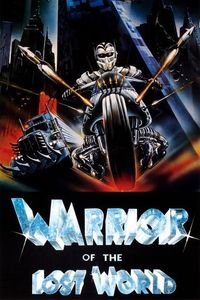
    (In French, On Cable TV, October 2021) As someone who has read metric tons of written Science Fiction, I’m probably more sensitive to bad Science Fiction than most people, and tripe like Warrior of the Lost World makes me seethe on a number of levels. It’s not just dumb science fiction filled with stolen clichés and cheap shortcuts—it’s painfully unimaginative and content to rely on material that would be too juvenile for teenage audiences. Much of the story is an obvious rip-off from the Mad Max series, with some generic authoritarian government nonsense (complete with red-white-black imagery not at all derived from Nazi Germany) on top of it. Our protagonist (Robert Ginty) looks like Chuck Norris, rides the country with his “smart” motorcycle (a thrice-talking machine so detestable that we can only cheer when it’s brutally-but-not-enough destroyed toward the end of the film) and gets rid of the oppressive regime. A few semi-known names fill up the cast, from Donald Pleasence as the top bald villain to Fred Williamson as a traitorous sidekick and Persis Khambatta (with a fuller head of hair than in Star Trek: The Motion Picture) as the mandatory love interest—plus I will never be unhappy to see Geretta Geretta pop up even in small roles. An extruded product of the 1980s Italian film industry (which had an unfortunate specialty of churning out cheap knockoffs of popular film), Warrior of the Lost World is post-apocalyptic science fiction at its laziest. There’s some money in the car chases and semi-familiar names in the cast, but that’s really not enough to masquerade the creative bankruptcy of everything else. Semi-notorious in the bad-movie genre (it was a Mystery Science Theater 3000 pick), it’s barely useful as a means of recalibrating expectations vis-à-vis dumb-but-expensive Hollywood films, but that’s not much of a barometer.

  • Gojira tai Megaro [Godzilla vs. Megalon] (1973)

    Gojira tai Megaro [Godzilla vs. Megalon] (1973)

    (On TV, October 2021) Oops—I may be overdoing my Godzilla series marathon. The recent cable release of King Kong vs. Godzilla has led Canadian cable TV channels to show as many Godzilla movies as they had rights for, and that meant that I’ve been seeing one of them every week for the past few weeks. Considering the formulaic nature of the series, I’m feeling burnt out now—and seeing them in scattered chronological order is not helping, as the technical and narrative polish of the film keeps changing. Godzilla vs. Megalon is a late-ish Showa era entry, meaning that the stylistic elements of the series were well established (with Godzilla now firmly a hero), but the series was also trying to find ways to stretch the formula as wide as it could. This means that, in addition to the monsters and aliens introduced in previous instalments, we also get an undersea, underground civilization attacking humanity for its damaging nuclear tests, and Godzilla racing to the rescue in his googly-eyed glory. This is the one with the humanoid robot fighting Godzilla if you’re looking for a shortcut. Godzilla vs. Megalon works in the same ways the Godzilla series knew how to work by that time—but taking a kids-friendly approach, making Big G the hero and having the convoluted plotting leading to a big kaiju-fighting finale. I don’t think I’m the target audience any more for this kind of material, but it’s still effective in bits and pieces. I’ll be the first one to admit that the series will probably make far more sense if ever I sit down to watch the entire thing chronologically. In the meantime, though, I’m seeing what falls on the DVR schedule… but I think I’ll take a break for the next while.

  • Invitation to Hell (1984)

    Invitation to Hell (1984)

    (In French, On Cable TV, October 2021) I gave a shot to Invitation to Hell because it’s a Wes Craven film. There’s an important caveat, though: this is a mid-1980s TV movie directed by Craven, not a theatrical release, and that can be seen in the lousy budget, familiar plotting strands and slap-dash conclusion. Still, the film hasn’t aged all that badly, especially when measured against most horror films of the period. Still, the story is odd: it’s about an engineer moving to a new area in order to join a high-tech firm, and becoming concerned that he’s being pressured to join a mysterious country club run by a disquieting woman. (Since she magically kills a man in the first scene, we’re concerned as well.)  Things kick up in high gear once his wife and kids join the club without him, and he’s attacked by them. Relying on the super-technology at his disposal at work, he suits up in a super-space outfit and uses his lasers to break into the club, get into its inner sanctum and discover that (wait for it) it’s a portal TO HELL, where his real family and kids are detained. But that’s all right—he’ll bust them out with THE POWER OF LOVE. So, yeah: TV movie. As a Poltergeist-ish (or rather: Stepford-Wives-ish) suburban horror film, Invitation to Hell is actually not too bad despite the heavy suspension of disbelief that it requires. Despite the limitations of the TV movie format, Craven does manage to give life to the result, and the production values (illustrating a familiar kind of Southern California 1980s suburbia) are good enough to carry us to the third act. The film becomes more laughable once the HELL AND LOVE things come up and the special effects technology can’t meet the requirements of the script, but that’s a familiar part of 1980s films. This is clearly not in the same league as, say, Craven’s Nightmare on Elm Street (also released in theatres that year) but it’s slightly better than I expected and not completely awful to watch. Expectations matter!

  • 365 Dni [365 Days] (2020)

    365 Dni [365 Days] (2020)

    (Netflix Streaming, October 2021) As I’ve mentioned before, a good chunk of my movie viewing is not by choice—in an effort to diversify my film horizons, I rely on a variety of semi-automated lists. I often barely glance at the log-line before diving cold into those picks. As a result, I see… everything and anything. After a perfunctory prologue that could have fit in any gangster film, the real nature of 365 Days emerges five minutes into the film, with a graphic fellatio for the male protagonist intercut with the female lead pleasuring herself with a vibrating instrument. That should be a signal that we’re not in the usual genres here, and before long the frank European nature of the film becomes even more perverse, as our male lead (a mafia boss) abducts a woman glimpsed a few years earlier and announces his intention to lock her up for a year in the hope that she’ll fall in love and willingly give herself up to him. Numerous soft-core sex scenes follow (with plenty of thrusting and nudity, albeit avoiding erect phalluses by millimetre-precise positioning of the camera) in between a narrative designed to present erotic fantasies. Clearly patterned after the Fifty Shades of Gray series in many ways, 365 Days is at once reprehensible and hilariously blunt in its intentions. Almost entirely reliant on the astonishing good looks of Anna-Maria Sieklucka and Michele Morrone, the film is designed to offer equal-opportunity fantasy fuel for all audiences—a lusty, rich, bad-boy male protagonist, a shy-but-wild-spirited and naked female lead, and enough opportunities for semi-consensual erotic episodes to push the envelope. It doesn’t hold much back and that’s part of the charm—as much as “the boat scene” is fit to inspire laughter, it’s also quite a bit beyond anything Hollywood has done in ages. There’s a bit of a weird turn in the film’s last third (with a heroine inexplicably downgrading her looks), but the cliffhanger ending fools no one and clearly announces that there’s more to follow. But the fun of 365 Days really began once I took a look at the reviews, where very high viewership numbers (for Netflix, but also in IMDB voting totals) had to be measured against abysmal critical ratings and half a dozen Razzie nominations, including “worst movie of the year.” Now, I have plenty of objections to the Razzies (which in no way even touch the bottom of the barrel of moviemaking), but the harsh critical reaction to a sexually charged film had me thinking about how contemporary movie reviewers are probably not very well equipped to handle the kind of film that is 365 Days. Let’s agree that, in reality, sexual relationships must be (as the expression goes) safe, sane and consensual. Fantasies, on the other hand, are another matter—and I’m not sure that the current zeitgeist is ready to accept that you can have wild fantasies without necessarily promoting their real-life equivalent. Yes, it’s absolutely reprehensible that 365 Days would make a romantic hero out of a murderous crime boss who takes what (and who) he wants. But that’s the nature of the fantasy—yet I can understand that no one wants to be seen condoning that aberrant behaviour. This places mainstream movie reviewers in a tough spot: if you want to talk about the social implications of the film, you can’t end up meeting it at the level it was made for. Meanwhile, if reviewers talk about its effectiveness as fantasy (and 365 Days does plays with big guns of sexual temptation), who knows what people will think of the reviewers? It’s a no-win situation. So here’s my prediction: 365 Days has been such a viewership success for Netflix that the sequels (based on the books) have already been announced. Those sequels will be widely seen and critically reviled. In a few decades, perhaps once society accepts the difference between reality and fantasy, we’ll get a reappraisal that may get what the films were going for. In the meantime, I can guarantee you that there’s nothing else in the Netflix catalogue that gets close to 365 Days, and that in many ways it’s far bolder than the Fifty Shades of Gray series. I’ll let you figure out the rest in the privacy of your own mind.

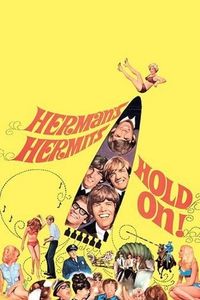
  • Hold On! (1966)

    Hold On! (1966)

    (On Cable TV, October 2021) Too weird not to exist, and yet weird enough to defy description, Hold On! is a super-topical musical comedy from the space-age 1960s that attempts to combine the then-furor for the British musical group Herman’s Hermits (now largely forgotten, but then a nation-wise obsession rivalling the Beatles) with the craze for the space program. That fusion is accomplished by the device of having NASA be asked to rename a space capsule Herman’s Hermit, allowing the band to play themselves as a touring group while the nation grapples with the request and its mania for the band. It’s such a weird and 1960s-specific film that it escapes much critical commentary: the film exists for the group to play their songs (some of them agreeable, but few of them memorable) against a structured comedy backdrop, with a ludicrous climax that sees them take a hypersonic jet to begin their concert in California, witness the launch of “their” capsule in Florida, and return to California in time to wrap up the concert. The 1960s were weird, man—we often recognize the post-1967 years as the hippies-and-Vietnam filled sixties of legend, but the earlier part of the decade was just as interesting and even more appealing, what with its increasing liberalism and bubbly space-age optimism. Hold On! is an illustrative example of that era and I can’t quite get enough of it.

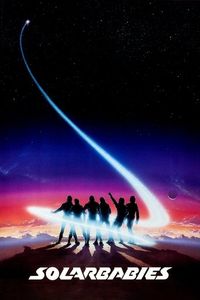
  • Solarbabies (1986)

    Solarbabies (1986)

    (On Cable TV, October 2021) I could claim to be overdosing on cheap post-apocalyptic films at the moment, but the truth is that it usually takes only one of them to have my fill anyway—long the domain of bargain-basement filmmaking, the post-apocalyptic genre is usually carte blanche given to unimaginative filmmakers to do whatever they want without regard for wit, coherence or realism. In director Alan Johnson’s Solarbabies, we have the usual movie cliché of post-apocalyptic stories combined with teen-movie clichés to end up with a result too stupid for adults and too repellent for younger audiences. I’m not sure what I least liked about Solarbabies (the robot sidekick? The teen-speak? The world-building incoherencies?) but I certainly know that I hated all of it. All right, that’s it—I’m done thinking about this film.

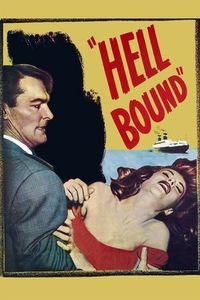
  • Hell Bound (1957)

    Hell Bound (1957)

    (On Cable TV, October 2021) Once you get past the classics of film noir, there’s an astonishing number of smaller-scale, less refined but still highly enjoyable entries in the genre. Late-period Hell Bound is one of them: a lean, sometimes mean thriller that manages to score a few minor high points while delivering an entertaining crime story against the backdrop of Los Angeles. Cheekily beginning with an idealized visual presentation of a proposed crime for its backers (with a rather wonderful transition between the fantasy and the presenter), the film focuses on a plot to steal surplus WW2 drugs from a ship for sale in the underworld. John Russell stars as a two-fisted criminal with no time for cutesy romance, while centrefold model June Blair plays the femme fatale. (I also liked Margo Woode a lot, but more for the glasses than anything else.)  Unusually enough for the genre, Hell Bound features a visually impressive finish taking place on Los Angeles’s Terminal Island, where (at the time) hundreds of trolleys had been stacked for scrap. The abrupt ending is one you may not necessarily guess either. This doesn’t make Hell Bound a terrific film—the obtuseness of the dialogue alone is often baffling—but it does make it a decent noir, and one that (by being so close to the streets) gives an interesting look at circa-1957 Los Angeles.

  • Mondo cannibale [Cannibal World] (2004)

    Mondo cannibale [Cannibal World] (2004)

    (In French, On Cable TV, October 2021) As much as I truly loathe to find anything nice to say about the infamous (and reprehensible) horror film Cannibal Holocaust, the universe has a perverse sense of humour, and today’s offering (via a scheduling mistake at the not-always-competent French-Canadian horror Cable TV channel) is Mondo cannibale, a 2004 film from shlockmaster Bruno Mattei determined to ape 1981’s Cannibal Holocaust but with even less wit. The plot is the same, as journalists head into the upper Amazonian to film cannibal tribes, and realize that they can’t just watch without being in mortal danger. The troubling “aren’t viewers the real monsters?” subplot of the original is here hammered so often that it becomes stale and then almost comic. As for the stomach-churning gore, well, there’s plenty of it—although it doesn’t seem to be filming the killing of real animals, so that’s at least one way in which the film is infinitely preferable to the original. Still, this is a terrible, useless film. Aping the cannibal movies of the early 1980s is in no way an achievement worth celebrating—skipping Mondo cannibale entirely is a wiser course of action. And don’t mistake this assessment for any kind of endorsement for the original.

  • Watermark (2013)

    Watermark (2013)

    (On Cable TV, October 2021) Follow-up to the somewhat similar Manufactured Landscapes, Watermark reteams filmmaker Jennifer Baichwal with photographer Edward Burtynsky for a widescreen look at the impact of man on nature. This time, the focus is on water—how it’s used, how it’s controlled, and how it’s threatened by human activities. As with the first film, we’re taken to incredible landscapes, most notably the Chinese Xiluodu Dam and the eerie flooding of its reservoir. The strengths of the filmmakers’ first film remain intact—a dispassionate but provocative eye for striking images, a non-preachy but convincing environmentalist message, a willingness to dig under the surface of the world to reveal its underpinning—but two notable flaws have been addressed: The images are now shot in high definition (ensuring their longevity with modern home viewing equipment) and the subject matter is not as overexposed today, also ensuring its continued interest. It’s also somewhat closer to visual documentaries à la Koyaanisqatsi than the unwieldy half-lecture/half-visuals format of the first film—there’s still some narration, but it’s less intrusive and unafraid to quiet down in order to let the images speak for themselves. The result takes us in real places that were new to me—places where humans interact with bodies of water, or try to control it through striking man-made architecture. It’s quite amazing in places—I’m not sure I would have imagined the manufactured inland waterfronts of Discovery Bay, California had Watermark not shown it from above, for instance. It does amount to a quietly impressive documentary, as much feast for the eyes as it’s fodder for thinking about our place in the world. An improvement over Manufactured Landscapes in nearly every way, Watermark sets high expectations for their third film Anthropocene.

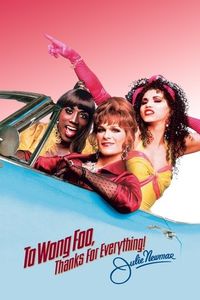
  • To Wong Foo Thanks for Everything, Julie Newmar (1995)

    To Wong Foo Thanks for Everything, Julie Newmar (1995)

    (On Cable TV, October 2021) There’s a perfectly fair argument to be made that To Wong Foo Thanks for Everything, Julie Newmar is too conventional a film—fluffy, predictable, shallow and willfully unwilling to confront deeper issues about its characters. On the other hand—this was a major Hollywood studio production about drag queens from the middle of the somewhat less accepting 1990s: How could it not be such a film? A safe way to talk about outsiders is to make them irresistibly likable, and that’s the bet successfully waged here. Patrick Swayze, Wesley Snipes and John Leguizamo star as three drag queens whose cross-country road trip lands them in a small Midwestern town, where they’ll confront local bigots, crooked police and various semi-romantic entanglements. It goes without saying that our three protagonists are without personal flaws, and are free to use both masculine and feminine virtues to overcome their obstacles. It all works really well, at least on a somewhat fairy-tale level. But notice how To Wong Foo quickly skims over the question of the protagonists’ sexuality (and when it does, makes such broad sassy considerations with such outdated terminology that they immediately become suspect) and takes the very convenient route of avoiding the transformation process—save from a scene at the very beginning of the film, our leads remain in drag all the time, night and day. There’s a sanitization process that helps with the film’s fantasy of easy acceptance, but we’re nowhere near realism. Reading about the film from the perspective of queer cinema commentators is highly enlightening. But on the surface level that it seeks out, To Wong Foo is more successful than not—let’s not underestimate the performances of Swayze and Leguizamo (for whom this is still one of his best movies)—plus a still-remarkable performance by black masculinity icon Wesley Snipes. Non-queen actors are also not too bad, with Blythe Danner and Stockard Channing getting some attention in largely functional roles. It all looks clean and stereotypically mid-American, with director Beeban Kidron keeping things moving at the intended level. No, To Wong Foo is not a heart-wrenching drama nor cutting social commentary—but it is likable and fun to watch and, in normalizing the outsiders, makes them less of outsiders. Not a bad result then or now.

  • Amityville 3-D (1983)

    Amityville 3-D (1983)

    (On Cable TV, October 2021) You could make a point that watching a 3D movie on a 2D screen is a good way to expose the ridiculousness of the result, but that fails to consider that, no matter the number of dimensions, Amityville 3-D is an exceptionally dumb movie. Clearly belonging to the “throw in as much spooky stuff even if it doesn’t make sense any more” school of bad horror films, this third instalment often feels like a hyperactive kid rushing through a variety of events at breakneck pace. It can’t focus on anything, and it kills off characters the moment it suspects we’re in danger of no longer paying attention. Legal rights issues meant that this sequel was untethered to any of the original characters except the house, further helping the result to go everywhere and anywhere. One of the few highlights of the mess is seeing a young Meg Ryan in a disposable role. It ends with the destruction of the house, thanks to a basement well conveniently filled with demons. In other words: all familiar stuff, plus the craziness of the anything-goes nature of the plotting and some touch of further excess thanks to the now hilarious 3D effects. It’s not good, but it’s just a touch more entertaining than expected.

  • Shall We Play? (2020)

    Shall We Play? (2020)

    (On Cable TV, October 2021) There’s an unwieldy messiness to Shall We Play that makes it both quirky and annoying. In barely 85 minutes, the film can’t quite decide whether it’s about an occult smartphone app, a family curse, demonic possession, or maybe even something else. We get teenage boys taking unconscious nudes of the protagonist (something that should land them straight to jail, except that the film doesn’t want to interrupt the protagonist’s carnival of humiliation), a character who’s already dead, psychiatric institutionalization, a girl taking revenge on her tormentors, friends turning on each other and, well, a lot of other things. It never coheres—in fact, some of the material is merely window dressing for an incoherent premise that doesn’t quite know where to go beyond the most obvious. Bullied teenagers turning to the occult is nothing new, and for a while Shall We Play is just messy enough to keep us from seeing the real shape of the plot. Once we do, alas, there isn’t much more to say or do. I did like Matreya Scarrwener’s vulnerable performance—she makes the character likable and that goes a long way in keeping our interest. Still, that’s not quite enough: all of Shall We Play is put together oddly, and not in an intentional way: the execution is as undisciplined, the story is hazy and the end of it all leads to a big shrug rather than any kind of satisfaction. I didn’t quite hate the result, but then again, it’s a Canadian film—I like to go soft on those.

  • Come Play (2020)

    Come Play (2020)

    (On Cable TV, October 2021) Had I stopped watching Come Play half an hour into it, my review would have been substantially more negative. I’m not claiming that it magically becomes a good movie at the end of its slow burn, but it gradually establishes itself as an average film, which is more than I would have thought after the dull introduction. The plot feels like a half-regurgitated mix of “all screens are bad and you should feel bad for watching them,” crossed with a bit of The Babadook and special-needs children’s horror. Our young lead is a non-verbal young boy who relies on his mobile devices to do his talking for him—but then he comes across “Larry,” a demonic entity who’s only too happy to cross over into the real world through screens. Mom and Dad both try to understand what’s going on—fortunately, there’s a book explaining it all; unfortunately, they don’t get around to reading it until at least an hour. The last half-hour of Come Play is somewhat more energetic than the rest, with bony hands poking out of any available screen even after they’ve been thrown on the front lawn. There’s a certain confidence to the way writer-director Jacob Chase assembles his material, although I wish he would have begun with a snappier beginning. Still, I like the film more after finishing it—it avoids the nihilistic shlockfest of many lesser horror films, and it does build to a watchable conclusion after spending far too much time dawdling and repeating itself. A good ending can rescue a film, and that’s a good reason to keep watching Come Play if you’ve already watched the first 30 minutes. It does get better. But that doesn’t necessarily mean it’s worth beginning.

  • Endangered Species (2021)

    Endangered Species (2021)

    (On Cable TV, October 2021) The one essential element to any survival-in-nature story is the desire to see the protagonists survive. Considering this, it’s really not a good sign when, ten minutes into Endangered Species, you want all five main characters to be eaten by lions as quickly as possible. Starting out on a truly bad footing, the film quickly sketches a family of five entitled, arrogant, overextended Americans landing in Kenya and immediately complain about everything. When things don’t turn out their way (what with a money-obsessed dad trying to cut vacation costs due to a layoff he’s trying to conceal), they simply ignore one warning after another on their way to the wilderness. When a rhino overturns their car (their fault for getting too close and in between mama rhino and her cub), the most merciful thing would have been for all of them to die right there. Instead, the bickering continues, more dumb mistakes are made and the entire thing just keeps going for longer than we’d like at a length of 101 minutes. There’s more merriment when the least obnoxious character gets pounced upon by a leopard, but don’t cheer too soon: he’s back a few scenes later. The elements hurriedly mentioned in the film’s first few minutes all come back in play, and that most notably includes poachers in the film’s last third. Blithely ignoring its own tone-deafness, Endangered Species works itself up to a heartfelt denunciation of poaching that frankly falls flat given the exasperating nature of its characters deserving to be poached. There are a few signs that the film isn’t completely unaware of its characters’ unlikability (most notably in criticizing the oilman dad as an even bigger predator than the poachers), but those merely serve to make the film even more unlikable and cynical. Even the ironic title just seems self-pompous. It’s not completely dull to watch—the Kenyan scenery is colourful and there’s some unintentional amusement at the overuse of CGI animals—but the result is so incredibly flawed that it’s a wonder no one ever looked at the script and said, “You’re kidding, right?” before it was too late and the film was already shooting. Despite writer-director MJ Bassett’s experience in wildlife photography, this isn’t one of his finest works—and in a filmography that includes the underwhelming Solomon Kane and Silent Hill: Revelation, that’s not saying much.