Book Review

  • Superman: Red Son, Mark Millar & Dave Johnson

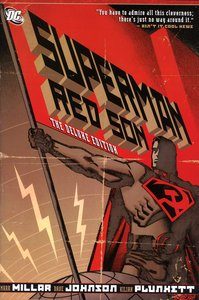
    Superman: Red Son, Mark Millar & Dave Johnson

    DC Comics, 2009 re-edition of 2003 series, C$29.99 hc, ISBN 978-1-4012-2425-7

    I don’t have much use for the standard superhero comic-book, which is too often an exercise in comfort reading, featuring melodrama that never amounts to much real growth and useless fight scenes thrown in to satisfy fan-boys.  Someone who stops reading a series and picks it up again years later misses out on little: The same archetype will continue to battle it out for as long as there is demand for it… and now that superheroes are big in Hollywood, you can bet that no one wants to upset the moneymaking genre, as narratively stale as it can be.

    I’m not completely immune to the genre’s charm (I’ve got too many Batman trade paperbacks on my shelves to claim otherwise), but I won’t pick up superhero stories unless they’re sold at a bargain, they’re particularly striking examples of the form (Identity Crisis) and/or they’re different.  And Superman: Red Son is certainly different enough.  The premise is suggested early on: What if Superman, rather than landing in a Kansas cornfield, had landed on a Soviet farm?  Audaciously blending Cold War history with the DCverse, writer Mark Millar delivers an alternate history that ends up veering far from ours, and reflecting upon Superman’s innate potential for fascism.

    It’s quite a change from the usual quasi-moronic goody-two-shoe persona that writers often impose on Superman.  This Man of Steel eventually takes up political power, shamelessly uses friends until their breaking point, has a few significant control issues and ends up remaking the planet to his liking.  Brainiac, Lex Luthor and Lois Lane plays important (and unusual) roles in the story, Batman goes against Superman, we get to feel sorry for Wonder Woman and even the Green Lantern corps makes an intriguing appearance.  On top of everything else, Red Son also ends up being an occasional critique of US imperialism and inner power struggles –Millar, of course, is not American.  Best of all, the ending actually wraps everything together, delivering a resolution, an utopian epilogue and a poignant coda.  For a three-book miniseries, it certainly contains a lot of material, even though some of the fights (most particularly the final one) seem a bit gratuitous.  The artwork is fair, although a bit more consistency would have been helpful –along with a better respect for Batman’s aesthetic preferences (you‘ll understand once you see the hat.)

    This vision of Superman is intriguing in part because it plays upon the Superman archetype itself.  A symbol of American power becomes its opponent, and Lex Luthor becomes the noble (and arrogant) genius taking up the task to preserve American Hegemony even as the United States starts seceding.  Millar’s Sickle-and-Hammer Superman also gets free reign to indulge his gift for invention, the genius of which is an aspect of Superman that has often been forgotten in recent incarnations of the character.  After taking up the reins of the Soviet Empire, Superman is free to impose his own version of peace, order and good leadership –as long as it goes through him.

    Red Son is also refreshingly told in shades of gray.  Free from years of accumulated history, Soviet Superman makes mistakes, over-coddles the planet and goes up against enemies that are led by pure and honourable motives.  Lex Luthor is a study in genius-level intelligence tainted by easy cruelty, but he ends up doing good despite his methods.  Wonder Woman is destroyed and discarded.  Batman, well, you’ll have to read it to see for yourself.  Despite the somewhat optimistic tone of the story, terrible things happen along the way.  Superman’s always been about power fantasies, but Red Son tackles the flip side of raw unchecked power.

    The result is something I wasn’t expecting: A Superman story that manages to make a believer out of a confirmed superhero sceptic.  Superman: Red Son is about as good as superhero comics get, even acknowledging that it gets most of its power from upending what everyone knows about Superman.  The 2009 deluxe edition is serviceable enough and while the end sketches don’t add much, the entire package is a good showcase for a series that is actually worth reprinting in hardcover.  Don’t miss it, even if you think you don’t have any interest in Superman.

  • A Year in the Merde, Stephen Clarke

    A Year in the Merde, Stephen Clarke

    Bantam, 2004, 335 pages, UK#9.99 pb, ISBN 0-593-05453-9

    As a French-Canadian, watching England argue with France is a bit like being caught between squabbling parents: No matter if most of my family tree left France back when it still had a king, I just wish both of them would get along.  Fortunately, we live at a blessed era in history –one where the enmity between France and England has been reduced to humorous books and snarky blog posts telling us that either Paris or London are overrated.

    As it turns out, I spent a bit of spring 2010 comparing the merits of both capital cities, and it’s only after coming back to London from Paris that I found a copy of Stephen Clarke’s A Year in the Merde.  This not-entirely-fictional comic novel follows the always-hilarious story of a young Englishman (Paul West) who takes a job in Paris.  The narrative of the book follows Paul’s first year in France, as he gets to understand and be further mystified by the French.  Various hijinks ensue, always with madcap results and just-as-always caused by characters exemplifying some kind of French flaw.  Had I read this book a month earlier, I would have been offended on behalf of France at its stereotyping of the French national character.  After coming back from Paris, however, I just find the entire novel spot-on funny.

    Surliness, strikes, cheese, corruption and near-constant eroticism are the only constants of Clarke’s novel, but you will find that they’re more than enough to fill three hundred pages.  Our plucky Brit hero comes to France to impart some of his Anglo-protestant work ethic, but quickly finds out that it’s no match for ever-striking workers, haughty French waiters, passive-aggressive colleagues and the smouldering sexiness of just about every woman he meets. Clichés?  Well, yes.  But it doesn’t mean they’re not based on reality.

    What really counts is what Clarke chooses to do with them.  An idyll with the boss’ daughter leads him to a seemingly perfect country house purchase opportunity which eventually turns sour when it uncovers a complex mess of political influence, back-scratching and outright corruption.  A seemingly sweet deal for an apartment (much sex included) blows up spectacularly, leaving him in the street with only a foreign cleaning lady to help him out.  He falls sick at the moment there’s a pharmacist’s strike.  All of his girlfriends eventually reveal other boyfriends.  It just goes on like that.  Fortunately, the readers are the net beneficiaries of Paul’s misfortunes, smiling from beginning to end.

    Like the best humour books, it zips by at a pace that will make readers wish it had gone on just a bit longer.  The prose is amusing, the many characters and bit-players are well-portrayed, and the asides about Paris have a well-worn quality that betrays Clarke’s long experience with the city.  How much of the book is true?  A bit more than half, says Clarke, although one notices that having spent twelve years in France, he was able to condense a lot of material in just twelve months of hell for his stand-in hero.

    As a look at France and Parisians, it’s quite a bit insulting, but also affectionately tongue-in-cheek.  Originally written for British readers, A Year in the Merde has since found international success and even, yes, a French translation named God Save la France.  (A quick check of the amazon.fr’s user ratings for the book reveal that it’s been received quite a bit better than you’d expect: “sympa et très british” says a sample review.)  Call it a must-read for anyone coming back from Paris or on their way there.  At the very least, this is one book where it’s a relief if the reality fails to match the fiction.

    [March 2011: Follow up Merde Actually is markedly less interesting, in part because it shits gears from one-shot hilarity to ongoing romantic comedy.  Romance is one of those genres where “happily ever after” is preferable to all other alternatives, and it’s not quite as amusing to see Paul go through another number of girlfriends in the sequel. The novel, inevitably, doesn’t feel as fresh or compelling as the first one, and it’s easy to feel as if the first book said everything that could be said about France as seen from an Englishman’s perspective.  Oh, the writing is accessible and the entire book is amusing… but at a basic and forgettable level.  There are now two further novels in the series, but I’m in no hurry to read them.  Used book sales will provide… eventually.]

  • The Girl with the Dragon Tattoo, Stieg Larsson

    The Girl with the Dragon Tattoo, Stieg Larsson

    Viking Canada, 2008 translation of 2005 original, 465 pages, C$32.00, ISBN 978-0-670-06901-9

    As an avid six-books-a-week reader, I’m finding increasingly difficult to resist the allure of the It Book.  You know the one: The book at the top of the best-seller lists.  The book that everyone else, casual five-books-a-year readers that they are, can’t stop talking about.  That’s how my bookshelves have somehow acquired copies of The Da Vinci Code, The Celestine Prophecy and even The Secret, along with a number of otherwise respectable books in movie tie-in editions.

    So when I realised that nearly everyone around me was reading Stieg Larsson’s Millenium trilogy, I started thinking that I was missing out on something.  The series certainly has a fascinating background: The work of a left-leaning Swedish journalist who died in 2005, the Millennium trilogy was published posthumously to near-instant international acclaim.  A trilogy of movies speedily made their way around the world, first landing in Canada in French translation about two years before the English editions.  By the time the first movie hit theatres in English and the third novel was published to good sale numbers, I decided to catch up on what had everyone raving.

    It turns out that contrary to elitist belief, quality and sales sometimes have something to do with each other.  The Girl with the Dragon Tattoo, first volume in Larsson’s trilogy, is a pretty good mystery set in modern-day Sweden.  It presents an effective enigma, two fantastic lead characters and is written with the kind of attention to procedural detail that only mystery readers can fully appreciate.

    It starts unusually enough, as its hero-journalist Mikael Blomvkist is convicted of libel against a rich industrialist.  Disgraced, he quits his position at the Millenium magazine he co-founded and plans on idling away the days until his prison sentence.  But things take another turn when he is hired by another rich businessman to investigate on a decades-old disappearance.  Working from the slenderest of threads with an unlikely ally, he manages to not only gain clues about the mystery he’s been asked to resolve, but uncover a far more terrifying one as well.

    Never mind the story, though: The real heart of the novel is the unlikely team between our journalist and a prickly hacker named Lisbeth Salander.  He is kind, honest, smart, a bit passive, a hit with the ladies and working from the privileged position of a well-off white male.  She, on the other hand, is moody, asocial, brilliant, considered a ward of the state and unable to form attachments with anyone.  They’re mismatched, but they develop an understanding.  Still, their partnership isn’t without its issues, and it’s that dynamic that ends up carrying the novel as much as the development of the plot.

    It also helps that The Girl with the Dragon Tattoo has quite a bit of thematic depth.  The original title of the book (and indeed the subtitle of the French edition) is Men Who Hate Women, and that theme does end up having an impact on the entire story on more than one level.  It’s no accident, for instance, if Salander is the one character of the pair who is both most victimized and most capable of violence.

    What does end up lessening the novel, though, is its relatively slow pacing.  It seemingly takes forever for the mystery to be revealed to the character, and even longer for any criminal activity to become apparent.  The investigation itself is fine, but the action climax of the novel happens far too early: The rest of the novel reads like an extended epilogue as all the remaining threads are slowly tied together.  If I was feeling generous, I would call this a delightful change of pace stemming from the different cultural milieu in which the novel was written (ie; the Swedes take their time).  For more impatient readers, however, this may end up being a sticking point.

    (Nitpick: The translation of the Canadian Viking edition also has the annoying tendency to translate measures in American-style imperial, rather than the metric system common to both Canada and Sweden.)

    But this aside, The Girl with a Dragon Tattoo is not just an enjoyable mystery/thriller, but also a promising first volume in an ongoing series cut short to a trilogy by the author’s death.  Blomvkist and Salander are a fascinating team, and there are at least two more books to spend with them.

  • The Losers, Andy Diggle & Jock

    The Losers, Andy Diggle & Jock

    Originally published 2003-2006 by Vertigo Comics.  First collected in trade paperback format as The Losers: Ante Up, The Losers: Double Down, The Losers: Trifecta, The Losers: Close Quarters and The Losers: Engame.
    Most recently collected as
    The Losers: Book 1, Vertigo, 2010, 304 pages, ISBN 1-4012-2733-3 and
    The Losers: Book 2, Vertigo, 2010, 480 pages, ISBN 1-4012-2923-9

    Comic books are still best-known for super-heroes, which is a shame given the much larger universe of stories that they could be telling.  That’s part of why I was so interested in reading The Losers after seeing its movie adaptation: A action-adventure comic book series tackling contemporary geopolitics?  That’s promising.  Add to that premise an ensemble cast of sympathetic characters facing down a ruthless villain and you’re got enough material there to ape the experience of a big overblown action movie in comic-book format… and I can never get too many big overblown action movies.

    The premise of the series may not be complicated, but it’s enough to get things rolling: A small team of operatives, having seen things they shouldn’t have seen, is double-crossed and left for dead by a high-ranking member of the American intelligence community named Max.  After recovering, they set out to avenge themselves by finding Max.  But that’s really an excuse for the writer to build elaborate heist scenarios, send his characters in desperate jeopardy, have them spout one-liners and eventually ease his way into a fantastically implausible threat to world peace.

    Being a comic book, there’s little budgetary limitations over where and how the Losers end up tracking Max.  So it is that by the time the series is over, it will have taken us to the continental United States, Quatar, the West Indies, Pripyat, Afghanistan, London, the Persian Gulf and a few places in-between.  Try to make a movie with that location budget!  For that matter, try to make a movie in which so many outlandish action sequences are featured: Writer Andy Diggle clearly has a lot of fun writing a script solely limited by his imagination.

    The best thing about The Losers is its cast of characters: Laconic Cougar, athletic hacker Jensen, transport specialist Pooch, leader Clay and shifty Rocque.  Add to that the dangerous presence of Aisha and the team is just about ready to face down any situation.  This turns out to be helpful, especially as they try to position themselves between run-of-the-mill anti-American enemies, the CIA and Max’s own Special Forces.

    If The Losers’ objective was to deliver a spectacular action-adventure story, it certainly achieve its goals.  Trying to stop reading the series is difficult after the first volume and the richness of the locations, gadgets and geopolitical themes ought to satisfy everyone looking for a somewhat over-the-top techno-thriller.  The only false notes are to be found in the needlessly implausible and down-beat ending, which mows down a significant proportion of the cast in the service of a nonsensical plot that owes more to the worst Bond movies than to the somewhat realistic tone that the series embraced during most of its run.  It doesn’t entirely kill off the series, but it certainly tempers any built-up enthusiasm.

    The other big weakness of The Losers is, of all things, the art: Jock’s kinetic style may be striking, but it’s noticeably darker, flatter and rougher than the industry standards.  Some will like it; others will find it ugly, under-drawn and disappointing.  It’s telling that most characters can only be identified thanks to gimmicky haircuts or other broad physical attributes.  The colouring doesn’t help, but then again there’s not a lot of opportunity for gradient volume in the blocky art the colourers have to work with.  There’s a reason why the script is what we remember about The Losers.

    Still, now that the series is once again easily available in just two volumes (the first one covers most of the ground tackled by the movie adaptation, with significant changes; the second, much thicker volume concludes the entire comic book run.), it’s worth picking up for anyone looking for contemporary action/adventure movie experience with an unlimited production budget.  The ending may be underwhelming, the art may frequently suck, but it’s an enjoyable read nonetheless.  And there’s not one superpower in sight.

  • Anansi Boys, Neil Gaiman

    Anansi Boys, Neil Gaiman

    Morrow, 2005, 336 pages, C$36.95 hc, ISBN 978-0-06-051518-8

    In fantasy circles, saying that one doesn’t care all that much for Neil Gaiman’s fiction is tantamount to an invitation to be lapidated.  The outrage is immediate: Neil is so nice!  Neil is such a great writer!  Neil has won so many awards! Well, yes, but no amount of heartfelt, diagrammed, possibly notarized disclaimers (Neil is nice!  Neil is a great writer!  Neil has won so many awards!) is enough to satisfy his many, many fans and make the point that some readers may not be receptive to Gaiman’s fiction, no matter how accomplished it is.

    So it is that I’m always a bit surprised when I do get to enjoy one of Gaiman’s books after all.  I’m not an enthusiastic fantasy reader, and even less of a mythology-oriented reader.  But that’s exactly what Gaiman is writing.  In Anansi Boys, for instance, he goes digging into trickster mythologies to inform a light-hearted novel of contemporary fantasy.  Against all odds, it worked for me.

    Part of my affection for Anansi Boys comes from how much it can be enjoyed on the slightest of fantasy levels.  When mild-mannered protagonist Fat Charlie discovers that his (Trickster God) father is dead, he has no clue as to how complicated his life is about to become.  On top of his grief, Charlie soon discovers that he has a vastly more extrovert brother named Spider.  Before long, Spider has taken Charlie’s girlfriend, caused him to be framed by a dishonest boss and upset a venerable peace between various supernatural entities.  Who has to fix everything?  Charlie, of course… and he may get to be less of a nerd once he’s done.

    So it is that the biggest strength of Anansi Boys is that you can, if you so choose, skip over the more overly fantastical elements and passages of the book in order to focus on Charlie’s adventures.  This isn’t, strictly speaking, a really good way to read the novel: you’ll end up missing out on half the story and nine-tenth of its depths.  But if you’re in a hurry, and already halfway convinced that the novel will be dull no matter how much attention you can pay, it’s not a bad way to read it diagonally.  (It does mean not caring at all about the links between Anansi Boys and the Hugo Award-winning American Gods, though.)

    But there is still a lot of fun in Anansi Boys even if you limit yourself to the more grounded elements of its story.  Fat Charlie (who’s not fat; it’s just a nickname that stuck) is an appealingly nebbish character, and his explanation of what it was to be the son of a Trickster God has a few hilarious moments, one of them involving dressing up for President’s Day.  His dramatic arc is well-accomplished, as he finds true love, discovers hidden reserves of strengths and even manages to bring back a bit of order and justice in the world and underworld.  The characters surrounding him are also interesting in their own ways, although it’s his outgoing brother who gets the share of the glory by being such an inveterate attention-hog.

    As usual, Gaiman’s prose effortlessly moves in-between high comedy, meaty mythology and sensitive drama.  It’s astonishing how precisely he is able to reach his goals, even in changing modes throughout the novel: The funny stuff is funny, the sensitive passages are sensitive, and the mythological underpinning of the story does give it quite a bit of depth that a lesser writer wouldn’t necessarily have bothered with.

    Not even a largely diagonal and inattentive reading can gloss over Gaiman’s gifts.  And that, ultimately, may be a telling test of any writer’s skills: being able to charm readers fundamentally unsuited to their brand of fiction, and allowing them to read the story at the level they choose.  Quite an achievement, that.

  • On Top of the World, Tom Barbash

    On Top of the World, Tom Barbash

    Harper Collins, 2003, 282 pages, C$39.95 hc, ISBN 0-06-051029-3

    This should have been a really interesting book.

    After all, the premise of On Top of the World is as simple as it is heart-wrenching: As dawn rose over New York on September 11, 2001, Cantor Fitzgerald was a high-flying financial services firm that employed seven hundred employees in its headquarters at the top of the World Trade Center.  By the end of the day, 658 employees –two third of the firm’s New York workforce- would be dead, and the company would be struggling to stay open after such a devastating loss.  The book is a description of the catastrophe that happened that day, and their recovery in the months that followed.

    As a subject for a documentary, it’s gold.  You can feel your throat closing as the book describes how survivors made choices that either saved or doomed them.  We get to be in the head of Cantor Fitzgerald employees as they go through the events of the day and start worrying at the magnitude of their loss.  We sit at a conference table alongside the survivors of the company as they start grappling with the possibility that the company may simply have to close down.

    A tough-eyed reporter experienced in dealing with such disaster recovery scenarios would have been able to make On Top of the World compelling reading, by focusing on the efforts of the survivors and describing what needed to be done at that time.  How do you re-form business units where everyone but a single person has died in a blink?  What IT challenges become crucial in offloading work to satellite offices?  How do you keep competitors at bay while rebuilding the capabilities to do business in this new environment?

    But novelist Tom Barbash is after something different.  He is, first and foremost, a personal friend of Cantor Fitzgerald CEO Howard Lutnick, and his self-imposed mandate is to present the story of Cantor Fitzgerald’s renewal through Lutnick’s eyes.  It’s almost certainly the most dramatic choice, the most humane choice in presenting the events.  (Lutnick lost his own brother in the tragedy, and only escaped death because it was his daughter’s first day of school)  Alas, it quickly turns into defensive hagiography.

    For when Americans recall Cantor Fitzgerald in the context of September 11, they usually recall two things: First, a teary-eyed Lutnick on national TV, grieving openly.  Then, media reports of Cantor Fitzgerald cutting off pay-checks to deceased employees only a few days after 9/11.  On Top of the World quickly becomes obsessed with setting the record straight about the media outrage that followed the second event: Chapters are spent explaining the business reasons leading to that decision, the frantic public-relations effort that followed the media criticism and the Lutnick’s feelings in the middle of increasingly-negative comments.

    That, too, is an interesting story.  But the way it’s presented is neither objective nor overly convincing.  There’s barely an acknowledgement that Cantor Fitzgerald may conceivably have erred in cutting off pay-checks: The focus instead becomes Lutnick’s life of as he is forced to confront the unfair media criticism.  From a fascinating description of an organizational struggle, On Top of the World soon turns into a dull celebration of a specific person.

    Meanwhile, the details of the company’s renewal are lost in the shuffle.  While the spotlight is on Lutnick and his gruelling efforts to correct disastrous PR, the suburban and London offices take over and save the company from bankruptcy.  Comparatively little is said about them, however: This is Lutnick’s book, as inspired by the “CEO as a hero” branch of business literature.

    This doesn’t make On Top of the World a bad book, but it certainly limits its appeal and, at the very least, makes it quite a bit self-serving.  In-between the most fascinating passages, such as the description of the art collection that decorated the company’s offices and how a few of them were recovered from the wreckage, there’s a sense that only a very narrow portion of Cantor Fitzgerald’s incredible recovery after 9/11 is told through this book and given the most favourable and uninformative spin.  Bring in an objective reporter, tell the story of the entire organization, focus on the inevitable challenges rather than those caused by a PR blunder and the book would be quite a bit stronger for it.

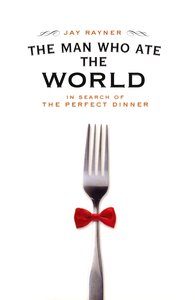
  • The Man Who Ate the World, Jay Rayner

    The Man Who Ate the World, Jay Rayner

    Henry Holt, 2008, 273 pages, C$28.00 hc, ISBN 978-0-8050-8669-0

    If you’re like me (and, on general principle, I hope you’re not), the notion of a high-end restaurant stands somewhere between irrelevance and affront.  It’s not as if I’ll ever need to go to such a place (or spend that much money on food), and my middle-class populist sensibilities are vaguely disgusted that such places exist as displays of conspicuous consumption.  No matter how much I keep telling myself that expensive multi-starred restaurants are about the experience, I still can’t place them in my universe of five-dollar sandwiches and weekly fifty-dollar grocery bills.

    Fortunately, there’s restaurant critic Jay Rayner to go do the heavy eating in my stead.  In The Man Who Ate the World, Rayner embarks on a quest for “the perfect dinner”, whatever that may be.  Going around the world and making his way to high-end restaurants, Rayner takes the opportunity to reflect on what makes a perfect meal, what justifies such three-star experiences and other related issues coming to mind as he jets between his home base of London and his targets in Las Vegas, Moscow, Dubai, Tokyo, New York and Paris.  The rationale of the book, as stated right after a mock warning not to read it while hungry (“Hunger can seriously affect your ability to concentrate and, after a few pages, you will be incapable of appreciating either the grace or the subtleties of my writing” [P.1]) is to investigate the result of more than two decades’ worth of changes in the upper gastronomy landscape.  Since 1990, haute-cuisine has escaped the confines of Paris and is now to be found in not-so-likely places from Las Vegas to Dubai, neither of whom have much of a local food culture.  What does this mean for the current state of eating around the world?

    Fortunately, Rayner’s not your average restaurant critic.  Born in a showbiz family, he became a solid investigative journalist before turning to restaurant reviewing and novel-writing.  You can feel all of those influences coming together in The Man Who Are the World, as Rayner reminisces about childhood experiences, explores the socioeconomic context of the restaurants ecosystem he’s studying and tells the story of his odyssey like an accomplished raconteur.  While the book may share a superficial resemblance with Anthony Bourdain’s A Cook’s Tour, they’re substantially different: Bourdain’s travelogue is about discovering local foods of the world (and getting drunk along the way) whereas Rayner aims to find commonalities between high cuisine outlets around the globe.  Both of their Tokyo experiences are worth reading in their own ways.  (Incidentially, Rayner does mentions Bourdain on page 145, and not entirely favourably.)

    The first stop on Rayner’s worldwide tour is Las Vegas, a place that has invented itself as a culinary destination thanks to large amounts of gambler-fuelled money infusions.  Never mind the famous all-you-can-eat buffets: Las Vegas is now home to a number of high end restaurants and that’s where Rayner first wrestles with the ethics of eating on the house, and restaurants that have to import their foodstuff over hundreds of kilometres given the lack of a local food-growing infrastructure.  In Moscow, Rayner confronts the consequence of a restaurant scene that caters to the unsophisticated oligarchs that have filled the void left by the fall of communism.  Organized crime, kitsch, eye-watering prices and the shadow of the Soviet Empire are all on the menu.  Rayner’s not entirely happy about it all, but the chapter is a lot of fun to read.

    In Dubai, he begins at the Burj Al-Arab Hotel by reflecting that eating at an expensive restaurant is like temporarily living as a rich person without the permanent moral karmic debt that becoming a rich person requires.  A passage about Gordon Ramsay becomes necessary when explaining how Dubai became a gastronomy destination by importing foreign expertise, much in the same way the rest of the city was built.  Not-so-random digressions on trying to keep fit as a restaurant critic and the hollow mirage of authenticity quickly follow.

    However weird Dubai can be, Tokyo is even stranger.  Rayner manages to find ways to eat both well and badly in the Japanese capital, in trying to explain the very different culture that still manages to confound westerners even after decades of cross-cultural influence.  He eats indescribable stuff while doing his best to describe it to us.  He visits a fish market, has an emergency bowel movement, gets lost in trying to find small restaurants and finishes his chapter by telling us about an unforgettable meal in the care of a sushi master.

    Following such a peak experience is tough even in New York, so Rayner changes tactics and goes on a good old-fashioned restaurant crawl alongside food blogger Steve Plotnicki: Five high-end restaurants in a single evening, a sprint that ends up inviting reflections on the relationship between New York and its restaurant, the Zagat guide, Rayner’s Internet gastroporn habit and what a place’s clientele says about it in a passage subtitled “Hell is Other People.”

    London is a return to family, familiarity, bad experiences at expensive restaurants and quite a bit of autobiographical material.  But that’s just a warm-up for the book’s last expedition in Paris, an upper-class Super-Size Me in which Rayner sets out to eat at three-star restaurants every single day for a week.  (It begins with a medical check-up.)  Part of Rayner’s goal is to find out if eating every day at a three-star restaurants makes the experience slide into familiarity.  What he finds out is that while one can get used to rich food on a daily basis, there are still worlds of difference even between expensive restaurants: His good experiences at some places are magnified by the bad ones at others.  Still, it’s impossible to read about his lunch at L’Arpège without feeling a vicarious thrill, especially when the experience at that restaurant alone end up costing him a (low) four-figure sum.

    The conclusion of the book (“Check, Please”) may not be what you’d expect.  In-between reflecting on the state of high-end world cuisine circa 2009 and all of its social and environmental implications, Rayner starts asking himself how long he still wants to stay in the restaurant-reviewing business.  As this review is written, he’s still actively updating his column on the Guardian site… but maybe “not indefinitely.  Just for a while.” [P.270]  After such an all-star tour of the world’s kitchens, who could blame him?

  • Ugly Americans, Ben Mezrich

    Ugly Americans, Ben Mezrich

    Morrow, 2004, 271 pages, C$38.95 hc, ISBN 0-06-057500-X

    After a moderate success as a thriller writer, Ben Mezrich finally found the winning formula with Bringing down the House, a book that blended true facts, blackjack-beating tricks, big winnings and fictional narrative tricks in order to give readers a taste of fast-earned money.  He repeated the formula with Busting Vegas, but in-between those two gambling books came Ugly Americans, “The True Story of Ivy League Cowboys Who Raided the Asian Markets for Millions”.  Some kinds of business, after all, are nothing more than high-stakes gambling and in telling this story, Mezrich describes the life of a young trader who went to Japan and made a small fortune betting even bigger fortunes.

    In some ways, Ugly Americans complements the story of Nick Leeson, the infamous British trader who found himself free to bet big from a faraway Asian trading outpost of the venerable Barings… and literally broke the bank.  The nineties were a good time for traders willing to exploit the wild and mercurial nature of the Asian markets: There weren’t as many players over there than in the saturated American and European markets, the regulations were quite a bit looser than on Wall Street and the line between legal and illegal activity was considerably thinner, much like the line separating organized crime from legitimate business activity.

    It’s in that context that ex-footballer and recent graduate “John Malcolm” is hired to execute orders from an expatriate trader living in Japan.  Sent to Osaka despite knowing next to nothing about Japan, Malcolm grows under the tutelage of his boss, experiences a massive earthquake first-hand, falls for the daughter of a well-connected businessman, finds himself working far too close to Nick Leeson and survives in-between loud bar crawls, conspicuous consumption and power demonstration by elements of the Yakusa.

    There’s something both exhilarating and repellent in Mezrich’s trademark glorification of people having more money than sense.  The fact that they are making it from trades rather than gambling makes little difference in the way Mezrich portrays them.  Fast cars, expensive prostitutes and wild parties: These, apparently, are what money gets you if you’re in the right place and the right time to take advantage of the system.  Just like a sports movie, Ugly Americans ends with a Big Score that allows the protagonist to step back from the madness, but not before (in Mezrich’s familiar dramatic arc) a friend is severely affected by the rough trade in which they are involved.  You can almost feel the author react gleefully to the presence of the Yakuza in his story: They’re the perfect shadowy menace, acting in all-powerful positions within a Japanese society that is, we’re told in not-so-subtle terms, inseparable from organized crime.

    But what are a few xenophobic comments for an audience looking for a few thrills?  It’s not as if Merzich swears fealty to truth: Like his other so-called non-fiction books, he obscures enough details to protect the identity of his sources and rearranges so many events for maximal drama that the entire narrative can be read as fiction.

    What’s more embarrassing to admit is that it works: Ugly Americans is a quick and enjoyable read, a vicarious look at another culture and a completely different lifestyle.  It’s best to ignore some of Mezrich’s most obviously pumped-up melodramatic moments (although the juxtaposition of an ethics class with a description of the Leeson meltdown is worth a few smirks) but otherwise Ugly Americans is a splendid read halfway between a confabulating business memoir and a practical advice manual on why westerners should avoid doing business in Asia.

    This isn’t to say that the real story is unavailable to those who want to dig a bit.  A quick look at online reviews of the book will uncover a number of revealing mistakes, and a few credible-sounding guesses as to the identity of the trader on which Ugly Americans is based.  People who know quite a bit more about trading –and more specifically westerners trading in Japan during the mid-nineties– will be able to piece together the real story and point out which part of the book are obvious nonsense.  For the rest of us, though, it’s another typical Mezrich dramatic non-fiction book; good enough to escape and imagine life as a high-roller, moral scruples temporarily suspended.

  • Your Hate Mail Will be Graded, John Scalzi

    Your Hate Mail Will be Graded, John Scalzi

    Tor, 2010 reprint of 2008 original, 368 pages, C$17.99 pb, ISBN 978-0-7653-2711-6

    Books often have complicated publication histories, and so it is that the content of Your Hate Mail Will Be Graded: A Decade of Whatever, 1998-2008 first existed as blog posts, then as a limited edition book from Subterranean Press before being republished by Tor for the mass market.  It also won a Hugo between the first and second edition of the book: The Tor edition is the first book I’ve seen with the new “Hugo Award” logo printed on the back.

    Your Hate Mail Will Be Graded is an attempt to present the best posts of the first decade of John Scalzi’s Whatever blog in book form.  Scalzi is now often best-known as a science-fiction writer, but his blog usually presents a mixture of pop-culture, politics, writing advice, autobiography, takes on the controversies-du-jour and, generally speaking, anything else that catches his interest.  Thanks to a background that includes a degree in philosophy, corporate writing assignments, science-fiction novels and a newspaper column, Scalzi writes in a way that is entertaining no matter the subject.  Whatever presents an addictive blend of clear prose, amusing writing, serious arguments, original reporting and a keen understanding of what keeps a readership coming back for more.

    Since I’ve been reading Whatever for about five years, much of the book feels familiar: A number of Scalzi’s best-known pieces, such as the “Being Poor” op-ed [P.297], “10 Things Teenage Writers Should Know About Writing” [P.213] or the trip report from the Creation Museum [P.135] are reprinted here, alongside pieces I had enjoyed at the time but re-discovered while reading the book, such as “I Hate Your Politics” [P.181], “The Lie of Star Wars as entertainment” [P.119] and “Unasked-For Advice to New Writers About Money” [P.253]  Finally, there’s the first half-decade of Whatever that I never got to read in real-time, the best bits of whom are reprinted here, including a “Best (…) of the Millennium” series dating from 1999.

    John Scalzi having a lot of experience as a reviewer, it’s no surprise to find him providing hints in his introduction by pointing out the ways in which Your Hate Mail Will Be Graded can be enjoyed: As an early collection of the “blog post” form, as a cultural capsule of the eventful 1998-2008 decade or as pieces of purely entertaining writing.  He’s right on all count, of course: Reading this book is like digging into a bowl of popcorn… it’s difficult to stop before the end.

    But as I try to flip back through the book to find specific posts and titles, I am also reminded of the most annoying “feature” of the book: A deliberate lack of organization or, as the back cover boasts, “a decade of Whatever, presented in delightfully random form, just as it should be.”  The pieces aren’t arranged chronologically, thematically or by word count.  There are no sub-headers at the top of the pages, nor anything looking like a table of content or an index.  Want to find that piece that discussed that thing you liked so much?  Start flipping through the book, because there’s no other way to find what you want.  A note at the beginning of the book further states that this is to replicate the Whatever reading experience, but that’s pushing adherence to the blog form a bit too far: Web readers have access to chronological archives and a search engine.  Book readers are, well, stuck with a shapeless mess.  Might as well go to Google and start searching site:scalzi.com because as a reference, Your Hate Mail Will Be Graded is actively hostile to any kind of organization.

    This nit-picky bibliographical nit aside, Your Hate Mail Will Be Graded is about as good as the “Collection of Blog Posts” form ever gets.  Scalzi’s writing is compelling even outside the context of a web browser, and the look back at some of his earlier posts show little difference from the latter, more widely-read pieces in terms of sheer reading appeal.  It may even earn Scalzi a few new fans while his current ones wait for his next novel.

  • Flicker, Theodore Roszak

    Flicker, Theodore Roszak

    Bantam, 1992 reprint of 1991 original, 672 pages, UK#6.99 pb, ISBN 0-553-40480-6

    A dead movie reviewer recommended this book to me.

    OK, so he wasn’t dead at the time, nor was he addressing me in particular, but I was an avid reader of the Usenet group rec.arts.movies.current-film in 2003, at the time the much-missed Toronto-based film critic Peter Harkness wrote a recommendation for Theodore Roszak’s Flicker.  I can’t say that I hunted it down in any serious fashion, but the book stayed in my mind and when I happened to see copies in a dealer’s room at a British SF convention in early 2010, I immediately grabbed a copy.

    And what a great recommendation that was.  Flicker’s slug-line is “Sunset Boulevard meets The Name of the Rose”, and that does manage to give an idea of the movie trivia and occult knowledge that are blended so successfully in Roszak’s novel.  It’s a coming-of-age story that becomes a historical investigation before turning a horror novel.  It’s crammed with real and invented detail, and not even the radical technological changes that have happened since 1991 can manage to completely defuse its paranoid premise.

    It starts leisurely enough, as a young Los Angeles man interested in movies during the fifties is taken under the wing of a complicated woman for whom movies and life are inseparable.  She understands films like few others, and her tutelage of our narrator is part argument, part passionate bedroom exertion.  Our protagonist is warped by the experience, but his true fall down the rabbit hole of Flicker starts at a wild Hollywood party in which they manage to steal a treasured movie from collectors.  Alas, it’s not the film canister they’re looking for, and so they end up with a film by mysterious German director Max Castle.  The film has a raw horrific power that neither character can understand, and so begins our protagonist’s journey to discover the truth about Castle’s movies… and then the real story behind Castle himself.

    The first third of Flicker can be read as an affectionate homage to the (maybe) more innocent fifties and sixties, an era where students discussed movies with passion, and Hollywood existed as a playground to the stars.  There’s a great portrait of a small hole-in-the-wall cinema, and a nostalgic depiction of what it felt to be a young man living on a mixture of eroticism and pure love of cinema.  The copious amount of period detail is all the more astonishing once we realize that the novel was written well before the rise of the Internet and wide availability of historical film information.

    But as the Max Castle mystery grows deeper, the novel shifts gear to something darker.  Something isn’t right about Castle’s movies, and this mystery soon comes to envelop our narrator’s life.  There are tricks inside those films that go well beyond subliminal messages to directly manipulate viewers’ brains.  As our narrator finds out more (twice getting information by sleeping with aging movie stars), the novels grows more and more sombre: Castle wasn’t the only one out there with the knowledge to manipulate people through the flicker of movies… nor the worst one.

    As Flicker advances, it also dives deeper into a conspiracy theory that blends religious history and manipulation –movies not only being used as instruments of propaganda, but of social decay.  By the end of the book, Roszak makes an argument that purports to explain the acceleration and depravity of modern pop culture, using a number of outrageous fictional examples.  It’s an effective creep-fest as long as you don’t think too much about the overblown darkness of the author’s vision, or how crime rates have declined quite a bit since when this book was written.

    It’s too bad that Flicker moves too leisurely to sustain the impact of its conceit, and often gets lost in the meandering of its own conspiracies.  A tighter third act could have helped the novel keep some of the impact that dilutes away in its extended epilogue.  Obviously, it’s best suited for hard-core film geeks: while casual moviegoers will like it, those with more historical knowledge of films will enjoy the references even more.  Still, it’s quite a wonderful reading experience: The dense narration is interesting, and the conspiracy theory is fit to momentarily blow anyone’s mind…

    But there’s a reason why Flicker keeps much of its cult appeal even today.  It may even have inspired a few other works since then: Ramsey Campbell’s The Grin of the Dark runs along the same lines as Flicker, with a hero tracking down a demonic director using resources that include the Internet Movie Database.  As Harkness suggested in his recommendation, this isn’t one of the many novels about Hollywood and filmmaking; it’s a novel about movies and the experience of watching them.  Now that it’s back into print, it ought to move up on any film buff’s reading list.

  • London, Edward Rutherfurd

    London, Edward Rutherfurd

    Fawcett, 1998 re-edition of 1997 original, 1126 pages, C$8.99 mmpb, ISBN 0-449-00263-2

    I went through much of James Michener’s back-catalogue a long time ago, but no one else since then has managed to re-create the kind of sweeping epic stories for which he was known.  In novels like Chesapeake, Michener told the story of geographical areas over centuries and generations of the same families.  Places may have been the subject of his books, but the families were his characters and the impact of seeing stories unfold over decades could be profound.

    So when I announced my plans to go spend a few days in London, I gladly accepted a recommendation to read Edward Rutherfurd’s brick-sized London.  I could spend my time on City-bound public transportation reading about the place I was exploring.  It made perfect sense: after all, one of my most useful travel tips is “bring the heaviest, densest paperback you can find”.

    London certainly weighs in on the heavy side: At more than 1100 dense pages, the paperback has a heft that hints at the history contained therein.  Describing London from 54 BC to 1997, Rutherfurd’s novel begins with maps of the city, and a chart of character names that extends over two thousand years and nearly a dozen families.  The stage is set for an epic.

    What we get is more akin to 20 short stories (some of them longer than others) taking place over London’s eventful history.  The families often become more important characters than members of any particular generation, as the haughty and dishonest Silversleeves battle it out with the long-time citizen Doggets, the tenacious Bulls or the swashbuckling Barnickels.  Every fifty pages or so, the narrative stops and another one begins… sometimes years, sometimes centuries after the previous one.  As London grows around the families, we get a sense of the development of the city, learn a few factoids and are enlightened about the reasons things are so.  It all reaches a climax of sorts during World War Two’s Blitz, as a millennia-old treasure comes back to haunt the descendants of those who lost it.

    As a fictional tribute to a world-class city, there’s no denying that London meets its goals: It’s a grand-scale epic in the old meaning of the term.  More than a hundred characters throughout London’s lengthy history often lead us back to the chart of who’s who in the chronology.  The amount of historical research that has crafted the novel is astonishing and convincing at once.  It’s an amazing achievement, and yet it could have been just a bit better.

    Referring to Michener is useful, in that Michener understood that families became characters in their own right, and through generations, enjoyed dramatic arcs that paid off at the climax of the book.  While Rutherfurd does make use of that principle to create a narrative that spans the short stories of each era (such as the strange and sometimes frustrating changes in fortune for the Doggetts), his family fortunes don’t always unfold in dramatically rewarding fashion, and that’s part of why he doesn’t quite manage to make the ending of the novel resonate as much as it could have.  The Silversleeves, perfect antagonists as they are, essentially disappear from the book’s last third and their sudden reappearance isn’t entirely satisfying.  London’s overall dramatic arc isn’t as gripping as it could have been, and a number of loose threads could have been tightened far more efficiently.

    Then there’s the heaviness of Rutherfurd’s prose which may be off-putting to readers who aren’t used to lengthy historical epics.  I will blame planes, trains and busses for not reading every single sentence carefully; nonetheless, few will be faulted for reading chunks of the book diagonally, trying to get to the next fascinating part: London isn’t always interesting, as you would expect from a loose assembly of twenty short stories.

    All of this being said, I still keep a very fond memory of reading London on the plane landing at Heathrow, in the Tube, and on the train bringing me back to London from Brighton and (later) Paris.  It tickled my neurons pleasantly to be stuck in a feedback loop where I would read about the sights I was about to see, or just did see, and gain just a bit of extra context by picturing the events of the book taking place around me.  In one amusing case of reality/fiction feedback, I ended up mystified by “Petty France Street” for a few hours until the novel explained why it was named so.  If there’s a better way of reading London, I can’t imagine it.

  • Imperial Life in the Emerald Palace aka Green Zone, Rajiv Chandrasekaran

    Imperial Life in the Emerald Palace aka Green Zone, Rajiv Chandrasekaran

    Vintage, 2010 movie tie-in re-edition of 2006 original, 365 pages, ISBN 978-0-307-47753-8

    It’s bad enough that the 2003 American invasion of Iraq was an exercise in imperial power projection legitimized by spurious intelligence reports and an orchestrated public-relations campaign: it wouldn’t have been so bad if the whole thing had been neatly wrapped up in a few weeks, followed by a tidy “Mission Accomplished” ceremony.  But no; as history rolls on, the country is still dangerous seven years later, with American soldiers still fighting it out with local insurgents.  Aside from the whole issue of not invading countries unless there’s a good reason to do so, what went wrong?  Why were Americans unable to foster a smooth transition from Saddam Hussein’s regime to a peaceful Iraqi democracy?

    Journalist Rajiv Chandrasekaran was on the ground for much of the first year of the American occupation of Iraq.  With Imperial Life in the Emerald Palace, he describes the tragedy of errors that characterized the initial efforts to run the country after taking military control of it.  Winning a war is easy when you have an army that get more than half of the world’s total military expenditure.  Keeping the peace, though…

    The best chapter of the book remains the first, “Versailles on the Tigris”, which describes the surreal life in the Green Zone surrounding Saddam’s Republican Palace, an area of Baghdad reserved for the foreign nationals taking over the country.  This oasis of Americana had Doritos, alcohol, sunbathing, DVDs, bacon, American flags –everything to remind staffers of home, “home” often being the southern USA.  Even in faraway Baghdad, US politics remained omnipresent: Staffers were often political operatives associated with Republican interests, sometimes young enough to allow enthusiasm to triumph over experience and knowledge.  (“More than half… had gotten their first passport in order to travel to Iraq.” [P.17])  Many of them spent their entire stay in Iraq within the fortified walls of the Green Zone.  If they weren’t working directly for the US government or military, then they were employed by the many corporate sub-contractors.  And yet they had electricity, running water, relative peace and security… quite unlike the Red Zone outside.

    Such contrasts go a long way to explain how Americans exhausted the initial supply of goodwill that accompanied their invasion of the country.  But as Chandrasekaran describes, the year in which the American-led Coalition Provisional Authority (CPA) led Iraq simply made things worse.  The blame starts at the top, with the ideology leading the so-called reconstruction of the country.  Led by neoconservative leadership, the CPA set out to remake Iraq as a beacon of what a pure market economy would be, ignoring local customs in trying to install a right-wing system at all costs.  Never mind that you shouldn’t trust anti-government people to run a government: One of the most pernicious impacts of this top-down mission to remake Iraq at the image of the Bush-era Republican Party was that fairly competent reconstruction experts were sidelined and replaced by people whose biggest credentials were ideological.  Loyal staffers, often far too young to have any experience in the areas they were asked to manage, came from Republican political ranks and often went back to the Bush/Cheney 2004 re-election campaign once their tour of duty was done.  (Interestingly, some of the most capable people on the ground in Iraq were military personnel: regardless of rank, they knew their area of expertise and –whenever allowed to act– were generally able to complete their assigned tasks.)

    Everyone on the ground meant well, of course; Chandrasekaran’s portrait of CPA staffers involved is generally sympathetic, even when it’s clear that they’re out of their depths.  But meaning well and doing well isn’t the same, and much of the book is a description of unbelievable blunders caused by a lack of expertise, ideological straightjackets, overuse of for-profit contractors and US partisan political considerations.  When a country is crying out for stable electricity, water, government and police, it’s not such a good idea to start by privatizing everything in sight (especially when no one is interested in buying), trying to implement a high-tech stock exchange, getting rid of competent military personnel and copying US State traffic laws.  But ideology often makes people do strange things…

    Perhaps the biggest strength of Chandrasekaran’s book is how clearly it manages to present a complex set of issues, through mini-narratives reconstructed from documents, interviews and his own work on the ground.  There’s a great passage in the chapter named “A Yearning for Old Times” that manages to vulgarize the complicated mess that was Iraq’s electrical infrastructure problems, and how it was made worse by greedy contractors, dumb budgeting and an emphasis on short-sighted repairs rather than infrastructure renewal.  Much of the book is just as easily readable, helped along by a strong streak of black comedy at the ineptitude of the American effort.

    It goes without saying that, as easy to read as Imperial Life in the Emerald Palace can be, it’s also an upsetting experience.  There’s a basic trust from citizens, whenever the government spends a few trillion dollars doing something, that a basic level of administrative competence will be met in working toward the project’s goals.  It’s one thing to disagree with neoconservative on the need to transform Iraq into a free-market heaven.  But if it works, then the debate becomes moot.  Alas, what happened in Baghdad in 2003-2004 was a failure of governance: the occupation was so incompetently mismanaged that it burned through the reserves of Iraqi patience after the fall of Saddam’s government and ignited a good chunk of the insurgency that followed.  (De-Baathification, which drove thousands of experienced soldiers in the cold rather than try to contain them in the existing hierarchy, was one of the biggest mistakes of the occupation’s first year.)  One can point at Iraq circa 2010 and claim that it’s finally working (something still very much under discussion), but there’s a credible claim that if the CPA had actually listened to its reconstruction experts, exerted greater control over its subcontracting, embraced local talent and respected Iraqi customs, then far less money, hardship and lives would have been required to get to a better result.

    But that may remain a matter for alternate historians and partisan bloggers.  Until we can get trans-dimensional media reports, there’s Chandrasekaran’s book to detail the mistakes that were made, hopefully so that nothing like that can ever be allowed to happen again.

    [March 2010: One final note on the relationship between the book and the Paul Greengrass’s Green Zone movie: As Greengrass’ foreword in the movie tie-in edition of the book states, Imperial Life in the Emerald Palace provided the context in which the original story of the film takes place.  Sharp-eyed readers will spot a number of background details in the film that are taken straight from the book: So it becomes a rich contextual briefing for the film if you happen to read the book first, or an expansion of the setting of the movie if you read it afterward.  Either way, it’s a well done adaptation that fully exploits the strengths of both medium.]

  • The City and the City, China Mieville

    The City and the City, China Mieville

    Del Rey, 2009, 312 pages, C$30.00 hc, ISBN 978-0-345-49751-2

    Every China Miéville novel is an experience, but I don’t think I was expecting what I got from his latest The City and the City. For the book answers one question that I’ve been reluctant to ask: Is it possible to enjoy a novel during which disbelief is never suspended?

    Funny thing, disbelief: While we can probably agree that fiction should strive to represent the human condition as best as it possibly can, those ideals of realism quickly seem to go flying out of the window once we’re dealing with speculative fiction.  After all, suspension of disbelief becomes a necessity and a prerequisite to get any enjoyment out of stories set knee-deep in aliens, elves and blood-sucking fiends from other dimensions.  Not that SF/Fantasy elements are the only thing that require disbelief: In recent years, I have found myself increasingly unable to get into stories with strong libertarian or even right-wing worldviews: Once I start muttering “It doesn’t work like that!”, it’s hard to follow without nit-picking everything in sight.  But while SF readers have long been conditioned to accept whatever premises authors require of them for the rest of the story, what happens when the premise can never be accepted?

    So it is that The City and the City first appears to be a standard murder mystery: A woman’s body has been discovered, and it’s up to our hero to puzzle out the events leading to her murder.  Soon enough, though, we get to realize that this isn’t a simple mystery: Our protagonist is not living in one city, but a city that is intermingled with another one, each with separate zones that can be accessed though controlled entry points.  Different languages, different cultures and different laws: Citizens of the two cities are trained from the youngest age to consciously ignore each other until they become blind to the other city.

    I’m not doing the concept any justice by stating it as blandly as this, but you can probably see the problems already.  Suffice to say that throughout The City and The City, I kept repeating to myself that this concept was nonsense, that it wouldn’t work like that, that it had more holes than a screen door, and so on.  I won’t even try a pitiful “…but Miéville makes it work!” because frankly, it never worked for me.  Not one single page.  I kept imagining kids leaping over fences, teens sneaking behind bushes, businessmen complaining about inefficiencies and governments slapping down this nonsense.

    (Which doesn’t mean that I dislike the idea, or refuse to acknowledge its grain of truth: I suspect that my mental map of cities is very different from others: My downtown is linked between bookstores, Subway restaurants, bus stops and smart shortcuts, whereas even a close friend’s downtown may be riddled by clothing stores, McDonald’s, parking spots and other things I may not care for.  How often, after all, do you walk down a familiar street and suddenly “discover” a building, store or detail that you had neglected for so long?)

    And yet, I found a lot to like about The City and the City.  Its lead character is a likable hero, even though his narrative arc is intensely predictable once the mysteries of his universe are revealed.  More importantly, it features perhaps Miéville’s most accessible prose so far: While I have fond memories of the baroque storytelling of his debut Perdido Street Station, The City and the City benefits from mean and lean thriller storytelling, with a stripped-down style that paradoxically hints at Miéville’s growth as a writer.  It’s quite a bit different from anything he has written before, and that too is quite an accomplishment.

    It amounts to a very strange, uniquely challenging reading experience quite unlike any other.  I may not completely appreciate what Miéville was trying to do with this novel, but I can’t say I’m displeased to have read it despite never completely accepting the reality of its imagination.  If this is a failure, it’s such an interesting one that it barely counts as a problem.  My disbelief wasn’t suspended, but any hasty judgement certainly was.

  • Repo Men aka The Repossession Mambo, Eric Garcia

    Repo Men aka The Repossession Mambo, Eric Garcia

    Harper, 2010 movie tie-in reprint of 2009 original, 328 pages, C$10.99 mmpb, ISBN 978-0-06-171304-0

    Repo Men can be said to be a dark satire about the flesh and the inner rot of hyper-capitalism, but looking at its movie adaptation and then at the source novel, I can’t help but see both versions of the story as being about tone, the slippery literalization of metaphors and how easy it is to ruin a story by telling it badly.  Because even though the novel and the movie share the same creator, (many of) the same characters and (many of) the same plot beats, I hated the film and thought the novel was an enjoyable piece of work.  How did that happen?

    First, the commonalities: In a not-too-distant future, artificial organs have become reliable and sophisticated enough that people don’t make much of a fuss in getting rid of their natural internals and getting better ones.  There’s a catch, of course: said organs are so expensive that they require financing, and if ever you don’t pay, well, the financing company feels completely justified in ripping them out of you.

    (Yes, this is a very similar premise to Repo! The Genetic Opera, which has clear antecedents over Repo Men in having been an off-Broadway play about a decade ago.  But then again, there are examples of that idea in a number of older SF stories, so let’s stop claiming idea paternity.  High concepts aren’t unique diamonds that can be discovered once and thereafter only stolen: Writers can come to the same conclusion from different sources of inspiration, and as this review will keep hammering home, it’s all in the execution rather than the premise.)

    It’s not difficult to come up with a few objections to the organ-ripping nonsense: There’s the slight issue of murdering people by removing their innards that defies a bit of common sense even in a satirical future.  But here’s one crucial difference between novel and movie: Whereas the novel can gloss over the messy business of organ extraction with a few wry sentences and allusions, the director of the film felt it necessary to show the removal in all of its glistening gory glory, along with a smirking narration that felt more psychopathological than amusing.  That’s one way to turn off an audience in less than five minutes and never get them back.

    Prose, for all of its deficient audio-visual qualities, is actually quite a bit better at presenting satire, context, justification and depth.  So it is that even after disliking Repo Men quite a bit, I found myself enjoying Garcia’s novel even as it covered the same ground as the film, except with quite a bit more detail and a number of significant changes to the third act.

    (It would be handy to criticize the film for being a ham-fisted hack-and-slash job on the novel, but the real story, as revealed in the movie tie-in edition’s afterword of the novel, is more a case of parallel development.  This being said, I suspect that films become worse when they’re developed over years of studio interference, whereas novels can only benefit from their writer’s sustained vision.  Still, it is surprising to find out that the film is quite a bit darker in its ending than the book.  This may be a first.)

    Readers coming at Garcia’s novel without preconceptions will find an energetic, tangentially-told dark satire.  The narrator’s story keeps looping back to his marriages, his war experiences, his anecdotes as a Repo Man, the events that have landed him in such a desperate situation, and what happens after that.  Happily, this isn’t a confusing novel even as it hops all over the entire life of its main character: the narration is crisp, the voice of the narrator is enjoyable and the reading experience is top-notch.  As Science Fiction, the details don’t quite make sense (which is to be expected from a satirical novel by a writer seen as working from outside the genre), but this isn’t quite enough to harm Repo Men’s odd charm.

    The lesson may be that I’m a far more lenient reader than a viewer: Perhaps I’m more patient with dense novels than simple movies.  But perhaps it’s also a lesson in how too much is too much, how a dark smile works better in written fiction than on a screen where there’s little wiggle room left to imagination.  But the result is the same: Eric Garcia may have scripted the adaptation of his own novel, but the book is clearly the winner here.  At the very least, it’s got all of its original guts.

  • Proust was a Neuroscientist, Jonah Lehrer

    Proust was a Neuroscientist, Jonah Lehrer

    Mariner, 2008, 242 pages, $14.95 tp, ISBN 978-0-547-08590-6

    Decades after C.P. Snow’s The Two Cultures, the so-called divide between art and science continues to fascinate.  Are the two “cultures” still so completely incomprehensible to each other?  Why does this gap persist despite a wide acknowledgement of Snow’s thesis?  Is a true “third culture” even possible?

    With Proust was a Neuroscientist, science journalist/editor Jonah Lehrer proposes that the work of artists through the ages has long hinted at natural truths that science has only recently acknowledged.  Marcel Proust’s exploration of the power of memory within In Search of Lost Time largely reflects what we have since learned about memory: how it interconnects with everything else, how it’s directly affected by smell and taste, how it mutates as it’s recalled, overwriting original memories with memories of the memory.  In eight successive chapters, Lehrer uses the work of a different artist as a springboard to discuss new developments in neuroscience, and then back again to an appreciation of the artist’s work.  It all makes for a serious, informative and compelling work of popular science/culture.

    That’s why and how Proust was a Neuroscientist goes from Stravinsky to dopamine, from Walt Whitman to phantom limbs and from Gerdrude Stein to the structure of language by way of Chomsky.  The references in the book are as artistic as they are scientific, with literary quotations and historical overviews of the artist’s career alongside research paper summaries.  Getting the most out of Lehrer’s book involves knowing a lot about many things, but even those who may not know their Emerson from their Escoffier won’t have any trouble understanding most of it, Lehrer’s easy-to-read style betraying his experience working at mass-market periodicals.

    Not every chapter is created equal, however, and so Lehrer really hits his stride in discussing George Eliott, leading to a luminously clear description of brain plasticity and how science has recently come to accept the once-heretical notion that neurons could reproduce in adults.  The Marcel Proust chapter is good enough to provide the book’s title, while discussing Paul Cézanne tells us a lot about vision, or more precisely how the images caught by our optics are then heavily post-processed by the brain.  But the best chapter of the book discusses turn-of-the-nineteenth-century chef Auguste Escoffier, which gently takes us from the codification of French cuisine to a discussion of umami and the mechanics of taste, recently up-ended after centuries of simple belief in sweet, sour, salty and bitter.  It’s good enough to read twice, especially if you have an interest in food.  (It also provides one of the book’s best lines in “Umami even explains (although it doesn’t excuse) Marmite, the British spread…” [P.60])  It’s enough to make us realize that Escoffier was a scientist in his own way, refusing accepted wisdom and only trusting the results of his experiments: there isn’t much of a humanities/science divide in a chef who relies on repeatability of experimental results.

    But the same can’t always be said about the other seven artists discussed by Lehrer, from writers who instinctively knew things about the human condition to artists whose processes mirror latter discoveries.  Overly sensationalistic descriptions of the book (see how artists scooped science by hundreds of years!) do it a disservice: It’s far more satisfying to approach Proust was a Neuroscientist as another piece of evidence supporting perhaps the most obvious conclusion of all: Both artists and scientists are aiming at a common description of natural truth, and both toolsets, when best deployed, will end up describing the same thing from complementary perspectives.

    The book closes on a meditation on C.P. Snow’s two cultures, and how even after more than fifty years, the gap between both remains significant.  More controversially, Lehrer writes that the current best-known examples of a “third culture” is essentially scientific vulgarization, which is essential in its own right, but often prone to the same pitfalls as scientific culture itself.  (Interestingly, while Lehrer does discuss Ian McEwan’s novel Saturday in favourable terms, he never mention Science Fiction at all.)  Perhaps there is a need for a truer third culture to stand aside and explore links between science and art without the preconceptions of either.  Readers, of course, are invited to find out for themselves how such a discipline would be helpful, starting with Lehrer’s Proust Was a Neuroscientist.