Book Review

  • Gone Tomorrow, Lee Child

    Gone Tomorrow, Lee Child

    Delacorte, 2009, 421 pages, C$32.00 hc, ISBN 978-0-385-34057-1

    Jack Reacher has a knack for finding himself in plot-rich situations, and his thirteenth adventure Gone Tomorrow is no exception to the rule. As usual, Lee Child confronts the coincidence-driven nature of his premises head-on, from the very first page. Reacher is back in New York, late at night, in a quasi-deserted subway train. Except that something is wrong: the woman in front of him shows clear signs that she’s a suicide bomber. As Reacher ticks off his mental checklist of suicide bomber traits, everything makes sense except for the timing. Why conduct a suicide mission late at night?

    So Reacher gets up and confronts the woman. The results of his action will surprise even him. Not that he stays confounded for long: Once again, he has stumbled into a puzzle box of surprises and twists and revelations, and he’s the best man to get to the bottom of it.

    This time, his enemies are a bit stronger than usual: It turns out that there is a terrorist connection to the whole business, not to mention a presidential hopeful. When that happens, official US forces don’t stop to make subtle distinctions between allies and enemy combatants, and Reacher soon finds himself targeted by elements of his own government. The left-leaning political content that bubbled up in Nothing to Lose is present here in a different way: Reacher’s struggles against the new half-corporate security apparatus show the way in which the thriller game is still evolving, and which contemporary threads can be used by authors to put their heroes in ever more complex jeopardy.

    Along the way, Reacher does get to go on a rampage of sorts through New York, beating up opponents who don’t consider him a threat, or enough of a threat. Unsurprisingly, his most formidable adversaries end up being those who look least threatening. Reacher doesn’t often end up in the hospital, but there are exceptions to most rules.

    Gone Tomorrow (the title can be found in-text as part of dialogue referring, bitterly, to Reacher’s lack of roots) features political maneuvering, New York lore and long-hidden military secrets dating back to Reacher’s early days in the military. The twists and turns are among the series’ best: It takes a while before the true plot is revealed, and there are plenty of surprises along the way. And yet… Child does foreshadowing and red herrings effectively, which is partly why latter plot development don’t seem as outlandish as they would have seemed if presented cold.

    As with the last few novels in the series, there are references to Reacher getting old: His old contacts aren’t working as reliably as they should, his technological know-how is primitive, and even the people in the US Government don’t think much of Reacher’s “prehistoric” history with Uncle Sam. One of the most damning aspects of the series’s structure is that Reacher seldom gains new friends and contacts along the way: Since the goal is to have all volumes read independently, Child can seldom point back meaningfully to Reacher’s previous adventures. In this case, readers could have expected Reacher’s US Secret Service adventures in Without Fail to have been mentioned whenever he’s contacting a high-level politician, but that’s not the case. This is a frustrating tension at play, in the middle of such well-constructed novels, and it’s getting harder to ignore.

    But it’s not difficult to avoid thinking about these things in the middle of any Lee Child novel: His crisp, detailed and fluid writing is as good as ever, and the plotting of Gone Tomorrow takes us back to the good days of One Shot in giving a good time to seasoned thriller readers trying to figure out the true plot of the story. Reacher’s problems with the shadow US intelligence apparatus are a fresh wrinkle on old plot drivers. None of Child’s increasing fans will be disappointed by this one, and he may pick up a few along the way.

    As for me, this thirteenth Reacher Novel marks the end of my monthly Lee Child Reading Project: I have now read the entire series, switching like a real fan from paperbacks to hardcovers along the way. The results are unarguable: Child may be the best pure-thriller series writer on the market today.

  • Avenger, Frederick Forsyth

    Avenger, Frederick Forsyth

    St. Martin’s Press, 2003, 370 pages, C$37.95 hc, ISBN 0-312-31951-7

    In the grand arc of Frederick Forsyth’s multi-decade career, Avenger was a return to form: Between 1996’s Icon and 2003’s Avenger, Forsyth published a gothic romance follow-up to The Phantom of the Opera (The Phantom of Manhattan, 1999) and a book of short stories (The Veteran, 2001). Avenger not only returned to the long-form thriller, but had the added advantage of being the first Forsyth novel written after 9/11.

    It’s a bit of a surprise, then, to find out that despite the frequent reminders that the bulk of the story takes place during the summer of 2001, Avenger is more concerned about a Serbian mass-murderer than a middle-eastern terrorist. It’s not a complicated story: Our protagonist is an ex Vietnam-era “Tunnel Rat” named Calvin Dexter, and his specialty is tracking down criminals that have somehow eluded traditional justice. He extracts them from their hiding places and delivers them to the proper authorities. Avenger tells the story of one such extraction, Dexter taking on the task of bringing back a Serbian involved in the murder of a young man with very rich relatives.

    The rest, frankly, is just detail. Fortunately, details are what Forsyth does best. Avenger lies somewhere between Icon and The Afghan (2006) in exposition delivery and structure. As in Icon, Forsyth interleaves vignettes describing Dexter’s life in-between installments of his Serbian adventure. If the detail with which he describes the story is heavier than in previous novel, it’s still not up to the quasi-ridiculous voice-of-God level of The Afghan. There’s quite a bit of dialogue, and the political outlook of the story doesn’t fall as deep in right-wing blood-lust territory as his follow-up novel.

    It’s also meant to take place in the real world, and isn’t set “five minutes in the future” like many of his other novels are meant to. The historical focus alludes to the waste of intelligence resources and shady deals that led to the events of 9/11 without necessarily beating readers over the head with them (or, worse, using the event as an escape hatch like Nelson DeMille did in Night Fall.) Elements of the epilogue seem familiar (Forsyth has used the “character having deeply-buried personal connections to another character” twist before), but then again the whole novel feels like another solid bag of Forsyth’s tricks.

    The real fun and interest of the novel doesn’t come as often from the sequence of events than in the flashbacks, extraneous details and technical knowledge that Forsyth weaves into his fiction. It’s instantly credible even in trying to justify something as trite as a white girl being led to prostitution by non-Caucasian criminals. When Forsyth spends the first half of the novel hopping around Dexter’s chronology, it’s not a holding action as much as an excuse to present a few showpieces (such as an excellent description of the “Tunnel Rats”’s activity in Vietnam) and slowly build up the character we will follow for the rest of a novel. It’s an effective trick, especially given that this is at least the second time Forsyth has tried it.

    At face value, the novel certain needs the help –if you disengage even slightly, the protagonist’s improbable accumulation of skill and talents seems wildly over-the-top. It’s a testament to Forsyth’s skill that he can not only pull it off, but make it seem all normal.

    While Avenger isn’t Grand Forsyth, it’s markedly more palatable than The Afghan, and far closer to the author’s core strengths than some of his previous books. As a bridge between Icon and The Afghan, is a nearly perfect fit. Fans will be pleased, beach readers will get a decent read and everyone will have a good time. Even Forsyth’s average novels are worth a read, after all.

  • Finity, John Barnes

    Finity, John Barnes

    Tor, 1999, 303 pages, C$31.95 hc, ISBN 0-312-86118-4

    I’ve read the majority of John Barnes’ work, but a few books got forgotten along the way –such as Finity. It’s not much of an oversight: Finity is a minor novel, a trifle compared to some of Barnes’ other efforts. It’s not a success, and a look at Amazon confirms that the book received mixed reviews (29 reviews, and not one of them a five-star!)… but it fails to cohere in interesting ways.

    If nothing else, it does have the decency to start promisingly: The first hundred pages or so take place in an alternate reality where Nazis have taken over the world, yet feature the quasi-comical adventures of one Lyle Peripart, a quiet academic whose days are calm enough to allow for pleasant exchanges with the panoply of AIs managing things around him. But for Lyle, a successful job interview becomes the prelude to an increasingly baffling series of events that he can’t understand –almost as if reality was being altered around him.

    By the time his wife kills a Nazi spy and then disavows all knowledge of her actions, the readers are getting clued onto the fact that the many realities of Lyle Peripart are merging, splitting, shifting –and something has to be done! Good thing, then, that he suddenly finds himself in the middle of a group assembled especially for this occasion.

    Alas, this middle chunk of the book presents its own unique challenges. As Lyle and friends shift between realities, the reader has little solid footing. Everything known is wrong, which includes all of the lovely amusing bits in the book’s first third. Our characters are stuck in a storm of parallel realities, and the impression left by this extended sequence is unique: It’s like reading in a fog, where the words on the page can be trusted, but the entire conceptual framework carried around by the reader has to be purged again and again. It’s not a pleasant moment, but I’m struggling in vain to remember a similar reading experience elsewhere in fiction.

    When things settle down, they don’t go back to the world of the first third. In fact, our protagonist has to contend with altered version of his friends and significant others –a difference that leads to a pretty ugly scene of non-consensual sex between a bound and bewildered narrator and a girlfriend whose kinks don’t include safe-words. (Never underestimate Barnes’ ability to insert forcible anal penetration in an otherwise light-hearted adventure. But his fans already knew that.)

    Alas, the novel continues unraveling from that point forward, to such an extent that it’s legitimate to wonder if Barnes is doing it on purpose to annoy genre readers. Even after all the characters are reunited and bound in a single stable reality, their grand quest peters out as characters are killed one by one, until the remaining ones decide to retreat into a passive lifestyle. This, too, may be a radically innovative concept for genre fiction: In how many novels do you recall the protagonists giving up the adventure in order to stay away from it all?

    The fact that all of those things are interesting doesn’t in any way make them more satisfying. Finity messes with the genre fiction formula to its own perils: There’s a reason why formula works the way it works, and any attempt to defy convention also risks a backlash worse than just “a dull book”. Despite trappings of conventional adventure, Finity certainly engages the reader in ways that defy conventional reading protocols… but it’s the kind of experience that leaves readers without satisfaction. I certainly wouldn’t be so kind to the novel if I wasn’t already well predisposed to Barnes’ work, and if I didn’t suspect that his fiction often means to enrage a certain kind of readers. At the very least, the middle portion of Finity is a really fascinating reading experience; I wonder if the whole “reading in a fog” feeling couldn’t be exploited in other contexts.

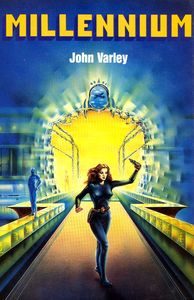
  • Millennium, John Varley

    Millennium, John Varley

    Berkley, 1983 (SFBC reprint), 214 pages, C$??.?? hc, ISBN ???

    With my ever-growing stack of books to read, I don’t often re-visit thing I have already read. But an idle viewing of the much-maligned Millennium on DVD left me wondering once again about what, exactly, John Varley had in mind before the movie industry made mincemeat out of his concept.

    The essential back-story of the saga goes like this: After causing quite a stir in written Science Fiction circles at the end of the seventies, Varley went to Hollywood to work on movies. His written output during those years slowed down considerably, and the only tangible result of those years is his screenwriter credit on the 1989 film Millennium. There’s a dearth of documentation regarding the film’s troubled production (If Varley talks about it briefly in his 2004 retrospective The John Varley Reader, corroborating documentation is difficult to find on the web), but it’s no accident if this 1989 film looks as if it’s been shot years earlier. The finished movie reportedly languished in studio vaults for years until it was finally released. Varley started work on the script in 1979, and his “novelization” (credited to MGM/UA) came out in 1983, and ended up nominated for that year’s Hugo Awards.

    At its best, the film plays like a fine science-fiction thrillers set in the early eighties. The first half-hour is intriguing, but everything quickly cheapens once the central mystery is explained. Millennium then gets bogged down in a redundant temporal loop (we really don’t need to see the middle when we know the end) and becomes increasingly inept at portraying the future sequences that are supposed to be the showpieces of the film. The end result is frustrating: there are a bunch of great ideas in the whole mess (the premise itself, about time-traveling operatives snatching away passengers of doomed flights, is the kind of idea that gets into your brain and then never goes away, especially for frequent flyers), but the execution becomes increasingly disjoint, all the way to a ridiculous amount of mystic yadda-yadda by the closing seconds of the film.

    The book, unsurprisingly, is much better. At a pleasantly-short 214 pages, it moves quickly and keeps the strengths of the film while adding the rest of Varley’s original vision for the concept. Alternately told by the two main characters of the story in first-person “testimonies”, Millennium first reassures readers by giving them an early-eighties inside look at air crash investigations, with all of the procedural details and jargon-laden knowledge that presupposes. But the book’s most-improved aspect is in depicting the time traveler’s perspective on the events. The film’s unconvincing supermodel actress becomes a tough and uncompromising operative with her own distasteful habits, and her narration show how much of the character was watered-down for the big screen.

    Not having to worry about a production budget, Varley is able to add all the depth and credibility that the story requires. Amazingly, the plot points of both versions of the story are largely similar: Varley, on the other hand, doesn’t play silly temporal games with his audience (when he does, it feels natural) and is able to give some sorely-needed background justification. He doesn’t try to tie the characters together more than strictly needed (the epilogue even suggests how unreliable the testimonies are) and is able to speak knowledgeably to his genre-hardened readers: all chapter titles are taken from previous time-travel stories.

    Of course, it’s written with Varley’s usual verve. I had fond memories of the book, and revisiting it only underscored how good Varley could be even in delivering a run-of-the-mill SF thriller. It’s not just an illuminating look at how mishandled adaptations can keep the bones of a story and still mess up everything else: Millennium is a truly good SF novel, one that still has a lot of charm and value as an increasingly-historical context. (Which bolsters my contention that Back to the Future aside, the most interesting time-travel stories are ones where the future intrudes on a present, not ones where the present revisits the past.) Happily, I see from Amazon that Millennium is still in print; give it a try –it’s better than most novels published these days.

  • The Scarecrow, Michael Connelly

    The Scarecrow, Michael Connelly

    Little Brown, 2009, 419 pages, C$30.99 hc, ISBN 978-0-316-16630-0

    For series readers, some books are an investment, while others feel like payoffs. While The Scarecrow will be perfectly intelligible and interesting to readers coming in cold to Michael Connelly’s crime thrillers, there’s no doubt that those who are familiar with the Connollyverse are going to get the most out of it. Starting by the fact that it’s a thematic sequel of sort to the author’s most successful book, The Poet.

    It’s true that there has already been a direct sequel to The Poet: The Narrows, after all, featured Harry Bosch disposing of the serial killer known as “The Poet”, while Jack McEvoy had small roles in other Connelly novels, most notably in A Darkness More Than Night. But this is McEvoy’s first return as a narrator, and the links between The Scarecrow and McEvoy’s previous adventure run deep.

    The Scarecrow certainly opens on some of the most depressing passages ever featured in a Connelly novel so far: As the novel begins, McEvoy has been fired. Newspapers everywhere are downsizing (the novel even includes a timely reference to the Denver Rocky Mountain News, which went web-only in early 2009), and veterans like McEvoy are too costly to keep in an era of corporate efficiency and dirt-cheap bloggers. Given two wholly unrealistic weeks to set his affairs in order and train his replacement, McEvoy is pushed to investigate a murder case where the accused has been coerced in an unconvincing confession. But in doing so, he alerts the real murderer, and this “Scarecrow” is a piece of work: an experienced serial killer with near-magical hacking skills, this antagonist takes no chances in dealing with McEvoy. Events unfold at a surprisingly fast pace from that moment: Only the timely appearance of FBI agent Rachel Walling saves McEvoy’s day, and their rekindled relationship isn’t much of a comfort when Walling’s career is once again on the line.

    As a reunion of familiar characters, The Scarecrow does quite a few things very well indeed. Harry Bosch is alluded to along the way, but his absence as the heavyweight protagonist of Connelly’s fiction frees Rachel Walling to become an interesting character once more. McEvoy’s narration is a welcome return to a journalist’s perspective on the usual sordid business that takes place in a Connelly novel: his wealth of experience as a reporter gives a neat twist to the procedural details of the tale (the book’s most telling detail being McEvoy’s recommendation to his successor to move a policeman’s quote closer to the top of the article, so that it will survive editing and create goodwill from the policeman) and echoes The Poet: the motto “Death is my beat” makes a return appearance, even as McEvoy seems at the end of his rope as a journalist.

    Otherwise, The Scarecrow hops between California and Nevada, goes from a newsroom to hotels to a data center, features some decent action scenes for McEvoy and doesn’t skimp on the denouement. Connelly’s prose is as crisp as ever, and if the result can often feel a bit familiar (especially toward the end), it’s a solid piece of summer reading with most of the qualities of the author’s fiction and few particular flaws. The novel’s cutting-edge references to the end of the newspaper era may prove to be just a bit too timely to act as an entirely escapist piece of fiction, but fans of Connelly’s output so far will be pleased to see familiar characters on-stage once more, while newer readers will come to understand what all the fuss around Connelly’s fiction is about.

  • Nothing to Lose, Lee Child

    Nothing to Lose, Lee Child

    Dell, 2008, 407 pages, C$32.00 hc, ISBN 978-0-385-34056-4

    In this twelfth entry in the highly successful Jack Reacher series, it’s a given that some plot mechanics will feel very familiar. Reacher being arrested in the first chapter of the book is a reminder of the very first volume of the series, whereas the small-town setting can bring to mind the rural Texas landscape of Echo Burning (with which it also shares an unfair bar-room fight). Reacher is always taking on hopeless odds; what’s wrong with staring down an entire town in this entry?

    Yet, at the same time, there’s something new in this twelfth adventure as well. For perhaps the first time, political content makes its way into Reacher’s actions as the background of Nothing to Lose depends heavily on the invasion of Iraq for its premise. In at least three sub-plots, casualties of the war find their way to America, and its consequences weigh heavily on every character. For a series that has so far navigated gracefully between the shoals of American politics, it’s a bit of a surprise to find this twelfth entry embracing material most readily discussed in left-leaning company.

    This time, Reacher’s troubles start as he walks over the wrong border: Trying to make his way from one American coast to another, he ends up at the border between the cities of Hope and Despair, Colorado. Things go sour as soon as he’s spotted in Despair: arrested without too much ceremony, he’s eventually scolded and deported back to Hope. Reacher, naturally, doesn’t like being told what to do: His aroused curiosity soon turns to obsession as it becomes clear that Despair holds many, many secrets.

    In fact, Nothing to Lose isn’t a thriller as much as it’s a description of how Reacher teases all the mysteries out of a puzzle box. Despair features three ongoing sets of secrets and a fantastically unlikely accumulation of surprises that would be unbelievable anywhere but in a Reacher novel. (Amusingly enough, a fantastically unlikely coincidence is outlandish enough to be discussed and rationalized by the characters: As one of them puts it, “That’s a coincidence as big as a barn.” [P.72])

    Fortunately, Child knows how to tease information effectively: By the time Reacher faces down a literal human chain of Despair residents determined not to let anyone sneak into their town, it’s easy to believe that something has gone deeply, deeply wrong in that small city. Seeing Reacher take down Despair’s entire police force feels like divine retribution over a hive of sin. The action set-piece of the book is either a demolition derby that leads to the hospitalization of Despair’s remaining police force, or a bar-room brawl in which Reacher manages to incapacitate half-a-dozen opponents and stare down the rest of the patrons.

    But such things are to be expected in this series. What’s perhaps a bit wilder is the identity and affiliation of the book’s main set of villains, another signal that will please left-leaning readers of the series. Alas, one of the plots uncovered by Reacher seems a bit too big, a bit too unlikely to sit comfortably. Reacher, after all, is at his best saving widows and orphans, not taking on entire geopolitical issues.

    On the other hand, Nothing to Lose proves that there’s still quite a bit of juice left in the Reacher series’ most enduring conceits: Reacher is still believable taking down unbelievable odds and the accumulation of technical details is still layered enough to strengthen the credibility of the entire novel. While this twelfth entry feels a bit like others, it’s also distinctive enough on its own. The strengthened political content may or may not lead to anything in further Reacher adventures, but it’s an intriguing development in a genre that sometimes has trouble balancing political views.

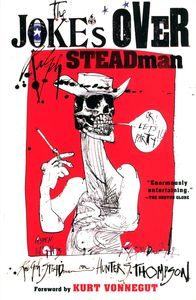
  • The Joke’s Over: Ralph Steadman on Hunter S. Thompson, Ralph Steadman

    The Joke’s Over: Ralph Steadman on Hunter S. Thompson, Ralph Steadman

    Harcourt, 2006 (2007 reprint), 396 pages, C$16.95 tpb, ISBN 978-0-15-101282-4

    Hunter S. Thompson was (sometimes) a brilliant writer, but most of his legend is based on stories of hard substance abuse, aggressive behavior and casual disregard for authority. While that makes for spectacular adventures, it’s quite another thing to reflect upon the consequences of that kind of mindset on close friends and family.

    Ralph Steadman’s The Joke’s Over is that strangest of autobiographies: a personal narrative almost entirely centered around another person. The autobiography of a sidekick, so to speak. Gonzo fans already know that Steadman is the artist responsible for the signature illustrations bundled with Thompson’s best-known work: The nightmarish caricatures in Fear and Loathing in Las Vegas are as much part of the reading experience as the text itself, and so Steadman has become an integral part of the Gonzo Journalism myth, the visual representation of Thompson’s prose aesthetics. Steadman is an accomplished artist in his own right, but there’s no doubt that there are more Thompson fans than people interested in a straight-up Steadman autobiography: Hence The Joke’s Over, a lengthy testimony of what it was like to be a friend of Hunter S. Thompson.

    It’s not a simple friendship made of friendly communication and simple fishing trips: From their first meeting in Kentucky (The first chapter of The Joke’s Over reads like the mirror image of Thompson’s “The Kentucky Derby is Decadent and Depraved”, down to Thompson macing Steadman and driving him away to the airport in a cloud of invectives), Steadman and Thompson seem to oscillate between common admiration and shared loathing. Steadman, upon writing down his memories, becomes conscious that it was a relationship in which only Thompson could see himself as the superior one. It didn’t help that the writer suffered from life-long money problems, and that a recurring topic in this biography is royalties and how much Thompson wrangled over his share of the proceeds. Not that Steadman took advantage of his partner: Tales abound about how his illustrations were re-used at a pittance, and how difficult Thompson could become whenever financial issues were discussed.

    Steadman never quite says it, but he comes close to acknowledging how much of an abusive relationship his friendship with Thompson could be. While the two remained close during their entire lives (which tells us something about how fiercely loyal Thompson could be, and how he inspired his friends to be the same to him), it wasn’t always smooth or simple. One thing almost left unsaid by Steadman that you have to read about in other biographies is the rift that erupted between the two men in the early nineties as Thompson had a stint in jail (which led to a fund-raiser, which led to more money issues) and Steadman contributed to unauthorized biographies that displeased the writer.

    It’s all great material, but one of the most frustrating things about The Joke’s Over is that it’s best read with ample knowledge of the context: Steadman may or may not be a skilled writer, but the editing of the book is deficient: The stream-of-consciousness gonzo writing style has no place in a biography of the sort: Entire paragraphs of The Joke’s Over are incomprehensible or tangential, veering off in wild political screeds that aren’t uninteresting, but distract considerably from the main text. At 396 pages, Steadman’s book is far too long and disjoint, not to mention unpleasant to read.

    It goes without saying that The Joke’s Over is a book for the die-hard Thompson fans: Most will be better off reading William McKeen’s superlative biography Outlaw Journalist to be told crisply what Steadman takes forever to say. On the other hand, skipping over The Joke’s Over means missing out on the feeling of being stuck with the Thompson whirlwind, having pills pressed in our hands and flying off in a daze of violent fear and loathing. The Joke’s Over may not be entirely pleasant experience for grounded readers, but it’s a minor success of gonzo writing taking Hunter S. Thompson as its subject.

  • Hunter’s Moon, David Devereux

    Hunter’s Moon, David Devereux

    Gollancz, 2007, 231 pages, C$24.95 tpb, ISBN 978-0-575-07985-4

    The recent explosive rise in urban fantasy (the new kind, with leather-clad heroines) has been one of the big publishing success stories of the past decade, and a lot of it has been fueled by a hybridization of romance with supernatural thrillers. The result, perhaps inevitably, has remained chiefly (although not exclusively) aimed at female readers, with the boys joining in for the thrill of reading about “kick-ass chicks”.

    Now comes David Devereux with Hunter’s Moon, a self-conscious reactionary take on the same themes that reads like urban fantasy hammered by military thrillers. It’s almost ridiculously aimed at male readers, and has an admirable determination in fulfilling that objective. The results may not be entirely comfortable, but it’s a bit of distinctiveness in a fast-expanding field that seems determined to race to the broadest generic denominator.

    The fun starts with the series tagline: “Magician by Profession, Bastard by Disposition”. Our narrator “Jack” may work for the British government, but he is not a nice man, and he means it. Like an authentically spicy dish in a small restaurant, his brand of nastiness has nothing to do with the watered-down bad boys that populate less determined thrillers: He knows magic and he’s paid to be ruthless. Not content with merely killing opponents, he’ll bring their spirit back from the netherworld and curse it so that even their souls will be lost. Now that’s hardcore.

    It seems like overkill to set such a protagonist against a mere convent of witches bent on assassinating the British Prime Minister, but that’s as good an excuse as many to initiate readers to the twisted world of military operations and magical incantation that “Jack” inhabits. One thing that may catch readers’ eyes before starting Hunter’s Moon is Devereux’s forward note saying “All the magic in this book is fake. I made it up. The Principles are sound, but since I don’t want anyone out there trying to do the things that Jack does, I assembled his methods from a wide variety of incompatible systems…” If that sounds like a stronger variety of “Don’t try this as home, kids”, it’s no accident: A look at Devereux’s site reveals an authentic interest for the occult (his first book, an autobiography, is titled Memoirs of an Exorcist) and while we’ll agree to disagree on the existence of occult phenomenas, Hunter’s Moon does a splendid job in setting up a messy magical system that feels as if it’s got the patchwork consistency of an authentic discipline.

    The rest of the book flies along at a snappy 230 pages as Jack infiltrates his target, depending either on military skills or occult knowledge to advance in his investigations. The twists and turns pile up, and there’s seldom a dull moment negotiating between national state secrets and black magic. There’s a lot of dark kink-friendly sex and even more neck-snapping violence, so don’t let the kids get a copy of this book unless they really, really want it.

    This being said, one aspect of Hunter’s Moon left me quite a bit less enthusiastic. “Jack” may be an equal-opportunity professional bastard, but it’s hard to avoid noticing that his targets in this book tend to be overwhelmingly female. Blame my upbringing, but (even in targeting a witch convent) male-on-female violence tends to stick in my craw a bit more than the other permutations. The torture scene, with its strong overtones of dominance and submissive behavior, is about as bad as it gets (well, if you don’t count the whole excessive kill-a-housewife-then-destroy-her-soul bit mentioned above.) I suspect that other readers’ reaction to this material will vary quite a bit.

    Others will argue that this type of discomfort is a good sign that this energetic, relentless urban fantasy is meeting its goals. If nothing else, Hunter’s Moon is a rarity in that it doesn’t have any fat nor mercy: it’s lean, it’s mean, and it’s a fast read. In most circumstances, it would be difficult to find anything more appropriate to say about it.

  • The Great Shark Hunt, Hunter S. Thompson

    The Great Shark Hunt, Hunter S. Thompson

    Simon & Schuster, 1979 (2003 reprint), 602 pages, C$25.00 tpb, ISBN 0-7432-5045-1

    Perhaps the most surprising thing about Hunter S. Thompson’s work is how short his most productive period has been: From Hell’s Angels to the end of Fear and Loathing: On the Campaign Trail ’72, his best years all took place during the 1965-1975 decade, with significant fallow periods within: Aside from his prolix biweekly schedule during the 1972 election (one that he wasn’t able to sustain past August/September), Thompson wrote far less than you’d expect from such a well-known journalist.

    But still frequently enough that a collection of his best work between 1960 and 1980 manages to fill a hefty trade paperback. From the National Observer pieces in which he criss-crossed South America to the post-celebrity pieces of the late seventies when Thompson had carte blanche to write about anything, The Great Shark Hunt is the essential collection of his pure journalism work.

    All the big classics are there: “The Kentucky Derby is Decadent and Depraved” marked the launch of Gonzo journalism, where the journalist becomes a primary motor for the events being described. Even today, no one is too sure how much of the piece is outright fiction and how much is altered fact: it certainly reads like a lively short story, and still works best as such even as the culture revolving around the Kentucky Derby has completely changed.

    Other landmark pieces include “Strange Rumblings in Aztlan”, a typically apocalyptic piece (featuring attorney Oscar D’Acosta) that would eventually lead to Fear and Loathing in Las Vegas. That article would be bookended six years later by “The Banshee Screams for Buffalo Meat”, which served as a requiem of sort for the still-absent D’Acosta. In between we get the entire 1972 campaign, the Watergate hearings, and the beginning of Thompson’s legend as a drug-addicted, catastrophe-minded, anti-authoritarian symbol. The title piece of the book may have been the first and purest piece written by Thompson as playing on his own legend: The subject becomes secondary to Thompson’s chemically-fueled adventures facing the emptiness of his assignment.

    For fans, half the fun is in discovering lesser-known material. There are a number of more overly humorous pieces here that leave an impact, from the Swiftian satire of “The so-called ‘Jesus Freak’ scare” to the overblown aggression of “The Police Chief” (which features the line “[tear gas] only slaps at the problem: nerve gas solves it” [P.416]). Other great moment in Thompson history include the bittersweet let-down at seeing Nixon resign in disgrace in “Mr. Nixon Has Cashed His Check”, to a fanciful speech from the balcony at the beginning of “Fear and Loathing at the Super Bowl” that brings to mind the kinship between Thompson and Transmetropolitan‘s Spider Jerusalem.

    In many ways, The Great Shark Hunt is designed to be the perfect introductory volume to Thompson’s work: In addition to the pieces that would make his renown as a Gonzo journalist, we get some of the best excerpts from his three best-known books: The “Edge” piece from Hell’s Angels is here, as are the first few pages of Fear and Loathing in Las Vegas and the “220 million used car salesmen” rant from the end of Fear and Loathing: On the Campaign Trail ’72. If you only get one Thompson book, get Fear and Loathing in Las Vegas… but if it’s not available, you won’t go wrong with The Great Shark Hunt.

    Still, it could have been a better volume. Insufficiently organized in four sections (unnamed, but summarized as “The Birth of Gonzo”, “Politics 1968-1976”, “Pre-Gonzo Journalism” and “Full-Gonzo Thompson”), the collection often seems to veer from one piece to another without reason, and now sorely lacks connecting material. Thompson’s prose is always an acquired taste, but the book often seems to assume that the reader is already convinced of Thompson’s brilliance.

    Hunter S. Thompson’s flame may have burned too briefly, but never as brightly as during the years chronicled in The Great Shark Hunt. If you’ve been wondering which volume best showcases Thompson’s considerable writing talents, look no further.

  • The Lost Fleet: Dauntless, Jack Campbell (John G. Hemry)

    The Lost Fleet: Dauntless, Jack Campbell (John G. Hemry)

    Ace, 2006, 293 pages, C$8.99 mmpb, ISBN 978-0-441-01418-7

    It’s an uncontroversial assertion to say that an author’s name is a more reliable marker for satisfaction than a genre label, which is why savvy readers are advised to take a look at “Jack Campbell”’s The Lost Fleet: Dauntless and flip over to the copyright page, which blandly attributes the book to “John G. Hemry writing as Jack Campbell”

    Hemry, of course, is the writer of the well-regarded “Paul Sinclair / JAG in Space” tetralogy. While the series obviously didn’t sell all that well (hence explaining the transparent name change), it was above-average military Science Fiction with an appealing protagonist and strong moral underpinnings that informed the content of the fiction. Those are the very same qualities that help make this first volume of The Lost Fleet series so engaging, even for those who don’t have any particular affection for military SF.

    The premise has its own kick of interest: A hundred years after being cryogenically frozen following an military engagement between two splinters of humanity, Captain John “Black Jack” Geary is revived to find out that the war is still going on, and that he’s been placed in charge of a fleet far away from home. The enemy is closing in; his own troops are demoralized and his reserves are running low. That’s the first chapter.

    Trying to learn as quickly as he can, Geary meets his first fans (who love the long-lost legend more than the real man), makes a few enemies and manages a few fancy military maneuvers. Then things get worse.

    Unfrozen out of his time, Geary quickly realizes that some things have changed dramatically in a hundred years. His own side isn’t quite as honorable as it used to be, and the constant toll of fighting has lowered strategic standards. Some of his early victories depend on tactical knowledge forgotten during the intervening century; others depend on a willingness to take the decisions that everyone else wants to avoid. But even then, a substantial number of officers under his command think that they can do much better than a quasi-mythic war hero…

    The first volume in a series with five volumes as of spring 2009, Dauntless is about setting up a rich framework for adventure. So there are plenty of expected and not-so-expected hints and portents: Geary’s mythical reputation; warring power blocks; the war’s history; hints of a third force; a quest to get back home; and Geary’s own doubts are all put on the table in this first entry. It remains to be seen whether they can sustain the series until the end, or keep it humming until it changes shape. It’s not a baseless concern: If there’s one lasting criticism about Hemry’s previous “Paul Sinclair” books, it’s that they all had the same structure, and that one book was a reliable guide to all the others.

    But at the same time, “Campbell”’s prose style is just as readable as Hemry’s, which can make the difference between reading a single book and committing to an entire series. It helps that Hemry doesn’t write the kind of military SF that most people picture when they think about the subgenre. Here, the emphasis is placed on the burden of being part of a military unit, not on the glory of combat: Geary is acutely conscious that every battle means death for someone, and that his forces aren’t strong enough to sustain the kind of spectacular battle that is the staple of the sub-genre. Oh, there’s clever combat all right –but the interest of the series is just as strong in matters of logistics and politics than it is when the weapons start firing.

    And that, in itself, is a good indicator of Hemry’s writing skill —no matter which name he uses on the cover. We’ll see how many volumes The Lost Fleet sustains, but if previous indicators are a reliable guide to future performance, it will be -at worst- a really entertaining series.

    [June 2009: The Lost Fleet: Fearless indeed keeps things moving in the right direction.  The stakes are raised with unexpected new characters, defections, a romance and stronger suggestions of alien interference.  There are also a few more space battles, although they don’t overshadow the series’ more interesting issues about leadership and cooperation.  The prose style is a jolly good read, and the series manages to hit a sweet spot between shoot-em-up military action and more thoughtful resource-management problems.  The growing sophistication of the characters is a hallmark of addictive fiction.  In short; this is one series that’s doing everything right so far.]

    [May 2010: It took six volumes, but The Lost Fleet: Victorious finally wraps things up.  The conclusion is satisfying, but the series has spent a long time doing nothing before revving into gear in the last volumes and a half.  What could have been a satisfying trilogy has become a badly-paced series.  Good characters, satisfying emphasis on the burden of leadership, but take out some scissors and snip away at the middle third of the series, because it almost overstays its welcome. There’s a reason why I haven’t even mentioned tomes 3-5.]

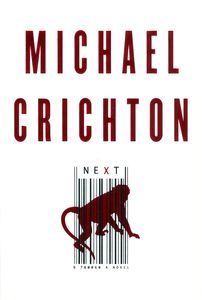
  • Next, Michael Crichton

    Next, Michael Crichton

    Harper Collins, 2006, 431 pages, C$32.95 hc, ISBN 978-0-06-087298-4

    It’s fitting that Michael Crichton’s last novel before his death in 2008 would encapsulate so many of the most distinguishing characteristics of his fiction. An alarmist techno-thriller with enough hypocrisy to choke two talking monkeys and a sentient parrot, Next is a polemic more than a novel, and it’s best appreciated with tons of contextual information.

    Intentionally structured in a scattershot fashion, Next reads like a free-form exploration of issues surrounding genetic research. For the first half of the book, readers will struggle to identify a plot thread as unrelated scenes pile up, starring dozens of characters that appear out of nowhere and seem to return to obscurity just as quickly. In interviews about Next, Crichton likens the novel’s various plotlines to DNA, with its genetic material that may or may not be important. It’s as fancy an excuse as one can imagine for a free-form whirlwind of loosely connected vignettes. After all, Crichton is less interested in telling a story than he is at baiting readers.

    For a man whose nonfiction writing career has been spent shouting down new technological development (starting with information technology in 1971’s The Terminal Man), it’s a return to basics more than a late-career affectation. Crichton even makes references to his own Jurassic Park (a novel that has aged far less gracefully than you’d expect with its gratuitous references to then-hot chaos theory) and how the state of genetic research has evolved since then.

    So it is that nearly all of Next‘s characters are either villains or victims: Rich businessmen trying to exploit genetic research for their own personal gain, or poor ordinary folks finding themselves in impossible situations —from a man whose DNA is patented by a commercial entity to another one who’s framed for proclivities blamed on genes. Not all victims are humans, this being a novel with an inordinate fondness for talking animals.

    It all gets ridiculous after only a few pages. Crichton’s accumulation of manufactured outrage gets tiresome and transparent; it doesn’t help that after a dozen novels of contrarian shtick, his methods are more obvious than ever. Everyone with money is evil; anyone with power can be counted upon to do the wrong thing; there are no solutions. This knee-jerk cynicism gets as tiresome as idealist naiveté, but reaches exasperation much, much faster.

    Hypocrisy has always been synonymous with Crichton’s fiction, and Next is no exception: Once the fiction is over, associated notes and interviews bundled with the book go on to reveal that Crichton basically feels optimistic about genetic research… provided that a few laws are passed. Not that you would know that from reading the main text: any optimistic viewpoints are carefully kept away from the plotting, and no solutions are portrayed during the course of the novel: It’s as violent a case of intellectual whiplash as you can get without reading an author’s note that says “I really didn’t mean what you just read.”

    But, hey: Michael Crichton. Hypocrisy and self-contradictions have always served him well. Frankly, it’s not as if he never gets anything right: In the middle of the whole reactionary mess that is Next, one can find this unarguable passage:

    Science is as corruptible a human activity as any other. Its practitioners aren’t saints, they’re human beings and they do what human beings do –lie, cheat, steal from one another, sue, hide data, fake data, overstate their own importance and denigrate opposing views unfairly. That’s human nature. It isn’t going to change. [P.62]

    Replace “Science” with “writing a novel” and there aren’t many better epitaphs about Michael Crichton’s novels. I happen to believe that fiction should allow for the possibility of being better than our own natures, but you can chalk this up to a philosophical difference between Crichton and myself. At the very least, I’ll grant one thing —Next may or may not be very good, but it’s as entertaining in its own way as the rest of his fiction.

  • Anathem, Neal Stephenson

    Anathem, Neal Stephenson

    Morrow, 2008, 937 pages, C$31.95 hc, ISBN 978-0-06-147409-5

    Being a dialogue between a not-entirely-satisfied reader and Neal Stephenson’s Anathem:

    Anathem: Hey, reader. Do you know what I am?

    Reader: (Rolling eyes): Yeah, yeah, you’re Neal Stephenson’s latest brick-sized novel. Obviously, he wasn’t listening when everyone complained about the Baroque Trilogy. Did you know that I still haven’t read those books? When will I find the time to do it?

    Anathem: But you read me! Am I not clever, or what?

    Reader: You were also nominated for a Hugo Award shortly before I got stuck for three days in one of the dullest cities in Canada with nothing to do but read anything close by. So don’t flatter yourself.

    Anathem: I dismiss the rest of the Hugo Shortlist. I’m smarter than all of them combined.

    Reader: A propensity toward glossolalia doesn’t necessarily correlate with genius. The fact that you’re incomprehensible without a made-up dictionary doesn’t make you any smarter than the wicked storytelling of Neil Gaiman’s Graveyard Book, nor any more engaged than Cory Doctorow’s Little Brother, nor any more sarcastically likable than John Scalzi’s Zoe’s Tale nor more interesting than the truckload of ideas in Charles Stross’ Saturn’s Childen. Try stopping being less full of yourself and we’ll talk on more amiable terms.

    Anathem: But… surely you must be impressed by how I re-invent much of human philosophy and science in barely less than a thousand pages!

    Reader: I hate to break it to you, but it’s been done before. Thousands of students do it every year, and they’re using the real words, not poisoning the information well of its audience with a made-up mythology. I understand that your point is to show off how intelligent you are, but that’s where our conceptions of the novel-as-a-novel may clash: Reinventing philosophy is not something I need from my pleasure reading.

    Anathem: But, but, but! You always say you like fiction that make you think!

    Reader: I also enjoy reading books that don’t send me back to my freshman year manuals in order to do my homework. You’re also ignoring the crucial point: I don’t mind a bit of thinking in addition to my fiction, but I mind when it displaces it. Face it: how much of a story is in your nine-hundred pages? How quickly would a more efficient author been able to tell it with a reasonable amount of detail?

    Anathem: You’re being unfair! I am a beacon of intellectual rigour and ambition in a wasteland of mere entertainment! You’re just indulging in cheap contrarianism for the sake of a querulous review!

    Reader: I’m perpetually guilty of contrarian sarcasm, but it comes from the heart. Look: You’re just too long and convoluted for your own good.

    Anathem: Ah, but admit it; after so long spent living in my world, you’re proud of what you have achieved! You’re feeling better for the effort you’ve spend reading me!

    Reader: So, what, you’re supposed to be my tough-love thousand-page buddy now? Did you see where I shelved Atlas Shrugged in my bookshelves?

    Anathem: (Horrified) Not… the… humor section?

    Reader: Fortunately for you, you’re too much of a stick-in-the-mud to be classified as funny.

    Anathem: But I’m the smartest book you’ve read this year, right?

    Reader: (Exasperated) Yes you are. Now here’s five bucks to go buy yourself a coffee.

    Anathem: (Walking away) Woo-hoo! I’m the “smartest book of the year”!

  • Nano, John Robert Marlow

    Nano, John Robert Marlow

    Tor, 2004 (2005 reprint), 381 pages, C$9.99 mmpb, ISBN 0-765-34071-2

    This isn’t a very good novel, but I’m sorry to have missed it when it was first released in 2004.

    Regular readers of these reviews have certainly noticed that I’m very lenient when it comes to high-tech thrillers. I’m biased, of course: However bad techno-thrillers verging on SF can be, they’re still speaking my language and engaging me on an level that I can’t find in other genres. The high-tech thriller is all about the technology, and preferably a whole lot of it. It’s a distilled, almost single-minded version of the genre, where two-page digressions about the characteristic of a gadget aren’t just acceptable; they become the reason why the novel exist.

    It doesn’t take a long time to figure out that John Robert Marlow’s Nano is more a piece of nanotechnology evangelism than a conventional work of fiction. Marlow’s biographical profile is a hit-parade of science journalism credentials with a heavy emphasis on nanotech. The foreword is by Chris Phoenix (“Director of Research, Center for Responsible Nanotechnology”) and the main text of the novel is followed by twenty-five pages of technical details. With that packaging, it’s not surprising if the plot of the novel itself ends up being nothing more than a showcase for nano-possibilities.

    The plot certainly isn’t much to brag about: After the public assassination of a billionaire who was on the verge of announcing the results of a major nanotechnology research effort, a (male) scientist and (female) journalist go on the run, chased by mysterious operatives but equipped with the latest nano-gadgets. Various chases and shootouts all lead to an ultimate confrontation between our plucky heroes and hostile elements of the government. If it reads like a movie, it’s not an accident.

    The prose isn’t elegant, the exposition is certainly not gentle and the characters aren’t much more than excuses for as-you-should-know-Bob dialogue. Taken at face value for its ideology, Nano is a clumsy mixture of adolescent libertarianism (“As you should know Bob, we can’t trust the government.”) and juvenile techno-boosterism. (“As you should know, Bob, technology is cool.”) While I’m quite fond of techno-utopianism myself, the political naiveté of the novel becomes an issue, especially when the protagonists gleefully kill dozens, then hundreds, then thousands of people on their way to a conclusion where they set themselves up as not-quite-benevolent demigods. Having indulged in my lifetime quota of nerd exceptionalism, my comments regarding the novel’s underlying contempt for the masses would have been harsher if I actually took it seriously.

    Fortunately, it’s hard to consider Nano as a respectable piece of fiction when the action stops so often on the flimsiest of pretexts. Every few pages, there’s room in the chase for a “dialogue” on space colonization, the ineffectiveness of tear gas, or a flashback about a particularly vexing industrial-espionage episode. This is a novel of ideas in ways that would embarrass most professional Science Fiction writers: Marlowe has no shame in going off on tangents, and that does give a certain charm to the whole novel. Reading Nano is a lot like being stuck with a bright sixteen-year-old boy overdosing on Atlas Shrugged: his rants are lively, but there’s a number of rough edges to tolerate until he learns better.

    It’s not as if the novel’s completely unimpeachable on a technical level either: Marlow’s credentials as a journalist aren’t much of a defense against Nano‘s most embarrassing scientific mistakes. While the novel’s packaging swears up and down that everything in the story is true and possible, that’s not quite exact: This is a story where the characters can shoot special bullets that will assemble trees in the middle of the road fast enough to crash following cars… a kind of assembling speed closer to fantasy than SF. It’s always the little details that kill, and so Nano has little time to spare regarding issues of information management between assemblers, heat dissipation or where the raw materials come and go during assembly and disassembly. (In one scene, disassemblers get to work and produce a gulf large enough for the sea to rush in, but there’s never any specification as to where the disassembled stuff actually goes. It’s not called a gray goo scenario for nothing!) Again and again, Nano ignores edge cases or cleanup issues: This gets particularly bad toward the conclusion of the novel, during which a nano-infestation is dealt with an a searing fashion that doesn’t sustain real-world scrutiny: The problem with runaway disassemblers is that you still have a problem even if a few of them survive the solution. Understandably, the nanotech-is-cool fun of the novel doesn’t dwell at length on that issue.

    But as I’ve hinted throughout of the novel, the nature of the book makes it hard to dislike. Compared with alarmist nano-tripe like Michael Crichton’s Prey, Marlow’s Nano is optimistic, fun, brainy and light. It’s throwing ideas at the readers as fast as it can, so why be angry if a chunk of them just don’t make sense? As long as it’s taken with a pallet of salt, it’s a rare example of pro-technology progressive propaganda that acts as a counterpoint to more alarmist novels. I may dismiss it on dramatic, ethical and scientific grounds, but whatever is left is still close enough to my own interests that I can’t help but still give it a mild recommendation.

    Surprisingly, this 2004 novel completely failed to register on my radar until recently. I can almost understand why; despite its strong scientific content, it’s frankly not good enough from a literary standpoint to survive and be discussed in today’s top-tier SF market. In hindsight, I regret not only that I missed the novel at the time, but that it hasn’t been followed by a second Marlow novel yet. Until that happens, Nano remains an intriguing book whose particular strengths do much to compensate for some significant flaws. It’s pretty much the definition of a book for a narrow audience –if you like it, you will like it a lot… and will forgive it many things.

  • Prodigy, Martin James

    Prodigy, Martin James

    Sanctuary, 2002, 315 pages, US$18.95 tpb, ISBN 1-86074-356-0

    The March 2009 release of The Prodigy’s fifth studio album Invaders Must Die rekindled my interest in the band to such a point that I was primed to buy anything about them on sight. The Toronto HMV on Yonge having cannily placed copies of Martin James’ Prodigy on an end rack to promote the band’s recent local concert, I went from “I had no idea this book existed” to “I’m buying this now” in about a second.

    But don’t feel sorry for my impulse purchase: Prodigy manages to fulfill every expectation a fan could have regarding a musical biography. A much-expanded rewrite of a biography first published in 1997, it’s a complete narrative of the band from its early-nineties roots to 2002. It covers nearly every single piece ever produced by the group (some of them still unreleased even today), gives a fair impression of what it would be like to hang out with them and doesn’t shy away from covering the more controversial moments of their history.

    If you’re receptive to rock and techno music yet aren’t already a fan of The Prodigy, I would suggest listening to either The Fat of the Land or their greatest-hits compilation Their Law. Chances are that you too will be hooked by their infectious mixture of energetic rhythm. They bark their vocals over catchy melodies, but they’ve never forgotten their roots in the rave scene: Their music is meant to move you until you drop from blissful exhaustion as the sun comes up. If Martin James does one thing particularly well at the onset of Prodigy, it’s to give us a good idea of the music scene in the early 1990s as Liam Howlett started assembling the foundations of his musical group. James is no mere scribbler with a book contract and access to a good bibliography: As the first few pages of the book make clear, he’s a long-time friend of the band, and his own concert memories often dovetail nicely with The Prodigy’s growing success. The result is a biography with ready access to the band members, almost but not quite veering in hagiography: Prodigy doesn’t shy away from the band’s less glamorous moments, and while it usually presents The Prodigy’s version of events as the correct one, it never forgets to give at least a cursory summary of the opposing arguments.

    It goes without saying that the best way to read Prodigy is to do so with your favorite MP3 player and the best possible assortment of the band’s tracks. I ended up listening to my entire Prodigy catalog a few times as I was making my way through the book, an approach made easy by a single-by-single discussion of the band’s discography as it is assembled. Since the video clips are also discussed, you may as well start looking for the DVD anthology of The Prodigy’s video clips while you’re collecting the complementary material. The various spin-off albums from members of the group (such as Flightcrank, the Dirtchamber Sessions or Liam Prodigy’s “Back to Mine”) can also help in rounding up the remaining references. (As luck had it, my first visit to a used record store after completing the book ended up netting two Prodigy singles and a copy of Flightcrank!)

    One of the best things about the book is how is contextualizes many of the tracks for those who weren’t in the scene at the time. For North-American fans, for instance, it’s hard to understand the political subtext behind Music for the Jilted Generation without understanding the changing nature of the British rave scene due to authoritarian clamp-downs: “Their Law” indeed!

    Weighing in at 120,000 words, this revised and expanded biography leaves little uncovered, although its 2002 publication date is getting more frustrating every year: A lot has happened in the band’s life since then, including the “Baby’s Got a Temper” episode, the mixed reception for Always Outnumbered, Never Outgunned, a few more side projects, the reunion of the group and the well-received release of Invaders Must Die. The Prodigy is still touring, and their music is still unmistakably as hard-hitting as it’s ever been. If someone’s paying attention over at Sanctuary Books, a third edition of the book would be more than welcome.

  • Bad Luck and Trouble, Lee Child

    Bad Luck and Trouble, Lee Child

    Dell, 2007 (2008 reprint), 512 pages, C$10.99 mmpb, ISBN 978-0-440-24366-3

    Lee Child’s Jack Reacher series turns eleven with this latest tough-guy thriller, and as it enters its troublesome teens, it becomes a series that is starting to ask questions about its own existence. Reacher’s getting old, and the issues that were raised in The Hard Way are getting more and more uncomfortable here. So much so that Reacher’s getting some help this time around.

    It starts as one of Reacher’s friends and ex-colleague is brutally assassinated, thrown off a helicopter over the desert between Los Angeles and Las Vegas. Reacher’s in Portland when it happens, but it doesn’t take a long time for a coded signal to make its way to him and bring him to California. That’s when he meets an old friend, Frances Neagley, who informs him of the situation: One member of their old military investigative unit has been killed, and Neagley’s bringing them all back together to figure out what’s going on. As their old team slogan had it, You do not mess with the special investigators.

    For readers used to a lone wolf such as Reacher, the dynamics of a team investigation are almost new: While Reacher’s been part of small teams before (most notably in Without Fail, where Neagley also had a strong supporting role), Bad Luck and Trouble brings him back to the dynamics of his old military unit. They may now be in the private sector, but they still work well together and they all have their own specialties. In some ways, Bad Luck and Trouble is an intriguing follow-up from Reacher’s military days described in The Enemy, while creating some space for another prequel in a similar vein.

    One thing’s for sure: Reacher certainly needs the team this time around. He spends an inordinate amount of time thinking about his slowing reflexes, his increasingly outdated knowledge of the world and even his dwindling financial resources. Incongruously, he also gets a new skill this time around as he abruptly becomes an arithmetic savant just in time to benefit the plotting of this newest adventure. [May 2009: Those new math skills seem to have disappeared in the follow-up Nothing to Lose.]

    Fortunately, it’s not all contrived math tricks on the road to the end of the mystery: Bad Luck and Trouble goes from Los Angeles to Las Vegas, oscillates between weapon-contracting concerns and gambling schemes, features a smashing sequence with a Chrysler 300 sedan and provides a satisfying give-and-take between Reacher and some old friends we didn’t even knew he had. It’s also, significantly, a far more personally-motivated story than usual for the series, and it avoid most of the coincidences that have plagued some of Child’s premises so far.

    As usual, the novel couldn’t be more compelling with its sentence-by-sentence prose and convincing details. Reacher is still a supernaturally effective investigator, and his skills for tactical thinking are still as mesmerizing as they ever were in previous installments. This volume’s standout action scene takes place on a deserted Las Vegas sidewalk near a casino construction site, as Reacher and friends take on a would-be assassin with maximum prejudice. It’s a beautifully choreographed sequence, taking place in bullet-time as Reacher’s brain races to out-think his opponents and trust his colleagues to do the same.

    After eleven installments, it’s almost normal to find out that the series is having growing pains: Child must be itching for a chance to try something new (if he hasn’t done so already, knowing his history of multiple aliases), and it’s not unreasonable to wonder if Reacher’s musings about his own limitations don’t reflect some of the author’s growing doubts about his character.

    But even if his doubts are growing, the thrills are still up to expectations. A look at Child’s bibliography to date suggests that there are still two more Reacher adventures to go (the thirteenth, Gone Tomorrow, was published this month). While the series may be weakening, it’s still running at a level that would intimidate most other thriller writers. With a track record like that, there’s no rush in replacing Reacher.