Book Review

  • State of Fear, Michael Crichton

    State of Fear, Michael Crichton

    Harper Collins, 2004, 603 pages, C$36.95 hc, ISBN 0-06-621413-0

    Few novels ever achieve the kind of over-the-top notoriety that Michael Crichton’s State of Fear immediately earned upon publication. Released during a crucial election year, it immediately became infamous for dismissing global climate change and environmentalism. Crichton got a warm reception from the Bush administration and associated right-wing groups, earned a critical trashing from most of the scientific community, and shot to the top of the best-selling lists.

    That, right there, tells you all you need to know about Crichton’s marketing instincts. This isn’t the first of his novel to tackle an issue from a contrarian perspective: Rising Sun (1990) could be seen as xenophobic race-baiting about the influence of Japanese interest over American business, while Disclosure (1994) was recognizably a reaction to the then-heated discussions around workplace sexual harassment. Even as far back as 1975’s The Great Train Robbery (which began with a foreword warning against the idea that all criminals are stupid), Crichton has been an admirably canny writer with a good instinct for themes that would promote themselves by ruffling established sensibilities. State of Fear may have been the least subtle manifestation of those instincts, but it’s hardly an exception in his bibliography.

    What is most unusual, though, is the extent at which it fails at being more than a controversy. Rising Sun may have raised the hackles of non-reactionary readers, but it remains a terrific mile-a-minute thriller. The same goes for most of Crichton’s fascinatingly uneven bibliography: his willingness to deliver thrills and chills could usually overcome and compensate for his hypocritical trolling. State of Fear, alas, lets the controversy take center-stage, with the sad result that even the narrative is undermined.

    You don’t need to know much more about State of Fear‘s plot than the following: It’s basically a “young man learns better” plot in which likable lad Peter Evans learns that global warming is a sham, science is corrupted and environmentalism is a religion. The novel is a series of lectures, one-sided discussions, myth-busting and overdone action set-pieces during which Evans gradually comes to accept the truth.

    In short, it’s more than six hundred pages of on-the-nose didactics, complete with in-text graphs, footnotes and no less than forty pages of appendices, sources and bibliographical references. All of it meticulously chosen, twisted and forced in service of Crichton’s rabble-rousing thesis. As with so many works in which the Holy Truth is gradually revealed to the innocent, the dramatic structure of the so-called fiction is thin. Here, every environmentalist is revealed to be a dupe or a mustache-twirling villain: Hollywood tree-huggers are unmasked not only as idiots, but female-molesting egomaniacs whose limousine lifestyles are dramatically at odds with their stated ideals. Other environmentalists are either bloodthirsty terrorists or greedy hustlers living large on donations to their movement. They gleefully kill people using esoteric means and plan global catastrophe for their own purposes. It’s as ridiculous as it’s unconvincing, and it’s a good thing that the polemic aspect of the novel is there to distract from the pulpish plotting.

    Crichton has always been a complex personality, equally admirable for his polymath skills and frustrating for his hypocritical ramblings. He railed against information technology in The Terminal Man in 1972, yet created a computer game in 1984 and won a technical Academy Award in 1994 “for pioneering computerized motion picture budgeting and scheduling.” Few other science-savvy writers have so consciously written to blatantly reactionary purposes, their fiction running against everything else in their backgrounds.

    State of Fear is not a bad example of his contradictions: It seems ruthlessly well-informed, and starts from ideas that any intelligent reader would consider to be reasonable: Science is corruptible, environmentalism has become a dogma, and it’s important to study the evidence before coming to an informed judgment. (The title of the novel refers to the somewhat accurate assessment that our society is being manipulated for material gain to go from one unthinking fear to another by the media, politicians and activist groups. Although what this has to do with Crichton’s own novels is a delicious irony best savored at length.) But from those self-obvious premises, Crichton hammers his way to an outlandish set of conclusions that ignore the vast wealth of information available on the issue of climate change and environmentalism. State of Fear is fascinating for Crichton-watchers, but it’s not convincing in the slightest when comes the moment to promote its agenda. It makes a great case of Crichton as an entertaining iconoclast, but not so much as a fact-finding truth-teller, or even a professional storyteller.

    It also sets the stage for Next, a similarly alarmist novel about the “dangers” of genetic manipulation that went from obvious premises to ludicrous conclusions. But let’s hand it to Crichton: this is a guy who, from the early seventies to the late aughties, was able to remain almost continuously in the spotlight with a variety of button-pushing ideological positions and media incarnations. He designed computer games, directed movies, wrote novels and became a celebrity in his own right. While most novels of 2004 have already faded in obscurity five years later, State of Fear remains interesting even if it falls apart as a work of dramatic suspense. Frankly, I’m going to miss having Crichton around to plot his next coup d’éclat.

  • Earthdoom!, David Langford & John Grant

    Earthdoom!, David Langford & John Grant

    BeWrite, 1987 (2003 reprint), 283 pages, C$24.26 tpb, ISBN 1-904492-11-8

    I don’t usually recommend books because they’re awful, but I’ll make an exception for David Langford and John Grant’s Earthdoom! for one good reason: It’s intentionally, skilfully, almost masterfully awful. It’s a parody of the type of bottom-basement catastrophe Science Fiction novels that are published with monotonous regularity whenever there’s a paying audience for that kind of stuff.

    Earthdoom! has its roots in the boom of disasters SF novels that populated much of the British mid-list during the seventies and eighties. Not that the formula has entirely disappeared… Even unseasoned readers with a general education in the field will be able to distinguish the familiar dramatic arc as it emerges: The portents of doom, the various incidents leading up to the catastrophe, the wide-screen scenes of death and destruction, and then the efforts of the plucky survivors to survive and prevent something even worse from happening.

    Here, it’s not one catastrophe than threatens the Earth but half a dozen of them ranging from the serious to the ridiculous. It’s one thing to suppose comet strikes and an accidental nuclear detonation in the London underground; it’s quite another to feature Hitler’s clones, the Antichrist, invading aliens and the Loch Ness Monster. Not that the heroes are any less ridiculous, in-between oversexed astronauts, clumsy psychics and lovelorn mathematicians. No cliché does unturned, no character has less than a master’s degree of exotic expertise and and no female character is (repeatedly) described as being less than beautiful.

    But people who know David Langford and John Grant may already be familiar with the whole approach. Earthdoom! is in many ways a companion volume to Guts!, their subsequent effort to parody horror novels in most of their repugnant permutations. So it is that we get a large cast of deliciously stereotyped characters, countless vignettes of destruction, dozens of unfolding subplots, intricate wordplay and a sense of fun that can’t be overstated.

    Trying to summarize the jokes is useless: They span techniques from conceptual set-pieces to knock-knock jokes. Like many full-length comic novels, Earthdoom! is best read in small doses in order not to rush through every page’s minefield of jokes. Like other spoofs, it’s heavy on snark and is probably best appreciated with a good knowledge of the subgenre being mocked. Finally, don’t form lasting attachments to any of the characters, as few of them can expect to survive, much less be ennobled as protagonists/victims in a disaster novel.

    It has survived the decades since its original publication better than you’d expect: If a number of references don’t make much sense any more (and that’s even accounting for the possibility of a slight re-write to accommodate the 2003 edition of the book), the musty charm of the whole is starting to look like a reflection of another generation. North-American readers are likely to have a tougher time puzzling the localized British references than dealing with the dated feel of the story.

    The first edition being long out-of-print, Earthdoom! is now available almost exclusively online from a publisher whose books feel a lot like print-on-demand products. The result looks a bit cheap (and the interior design could certainly be more readable), but the content is worth a look, especially for those who are already fans of David Langford’s brand of dry humor. Earthdoom! is a must-read for those growing numbers of Langford completists: Not only are you unlikely to read a better spoof of catastrophe SF novels, chances are that you’ll be unwilling to do so.

  • The Boys on the Bus, Timothy Crouse

    The Boys on the Bus, Timothy Crouse

    Random House, 1973 (2003 reprint), 383 pages, C$20.00 tpb, ISBN 978-0-8129-6820-0

    My ongoing Hunter S. Thompson reading project is taking me to some fascinating places. Take, for instance, Timothy Crouse’s The Boys on the Bus, a book-length study of the media during the 1972 elections: I probably never would have been tempted to read it if it wasn’t for its association with Thompson’s Fear and Loathing: On the Campaign Trail ’72.

    It’s not a thin connection either: Hired by Rolling Stone magazine to, essentially, baby-sit and post bail for their star writer Thompson, Crouse not only played the straight man to his colleague’s impressionistic wildness, but also spent his time studying the press corps surrounding them. An article on the media snowballed into a full-length narrative and then on to an enduring classic that, like Thompson’s book on the campaign, remains just as readable and worthwhile today than when it was published.

    Maybe even more worthwhile, even. Yes, political journalism has changed completely since 1972. The twin revolutions of cable-driven electronic news-gathering, and then the recent always-on pressure of the political blogosphere, have altered the field in ways that would have been unimaginable back then: One of the book’s first pleasures is in seeing the mechanics of reporting back then, with journalists depending on land-lines to report back to their papers, and the laborious process of (literally) cutting a TV spot every day to cover the campaign. Reading The Boys on the Bus, it’s not hard to imagine the all-male, all-WASP atmosphere of journalism in the early seventies, and to understand why alcohol played such an important part in their lives.

    Crouse notably uses his book to profile some of the foremost political journalists of the time, most of whom are only passing footnotes today. This is one book meant to be read with access to Wikipedia, if only to get a quick summary of what later happened to the careers of the various personalities mentioned along the way. Some profiles take up nearly a dozen pages. Hunter S. Thompson himself is described during the latter half of the book, although the profile has as much to do with the rest of the press corps’ reaction to Thompson than Thompson himself. (Through those reactions, though, Crouse highlights one crucial distinction between Thompson and the others: The Rolling Stone journalist was writing for a specific audience and could dispense with the balanced approach that big-outlet writers had to use. A number of mainstream journalists envied Thompson’s freedom, but Thompson was not exactly playing by the same rules as they were.)

    There are a number of highlights to The Boys on the Bus, but perhaps one of the most haunting ones are the two chapters dealing with the White House press corps which, at the time of the 1972 elections, had to contend with a Republican candidate who was barely campaigning and whose approach to the press was contentious at best. Where that chapter hits home is in comparison with the Bush-era press corps, which scarcely did any better than the cowered journalists that covered the Nixon administration. A number of White House official tactics described in the book are suspiciously similar to what occured during the Bush administration, and there is no comfort in reading Crouse’s explanation of why even the best reporters are neutered when they accept the White House beat: at the utter mercy of the President’s staff, they can’t do any serious journalism that would jeopardize this level of access for their organization. (In one of the bitterest ironies of the entire book, Crouse explains how and why the entire Watergate business was initially uncovered by crime beat reporters, with practically no input from political journalists.)

    That’s only one of the many aspects of the book that remain curiously relevant today, cell phones and digital cameras and Twitter updates aside. I’m sure that the excruciating toll of the campaigns on the press corp is just as awful today as it was in 1972, and that many of the pressures that Crouse describes haven’t gone away in the slightest. Some of The Boys on the Bus has the same startling conclusions than the often-merciless dissections of journalism practiced by some of the most insightful political blogs. The description of “pack journalism” (how journalists never go wrong by saying the same thing as the rest of their colleagues) is still as accurate now than then. Nothing ever changes, really.

    This being said, I’m not sure that the 1972 campaign -coming on the heels of the carefree sixties- has ever been equaled in matters of debauchery. If there’s a movie to be made about The Boys on the Bus, the screenwriters may want to begin with the lighter passages dealing with “The Zoo Plane”, the nickname of the aircraft carrying the technicians, backups, minor-outlet journalists or outcasts following the campaign: Hanky-panky at 30,000 feet (“The fourth [stewardess] had a thing for Secret Service men and entertained no less that eighteen of them before the campaign ended. [P.351]”), hotel key collections and prodigious amount of drugs and booze. The intensity of the campaign coverage is described just as well as the let-down once the last flight has returned to Washington and the reporters, now a band of brothers having been tested for months by an exhausting odyssey, part ways for the last time.

    The sober truth, more accepted now than in 1972 but not by much, is that the sober just-the-facts reports we read are in fact written by fallible humans taking notes in the middle of a hurricane of events. Crouse is not unsympathetic to them, and the failings he identifies are so systemic that they can be perceived even today. Politicians and journalists come and go, but there’s a sense that the game remains the same. The Boys on the Bus, manages to capture that truth so well that it has sailed through the years with few wrinkles. No wonder if I had fun reading for pleasure a book that is still on the syllabus of journalism courses today.

  • Fear and Loathing: On the Campaign Trail ’72, Hunter S. Thompson

    Fear and Loathing: On the Campaign Trail ’72, Hunter S. Thompson

    Grand Central, 1973 (2006 reprint), 481 pages, C$20.99 tpb, ISBN 978-0-446-69822-1

    Few things age faster that political reporting, especially when covering actual elections. Today’s hot scoop is tomorrow’s accepted wisdom and next week’s irrelevant history. It’s no surprise that political commentary has been embraced so fiercely by the instant-publishing world of blogging, when every moment counts and no opinion goes unpublished.

    But it wasn’t always so, and a lifetime ago (my lifetime, at least) some periodicals had to be content with running election coverage once every two weeks. Few people would be crazy enough to accept such an assignment, but gonzo journalist Hunter S. Thompson wasn’t an entirely sane man even when he was completely sober. When Thompson managed to convince the biweekly Rolling Stone magazine to cover the 1972 presidential elections, a unique match was struck between reporter and venue: Thompson would set up shop in the nation’s capital and cover the election from an avowed left-leaning perspective, without any regard to keeping bridges standing longer than it would take to make it to November 1972.

    From the very first installment, in which Thompson describes a hellish wintertime drive from Colorado to Washington (speaking to some suspiciously convenient interlocutors along the way), it’s obvious that this isn’t routine objective political reporting. Thompson barged on that world with an outsider’s perspective, and no amount of official accreditation would alter this mindset. By the time he allows his press credentials to be used by a heckler to climb aboard disliked candidate Ed Muskie’s whistlestop tour, and later plants rumors of Muskie’s Ibogaine drug addiction, it’s obvious that Thompson is neither neutral nor interested in playing it safe. That largely explains why the result of this year-long electoral chronicle still remain compelling, more than 35 years after publication.

    Much of the book has aged ungracefully: Despite Thompson’s intent to explain the mechanics of the presidential campaigning process to readers discovering politics for the first time, many of his off-hand references to contemporary figures and events are now mystifying: Readers may want to invest a few minutes into reading a more objective summary of the 1972 campaign before leaping into the more impressionistic, commentary-enhanced prose of Thompson’s chronicles. Some of the photos, most notably, could now use updated captions as the event surrounding them have completely faded away and the surrounding text doesn’t help.

    Thompson isn’t nearly as interesting a reporter as he is a commentator, or a walking stereotype of his own burgeoning legend. Some of the most dramatic hard-news moments of the campaign (such as the attempted assassination of candidate George Wallace) are distantly described at a remove, whereas some of the book’s strongest passages occur as Thompson takes flights of fancy into the mystique of a hard-boozing reporter stuck between hellish working conditions and inflexible deadlines, or editorializes the results of the election —famously saying

    “This may be the year when we finally come face to face with ourselves, finally just lay back and say it —that we are really just a nation of 220 million used-car salesmen with all the money we need to buy guns, and no qualms at all about killing anybody else in the world who tries to make us uncomfortable.” [P.389]

    and proving that some things remain true even decades and a few more million Americans later.

    But the insane pacing of a presidential campaign eventually takes its toll on the reporter. It’s not insignificant if more than half of the book focuses on the Democratic party primaries and if nearly two-thirds of the narrative occurs before the end of the two party conventions in Miami –the rest of the campaign is covered limply, and a good chunk of the book’s last third takes the form of post-election analysis. In the grand arc of Thompson’s career, Fear and Loathing: On The Campaign Trail ’72 marks an intellectual crescendo of sorts; an enduring proof of what he could do when running in peak condition. But many biographers also describe how the campaign broke Thompson’s spirit, dogged him through tense personal moments, led him to harder drugs and made him a celebrity, all of which would make it impossible for him to go back to the type of work he was capable of doing between the release of Hell’s Angels and Fear and Loathing in Las Vegas (which was finally published in book form during the campaign). More significantly, it’s also the book that cemented Thompson’s credentials as a celebrity political commentator —a role he would adopt until the end of his life.

    But On the Campaign Trail ’72 hasn’t aged as well as Thompson’s Fear and Loathing in Las Vegas in part because its ground-breaking quality gets increasingly less distinct as the years go by. For modern readers tempered in the fire of the 2004 and 2008 elections, Thompson’s prose reads a lot like pungent blog entries fueled by an unusual level of access. Thompson’s then-revolutionary subjective viewpoint is now a common quality of partisan blogging, and his “getting the story” gonzo-journalism shtick has now been co-opted by an increasing number of blogs set up by established mainstream reporters. In their own ways, bloggers are the true children of gonzo, reporting quickly and without any editorial filters to their readers and trusting them to see where reporting ends and subjective commentary begins. (No wonder if some of Thompson’s last writing was published on ESPN’s web site, in a style faithful both to his earlier gonzo work and to modern blog-writing.)

    For those who have read a lot about Thompson and his writing process, it’s hard to read this collection of essays without sparing a thought for the Rolling Stone editors who had to wrestle Thompson’s undisciplined output into readable shape. The effort isn’t completely transparent: The columns still have a herky-jerky stream-of-madness quality that reads more like a stack of related items than a sustained narrative. The last third of the book is particularly scattered, as the “notes from the editor” multiply and narrative fiction is suspended in favor of interview-like questions-and answers. After lengthy missives earlier during the year, the entirety of the month of October fits in four airy pages of anguished prose about the inevitability of Nixon’s victory.

    It’s hard to make out the true shape of the campaign at is occurs, but the final pages are made of savvy analysis about the campaign. For modern readers, the 1972 presidential campaign remains one of the most baffling one in American history: Even as the Watergate scandal was picking up steam, a war-torn America still awarded Richard Nixon one of the largest majority on record, only a few months before he resigned the presidency —and that’s not even mentioning Spiro Agnew’s straight journey from the vice-presidency to prison. Thompson’s instant analysis provides a few clues as to what happened, but it’s noteworthy that his undisguised loathing of failed vice-presidential democratic candidate Thomas Eagleton would dovetail with the 2007 revelations that Eagleton
    was the undisclosed originator of the “Amnesty, Abortion, and Acid” catch-phrase that so damaged George McGovern during the campaign.

    But the most remarkable thing about the book is that even nine presidential elections later, Fear and Loathing: On the Campaign Trail ’72 remains an intriguing read for American politics junkies. The good moments are still a joy to read, and the time-capsule aspect of the narrative has a certain interest. Needless to say, the book amply proves why it remains near the top of Thompson’s bibliography. It’s a just a shame that he was never able to reach that level of sustained political analysis ever again.

  • Busting Vegas, Ben Mezrich

    Busting Vegas, Ben Mezrich

    Morrow, 2005, 289 pages, C$32.95 hc, ISBN 978-0-06-057511-3

    Ah, sequels; always tricky.

    For Ben Mezrich, the challenge was to go back to the story of college whiz-kids using a system to beat casino blackjack without necessarily producing a carbon copy of his hugely enjoyable Bringing Down the House (recently adapted to the big screen as 21). You would think that there’s a limit to the number of blackjack-busting schemes to come out of Boston’s MIT, but it seems that there are at least two: In Busting Vegas, Mezrich gets to tell the true story of one Semyon Dukach (his real name), a student who eventually becomes part of a team dedicated to profitable card-counting.

    Whereas Bringing Down the House depended on a scheme involving aggregate card-counting, many players and a bit of theater, Busting Vegas discusses a number of solo precision techniques that allow players to locate a particular card, know when it’s going to be exposed and then bet heavily on that knowledge. But no matter the technique, the dramatic arc of the two books remains the same. This volume may open on a dramatic plane crash and then go on to a seedy whorehouse meeting between Mezrich and his source, but the story is pretty much the same: See boy bored, see boy learn, see boy win, see boy get greedy, see boy forced out of the racket… As with Bringing Down the House, there’s a shadowy mentor answering to even more mysterious investors, a cute MIT girl to provide romantic tension, and a formidable antagonist to personify the casino security systems. If you’ve seen 21, it’s hard not to picture Kevin Spacey, Kate Bosworth and Laurence Fishburne smoothly stepping into the same roles.

    As with most non-fiction books never meant to include a reference index, it’s often difficult to figure out where the real story ends and where the writer’s embroidery begins. The tale told on the page often appears too convenient to be entirely truthful. Semyon and his partners in casino-busting are too flamboyant to be credible: You would think that serious players would limit their winnings as well as their losses in an effort to play undetected. But the ticking clock in Busting Vegas, like Bringing Down the House, is to see how long they can get away with it. Alas, the players in this second volume go well beyond the weekend Vegas fantasies to embark on serious capital-building. Any lingering sympathy goes away quickly: Death threats from European casino security personel may be exotic, but they’re issued in response to behavior that goes well beyond anything we readers would consider to be cautious or reasonable.

    In short, Mezrich gambles and loses on the reader’s attachment to the protagonists of his story. By the time he describes the world of the European ultra-rich, Busting Vegas is as likely to inspire a serious case of class resentment than it is to inspire admiration in “the little guy that beat the system”: the protagonist gets too greedy, and the narrative ends up leading the reader to a place where the hero arguable deserves his fall from grace. (Plus; don’t try the card tricks at your local gambling establishment: It’s dead-easy for the casinos to mess with the deck if they think you’re playing games with their games.)

    As with most follow-ups, it doesn’t have the freshness or the energy of the original. The familiarity and thinness of the story leads to a few chapters of perfunctory padding in which Mezrich suddenly becomes interested in, say, the economics of the Vegas sex trade. (He coyly ends the chapter, and his description of a paid interview with an escort, with the creepy “What happens in Vegas stays in Vegas” [P.211]) Other moments are so unlikely as to strain the credibility of even the most forgiving readers, especially when they include some of Mezrich’s most over-the-top dramatic prose.

    This being said, the book itself remains a pretty good read despite its flaws. Those who pick up the book will get what they expect: a look at casinos, the people who play in them, and the people who make sure the house always wins. As a follow-up to Bringing Down the House, Busting Vegas is intensely familiar… but those who just want another hit of the same reading experience don’t have much of a reason to complain if they, indeed, get more of the same.

  • A Hidden Place, Robert Charles Wilson

    A Hidden Place, Robert Charles Wilson

    Orb, 1986 (2002 reprint), 220 pages, C$15.50 tpb, ISBN 0-7653-0261-6

    One of the small ironies of voracious reading is the occasional hollow realization that there are forgotten books out there. Even knowledgeable fans of an author occasionally find out that they’ve missed one or two early titles. So it is that despite having nearly all of Robert Charles Wilson’s books on my shelves, I somehow missed out on his first two novels. Memory Wire is out of print, but A Hidden Place has been available in a nice trade paperback reprint edition for a while now: it took a chance meeting in a bookstore to remind me that I still had a short way to go to complete the Wilson set.

    But reading this book now, years after formerly-underrated Wilson became a Hugo-award winning author (with 2005’s Spin), is a different experience than it must have been to read a first book from a promising novelist. A Hidden Place is now read more as a set of clues about Wilson’s ongoing career than a novel in itself. It’s a bit of research more than entertainment.

    Which isn’t to say that it’s not a fine book on its own. For a novel of its time, especially a first effort by a newcomer, it’s got quite a few strengths, and its weaknesses will not be a problem for all readers.

    Being firmly set in Wilson’s pre-Harvest period, the book is light on SF elements, and rather conventional in the way it deals with them. Set in Depression-era middle-America, A Hidden Place begins by describing the adventures of a mysterious vagabond named Bone, but soon turns its attention to a young man, Travis Fisher, as he travels to a new town and accidentally starts unraveling the mystery surrounding his new foster family. He’s come to a new place to escape the shadow of his mother’s death, but there’s no shortage of drama in his new home: Whether it’s the mysterious woman living with them, or the growing conflict between Travis and his uncle, A Hidden Place crackles with early conflict, and it’s one of Wilson’s distinguishing characteristics, even in this first effort, that the novel is often more interesting for its mainstream drama than its SF elements. As Travis struggles under mundane concerns such as keeping his job, arguing with his relatives or deciding which girl he wants to date, A Hidden Place becomes a charming small-town historical novel well before delving into the more mind-expanding vistas of Science Fiction. The historical details are convincing (our protagonist gets a job in an ice factory that’s starting to feel the effects of consumer refrigeration), and there’s a real pseudo-nostalgic charm in spending some time in a simpler era.

    When the SF elements appear, they’re so watered-down as to take the quasi-mystic form of fantasy, with alien visitors sharing symbiotic links and transcendental travel mechanism. Frankly, I ended up liking the more realistic aspects of A Hidden Place better than the SF moments. But this, too, is a part of Wilson’s continuing development as a writer. His emphasis on recognizable character interaction has always been one of the best part of his fiction, but it took until The Harvest for his SF imagination to catch up with the quality of his writing, and then until The Chronoliths to really develop both aspects of his craft to a level that the wider SF community would stop to acclaim. It’s no accident that his best work to date, Spin, successfully manages both tight character drama and large-scale SF ideas.

    A Hidden Place is certainly recognizable as an integral part of Wilson’s career: With its clean prose and attention to character, it shows a writer with high literary ambitions. The strengths remain in latter works, as the weaknesses disappear and the result is one of the best SF writers in the business today. Everyone has to start somewhere, and A Hidden Place is a respectable debut. Even fans weaned on latter-day Wilson will find much to appreciate here.

  • Dreams From My Father, Barack Obama

    Dreams From My Father, Barack Obama

    Three Rivers Press, 1994 (2004 revision), 457 pages, C$16.95 tpb, ISBN 978-1-4000-8277-3

    Sometimes, the most important part of a book isn’t the text.

    So it is that the most vital line of Barack Obama’s Dreams From My Father is found on the back cover of the 63rd printing of the book’s revised paperback edition: “Barack Obama was elected President of the United States on November 4, 2008.” Much to the dismay of the author who, in 1994, promoted his autobiography-so-far as an original contribution to the ongoing American racial debate, most people will read the book knowing much about the author as a career politician.

    Written in the early nineties, Dreams From My Father predates Obama’s formal political career and, as such, offers a very different type of memoir than you would expect from a politician. It’s essentially a narrative of a young bi-racial man as he tries to navigate the shoals of America’s racial identity issues. From a very unusual background (white American mother; black Kenyan father; born in Hawaii before being raised in Indonesia; then back to studies in Hawaii, Los Angeles, New York and Chicago), young Barack Obama ends up trying and rejecting various ways of thinking about himself: He learns racism, rejects black nationalism, meets people of all kinds of backgrounds and tries to come to grip with the absence of a father in his life. The book leads almost inevitably to a defining visit to Kenya, where he comes to learns about his father’s true history and where that leaves him as a person.

    Dreams From My Father is written as a personal narrative that incorporates elements of fiction-writing: dialogues are recreated, scenes are pieced together, composite characters are meant to represent various ideologies, and so on: It’s a surprisingly readable book, and if the language can become occasionally florid, it’s a book that people will read while hearing Obama’s voice. (Sometimes literally so, as the audio book of the book -occasional profanities and all- was read by Obama himself… and netted him the first of his two Grammies.) After eight years of a president who barely appeared literate, it’s a bit of a shock to find out that an actual author (and a pretty good one at that, even allowing for the possibility of editorial assistance) is actually now sitting in the While House.

    But my ideological colors are showing. It’s still a bit of a shock, though, to read a long passage about social inequity, about how black/white divisions can be a distraction from class issues, and realize that this contentious community organizer, this careful, conflicted young man (having outgrown early drug experiences –yes, he does talk about how “Pot had helped, and booze; maybe a little blow when you could afford it.” [P.93]) is now sitting in the White House, shaped by his experiences and ready to apply his best judgment to the crises confronting the nation. It almost enough to warm the heart of even the most comfortable cynics, although those same cynics may have trouble reading the weepy grave-sweeping epiphany that serves as the book’s conclusion.

    Because, no matter what the author may have intended in 1994, we are reading this book to get clues about the current president: where he comes from, what experiences had an impact on him, and how he’s likely to react from this depth of knowledge. Modern readings of Dreams From my Father turn the book’s initial goal inside-out: We’re not reading about an unknown author considering overarching issues, but reading about a specific person’s thoughts on those specific issues. Some Obama fans are bound to be disappointed at the book’s early genesis (Michelle barely makes an appearance in the book’s closing pages, and we get almost no glimpse of Obama’s post-law school experiences), but that’s the nature of the first tome in any autobiography. The follow-up volume, The Audacity of Hope, has been out since 2004… and no matter what happens, Tome 3 and beyond are being experienced right now. They’ll make fascinating reading.

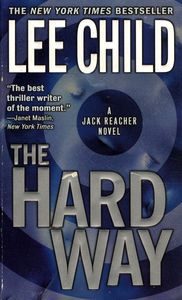
  • The Hard Way, Lee Child

    The Hard Way, Lee Child

    Dell, 2006 (2007 reprint), 477 pages, C$10.99 mmpb, ISBN 978-0-440-24103-4

    After ten Jack Reacher novels in a decade, it can be difficult to find something fresh and interesting to say about every entry in the series. By now, Lee Child’s strengths are obvious: He’s a top-notch thriller writer who fully understands the genre and the permutations it takes, writes in a clean and efficient prose, knows how to imagine tough-guy protagonists, never loses sight of the telling details that make his prose credible, and can be counted upon to deliver a satisfying experience every single time. Even his weakest novel so far (Running Blind) is still better than most average thrillers, and if The Hard Way isn’t one of his best, it’s still the kind of novel that has earned Child his legion of fans.

    It starts, like too many of Child’s novels do, with a simple coincidence: Reacher happens to be sitting in a New York cafe for the second night in a row when he’s asked a few probing questions by men who appear to know their business: Has he noticed anything strange about some guy entering a car the day before? It wouldn’t be a Reacher adventure without our protagonist being a master of detection: His precise and insightful description of what he’s seen the previous night soon leads to a meeting with an employer who wants to retain Reacher’s service.

    As it turns out, coincidentally enough, Reacher has seen the payoff to a kidnapping: His new employer is a rich ex-mercenary whose wife and daughter has been abducted, and he needs Reacher’s help in tracking down the guilty parties. Reacher may have doubts about his employer, but the knight-errants archetype of the series won’t let him walk away: despite the promise of a lavish pay-off, Reacher is really tracking down the woman and child for their own sakes.

    The now-expected twists aren’t long in coming. Reacher’s new employer and colleagues have spectacularly nasty pasts, someone else is tracking them down, and the whole thing quickly becomes something else than a simple kidnapping case. After books such as One Shot, few will be surprised to find out that the climax of the book pits Reacher against a numerically superior force in an isolated location. The novel itself spends its time going from the urban richness of New York to the wide-open landscapes of rural England. (This is the first time that part of a Reacher novel takes place in the United Kingdom: quite a milestone for a writer who lived there prior to the publication of the Reacher novels.)

    What’s slightly different this time around is that Reacher is starting to feel his age: He’s been out of active service for years, now, and his detection skills are getting rusty. The Hard Way sees him making bad assumptions and knock down the wrong doors. More so here than in previous novels, Reacher is conscious of his slowing body and his failing intuition: what that portends for the rest of the series will have to be seen.

    While the novel’s last-third migration to rural England may take away from the tension of seeing Reacher rampage through New York, The Hard Way is as good as the series’ high standards. While it’s true that the series is repeating itself at this point, this tenth entry is starting to acknowledge its own tiredness. Hopefully, Child will know how to take advantage of this idea while winding down the series to a satisfying conclusion or another character. It’s getting harder to keep Reacher going through the same motions (significantly, he never seems to acknowledge the fact that London is where one of his ex-girlfriends stayed for a while), and I wouldn’t be surprised if Child starts a new series soon –although given the author’s penchant for pseudonyms, this may have already happened.

    In the meantime, The Hard Way doesn’t detract from the fact that Lee Child is at the top of the tough-guy thriller genre, and is likely to stay there for a while longer.

  • Content, Cory Doctorow

    Content, Cory Doctorow

    Tachyon, 2007, 213 pages, C$14.95 tpb, ISBN 978-1-892391-81-0

    Cory Doctorow’s non-fiction collection Content is both essential and redundant.

    It’s hard to imagine that there’s someone out there who knows Cory Doctorow but isn’t aware of his stance regarding intellectual property. Doctorow’s an Internet celebrity, and everything he does seems influenced by his copyfighting, from editing Boingboing.net to writing novels celebrating open-sourced resistance to working for various organizations as a political/technology activist. He has written extensively about those issues on-line, and a book collecting those essays hardly seems like something worth much more than a passing note.

    What’s more, copyfighting seems so native to the Internet that the idea of a paper book about it has a quaint mustiness. Nearly every piece printed in Content already lives on the web, where they can be linked, discussed and annotated as times goes by. Since the debate around intellectual property seems to evolve on a weekly basis, is it useful to time-bind Doctorow’s essays in a permanent format even as the context around the book keeps evolving?

    And yet that’s a fairly narrow view of things. It may be hip to dismiss those paper-ink-glue devices from the virtual pulpit of a web site, but there’s no denying that by virtue of their collection in Content, Doctorow’s non-fiction pieces become something grander than what they are at the moment. Because, as strange an idea as it may seem to plugged-in cyber-nerds, not everyone is so taken with ideas circulated on the Internet. There is still a place for paper-set arguments, for respectable books that take actual space on a desk, on shelves or in briefcases.

    In short, there’s still a physical life out there for Internet-native advocacy pieces. The nebulous notion of “Cory Doctorow’s ideas on intellectual property” gets an actual rectangular shape with Content, with the non-inconsiderable benefit that the object can be sold, bought, lent or cited. Content becomes something from which others can book conferences or consulting gigs.

    Then there’s the old-fashioned entertainment aspect. While Doctorow’s non-fiction pieces are usually read on-screen between two (or two hundred) other things, Content can be read at leisure, with a good bookmark. It’s a pleasure to read in more ways than one: Not only are the ideas interesting, but the style in which they are expressed is vivid and argumentative, with plenty of examples and extrapolations.

    There’s a flip side, of course, one that becomes nearly inevitable when putting together a number of similar essays: repetition. Cory Doctorow’s advocacy tends to revolve around a few common themes, and the examples can be very familiar. Many will note that Content doesn’t package all of Doctorow’s non-fiction between 2001 and 2007: It picks a few more famous earlier pieces (such as his 2004 DRM talk to Microsoft), then skips ahead to a more diverse selection of his 2006-2007 pieces, including a number of columns for Locus and Information Week. Readers may want to let some time elapse in-between essays, or risk quite a bit of deja lu.

    The other nagging issue about this book is how instantly dated it was. For every timeless piece like his ever-relevant 2001 essay on the illusion of the semantic web, other essays are already creaking under dated references and shifting goalposts. Content may be as fresh as 2007, but 2009 is already a different world from two years ago: Many of Doctorow’s points have already been conceded by industries that have come to terms with economic realities: Both the RIAA and MPAA are far less aggressive about intellectual copyright than they once were (losing a number of court challenges hasn’t helped), and “DRM-free” has become an actual selling point for no less a former enemy than iTunes. Meanwhile, TV networks are voluntarily putting freely-downloadable material on the web. Finally, Cory Doctorow himself is not the Cory Doctorow of 2007: He’s now a proud father, a husband and a New York Times best-selling author thanks to the runaway success of Little Brother —a book that widened open-computing principles to include not only copyfighting, but civil disobedience in the face of eroded freedoms.

    So it is that “a science fiction writer” (a description that never totally quite fit Doctorow’s full-bandwidth activism) is well on his way to becoming no less than An Authority. A book like Content can be invaluable in the process: it can be placed on reading lists, passed around firewalls and content filters, cited in major newspapers (even if they’re moving to the web themselves) and bought by the crate-load whenever Doctorow’s speaking at conferences. It’s a neat bit of irony that most of this review has been spend arguing in favor of a real book: in some ways, Content is its own best demonstration.

  • Gradisil, Adam Roberts

    Gradisil, Adam Roberts

    Gollancz, 2006, 458 pages, C$12.99 tpb, ISBN 0-575-07817-0

    I’m not the first person to link the old “familiarity breeds contempt” with the new “uncanny valley”, but I don’t think anyone yet has used to expressions to refer to Adam Roberts’ interestingly flawed Gradisil.

    Every one of Adams’ novels so far has tackled different sub-genres of science-fiction along with some stylistic experimentation. Results have been mixed: Roberts is very clever, but this doesn’t always translate in a satisfying reading experience.

    I’ve been waiting a while for the Adams novel I would wholeheartedly embrace, and I had high hopes for his hard-SFish Gradisil. After all, hard-SF is the type of SF I know best and like most: I’m considerably more lenient about it than I am about other kinds of science-fiction. But I hasn’t counted on the possibility of someone trying to write hard-SF and getting it wrong.

    We can quibble endlessly on the definition of hard-SF, or on whether getting the details is more important than portraying the correct attitude. Given Roberts’ iconoclastic output so far, it would have been unrealistic to expect slavish devotion to the often-simpleminded ideals of the crudest hard-SF, but that doesn’t excuse any of the gigantic science blunders that repeatedly slap readers across the brow as they try to make it through Gradisil.

    The first and most obvious one almost gets a pass: The idea of harnessing unexplored properties of electromagnetic fields to get to space more efficiently than chemical rockets is pretty unlikely, but it’s integral to the rest of the novel. But what does not manage to suspend disbelief as well is the conceit that private individuals would seize upon this to colonize near-earth orbit while NASA, the military and large telecommunication companies keep struggling with traditional launchers. You would think that after a few successful private launches, the Big Players wouldn’t just move into the field, but would own it outright.

    But Adams’ insistence on presenting a deformed mirror of American-libertarian hard-SF is pure enough that he ignores historical precedents, real-world technology and elementary physics on his way to the story he really wants to tell. In his imagined future, for instance, the might of the American military has somehow forgotten to track orbiting objects the size of buses, even while real-world satellite tracking is something that’s not much more than a Google query away. This gets pretty hard to explain when entire subplots of Gradisil depend on people hiding in plain sky while authorities look befuddled. Other blunders are much funnier to anyone with a good understanding of high school physics: The orbital colonists of Gradisil are somehow able to suck refreshing oxygen from the atmosphere out of 50-kilometer long capillaries and pumps that are somehow more efficient than, oh, space itself.

    Sometimes, it’s hard to decide whether Adams is just kidding, because even his heart doesn’t seem into it. At the end of the novel’s first section, he introduces a fan-based pseudo-gravity system (in which, yes, big fans push you to the “ground” of a space station) that is so stupid that even the characters complain about it. It’s justified as another one of those dumb military innovations, which is perfectly in-character for a novel that tries to portray the military as being both terminally stupid and dangerously clever at the same time. After so many mistakes and missteps, the real question about Gradisil becomes why Adams has attempted to write something that looks like a hard-SF novel if he thinks so little of the form.

    Because Gradisil is a pseudo-hard-SF novel. It attempts to disguise itself under jargon and science, but its obvious lack of authenticity only reinforces the fact that it’s an pretentious poser. It ended up annoying me like few novels I’ve read recently. It got on my nerves with a loathing born out of familiarity. I won’t always try to defend hard-SF’s failings, but it’s got a real heart underneath the mechanical trappings: A vision of a better world through human ingenuity and advanced technology. Good old-fashioned hard-SF may be too blunt for the rarefied sensibilities of the literary set, but it’s literature for the rest of us readers who would rather play around with high-tech toys than discuss literary theory. Gradisil makes a big show of being literature for engineers, but it ends up looking foolishly like a snarker dressing up with oversize glasses and pocket protectors. It’s not fooling anyone, and it falls right in the uncanny valley of novels that pretend to be “down with it” but really don’t have the slightest clue what “it” is and think they can fake it with big brains and fancy language.

    I haven’t mentioned the characters or the story yet because, in many ways, they’re the most disappointing part of the novel. In another twist from the hard-SF gold standard, the characters are built to be hated. Meanwhile, none of the hilarious science errors are redeemed by the overlong multi-generational plot that barely warrants the “saga” description, nor a narration that gets increasingly showy as language drifts away from turn-of-the-century standard. It’s very clever, see, but it’s not doing much to make the novel better.

    The flip-side of my annoyed, vaguely disgusted reaction to Gradisil is the very real possibility that someone else without as big an attachment to hard-SF would like it a lot more than I did. That’s OK in more or less the same ways I used to like some pop-music groups before learning better. Gradisil is, like many of Roberts’ novels, an outsider’s attempt to play with the toys of a subgenre. The problem is that in many cases, those toys are tools, and Robert doesn’t know what to do with them. Faced with such a flawed simulacrum, I’d rather see Roberts doing something else.

  • Sly Mongoose, Tobias Buckell

    Sly Mongoose, Tobias Buckell

    Tor, 2008, 320 pages, C$29.95 hc, ISBN 978-0-7653-1920-3

    With three linked novels under his belt (plus a New York Times best-selling Halo tie-in), Tobias Buckell has established his own brand of Science Fiction: action-adventure in the classical mold, but filtered through a sensibility that differs from the usual SF norm.

    The first surprise in Sly Mongoose is that it takes place decades after the events of Ragamuffin, at a time when the Satrap Hegemony has been thoroughly dismantled: Those who were expecting a series of novels describing the war between humans and their former masters will have to make with an epilogue. But the aftermath of war is never pleasant, and as the novel begins, recurring series hero Pepper crash-lands on a floating city to warn them of an impending threat: “groaning, stumbling, dumb-as-f…, old-school zombies.” [P.46.]

    Oh yeah; zombies. But just to make things a little bit more interesting, Buckell isn’t content with your run-of-the-mill planetary apocalypse scenario featuring mass-minded fast zombies. Oh no: this time, the zombie plague takes place far above the surface, first in a spaceship and then on the floating cities above Chilo, a Venus-like planet where the only livable environment is above the clouds of sulphuric acid.

    That’s where we meet one of our two protagonists: Timas, a teenager working in the sulphuric muck of Chilo, but stuck with outdated equipment that can’t accommodate his increasing size. The arrival of series protagonist Pepper in the middle of Timas’ life doesn’t happen gracefully: Forced to crash-land on Chilo after jumping out of a spaceship without a parachute (hey, these things happen), Pepper’s arrival leads to the death of one of Timas’ friends, an event that will have consequences through the story.

    In-between Pepper’s zombie warnings and the city-smashing finale, we get new models of politics, an expansion of a culture first introduced in Buckell’s debut Crystal Rain, severe character trauma, big alien schemes, galactic repercussions and all that good stuff. As with his previous novels, Buckell is able to integrate a high concept (Zombiiies! In spaaace!) and make it work within a far more complex framework.

    Sly Mongoose is also an evolution in Buckell’s work in that it explores Pepper’s recurring character in a deeper fashion than before. We know that when Pepper’s on the scene, things will blow up and be solved. What this third novel shows is that these actions don’t happen in a vacuum: The relationship between Pepper and Timas is strained by the heroics required of an action/adventure novel, and it leads to a pretty good scene in which Pepper tells his younger companion that he wouldn’t ask him anything he wouldn’t do… which isn’t too reassuring considering what Pepper’s enhanced body and ruthless mind can conceive and sustain. A strong epilogue will reassure Pepper fans by suggesting that there are quite a few more adventures in store for him.

    Placed in the context of Buckell’s output so far, Sly Mongoose doesn’t have the structural problems that plagues the second half of Ragamuffin and the ever-leaner prose shows Buckell’s improving tradecraft since Crystal Rain. But this third novel stops short of kicking Buckell’s fiction to a superior level. Now that he has shown his mastery of basic SF plot templates, this reader’s expectations become more demanding. As it is, his three novels so far show a competent mid-list SF writer with an unusual skill for cultural details… but what’s stopping him from more ambitious material? Now that he’s added “New York Times best-selling author” to his list of credentials, let’s see him move to the forefront of SF writers.

  • Fear and Loathing in Las Vegas, Hunter S. Thompson

    Fear and Loathing in Las Vegas, Hunter S. Thompson

    Vintage, 1971 (1998 reprint), 204 pages, C$14.95 tpb, ISBN 0-679-78589-2

    I wasn’t planning on re-reading this book. My “Year of the Thompson” didn’t include another pit-stop in Las Vegas given that I had read this book in 1999 and I don’t usually re-read books unless I have good reasons. But the amount of Thompson biographical information I’ve been consuming lately naturally led back to another look at he book, a look that became even more urgent once I searched my archives and realized I had never formally reviewed the book at length. So here goes:

    This is a book that comes with a lot of baggage. It’s Thompson’s best-known work, and arguably the single item that made him popular with casual readers. On a surface level, it’s fiction about two wild and crazy guys doing drugs (and I mean a lot of drugs) and behaving badly in Las Vegas at the beginning of the seventies. But the more you know about Thompson or about the sixties, the more the book becomes something else, starting out by acting crazy, but eventually finding that it all leads to a hollow place, an artificial recreation of a failed ideal, or an excuse to be unpleasant to others.

    It does start out in an amusing fashion. I defy any fan of the book to resist the impulse to read the first few lines out loud, or linger a bit longer on the description of what’s in the protagonist’s suitcases. In the first two pages of the book, you can already find the unique mixture of craziness and world-weary knowledge (“There is nothing in the world more helpless and irresponsible and depraved than a man in the depths of an ether binge.” [P.2]) that fuels most of the novel.

    But the influence of drugs and a thorough knowledge of depravity aren’t quite enough to characterize Thompson’s narration, which wouldn’t be complete without the certitude that the good times have ended, that civilization is in decline and that the nuclear-powered apocalypse may begin at any moment. This, I often feel, is what separates the good Thompson imitators from the superficial ones. Fear and Loathing in Las Vegas may describe irresponsibility, as its characters ignore their professional obligations, steal hotel soap in bulk and trash the rooms they’re given. But they’re doing so out of the conviction that none of it matters, that they will be dead by the time their credit ratings will be revised.

    This sense of impending doom constantly floats above the novel, but it becomes more and more apparent as it goes on. War in Vietnam, Nixon, the atonal passage on the high water mark of the sixties… it all leads to feckless recklessness, until the terrible scene where a waitress is pushed too far and (unlike a previously-scared maid) cannot be brought back into the protagonist’s shared madness which, by this point, is starting to wear thin and veer in either paranoia or depression.

    Particularly empathic readers will catch this nuance that eludes those who read the novel as a drug-addled jaunt through Vegas: As our characters get away with acting rudely, it’s not hard to feel poorly for those they leave behind in their wake. The characters may come to realize the consequences of their actions late in the book (“I’d abused every rule Vegas lived by –burning the locals, abusing the tourists, terrifying the help.”) [P.173], but by that time a number of readers will have rejected the idea that they are in any way admirable. (The movie adaptation is broadly faithful to this interpretation.)

    Those who know Thompson will get more out of the book than those who discover Thompson through it. There are references to Hell’s Angels and San Francisco and to Colorado, but also a sense that it’s through fiction that Thompson could spread his wings at the widest, writing more casually about his true themes. The Rum Diary and other short fiction aside, it’s a shame that Thompson was never able to revisit the same place. But maybe it couldn’t be revisited.

    For those who haven’t read Thompson before, well, it’s a trip of a different sort. It’s a very short novel (barely over 50,000 words), but it’s dense in events and hard-hitting narration. Take your time, savor one chapter every day, don’t see this as a guide to emulate, and everything will be fine. Which is more than we can say for Thompson or his alter-ego.

  • Outlaw Journalist: The Life and Times of Hunter S. Thompson, William McKeen

    Outlaw Journalist: The Life and Times of Hunter S. Thompson, William McKeen

    Norton, 2008, 428 pages, C$31.00 hc, ISBN 978-0-393-06192-5

    During my ongoing binge of Hunter S. Thompson material, I have come across a number of biographies, memoirs and related books about him. Not all of them are created equal, but I think I have found the definitive biography of the legendary writer: William McKeen’s Outlaw Journalist.

    Following Thompson’s suicide in 2005 and the time it usually takes to propose, write and publish a good non-fiction book, it’s no accident if 2007-2008 were the biggest years on record regarding Thompson memorabilia, even eclipsing the 1993 Carroll/Perry/Whitmer trilogy of biographies. The more recent crop has lot of qualities: Jann Wenner and Corey Seymour’s oral biography Gonzo was a compulsively readable grab-bag of Thompson stories and recollections, for instance. Unfortunately, it lacked direction and context by focusing on anecdotes and small slices of the writer’s life… and that’s where Outlaw Journalist steps into the gap, offering a complete look at Thompson’s life and works.

    The first obvious difference is that McKeen approaches the subject from a professional perspective. McKeen, who teaches at the University of Florida, does his subject a favour by seeing him as a newsman: by measuring Thompson against the standards of his profession, McKeen is not only able to identify much of the sensationalism surrounding the legend, but also contextualize it against a coherent portrait of the man. No other Thompson biography, for instance, describe his Gonzo breakthrough article, “The Kentucky Derby is Decadent and Depraved” in a chapter called “Epiphany”, linking it to Thompson’s well-documented desire to get away with whatever he wanted to do. (At the same time, McKeen makes his disdain for “Gonzo fans” clear, pointing out that Thompson was often the favourite writer of people who didn’t read.)

    Thompson’s quasi-mythical substance abuse is studied in the same carefully-documented detail, McKeen going as far as suggesting that cocaine abuse had a role to play in Thompson’s silence following the publication of Fear and Loathing on the Campaign Trail ’72. But there was a lot more to Thompson than drugs, and if Outlaw Journalist does something particularly well, it’s to give an even idea of the man behind the trappings of the legend. McKeen spends a lot of time, for instance, describing the less-exciting moments of his subject’s life: the fallow periods between projects, for instance, or the years of hand-to-mouth living between the greatest hits of his career. Thompson, we’re constantly told, was famous and yet not rich, living large on the generosity of his friends and the expense accounts of his employers.

    McKeen is also meticulous in providing context for his subject’s life. Thompson’s stints for various publications are accompanied with a description of the place that the publications held at the time within American journalism. Sources, impeccably detailed either in-text or through over forty pages of assorted notes, range from Thompson texts, original interviews, past Thompson biographies or third-party sources. (A fifteen-page index completes the book) As of 2008, Outlaw Journalist is complete not only regarding the details of its subject’s life, but also about the stack of other works about him (It even mentions Warren Ellis’ Transmetropolitan, something that eluded most of the press outside sf/comics fandom) McKeen, being neither a member of Thompson’s close circle of friends nor a past employer, is considerably more even-handed than many other biographers: He describes the tensions between Thompson and Rolling Stone magazine with a fairness that lacks from Gonzo, and doesn’t place undue importance on his own meetings with Thompson the way Paul Perry does in Fear and Loathing, for instance.

    Best of all, Outlaw Journalist is a pure joy to read. Even the moments in-between Hunter’s high points are made interesting thanks to an engaging prose style and an eye for telling details. McKeen is always guiding his readers toward conclusions about his subject without highlight them. Unlike most other portraits of Hunter S. Thompson, this one feels fair, just detached enough, yet sympathetic and (make no mistake) highly entertaining at the same time.

    In short, it’s the best biography of Hunter S. Thompson on the market so far, and it’s likely to remain so unless someone else spends a considerable amount of energy trying to go over the same territory. Given the myth-making that constantly surrounded Thompson, his scattered bibliography or the way the image of Thompson arguably became greater than the journalism himself, that’s a significant achievement.

  • Vitals, Greg Bear

    Vitals, Greg Bear

    Del Rey, 2002, 356 pages, C$37.95 hc, ISBN 0-345-43528-1

    Warning: This isn’t a review as much as it’s an explanation of why I pretty much ended up giving up on the novel mid-way through, then skimmed my way to the conclusion. While the platonic ideal of a review should only be written after a careful second re-read and with knowledge of the author’s entire oeuvres (along with a thorough knowledge of the author’s socio-cultural context), I happen to think that there’s a certain place for descriptions of failures along the way, if only as a billet d’humeur to recalibrate everyone’s expectations.

    So it is that I should state up-front that Bear is the very definition of an uneven writer. While he has written some astonishingly great novels (Moving Mars, The Forge of God, Eon, Blood Music), many of his other books have been dullness given hard covers. His bibliography ping-pongs between good and bad so inconsistently that it may not be an accident if this if it took until 2009 for me to try anything he’s written in the 21st century.

    In context, Vitals fits in Bear’s years-long flirtation with the technothriller. From the contemporary SF action of 1999’s Nebula-winning Darwin’s Radio to 2005’s Quantico, Bear spent most of a decade writing near-future stories with a thriller template. Vitals plays a familiar tune for genre readers, as it shows a Science Fiction-minded author tackling issues in current settings, usually with an eye toward a mainstream audiences and sales. See: Kress, Nancy; Williams, Walter Jon; Sawyer, Robert J.; etc.

    The first few pages of Vitals are pretty good: As a scientist descends to the ocean floor in company of an increasingly perturbed submarine pilot, we’re introduced to the scientist’s work in life-extension. A few things are unfocused, but it’s just the beginning of the novel. By the time the pilot turns nuts in a confined space thousands of meters below the sea level, it’s hard not to become involved.

    By the time our narrator has returned to the surface, seen other instances of people behaving badly, being almost accused of murder, and finding out that his twin brother is dead, two things are becoming clear about Vitals: It’s a story with intriguing ideas, and it’s being badly told. While well-paced thrillers ratchet up the tension with nearly-audible clicks, Vitals muddles forward and sideways and even back when, midway through, we switch narrators and go back a few months previously. There’s a mushy, indistinct quality to Vitals that’s hard to reconcile with the demands of a tautly-told thriller. The fact that the protagonists often have their head messed with isn’t much of an excuse; instead, it’s confusion and vagueness all the way through. The lack of clear characters doesn’t help, and neither do the various attempts to one-up the action with paranoid killer schemes. (This is another one of those novels where an exotic way of killing someone ends up used in every possible fashion, rather than more direct and effective methods that could end the narrative right there. Ah, give a toy to an SF writer…)

    By the time we piece together a Soviet conspiracy that hides a microbial conspiracy, it’s far too late to care even about such a globe-spinning premise: Vitals has faded away, and the only reason to rush to the conclusion is to see whether it will conclude or just drop away. (Well, that and to spot the Stalin cameo.) But this novel does not conclude: it runs out of ideas, looks around dazedly, gives up and terminates. What kills Vitals isn’t the nature of the far-out ideas, but their lousy execution. Another writer would have been able to do something fantastic with them, but not Bear: Vitals is too long, too sloppy and too uninterested in what it’s saying —although I may be projecting that last flaw onto the novel.

    It also justifies my continued coolness toward anything that Bear has written since 1995. (His new City at the End of Time? Not before I see it on sale, baby!) I don’t seem to be alone: Go look at the awful 2.5-stars average Amazon reviews for what seems like a consensus opinion on Vitals. This may have been a personal rant, but my disappointment hardly seems unique whenever this novel is concerned.

  • Death Match, Lincoln Child

    Death Match, Lincoln Child

    Anchor, 2004 (2006 reprint), 388 pages, C$9.99 mmpb, ISBN 0-307-27556-6

    Here’s a pop quiz to test your genre savvy: You’re locked in a room with a string of murder victims on the floor. Around you are a cowboy, a vampire, an Artificial Intelligence, a ninja, a pirate, the President of the United States and a butler. You find out you’re in a technothriller. Who killed the victims?

    That’s right: The Artificial Intelligence. Well done.

    It’s never Lupus, but it’s always the Artificial Intelligence in technothrillers. It’s an impulse as basic as the class anxieties that led to an improbable number of homicidal butlers in British cozy murder mysteries: Technothriller writers are in the business of chilling their readers, and they calculate that since we already loathe our laptops and smart phones, we should be terrified of even smarter machines. The point at which computers become smarter than ourselves may already be here: looking at how many iPhones are already more intelligent than their teenage owners, it’s hard not to believe in the upcoming Singularity —not through machine intelligence, but thanks to increasing human stupidity.

    And it’s human stupidity that finally brings us to Lincoln Child’s Death Match, three paragraphs in our review. Like Child’s two other solo novels so far, it deals with high technology run amok. It also shares with Utopia and Deep Storm, a fantastic first half that ultimately gets ground to generic platitudes by the end of the novel. Taken together, they make a convincing argument that Lincoln Child is the logical heir to Michael Crichton. This, however, may not be compliment.

    But before getting there, let’s lay down the basics of the story: Our protagonist is one Christopher Lash, a “forensic psychologist” whose career at the FBI was cut down by an initially unspecified trauma. Lash is called upon by Eden Inc, a secretive matchmaking service: Apparently, one of their happily married couples has committed double suicide, and they want to know why. Eden, mind you, isn’t your usual matchmaking service: it asks for $25,000 up-front, requires a full day of wide-spectrum psychological and medical testing, and is vastly more accurate than any other matchmaking services. Eden doesn’t take failure lightly, and the suicide of one of their most successful success stories is more than a professional offense: it may be a problem with their entire approach.

    So Lash is called on the case, peeling back the layers of Eden’s operations in an attempt to understand what went wrong. His attempt to undergo the usual Eden candidate screening process goes wrong, but it’s not the only part of his life that is suddenly troublesome: All around him, annoyances and threats pile up, from suddenly-unpaid bills to mysterious calls to toll booth passes suddenly not working.

    And for all of the novel’s faults, the first half works well. Faced with an intriguing mystery (a foolproof matchmaking process; a suicide between a seemingly perfect couple), readers are asked to follow along the mystery. Some of the best moments in Death Match are strictly procedural, as something is explained to us via the protagonist, and we get to look at a complicated process. Mystery and secrets can do much to lead a reader along, and I’ve got not problem with that part of the novel.

    No, the troubles start when the AI is introduced. At that point (and maybe even before), experienced readers will look at the book’s remaining 200 pages and wonder how long Child is going to take to tell us that, as in all technothrillers, it’s the AI whodunit. The rest of the book is considerably less graceful than the first half, all the way down to the evil machines “spitting sparks and belching ever darker gouts of smoke” [P.367] Ah yes, sparks and smoke; sure signals of evil computer engineering mastery.

    As for the rest, well, it’s pretty much routine for Child: clean prose, slightly tepid pacing when not uncovering secrets, conventional end. Tons of issues are left unexplored, but the mechanics of high-tech matchmaking are relatively interesting and that’s pretty much the only thing saving the book from complete formula-photocopying. It’ll do if you’re stuck on a beach, in a plane or on a bus. Beyond those desperate situations, though, there are better choices.